 by Tom Gurney
Tom Gurney BSc (Hons) is an art history expert with over 20 years experience
Published on June 19, 2020 / Updated on October 2, 2026
Email: tomgurney1@gmail.com / Phone: +44 7429 011000
The Annunciation by Fra Filippo Lippi
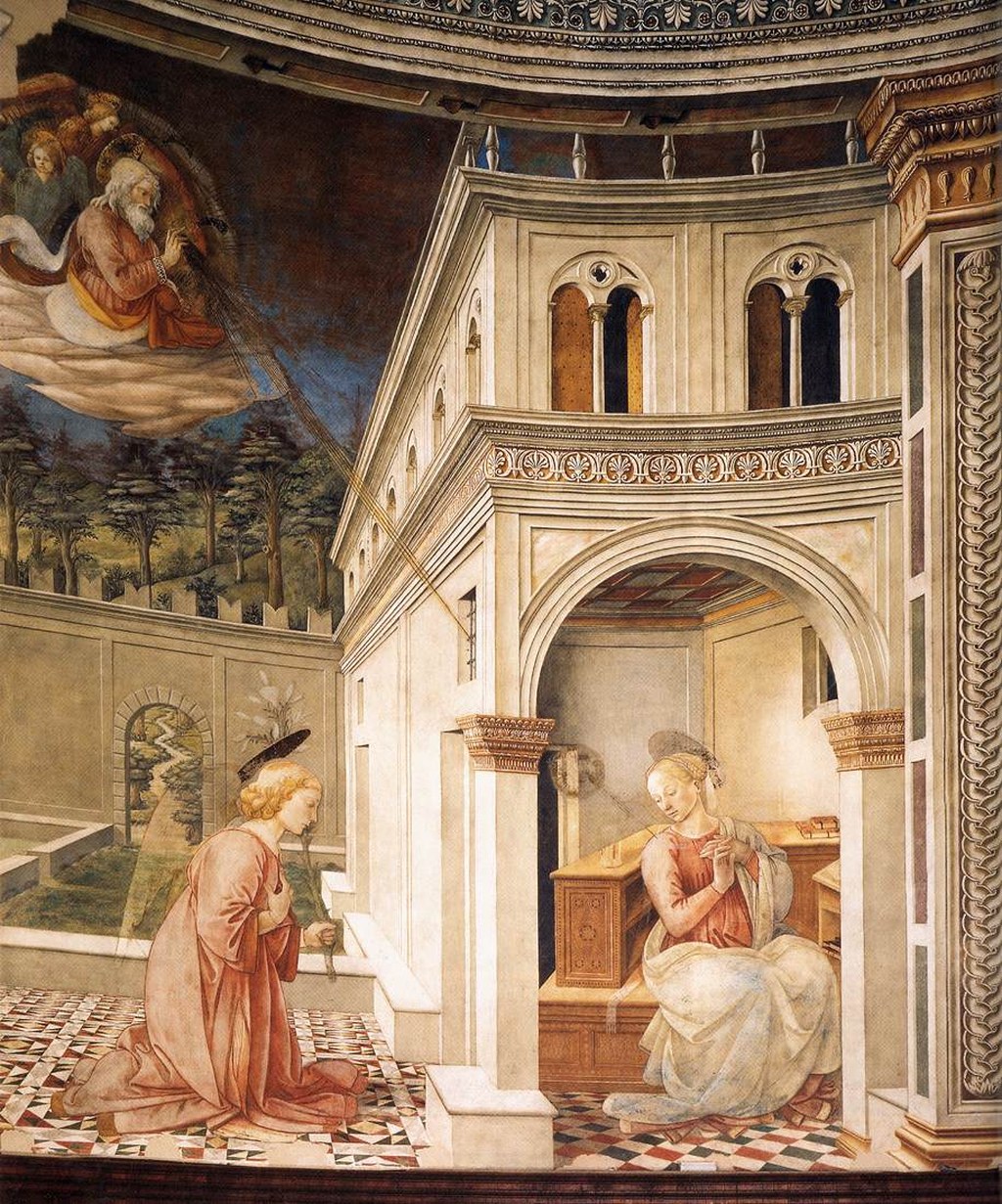
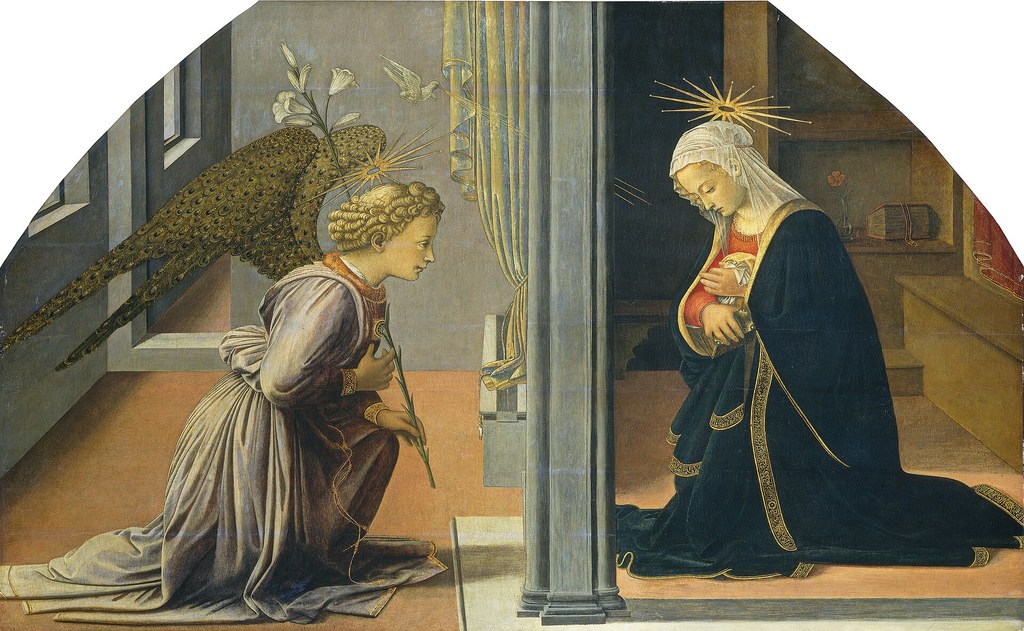
Fra Filippo Lippi’s Annunciation in the National Gallery, London, is one of the most refined surviving paintings connected with Medici private patronage. Painted about 1450–53 in egg tempera on wood, it shows the archangel Gabriel kneeling before the Virgin Mary within a carefully ordered garden and architectural setting.[1] The painting was made as a pair with Lippi’s Seven Saints, also now in the National Gallery. The two panels came from the Palazzo Medici in Florence and are generally interpreted as overdoor or similarly elevated decorations designed for the family palace.[1]
That original setting is crucial. This was not simply another church Annunciation. It belonged to the domestic environment of the most powerful family in fifteenth-century Florence, and its companion panel represents saints whose names correspond to members of the Medici family. Lippi’s composition is remarkably symmetrical and restrained. Gabriel enters from the left with extraordinary peacock-feather wings, while Mary turns from her reading and accepts the divine message with a measured gesture.
A vase of lilies, the enclosed garden, the dove of the Holy Spirit and a stream of divine light make the theological narrative legible. Yet the picture also belongs unmistakably to the elegant visual culture of Renaissance Florence. Its importance lies partly in this balance. Lippi turns a supernatural event into an encounter that feels spatially coherent and psychologically gentle without diminishing its sacred meaning. The panel is also a strong example of how Medici patronage could work inside the home. Dynastic identity, personal devotion and sophisticated art occupied the same architectural world.
At a Glance
- ArtistFra Filippo Lippi
- TitleThe Annunciation
- Dateabout 1450–53
- MediumEgg tempera on wood
- Current locationNational Gallery, London
- Collection numberNG666
- Original settingPalazzo Medici, Florence
- CompanionSeven Saints, NG667
- Probable functionOverdoor or related palace decoration
- Principal figuresVirgin Mary and Archangel Gabriel
- Key symbolsDove of the Holy Spirit, lilies, enclosed garden, divine light
- Distinctive featureGabriel’s peacock-feather wings
- PatronageMedici family
Contents
- What Does the Painting Show?
- Mary
- Symmetry
- Were They Overdoor Panels?
- Colour
- Comparison with Fra Angelico
- Reconstructing How the Pair Might Have Been Seen
- Silence as a Compositional Choice
- Why Pairing Matters for Modern Display
- Why The Annunciation Matters
- A Quiet Medici Masterpiece
- FAQs
- References
What Does the Painting Show?
Gabriel kneels on the left side of the composition. Mary occupies the right. The space between them is not empty. It is charged with the divine message that has just entered Mary’s life.
Gabriel’s body bends respectfully while his gesture communicates speech. Mary turns towards him with calm surprise and acceptance. Behind and around them, Lippi constructs a setting combining architecture and garden.
The encounter therefore feels private. There is no crowd. The silence of the scene makes the Annunciation appear almost like a personal conversation.
The Story of the Annunciation. The subject comes from the Gospel of Luke. The angel Gabriel is sent to Mary in Nazareth and tells her that she will conceive and give birth to Jesus. Mary asks how this can happen.
Gabriel explains that the Holy Spirit will come upon her. Mary then accepts the divine will. For Christian theology, the Annunciation marks the moment of the Incarnation.
It is therefore one of the central events in salvation history. Renaissance artists faced an unusual challenge when painting it. The essential action is speech and consent rather than physical drama. The artist must make invisible transformation visible. Lippi does this through gesture, light, symbolic objects and spatial relationship.
Gabriel. Gabriel is youthful and graceful. He kneels rather than standing over Mary, establishing reverence. His clothing falls in controlled folds, and his wings are among the most memorable parts of the panel.
The National Gallery specifically draws attention to their peacock-feather appearance.[1] Peacock feathers allowed Lippi to create colour and pattern while marking Gabriel as a being outside ordinary human experience. The exotic surface does not overwhelm the angel’s humility. He is splendid but submissive. His role is to deliver a message, not to dominate the scene.
Mary
Mary is shown as a reader interrupted. Books frequently appear in Annunciation imagery and connect the Virgin with scripture, learning and devotion. Her response is controlled.
Lippi avoids exaggerated shock. The drama lies in comprehension. Mary’s body turns, but her dignity remains intact. This psychological restraint suits a painting intended for repeated private viewing. The viewer is invited to contemplate acceptance rather than spectacle.
The Dove and Divine Light. The Holy Spirit appears as a dove. Its movement towards Mary makes visible the theological explanation Gabriel gives in Luke’s Gospel. Light accompanies the divine action.
Renaissance painters frequently used rays or beams to represent supernatural agency entering a naturalistic world. This creates an interesting tension. Lippi constructs a believable space governed by architecture and perspective, then allows divine light to cross it. The supernatural does not abolish physical space. It acts within it.
The Lilies. Lilies are one of the most familiar attributes of the Virgin. Their whiteness is associated with purity. In an Annunciation, they reinforce the doctrine of Mary’s virginity.
Lippi places them as recognisable objects rather than abstract emblems. This is characteristic of Renaissance religious painting. Symbols increasingly occupy convincing material space. The viewer can read them devotionally while also experiencing them as flowers inside a room or garden.
The Enclosed Garden. The garden can be connected with the medieval hortus conclusus, the enclosed garden associated with Marian virginity. The image derives ultimately from the Song of Songs and became a standard visual metaphor for Mary. Lippi’s handling is particularly effective because the garden is also spatially useful.
It creates a protected, quiet zone for the encounter. Architecture encloses the event without making it claustrophobic. The sacred meaning and the design solve the same problem.
Symmetry
The National Gallery describes the scene as beautifully symmetrical.[1] That symmetry is not absolute mirror reflection. Rather, Gabriel and Mary establish balanced weights on either side of the centre.
The result produces calm. A more diagonal or crowded design would create urgency. Lippi wants contemplation. The geometry therefore contributes to theology. Divine order is expressed through pictorial order.
Perspective and the Supernatural. The Annunciation was a favourite subject for Renaissance experiments in perspective because it combines architecture with an invisible event. Painters could demonstrate mastery of measurable space while representing something that exceeds measurement. Lippi uses architectural recession to make the encounter plausible.
The supernatural message then crosses that rational setting. This juxtaposition is one of the intellectual pleasures of early Renaissance Annunciation imagery. Perspective does not secularise the scene. It makes miraculous intervention appear to occur within a coherent world.
Palazzo Medici. The painting’s palace origin fundamentally changes how it should be read. Palazzo Medici was both family home and political environment. Art within it contributed to devotion, memory and dynastic identity.
The Annunciation was therefore seen not by an anonymous congregation but by a household and its visitors. Its relatively intimate subject suited such a context. The picture brought one of Christianity’s decisive moments into the domestic world. That is very different from a monumental Annunciation high on a church wall.
The Companion Panel: Seven Saints. The Annunciation was paired with Seven Saints. The relationship is essential. The saints in the companion painting correspond to patron saints of Medici family members.
Together, the panels link universal Christian history with one specific Florentine dynasty. The Annunciation provides the foundational sacred event. The companion panel provides a heavenly network associated with the household. The pair therefore works both devotionally and genealogically.
Were They Overdoor Panels?
The National Gallery catalogue discusses the paintings as Medici “overdoor?” panels, retaining a degree of uncertainty in the reconstruction.[1] Their shape and palace provenance make an elevated architectural function plausible. If placed above doors, they would have been encountered repeatedly through movement around the palace.
That matters. They were not necessarily objects before which someone sat for long periods. They may have functioned as sacred presences embedded within architecture. The distinction affects composition. Clear silhouettes and balanced groups work well at some distance and height.
Medici Patron Saints. The relationship with Seven Saints reinforces the idea that the commission was deeply personal to the family. Saints could function as celestial protectors and as namesakes. A person named Cosimo, Giovanni, Piero or Lorenzo inhabited a culture in which the saint sharing his name had devotional significance.
The paired panels therefore transformed names into imagery. This is more subtle than inserting literal portraits of the family. The Medici are present through their sacred counterparts.
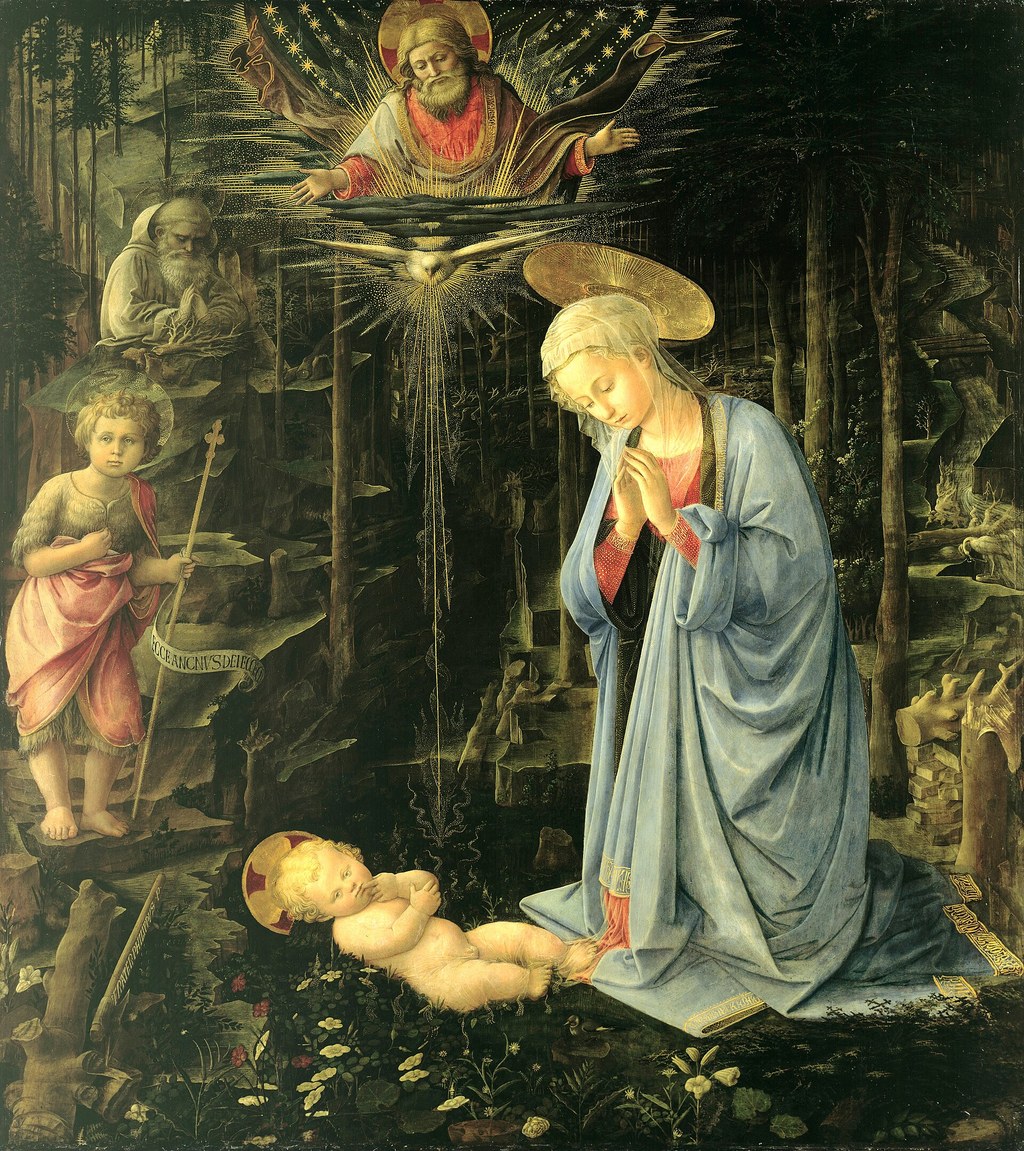
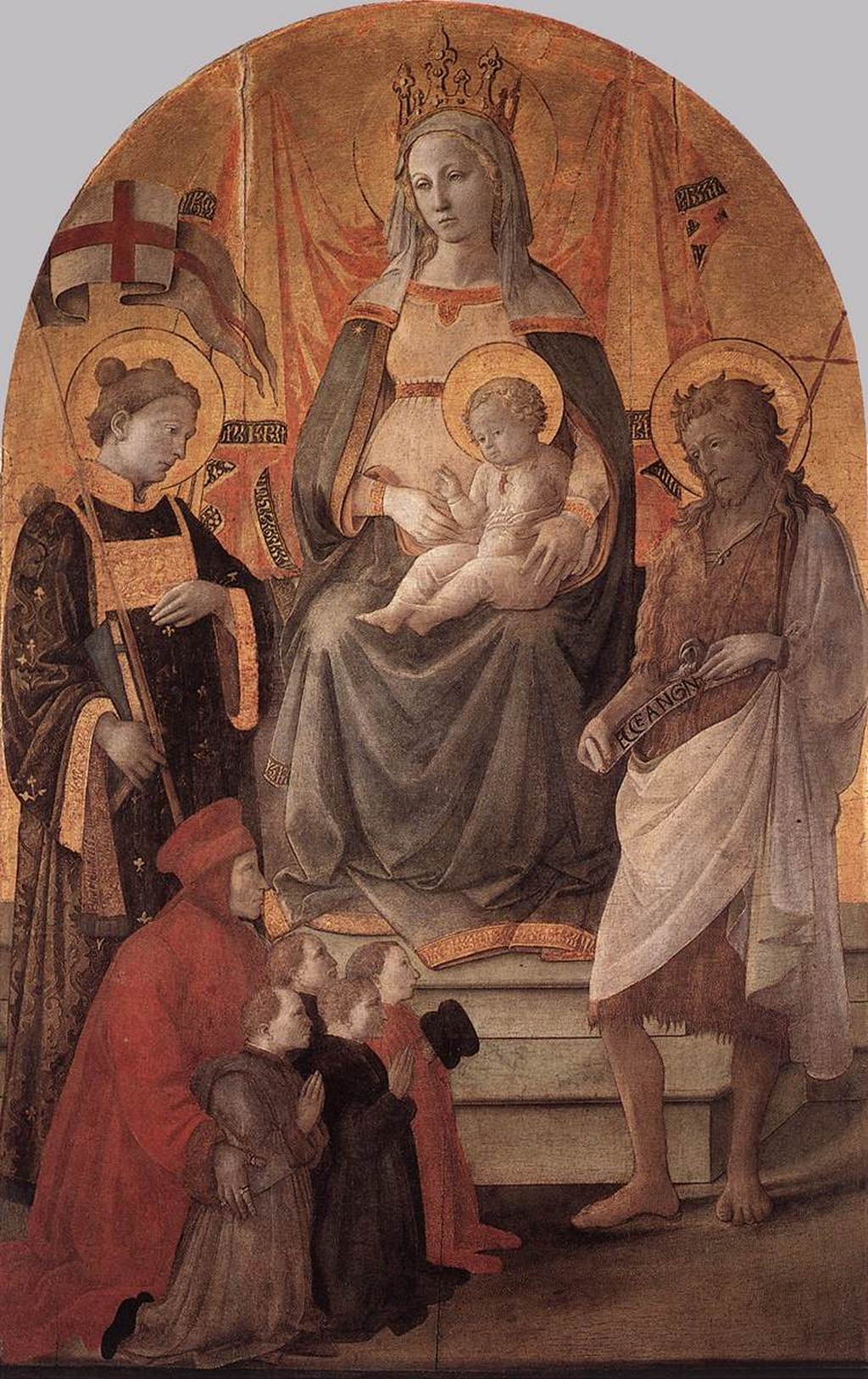
Fra Filippo and Medici Patronage. The National Gallery identifies the Medici as active supporters of Lippi.[1] Their commissions were important to his career. The relationship included not only the London panels but major works such as the Adoration in the Forest for the Magi Chapel.
This range is revealing. Lippi could supply a dense mystical altarpiece for one palace chapel and a quiet Annunciation for another architectural location. Medici patronage did not produce one fixed style. The artist adapted to function.
Colour
Lippi’s colour contributes strongly to the painting’s elegance. The figures are differentiated without destroying the overall serenity. Gabriel’s wings provide one of the most visually complex surfaces.
Mary’s clothing establishes her importance through traditional Marian colour. The garden adds natural tones and small detail. The palette therefore moves between sacred convention and decorative refinement.
Line. Line is one of Lippi’s defining strengths. Contours around faces, hands and drapery give the figures grace without making them insubstantial. This aspect of his style became particularly important for Botticelli.
In the Annunciation, line controls emotional tone. Gabriel’s bend, Mary’s turn and the edges of architecture produce a rhythm of approach and response. The scene is dramatic through contour rather than violent motion.
Egg Tempera. The National Gallery identifies the medium as egg tempera on wood.[1] Egg tempera dries quickly and rewards controlled application. It is well suited to crisp edges, fine detail and luminous layered colour.
Lippi’s handling makes the material appear delicate. The medium supports his interest in patterned wings, hair, textiles and precise architectural forms. The wood panel also reminds us that this was a movable object integrated into palace architecture rather than a fresco permanently bound to a wall.
Comparison with the Munich Annunciation. Lippi painted the Annunciation more than once. The large Murate altarpiece now in Munich provides an excellent comparison. That earlier work is monumental and ecclesiastical.
The London panel is more compressed and private. The same biblical event therefore changes according to patron, scale and location. Comparing the two works makes clear that subject alone does not determine composition. Function does.
Comparison with Fra Angelico
Fra Angelico was another master of Annunciation imagery. His versions often combine strict architecture, luminous colour and intense devotional stillness. Lippi shares the desire to make the miraculous intelligible through space.
Yet his figures tend towards a more worldly elegance. The comparison demonstrates diversity within Florentine sacred painting rather than a simple sequence of influence. Both artists could naturalise a miracle while preserving contemplation.
Comparison with Botticelli. Botticelli later developed the Annunciation into more emotionally charged and linear compositions. His connection with Lippi’s workshop makes comparison especially relevant. The inherited elements include graceful bodies, expressive contours and the ability to make gesture carry meaning.
Botticelli pushes those elements toward greater nervous energy. Lippi’s London panel remains calmer. That difference helps clarify what Botticelli transformed rather than merely borrowed.
The Annunciation and Seven Saints as a Single Programme. The most important corrective to a museum-by-museum reading is to reunite the Annunciation mentally with Seven Saints. The National Gallery catalogue treats them as a pair from Palazzo Medici.[1] This means their iconography was designed in relation.
On one panel, Mary receives the message that initiates the Incarnation. On the other, seven saints associated with Medici names form a sacred community. The pairing allows universal salvation history and family devotion to coexist without inserting contemporary patrons directly into the biblical event.
That is a sophisticated form of dynastic imagery. The Medici do not need to appear as portraits. Their names echo through the saints. The family residence is therefore placed under a network of sacred protection while the Annunciation supplies the theological centre.
Reconstructing How the Pair Might Have Been Seen
If the panels functioned as overdoors or elevated decorations, their daily reception differed from an altarpiece. A person could pass beneath them repeatedly. They would become part of the rhythm of moving through the palace.
That kind of viewing favours clear composition. Lippi’s balanced Annunciation can be grasped quickly from a distance. The companion saints form an equally readable horizontal group.
Repeated encounters could then reveal finer details. This is an important reminder that “private devotion” did not always mean a person kneeling motionless in front of a small picture. Sacred imagery could be embedded throughout a home. Architecture turned viewing into habit.
Gabriel's Wings and the Problem of Heavenly Bodies. Renaissance artists faced a visual problem when painting angels. Angels were spiritual beings, but paintings require visible bodies. Wings became one of the traditional devices for resolving that problem.
Lippi makes Gabriel recognisably human in face, hands and clothing, then gives the wings extraordinary decorative specificity. The peacock-like feathers emphasise difference without making the angel frightening. He is supernatural but beautiful.
That solution suited Lippi’s broader artistic language. The miraculous is translated into grace. The same instinct helps explain why his Madonnas and angels became so influential on Botticelli.
Mary's Reading. Mary’s book is easy to overlook because the encounter with Gabriel attracts immediate attention. Yet the motif contributes strongly to her character. She is interrupted in a state of disciplined attention.
Reading makes the Annunciation not only an invasion of domestic space but an interruption of devotion. This reinforces her preparedness. Mary does not become holy because Gabriel arrives.
Her existing spiritual orientation makes her the appropriate recipient of the message. For a literate elite household, the image could also validate private devotional reading as an activity. The Medici palace was a place of books as well as pictures.
Silence as a Compositional Choice
The National Gallery panel is striking for what it excludes.[1] There is no crowd of witnesses. There is no elaborate celestial court.
There is no burst of theatrical movement. This restraint creates silence. That silence becomes part of the subject because the Annunciation ultimately depends on listening.
Gabriel speaks. Mary receives and responds. The space between them gives pictorial form to communication.
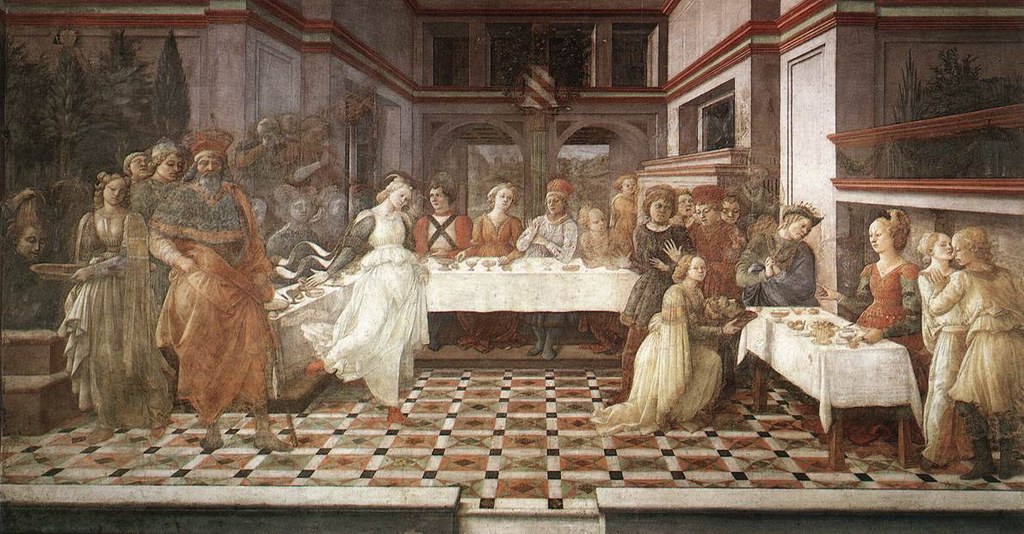
Lippi therefore demonstrates that Renaissance narrative need not always be crowded. His Prato frescoes show his ability to manage dozens of figures. Here he proves that two can be enough.
Palace Art and Political Visibility. Palazzo Medici was a domestic residence, but it was also a place where clients, allies and visitors encountered the family. Art displayed within it therefore had audiences beyond the immediate household. This makes the distinction between “private” and “public” more complicated than it first appears.
A religious panel could support sincere personal devotion and still contribute to the cultural prestige of the house. The elegance of Lippi’s painting mattered socially. Commissioning one of Florence’s leading painters demonstrated refinement. The paired saint programme demonstrated piety and family continuity. Neither function cancels the other.
A Bridge to Botticelli. The painting also provides a useful bridge into the later history of Florentine line. Botticelli’s association with Lippi’s workshop is securely established in institutional accounts. What he inherited was not a set of compositions to copy mechanically.
He inherited ways of thinking. A hand could express psychological response. A contour could carry emotion.
Fine surface detail could coexist with lucid spatial design. The Annunciation is a particularly clean example of those lessons because the composition is not distracted by narrative abundance. The figures themselves carry the event.
Why Pairing Matters for Modern Display
Museums often separate works physically for practical reasons, but even when paired paintings remain in the same institution, visitors may encounter them as independent labels. Seeing the two panels together restores a relationship that museum display can otherwise make easy to overlook. The two panels are best considered side by side because their probable Palazzo Medici function is part of the evidence.
A simple paired-image feature could explain their probable Palazzo Medici function. This is not decorative enhancement. It restores lost context. For this painting, the companion object is part of the evidence.
Why The Annunciation Matters
The National Gallery Annunciation matters because it places a major Christian mystery inside the intimate political world of the Medici palace.[1] It demonstrates how private patronage could connect family identity with sacred history. It also preserves the unusual relationship of a paired commission.
The Annunciation cannot be fully understood without Seven Saints, and Seven Saints becomes more meaningful when returned conceptually to its companion. Lippi’s treatment is visually restrained but intellectually rich. Architecture, garden, lilies, dove and light each contribute to the theological event.
Gabriel’s patterned wings provide splendour. Mary’s controlled response provides emotional focus. The result shows an artist capable of making a miracle feel quiet.
The painting also connects naturally with Lippi’s Medici patronage, Botticelli’s training, the Berlin Adoration in the Forest and the Munich Annunciation. Its original palace function makes it fundamentally different from Lippi’s larger church commissions and helps explain its unusually intimate scale and controlled composition.
Devotion Without Narrative Excess. The painting’s restraint also distinguishes it from Lippi’s monumental fresco work. At Prato he could use architecture to carry episodes across broad walls and populate a scene with dozens of spectators. Here the same intelligence is concentrated. One messenger, one recipient, a few objects and a controlled garden are sufficient.
That economy is especially suited to an image embedded in a palace interior, where the subject needed to remain legible during repeated encounters rather than demand the sustained narrative reading of a chapel fresco. The comparison strengthens our understanding of Lippi as an adaptable designer rather than an artist tied to one compositional formula.
A Quiet Medici Masterpiece
The small number of actors should not make the panel seem secondary beside Lippi’s larger commissions. Its refinement lies in compression. The Medici received a painting in which every element could carry disproportionate weight: a flower, a book, a wing, a turn of the hand. For a family accustomed to sophisticated visual culture, such understatement could itself communicate status. The work demonstrates that magnificence in Renaissance patronage did not always require monumental scale. It could also appear as precision, rarity and intelligent adaptation to architecture.
FAQs
Discussion
What stands out to you most about The Annunciation National Gallery in relation to Filippo Lippi's wider career?
Reader Insights
Notice how the page connects close visual detail with patronage, workshop practice and the wider Renaissance setting.
Which comparison elsewhere in the cluster helps clarify this work or theme most strongly?
Join the Conversation
Have a thought or observation about The Annunciation National Gallery? Share it below. Thoughtful responses may be added to this section.
References
- National Gallery, London, Fra Filippo Lippi, The Annunciation, NG666. View Source
- Dillian Gordon, National Gallery Catalogues: The Fifteenth Century Italian Paintings, vol. 1, entry on the Medici overdoor panels.
- National Gallery, Fra Filippo Lippi artist biography and Medici family resources. View Source
- Jeffrey Ruda, Fra Filippo Lippi: Life and Work with a Complete Catalogue, 1993.
- Megan Holmes, Fra Filippo Lippi: The Carmelite Painter, Yale University Press, 1999.