 by Tom Gurney
Tom Gurney BSc (Hons) is an art history expert with over 20 years experience
Published on June 19, 2020 / Updated on October 2, 2026
Email: tomgurney1@gmail.com / Phone: +44 7429 011000
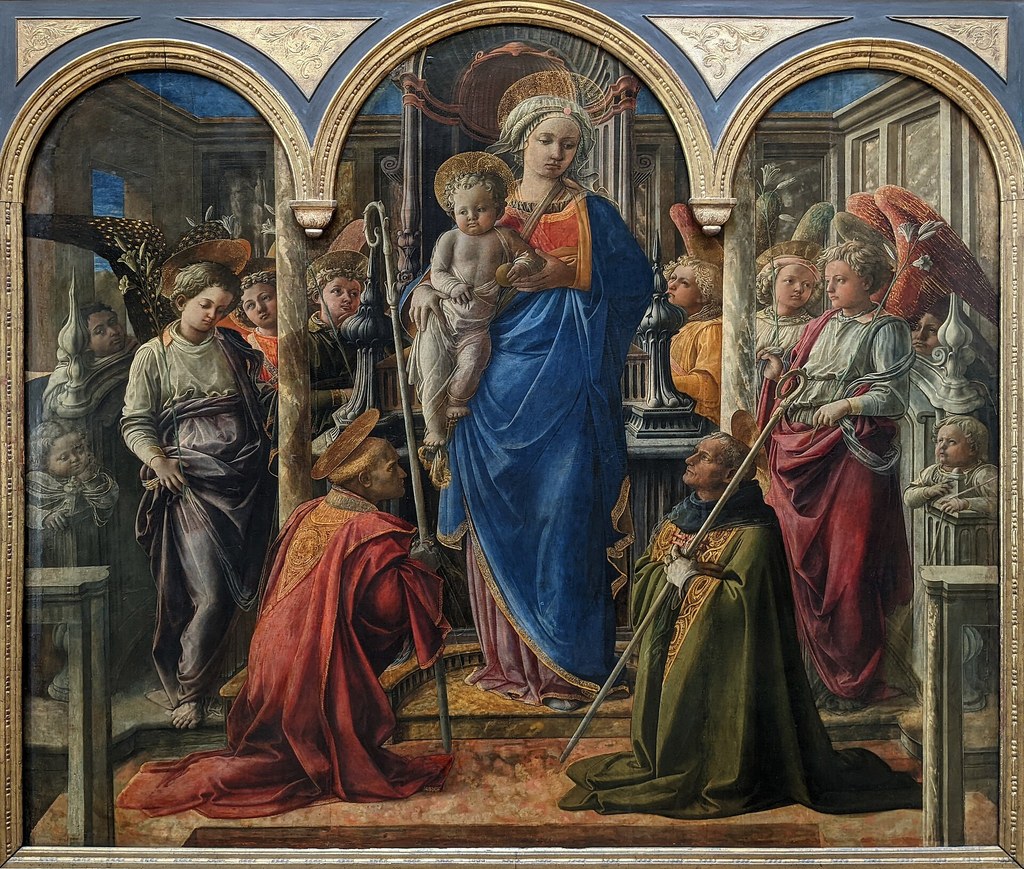
Barbadori Altarpiece by Fra Filippo Lippi
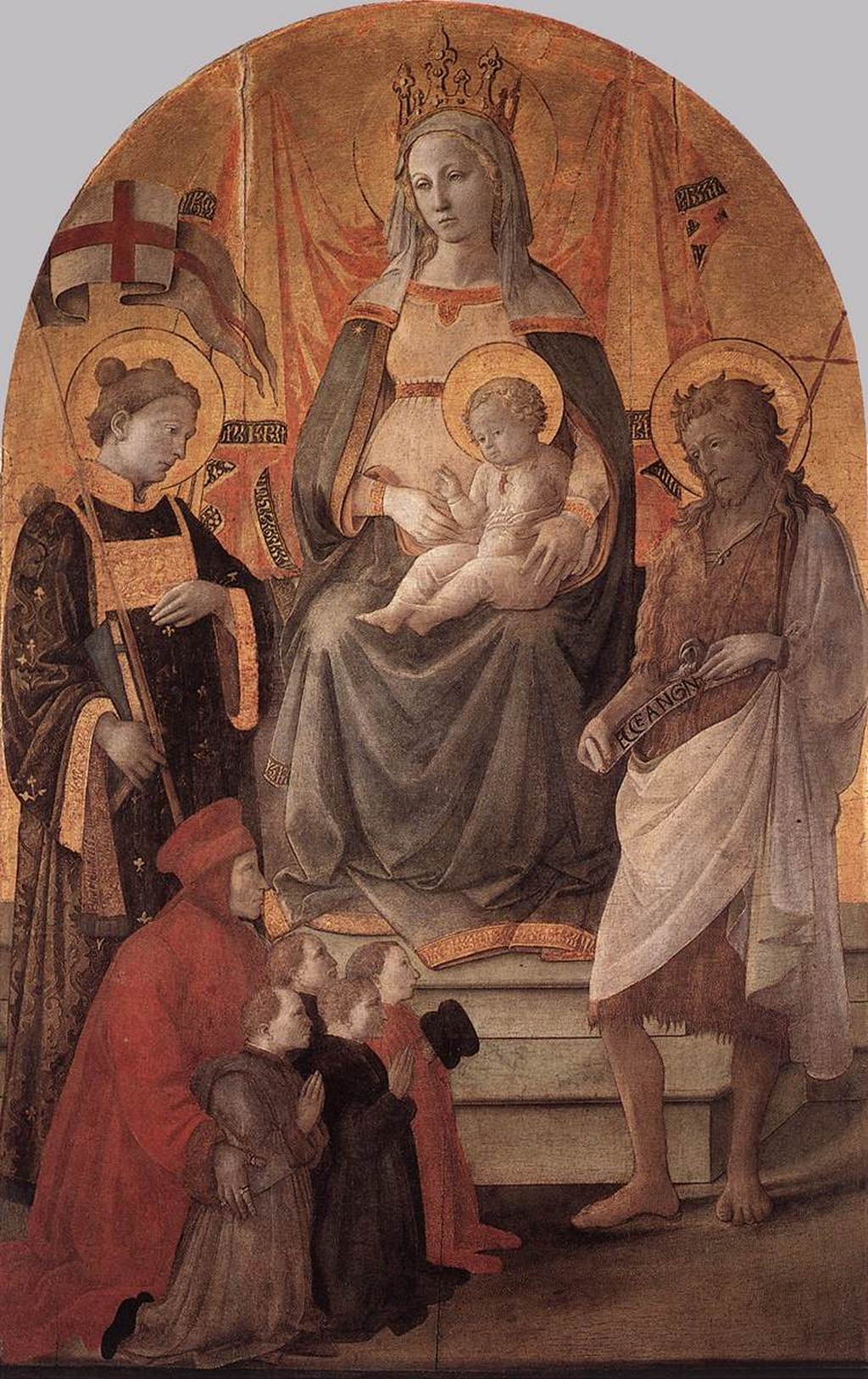
Fra Filippo Lippi’s Barbadori Altarpiece, painted in 1437 and now in the Louvre, is one of the key works of his early maturity. Commissioned for the Barbadori chapel in the Florentine church of Santo Spirito, it shows the Virgin and Child surrounded by angels and the saints Fredianus and Augustine.[1] The Louvre’s documentation gives the commission unusual historical precision. The central panel was ordered on 8 March 1437 by the captains of Orsanmichele, acting in accordance with the testamentary wishes of Gherardo Barbadori, who had died in 1429.[1]
The altarpiece therefore originated not simply as an artist’s invention but as the fulfilment of a deceased patron’s will. It belonged to a chapel, a family memory and a specific institutional process. The painting is also important because its original components are now divided. The large central panel is in Paris, while three predella scenes survive in the Uffizi in Florence.[5]
That dispersal is typical of the later history of many Renaissance altarpieces. What appears today as one museum painting was originally part of an architectural and narrative ensemble. The Louvre records a further remarkable piece of contemporary evidence: Domenico Veneziano mentioned the altarpiece in a letter sent from Perugia to Piero de’ Medici in 1438. The work was therefore already notable enough to enter correspondence between important figures in the Florentine artistic world almost immediately after its creation.[1]
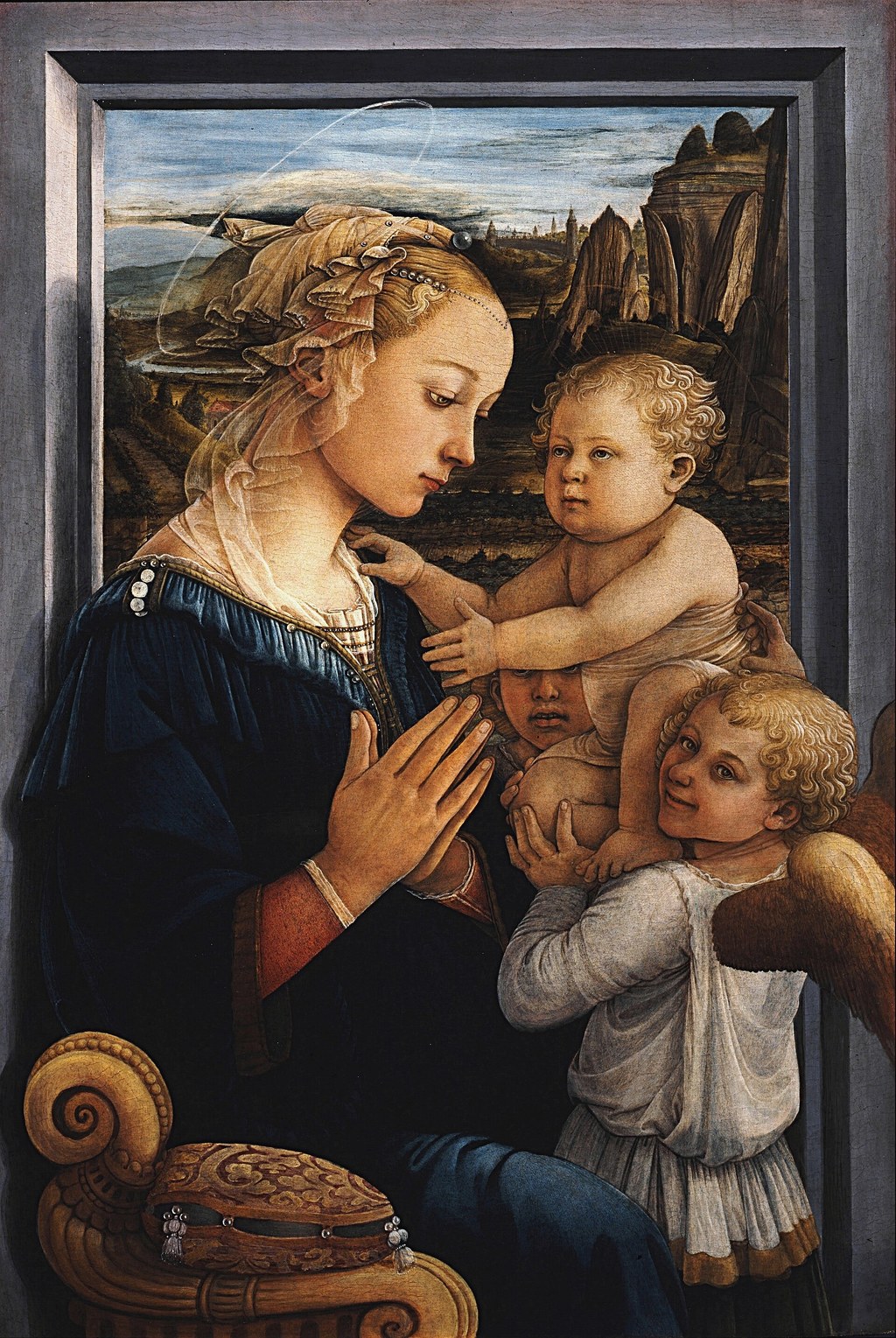
Stylistically, the Barbadori Altarpiece stands at a fascinating point in Lippi’s development. It retains the bodily weight and spatial seriousness associated with Masaccio while moving towards the more graceful, decorative and emotionally accessible language that would become distinctly Lippesque.
At a Glance
- ArtistFra Filippo Lippi
- TitleBarbadori Altarpiece
- Full titleVirgin and Child with Angels, Saint Fredianus and Saint Augustine
- Date1437
- SupportPoplar panel
- MediumLouvre lists oil (?) on wood; technical wording should remain qualified
- Dimensionsapproximately 208 × 244 cm
- Current locationLouvre, Paris
- Original locationBarbadori Chapel, Santo Spirito, Florence
- Commission date8 March 1437
- Commissioning bodyCaptains of Orsanmichele
- Underlying patronageTestamentary wishes of Gherardo Barbadori, who died in 1429
- Principal saintsSaint Fredianus and Saint Augustine
- PredellaThree surviving panels now in the Uffizi
- Contemporary referenceMentioned by Domenico Veneziano in a 1438 letter to Piero de’ Medici
- Transferred to Louvre1814, following Napoleonic removal from Florence
Contents
- What Does the Barbadori Altarpiece Show?
- Gherardo Barbadori
- Saint Augustine
- A Dispersed Altarpiece
- Masaccio’s Legacy
- Angels
- Size
- Testamentary Patronage: Commissioning After Death
- Reconstructing the Original Ensemble
- The Letter from Domenico Veneziano as Evidence
- Comparison with the Later Coronation of the Virgin
- FAQs
- References
What Does the Barbadori Altarpiece Show?
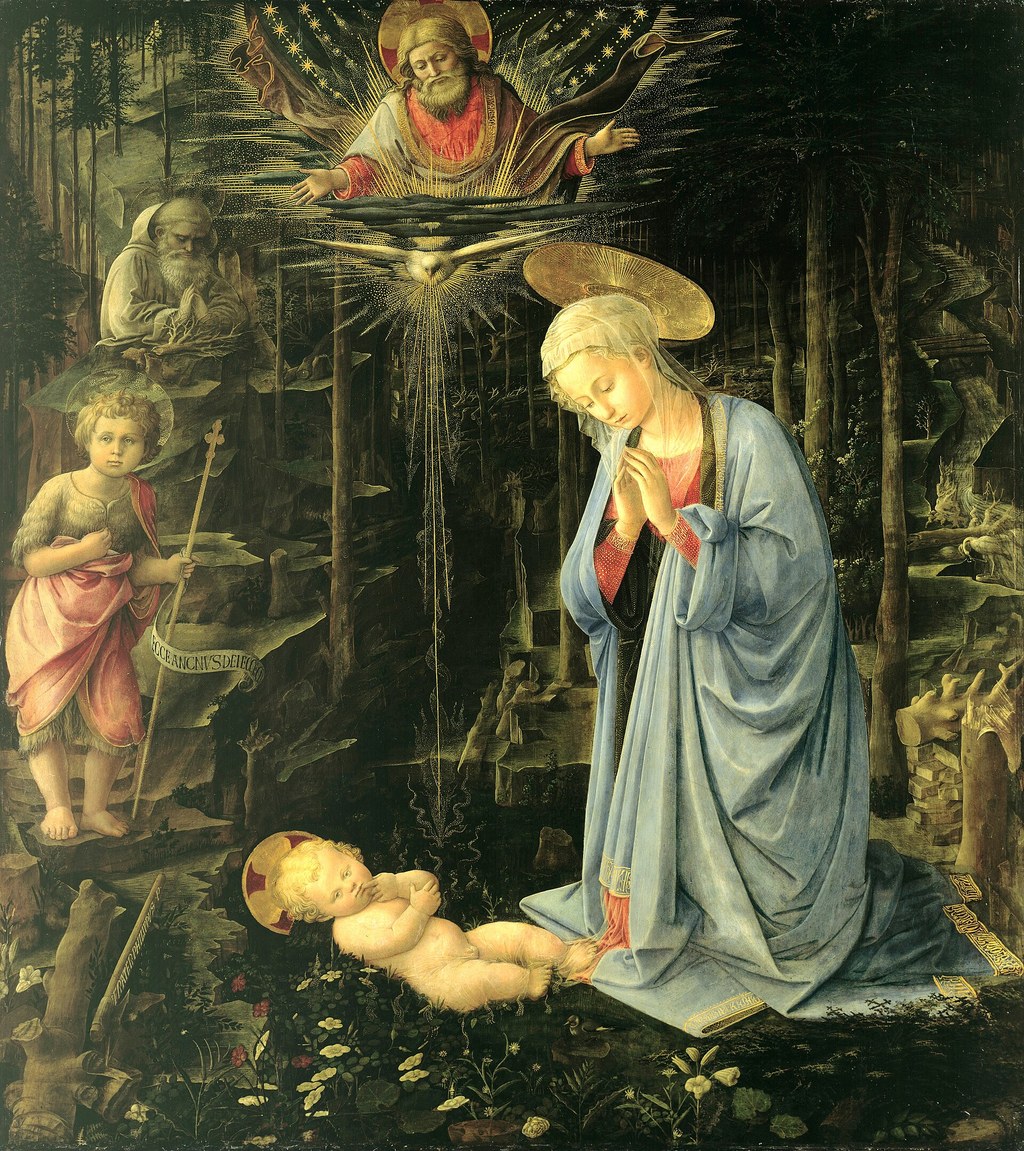
At the centre, the Virgin Mary presents the Christ Child within a gathering of angels and saints. Saint Fredianus and Saint Augustine occupy privileged positions within the sacred assembly. The figures are brought together into a unified space rather than separated rigidly into independent compartments.
That choice matters. Earlier Italian altarpieces often divided saints into separate Gothic panels beneath individual arches. Lippi moves towards the Renaissance sacra conversazione, or holy conversation, in which sacred figures share a continuous environment. The architecture still carries echoes of older altarpiece structures, but the figures increasingly behave as inhabitants of one spatial world. This creates a more immediate devotional encounter. The Virgin and saints no longer appear as isolated icons arranged side by side. They become a community.
The Commission of 8 March 1437. The Louvre records the precise commission date as 8 March 1437.[1] Such documentary precision is valuable because many Renaissance works can only be dated through style. The commission was issued by the captains of Orsanmichele in fulfilment of Gherardo Barbadori’s testamentary wishes.
Barbadori had died eight years earlier, in 1429. The gap between his death and the commission reminds us that commemorative religious projects could unfold slowly. Wills might provide funds or instructions that required later institutional action. The altarpiece therefore became a posthumous act of patronage. Gherardo Barbadori did not stand beside Lippi and direct the painting. His wishes survived through legal and institutional mechanisms.
Gherardo Barbadori
The Barbadori family belonged to the Florentine social world in which chapel patronage served both devotional and commemorative purposes. Funding an altarpiece could honour God and saints while preserving family presence within a church. A chapel offered continuity beyond an individual life.
Masses could be celebrated, family members buried or remembered, and visual symbols maintained. The altarpiece therefore participated in a culture of salvation and memory. Its beauty was not a luxury detached from religion. The commission’s material value helped create a lasting devotional object.
Why Orsanmichele Was Involved. The Louvre identifies the captains of Orsanmichele as the body that commissioned the central panel.[1] Orsanmichele was deeply embedded in Florentine civic and corporate life. Institutional involvement in carrying out Barbadori’s testament illustrates how patronage could operate through networks rather than a single buyer.
The artist’s client was therefore partly an organisation fulfilling another person’s wishes. This kind of structure matters when we speak casually of who “commissioned” a Renaissance painting. Patronage can have several layers: the person whose money or will initiated the project, the administrators who negotiated it, the religious institution that housed it and the artist who executed it.
Santo Spirito. The altarpiece was made for the Barbadori chapel in Santo Spirito, the major Augustinian church in the Oltrarno district of Florence. The Augustinian setting helps explain the presence of Saint Augustine. A painting installed in a side chapel participated in the daily life of the church.
It was seen during Mass, private prayer, memorial observance and the routine movement of clergy and worshippers. The Louvre panel’s present position in the Salon Carré is therefore radically different from its first function.[1] It has become an autonomous masterpiece. Originally it was part of a devotional environment.
Saint Augustine
Saint Augustine was among the most influential theologians of Western Christianity and the spiritual authority behind the Augustinian order. His inclusion in Santo Spirito is therefore completely appropriate. He does not function merely as one saint selected for visual balance.
He represents the institutional identity of the church itself. For Augustinian viewers, his presence connected the altar to the intellectual and spiritual tradition of their order. This demonstrates how iconography often begins with site. The question “why this saint?” can frequently be answered by asking where the painting originally stood.
Saint Fredianus. Saint Fredianus, or Fridianus, is less immediately familiar to modern audiences than Augustine. His presence is therefore especially useful for identifying the local and patronal meanings of the altarpiece. Fredianus was associated with Lucca and with miracle traditions, including the redirection of the Serchio River.
That miracle appears in one of the predella scenes preserved in the Uffizi.[5] The predella consequently expanded the saint’s identity from static presence into narrative. A viewer looking above saw Fredianus as a holy participant in the main sacred assembly. Looking below, the viewer could see an episode demonstrating his miraculous power.
The Predella. Three predella panels survive in the Uffizi:[5] - Saint Fredianus Diverts the River Serchio - The Announcement to the Virgin of Her Approaching Death - Saint Augustine in His Cell These smaller scenes were originally part of the same altarpiece.
They matter because they make the iconographic programme more intelligible. Fredianus and Augustine are not merely labels in the main panel. Their stories continue below. The Marian scene concerning the announcement of the Virgin’s death connects the predella with the central Virgin and Child.
The complete altarpiece therefore moved between timeless sacred presence and episodes unfolding in narrative time. This was a common and effective Renaissance structure. The large central image supported contemplation. The predella supported storytelling.
A Dispersed Altarpiece
Today the central panel is in Paris and the predella panels are in Florence. That separation creates practical difficulties for interpretation. Museum visitors rarely see the components together.
Reconstructing the original ensemble is therefore particularly valuable. A schematic reconstruction can help show how the Louvre and Uffizi panels once belonged to one object.[5] This would help visitors understand scale as well. The main panel is more than two metres high, while predella scenes are much smaller. Their visual functions were different because their viewing distances were different.
Domenico Veneziano’s 1438 Letter. One of the strongest pieces of evidence for the altarpiece’s early reputation is the letter mentioned by the Louvre.[1] In 1438 Domenico Veneziano, writing from Perugia to Piero de’ Medici, referred to the work. This is exceptionally useful because it moves us close to the moment of creation.
Later biographies such as Vasari’s can tell us how sixteenth-century writers remembered Lippi. A letter written around the time of the commission provides a different kind of testimony. It shows that the altarpiece existed within contemporary artistic conversation. The fact that Piero de’ Medici was the recipient also links the work indirectly to the patronage networks that would become crucial to Lippi’s career.
Fra Filippo Lippi in 1437. The date places the Barbadori Altarpiece at a pivotal moment. Lippi was no longer simply the young Carmelite formed in the environment of Santa Maria del Carmine. He was becoming a painter capable of securing important independent commissions.
The influence of Masaccio remained fundamental. Lippi had grown up where the Brancacci Chapel offered one of the most advanced demonstrations of bodily volume, light and perspectival space in Florence. Yet Lippi was not content to repeat Masaccio. His figures increasingly develop softer contours, graceful gestures and a decorative sensitivity that would become central to his mature style. The Barbadori commission therefore reveals an artist negotiating inheritance and individuality.
Masaccio’s Legacy
Masaccio’s impact can be seen most broadly in the desire to make sacred figures occupy real space. Bodies have weight. Architecture is not merely ornamental framing.
The Virgin and saints participate in a world governed by physical presence. This naturalism represented a major departure from the flat hierarchies of older altarpieces. Lippi adopted those lessons but softened their severity. Where Masaccio can feel monumental and austere, Lippi often seeks elegance and emotional accessibility. The Barbadori Altarpiece sits between those tendencies.
Towards the Sacra Conversazione. The unified gathering of saints anticipates the increasingly important Renaissance format known as the sacra conversazione. The phrase does not imply that the figures literally converse. It describes a sacred gathering in which figures from different historical periods share one coherent devotional space.
The format solved several problems at once. It allowed patrons to include multiple saints without fragmenting the image. It also made the Virgin and Child appear more immediately present.
The Barbadori composition is important because it demonstrates this transition while traces of older architectural division remain visible. The Renaissance did not replace Gothic forms overnight. Artists adapted and reorganised them.
Architecture. Lippi uses architecture to provide order without isolating each figure. Arches and columns create rhythm. The Virgin occupies a privileged central position while the saints remain integrated around her.
This balance between hierarchy and unity is central to successful altarpiece design. The viewer must understand immediately who matters most. At the same time, the sacred figures should feel like members of one heavenly gathering. Lippi’s architecture therefore functions both structurally and symbolically. It creates a place in which communion becomes visible.
Angels
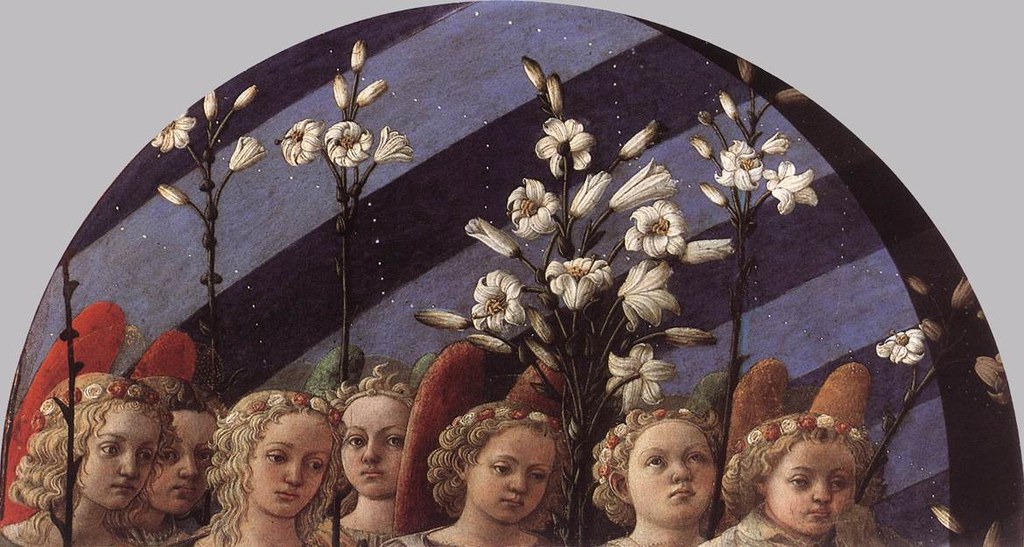
Angels animate the sacred gathering and soften the monumentality of the larger figures. Lippi would later become especially famous for youthful angels whose expressions verge on everyday human warmth. In the Barbadori work, angels help bridge the Virgin and saints while reinforcing the altarpiece’s celestial character. They also provide opportunities for variation in faces and gesture. This prevents the composition from becoming static.
The Virgin and Child. Mary remains the focus. Her position creates the theological centre around which all other figures organise themselves. The Christ Child turns the image from a court of saints into a statement about Incarnation.
Every saint derives meaning from relationship to Christ. The Virgin’s role is both maternal and hierarchical. She presents the Child while occupying a place of exceptional honour. Lippi’s later Madonnas would become more intimate. Here the scale and original altar setting require a more public sacred presence.
Medium and Technique. The Louvre currently describes the material as oil (?) on poplar panel.[1] The question mark matters. Early fifteenth-century Italian panel painting often involved tempera and increasingly complex use of oil-containing media, and museum technical descriptions can change as analysis improves.
The medium is best described using the Louvre’s qualified wording rather than simplified confidently to “oil painting”.[1] The uncertainty itself is informative. It reminds readers that technical knowledge evolves. The panel support is poplar, a common Italian choice. Large wooden altarpieces required skilled preparation because movement in the support could damage brittle paint and ground layers.
Size
At about 208 × 244 cm, the central panel is monumental. Online reproduction can disguise that fact. On a phone or computer, it appears as another rectangular image.
In person, its scale is architectural. The figures were meant to communicate across a chapel. This is another reason the predella’s smaller narrative detail should be understood separately. Different parts of the object were optimised for different kinds of viewing.
Later History in Santo Spirito. The Louvre records the altarpiece in its original location and notes later references by Vasari.[1] It remained associated with Santo Spirito until the early nineteenth century. By then, political upheaval and institutional suppression across Italy were changing the fate of church art. Works created for specific altars could become movable cultural property. The Barbadori panel was transferred to the Accademia delle Belle Arti in Florence before being taken to Paris.
Napoleonic Removal. The Louvre records its acquisition mode plainly as “conquête militaire” — military conquest.[1] The panel was removed and taken to the Louvre in February 1814.[1] That provenance deserves transparent treatment.
Many European museum collections were shaped by war, suppression, confiscation and unequal transfers. The painting’s presence in Paris is therefore part of its history, not a neutral endpoint. Unlike works acquired through later purchase, the Barbadori panel entered the French state collection through Napoleonic seizure. The predella remaining in Florence makes the dispersal especially visible.
From Altarpiece to Museum Masterpiece. The change of setting altered the way the painting is interpreted. At Santo Spirito, Saint Augustine’s presence was institutionally obvious. In the Louvre, viewers may need a label to understand him.[1]
At Santo Spirito, the chapel’s architecture framed the work. In Paris, a museum frame and gallery wall do that job. At Santo Spirito, the predella and liturgy expanded the narrative.
In Paris, the central panel stands alone. The painting has survived physically, but its context has been transformed. Art history partly consists of reconstructing what museum display has separated.
Testamentary Patronage: Commissioning After Death
The Barbadori commission is particularly useful because it demonstrates that a Renaissance patron did not always need to be alive when the artist was hired. Gherardo Barbadori’s will created an obligation that survived him. Administrators then translated that intention into an actual commission years later.
This separation between originator and executor complicates the modern idea of patronage as a face-to-face relationship between artist and client. Lippi’s practical negotiations were with living officials. Yet the devotional and commemorative meaning of the chapel still derived from Barbadori.
The resulting altarpiece therefore joined two timeframes: a dead patron’s intentions and a living institution’s execution of them. For family members, this continuity helped make the chapel a durable memorial. For historians, the process exposes the legal infrastructure behind artistic production. Art depended upon wills, executors, corporate authorities and accounts as much as upon imagination.
Orsanmichele and Civic Administration. The involvement of the captains of Orsanmichele also places the painting inside Florence’s dense network of civic institutions. Orsanmichele was more than a church. Its administration was connected to the city’s guild and public life, and its officers could carry responsibilities extending beyond the building itself.
Their role in the Barbadori project shows how religious patronage could be supervised through civic structures. This matters because Florence’s Renaissance was not produced solely by princely courts. Families, confraternities, guilds, monasteries, republic institutions and charitable bodies all commissioned art. Lippi’s career moved among these overlapping worlds. The Barbadori altarpiece belongs particularly clearly to the republican and institutional side of that ecology.
Reconstructing the Original Ensemble
A useful way to imagine the lost altarpiece is to begin with scale. The central Louvre panel is more than two metres high.[1] Beneath it ran a sequence of much smaller predella scenes.
Around both would have been a frame that organised the hierarchy and probably introduced gilded architectural forms. The eye would first register the great sacred gathering. As the viewer approached, the smaller stories became legible.
That change in scale was intentional. A Renaissance altarpiece could therefore communicate at several distances, almost like a modern webpage containing a headline, main image and detailed supporting modules. The present museum split breaks that hierarchy.
In Paris, the central painting lacks its narrative base. In Florence, the predella panels appear as small independent works. Reconstruction can conceptually reunite components that the physical collections currently display separately. A reconstruction should be labelled clearly as such, but even a simple diagram could help visitors understand the original object better than viewing four isolated museum records.
The Three Predella Stories as a Programme. The surviving predella scenes also clarify why Fredianus and Augustine appear in the main panel. Saint Fredianus Diverts the River Serchio gives narrative form to a saint who may otherwise be unfamiliar to modern audiences. His miracle demonstrates divine power working through a holy bishop in a local Italian landscape.
Saint Augustine in His Cell shifts towards intellectual and monastic sanctity. The saint is encountered in a more private, contemplative environment. Between these institutional saints, The Announcement to the Virgin of Her Approaching Death extends the Marian narrative beyond Christ’s infancy.
The predella therefore spans miracle, contemplation and the later life of Mary. These stories are not random illustrations. They translate the identities gathered in the main panel into narrative episodes.
The Letter from Domenico Veneziano as Evidence
The 1438 letter deserves more weight than a passing mention because contemporary references to specific early Renaissance paintings are precious. Domenico Veneziano was himself a major painter. When he referred to Lippi’s altarpiece in correspondence with Piero de’ Medici, the object entered a documentary network connecting artists and patrons.
The reference confirms the work’s visibility at a very early date. It also reminds us that painters watched one another. The Florentine Renaissance was competitive as well as collaborative.
Artists sought commissions in an environment where patrons could compare reputations, styles and recent achievements. The Barbadori Altarpiece therefore contributed to Lippi’s professional standing. Its importance was not invented by later museum culture. It was already noticed by his contemporaries.
Removal, Ownership and Museum Ethics. The Louvre’s unusually direct provenance wording—“military conquest”—is worth preserving because it avoids the euphemisms that often obscure Napoleonic transfer.[1] The panel did not simply “move” to Paris. It was taken.
That fact does not determine what should happen to the painting today, but it is essential historical information. The removal also had an artistic consequence beyond ownership. It separated the central panel from its predella and from Santo Spirito.
A military and political event therefore changed the physical form in which later generations encountered Lippi’s work. This is a useful reminder that provenance is not an appendix to art history. Provenance can transform the art object itself.
Comparison with the Later Coronation of the Virgin
The Barbadori Altarpiece can be compared with Lippi’s Coronation of the Virgin for Sant’Ambrogio, completed a decade later. Both are large Florentine church commissions. Both reveal the demands of institutional patronage.
Yet the Coronation is far more crowded and theatrical. The comparison demonstrates how rapidly Lippi’s workshop, confidence and compositional ambition developed. The Barbadori work provides the foundation. The Maringhi commission expands it.
Why the Barbadori Altarpiece Matters. The Barbadori Altarpiece matters because it captures Lippi at the moment his mature public career comes clearly into view. Its documentation anchors the work to a date, chapel and testamentary patron. Its contemporary mention by Domenico Veneziano shows that it entered artistic conversation immediately.
Its composition helps chart the transformation of the Florentine altarpiece from compartmentalised Gothic structure towards unified Renaissance sacred space. Its dispersed predella demonstrates how museum history can fragment an object. And its Napoleonic removal adds a modern political history to its Renaissance religious one.
The work therefore rewards more than a description of the saints. It can explain what an altarpiece was, how a dead patron could commission through a will, how institutional intermediaries operated, how Lippi absorbed Masaccio, and how a church object became a Louvre masterpiece.[1] That combination makes the Barbadori Altarpiece one of the strongest surviving documents of Lippi’s early mature career.
FAQs
Discussion
What stands out to you most about Barbadori Altarpiece in relation to Filippo Lippi's wider career?
Reader Insights
Notice how the page connects close visual detail with patronage, workshop practice and the wider Renaissance setting.
Which comparison elsewhere in the cluster helps clarify this work or theme most strongly?
Join the Conversation
Have a thought or observation about Barbadori Altarpiece? Share it below. Thoughtful responses may be added to this section.
References
- Musée du Louvre, collection record for Fra Filippo Lippi, Pala Barbadori / Virgin and Child with Angels, Saint Fredianus and Saint Augustine. View Source.
- Jeffrey Ruda, Fra Filippo Lippi: Life and Work with a Complete Catalogue, London, 1993.
- Megan Holmes, Fra Filippo Lippi: The Carmelite Painter, Yale University Press, 1999.
- Louvre Italian paintings catalogue literature listed in the museum record. View Source
- Uffizi collection documentation for the three surviving Barbadori predella panels.