 by Tom Gurney
Tom Gurney BSc (Hons) is an art history expert with over 20 years experience
Published on June 19, 2020 / Updated on October 2, 2026
Email: tomgurney1@gmail.com / Phone: +44 7429 011000
Adoration in the Forest by Fra Filippo Lippi
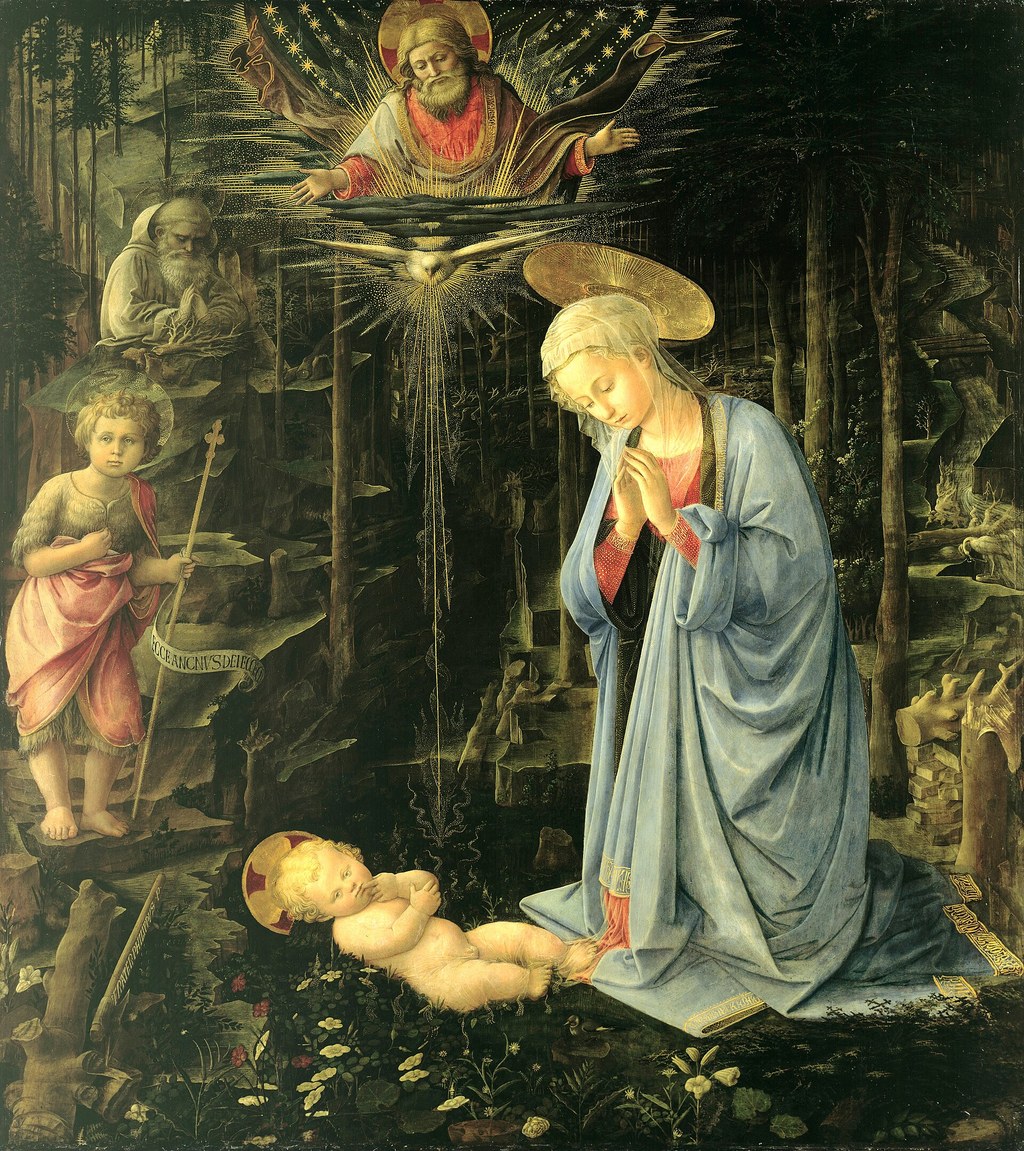
Fra Filippo Lippi’s Adoration in the Forest, also known as the Mystical Nativity, is one of the most unusual and intellectually rich paintings of the Florentine Renaissance. Painted around 1459 for the private Magi Chapel in the Palazzo Medici in Florence and now in the Gemäldegalerie in Berlin, it replaces the familiar stable of Bethlehem with a dark, steep woodland filled with flowers, felled timber, running water and signs of human labour.[1]
The Virgin kneels before the newborn Christ, who lies directly on the ground. Nearby stand the young Saint John the Baptist and a praying monk-saint, while God the Father and the dove of the Holy Spirit appear above. Together they turn a Nativity into a meditation on the Trinity, prophecy, wilderness and redemption. The painting is equally important because of its original setting. Benozzo Gozzoli’s celebrated frescoes of the Journey of the Magi cover the walls of the Medici chapel, and the Gemäldegalerie argues that the fresco cycle and Lippi’s altarpiece were conceived in deliberate relation to one another.[1]
The painted procession of the Magi effectively moves towards Lippi’s sacred image at the altar. The architecture of the chapel, the glittering frescoes, the dark forest panel and candlelight would therefore have formed one integrated devotional environment. Today the painting is also the subject of an unusually important conservation project. The Gemäldegalerie’s 2026–28 programme is examining the work with microscopy, X-radiography, ultraviolet fluorescence, infrared reflectography and scientific analysis of pigments and binders.[1]
That project was prompted by active deterioration. Conservators discovered numerous small areas where the paint was lifting and flaking because an aged nineteenth-century varnish had become unstable. As a result, the Adoration in the Forest offers something rare: a major Renaissance masterpiece whose material construction and conservation history are being investigated in depth now, while new evidence is still emerging.
At a Glance
- ArtistFra Filippo Lippi
- TitleAdoration in the Forest
- Alternative titleMystical Nativity
- Datec. 1459
- SupportWooden panel
- Current locationGemäldegalerie, Staatliche Museen zu Berlin
- Original locationMagi Chapel, Palazzo Medici, Florence
- PatronageMedici family
- Principal figuresVirgin Mary, Christ Child, young Saint John the Baptist, Saint Bernard of Clairvaux, God the Father and the Holy Spirit
- SettingMountainous forest rather than conventional stable
- Important original relationshipDesigned in dialogue with Benozzo Gozzoli’s Magi Chapel frescoes
- Later historyRemoved after the Medici expulsion of 1494; a fifteenth-century copy occupies the chapel today
- Current researchMajor examination and conservation campaign, 2026–28
- Key technical methodsStereomicroscopy, X-ray imaging, UV fluorescence, infrared reflectography, pigment and binder analysis
Contents
- What Does Adoration in the Forest Show?
- The Medici Chapel
- Medici Devotion to the Magi
- Christ on the Ground
- God the Father and the Holy Spirit
- Water
- Comparison with Lippi’s Other Adorations
- The 2026–28 Conservation Project
- Conservation and Authorship
- From Procession to Adoration
- Private Devotion and Political Identity
- Nature Observed and Nature Invented
- From Infrared to X-Ray: Reading Beneath the Surface
- The Fifteenth-Century Copy in Florence
- Why Adoration in the Forest Matters
- FAQs
- References
What Does Adoration in the Forest Show?
The picture centres on the Virgin Mary, who kneels in prayer before the naked Christ Child. The infant lies on the earth rather than in a manger. This iconography belongs to a late-medieval and Renaissance tradition of the Virgin adoring the newborn Christ. It emphasises the miraculous nature of the birth and Mary’s immediate recognition of the Child’s divinity.
Yet Lippi transforms the scene through its environment. There is no stable filled with shepherds and animals. Instead, the holy event takes place within a dense mountain forest. Trees rise through the picture, the land climbs steeply upward, flowers grow across the foreground and a stream descends through the landscape. The world looks secluded, cool and almost silent.
To the left appears the young Saint John the Baptist, identifiable by his role as Christ’s forerunner. Elsewhere a praying monastic saint introduces another layer of devotional meaning. Above, God the Father and the dove of the Holy Spirit establish a vertical relationship with Christ on the ground. The result is far more than a simple Nativity. Father, Spirit and Son create a Trinitarian structure, while John the Baptist points forward towards Christ’s future mission.
Why Is the Nativity in a Forest? The forest is the painting’s most extraordinary feature. Traditional Nativity imagery normally supplies a stable, ruin, cave or shelter. Lippi instead makes wilderness itself the sacred architecture. This changes the emotional tone. The forest is beautiful but austere.
Its trees, rocks and shadowy depths suggest separation from ordinary social life. Mary and Christ seem removed from the noise of the city and placed inside a contemplative landscape. For a devotional picture, that withdrawal has clear resonance. Forests and hermitages were associated with monastic solitude, penitence and spiritual concentration. The presence of a monastic saint reinforces the connection. At the same time, the woodland is not untouched nature. An axe, cut wood and other signs of labour reveal a managed landscape. This tension between wilderness and cultivation has generated important modern scholarship.
The Medici Chapel
The original home of the painting was the private chapel in the Palazzo Medici, the family palace built in Florence to Michelozzo’s designs. The chapel was among the most magnificent interiors in the residence. Benozzo Gozzoli covered its walls with a sumptuous procession of the Magi travelling through an idealised landscape. The Gemäldegalerie’s collection research emphasises that Lippi’s altarpiece and Gozzoli’s frescoes were designed in mutual relationship.[1]
This is crucial. Seen alone in Berlin, the Adoration in the Forest appears like an independent woodland meditation. In Florence, it formed the destination of an entire visual journey. The Magi processed around the chapel walls towards the altar. Lippi’s image supplied the holy encounter that completed their pilgrimage. The viewer participated in the same spatial logic. To enter the chapel was effectively to join a movement towards the Virgin and Child.
A Chapel Without Windows. The Gemäldegalerie notes that the Medici chapel was originally without windows and illuminated by candlelight.[1] That detail radically changes how we should imagine the painting. The dark forest would not have been viewed under the even, bright illumination of a modern gallery. It would have emerged from a dim chapel amid gilded surfaces, painted processions and moving points of flame.
The subtle flowers and water may have appeared and disappeared as the light changed. The sacred figures themselves would have been part of a deliberately mysterious environment. This helps explain why the panel’s atmosphere differs so strongly from the glittering worldly splendour of Gozzoli’s Magi. The chapel created a journey from princely procession to contemplative encounter.
Medici Devotion to the Magi
The Magi were especially important to Medici identity. Florence had a strong public tradition of devotion to the Three Kings, including processional celebrations, and the Medici used Magian imagery repeatedly. Kings travelling with luxurious entourages offered obvious possibilities for elite patronage. Their story united wealth with legitimate devotion because the riches of the Magi were ultimately offered to Christ.
The private chapel transformed this civic and dynastic symbolism into a domestic religious environment. Lippi’s painting is therefore inseparable from Medici self-presentation, even though the panel itself is remarkably austere. That contrast is one of its greatest strengths.
Gozzoli presents procession, fabric, horses, jewels and public magnificence. Lippi presents a baby lying on the earth in a dark forest. The movement from one to the other could function as a moral transformation of wealth into adoration.
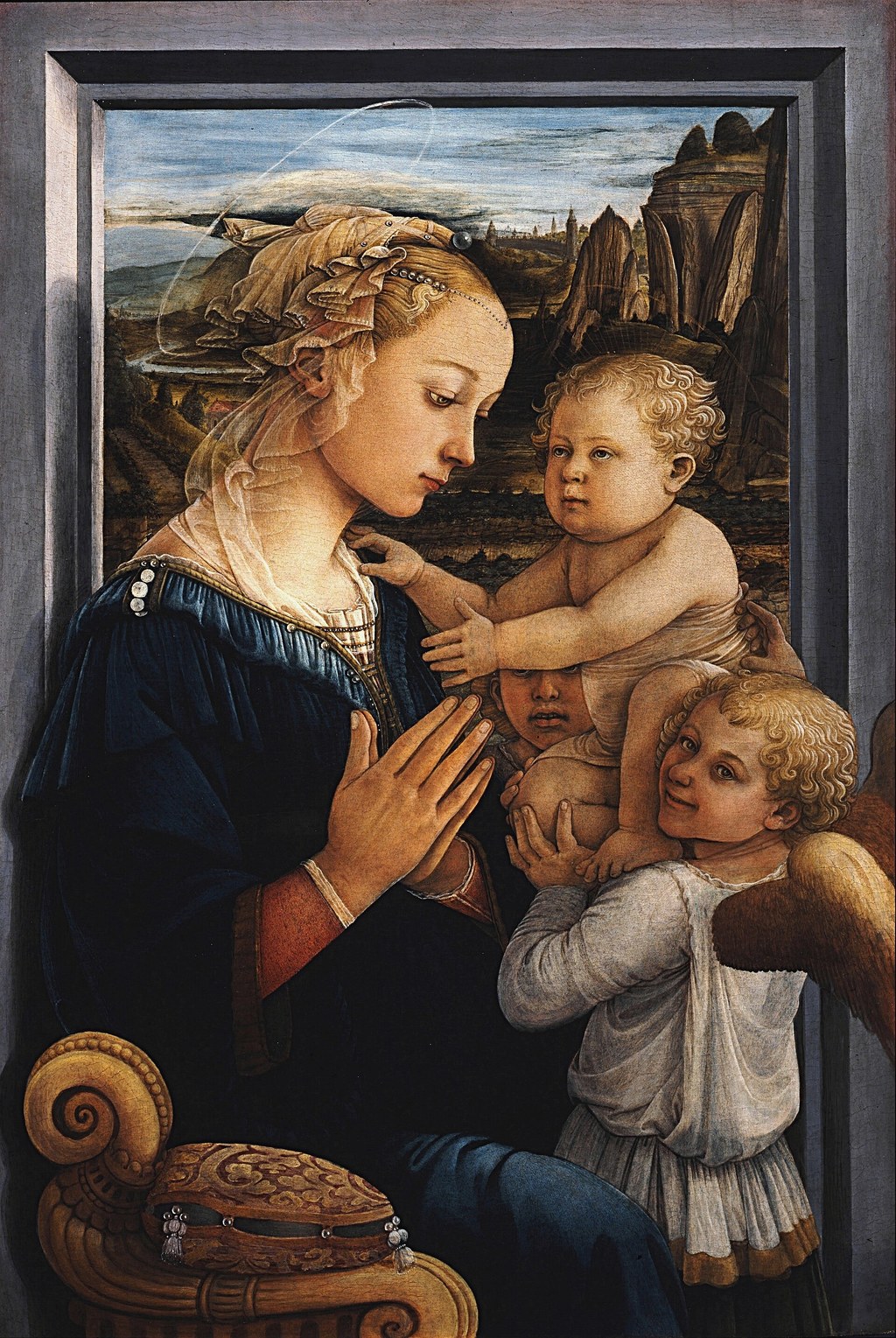
The Virgin. Mary kneels with her hands joined in prayer. Her pose differs from the affectionate contact found in Lippi’s Madonna and Child with Two Angels. Here she does not hold the baby. The physical separation makes the act of worship explicit.
Mary is mother and first adorer. Her body creates a strong visual curve towards Christ, concentrating attention on the Child despite the abundance of natural detail around them. Lippi gives her the graceful features and carefully arranged drapery characteristic of his mature style, but she is more solemn than fashionable. The forest strips away much of the domestic elegance associated with his best-known Madonna.
Christ on the Ground
The naked Christ Child lies directly on the earth. This motif belongs to the iconography of the Adoration of the Child and can be related to devotional accounts, including the vision of Saint Bridget of Sweden, in which the newborn Christ appears miraculously radiant. Placing Christ on the ground also intensifies the theme of humility.
The divine Child enters the world without throne, bed or palace. In the Medici context, that humility would have been especially resonant. One of Florence’s wealthiest families encountered Christ as a naked infant surrounded by woodland debris. The contrast between palace and painted poverty could scarcely be stronger.
Saint John the Baptist. The young John the Baptist appears as Christ’s forerunner. John was the patron saint of Florence and therefore carried civic as well as theological significance for a Medici audience. In Christian narrative, he prepares the way for Christ and later identifies him as the Lamb of God.
Including John in a Nativity scene compresses time. He is not present in the Gospel birth narrative in this way. Instead, Lippi creates a devotional synthesis. The infant Christ is seen through knowledge of his future ministry, Passion and redemption. John makes that future visible inside the scene of birth.
The Monastic Saint. A praying monastic saint appears within the forest. The Gemäldegalerie identifies him as Saint Bernard of Clairvaux, founder of the Cistercian abbey of Clairvaux and one of the most influential monastic figures of the Middle Ages.[1] His presence strengthens the painting’s emphasis on monastic contemplation and penitential withdrawal. The forest setting can therefore be understood as both physical landscape and a setting for spiritual discipline.
The Medici also supported Camaldolese institutions, a relationship explored in recent environmental scholarship comparing the Berlin painting with Lippi’s later Camaldoli Adoration of the Child. Because identifications in Renaissance iconography can shift with scholarship, secure attributes should be distinguished from traditional naming where necessary. What matters visually is that Lippi places monastic contemplation inside the Nativity itself.
God the Father and the Holy Spirit
At the upper part of the image, God the Father and the dove of the Holy Spirit complete a Trinitarian arrangement with Christ. This is one reason the title Mystical Nativity feels appropriate. The painting is not primarily about anecdotal details surrounding childbirth. It is about the Incarnation as a cosmic event.
Christ lies physically on earth while Father and Spirit appear above. The vertical axis unites heaven and ground. Mary’s adoration becomes the human response to that divine structure.
The Axe. Among the most discussed details is the axe embedded in a stump or piece of cut timber. At one level, it belongs naturally to the worked forest. At another, it can carry scriptural associations.
John the Baptist warns in the Gospel tradition that the axe is laid to the root of the trees, imagery connected with judgement and repentance. In a painting where John himself appears, the tool can therefore operate as more than landscape detail. Lippi’s signature has also been associated with the axe, making the object simultaneously practical, symbolic and authorial. This is typical of the painting’s density. Ordinary things become carriers of spiritual meaning without ceasing to look ordinary.
Flowers and Plants. The forest floor is filled with carefully observed vegetation. The Gemäldegalerie specifically notes that the detailed flowers are thought to have influenced Lippi’s pupil Sandro Botticelli.[1] That connection is especially tempting when considering the famously botanical foreground of Botticelli’s Primavera.
It would be too simple to claim that one painting directly caused the other. Florentine artists shared a broader culture of close natural observation and workshop transmission. Nevertheless, Lippi’s interest in individual plants forms part of the visual inheritance Botticelli received from his teacher. The flowers also reward close devotional viewing. In candlelight, small pale blossoms may have appeared as points of brightness on the dark forest floor.
Water
A small stream descends through the landscape. Its winding path animates the otherwise still setting and introduces another natural element with potential spiritual resonance. Water carries obvious Christian associations with baptism, purification and life. The presence of John the Baptist makes those associations particularly suggestive.
Yet the stream should not be reduced automatically to one fixed symbol. It also helps make the forest physically believable. Recent environmental readings have considered the managed waterways and working forests associated with Camaldoli, opening the possibility that Lippi’s natural setting reflects real ecological practices as well as devotional meanings. Such interpretations are valuable when presented as scholarship rather than certainty.
A Working Forest. One of the most interesting recent approaches to the painting is ecological. The wood is full of evidence that humans cut, use and manage trees. Stumps, timber and tools interrupt any idea of untouched wilderness. That observation matters historically.
Fifteenth-century forests were resources. They supplied fuel, building material, grazing environments and controlled water systems. Religious communities living in wooded landscapes also participated in forms of management. Reading the painting this way does not cancel its symbolism. It makes the symbolic forest more materially grounded. Lippi may have been attentive to the reality of a landscape where contemplation and labour coexisted.
The Painting and Botticelli. Sandro Botticelli is the most famous artist trained in Lippi’s orbit, and the Adoration in the Forest provides several points of connection. The Gemäldegalerie particularly highlights the flowers.[1] More broadly, Botticelli inherited Lippi’s sensitivity to line, delicate faces, transparent effects, graceful devotional figures and richly observed natural detail.
The transmission was not one-way imitation. Botticelli developed a more abstract and rhythmic line, eventually creating a visual language unmistakably his own. But Lippi supplied an important foundation. In this painting, the combination of spiritual intensity and botanical observation anticipates qualities that later became celebrated in Botticelli’s work.
Comparison with Lippi’s Other Adorations
The Berlin panel belongs to a group of related devotional images in which Lippi explored the Adoration of the Child. The Gemäldegalerie connects it compositionally and iconographically with other altarpieces from the 1450s and early 1460s, including examples now in the Uffizi.[5] This suggests that the Medici painting was not an isolated invention.
Lippi developed and adapted a successful devotional type for different patrons and settings. What makes the Berlin version unique is the relationship with the Magi Chapel and the intensity of its forest environment. The same basic theme could therefore become highly specific through patronage and site.
What Happened After 1494? The political history of Florence changed the painting’s fate. When the Medici were expelled from the city in 1494, their palace and possessions were disrupted. The Gemäldegalerie records that the Adoration in the Forest was taken to the Palazzo della Signoria after the family’s expulsion.[1]
It later returned to Medici ownership before eventually leaving Florence. Today the original is in Berlin. A fifteenth-century copy remains in the Magi Chapel, allowing visitors to understand something of the intended relationship between altarpiece and frescoes even though Lippi’s own panel is absent.
Why Is the Painting in Berlin? Like many Renaissance works, the Adoration entered the international art market during a period when paintings were increasingly detached from their original ecclesiastical and domestic settings. Its movement ultimately brought it into the Berlin collection. That relocation transformed its meaning.
In Florence, the picture completed a Medici devotional programme. In Berlin, it became an autonomous masterpiece of early Renaissance painting. Modern research increasingly tries to restore the lost connections conceptually. The Gemäldegalerie’s own catalogue foregrounds the Magi Chapel context, making original function central to interpretation.[1]
The 2026–28 Conservation Project
The current conservation campaign makes the painting especially valuable for a new article. During reframing, Gemäldegalerie conservators discovered many tiny areas where the paint layers were lifting and flaking.[1] Microscopic examination indicated that the problem was related to an aged varnish, thought to date from the nineteenth century.
The varnish was once transparent. It has yellowed over time and broken into numerous small flakes. As it deteriorates, it exerts damaging effects on the original paint beneath. The museum has therefore launched a comprehensive programme of examination and treatment supported by specialist conservation funding. The immediate goal is preservation, but the project is also generating new technical knowledge about Lippi’s materials and methods.
What Scientists Are Looking For. The examination uses several complementary techniques. Stereomicroscopy allows conservators to inspect the paint and varnish surfaces at high magnification. X-radiography can reveal structural information beneath the visible surface, including changes in dense pigments and aspects of the panel or preparation.
Ultraviolet fluorescence helps differentiate varnishes, retouchings and restoration layers because materials can respond differently under UV light. Infrared reflectography is particularly valuable for investigating underdrawing and changes beneath paint layers. Pigment and binder analysis can identify the materials Lippi and later restorers used. Together these methods separate the painting we see today into a historical sequence: original preparation, underdrawing, paint, later varnish, retouching, damage and conservation.
Why the Yellow Varnish Matters. A yellowed varnish does more than make a painting look old. It changes colour relationships. Pale flowers can become grey or dull, cool tones can shift warmer and the contrast between illuminated figures and dark woodland can become compressed.
The 2026 conservation reporting notes that treatment is expected to produce a brighter appearance and restore stronger distinctions between light and dark. That prospect is especially important for a painting whose meaning depends so heavily on light emerging within forest shadow. Conservation may therefore change not just appearance but interpretation. A forest we have become accustomed to seeing through yellowed varnish may prove more luminous and varied beneath it.
Conservation and Authorship
Scientific examination can also refine our understanding of how Lippi worked. Infrared images may reveal underdrawing, alterations and compositional changes. X-rays can expose concealed passages or differences in paint handling.
Material analysis can clarify where later restoration has modified an original colour or form. This matters because visual connoisseurship alone sometimes treats every visible feature as the artist’s deliberate final decision. Conservation reminds us that a Renaissance painting is layered through time. What we call “Lippi’s style” must be disentangled from ageing and intervention.
A Painting Still Producing New Knowledge. The conservation campaign runs from 2026 to 2028, so its findings are still developing. Published conclusions about underdrawing, pigments, workshop participation or earlier restoration should therefore be treated as provisional until the museum reports the completed investigation.
From Procession to Adoration
The relationship between Gozzoli’s frescoes and Lippi’s altarpiece deserves to be imagined as an experience rather than merely listed as a fact. A visitor entering the chapel encountered a world of movement. Riders, attendants and richly dressed figures travelled through the painted landscape of the Magi procession. The eye followed them around the walls. Their journey had direction.
At the altar, that movement resolved into stillness. Lippi’s Virgin does not ride or process. She kneels. Christ does not receive an elaborate court while seated majestically. He lies close to the forest floor.
The distinction creates an almost cinematic transition from exterior spectacle to interior contemplation. The wealth of the Magi, and by implication Medici magnificence, moves towards an image that makes humility its central visual fact. The arrangement also changes the status of the real worshipper. The person praying in the chapel occupied physical space between the painted procession and its sacred destination.
They were not simply looking at two unrelated commissions. They stood within a constructed pilgrimage. This site-specific relationship is one reason a museum photograph can never completely reproduce what the altarpiece originally meant.
Private Devotion and Political Identity
Calling the Magi Chapel “private” should not imply that it was politically insignificant. A chapel inside a great family palace was simultaneously a place of prayer and a statement about the household that maintained it. The Medici had to negotiate a delicate position in fifteenth-century Florence. Their influence was extraordinary, but the city retained republican institutions and remained suspicious of overt princely display.
Religious patronage offered a powerful language through which wealth and authority could be presented as piety, service and cultural leadership. The Magi were ideal for that purpose. They were rulers who recognised a higher sovereignty in Christ. They arrived with riches but knelt before a child.
For patrons who possessed immense financial and political power, the theme could support both splendour and humility. Lippi’s painting intensifies the second half of that equation. The forest strips away courtly architecture at the very point where the Medici procession reaches its destination. That does not make the image politically cynical. Its devotional force and dynastic function can coexist. Renaissance patronage repeatedly joined sincere belief with social identity.
Forest Darkness and Sacred Light. The painting’s light is difficult to separate from its theology. Christ enters a landscape dominated by trunks, rocks and shadow. The figures are legible because light seems to find them within that darkness. In Christian imagery, light offered an obvious metaphor for Incarnation and revelation, but Lippi does not need to turn the symbolism into a literal diagram.
The visual experience already performs it. Brightness gathers around vulnerable flesh, pale flowers, water and the Virgin’s clothing. The dark forest makes small illuminated details disproportionately important.
This is why the current varnish problem matters aesthetically as well as chemically. If yellowed coating has reduced contrast and suppressed pale details, modern viewers may have inherited a significantly flatter relationship between darkness and illumination than Lippi intended. The conservation treatment therefore has the potential to clarify one of the painting’s central expressive mechanisms.
Nature Observed and Nature Invented
The woodland feels specific because Lippi pays attention to individual natural forms, but it should not be treated as a literal topographical portrait. Renaissance landscape could combine close observation with imaginative assembly. A painter might study flowers, rocks, trees and water carefully while organising them into a setting that never existed exactly as shown.
That mixture is particularly appropriate to a mystical subject. The forest needs to be believable enough to support the Incarnation as an event in the physical world, yet strange enough to become a place of revelation. Lippi achieves this without resorting to fantastic monsters or impossible architecture.
The uncanniness comes from selection and concentration. Too many meaningful things coexist in a small area: infant, prophet, hermit, axe, flowers, stream, felled timber and the open heaven above. The landscape is naturalistic in parts but theological in structure.
From Infrared to X-Ray: Reading Beneath the Surface
The scientific techniques used in Berlin can sound abstract unless their purposes are distinguished. Infrared reflectography can penetrate certain paint layers and reveal carbon-rich drawing beneath them. For an artist such as Lippi, this can help scholars examine how a composition moved from design to painted surface. If lines beneath the visible figures differ from their final positions, those changes can show where the artist revised the image while working.
X-radiography operates differently. Materials containing heavier elements absorb X-rays more strongly, allowing some underlying structures and dense pigments to become visible. An X-ray may therefore reveal alterations or construction features that infrared does not. Ultraviolet fluorescence is particularly useful for later history. Old varnishes and restoration materials can fluoresce differently, helping conservators map where retouching has occurred.
Microscopy works at another scale entirely. Under high magnification, a conservator can examine cracking, lifting paint, pigment particles and the physical boundary between original and later layers. Chemical analysis then addresses composition. Identifying pigments or binding media can clarify technique and distinguish original material from later intervention. No single method provides a complete answer. Their power comes from comparison.
What Conservation Can Change in Art History. Conservation is sometimes described as though its only purpose were to make a painting safer or cleaner. Preservation is the first responsibility, but technical treatment can also change historical interpretation. Suppose infrared examination reveals that a figure was shifted substantially during execution. That would tell us something about Lippi’s compositional process.
Suppose analysis finds a colour was originally much cooler before varnish altered it. That could change how we understand spatial or symbolic relationships. Suppose UV examination reveals that a striking facial detail is largely nineteenth-century retouching. Connoisseurial arguments based on that detail would need reconsideration. The Berlin project also demonstrates how knowledge of an Old Master painting is actively produced through conservation rather than merely inherited from older catalogues. The Adoration in the Forest is not a closed historical fact. It is a material object still capable of answering new questions.
The Fifteenth-Century Copy in Florence
The copy remaining in the Palazzo Medici is valuable in a different way. It cannot substitute for Lippi’s original as a work of authorship, but it preserves the essential composition in the site for which that composition was created. Standing before the copy allows modern visitors to recover relationships that are invisible in Berlin.
The direction of Gozzoli’s procession, the scale of the altar opening, the dimensions of the chapel and the proximity of the frescoed angels become physically understandable. Meanwhile, viewing the original in Berlin permits close study of Lippi’s actual painted surface. The two locations therefore offer complementary forms of evidence.
Florence preserves context. Berlin preserves the original panel. Both forms of evidence matter: Florence preserves the original setting, while Berlin preserves Lippi’s original panel.
Why Adoration in the Forest Matters
The Adoration in the Forest is one of Fra Filippo Lippi’s most important paintings because almost every aspect of it connects to a larger story. Its patronage connects it to Medici power. Its original placement connects it to Gozzoli’s Magi frescoes.
Its iconography connects Nativity, Trinity, John the Baptist and monastic contemplation. Its forest connects devotional symbolism with real landscapes, labour and environmental history. Its flowers connect Lippi to Botticelli.
Its political history connects the painting to the Medici expulsion of 1494. And its current condition connects Renaissance technique to twenty-first-century conservation science. Few paintings in Lippi’s career offer such a broad range without requiring artificial expansion.
Most importantly, the work retains a compelling central paradox. It was created for one of the richest families in Europe and placed in a sumptuous private palace, yet it presents divinity as a naked child lying on the earth in a worked forest. That contrast between magnificence and humility is not incidental. It is the intellectual and devotional heart of the painting.
FAQs
Discussion
What stands out to you most about Adoration in the Forest in relation to Filippo Lippi's wider career?
Reader Insights
Notice how the page connects close visual detail with patronage, workshop practice and the wider Renaissance setting.
Which comparison elsewhere in the cluster helps clarify this work or theme most strongly?
Join the Conversation
Have a thought or observation about Adoration in the Forest? Share it below. Thoughtful responses may be added to this section.
References
- Gemäldegalerie, Staatliche Museen zu Berlin, collection record for Die Anbetung im Walde / Adoration in the Forest. View Source.
- Gemäldegalerie, Staatliche Museen zu Berlin, “Examination and Conservation of the Painting ‘The Adoration in the Forest’ by Fra Filippo Lippi,” 2026–28 conservation project. View Source.
- Jeffrey Ruda, Fra Filippo Lippi: Life and Work with a Complete Catalogue, London, 1993.
- Megan Holmes, Fra Filippo Lippi: The Carmelite Painter, Yale University Press, 1999.
- Rebekah Compton, “Forest Ecology: The Silver Fir Trees of Camaldoli in Fra Filippo Lippi’s Uffizi and Berlin Adoration of the Child Paintings,” Different Visions: New Perspectives on Medieval Art 12 (2025), DOI: 10.61302/JUUW5642.