 by Tom Gurney
Tom Gurney BSc (Hons) is an art history expert with over 20 years experience
Published on June 19, 2020 / Updated on October 2, 2026
Email: tomgurney1@gmail.com / Phone: +44 7429 011000
Madonna and Child with Two Angels by Fra Filippo Lippi
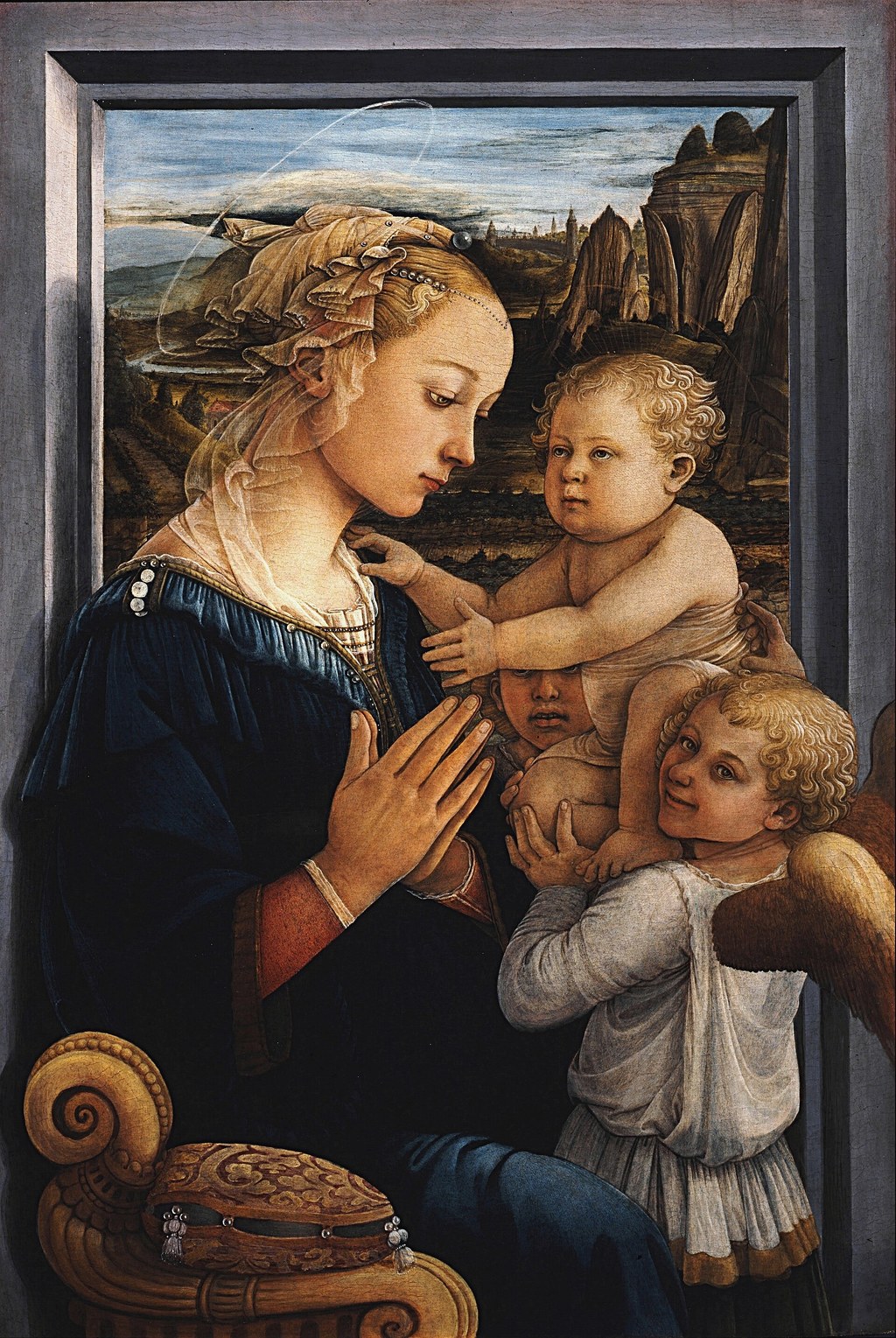
Fra Filippo Lippi’s Madonna and Child with Two Angels is one of the most immediately engaging images of the Florentine Renaissance. Painted around 1465 and now in the Uffizi Galleries in Florence, it presents a familiar Christian subject with an intimacy that makes the sacred figures appear almost to inhabit the same world as the viewer.[1]
The Virgin sits in profile before an open window, her hands joined in prayer as the Christ Child is lifted towards her by two youthful angels. One angel turns towards us with a smile, creating an unusually direct connection between the devotional image and the person standing before it. Beyond Mary is a landscape of rocks, vegetation, buildings and distant water. The setting is neither the timeless gold ground of earlier medieval painting nor a grand throne room, but something closer to an idealised Florentine interior opening onto an expansive world.
This combination of sacred meaning and recognisably human experience is central to the painting’s appeal. Mary is still the Mother of God, Christ is still the divine child, and the angels remain heavenly attendants, yet Lippi gives them expressions, clothes and gestures drawn from the visual culture of fifteenth-century Florence. The painting is often called the Lippina, a name that has helped establish it as the artist’s best-known Madonna. It has also become entangled with the story of Lippi’s relationship with Lucrezia Buti, although the popular claim that Lucrezia modelled for the Virgin cannot be demonstrated from surviving evidence.
More securely, the work occupies an important position in the development of Florentine painting. Its composition was admired and repeated, and the Uffizi specifically identifies the young Sandro Botticelli, Lippi’s pupil, among the artists who used it as a model.[1] The Madonna and Child with Two Angels therefore rewards several kinds of reading at once. It is a devotional image, a study of maternal feeling, a display of fashionable Florentine beauty, an experiment in spatial illusion, and an important link between Fra Filippo Lippi and the generation that followed him.
At a Glance
- ArtistFra Filippo Lippi
- TitleMadonna and Child with Two Angels
- Common nameLippina
- Datec. 1465
- MediumTempera on panel
- Current locationUffizi Galleries, Florence
- SubjectVirgin Mary, Christ Child and two angels
- Original destinationUnknown
- Earliest documented provenanceMedici Villa of Poggio Imperiale, Florence, in the late eighteenth century
- Key featuresProfile Virgin, smiling foreground angel, open landscape, pearl ornaments, contemporary Florentine dress and extremely discreet halos
- Major influenceIts composition became a model for later Florentine artists, including Sandro Botticelli
- Important cautionThe traditional identification of the Virgin as Lucrezia Buti is not confirmed by evidence
Contents
- What Does the Painting Show?
- A Sacred Image Made Human
- The Virgin’s Face
- Was the Virgin Lucrezia Buti?
- The Smiling Angel
- The Landscape Beyond the Window
- Pearls, Veils and Renaissance Fashion
- Composition and Space
- Colour and Surface
- When Was the Painting Made?
- What Was the Painting Made For?
- Fra Filippo Lippi and the Reinvention of the Madonna
- Influence on Botticelli
- Comparison with Earlier Madonnas by Lippi
- Why the Painting Still Feels Modern
- Legacy
- Why Madonna and Child with Two Angels Matters
- FAQs
- References
What Does the Painting Show?
The composition is built around a close exchange between Mary and Christ. Mary occupies the right half of the panel, while the Child is raised towards her from the lower left by two angels. Mary does not cradle Christ in the conventional manner. Instead, her palms meet in prayer, introducing a devotional distance even as mother and son draw physically close to one another.
The Child reaches towards Mary. His body is supported by the foremost angel, while a second angel is partly visible behind him, creating a compact cluster of overlapping heads, arms and bodies. The closest angel is one of the painting’s most memorable inventions. He looks outward rather than inward, meeting the viewer with a slight, almost mischievous smile that changes the emotional temperature of the scene.
His expression acts as a counterweight to Mary’s gravity. The Uffizi’s interpretation emphasises a melancholy quality in the Virgin, suggesting a mother whose tenderness is shadowed by knowledge of Christ’s future Passion.[1] The relationship between the figures is consequently more complex than simple maternal happiness. The Child approaches Mary with energy, the angel smiles openly, but Mary remains composed and prayerful.
That tension between affection and foreknowledge is fundamental to Christian images of the Virgin and Child. Renaissance viewers could recognise the infant Christ as both a vulnerable baby and the future redeemer whose suffering was already implicit in his birth. Lippi makes this theological idea emotionally legible without requiring a dramatic symbol of the Crucifixion. The mood emerges from faces, gestures and the controlled distance between mother and child.
A Sacred Image Made Human
Fra Filippo Lippi was particularly gifted at bringing religious subjects into the language of ordinary human feeling. In the Lippina, he does not remove the divinity of the figures, but he makes holiness visible through beauty, tenderness and restraint rather than through overwhelming supernatural display. This is especially evident in the halos. Instead of broad discs of gold, Mary and Christ have extraordinarily delicate signs of sanctity, fine enough that they do not interrupt the view of the landscape.
The Uffizi draws attention to this reduction. It is a small device with a large effect, allowing the sacred family to belong visually to the same continuous space as the world outside the window.[1] Mary’s clothes reinforce the same process. She is not dressed as an archaeologically imagined woman of ancient Palestine but with the refinement associated with an affluent Florentine woman of Lippi’s own period.
Her hair is elaborately arranged and partly covered with transparent veils. Pearls appear within the hairstyle and elsewhere in the painting, creating a sophisticated surface that would have been immediately recognisable as luxurious. Yet the jewellery does not simply secularise Mary. Renaissance viewers were accustomed to precious materials carrying religious meanings, and the Uffizi’s research on jewellery explains how pearls were associated with purity and virginity.[1] The apparent contradiction between worldly elegance and sacred virtue is therefore deliberate. The Virgin may resemble an ideal Florentine beauty, but the details of her appearance simultaneously reinforce her theological identity.
The Virgin’s Face
Mary’s profile is one of the defining features of the painting. Her high forehead, pale complexion, fine nose, golden hair and delicate features correspond to ideals of feminine beauty found across fifteenth-century Florentine art. The profile format also recalls portraiture. Florentine women were frequently represented in profile in formal portraits, and this gives Lippi’s Virgin a striking sense of individual physical presence.
She is not, however, simply a portrait inserted into a religious composition. Lippi idealises her features and uses the profile to control the emotional encounter between Mary and Christ. Because we see Mary from the side, she does not engage us directly. Her attention remains fixed upon the Child, while the foreground angel assumes the role of connecting the sacred event to the viewer.
This distribution of gazes creates a subtle hierarchy. The angel acknowledges us, Christ reaches towards Mary, and Mary responds through prayer. The result is both accessible and reverent. We are invited close to the scene without becoming its centre.
Was the Virgin Lucrezia Buti?
No discussion of the Madonna and Child with Two Angels can entirely avoid Lucrezia Buti. She has become so closely associated with Lippi’s biography that reproductions of the painting are often described as though the identification were certain. The story has undeniable appeal. Fra Filippo was a Carmelite friar, Lucrezia was a young woman connected with the convent of Santa Margherita in Prato, and their relationship produced a son, the future painter Filippino Lippi.
Later biographical traditions turned the relationship into one of the Renaissance’s great artistic romances. Within that story, Lucrezia becomes the beautiful model who supplied the face of Lippi’s Madonnas. The Lippina is consequently often treated as an indirect portrait of her. Some presentations even extend the identification to other female figures painted by Lippi during the Prato years.
The problem is evidential. The Uffizi’s own collection entry states plainly that there is nothing confirming the suggestion that the Virgin’s face is Lucrezia Buti.[1] That distinction matters. The relationship between Lippi and Lucrezia belongs to the artist’s documented biography, but the identification of a particular painted face is a separate claim requiring separate evidence.
There is no secure contemporary document saying that Lucrezia sat for this Madonna. Nor does the resemblance between idealised female figures prove that Lippi was repeatedly representing one real woman. The most responsible conclusion is therefore a qualified one. Lucrezia Buti has traditionally been proposed as the model for the Virgin, and the association has become an important part of the painting’s reception, but it should not be presented as established fact. This uncertainty does not weaken the picture. If anything, it provides a useful example of the way Renaissance art history can become layered with biographies, anecdotes and attractive later assumptions.
The Smiling Angel
If Mary supplies the painting’s solemnity, the foreground angel supplies its immediacy. His face has become nearly as famous as the Virgin’s. The angel supports Christ from below and looks directly towards us. His raised position at the edge of the fictive space makes him appear almost to lean over the threshold of the picture.
The smile is unusually informal for a devotional painting. It suggests delight, warmth and perhaps even a youthful awareness that the viewer has entered into the scene. Lippi had long been interested in youthful angels whose vitality softens the formality of sacred imagery. Here the device reaches an especially effective balance because the angel is not merely decorative.
He performs several tasks at once. Physically, he lifts the Child; compositionally, he anchors the lower left; emotionally, he introduces joy; and pictorially, his gaze draws the viewer into the exchange. The contrast with Mary is carefully managed. Without the angel, the image might feel almost elegiac, but his expression gives the composition movement and life. Botticelli and other younger Florentine painters would learn from precisely this kind of invention. Sacred subjects could retain devotional seriousness while admitting beauty, grace, humour and psychological variety.
The Landscape Beyond the Window
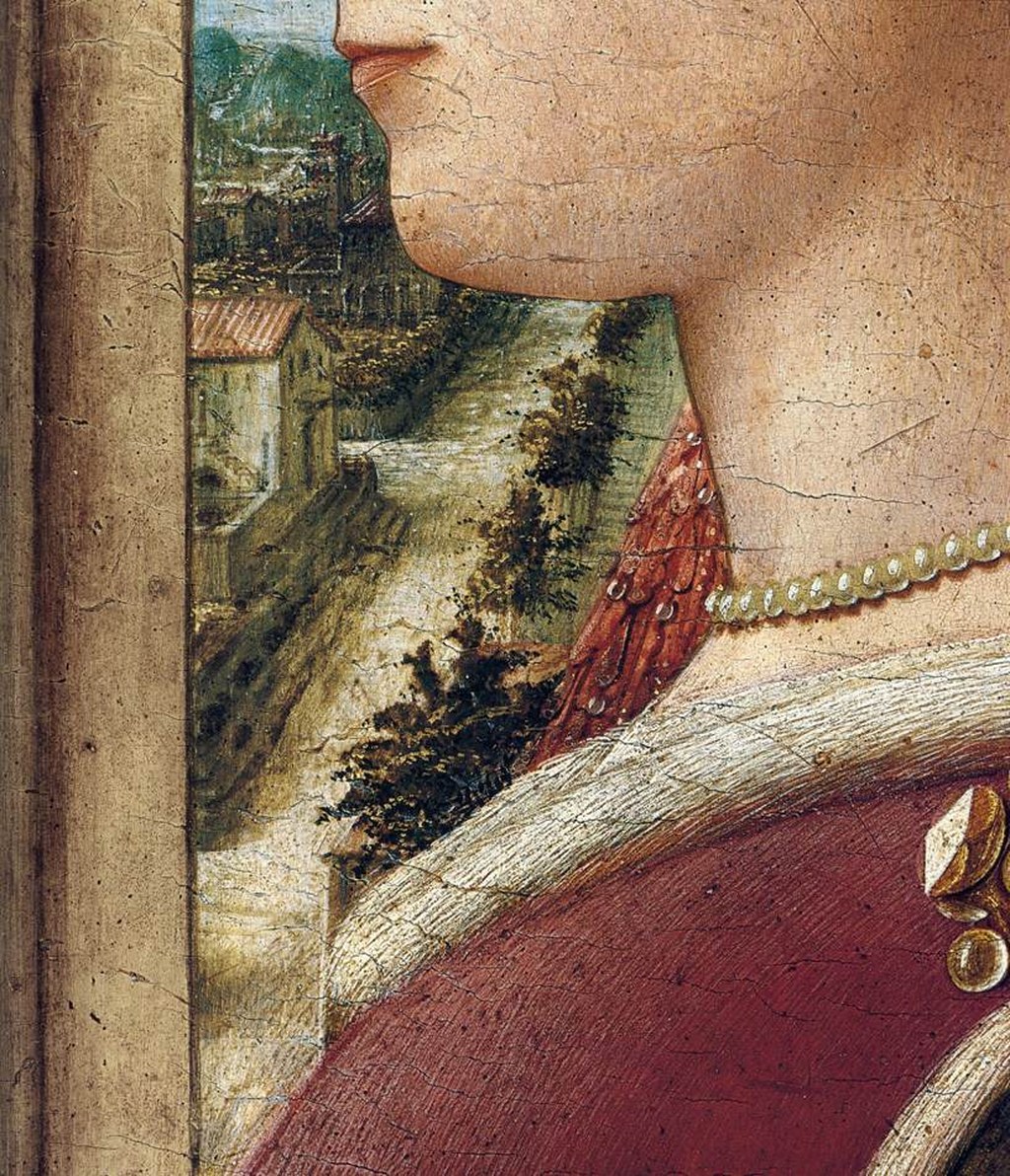
One of the most striking features of the Lippina is the landscape visible behind Mary. The opening reveals water, rocks, trees, paths and distant architecture, greatly expanding the apparent world beyond the compact group of figures. The Uffizi describes the vista as a varied landscape overlooking the sea. Whether every geographical feature was intended to represent a specific place is less important than the spatial function of the view.[1]
The window prevents the figures from existing against a flat or neutral background. Instead, Mary inhabits an interior that connects to a much larger natural environment. The contrast is powerful. The sacred encounter takes place at close range, yet the landscape suggests a world extending far beyond it. Renaissance painters increasingly used windows and distant views to create depth and to situate religious figures within believable environments. Lippi’s handling of the device is especially elegant because the landscape remains subordinate to the figures.
The blue distance and small details do not compete with Mary’s profile. They provide breathing space around it, sharpening the silhouette of her face and veil. There is also a conceptual resonance between interior and exterior. Mary represents enclosed purity, while the open landscape evokes creation and the world into which Christ has entered. It would be excessive to insist that every rock or path carries a fixed symbolic meaning. The greater achievement lies in the fusion of devotional intimacy with a convincing sense of inhabited space.
Pearls, Veils and Renaissance Fashion
The Virgin’s appearance offers a particularly rich example of how Lippi transformed contemporary fashion into sacred imagery. The Uffizi describes her hairstyle as similar to that of Florentine noblewomen of the late fifteenth century.[1] Her translucent veil is woven through carefully arranged hair and accented with pearls. Fine fabrics, jewellery and the brocade cushion provide restrained but unmistakable signs of refinement.
Pearls were especially appropriate for the Virgin. In the Uffizi’s exhibition on jewels, their whiteness is connected with chastity and natural perfection, while medieval interpretations could associate the formation of a pearl within a shell with the miraculous conception of Christ.[1] Such symbolic readings did not make pearls any less fashionable. Their effectiveness depended partly on the fact that viewers already understood them as beautiful and valuable objects.
Lippi exploits both meanings. The pearls establish Mary as an ideal of elegant womanhood while simultaneously supporting an iconography of virginal purity. The treatment of the jewels has also been compared to the detailed observation associated with northern European painting. Fifteenth-century Florentine artists were increasingly attentive to the effects of light on surfaces, fabrics and precious materials. In the Lippina, such detail never becomes mere inventory. It contributes to the fusion of the earthly and divine that defines the entire painting.
Composition and Space
The design depends upon a series of carefully balanced oppositions. Mary is vertical and calm; the Child moves diagonally towards her; the angel pushes upwards; and the landscape recedes away from the surface. The ledge at the bottom is particularly important. It establishes a boundary between the viewer’s space and the painted world while also giving the angel something like a stage from which to lean outward.
This device makes the picture more immediate. The figures appear close enough to touch, even though the landscape behind them implies considerable depth. Mary’s profile forms a strong contour against the pale distance. The arc of her veil, brow and nose directs attention towards Christ, whose body creates a counter-movement back towards her. Hands carry much of the meaning. Mary’s joined hands identify her devotional response, while Christ’s outstretched arms signal physical desire for his mother.
The angels’ hands are more practical, supporting the Child’s weight. Lippi therefore separates the roles of the figures through gesture as much as through facial expression. The composition feels effortless, but its simplicity is highly calculated. Four heads occupy a relatively small area without becoming confused, and each contributes a distinct emotional note.
Colour and Surface
Fra Filippo worked in tempera on panel, a medium capable of brilliant colour and precise detail. The Lippina exploits those qualities in the clear modelling of faces, fine hair, transparent veils, patterned textiles and distant landscape. Mary’s blue mantle establishes her traditional Marian identity. Against it, her pale face and delicate headdress become especially luminous.
The colour is controlled rather than spectacular. Lippi avoids overwhelming gold backgrounds and instead distributes visual richness through materials, skin, textiles and the atmospheric view beyond. This restraint supports the painting’s intimate scale and purpose. It asks to be approached closely, where small details reward sustained looking. The surviving surface also reminds us that fifteenth-century panel paintings were materially complex objects. Pigments, binders, wooden support, gilded or precious-looking details and later conservation all contribute to the appearance we now encounter in the museum.
A full technical reading should therefore distinguish between what belongs securely to Lippi’s original execution and what may have changed through ageing, cleaning and restoration. Where no published technical evidence is available for a particular claim, visual interpretation should remain cautious.
When Was the Painting Made?
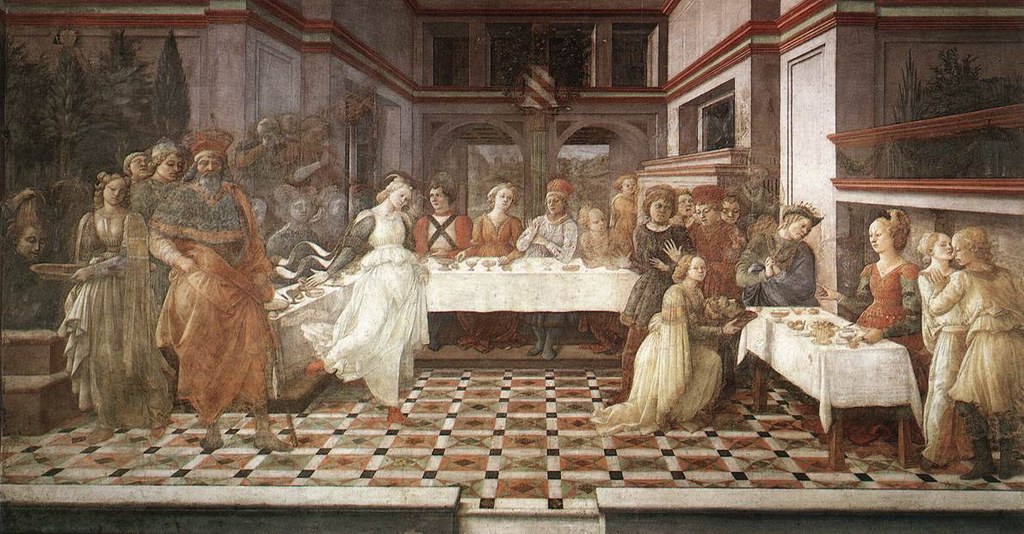
The Uffizi dates the painting to around 1465, placing it late in Fra Filippo Lippi’s career. By this point the artist had spent years working in Prato, where his monumental fresco cycle in the cathedral had occupied him for much of the previous decade.[1] The date matters stylistically. The painting shows an artist who had long since absorbed the monumental lessons of Masaccio but had developed a far more lyrical and decorative language of his own.
Earlier Lippi Madonnas can be more architectonic and solid. In the Lippina, physical presence remains important, but line, expression, surface beauty and emotional grace have acquired greater prominence. The picture also belongs to the period in which the young Botticelli was associated with Lippi. This helps explain why the connection between the two artists is more than a vague resemblance. Botticelli inherited a living repertoire of compositional solutions from Lippi’s workshop environment. Among them were graceful Madonnas, youthful angels, delicate veils, expressive contours and the translation of religious figures into recognisably Florentine types.
What Was the Painting Made For?
The original destination of the Madonna and Child with Two Angels is unknown. This uncertainty should be acknowledged rather than filled with an invented patron or chapel. The Uffizi notes that the first known information about the panel comes from the late eighteenth century, when it was recorded at the Medici Villa of Poggio Imperiale in Florence.[1]
Its format and intimate character are consistent with private devotion, and the Uffizi’s jewellery exhibition describes the panel in precisely that context. Such an image could support prayer in a domestic or semi-private environment rather than functioning as a huge public altarpiece.[1] Private devotional paintings occupied an important place within wealthy Renaissance households. They brought sacred figures into domestic space and allowed personal prayer to take place before images whose scale and emotional language suited close viewing.
The Lippina is particularly effective in this role because the sacred figures themselves appear domestic. The opening window, contemporary clothing and direct gaze of the angel collapse some of the distance between biblical history and fifteenth-century life. Nevertheless, without documentary evidence identifying the first owner or location, a specific reconstruction of its original setting remains speculative.
Fra Filippo Lippi and the Reinvention of the Madonna
The Madonna and Child was among the most familiar subjects in Christian art, which made innovation difficult and meaningful. Painters did not need to invent a new narrative; they needed to renew an image viewers had seen repeatedly. Lippi’s solution was to focus on human relationship. He gives Mary and Christ a believable emotional connection without turning the picture into a purely secular mother-and-child scene.
His sacred figures retain signs of divinity, but those signs are deliberately understated. The halos nearly disappear, and theological meaning migrates into expression, gesture, symbolism and ideal beauty. This approach reflects a broader Florentine interest in making religious narratives physically and psychologically convincing. Masaccio had been crucial in establishing monumental bodies and coherent space earlier in the century.
Lippi absorbed that achievement but took it in a more lyrical direction. His figures can be solid yet elegant, emotionally accessible yet decoratively refined. The Lippina is therefore not simply a pretty Madonna. It represents a sophisticated answer to one of Renaissance painting’s central problems: how can an artist make a sacred image feel both eternally significant and immediately present?
Influence on Botticelli
The Uffizi explicitly states that the composition was successful and served as a model for many artists, including the young Botticelli, who had been Lippi’s pupil.[1] This relationship is visible in Botticelli’s early Madonna paintings. Graceful profiles, transparent veils, youthful angels, elongated hands and emotionally delicate exchanges all belong to a visual language that develops from Lippi’s example.
The connection should not be reduced to copying. Botticelli transformed what he learned, intensifying linear rhythm and developing the distinctive elegance that would eventually define works such as the Madonna of the Magnificat. Lippi’s importance lies partly in making that transformation possible. His workshop helped carry Florentine painting from the monumental naturalism of the earlier fifteenth century towards the more linear, poetic and psychologically refined style associated with the later Quattrocento.
The Lippina is particularly useful for seeing that transition because it contains both tendencies. The Child has physical weight and the figures occupy believable space, yet line, beauty and emotional nuance are equally important. The painting consequently belongs not only to Lippi’s personal story but to a larger history of artistic transmission in Florence.
Comparison with Earlier Madonnas by Lippi
Fra Filippo painted the Virgin and Child repeatedly, but the repetition was productive rather than mechanical. Different commissions allowed him to explore the subject through changing formats, poses, settings and emotional registers. An earlier Madonna and Child in the National Gallery of Art in Washington, dating to around 1440, shows how deeply the subject occupied him well before the Lippina. Comparing the two helps reveal the increasing elegance and intimacy of his later style.[4]
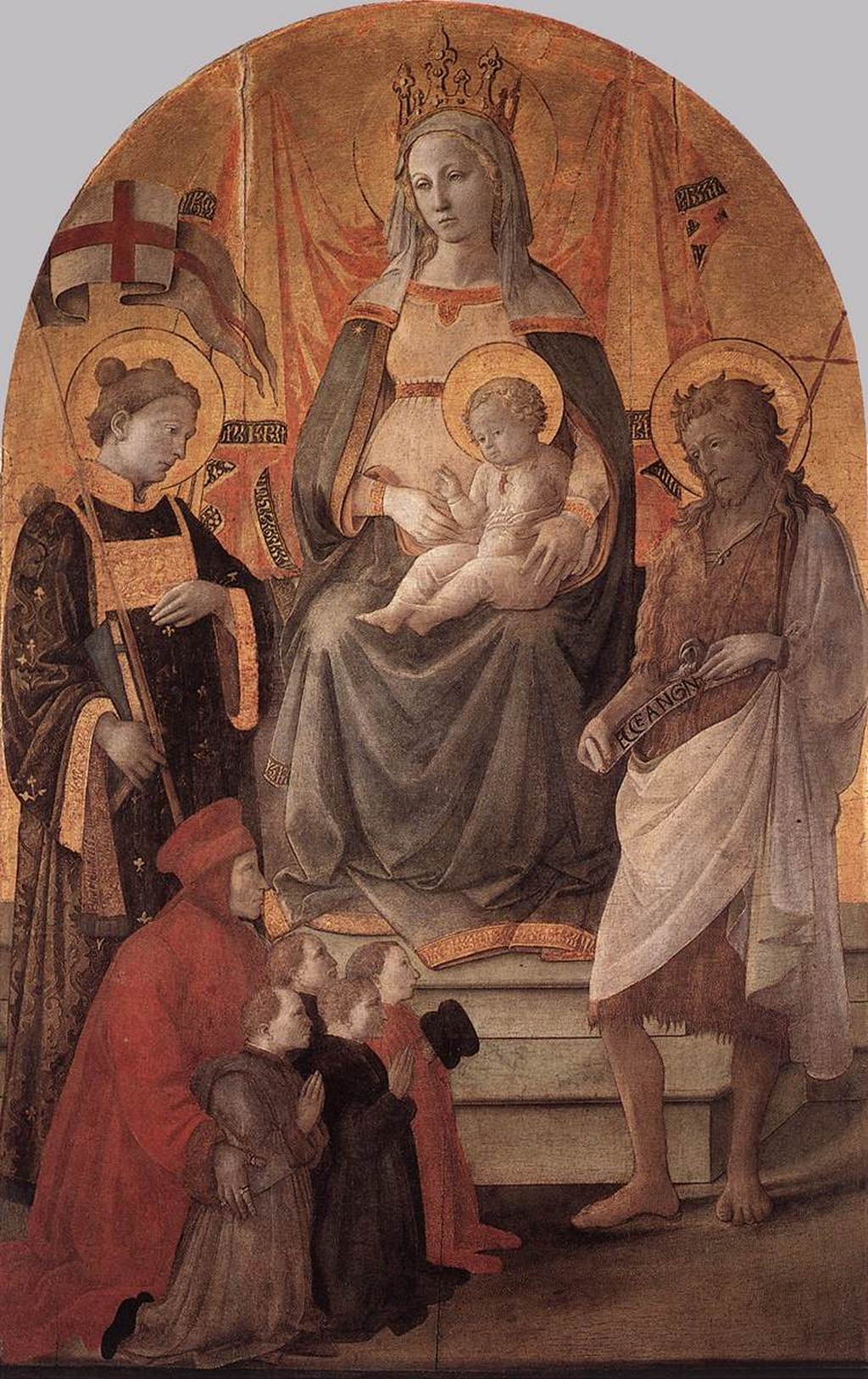
Other works, including the Madonna of Tarquinia and the large tondo with scenes from the life of Saint Anne, place the Virgin within more elaborate interiors or narrative structures. The Lippina strips the situation back to a small number of figures and a landscape opening. This economy makes every decision more visible. There are no crowds of saints and no complex architecture to absorb attention. Instead, the article of faith is embodied in a mother’s face, a child’s reach and an angel’s smile.
The Painting and Renaissance Ideas of Beauty. The Lippina has often been admired for the beauty of its Virgin, but Renaissance beauty was not understood simply as physical attractiveness. In religious art, outward harmony could suggest inner virtue and spiritual order. Mary’s appearance therefore operates simultaneously in several registers. She resembles an ideal noblewoman, embodies purity, and functions as the principal devotional focus.
Her fashionable appearance may seem to modern viewers to blur the boundary between portraiture and sacred art. For a fifteenth-century audience, however, contemporary dress could make the holy figures more immediate rather than less holy. This process was common in Renaissance art. Biblical events were repeatedly furnished with contemporary architecture, clothing and social behaviour, allowing viewers to imagine sacred history within a world they recognised. Lippi’s contribution was to make that world unusually graceful. His Virgin is not merely placed in contemporary Florence; she embodies an idealised version of its femininity.
Why the Painting Still Feels Modern
Part of the Lippina’s continuing popularity comes from its resistance to stiffness. The figures do not look like emblems arranged to explain doctrine, even though the painting is full of doctrinal meaning. The angel’s smile is especially important to this modern response. Direct eye contact remains one of the quickest ways for a painted figure to create psychological immediacy.
Mary’s expression works differently. Because she turns away from us, she feels private, almost absorbed in a thought we have been permitted to witness. The Child’s movement completes the emotional triangle. He does not pose ceremonially but reaches towards his mother. These effects are carefully constructed, but they do not feel mechanical. Lippi turns sophisticated Renaissance design into an image whose basic emotional relationships can be understood without specialist knowledge.
That accessibility is one reason the painting works so well as an introduction to the artist. It reveals his command of line, colour, space and devotional iconography while also showing his unusual sensitivity to human expression.
Legacy
Fra Filippo Lippi died only a few years after the probable date of the Lippina, while working on the frescoes in Spoleto Cathedral. His career had already connected several generations of Florentine art. He had grown up in the environment of Santa Maria del Carmine, where Masaccio’s work transformed early Renaissance painting. He later became an important painter for Medici patrons, produced monumental frescoes at Prato, and trained or influenced younger artists including Botticelli.
His son Filippino Lippi would become a major painter in his own right. The family connection adds another layer to Fra Filippo’s place in the transmission of Renaissance style. Yet the Madonna and Child with Two Angels remains perhaps the clearest single image through which to understand his achievement. It combines monumentality inherited from the early Renaissance with the grace, line and emotional refinement that would become increasingly important later in the century. Its influence cannot be measured only through direct copies. The painting helped establish a way of imagining the Madonna that could be intimate, fashionable, beautiful and recognisably human without surrendering devotional seriousness.
Why Madonna and Child with Two Angels Matters
The importance of the Madonna and Child with Two Angels lies in the apparent ease with which it joins different worlds. A Christian icon becomes a scene of human affection; contemporary Florentine beauty carries theological meaning; a domestic window opens onto an expansive landscape; and an angel smiles directly at the viewer without breaking the devotional mood.
The painting is also an unusually clear demonstration of Fra Filippo Lippi’s historical position. Behind it stand Masaccio and the achievements of the early Florentine Renaissance, while ahead of it lies Botticelli and the lyrical elegance of the later fifteenth century. Its uncertain elements are equally instructive. We do not know its original destination, and we cannot prove that Lucrezia Buti modelled for Mary.
Recognising those limits makes the painting more, not less, interesting. It allows us to distinguish the surviving object from the stories later generations have built around it. What remains secure is the extraordinary visual intelligence of the work itself. Lippi makes the Virgin monumental without making her remote, turns contemporary fashion into sacred symbolism, and gives a smiling angel enough personality to invite the viewer into the scene. For those reasons, the Lippina deserves its status as one of Fra Filippo Lippi’s defining works and one of the most memorable Madonnas of the Italian Renaissance.
FAQs
Discussion
What stands out to you most about Madonna and Child with Two Angels in relation to Filippo Lippi's wider career?
Reader Insights
Notice how the page connects close visual detail with patronage, workshop practice and the wider Renaissance setting.
Which comparison elsewhere in the cluster helps clarify this work or theme most strongly?
Join the Conversation
Have a thought or observation about Madonna and Child with Two Angels? Share it below. Thoughtful responses may be added to this section.
References
- Uffizi Galleries, “Madonna with Child and two Angels by Filippo Lippi,” collection entry, text by Daniela Parenti. View Source.
- Uffizi Galleries, “Madonna and Child with Two Angels by Filippo Lippi,” curatorial video. View Source.
- Uffizi Galleries, “Jewels in the Uffizi: The Secrets of Depicted Gems,” online exhibition, sections on Fra Filippo Lippi’s Madonna. View Source.
- National Gallery of Art, Washington, “Madonna and Child,” Fra Filippo Lippi, c. 1440, collection record and bibliography. View Source.
- Jeffrey Ruda, Fra Filippo Lippi: Life and Work with a Complete Catalogue, London, 1993.
- Megan Holmes, Fra Filippo Lippi: The Carmelite Painter, Yale University Press, 1999.