 by Tom Gurney
Tom Gurney BSc (Hons) is an art history expert with over 20 years experience
Published on June 19, 2020 / Updated on October 2, 2026
Email: tomgurney1@gmail.com / Phone: +44 7429 011000
Fra Filippo Lippi: Style and Technique
Fra Filippo Lippi's style is often recognised before it is easily defined. His figures possess the physical presence associated with the Florentine early Renaissance, but their outlines can be unusually elegant. Sacred scenes are constructed with perspective, yet they are also filled with patterned fabrics, translucent veils, jewellery, flowers and expressive faces. Madonnas can look simultaneously idealised and personal; fresco narratives can obey convincing architecture while bending spatial logic to make a story easier to read.
These qualities help explain why the Florentine humanist Cristoforo Landino praised Lippi in 1480 for grace, ornament, composition, variety, colour and relief. Landino's list is useful because it does not reduce Lippi to “sweetness” or to his later reputation as Botticelli's teacher. It identifies an artist whose achievement depended on combining several kinds of pictorial intelligence.
Modern technical study adds another dimension. Infrared imaging, X-radiography, microscopy and conservation research show that the visible surface is only one stage in a painting's life. Lippi revised designs, worked with assistants, mixed true fresco with a-secco finishing, used gilding and elaborate surface effects, and relied on workshop processes that complicate the modern idea of a completely individual hand.
Contents
- Masaccio and bodily presence
- Line and contour
- Contemporary beauty and dress
- Egg tempera and panel painting
- Continuous narrative
- Fresco technique
- Collaboration and authorship
- Conservation and the changing image
- Technique as response to function
- Oil and mixed-media uncertainty
- Gilding, wax and lost brilliance
- Perspective: rule and flexibility
- Technique and Botticelli
- Style Is Evidence, Not a Checklist
- References
Masaccio and bodily presence
Lippi's earliest formation took place in the Carmelite environment of Santa Maria del Carmine in Florence, where Masaccio and Masolino's Brancacci Chapel frescoes offered a new model of monumental painting. There is no secure evidence that Lippi was formally apprenticed to Masaccio, but the younger painter had direct access to an extraordinary visual lesson. Masaccio's figures possess weight. Their bodies seem to occupy measurable space, and light helps describe form rather than merely decorating it. Perspective establishes an environment in which people can stand, move and interact. These characteristics profoundly affected Florentine painting.
Lippi adopted that concern for bodily credibility but rarely remained as severe. His figures become more slender, richly dressed and emotionally accessible. In this sense his art does not reject Masaccio; it translates monumentality into a more flexible language.
Sculpture and the sense of relief. Landino's praise of Lippi's “relief” points toward another Florentine concern: the relationship between painting and sculpture. Donatello, Luca della Robbia and other sculptors had made low relief a field for extraordinary experiments in depth, gesture and sacred intimacy. Lippi's half-length Madonnas often feel almost sculptural in their organisation. Figures press close to the picture plane, and architectural frames can behave like windows or niches. Hands, faces and drapery project against shallower backgrounds before landscape reopens the space. The result is a productive tension between object and illusion. The painting remains a flat panel, but bodies seem tangible enough to occupy the viewer's world.
Line and contour
One of Lippi's most consequential contributions to Florentine painting was his increasing emphasis on graceful contour. The edge of a face, the arc of a veil, the turn of a shoulder or the rhythm of drapery can carry emotional meaning. This quality becomes particularly important when considering Botticelli. The younger painter would transform line into one of the defining instruments of his art, but Lippi's workshop supplied an important precedent. In early Botticelli Madonnas, the relationship is visible not only in facial types but in the way contour organises beauty.
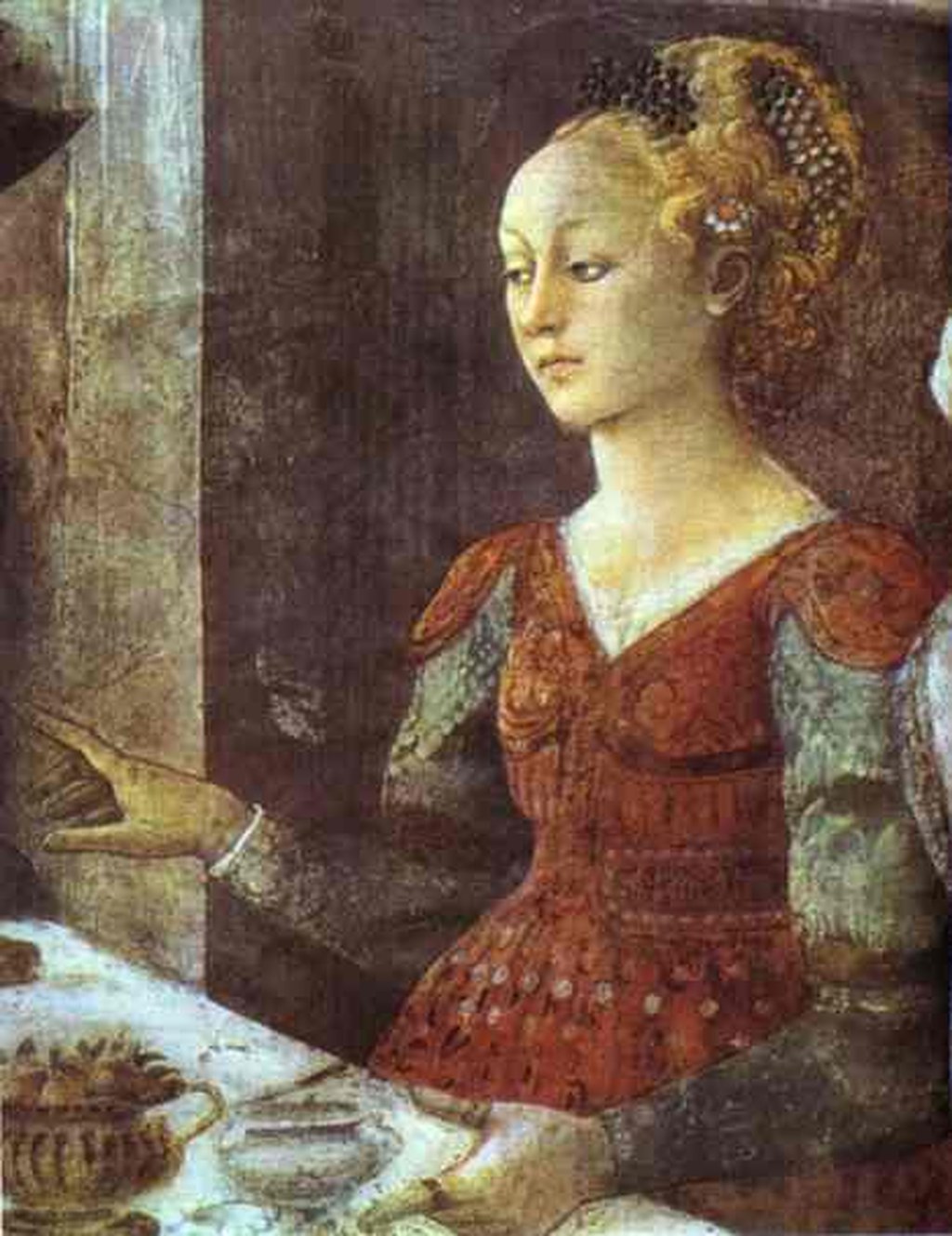
Lippi's line is rarely purely decorative. It clarifies pose and controls attention. A profile can make the Virgin seem contemplative; a curved arm can link mother and child; the movement of Salome's body can become the narrative centre of a fresco.
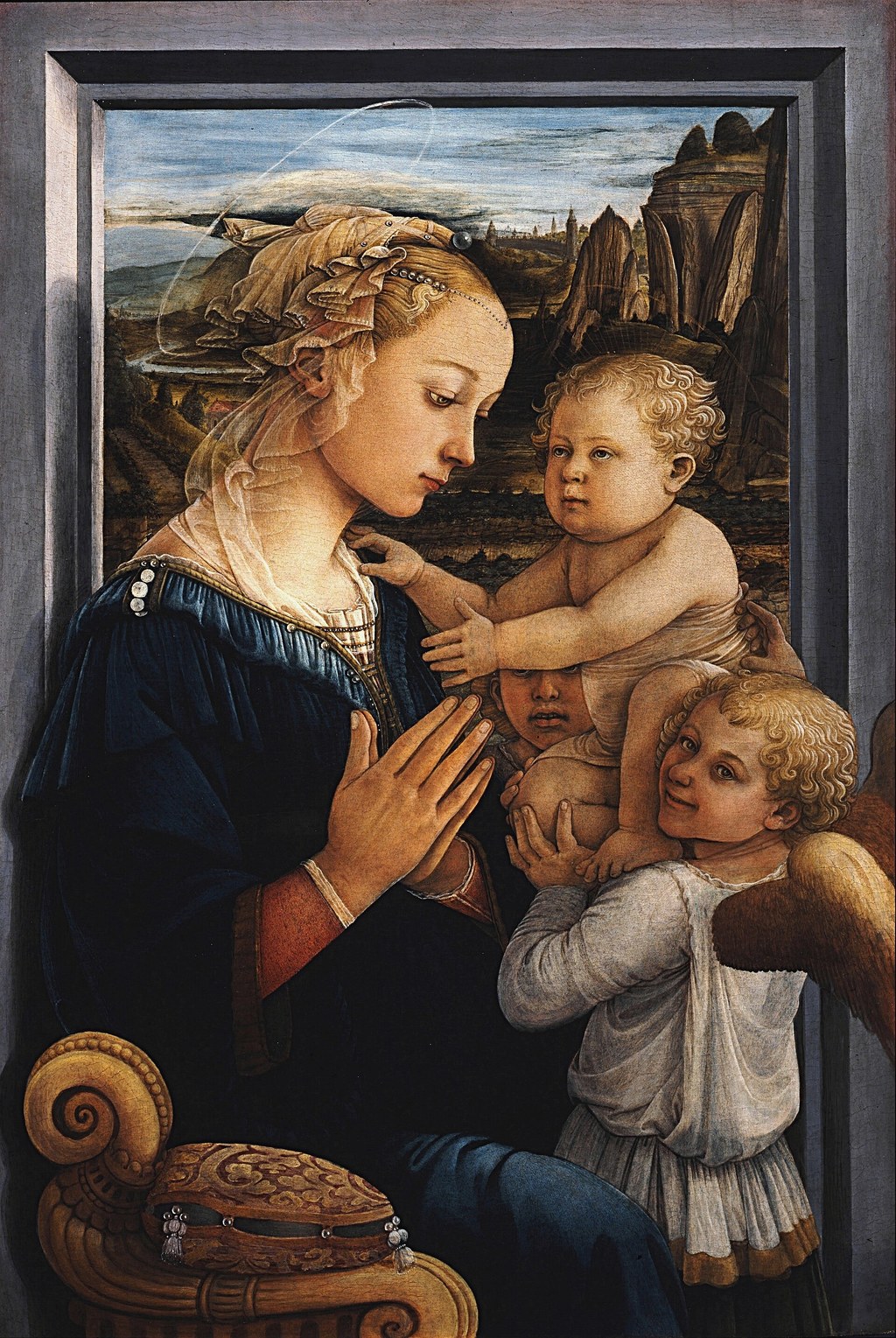
Faces and expression. Lippi's sacred figures often appear unusually human because expressions are restrained rather than theatrical. Mary may lower her eyes or hold her hands in prayer while the Christ Child reaches toward her. Angels can smile or look outward, acknowledging the spectator. The foreground angel in the Uffizi's Madonna and Child with Two Angels is the most famous example. His direct, almost mischievous engagement with the viewer changes the emotional temperature of the entire picture. The sacred group is not sealed behind an icon-like barrier.
This humanisation should not be confused with secularisation. Fifteenth-century devotional art sought emotional engagement. Recognisable tenderness could intensify religious contemplation by encouraging viewers to imagine the humanity of Christ and the maternal experience of Mary.
Contemporary beauty and dress
Lippi repeatedly clothes holy figures in fashions that would have resonated with contemporary Florentine ideals. Elaborate hair arrangements, pearls, fine veils and rich textiles make his Madonnas visually close to elite women of his own society. This has encouraged attempts to identify particular sitters, especially Lucrezia Buti. Yet stylistic specificity is not the same as portrait evidence. The Uffizi cautions that nothing confirms the traditional identification of Lucrezia as the Virgin in the Lippina. A safer and more productive interpretation is that Lippi made sacred beauty legible through contemporary culture. Viewers encountered holiness in forms they recognised as refined, desirable and socially meaningful.
Ornament as meaning. The richness of Lippi's surfaces is sometimes treated as a retreat from the structural seriousness of Masaccio. That misunderstands how ornament functions. Pearls can allude to purity while also displaying status. Gold catches real light and marks sacred or luxurious surfaces. Patterned textiles make rank visible. Flowers can carry symbolic associations while enriching a landscape. Architecture can simultaneously establish perspective and announce wealth. For a Renaissance viewer, ornament was not necessarily opposed to meaning. Material splendour could be one of the ways meaning became visible.
Colour. Landino specifically praised Lippi's colouring. The judgement is difficult to reconstruct fully because panels and frescoes have changed through ageing, cleaning and restoration, but the surviving works show a painter attentive to colour as both structure and attraction. Lippi often sets clear local colours against pale flesh and architectural neutrals. In large groups, alternating garments help separate figures and establish rhythm. In intimate Madonnas, cooler veils and landscapes can frame warmer flesh. Surface effects could extend beyond pigment. Gold leaf, reflective details and carefully differentiated textures contributed to an original visual richness that modern reproductions often flatten.
Egg tempera and panel painting
Many of Lippi's panels were painted in egg tempera on wood, the dominant technique of fifteenth-century Florence before oil painting became widespread. Tempera dries quickly and rewards controlled layering, fine hatching and precise edges. This suits Lippi's interest in contour and detail. Hair, jewels, patterned fabric and facial modelling can be built through small, deliberate strokes. Yet the speed of drying also requires planning; broad wet blending is less available than in mature oil technique.
Panels themselves were complex objects. Boards had to be joined and prepared, grounds applied, drawings transferred or developed, gilded areas planned and frames integrated into the intended setting. A finished altarpiece was therefore the product of several crafts as well as painting.
Underdrawing and revision. Technical imaging increasingly allows scholars to look beneath visible paint. Infrared reflectography can reveal carbon-based underdrawing, while X-radiography can expose structural or compositional information inaccessible at the surface. This matters because Renaissance paintings were not always executed by mechanically following a perfect preparatory cartoon. Artists could revise contours, alter positions and adjust relationships during production.
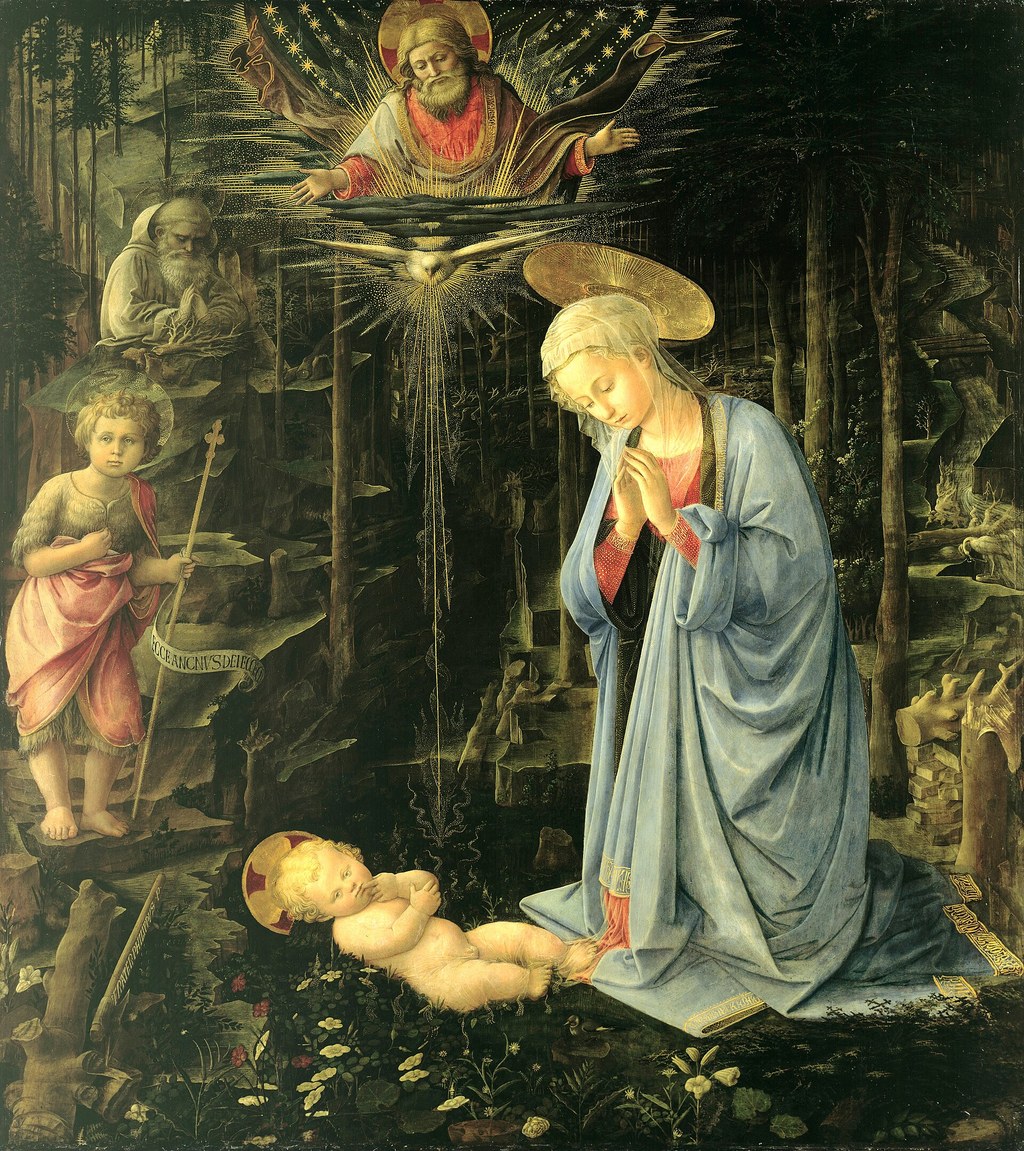
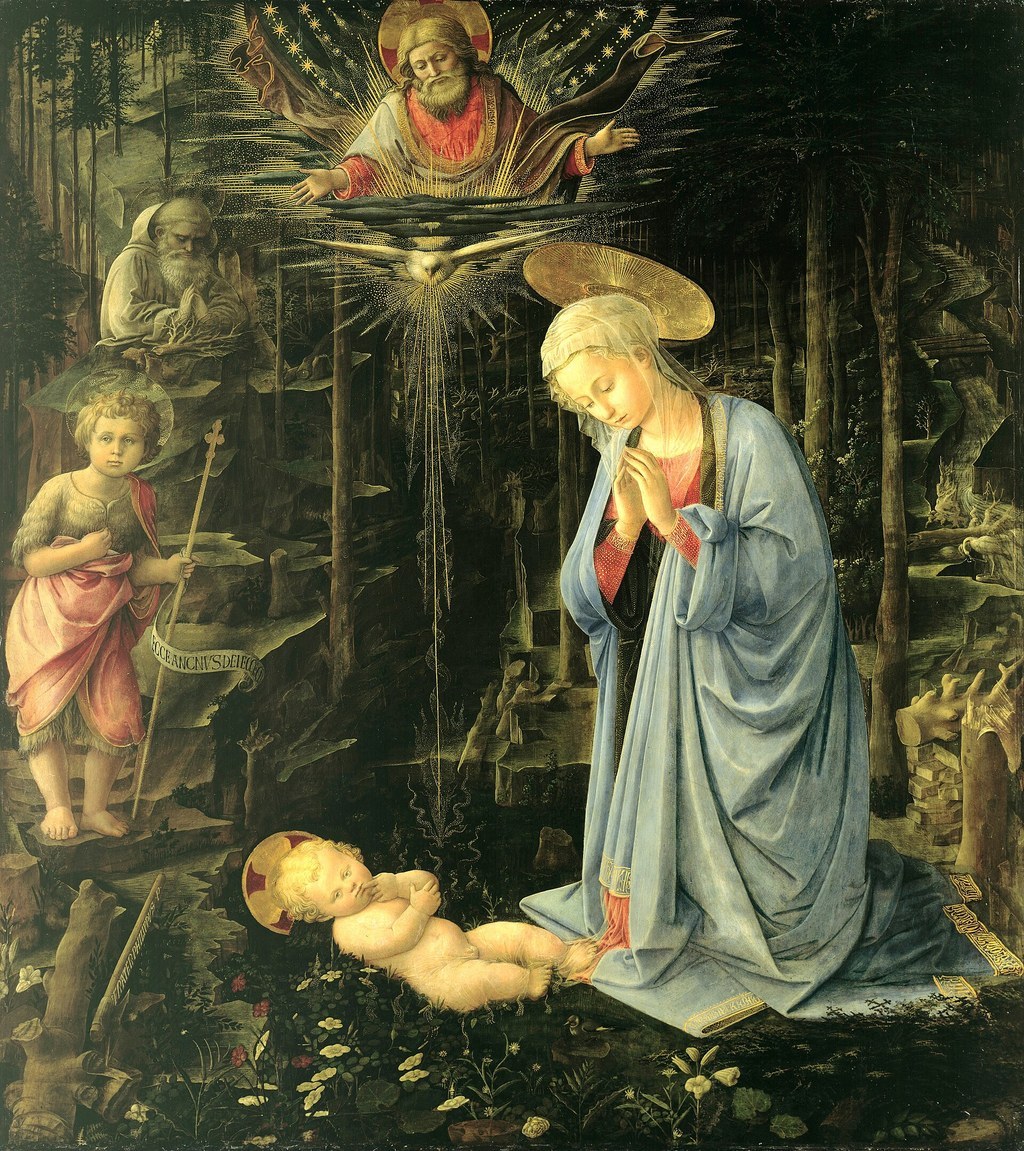
The 2026–28 Gemäldegalerie examination of Lippi's Adoration in the Forest is particularly valuable for this reason. Its programme includes infrared reflectography, X-radiography, ultraviolet fluorescence, microscopy and pigment and binder analysis. The resulting evidence should refine our understanding of Lippi's sequence of work and later interventions.[1]
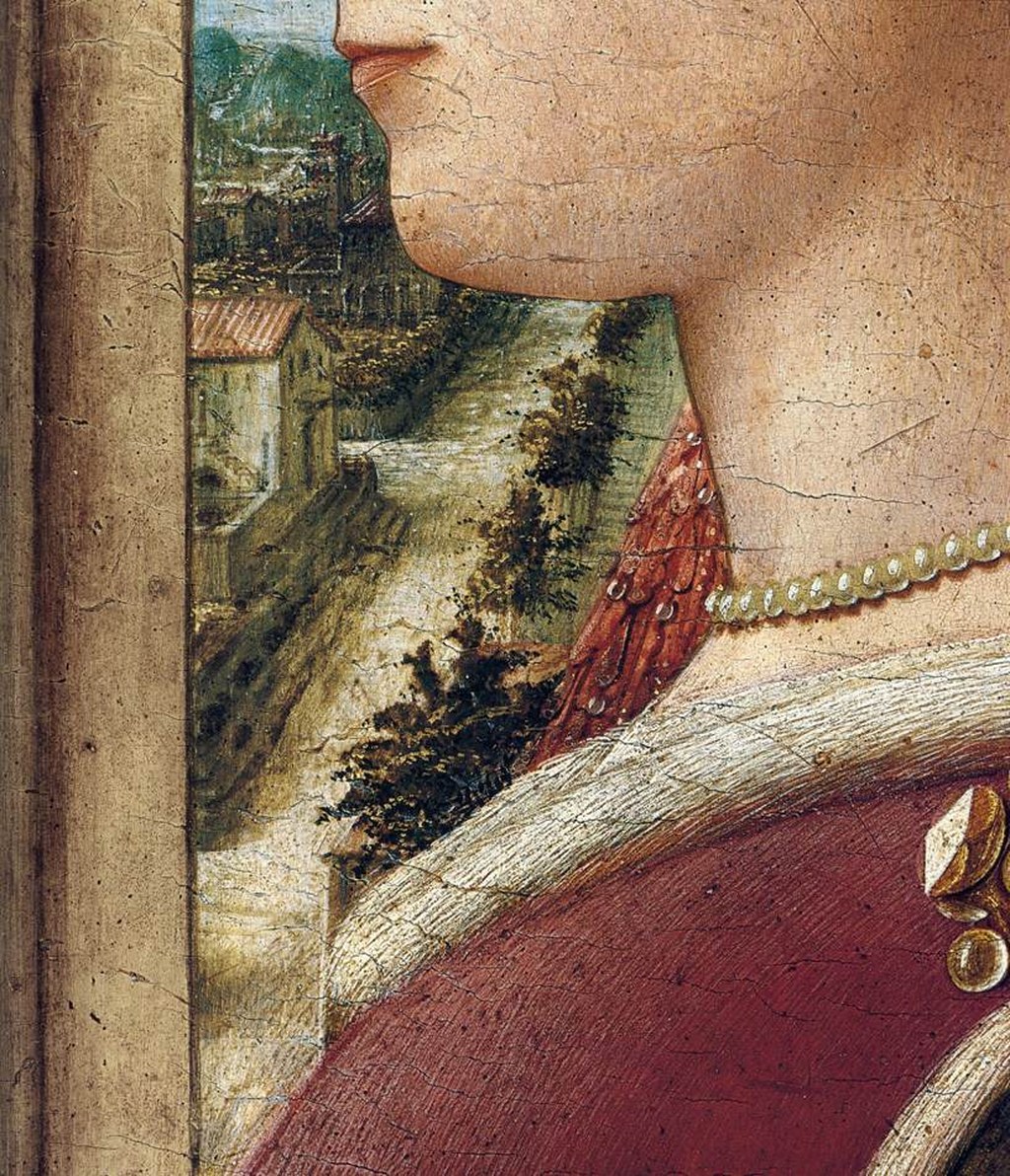
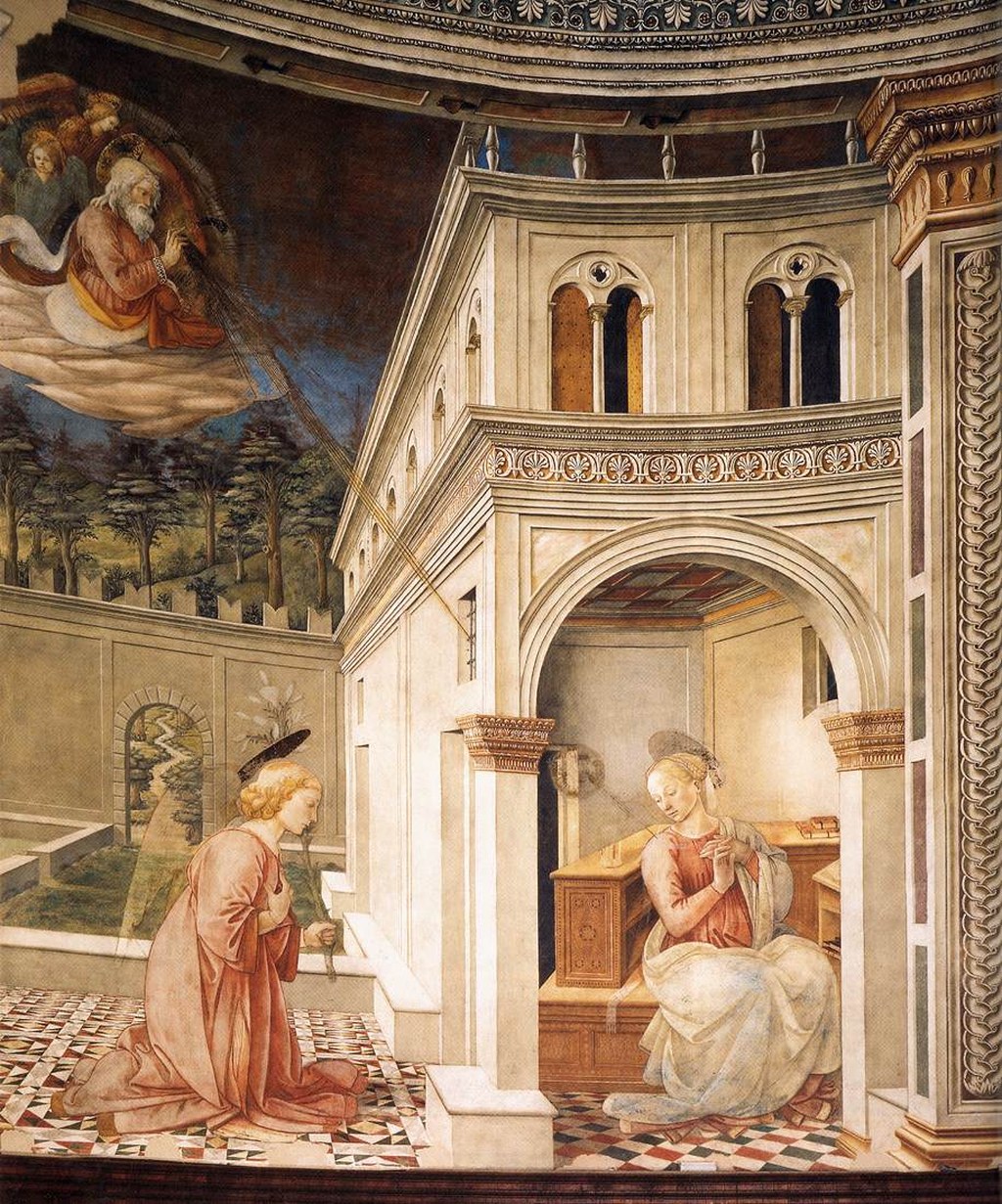
Perspective. Lippi understood the Florentine fascination with perspective, but his work demonstrates that early Renaissance space was not simply a competition to produce the most mathematically perfect grid. In panel paintings such as the Madonna of Tarquinia, architecture creates a convincing domestic environment. Orthogonals and openings place the figures inside a measurable room while windows expand the world into landscape.
At Prato, the problem changes. A fresco narrative may include several episodes and be viewed from different positions in a chapel. Lippi can therefore adjust or multiply perspectival systems so that storytelling remains clear. This makes perspective an expressive technique rather than an end in itself. The successful space is the one that makes the image persuasive and readable.
Continuous narrative
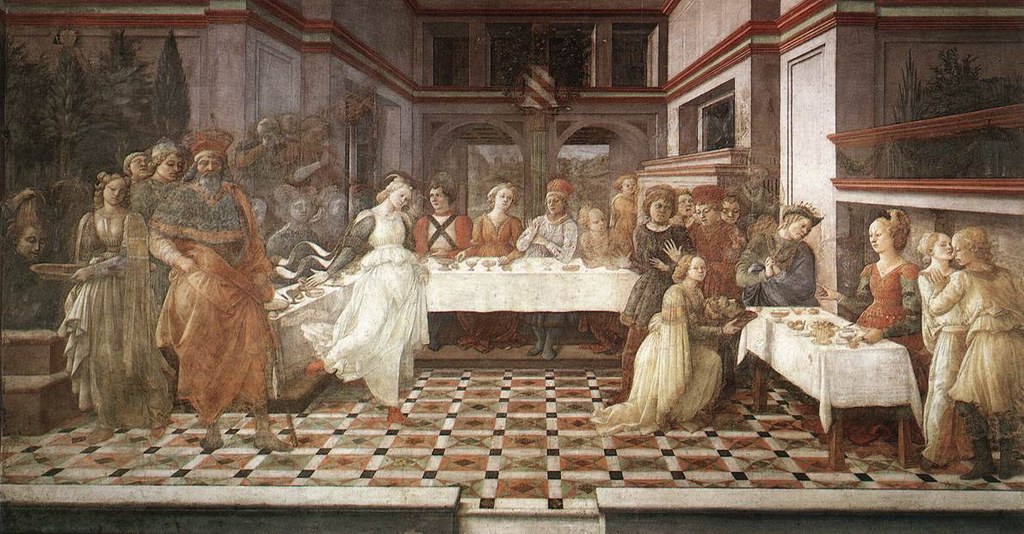
The Feast of Herod demonstrates Lippi's mastery of continuous narrative. Several chronological moments occur within one coherent setting. The viewer encounters Salome dancing, the death of John the Baptist and the presentation of his head by moving through the painted architecture. Such construction requires more than perspective. Gesture, grouping, costume, empty intervals and architectural barriers all help distinguish moments. The viewer is effectively instructed where to look next. Lippi's approach belongs to a long Italian narrative tradition but gives it a specifically Renaissance spatial sophistication.
Landscape. Landscape becomes increasingly important in Lippi's paintings. Sometimes it appears through a window behind an interior; elsewhere, as in the Adoration in the Forest, it dominates the entire devotional atmosphere. Distant rocks, water, vegetation and buildings can create depth, but they can also carry symbolism. The Berlin forest is not simply an exercise in naturalism. Its wilderness setting, plants and objects participate in the picture's mystical character. The detailed observation of nature also formed part of Lippi's legacy to Botticelli, whose paintings would become famous for their flowers and decorative vegetation.
Netherlandish-looking detail. Italian artists of Lippi's generation were increasingly aware of northern European painting, whether through imported works, travelling objects or wider networks of exchange. Lippi's fascination with reflective surfaces, rich textiles, domestic interiors and distant landscape has often been discussed in relation to Netherlandish art. Influence should not be reduced to a claim that Lippi copied one northern master. The broader point is that Florentine painting was not culturally sealed. A painter could combine Masaccio's spatial and bodily lessons with types of detail and luminosity associated with northern work. This hybridisation is one reason Lippi's paintings can look so materially dense despite their clear Renaissance structure.
Fresco technique
Fresco required a different working rhythm from panel painting. Pigment applied to fresh lime plaster becomes bound into the wall as the surface carbonates. Because fresh plaster remains workable only for a limited period, the mural is divided into daily sections. Large cycles therefore demand careful logistical planning. The master and workshop need drawings, scaffolding, plaster preparation and a sequence of execution. At Prato, documentary evidence and surviving surfaces demonstrate substantial collaboration. Lippi also used a-secco finishing, applying details after the plaster had dried. This increased flexibility but reduced durability. Surface additions are more vulnerable to moisture and cleaning than pigment locked into true fresco.
Gilding and lost surface effects. Prato research has identified traces associated with gilded details, including dark wax-like applications that originally supported gold. This materially changes how the cycle should be imagined. Modern viewers often encounter Renaissance fresco as muted colour on aged plaster. In the fifteenth century, reflective gold could animate hems, halos and ornaments as viewers moved through changing light. The loss of such materials affects interpretation. A passage now perceived as austere may originally have participated in a much richer system of sacred display.
Workshop practice. Lippi ran a workshop capable of producing substantial commissions. Assistants are documented on large projects, and some surviving paintings are attributed to “Fra Filippo Lippi and workshop” rather than solely to the master. A workshop could preserve and reproduce successful types. Drawings, cartoons and established patterns allowed a Madonna, angel or saint to reappear with variation. This was not automatically considered fraudulent repetition; it was part of efficient production. The workshop also trained artists. Botticelli's connection is the most famous, while Fra Diamante became a major collaborator. Lippi's son Filippino entered this artistic network after his father's death.
Collaboration and authorship
The Pistoia Santa Trinità Altarpiece demonstrates the difficulty of forcing Renaissance objects into simple modern authorship labels. The commission began with Francesco Pesellino. After his death, Lippi and his workshop completed it. Surviving documentation makes the shared process visible. For many other paintings, the records are less complete, but the same workshop reality must be kept in mind. Technical examination can sometimes help distinguish hands or sequences, but it cannot always turn a collaborative object into neat percentages of authorship. The historically accurate story may remain collective.
Adapting style to function. One of Lippi's strengths was his ability to adapt without becoming anonymous. A Medici palace panel, a convent altarpiece, a domestic tondo and a cathedral fresco serve different purposes. Private devotional works can bring faces close to the spectator. High-altarpiece figures need stronger ceremonial hierarchy. Frescoes require broad legibility and narrative movement. Portraiture demands attention to clothing, heraldry and social identity. The variation across Lippi's oeuvre is therefore evidence of professional intelligence. Style was not one fixed look applied regardless of context.
Influence on Botticelli. The most consequential transmission of Lippi's style occurred through Sandro Botticelli. Institutional biographies place Botticelli in Lippi's workshop, and early works reveal the relationship visually. Botticelli learned from Lippi's graceful contour, elegant female types, fine veils, tender Madonna-and-Child relationships and decorative attention to hair and fabric. He then pushed line toward an even more autonomous expressive role.
The relationship is particularly clear when Lippi's Madonna and Child with Two Angels is compared with Botticelli's early Marian paintings. The similarity is not merely facial. Both artists use framing, profile, gesture and surface refinement to reconcile spiritual imagery with contemporary beauty.
Conservation and the changing image
Any account of technique needs to distinguish original method from present appearance. Wood moves and cracks. Varnish yellows. Tempera can abrade. Fresco can lose a-secco additions. Gold can disappear. Restorers may remove old overpaint or discover earlier interventions. The Berlin conservation project is valuable because it makes this history visible in real time. Its purpose is not simply to make the Adoration in the Forest look “new”. Scientific examination seeks to separate Lippi's materials from later coatings and repairs, clarify the painting's structure and devise a stable treatment. Such work reminds us that style is partly reconstructed through conservation knowledge. What we call Lippi's colour or finish must be tested against the object's physical history.
How to recognise a Fra Filippo Lippi painting. No checklist can authenticate a work, but several visual tendencies recur in securely attributed paintings. Figures often combine bodily solidity with elegant outlines. Female faces may have high foreheads, delicate profiles and carefully arranged hair. Veils and pearls receive precise attention. Mother and child interact with unusual tenderness. Architecture creates believable but sometimes flexible space. Landscapes open beyond windows or sacred groups. Textiles and ornament carry visual weight.
In larger narratives, Lippi favours varied groups and expressive gesture rather than rigid repetition. His perspective serves the story. Sacred figures frequently inhabit contemporary-looking environments. Yet these traits were imitated by pupils and followers. Attribution must therefore depend on provenance, documentation, technical evidence and comparative scholarship rather than visual resemblance alone.
Technique as response to function
The most important principle in Lippi's technique is adaptability. There is no single “Fra Filippo method” applied identically to every commission. A small private Madonna rewards delicate veils, facial nuance and close surface detail. A high-altarpiece needs strong hierarchy and distance legibility. A cathedral fresco requires broad design, workshop coordination and techniques adapted to wet plaster. A palace overdoor needs a long composition that reads from an elevated architectural position. Style therefore changes because use changes.
From drawing to painted surface. Renaissance panel painting began long before colour. The wooden support had to be constructed and prepared, ground layers applied and composition transferred through drawing. Technical study of works associated with Lippi reveals underdrawing and revisions beneath the paint. The Pistoia altarpiece is especially valuable because differences in underdrawing help scholars reconstruct contributions and stages of work. This evidence shows design as process. A finished contour may be the result of several abandoned decisions below.
Pentimenti and revision. Changes made during execution are often called pentimenti. They matter because they contradict the idea of an Old Master simply copying a perfect preparatory design. Lippi could adjust figures, add groups or alter spatial relationships while working. The Prato frescoes show especially clear evidence of flexibility. Revision should therefore be understood as intelligence rather than indecision. The artist responded to the actual surface and viewing conditions.
Egg tempera in practice. Egg tempera creates a quick-drying paint film. It encourages layered strokes and careful planning because colours cannot be blended wet for long periods in the way later oil painters could manipulate them. Lippi uses the medium to produce crisp contours, luminous local colour, fine hair, pearls, textile patterns and delicate facial modelling. The apparent softness of a mature Madonna is therefore technically achieved through controlled accumulation rather than broad wet blending.
Oil and mixed-media uncertainty
Museum catalogues occasionally preserve uncertainty about Lippi's binding media, as in the Louvre's “oil (?)” description of the Barbadori panel. That uncertainty is useful. It reminds us that fifteenth-century Italian painters were not divided into a simple tempera-before-oil timeline. Workshops could experiment with materials and use different binders for particular effects. Current technical catalogues take precedence over any blanket description of Lippi's panels as tempera.
Wood as an active material. Panel supports move with humidity and age. Joints open, boards warp and brittle paint layers respond. This material reality explains why conservation is not separate from technique. A painter's choices interact with centuries of environmental change. The current condition of a work can therefore reveal both original construction and later stress. Large panels such as altarpieces faced especially demanding structural problems.
Fresco versus a secco. At Prato, true fresco and a-secco work coexist. Pigment placed on fresh plaster becomes chemically integrated as the surface sets. A-secco additions sit more vulnerably on dry plaster. Lippi exploited the second method for detail and revision, but many such passages have faded or disappeared. The distinction explains why original appearance cannot always be reconstructed simply by looking at what remains strongest today.
Giornate. The daily plaster sections of fresco painting, or giornate, impose a visible production rhythm. A monumental scene had to be divided into achievable working areas. Assistants prepared plaster while painters coordinated the order of figures and backgrounds. Understanding giornate makes clear why fresco is organisational as well as artistic technique. The master manages time literally in the wall.
Gilding, wax and lost brilliance
Conservation research at Prato has identified wax applications that originally supported gold leaf on decorative details. These effects are now reduced, meaning modern viewers often imagine Lippi's fresco palette as less luxurious than it was. Gold would catch real light and animate hems, halos and ornament. Material loss can therefore change our stylistic judgement: what now appears restrained may once have been highly sumptuous.
Infrared reflectography. Infrared examination can reveal carbon-based drawing beneath paint layers. The current Berlin conservation project on the Adoration in the Forest uses infrared reflectography alongside other methods. For Lippi studies, such tools can expose changes, workshop planning and the relationship between drawing and final paint. Technical imaging gives modern scholars access to decisions never intended to remain visible.
X-radiography and material analysis. X-rays reveal different information because dense materials absorb radiation differently. Pigment and binder analysis can identify the physical substances used by the workshop. The Berlin 2026-28 project is especially valuable because these techniques are being applied to one of Lippi's major Medici paintings now. Because the Berlin investigation continues through 2028, its technical conclusions remain provisional until the museum publishes completed results.
UV fluorescence and restoration history. Ultraviolet light can help distinguish old varnish and later retouching. This is central to the Berlin project because a deteriorated nineteenth-century varnish is actively damaging the paint. The example makes an important point: what we see on an Old Master surface may include centuries of materials applied after the artist died. Technical art history attempts to separate those layers.
Perspective: rule and flexibility
The Feast of Herod has been analysed geometrically in exceptional detail. The study shows that Lippi understood perspectival organisation but departed from strict consistency where visual balance or narrative clarity required it. This is more revealing than simply calling him “good at perspective”. He treated geometry as a tool serving perception. Renaissance naturalism was not the mechanical application of mathematics.
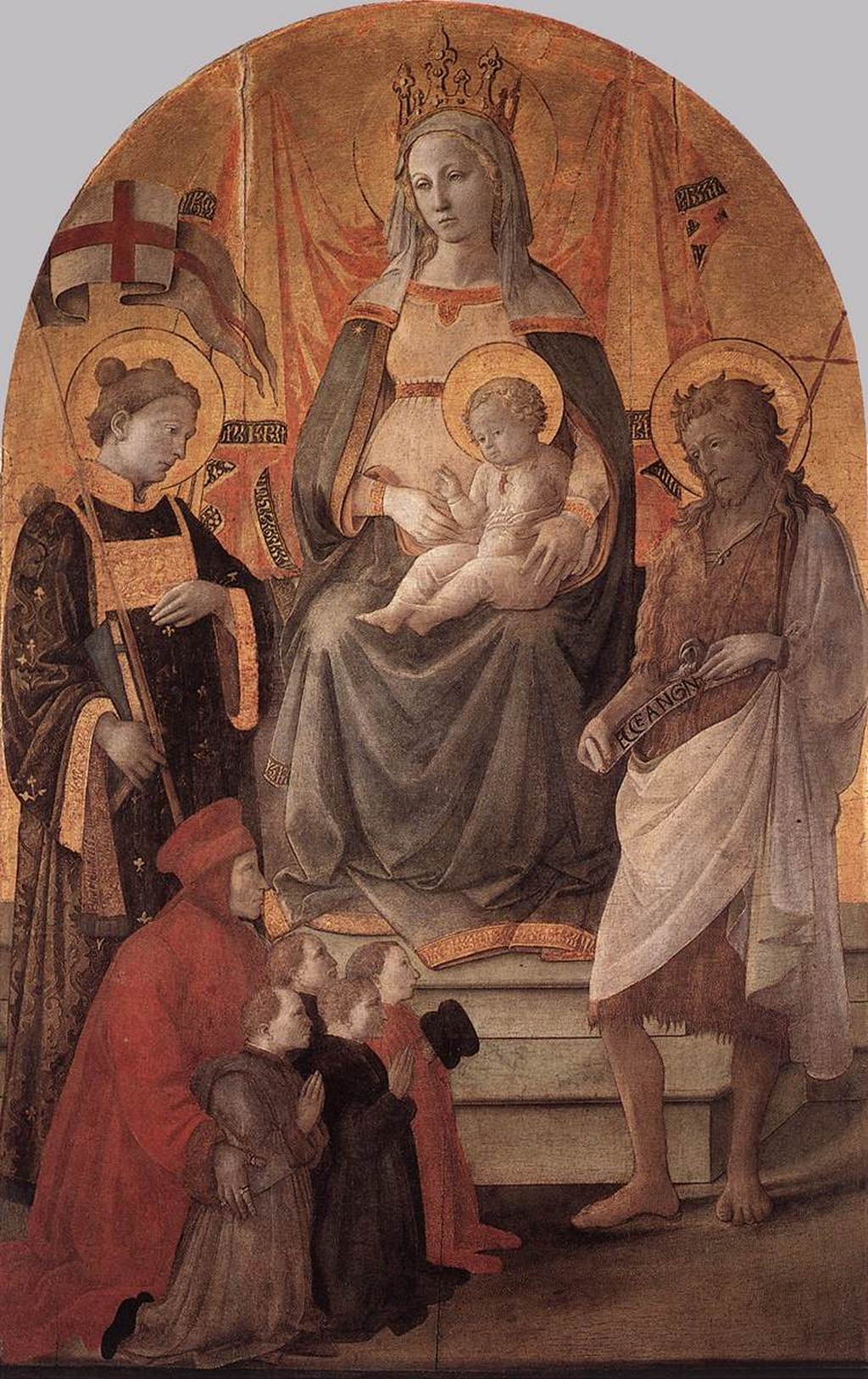
Scale as meaning. Lippi sometimes uses naturalistic perspective and sometimes retains hierarchical scale. In the Madonna del Ceppo, donors are deliberately smaller than sacred figures. The choice demonstrates that symbolic systems did not disappear when Renaissance artists learned perspective. Technique remained subordinate to meaning. The artist could break spatial consistency knowingly.
Material description and northern influence. Lippi's detailed jewels, textiles, domestic interiors and landscapes have often been connected with northern European visual culture. The safest formulation is one of exchange rather than unsupported travel. Imported paintings, luxury objects and international trade allowed Florentine artists to encounter northern effects without personally visiting Flanders. Lippi combines that descriptive attention with Florentine line and perspective.
Workshop style. A successful workshop had to produce enough stylistic consistency that assistants could contribute without destroying the identity of a commission. This helps explain why attribution becomes difficult around Lippi. Workshop paintings can contain his designs without his direct execution throughout. The Pistoia altarpiece offers an especially clear example of the distinction between master design, assistant labour and inherited work by another artist.
Technique and Botticelli
Botticelli's apprenticeship demonstrates that technique is transferable culture. He learned not only motifs but ways of constructing faces, line, drapery and devotional intimacy. He later transformed those habits into a more intensely linear style. The stylistic relationship with Botticelli is best understood through specific comparative works rather than by repeating a general influence claim.
How conservation changes “style”. A worn surface can make an artist seem flatter, darker or more severe than originally intended. Yellow varnish can warm cool colour. Lost a-secco additions can empty a crowd. Missing gilding can suppress luxury. Style must therefore be reconstructed from material evidence as well as visual impression. The current Berlin project and Prato restoration literature make Lippi an unusually good artist through whom to teach this principle.
A visual checklist for readers. When looking for Lippi's hand or influence, readers can watch for a combination rather than one signature feature: - substantial bodies inherited from early Florentine naturalism; - increasingly elegant contour; - refined female profiles and high foreheads; - expressive hands and youthful angels; - contemporary dress and costly textiles; - spatial settings that can be rational yet flexible; - landscapes and domestic detail; - sacred figures made psychologically approachable. No single item proves attribution. Together they help define the visual language associated with the master and his workshop.
Why Lippi's technique matters. Fra Filippo Lippi's technique matters because it reveals how early Renaissance innovation could be additive rather than revolutionary in a single direction. He did not discard the achievements of Masaccio; he layered onto them a new concern for grace, ornament, emotion and contemporary material life. He also demonstrates that “Renaissance naturalism” was not one thing. A convincing body, a perspectival room, a gleaming jewel, a distant landscape and a believable maternal gesture are all different forms of naturalistic persuasion.
His art succeeds because these forms are coordinated. Structure supports beauty; detail supports devotion; line supports emotion; perspective supports narrative. The result was influential enough to shape Botticelli and flexible enough to work from intimate panel to cathedral wall.
Style Is Evidence, Not a Checklist
The recognition checklist above should never be used to authenticate a painting by itself. Workshop assistants, followers and Botticelli could share many Lippesque traits. Attribution requires provenance, technical evidence, drawing comparison and specialist scholarship as well as visual resemblance. That caveat is especially important for an artist whose workshop influence was strong. The aim is to look closely without encouraging overconfident connoisseurship.
Discussion
What stands out to you most about Style and Technique in relation to Filippo Lippi's wider career?
Reader Insights
Notice how the page connects close visual detail with patronage, workshop practice and the wider Renaissance setting.
Which comparison elsewhere in the cluster helps clarify this work or theme most strongly?
Join the Conversation
Have a thought or observation about Style and Technique? Share it below. Thoughtful responses may be added to this section.
References
- Gemäldegalerie, Staatliche Museen zu Berlin, “Examination and Conservation of the Painting ‘The Adoration in the Forest’ by Fra Filippo Lippi,” 2026–28 conservation project. View Source.
- Musei Diocesani di Prato, institutional research on the technique and restoration of the Prato Cathedral frescoes. View Source.
- Officina Pratese: tecnica, stile, storia, technical and conservation studies, 2014.
- National Gallery, London, Fra Filippo Lippi collection and catalogue entries. View Source.
- Jeffrey Ruda, Fra Filippo Lippi: Life and Work with a Complete Catalogue, 1993.
- Megan Holmes, Fra Filippo Lippi: The Carmelite Painter, Yale University Press, 1999.