 by Tom Gurney
Tom Gurney BSc (Hons) is an art history expert with over 20 years experience
Published on June 19, 2020 / Updated on October 2, 2026
Email: tomgurney1@gmail.com / Phone: +44 7429 011000
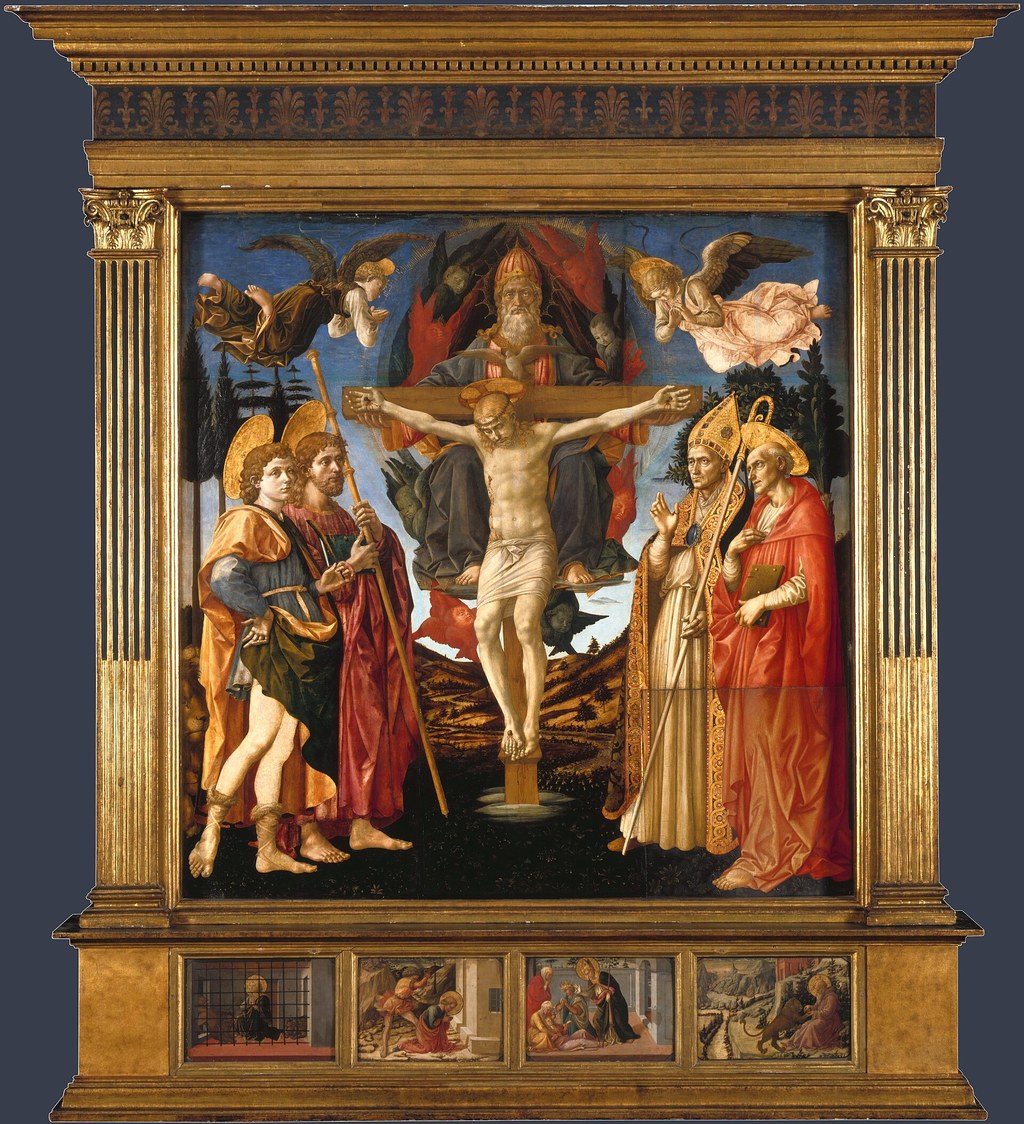
The Pistoia Santa Trinita Altarpiece by Pesellino, Fra Filippo Lippi and Workshop
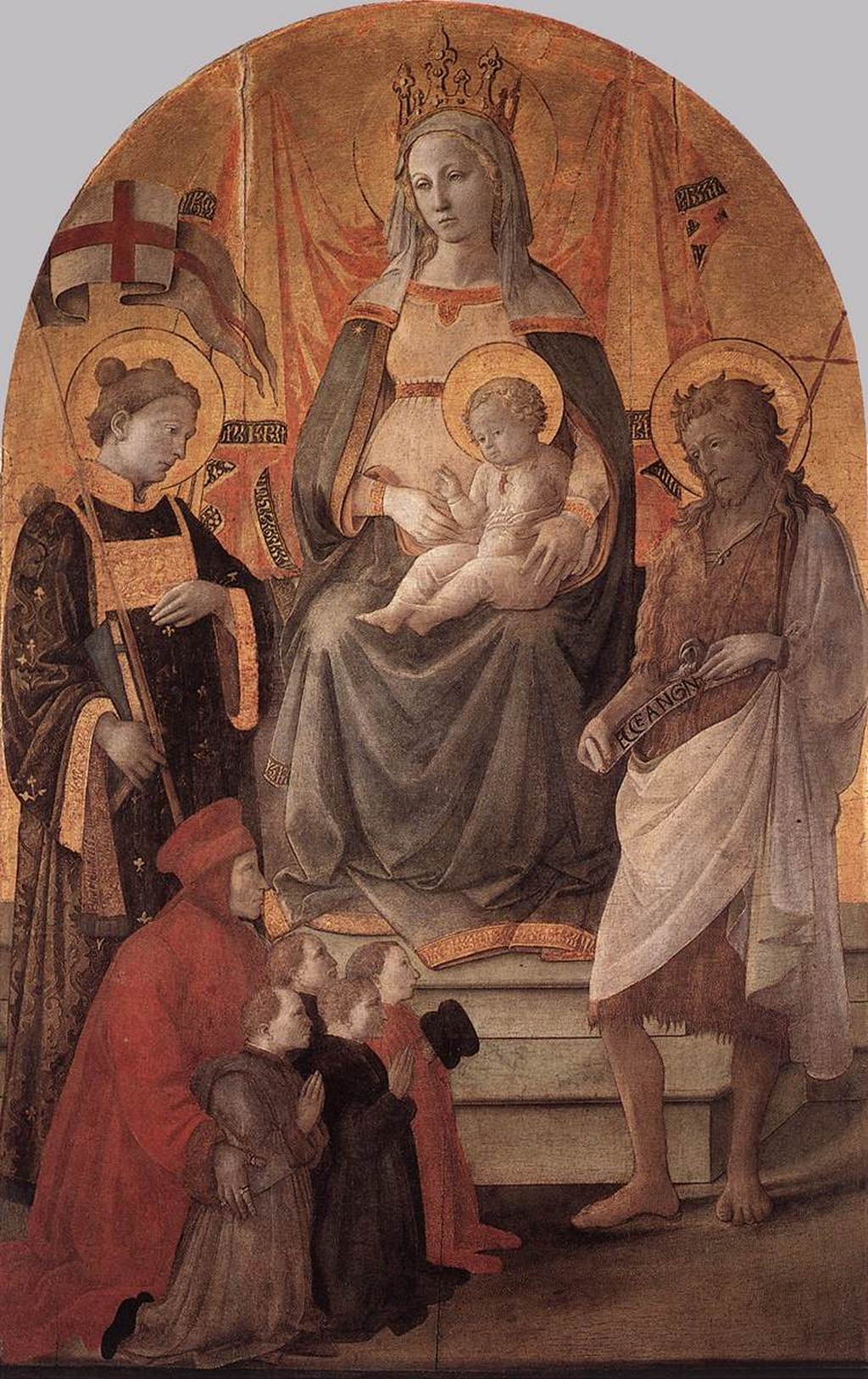
The Pistoia Santa Trinita Altarpiece in the National Gallery, London, is one of the best-documented Renaissance commissions associated with Fra Filippo Lippi, yet it is also one of the works that should least be reduced to his name alone. The altarpiece was begun by Francesco Pesellino for a confraternity of priests in Pistoia, left unfinished when Pesellino died in 1457, and subsequently entrusted to Fra Filippo Lippi and his workshop.[1]
The surviving records are extraordinary. Minutes, accounts, payments, arbitration and later legal disputes allow the commission to be reconstructed in unusual detail. We know when the confraternity decided to order the work, the planned cost, the saints chosen, how grain was sold to finance it, how Pesellino's death interrupted production, and how Lippi became involved in assessing and then completing the object.
The painting's physical history is equally dramatic. The altarpiece was dismantled after the suppression of the confraternity in the eighteenth century. Its main panel was sawn into several pieces, dispersed, and finally reassembled by the National Gallery in 1929-30. The joins can still be seen under suitable light.[1] Its importance goes far beyond a generic description of the Trinity and saints. The work is a case study in contracts, death, workshop collaboration, unfinished art, conservation, dispersal and reconstruction.
At a Glance
- ArtistsFrancesco Pesellino; Fra Filippo Lippi and workshop
- TitleThe Pistoia Santa Trinita Altarpiece
- Commission initiated10 September 1455
- Original patronCompagnia della Trinita, a confraternity of priests in Pistoia
- Original churchConfraternity church in present-day Piazza Gavinana, Pistoia
- Original budget150-200 florins
- Original principal artistFrancesco Pesellino
- Pesellino died1457, leaving the work incomplete
- Lippi completion contract31 October 1458
- Workshop location after transferPrato
- Painting completed1460; *full ensemble hoisted into place:* June 1465
- Current locationNational Gallery, London
- Major subjectTrinity with Saints Zeno, Jerome, Mamas and James
- PredellaNarrative scenes related to the saints and Trinity
- Later historyDismembered in the eighteenth century and reassembled in London in 1929-30
Contents
- A Commission We Can Watch Happening
- Pesellino's Death
- How Much Did Lippi Actually Paint?
- Saint James
- Underdrawing
- Suppression of the Confraternity
- Why the Joins Matter
- Comparison with Prato
- Lippi and Domenico Veneziano as Expert Witnesses
- Predella Design and Lippi's Intellectual Contribution
- Reassembly as a Twentieth-Century Value Judgement
- FAQs
- References
A Commission We Can Watch Happening
Most Renaissance paintings survive without a complete administrative paper trail. The Pistoia altarpiece is different. The National Gallery catalogue reconstructs the commission from records kept by the confraternity's treasurer, company accounts and legal documents generated after Pesellino's death.[1]
This evidence allows the commission’s decisions to be followed rather than merely inferred. We can see patrons selecting subject matter, setting a budget, raising funds, judging unfinished work and hiring another master. The painting becomes an event in institutional history.
The Decision of 10 September 1455. On 10 September 1455 the Compagnia della Trinita decided to commission a new altarpiece. The projected cost was 150-200 florins. The confraternity sold grain to help finance the work.
This detail is especially valuable because it turns “patronage” into something concrete. A religious body needed resources. Those resources had to be raised and converted into artistic labour. The altarpiece was therefore an economic project as well as a devotional one.
The Chosen Subject. The priests agreed that the Trinity should occupy the centre with two saints on each side. Saint James was important as patron of Pistoia. Saint Zeno was patron of the city's clergy.
Saint Jerome brought theological associations, including a traditional connection with contemplation of the Trinity. Saint Mamas completed the group. The selection therefore reflects local identity and institutional devotion rather than arbitrary artistic preference. The patrons helped determine iconography before painting began.
Francesco Pesellino. Pesellino received the original commission. He was a respected Florentine painter connected with Fra Filippo Lippi's artistic circle. The two men had collaborated on other projects.
That previous relationship became important after Pesellino's death because Lippi understood his colleague's visual language well enough to continue the commission. The altarpiece is therefore not the product of two unrelated hands accidentally brought together. It emerged from an existing network.
Pesellino's Death
Pesellino died in 1457 before the work was complete. His death created a practical and legal problem. How much work had he done?
How much should his widow or estate be paid? Who should finish the altarpiece? These questions generated documentation that is now invaluable to art historians. Unfinished art can reveal production processes precisely because ordinary routines break down.
Lippi as Arbitrator. Fra Filippo Lippi first entered the story as an expert asked to evaluate the state of the painting. Together with Domenico Veneziano, he participated in assessing how much Pesellino had completed. This role is important.
Lippi was not merely a painter available for hire. He was treated as a professional authority capable of judging another artist's work and financial value. That tells us something about his standing by the late 1450s.
Lippi Receives the Completion Contract. On 31 October 1458 the confraternity gave Lippi the commission to complete the altarpiece. Days later the panel was transported to Prato, where Lippi and his workshop were engaged on the cathedral frescoes. This connects the Pistoia object directly with the busiest phase of his Prato career. The workshop had to manage multiple major commitments at once. Renaissance masters were often project managers as much as individual painters.
Fra Diamante and Domenico. National Gallery documentation records payments collected by named assistants including Fra Diamante and a disciple called Domenico.[1] Fra Diamante is especially important because he appears repeatedly in Lippi's major workshop projects. His involvement reinforces the collaborative nature of the completion. The finished altarpiece should not be described as though Lippi personally painted every passage. The workshop was part of authorship.
How Much Did Lippi Actually Paint?
This is one of the central scholarly questions. The documentation indicates that Pesellino had already made substantial progress. Lippi and Domenico Veneziano judged the work to be about half-finished, while other legal descriptions suggested it was nearly complete.
Technical and stylistic analysis has therefore tried to separate Pesellino's contribution from later completion. The National Gallery concludes that much of the eventual execution seems to have been left to Lippi's workshop, although Lippi himself likely contributed, particularly in parts of the predella and in design.[1] That uncertainty should be preserved rather than resolved by guesswork.
The Trinity. The main subject shows the Christian Trinity. God the Father supports or presents the crucified Christ while the Holy Spirit is represented through the traditional dove or associated celestial imagery. The subject had established precedents in Tuscan painting. What is striking here is the way an older devotional type is adapted into a Renaissance unified altarpiece. The Trinity becomes almost a contemplative Crucifixion placed within a landscape and flanked by standing saints.
Saint Zeno. Saint Zeno, bishop of Verona, had particular significance for the clergy of Pistoia. His presence reflects the identity of the commissioning confraternity. A predella episode represents him exorcising the daughter of Emperor Gallienus. The narrative panel expands a standing saint into a story. This relationship between main tier and predella is essential to reconstructing the complete programme.
Saint Jerome. Jerome appears as scholar and saint. His possible association with a vision of the Trinity makes him especially appropriate to the central subject. The predella includes the popular episode in which he removes a thorn from the lion's paw. This creates a striking contrast between theology above and intimate narrative below. Different scales invite different forms of looking.
Saint James
Saint James was patron saint of Pistoia. His inclusion anchors the altarpiece civically. The predella shows his beheading, one of the most dramatic surviving scenes. Lippi and workshop turn the saint's martyrdom into compact narrative action beneath the contemplative main panel.
Saint Mamas. Saint Mamas was an early Christian martyr whose legend included imprisonment and lions. A predella panel shows him thrown to lions. The animals also create a compositional correspondence with Jerome's lion at the opposite end of the predella. Iconography and visual balance work together.
The Predella. The predella is one of the most valuable parts of the surviving reconstruction. Its small narrative scenes include episodes from the lives of the main saints and a story of Saint Augustine contemplating the Trinity. Technical analysis has shown freer underdrawing in the predella than in parts of the main tier. The National Gallery suggests that Lippi may have designed the predella programme and contributed to some of its stronger scenes.[1] This is an excellent example of how technical evidence can refine documentary history.
Saint Augustine and the Child. One predella scene shows the famous story of Saint Augustine encountering a child trying to empty the sea into a small hole. Augustine points out the impossibility of the task. The child replies that understanding the Trinity is even more impossible for the human mind.
The story connects directly to the main subject above. The predella therefore does not merely illustrate saints independently. It interprets the theology of the central panel.
Underdrawing
The National Gallery catalogue describes important differences in underdrawing.[1] The main tier includes meticulous cross-hatching in places. The predella drawing is freer.
Such evidence can help distinguish stages of production and hands. Infrared or technical examination allows scholars to look beneath the final paint and reconstruct planning. The altarpiece therefore preserves not only finished images but traces of process.
Adapting to Pesellino. Because Lippi inherited another painter's unfinished commission, stylistic continuity mattered. A wildly different completion would have made the altarpiece look fragmented. The National Gallery notes that Lippi had collaborated with Pesellino before and was capable of adapting his style to what already existed.[1] This kind of artistic flexibility is rarely visible when one master controls a project from beginning to end. The Pistoia work shows completion as an act of sympathetic translation.
The Full Ensemble Installed in 1465. The painted altarpiece was completed and approved in 1460, but the wider ensemble—including later framing and related structural elements—was not finally hoisted into place until June 1465. That means roughly five years separated completion of the painted work from the final installation of the full ensemble, and about a decade separated the original commission from that installation.
The delay reflects death, legal complications, workshop scheduling and the scale of the object. Renaissance commissions could be slow and administratively difficult. The finished painting conceals that history unless documents restore it.
Frame, Shutters and Other Components. The original object extended beyond the painted panels now emphasised in museum display. Records mention shutters, canopy, frame and painted insignia of the confraternity. Meo di Bocchi contributed to these surrounding elements.
This reminds us again that an altarpiece was a constructed ensemble. Different artisans could contribute carpentry, painting, hinges, surface decoration and installation. The “artist” of the whole object was therefore plural.
Suppression of the Confraternity
The confraternity was suppressed around 1783. The altarpiece was probably dismantled in connection with that institutional change. Once the organisation that had commissioned and maintained the work disappeared, the object lost its functional anchor. This is a recurring pattern in provenance history. Institutional suppression often turns sacred furnishings into movable art.
Sawing the Main Panel Apart. The main panel was cut into five or perhaps six pieces. This act seems shocking today, but the art market often treated large altarpieces as divisible assets. Individual saints or fragments could be easier to sell and display. The physical object was sacrificed to new collecting habits. The scars remain important evidence.
Reassembly in the National Gallery. The National Gallery reassembled the main fragments in 1929-30.[1] The joins remain visible in raking light. One lower corner is a modern addition dating from the reconstruction.
This means the painting in London is both Renaissance and twentieth-century object. The museum did not simply receive an intact altarpiece. It rebuilt one. The reconstruction is an art-historical argument made physical.
What Does Reconstruction Mean? Reassembly aims to recover the original relationship of fragments, but it inevitably involves decisions. How wide was the main panel? Were side edges cut?
How did the predella project beneath the upper tier? What did the missing frame do? The National Gallery catalogue discusses these questions openly.[1] A reconstructed altarpiece is therefore not a time machine. It is the best-supported modern model of a damaged historical object.
Why the Joins Matter
A future annotated image should point out the reassembly lines. This would help readers understand that conservation history is not abstract. The physical scars can be seen. They tell the story of dismantling, dispersal and recovery more effectively than a paragraph alone. The physical joins and reconstruction are therefore central to understanding the work’s present appearance.
Confraternity Patronage. The commissioners were a brotherhood of priests rather than a prince or single merchant. Their meeting minutes record collective decision-making. This gives the work a different patronage structure from the Medici commissions or Datini's charitable legacy.
The altarpiece represents institutional consensus. Saints, budget and payment had to be agreed. Art emerged from administration.
Selling Grain to Buy Art. The grain sale is one of the most vivid details in the documents. It shows resources changing form. Agricultural wealth became cash.
Cash became wood, pigment, labour and sacred representation. This is an unusually concrete way to explain Renaissance art economics to readers. The altarpiece was not produced by abstract “patronage”. Someone had to finance it.
Comparison with the Barbadori Altarpiece. Both the Pistoia and Barbadori commissions reveal complex institutional patronage. The Barbadori panel fulfilled a dead patron's testament through the captains of Orsanmichele. Pistoia was commissioned directly by a confraternity and then disrupted by the death of the artist. Both show why a simple artist-patron model is inadequate. Renaissance commissions often involved administrators, estates, confraternities and workshops.
Comparison with Prato
The Pistoia completion took place while Lippi's workshop was heavily engaged at Prato Cathedral. That overlap is important for understanding labour. A successful master did not necessarily finish one project before accepting another. The workshop distributed effort. Prato therefore forms the operational background to Pistoia.
Patron Meetings as Art-Historical Evidence. The confraternity minutes are unusually valuable because they preserve art before it became art. We see a group of patrons deciding that an object should exist. They discuss cost and subject before Pesellino turns those decisions into a painted design. This reverses the normal way viewers encounter Renaissance painting. Usually we begin with the finished surface and work backwards. At Pistoia the archive lets us begin with intention. That means questions of iconography can be tied to documented decisions rather than inferred solely from visual symbolism.
Budgeting 150 to 200 Florins. The agreed budget gives a rare sense of financial expectation. A range rather than one fixed amount suggests practical uncertainty. Materials, labour, framing and changes could affect final expenditure. The figure also shows that the confraternity considered the altarpiece a major capital project.
Selling grain to fund it demonstrates that the money had to be actively assembled rather than simply drawn from limitless reserves. The surviving records show patronage as budgeting, fundraising and risk management as well as artistic choice.
What Happens When an Artist Dies Mid-Commission? Pesellino's death exposes the legal fragility of artistic work. The panel existed partly complete, but money, ownership and responsibility remained unresolved. His widow had claims. The confraternity had expectations. The object itself had measurable value in its unfinished state.
Experts were asked to judge that state because aesthetic progress had financial consequences. This is a fascinating example of art and law intersecting directly. The question “how finished is this painting?” became a question about payment.
Lippi and Domenico Veneziano as Expert Witnesses
The role of Lippi and Domenico Veneziano in evaluating Pesellino's work gives us a glimpse of professional peer judgement. Renaissance painters could be summoned not simply as craftsmen but as recognised experts. Their reputations gave authority to estimates. This has a modern parallel in valuation, conservation and expert testimony, although the institutions were different. For Lippi's biography, the episode demonstrates status: his judgement mattered outside his own commissions.
From Valuer to Successor. There is also an interesting shift in Lippi's role. He first assesses the unfinished object and then receives the contract to complete it. That sequence placed him in an unusually informed position. He already knew what Pesellino had achieved and where problems remained. His previous collaboration with Pesellino further reduced the stylistic distance between them. The takeover can therefore be understood as continuity rather than replacement.
Transport to Prato. The panel's movement to Prato is a vivid reminder that large Renaissance artworks were physical logistical problems. A substantial wooden altarpiece had to be transported safely between cities. Once in Prato, it entered the environment of Lippi's active workshop. That location mattered because assistants, materials and managerial attention were already concentrated around the cathedral campaign. The Pistoia commission was therefore completed inside another city's artistic infrastructure.
Workshop Scheduling. The interval between completion of the painting in 1460 and installation of the full ensemble in 1465 should not automatically be interpreted as neglect. Lippi's workshop was handling major commitments. Painters had to sequence labour around plaster work, panel preparation, drying stages, payments and other obligations. A Renaissance workshop was not a modern production line, but it still faced capacity limits. The Pistoia chronology makes those limits visible.
Predella Design and Lippi's Intellectual Contribution
Even if workshop assistants executed much of the paint, design can remain a master's contribution. The National Gallery's analysis suggests Lippi may have conceived the overall predella sequence.[1] This distinction matters because modern viewers often equate authorship with brushwork. Renaissance masters could contribute through composition, cartoons, iconographic solutions and supervision. The Pistoia altarpiece is an ideal place to explain that broader concept of authorship.
The Main Tier and Predella as Different Visual Speeds. The main panel is contemplative. The predella is narrative. That difference creates two visual speeds within one object.
From a distance, worshippers encounter the Trinity and saints as a stable sacred hierarchy. Closer to the altar, the smaller scenes reward sequential reading. The object therefore accommodates both meditation and story. Dismemberment later destroyed this designed relationship.
The Augustine Predella and the Limits of Reason. The story of Augustine and the child is particularly apt beneath a Trinity. The saint attempts intellectually to comprehend an infinite mystery. The child's impossible task of emptying the sea into a hole becomes a parable for the limits of human reason. Placed beneath the painted Trinity, the episode teaches viewers how to look at the main subject: with contemplation rather than expectation of complete rational mastery. This is iconography functioning as commentary on iconography.
Dismemberment as a Change in Value. When the altarpiece was cut apart, the meaning of its pieces changed. A saint that had once served one side of a Trinity could become an independent collectible painting. A predella scene could circulate as a small narrative masterpiece.
The market rewarded portability and attribution rather than liturgical completeness. Dismemberment therefore reflects a change in what society valued about the object. Its religious programme became secondary to the desirability of individual fragments.
Reassembly as a Twentieth-Century Value Judgement
The National Gallery's reconstruction reverses that earlier logic.[1] Instead of celebrating fragments as independent pictures, the museum sought to recover the historical whole. This reflects a modern art-historical value: context. The joins are therefore not embarrassing flaws to hide. They are evidence of changing attitudes towards the object across centuries.
Why Conservation Is Essential to the Altarpiece. Raking-light photographs can reveal joins, while technical diagrams can show underdrawing and reconstruction. These forms of evidence make the altarpiece’s fragmented and reassembled history materially visible rather than leaving it as an abstract provenance story.
Why Collaboration Is the Correct Headline. Simplified accounts of Renaissance art often compress collaborative objects into the name of a single famous master. That would be historically misleading here. Pesellino conceived and executed major parts. Lippi entered later. His workshop contributed substantially. Other craftsmen made frame and shutters. The National Gallery reconstructed the surviving fragments centuries later.[1] The altarpiece is a history of collaboration across both Renaissance production and modern conservation. That is a stronger story than claiming a single-master masterpiece.
Why the Pistoia Santa Trinita Altarpiece Matters. The Pistoia Santa Trinita Altarpiece matters because it allows us to see Renaissance art as a process rather than a finished image. We can watch patrons make decisions. We can see them raise money.
We can follow an artist's death, arbitration, transfer of responsibility and workshop completion. We can study the predella and underdrawing for evidence of design. Then we can follow the object through suppression, dismantling and twentieth-century reconstruction.
Few works associated with Fra Filippo Lippi preserve so many stages of artistic life. For that reason collaboration is a more accurate framework than treating the altarpiece as an uncomplicated Lippi masterpiece. Its complexity is precisely what makes it valuable.
FAQs
Discussion
What stands out to you most about Pistoia Santa Trinita Altarpiece in relation to Filippo Lippi's wider career?
Reader Insights
Notice how the page connects close visual detail with patronage, workshop practice and the wider Renaissance setting.
Which comparison elsewhere in the cluster helps clarify this work or theme most strongly?
Join the Conversation
Have a thought or observation about Pistoia Santa Trinita Altarpiece? Share it below. Thoughtful responses may be added to this section.
References
- National Gallery, London, Dillian Gordon, “The Pistoia Santa Trinita Altarpiece,” The Fifteenth Century Italian Paintings, 2003. View Source.
- National Gallery object pages for the reassembled main panels and predella scenes.
- Jeffrey Ruda, Fra Filippo Lippi: Life and Work with a Complete Catalogue, 1993.
- Megan Holmes, Fra Filippo Lippi: The Carmelite Painter, 1999.