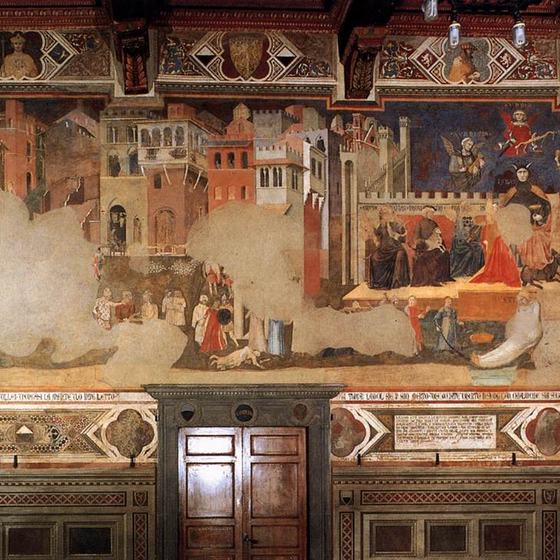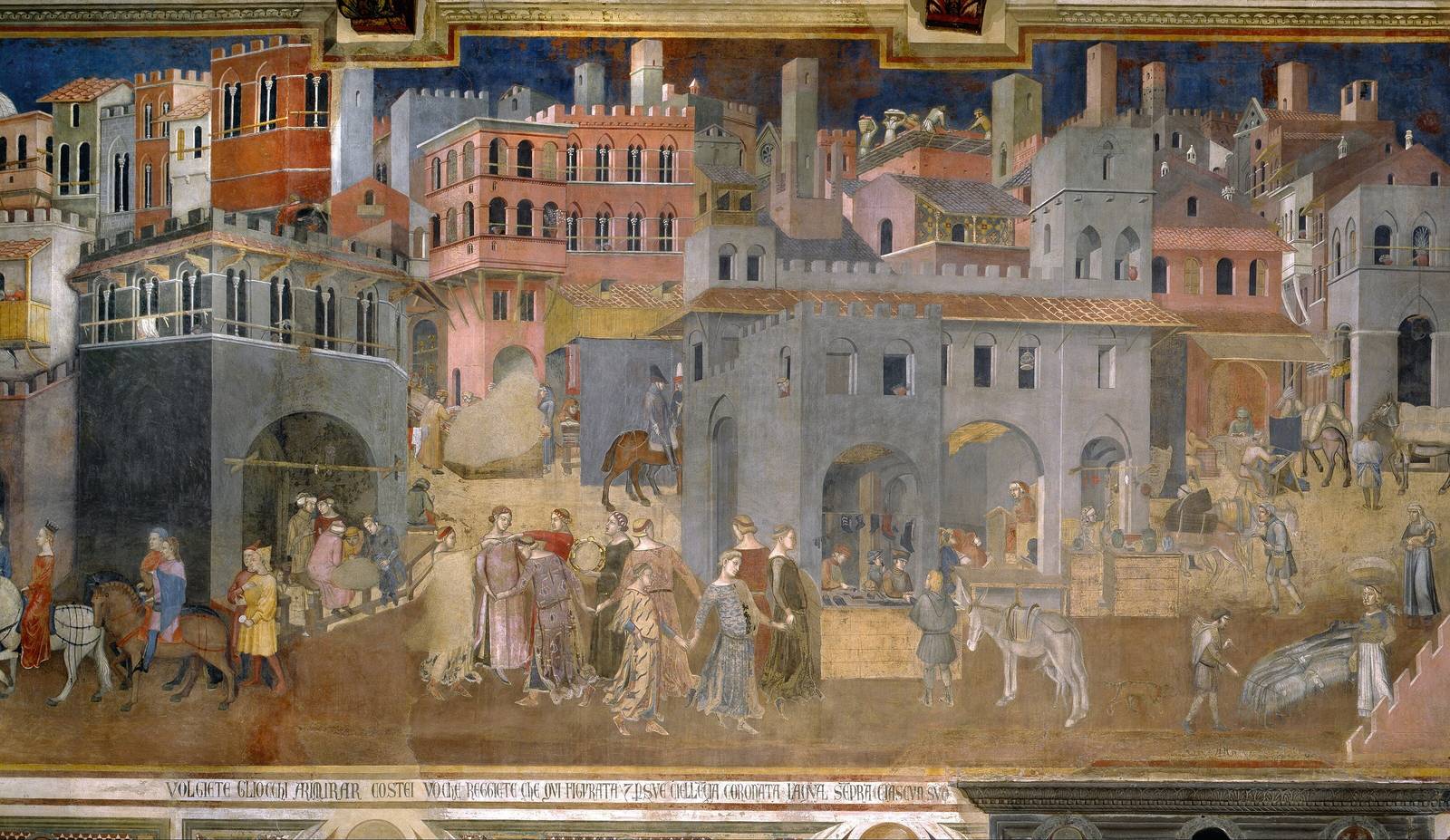
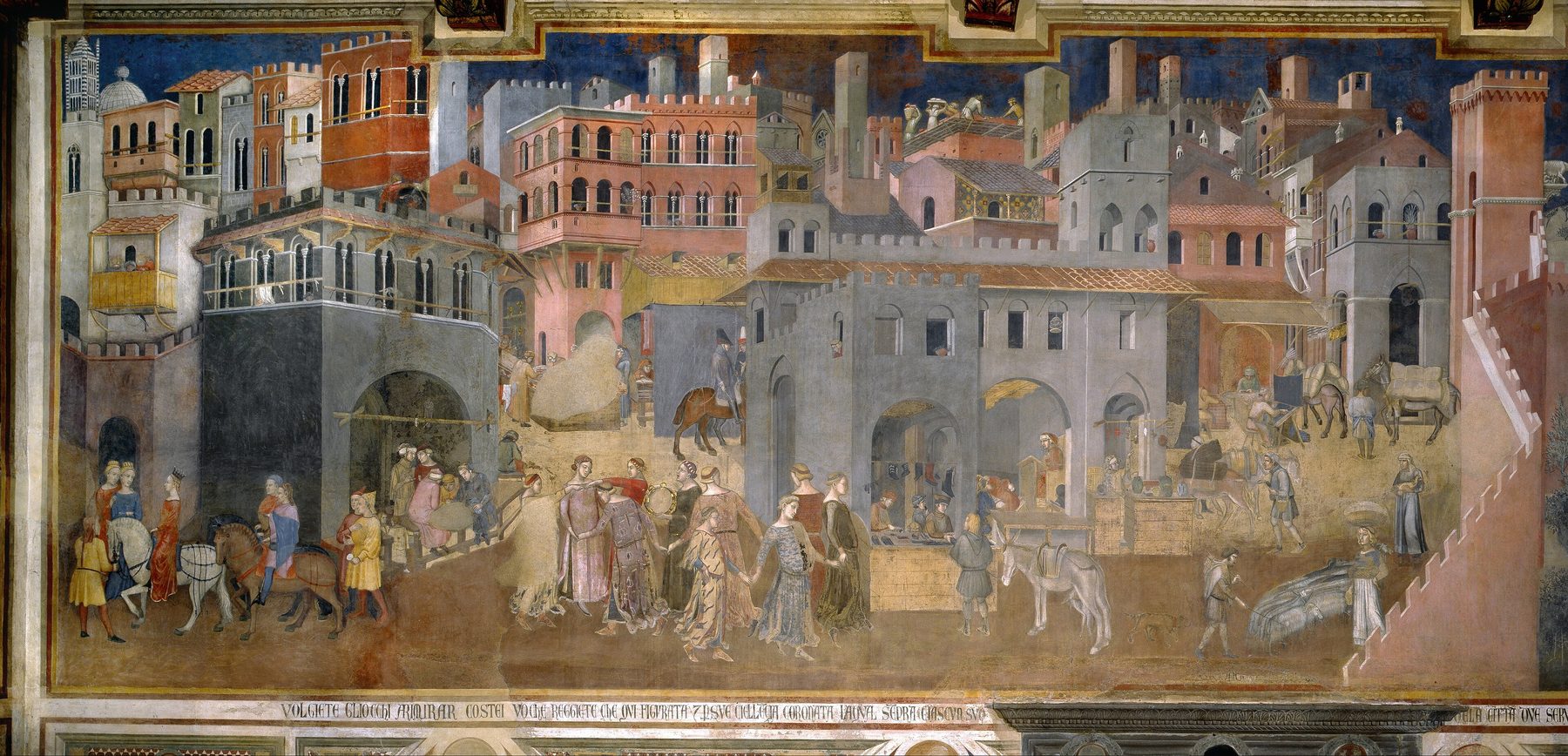
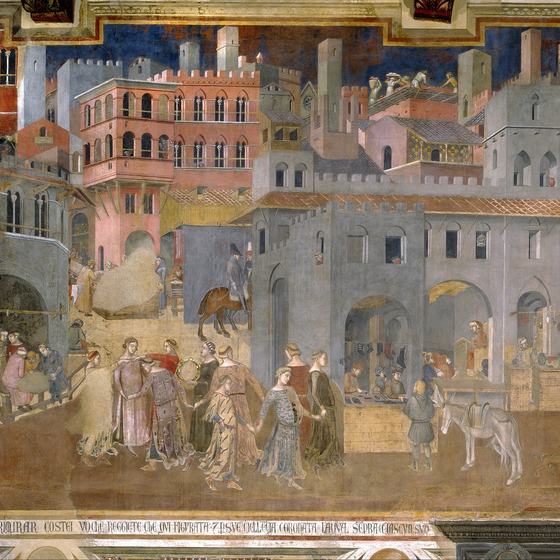
Image reference: Ambrogio Lorenzetti, Effects of Good Government in the City.
At a Glance
- Practical periodc. 1250–1400, with earlier sources and later continuities
- Historical identitylate medieval Italian art · Duecento · Trecento
- Principal centresFlorence · Siena · Pisa · Rome · Assisi · Padua
- Key mediafresco · tempera panel · mosaic · marble sculpture · architecture · stained glass · manuscripts
- Known forbodily volume · emotional narrative · experimental space · classicising sculpture · Gothic movement · brilliant gold
- Central figuresNicola and Giovanni Pisano · Cimabue · Cavallini · Giotto · Duccio · Simone Martini · the Lorenzetti
- Best understood asseveral connected artistic renewals, not one organised movement or inevitable march toward perspective
Contents
- Where the Proto-Renaissance fits
- Italy around 1250
- Byzantine inheritance and Gothic exchange
- Sculpture before Giotto
- Rome, Cavallini and Arnolfo
- Cimabue and the problem of a beginning
- Giotto’s pictorial world
- The Scrovegni Chapel
- Duccio and Siena
- People and places to know
Where the Proto-Renaissance fits
Nicola Pisano
Principal careerGiovanni Pisano
Principal careerArnolfo di Cambio
Principal careerPietro Cavallini
Principal careerCimabue
Principal careerGiotto
Principal careerDuccio
Principal careerSimone Martini
Principal careerPietro Lorenzetti
Principal careerAmbrogio Lorenzetti
Principal careerAssisi
Principal careerPadua
Principal careerThe Proto-Renaissance was not a movement that artists joined. It is a retrospective name, used most often in English-language art history for a cluster of changes in Italian art from roughly 1250 to 1400. Sculptors carved Christian stories with the bodily authority of Roman antiquity. Painters made figures seem to stand, grieve, turn and inhabit rooms. Gold-ground panels became more intimate and more materially splendid. Fresco cycles joined sacred history to the actual space and movement of a chapel.[1] [3]
Even the name is unstable. In Italian, protorinascimento can mean the “first Renaissance” of the fifteenth century—approximately 1401 to 1500—rather than the art of Giotto's age.[2] Italian historians commonly use Duecento and Trecento for the 1200s and 1300s. “Late medieval Italian art” is often the most historically accurate description. “Proto-Renaissance” remains useful as a familiar gateway, provided that proto does not reduce an extraordinary medieval culture to a waiting room for the Renaissance.
There was no single road from flatness to space or from symbol to reality. Byzantine icons, ancient sculpture, French Gothic art, Roman mosaics and local Italian practices remained active together. Florence, Siena, Pisa, Rome, Assisi, Padua, Naples, Rimini, Bologna and Venice developed different solutions. Giotto gave bodies unprecedented weight and narrative feeling; Duccio made colour, line and gesture emotionally immediate; Nicola Pisano looked at Roman sarcophagi; Pietro Cavallini renewed Rome's monumental inheritance. Their arts were connected, but not interchangeable.[1] [5]
Nor did sacred meaning retreat as observation increased. The gold behind a Virgin still announced a heavenly realm. A grieving face could intensify doctrine. A convincing room could make scripture more available to prayer. The decisive achievement of the period was not the replacement of faith by reality. It was the discovery of many new ways for images to mediate between them.
In conventional survey history, Proto-Renaissance precedes the Early Renaissance associated with Brunelleschi, Donatello and Masaccio in fifteenth-century Florence. It identifies developments that later artists could inherit: renewed attention to antique form, weighty bodies, spatially coordinated stories, observed emotion and the prestige of an individual artistic name. Yet most of the period's institutions, subjects, formats and habits remained medieval.[3] [4]
The boundary at 1400 is practical rather than absolute. Trecento artists continued working into the fifteenth century; International Gothic joined courts and cities across Europe; regional workshops changed at different speeds. Mathematical linear perspective was not formulated until later, but painters already built compelling rooms and landscapes through overlapping figures, angled architecture, converging floors and scale. Their space need not satisfy a later geometrical system to be intelligible.
The term also creates a geographical problem. It usually describes the Italian peninsula, not a European movement. Parisian ivories, French Gothic sculpture, Byzantine icons and northern manuscripts helped shape Italian work, while Sienese painters later carried their art to Avignon and beyond. Developments elsewhere should not be called Proto-Renaissance merely because they resemble an Italian example.
Most importantly, “Renaissance” and “medieval” are not opposites here. The renewed study of antiquity occurred within cathedral building, Christian devotion and urban communal identity. The Renaissance itself grew from medieval inheritances rather than appearing after they had been swept away. The strongest account therefore looks in both directions without making later fame the measure of every work.
Italy around 1250
There was no political Italy in the modern sense. The peninsula contained communes, maritime republics, papal territories, episcopal centres and kingdoms. Florence and Siena competed through trade, territory, buildings and images. Pisa's maritime connections and Roman remains gave its sculptors a particular visual archive. Rome combined papal ceremony with ancient and early Christian monuments. Angevin Naples drew artists from several regions.
Economic expansion supported ambitious churches, civic palaces and furnishings. Cathedral works organisations coordinated builders, sculptors, painters, metalworkers and suppliers across decades. Guilds commissioned images of patron saints and helped govern public projects. Confraternities—lay devotional associations—ordered large panels and hymn books. Urban families acquired rights to decorate chapels, joining prayer for the dead to family memory and status.[39]
The new mendicant orders altered the city. Franciscans and Dominicans preached to lay audiences and established large churches whose naves accommodated crowds. Their women’s communities, including Poor Clares and Dominican nuns, participated in devotional culture even though documents less often preserve their individual voices. Images had to work at different distances: a monumental crucifix above a screen, a fresco cycle along a chapel wall, a small Virgin in a cell or home.[40]
Artists moved among these settings. A painter might decorate a communal account book, design stained glass, supply a vast altarpiece and paint a private panel. A sculptor could oversee architecture as well as carve figures. Modern categories separate fine art, construction and craft more sharply than their workshops did.
Byzantine inheritance and Gothic exchange
Italy's connection to Byzantium was long and living. Southern Italy had formed part of the Byzantine world, and trade continued after Norman conquest. Icons, textiles, metalwork and manuscripts circulated through ports and courts. After western crusaders sacked Constantinople in 1204, precious objects reached Italy under conditions that joined admiration to conquest and displacement.[1]
Italian painters adapted Byzantine icon types such as the Hodegetria, in which the Virgin directs attention toward Christ as the way to salvation. Gold grounds, frontal sacred figures, patterned highlights and hierarchical scale were not signs that artists could not observe the world. They formed an exact visual language for divine presence. The later phrase maniera greca, or Greek manner, groups varied Italian responses to Byzantine art and can conceal their technical sophistication.[5]
Gothic exchange was equally important. Pointed arches, slender figures, sweeping contours, courtly fabrics and expressive movement travelled through sculpture, architecture, ivory and manuscript illumination. Giovanni Pisano's bodies combine antique knowledge with northern Gothic intensity. Duccio and Simone Martini could preserve gold and elegant line while making a hand, glance or recoil astonishingly immediate.[1]
The most useful model is translation, not replacement. Artists reorganised inherited forms for new buildings, patrons and devotional habits. A Byzantine throne could become architectural space. A Gothic sway could carry psychological tension. A Roman sarcophagus figure could become the Virgin at Christ's birth. None of these sources remained pure, and none simply disappeared.
Sculpture before Giotto: Nicola and Giovanni Pisano
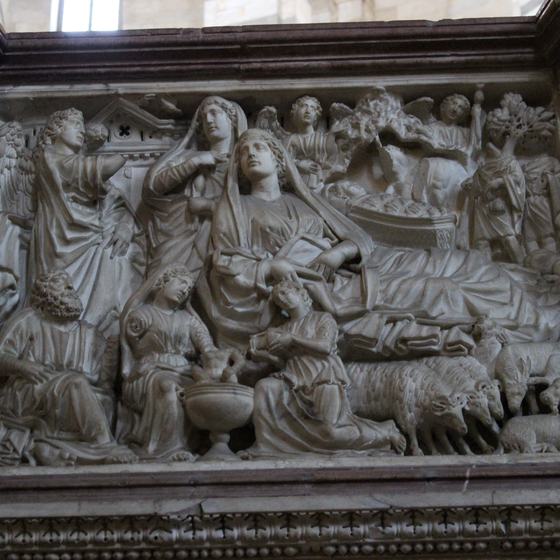
The Proto-Renaissance is often narrated as a revolution in painting, but one of its earliest and clearest landmarks is sculpture. Nicola Pisano signed and dated the marble pulpit of the Pisa Baptistery in 1260. Its hexagonal platform stands on columns and figurative supports; five reliefs present the Nativity, Adoration, Presentation, Crucifixion and Last Judgement. The work belonged to preaching, liturgy and a carefully structured ascent of theological meaning.[31]
Nicola's antique sources are visible in the broad heads, heavy drapery and compressed bodies. In the Nativity, the reclining Virgin has the authority of a Roman matron. The Christ Child's bed recalls a sarcophagus. Figures in the Adoration draw on ancient reliefs visible at Pisa. This is not archaeological imitation. Christian episodes are compressed into continuous, crowded fields, and Gothic architecture helps order their telling.
Antiquity was physically present in medieval Pisa. Sarcophagi in and around the cathedral complex offered models of pose, cloth and bodily mass. Nicola's achievement was to make those forms operate within a thirteenth-century pulpit. Classical renewal therefore began not in a scholar's detached reconstruction of pagan culture, but inside Christian ritual.
His son Giovanni Pisano developed a more volatile language. At the pulpit of Sant'Andrea in Pistoia, completed in 1301, prophets, sibyls and narrative figures turn, lean and cry across a compact architectural structure. The inscription names Giovanni, son of Nicola, but the object also records a system of patrons, church officials and labour.[33]
Giovanni's later Pisa Cathedral pulpit, made between 1302 and 1310, required a large workshop. Surviving components show sharp drilling, twisting bodies and gestures broadened to register in a vast, dim interior. A group of trumpet-blowing angels once contributed sound, motion and apocalyptic urgency to the Last Judgement.[34] The cathedral fire of 1595 and later dismantling changed the work's physical history; reconstruction cannot fully restore its first viewing conditions.[32]
Father and son resist a simple progression from classicism to emotion. Nicola could be dramatic; Giovanni also understood antiquity. Their difference demonstrates how quickly one workshop inheritance could be revised. Sculpture made the body an instrument of narrative before Giotto's most famous frescoes.
Essential works
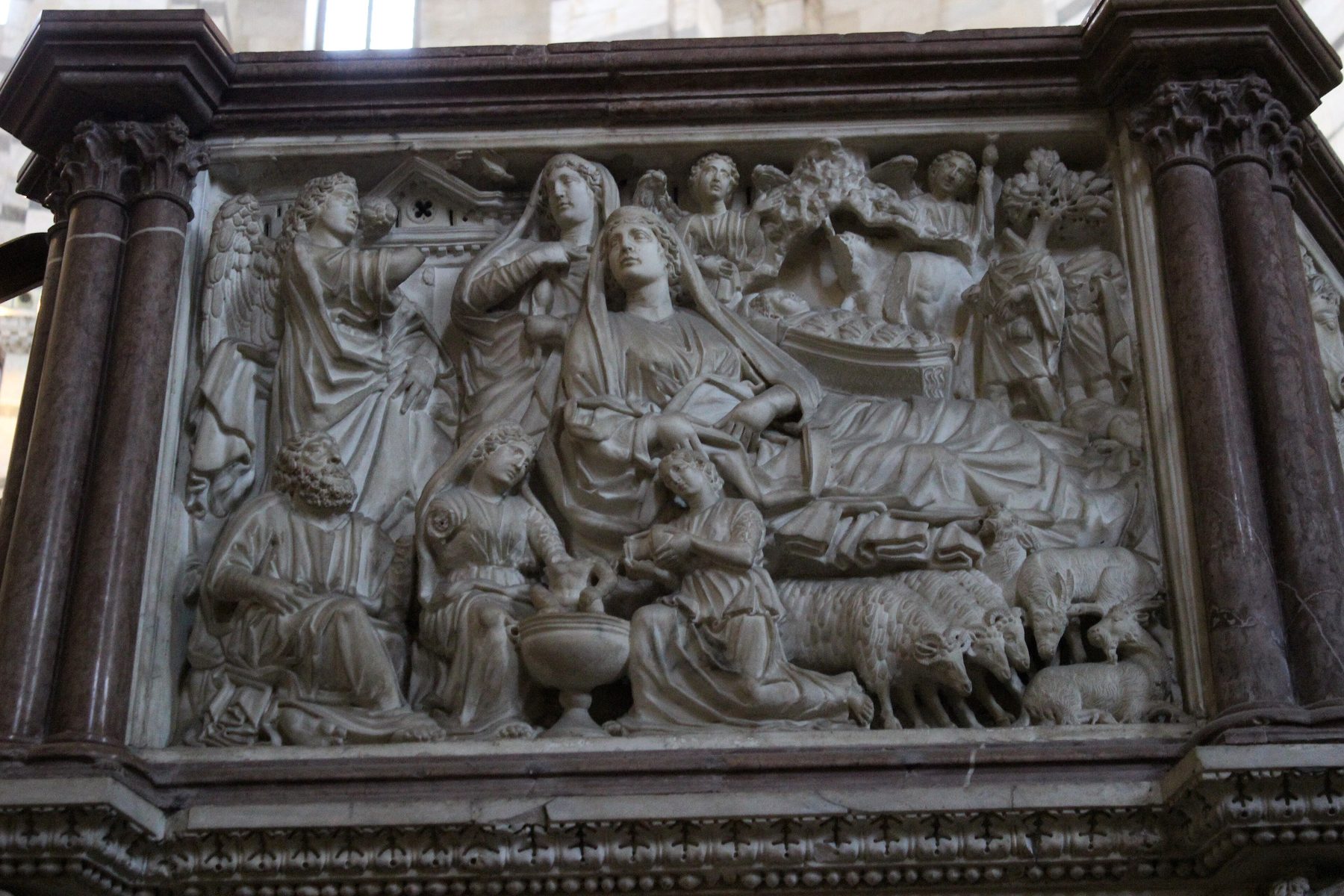
Pisa Baptistery Pulpit
Nicola Pisano, 1260
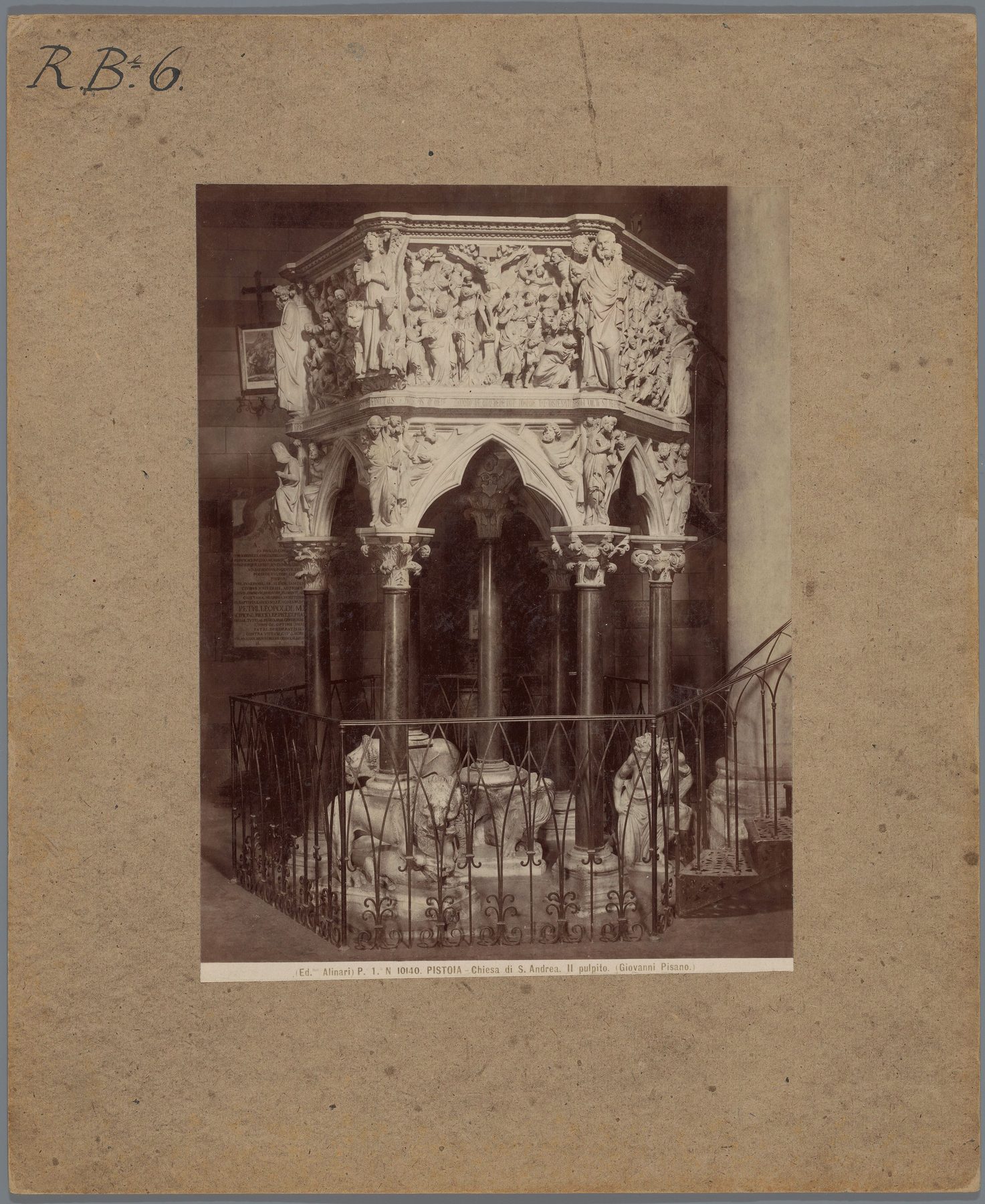
Pulpit of Sant’Andrea
Giovanni Pisano, 1298–1301
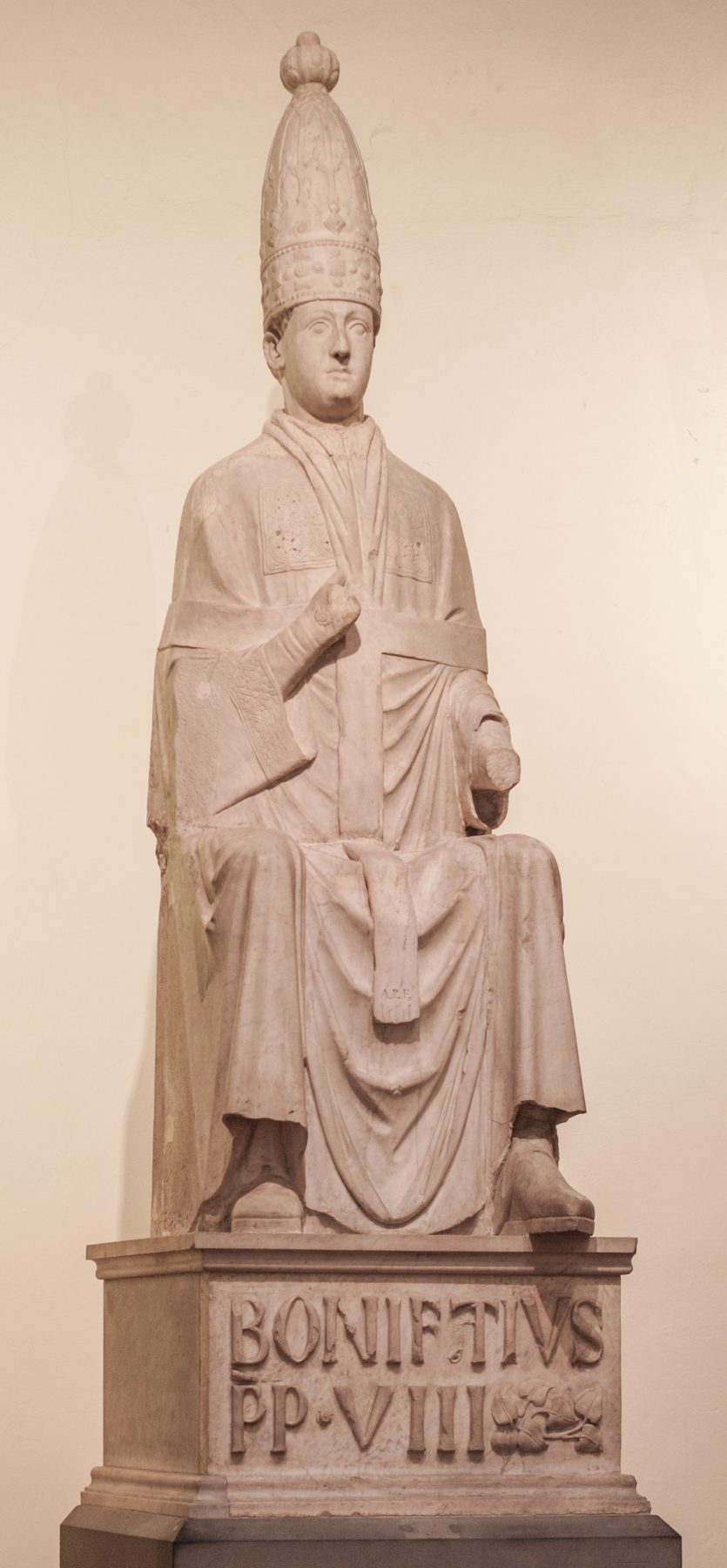
Pope Boniface VIII
Arnolfo di Cambio and collaborators, 1296–1300
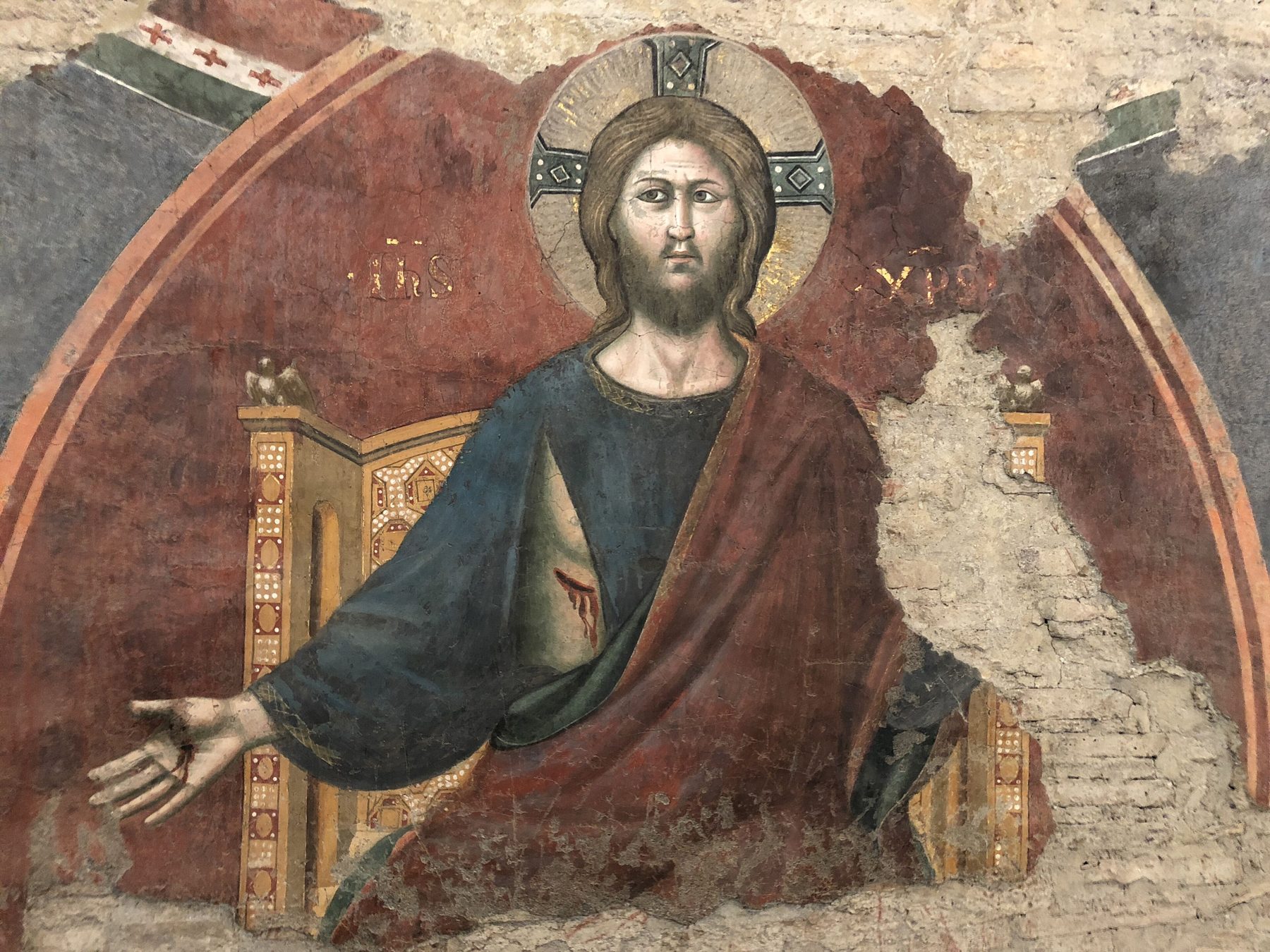
Last Judgement
Pietro Cavallini, c. 1293
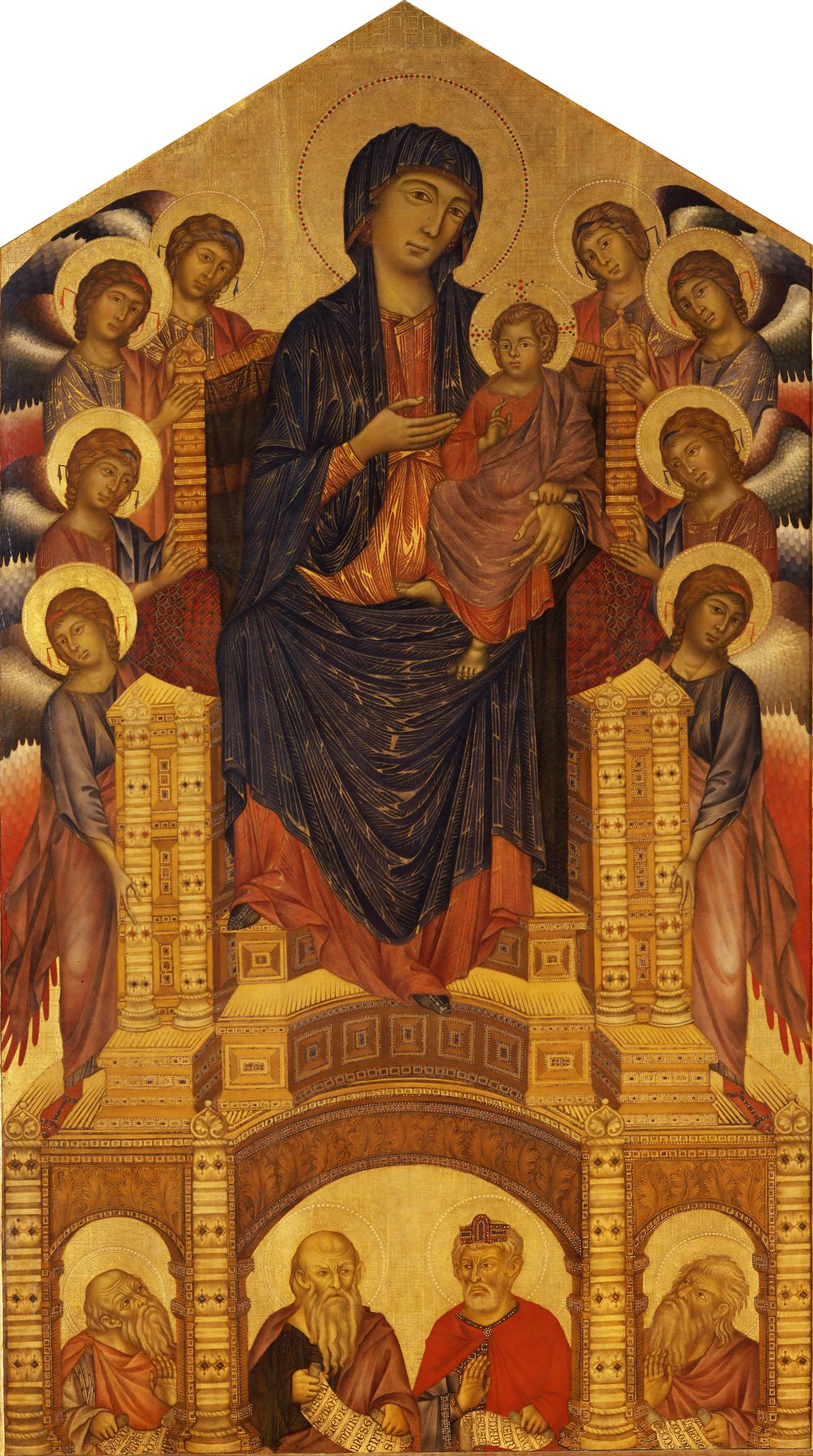
Santa Trinita Maestà
Cimabue, c. 1280–90
Rome, Cavallini and Arnolfo
Florence dominates many Renaissance histories, but late-thirteenth-century Rome was an independent centre of renewal. Ancient sculpture, Early Christian mosaics and vast basilicas remained accessible. Papal families commissioned tombs, façades, ciboria, frescoes and mosaics that joined authority in the present to the city's sacred past.[37]
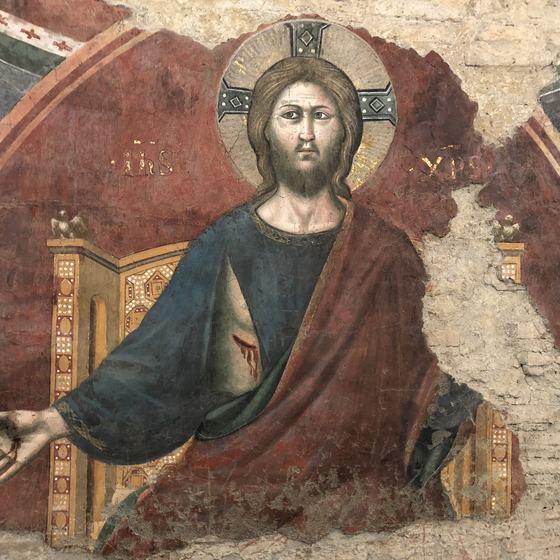
Pietro Cavallini worked within Roman mosaic and fresco traditions. The Virgin narratives in Santa Maria in Trastevere retain Byzantine iconography while giving architecture depth and figures a soft, weighty presence. His surviving Last Judgement in Santa Cecilia in Trastevere builds bodies through broad colour and shadow. Proposed dates and the sequence of the Roman campaigns remain debated, so his relation to Giotto cannot be reduced to teacher or follower.[36]
Cavallini matters because he breaks the myth that Florentine naturalism developed alone. Roman painters could study monumental ancient and Christian precedents unavailable in the same form elsewhere. Their figures do not look exactly Giottesque; colour, atmosphere and compositional breadth create another route toward bodily presence.
Arnolfo di Cambio also moved between media. Sculptor, architect and organiser, he designed tombs and façade figures that integrated a body with its architectural and political setting. His seated Pope Boniface VIII, carved with collaborators between 1296 and 1300 for Florence Cathedral's medieval façade, made papal authority monumental above the city. The façade's demolition in 1587 removed the figure from that original argument.[35]
The papal court's move to Avignon after 1309 weakened some Roman systems of patronage while opening new networks elsewhere. Giotto, Cavallini and Simone Martini all entered papal or Angevin worlds. The period's geography shifted with institutions and people.
Cimabue and the problem of a beginning
Cimabue, whose documented name was Cenni di Pepo, has often been cast as the last medieval master before Giotto. Very little of his life is secure. He is recorded in Rome in 1272 and at Pisa around 1301–1302. The Saint John mosaic in Pisa Cathedral is his only surviving work tied firmly to a document. The claim that he taught Giotto is an old tradition, not an established workshop record.[11] [32]
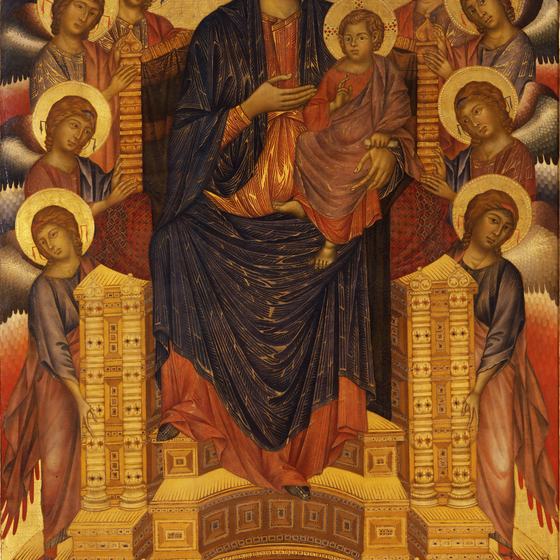
His paintings make the idea of “last medieval” inadequate. In the Santa Trinita Maestà, the Virgin rises within a complex throne, angels stack in depth and prophets appear below. Transparent paint, white highlights and subtle modelling animate flesh and drapery. The work preserves an iconic sacred hierarchy while testing how figures share an architectural enclosure.[6]
The monumental Maestà formerly in San Francesco at Pisa, now in the Louvre, is more than four metres high. Its poplar panel, original frame medallions, gold and tempera were designed to command a church at distance. Saints Francis and Clare in the frame linked the heavenly image to Franciscan identity. Removed from Pisa during the Napoleonic era, it now carries a museum provenance shaped by military power.[9]
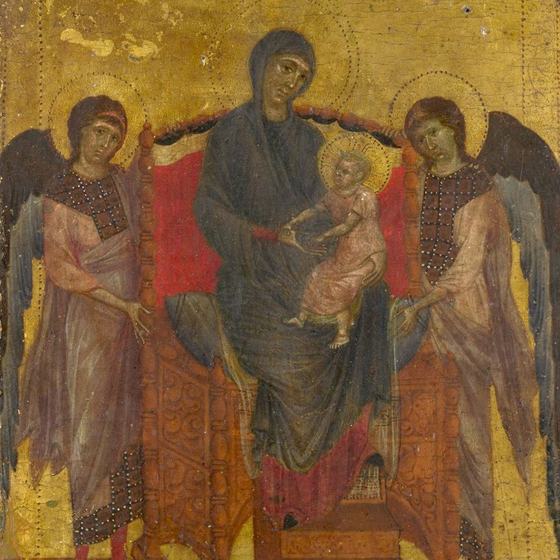
Small works reveal another Cimabue. A tiny Virgin and Child in London once belonged to a diptych. The Child grasps Mary's hand with the specificity of an ordinary infant. In 2019, wood-grain continuity joined it to a newly recognised Christ Mocked, confirming parts of a dispersed narrative. Infrared study, cut edges and the grain of poplar became evidence as consequential as style.[7]
The Louvre's recent reconstruction presents Cimabue as an inventive narrator whose crowded gestures and contemporary dress prepared possibilities taken up differently by Duccio and Giotto. That does not make every work a step toward them. It restores variety to an artist flattened by the need for a heroic succession.[8]
Dante supplied the most famous contemporary comparison. In Purgatorio, he writes that Cimabue once seemed to hold the field in painting, but Giotto now had the acclaim. The passage is about the vanity and changeability of worldly fame: one artist replaces another as one poet displaces the last.[10] [12] It proves that Giotto's reputation rose rapidly, not that Dante had invented the Renaissance.
Giotto's new pictorial world
Giotto's fame was extraordinary during his lifetime. He worked in Florence, Padua, Rome and Naples, and his influence spread through central and northern Italy. His securely accepted corpus is smaller than popular attribution suggests. Workshops executed parts of major projects; frescoes have been lost or transformed; the authorship of celebrated cycles at Assisi remains contested.[16]
What looks new is the coordination of bodies, space and narrative. Giotto's figures seem to possess weight before they act. Feet stand; knees press through cloth; hands take hold of another person. Buildings do not merely label a place but organise the encounter. Faces and gestures differ according to role, turning a biblical episode into a field of responses.
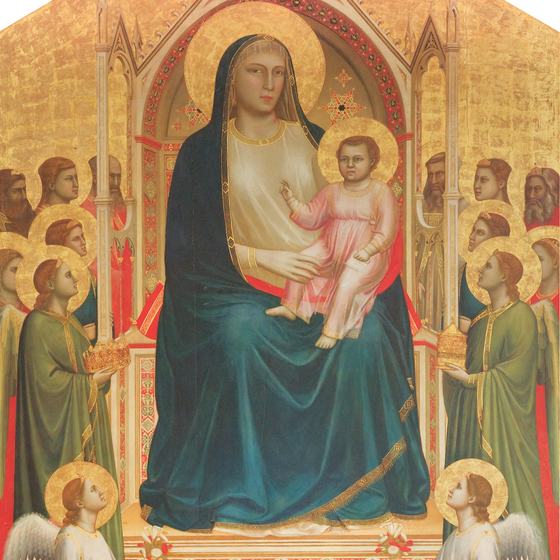
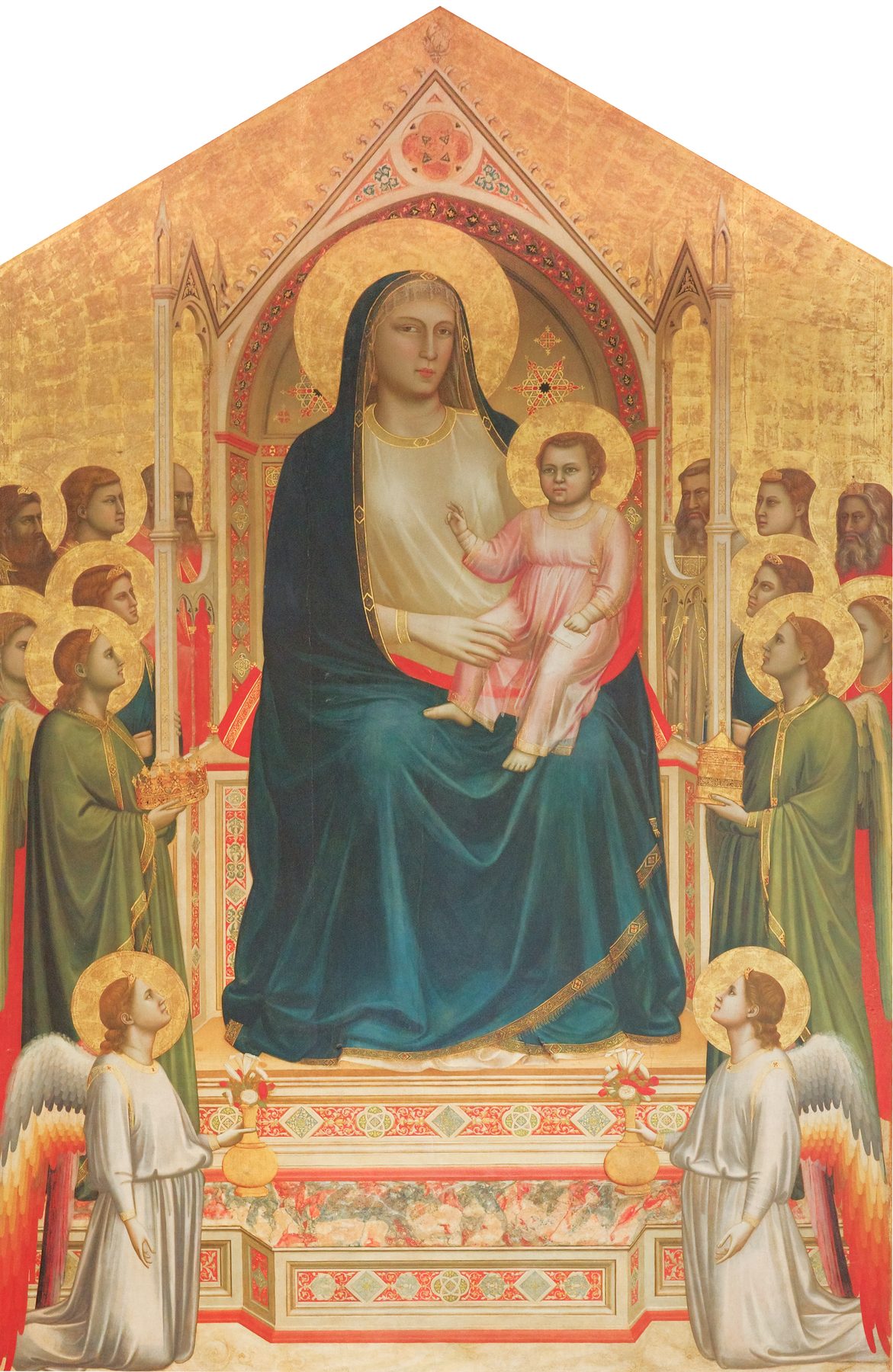
The Ognissanti Madonna, painted around 1300–1305, retains a gold ground and the traditional enthroned Virgin. Yet its Gothic tabernacle behaves like a structure occupied by people. Angels kneel at the base; saints appear behind the throne; halos and bodies overlap. Light and shadow make Mary's robe describe a large seated body. Sacred scale, gold and naturalism reinforce one another rather than marking separate eras.[13]
A smaller Madonna and Child in Washington reveals intimacy within iconography. The Child reaches for Mary's finger and a rose; punched and incised gold surrounds them. Technical examination has revised understandings of the support, underlayers and related panels, reminding us that “a Giotto” can be a surviving element of a dismantled ensemble shaped by workshop practice.[17]
Later writer Cennino Cennini said that Giotto changed painting “from Greek into Latin” and brought it into the modern. The phrase is powerful because it compares visual change to a vernacular language emerging from inherited culture.[18] It is also partisan: “Greek” becomes what must be surpassed. Giorgio Vasari later made Giotto the restorer of art after decline, establishing a Florentine heroic story that still affects what museums and textbooks emphasise.[4]
Giotto's importance survives the critique of that story. He made a pictorial world in which volume, setting and emotion operate with remarkable consistency. The correction is to place that world among Roman, Sienese, Pisan, Byzantine and Gothic renewals—not to diminish it.
The Scrovegni Chapel
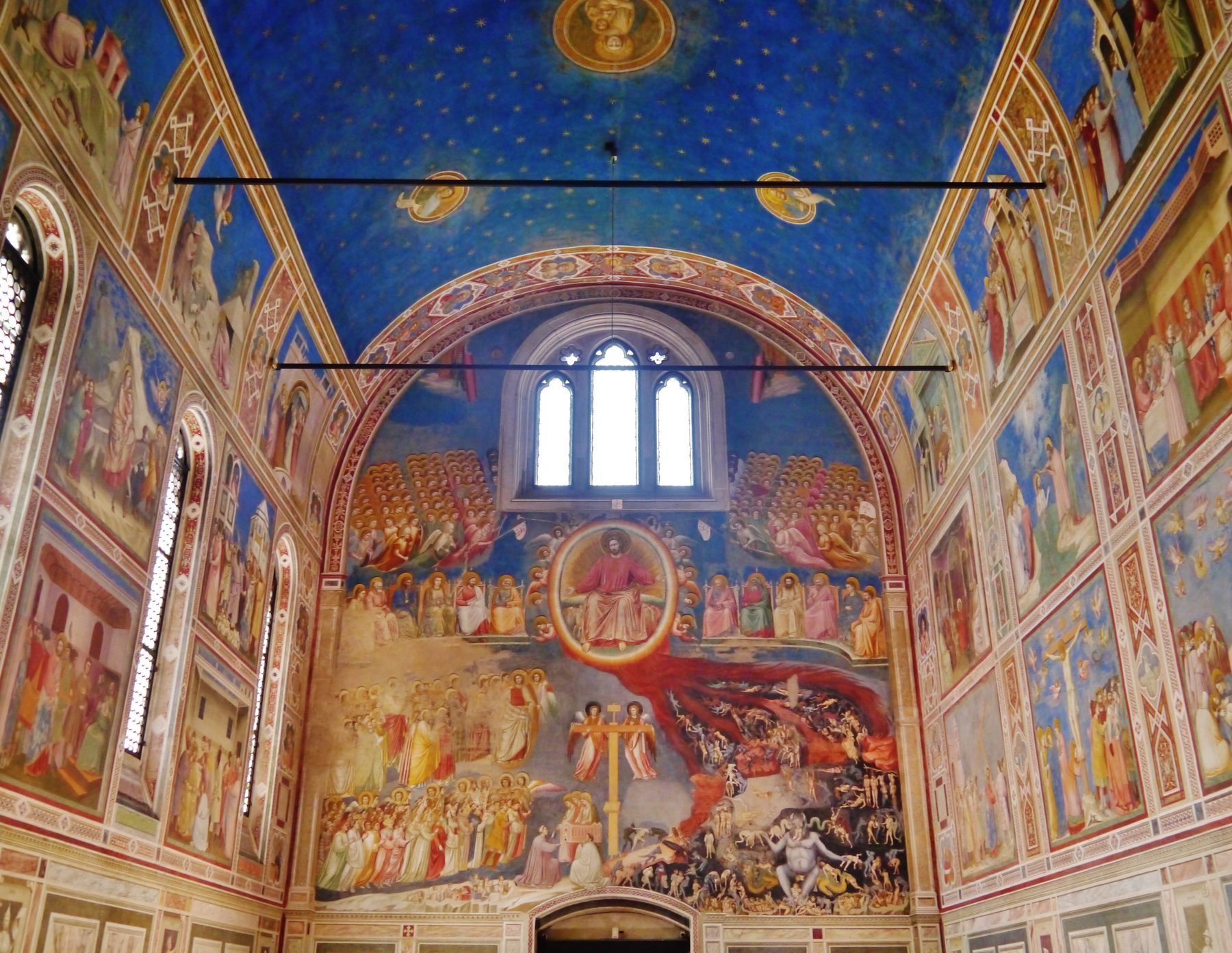
The Scrovegni Chapel in Padua offers the most complete surviving encounter with Giotto's art. Enrico Scrovegni commissioned the building beside his family palace on the site of a Roman arena. Giotto frescoed it between 1303 and 1305, with work completed by the beginning of 1306 according to the wider Padua heritage account. The commission joined devotion to the Virgin, concern for salvation and the public identity of an affluent urban patron.[14] [15]
Images occupy nearly every surface. Scenes from the lives of the Virgin and Christ unfold in horizontal registers. A vast Last Judgement fills the entrance wall. Personified Virtues and Vices stand below the narratives like sculpted moral examples. A blue vault binds the interior, while fictive architectural spaces near the chancel suggest rooms beyond the wall.
The cycle must be read through movement. Entering beneath the Last Judgement places the viewer inside a history whose end is already visible. Walking toward the altar follows episodes across and back along the walls. Repeated buildings and landscapes separate scenes while echoes of gesture connect them. Time is not a line printed on a page; it unfolds through the body turning in a chapel.
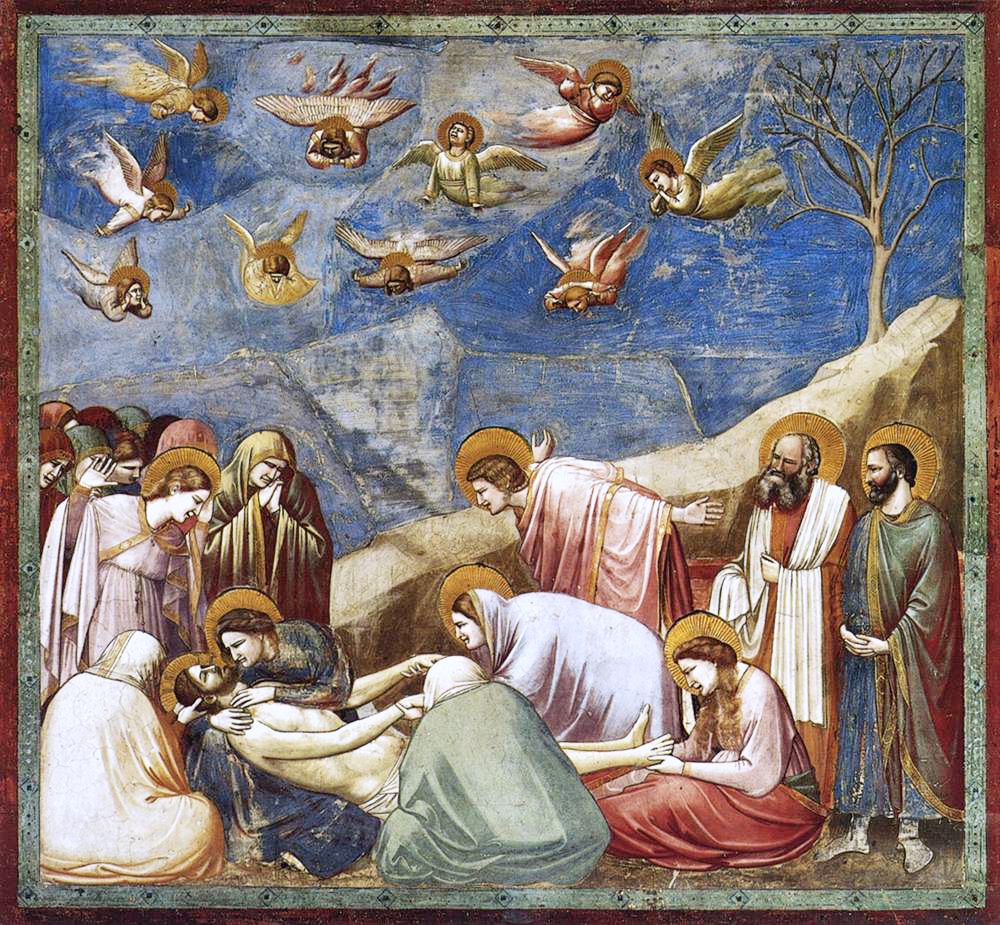
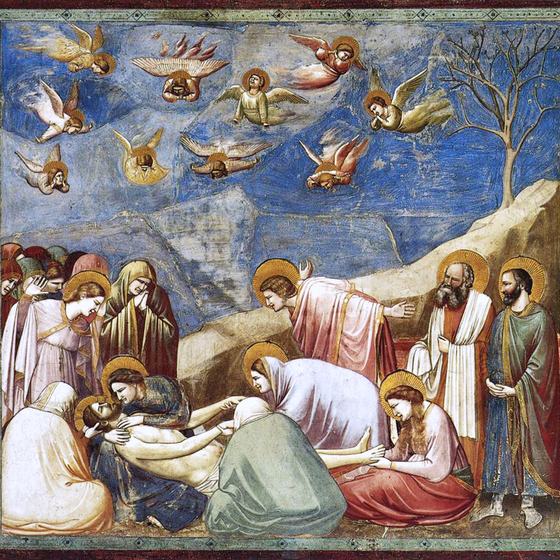
In the Lamentation, a bare rock descends diagonally toward Christ's face. Mary holds her dead son's head, their faces nearly touching. Disciples bend into different shapes of grief. Two foreground mourners turn their backs, making emotion legible through shoulders and posture while opening the scene to the viewer's position. Angels above twist and cry with a violence that amplifies the restrained human circle.
The setting is sparse but exact. The diagonal rock directs attention; a small tree at its summit can suggest death and renewal; the interval of blue sky increases the figures' concentration. Depth is constructed through overlap, scale, angled ground and bodies seen from behind, not through one mathematical vanishing point. The scene is convincing because every formal decision serves grief.
Elsewhere, architecture becomes a moral instrument. In the Expulsion of the Money Changers, bodies collide across the temple threshold. In the Kiss of Judas, a cloak surrounds the confrontation between Christ and Judas while soldiers compress space into impending violence. In the Annunciation to Saint Anne, a cutaway room makes domestic enclosure the stage of sacred history.
Enrico Scrovegni appears offering a model of the chapel in the Last Judgement. His presence does not prove that the building was simply a payment for his father's notorious usury, a popular reduction. It visualises patronage within a theology of gift, intercession and judgement. Family aspiration and genuine devotion need not be mutually exclusive.
The chapel's fragile material life also matters. Humidity, pollution, earlier interventions and heavy visitation have required long conservation and controlled access. Fresco is not a permanent window miraculously untouched by time. What we see is a medieval surface continuously monitored and cared for.[14]
Padua did not stop with Giotto. Fresco cycles by Guariento, Giusto de' Menabuoi, Altichiero and others filled religious and secular buildings through the century. Different patrons—families, clergy, commune and ruling court—made the city a sustained environment of experiment. Giotto was a beginning within Padua, not its entire Trecento.[15]
Follow the period through four stages
–1290
Antiquity, Gothic exchange and sacred renewal
Pisan sculpture, Roman monuments, Byzantine painting and Gothic movement provide several active languages rather than a single beginning.
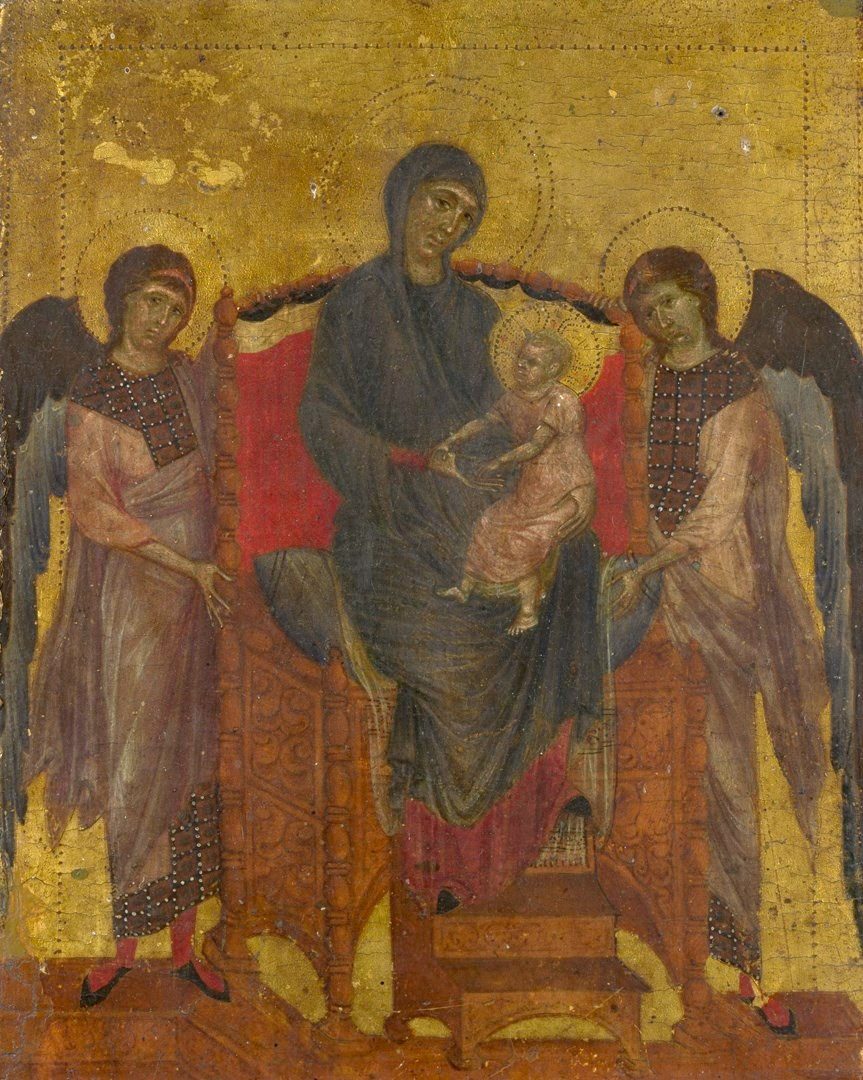
–1310
Bodies, buildings and complete environments
Giovanni Pisano, Arnolfo, Giotto, Duccio and related workshops coordinate bodily presence, architectural setting and narrative across pulpits, panels and chapels.
–1348
Sienese invention and civic scale
Simone Martini and the Lorenzetti brothers transform line, gold, spatial experiment and observation for altars, Franciscan spaces and communal government.
–1400
Plague, recovery and diverse afterlives
The Black Death disrupts patrons and workshops without imposing one style; collaboration and regional traditions continue across a changed artistic landscape.
Duccio and Siena's alternative modernity
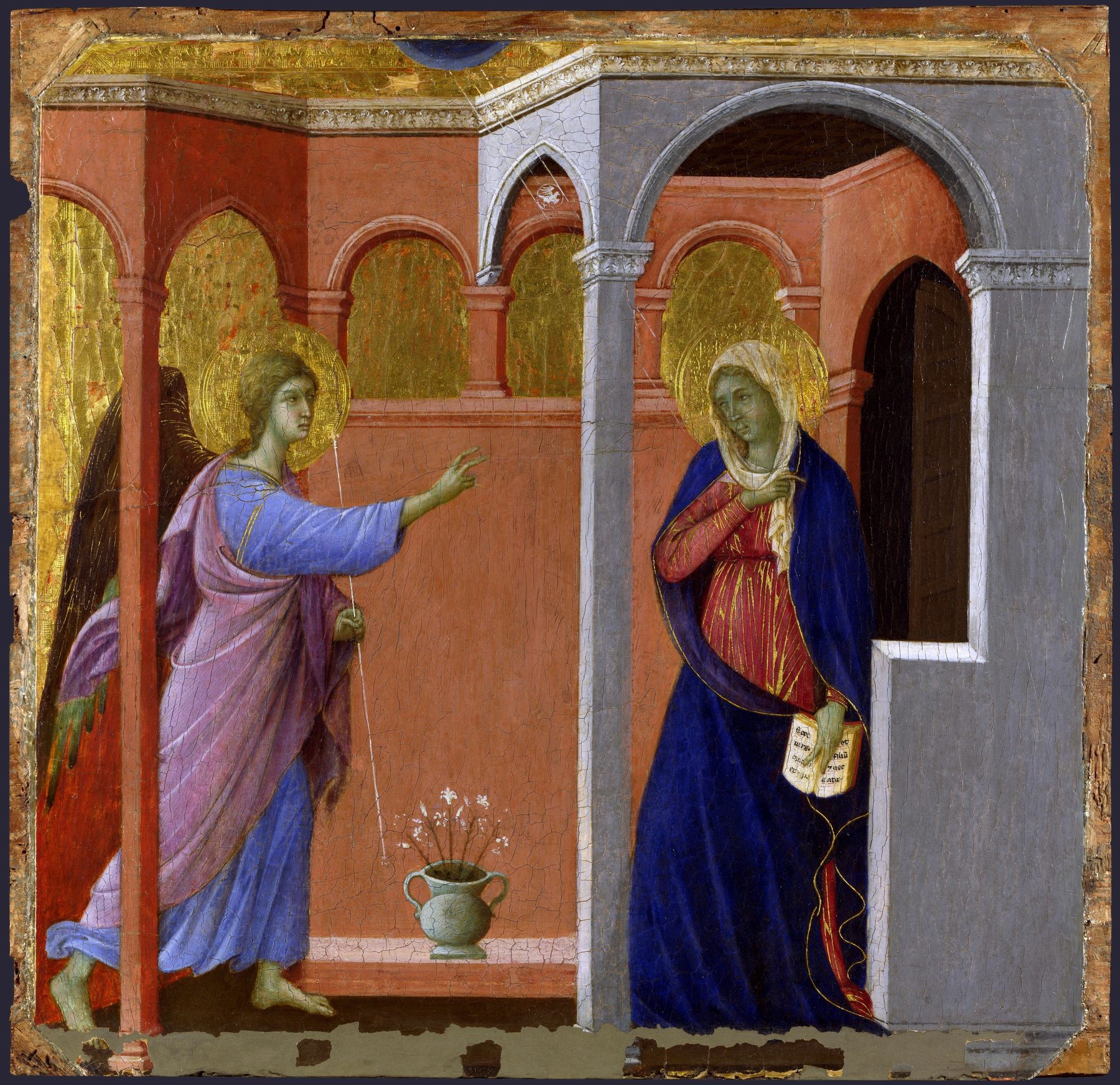
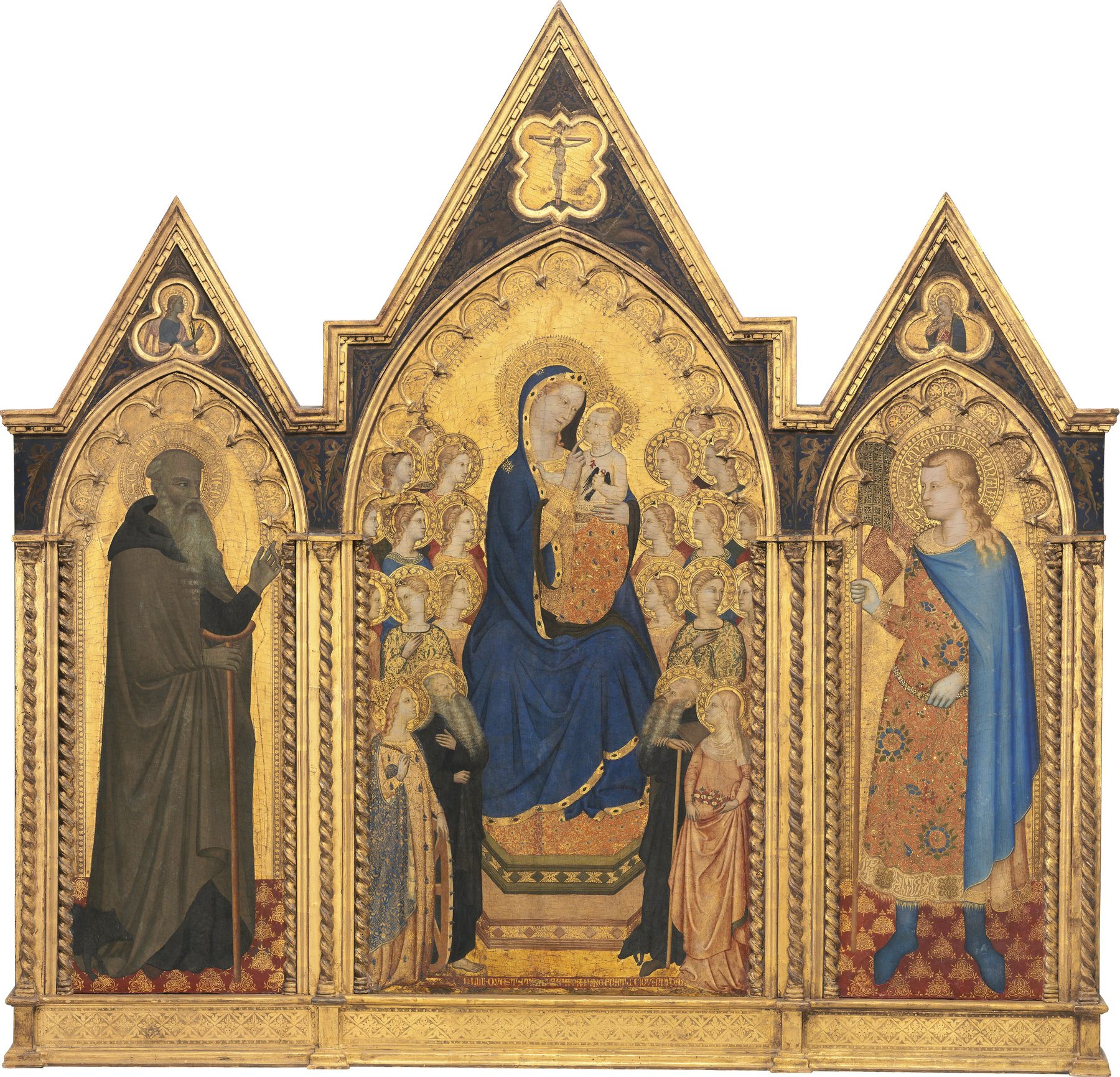
Duccio di Buoninsegna offers the clearest challenge to a one-line Florentine history. Documented in Siena from 1278, he undertook tasks ranging from decorating the Commune's account chests to designing the cathedral's immense stained-glass window. A Florentine confraternity commissioned his Rucellai Madonna in 1285. He was therefore a civic worker, monumental designer and painter for both public and intimate devotion.[20]
His art remains closely engaged with Byzantine types, but its humanity does not depend on becoming Giottesque. In a small Madonna and Child now at the Metropolitan Museum, a parapet marks the threshold between sacred image and viewer. The Child reaches toward his mother's veil; Mary's delicate face carries awareness of his future death. Gold, contour and controlled colour make proximity feel precious rather than spatially neutral.[19]
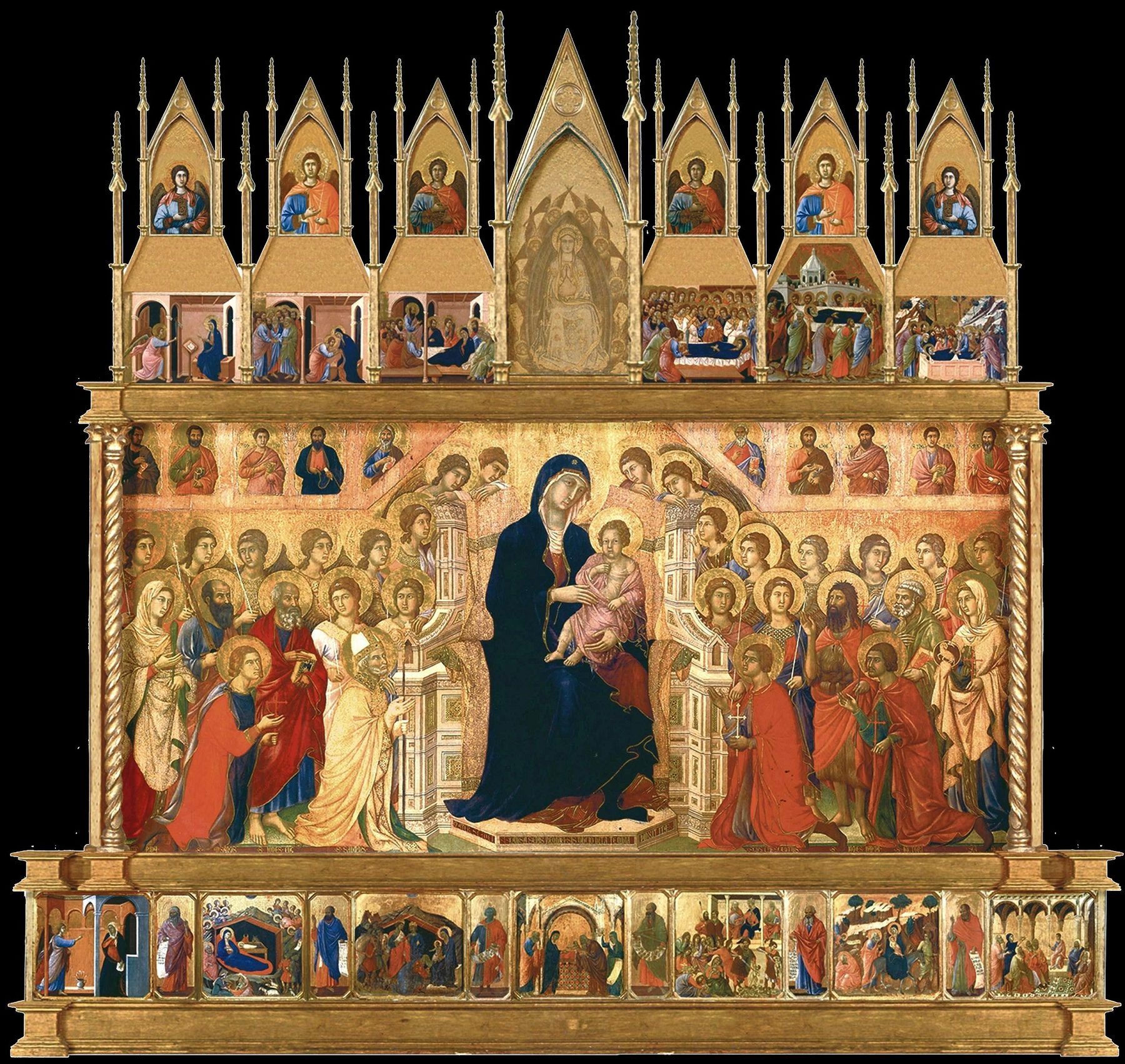
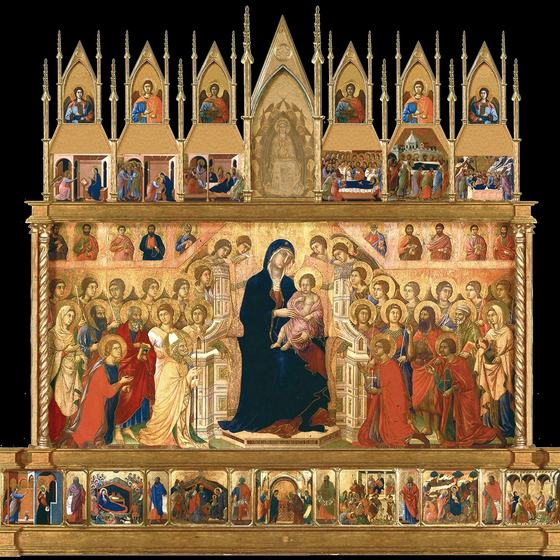
The great Maestà made between 1308 and 1311 for the high altar of Siena Cathedral was painted on both sides. On the front, the Virgin and Child sit within a court of angels and saints. On the reverse, twenty-six principal scenes narrate Christ's Passion, while predella and pinnacle panels extended the histories. More than forty figures occupied the front and nearly eighty the larger narrative ensemble described by the cathedral museum.[21]
Its double-sided form answered movement through the cathedral and the differing positions of clergy and laity. The enthroned Virgin was also Siena's protector. Sacred community and civic identity met in her court. The altarpiece's installation was a public event, but modern viewers encounter it dismantled, with panels distributed among museums. A predella Annunciation in London can be studied at close range, yet its original rhythm and architectural relation must be reconstructed.[22]
Duccio's Passion scenes build space flexibly. Architecture opens, tilts or compresses according to narrative need. Crowds form patterned masses, then separate around a gesture. The solemn sequence can pause for intimate exchanges. His modernity lies not in approaching Giotto by another route, but in making inherited line, colour and sacred splendour newly responsive to experience.[23]
Siena's painting would shape Europe through Duccio's successors. The city's alternative should not be stereotyped as decorative, feminine or conservative beside a rational, masculine Florence. Sienese painters explored political allegory, complex architecture, bodily emotion, international travel and workshop identity with exceptional ambition.
Simone Martini and the Lorenzetti brothers
Simone Martini may have trained in Duccio's orbit, but developed an unmistakable language of slender figures, tense contour, luxurious surface and social precision. His commissions linked Siena's government, cathedral and charitable institutions to Assisi and ultimately the papal court at Avignon. Working with relatives and assistants, he made Sienese art mobile across political borders.[25]
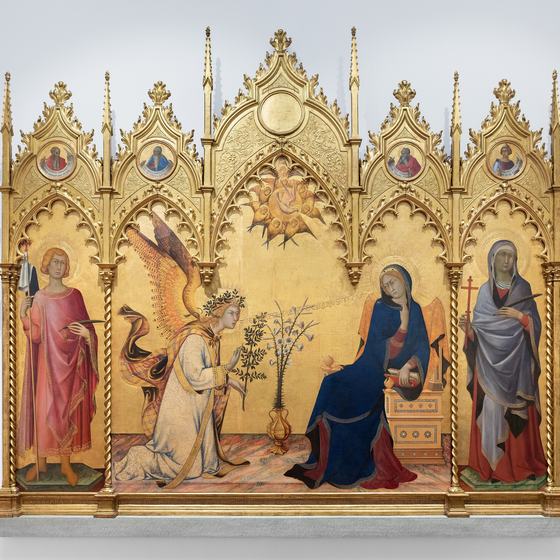
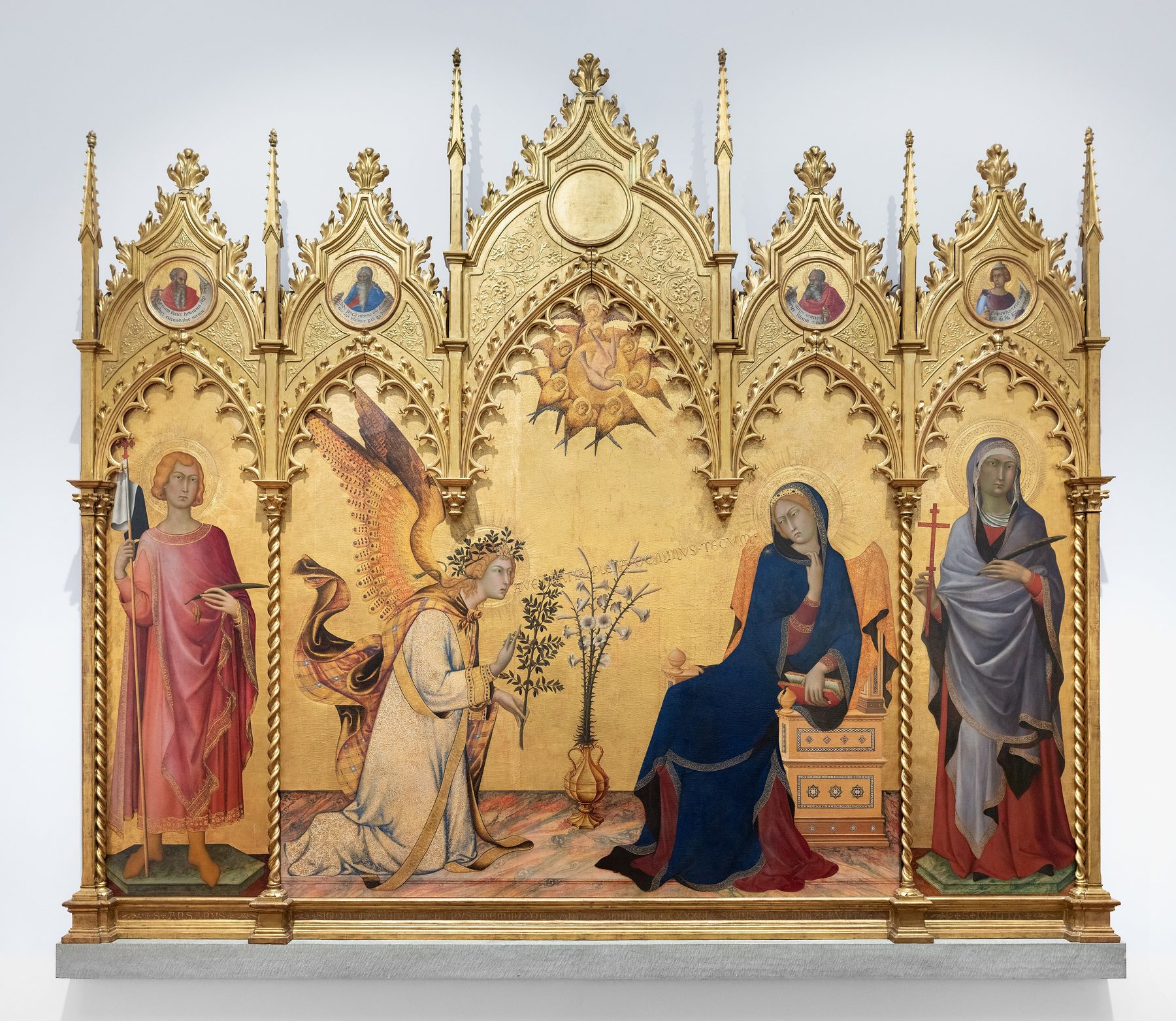
The Annunciation of 1333, signed by Simone and Lippo Memmi, was painted for an altar in Siena Cathedral. Gabriel arrives with mantle and wings still moving. Raised words of greeting travel across the gold toward Mary. She recoils, draws her blue mantle around herself and keeps a finger in her book. The space is shallow, but the encounter has duration: arrival, speech, disturbance and consent are held together.[24]
Gold is active throughout. It carries the inscription, halos, divine light and the costly honour appropriate to the cathedral. The angel's patterned cloak and vase of lilies heighten material beauty while his forward movement breaks ceremonial stillness. Psychological force does not require the heavy bodies associated with Giotto.
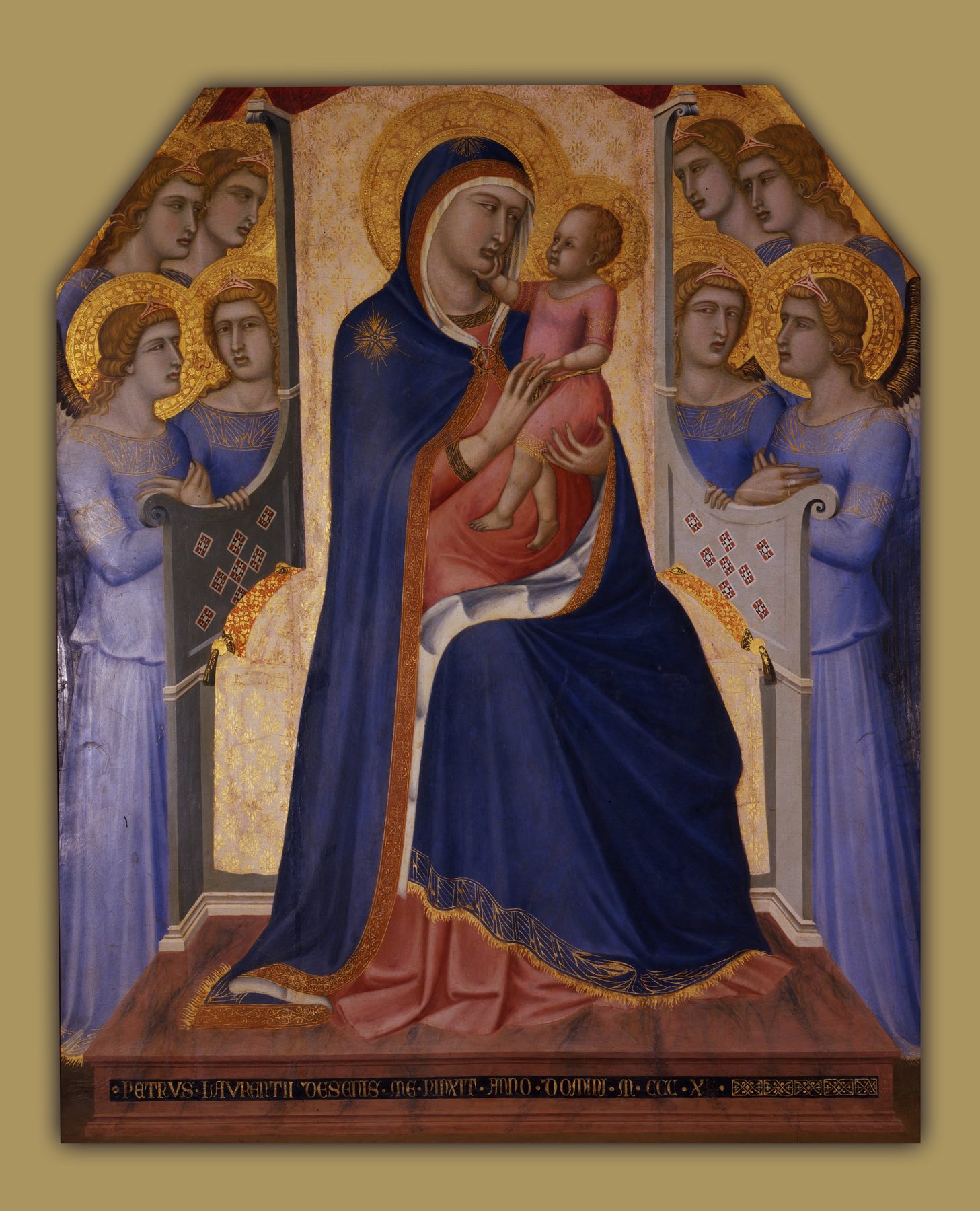
Pietro Lorenzetti learned from Duccio while responding to Giotto and Giovanni Pisano. In his mature Madonna, the marble throne constructs a measured enclosure and light seems to come from one side. Christ touches Mary's face and fingers, making theology of incarnation tangible through affection. The inscribed date has been heavily restored, a small warning that even apparently firm documentary evidence has a material history.[28]
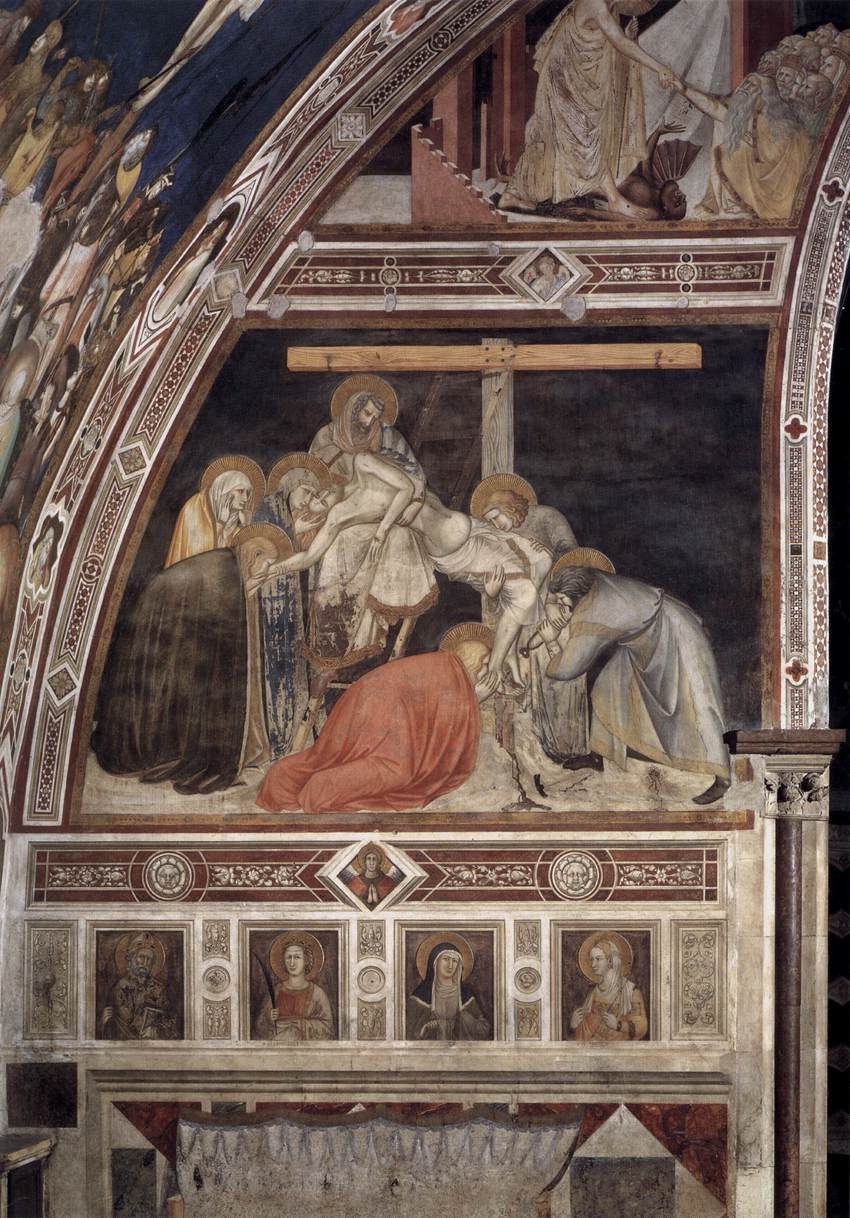
Pietro's work at Assisi brings crowded architecture and extreme emotion into Franciscan narrative. The bodies of mourners, soldiers and apostles have density, yet their movement can be angular and urgent. National Gallery of Art scholarship describes his art through Duccio's inheritance, Giotto's monumentality and Giovanni Pisano's expressive charge without reducing it to any one source.[29]
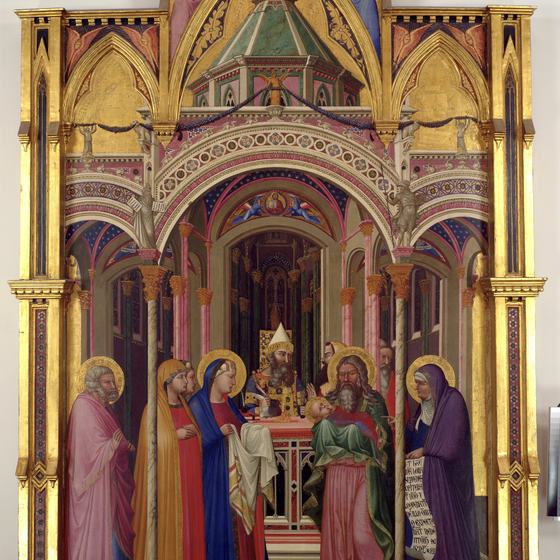
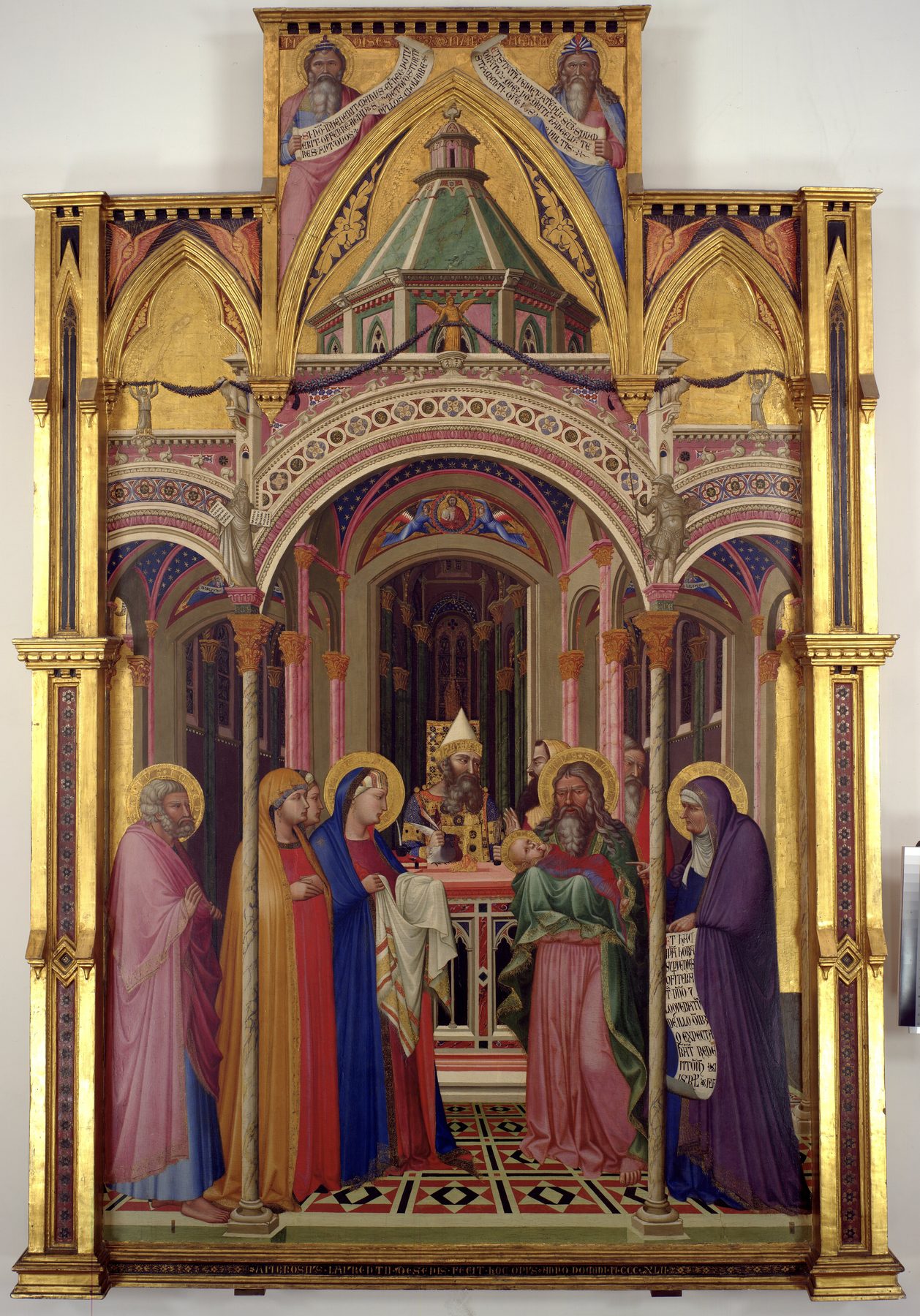
Ambrogio Lorenzetti pursued different experiments. In the Presentation at the Temple of 1342, exterior and interior appear at once. Coloured floor lines converge, columns divide groups and the infant sucks his fingers amid ritual solemnity. The building is not geometrically unified according to later perspective, but it creates a legible, richly imagined sacred place.[26]
His Saint Nicholas panels interweave ships, ports, bedrooms, streets and church interiors. Separate episodes can occupy one architecture, and narrative moves vertically as well as laterally. Everyday details do not secularise the miracle; they give divine action a social world in which grain travels, children sleep and bishops are chosen.[30]
Simone, Pietro and Ambrogio are often gathered as Duccio's heirs, but “school” should not imply obedient repetition. Each developed a distinct relation among surface, space and story. Their workshops travelled, collaborated and competed. Their separate achievements warrant the dedicated history of Sienese painting, rather than a footnote to Florence.
Assisi as a meeting place
The Basilica of San Francesco at Assisi is one of the period's great crossroads. Built around the burial and cult of Francis, its upper and lower churches brought architecture, stained glass and multiple painting campaigns into an international Franciscan centre. UNESCO identifies work associated with Cimabue, Giotto, Simone Martini and Pietro Lorenzetti as fundamental to European artistic development.[38]
Assisi is not securely divided into isolated masterpieces by famous men. Workshops overlapped; surfaces were damaged; later accounts assigned names; scholars continue to debate whether Giotto personally painted the upper-church Francis cycle and which hands belong to Roman or Tuscan masters. “Giotto and workshop” can be a responsible conclusion rather than evasive wording.
The site's value lies partly in exchange. Cimabue's dramatic transept paintings, Roman spatial and colour traditions, the Francis narratives, Simone's courtly Saint Martin cycle and Pietro's Passion scenes coexist within one institution. The basilica made experiment visible to travelling friars, patrons and artists.
Franciscan meaning also shaped form. Episodes from a recent saint's life brought sacred history close to recognisable towns, interiors, crowds and bodies. Emotional immediacy answered preaching and meditation. Yet Franciscan poverty existed within a building of immense artistic expense. That tension belongs to the art's function, not outside it.
Patrons, cities and religious orders
The period's changes cannot be explained by artists alone. Communes commissioned images that embodied public order; cathedral organisations managed work across generations; guilds funded patron saints; confraternities created collective devotional objects; families decorated chapels; popes and kings carried artists between courts.[39]
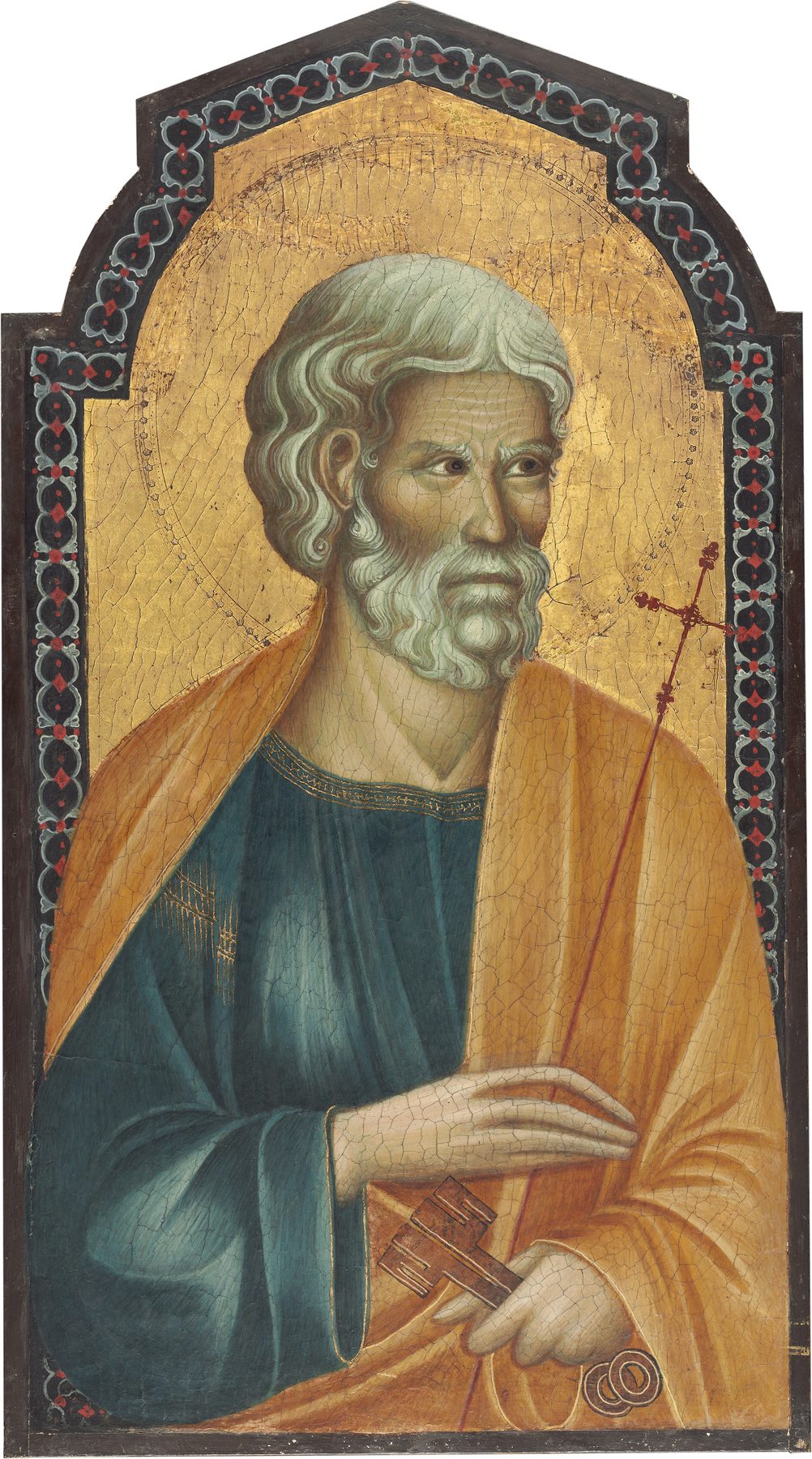
Different patrons could choose different visual languages at the same moment. A Florentine panel by Grifo di Tancredi retains an intentionally archaising format while Giotto's influence was already present. Its scale and incised gold suggest an important commission, not an uninformed failure to become modern.[48] Tradition might convey doctrinal reliability, institutional memory or a patron's desired form of devotion.
Mendicant churches created new surfaces and audiences. Preaching naves, screens, chapels and chapter houses required images at varied scale. Franciscans emphasised Christ's humanity, poverty and the life of their founder; Dominicans joined learned preaching to devotion; Augustinians and female communities built their own visual programmes. Their positions were never perfectly uniform.[40]
Women enter the records unevenly. Nuns prayed before panels, convents commissioned furnishings, widows and wives participated in family patronage, and women worked within households and workshops whose contracts often preserve male names. Absence from signatures is not absence from production or use. At the same time, evidence does not permit every anonymous object to be reassigned to a named woman.
The image could serve several publics. A Maestà belonged to liturgy, institutional prestige and civic protection. A chapel fresco aided prayer while securing family memory. A communal allegory instructed officials within their meeting room. “Religious” and “political” are not exclusive modern boxes for these works.
How panel paintings were made
A gold-ground panel began as carpentry. Poplar boards were joined, shaped and often braced. Layers of animal-glue size isolated the wood; linen could reinforce vulnerable joins; repeated gesso coats created a brilliant white surface. The painter or workshop established the design through underdrawing and incised construction.[41]
Egg yolk mixed with pigment made tempera. It dried quickly, encouraging small, controlled strokes and layered modelling. Expensive blue might use ultramarine derived from lapis lazuli, though other blues were available. Colour choice belonged to contracts, symbolism, supply and workshop economy as well as artistic preference.
For gilding, red-brown bole was laid over gesso. Extremely thin gold leaf was applied, burnished and patterned with punches or freehand incision. Candlelight activated the surface. Punch tools can now help scholars associate separated panels with workshops, just as fingerprints of manufacture can survive when an altarpiece's frame and original church are gone.[41] [43]
Large works were collaborative constructions. A master could design, paint important passages and supervise assistants who prepared grounds, repeated figures, laid gold or completed secondary areas. Carpenters and frame makers helped determine the final architecture. The modern desire to separate one authentic hand from “workshop” can obscure how such objects came into being.
Panel painting expanded greatly from the middle of the thirteenth century. Monumental crosses and altarpieces served churches; diptychs and small Virgins supported close devotion. Formats changed with screens, altars and private practice.[42] What survives in a museum may be a pinnacle, shutter, predella or sawn fragment whose neighbours are continents away.
Fresco, architecture and narrative time
Fresco is inseparable from its wall. Pigments suspended in water are applied to fresh lime plaster and become bound as it sets; some details and colours may be added after drying. Each day's area of plaster must be planned, transferred and painted before it becomes unworkable. The surface records the organisation of labour as well as the image.
A cycle involves architecture twice: the wall is its physical support, and painted buildings organise the story. Doors, arches and corners can align real and fictive space. Windows interrupt sequences; light enters from actual openings; an altar gives one direction greater sacred weight. A photograph of a single scene removes these relationships.
Padua's eight surviving Trecento complexes show how the medium evolved through different patrons and functions. Frescoes appeared in private chapels, public halls, baptisteries, palaces and religious houses. Spatial investigation and emotional narrative became a city-wide conversation rather than a recipe handed down unchanged from Giotto.[15]
Space, emotion and gold
Proto-Renaissance “naturalism” is not one feature. It can mean a body modelled by light, a mother touching her child, a crowd arranged around an event, a room that contains people, or an animal observed in motion. Cimabue, Giotto, Duccio and the Lorenzetti brothers balance these qualities differently.[1]
Emotion is similarly structured. The mourners in Giotto's Lamentation do not display spontaneous modern psychology captured by chance. Pose, gesture, direction and repetition organise grief for viewers who knew the sacred story. Artifice makes feeling communicable.
Space before linear perspective is not incorrect space. Duccio can enlarge a figure because sacred or narrative focus requires it. Ambrogio can show the inside and outside of a temple together. Giotto can angle a platform or building to make bodies share a ground. Coherence is measured by the work's purpose, not only by whether orthogonals meet at one point.
Gold belongs within that spatial intelligence. It can deny ordinary atmosphere while making the sacred materially present. Punchwork catches changing light; haloes overlap bodies; inscriptions become visible speech. Simone Martini uses the gold field as surface, setting and divine medium at once.[24]
These artists did not gradually remove gold until reality appeared. They decided where heavenly splendour, physical setting and devotional nearness should meet. Later Renaissance rooms would answer different theological, institutional and technical needs.
Civic art and Good Government
Ambrogio Lorenzetti's Allegory and Effects of Good and Bad Government, painted in 1338–1339, surrounds the room in which Siena's Nine governed. Justice, Concord, Peace and other virtues join a personification of the Commune. Citizens hold a cord descending from Justice, making agreement a visible political action.[27]
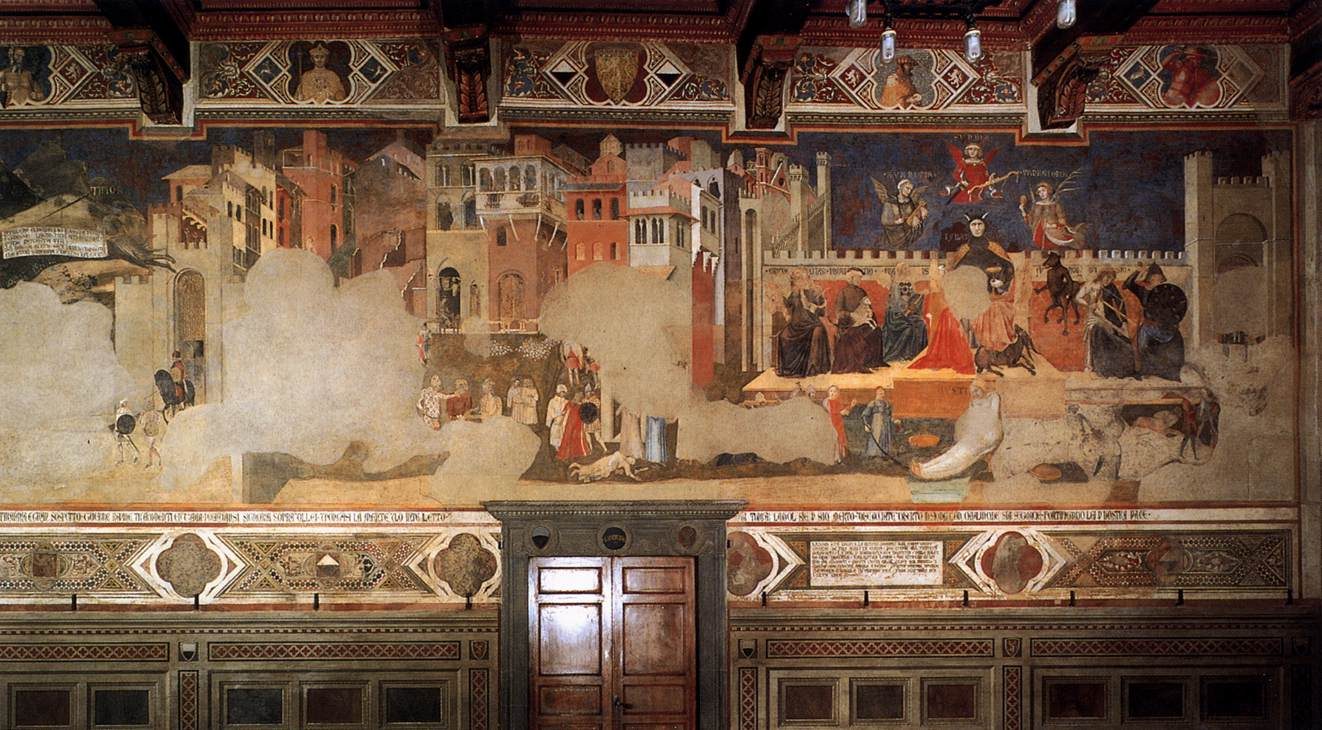
On the adjoining wall, a thriving city and countryside show the effects of order: people trade, build, teach, dance, travel and cultivate land. Security appears above the roads. The opposite vision of tyranny damages both city and territory. The cycle is an argument addressed to governors, not a neutral panorama or the first modern landscape.
Its worldly detail does not mark a departure from allegory. Personified virtues and observed labour depend on one another. Civic well-being is made visible through bodies, buildings and fields. The work expands the possible subject of monumental painting while retaining a medieval ethical cosmos.
Plague and the later Trecento
The Black Death reached Italy in 1348 and killed an immense part of the population. Workshops lost masters, assistants and clients; families redirected gifts; labour conditions changed. Siena's vast New Cathedral extension, begun in 1339, was abandoned after the plague, leaving architecture itself as evidence of interrupted ambition.[21] [46]
Both Lorenzetti brothers disappear from records after 1348 and may have died in the epidemic, but exact circumstances are unknown. Giotto and Simone had already died. A generation of younger painters inherited celebrated languages within a radically changed society.
Older scholarship sometimes argued that plague trauma produced a uniform turn toward conservative, hieratic or gruesome art. Devotion certainly responded to mortality, and fourteenth-century Europe faced famine and war as well as disease.[44] Yet style does not follow catastrophe mechanically. Regional workshops recovered differently; older formats remained meaningful; new collaborations and migrations appeared.
A 1354 triptych involving Puccio di Simone and Allegretto Nuzi, artists from different places, shows post-plague production continuing through unusual collaboration.[45] Later Florentine, Sienese, Venetian and Paduan painters revised earlier models rather than simply retreating from innovation. The Uffizi's Trecento collection makes this plurality visible, ranging from Giottesque volume to Sienese line and Venetian colour.[47]
Workshops, attribution and survival
Many artists in this period are known through fragments and documents that do not align neatly. Cimabue has one securely documented surviving mosaic. Giotto's name accumulated paintings by followers. Duccio's Maestà was dismantled. The identity of hands at Assisi remains disputed. Workshop is not a lesser category; it describes the normal collective conditions of large commissions.
Technical study has transformed attribution. Infrared reflectography reveals underdrawing. Wood grain can reconnect separated scenes. Gesso edges show where frames once sat. Repeated punches can identify tools used across an ensemble. X-radiography and pigment analysis distinguish alteration from original design. National Gallery research repeatedly revises early Italian catalogues through this combination of looking, documentation and material evidence.[43]
Survival is selective. Frescoes collapsed, faded or were painted over. Panels were cut for sale. Church screens were removed, changing the location and visibility of altarpieces. Napoleonic seizure transferred Cimabue's Pisan Maestà to Paris. Florence Cathedral's medieval façade was dismantled, displacing Arnolfo's sculpture.[9] [35]
Modern museums allow close comparison but create a new fiction: isolated, evenly lit masterpieces by individual names. Restoring imagined height, candlelight, liturgical movement, workshop collaboration and patronage makes the works stranger—and more intelligible.
People and places to know
Nicola Pisano and Pisa
Nicola's 1260 Baptistery pulpit gives ancient bodily forms new Christian narrative work. Pisa's cathedral complex provided both commission and material encounter with Roman sculpture.[31]
Pietro Cavallini and Rome
Cavallini built monumental figures through colour, volume and Rome's ancient and Early Christian inheritances. His uncertain chronology is part of why Florence-centred stories must remain open.[36]
Giotto and Padua
Giotto coordinated weight, gesture, setting and narrative with exceptional force. Scrovegni preserves his art as an environment rather than a collection of famous scenes.[14]
Ambrogio Lorenzetti
Ambrogio explored architecture, daily observation and political allegory. His art demonstrates that spatial experiment could serve cathedral ritual and communal government alike.[26] [27]
Further people and places
Giovanni Pisano
Giovanni intensified bodily torsion, drilled shadow and dramatic gesture in pulpits and cathedral sculpture. His art was designed to act through distance, architecture and preaching.[33] [34]
Simone Martini
Simone connected Siena, Assisi and Avignon. His line, surface and psychological timing helped Sienese painting become an international language.[25]
Pietro Lorenzetti
Pietro joined bodily density to urgent expression, creating powerful panels and Franciscan fresco narratives through a synthesis that remained his own.[28] [29]
Assisi
More than one master's destination, Assisi brought Franciscan patronage and several regional traditions into a shared, still-contested monument.[38]
Major artists directory
| Name | Nationality | Key Works |
|---|---|---|
| Ambrogio Lorenzetti | Italian | Presentation in the Temple, Effects of Good Government in the City, Bad Government and its Effects |
| Arnolfo di Cambio | Italian | Pope Boniface VIII |
| Cimabue | Italian | Santa Trinita Maestà, Virgin and Child with Two Angels |
| Duccio | Italian | Maestà, Annunciation |
| Giotto | Italian | Ognissanti Madonna, Lamentation, Scrovegni Chapel interior |
| Giovanni Pisano | Italian | Pulpit of Sant’Andrea |
| Nicola Pisano | Italian | Pisa Baptistery Pulpit |
| Pietro Cavallini | Italian | Last Judgement |
| Pietro Lorenzetti | Italian | Madonna and Child with Angels, Deposition from the Cross |
| Simone Martini | Italian | Annunciation with Saints Ansanus and Margaret |
How to look at Proto-Renaissance art
First identify the original job. Was the object above an altar, on a screen, inside a family chapel, around a pulpit or in a government room? Function explains scale, material, repetition and what kinds of viewers could approach.
Look at bodies without scoring them for realism. Notice where weight falls, how cloth reveals or conceals anatomy, and whether gesture carries speech, prayer, grief or authority. Compare the emotional means of Giotto's compact figures with Simone's tensile line.
Follow space as a reader. Which architecture separates episodes? Can inside and outside appear together? Does a diagonal guide attention? A space may be inconsistent as geometry and exceptionally clear as narrative.
Treat gold as material. Watch for punchwork, incision, inscriptions and overlapping haloes. Imagine reflected candlelight. Gold can make a surface more active, not less sophisticated.[41]
Finally, inspect the object's edges. A sawn side, missing pinnacle or detached fresco records later history. Ask which workshop made it, which institution paid, why attribution changed and how the museum altered its encounter.
Frequently Asked Questions
Not always. Treccani defines the Italian word as a less common synonym for the first or Early Renaissance, approximately 1401–1500. For thirteenth- and fourteenth-century art, Duecento, Trecento and late medieval Italian art are often clearer.[2]
They created powerful forms of pictorial space through overlap, architecture, scale, diagonals and converging surfaces. They did not use the systematic mathematical linear perspective formulated in the fifteenth century. Their spaces should be judged by narrative and devotional purpose as well as geometry.[15] [26]
Discussion
Which description best helps you see this art: Proto-Renaissance, Trecento, or late medieval Italian? When you look at a gold-ground panel or fresco cycle, does its sacred purpose make its physical world feel more distant—or more immediate?
Reader Insights
Begin with the altar, chapel, pulpit, cathedral façade or government room for which the work was made.
Notice weight, gesture, overlap and architecture without scoring the work against later mathematical perspective.
Look for punchwork, incision, inscriptions and haloes, then imagine how candlelight activated the surface.
Join the Conversation
Which description best helps you see this art: Proto-Renaissance, Trecento, or late medieval Italian? Share your view below.
References
- Italian Painting of the Later Middle Ages — Metropolitan Museum of Art, metmuseum.org. View Source
- Protorinascimento — Treccani, (in Italian). View Source
- A primer for Italian Renaissance art — Smarthistory, smarthistory.org. View Source
- The Art of Renaissance Europe — Metropolitan Museum of Art, metmuseum.org. View Source
- The Arts of Byzantium — Metropolitan Museum of Art, resources.metmuseum.org. View Source
- Tra umano e divino: Cimabue e la Maestà di Santa Trinita — Gallerie degli Uffizi, (in Italian). View Source
- Cimabue, The Virgin and Child with Two Angels — National Gallery, London, nationalgallery.org.uk. View Source
- A New Look at Cimabue — Musée du Louvre, presse.louvre.fr. View Source
- La Vierge et l'Enfant en majesté entourés de six anges — Musée du Louvre, (in French). View Source
- Purgatorio, Canto XI, lines 91–108 — Princeton Dante Project, (Italian with English translation). View Source
- Cenni di Pepe, detto Cimabue — Treccani, Dizionario Biografico, (in Italian). View Source
- Non per foco ma per divin’arte — Gallerie degli Uffizi, uffizi.it. View Source
- Giotto, Ognissanti Maestà — Gallerie degli Uffizi, (in Italian). View Source
- The Scrovegni Chapel — Comune di Padova, cappelladegliscrovegni.it. View Source
- Padua’s fourteenth-century fresco cycles — UNESCO World Heritage Centre, whc.unesco.org. View Source
- Giotto — National Gallery, London, nationalgallery.org.uk. View Source
- Giotto, Madonna and Child, c. 1310/1315 — National Gallery of Art, Washington, nga.gov. View Source
- Cennino Cennini, Il libro dell'arte — Wikisource, (in Italian). View Source
- Duccio's Madonna and Child — Metropolitan Museum of Art, metmuseum.org. View Source
- Duccio di Buoninsegna — National Gallery of Art, Washington, nga.gov. View Source
- Museo dell’Opera — Opera Duomo Siena, (in Italian). View Source
- Duccio, The Annunciation — National Gallery, London, nationalgallery.org.uk. View Source
- Duccio and the Origins of Western Painting — Metropolitan Museum of Art, resources.metmuseum.org. View Source
- Simone Martini and Lippo Memmi, Annunciazione e i santi Ansano e Massima — Gallerie degli Uffizi, (in Italian). View Source
- Simone Martini — National Gallery, London, nationalgallery.org.uk. View Source
- Ambrogio Lorenzetti, Presentazione al Tempio — Gallerie degli Uffizi, (in Italian). View Source
- Ambrogio Lorenzetti, Allegoria del Buon Governo — Museo Civico Siena, (in Italian). View Source
- Pietro Lorenzetti, Madonna col Bambino in trono e angeli — Gallerie degli Uffizi, (in Italian). View Source
- Pietro Lorenzetti — National Gallery of Art, Washington, nga.gov. View Source
- Ambrogio Lorenzetti, Storie di San Nicola — Gallerie degli Uffizi, (in Italian). View Source
- Pulpito del Battistero di Pisa — Pisa Miracles Guide, (in Italian). View Source
- Pisa Cathedral — Opera della Primaziale Pisana, opapisa.it. View Source
- Giovanni Pisano, Pulpito 1301 — Catalogo Generale dei Beni Culturali, (in Italian). View Source
- Workshop of Giovanni Pisano, Pilaster of Angels from a Pulpit — Metropolitan Museum of Art, metmuseum.org. View Source
- Arnolfo di Cambio, Pope Boniface VIII — Opera del Duomo Firenze, duomo.firenze.it. View Source
- Pietro Cavallini — Treccani, (in Italian). View Source
- Le città dei papi: Roma e Avignone — Treccani, (in Italian). View Source
- Assisi, the Basilica of San Francesco and Other Franciscan Sites — UNESCO World Heritage Centre, whc.unesco.org. View Source
- Florence in the Late Gothic period — Smarthistory, smarthistory.org. View Source
- Medieval Art: A Resource for Educators — Metropolitan Museum of Art, resources.metmuseum.org. View Source
- An Eye for Art — National Gallery of Art, Washington, nga.gov. View Source
- Italian Panel Painting of the Duecento and Trecento — National Gallery of Art, Washington, nga.gov. View Source
- The Italian Paintings before 1400 — National Gallery, London, nationalgallery.org.uk. View Source
- European Art of the Fourteenth Century — J. Paul Getty Museum, shop.getty.edu. View Source
- Puccio di Simone and Allegretto Nuzi, Saint Venantius, 1354 — National Gallery of Art, Washington, nga.gov. View Source
- Cathedral Museum — Opera Duomo Siena, operaduomo.siena.it. View Source
- Trecento — Gallerie degli Uffizi, (in Italian). View Source
- Grifo di Tancredi, Saint Peter — National Gallery of Art, Washington, nga.gov. View Source
- Image references 49–67: open-access reproductions and institutional collection records.
View 19 image sources
01 · commons.wikimedia.org02 · commons.wikimedia.org03 · commons.wikimedia.org04 · commons.wikimedia.org05 · commons.wikimedia.org06 · commons.wikimedia.org07 · commons.wikimedia.org08 · commons.wikimedia.org09 · commons.wikimedia.org10 · commons.wikimedia.org11 · commons.wikimedia.org12 · commons.wikimedia.org13 · commons.wikimedia.org14 · commons.wikimedia.org15 · commons.wikimedia.org16 · commons.wikimedia.org17 · commons.wikimedia.org18 · commons.wikimedia.org19 · commons.wikimedia.org