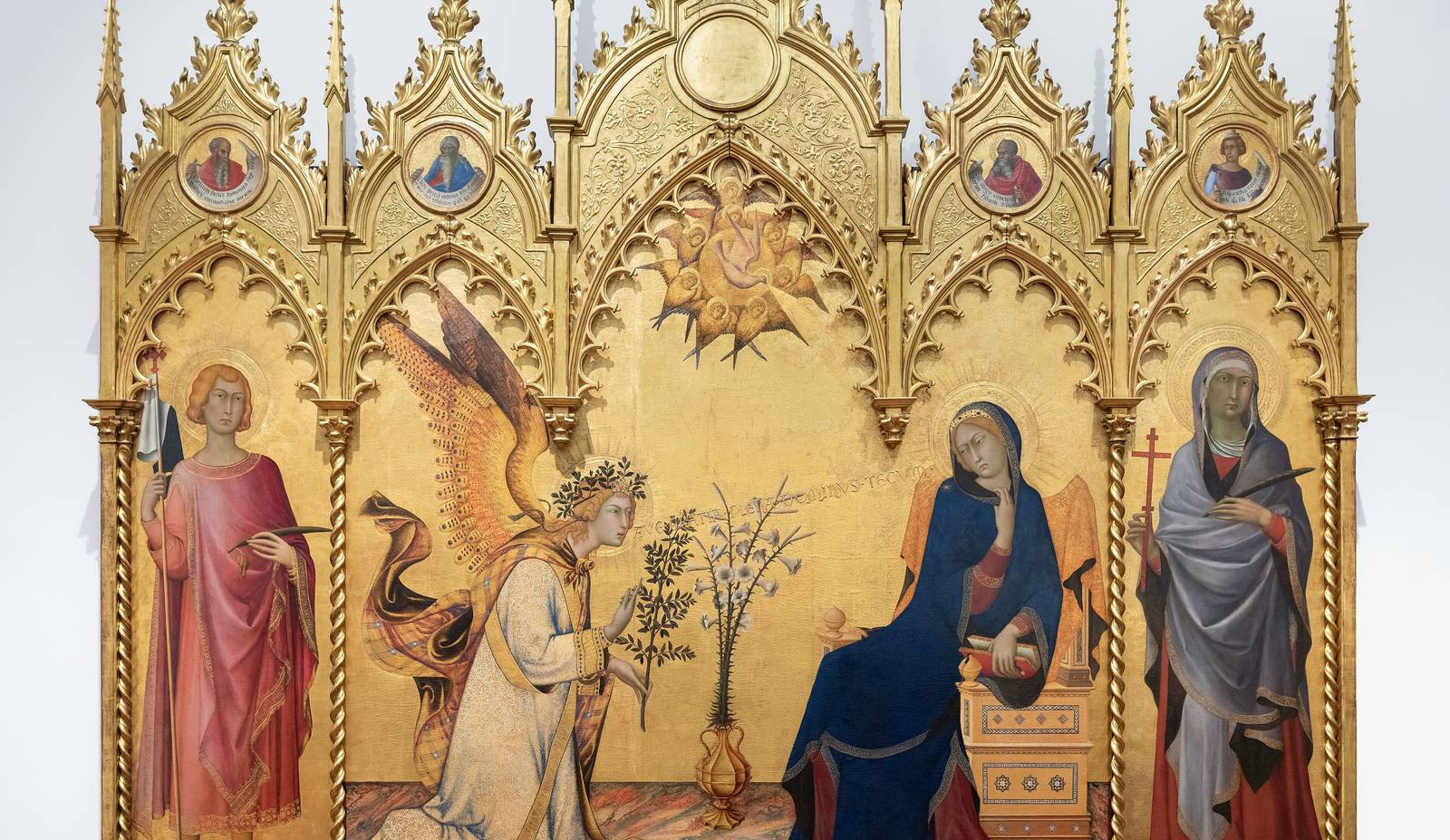
Image reference: Simone Martini and Lippo Memmi, Annunciation with Saints Ansanus and Margaret.
At a Glance
- Core periodc. 1250–1500, with earlier foundations and later continuities
- Principal centreSiena and its territory, with major works in Assisi, Avignon and elsewhere
- Known forgold grounds · expressive line · brilliant colour · Marian devotion · civic murals · complex altarpieces · visionary landscape
- Trecento mastersDuccio · Simone Martini · Pietro Lorenzetti · Ambrogio Lorenzetti
- Fifteenth-century renewalSassetta · Giovanni di Paolo · Sano di Pietro · Vecchietta · Matteo di Giovanni · Neroccio
- Key institutionsSiena Cathedral · Palazzo Pubblico · Santa Maria della Scala · confraternities · religious orders · civic offices
- Best understood asa long, changing urban school—not a uniform style or a story that ends with the Black Death
Contents
- Where the Sienese School fits
- Siena, the Virgin and the commune
- Before Duccio
- Duccio and the Maestà
- Simone Martini
- Pietro and Ambrogio Lorenzetti
- Good and Bad Government
- The Black Death and the myth of decline
- Fifteenth-century renewal
- People and places to know
Where the Sienese School fits
Duccio
Principal careerSimone Martini
Principal careerPietro Lorenzetti
Principal careerAmbrogio Lorenzetti
Principal careerBartolomeo Bulgarini
Principal careerSassetta
Principal careerGiovanni di Paolo
Principal careerSano di Pietro
Principal careerVecchietta
Principal careerMatteo di Giovanni
Principal careerNeroccio de’ Landi
Principal careerFrancesco di Giorgio
Principal careerThe Sienese School was not a club, academy or movement with a manifesto. It is the name later historians gave to a changing artistic culture centred on Siena: a network of workshops, patrons, churches, government offices and neighbouring towns whose painters shared local memories while constantly revising them. Its practical story begins in the mid-thirteenth century and runs through the fifteenth, with important continuities into the early sixteenth. Across that long span, Siena produced monumental altarpieces, intimate devotional panels, frescoed government rooms, painted account-book covers, hospital narratives and manuscript illuminations. “School” is useful only if it leaves room for this variety.[1] [2]
Sienese painting is often introduced as Florence’s elegant opposite: graceful rather than solid, decorative rather than rational, Gothic rather than Renaissance. That contrast is memorable but badly distorts both cities. Sienese artists investigated body, emotion, architecture, landscape and narrative in many different ways. They worked in Florence and Assisi, at the Angevin court in Naples and the papal court at Avignon; they absorbed northern Gothic art, Byzantine images, classical remains and the work of Tuscan neighbours. Recent exhibitions have therefore presented Siena not as a beautiful side road from a Florentine main route, but as one of the places where European painting was fundamentally remade.[3] [4]
The school’s most celebrated century stretches from Duccio’s mature career to the deaths of the Lorenzetti brothers, yet 1348 is not a convincing ending. The Black Death transformed Siena’s population, institutions, workshops and art market, but painting continued in plural forms. In the fifteenth century, Sassetta, Giovanni di Paolo, Sano di Pietro, Vecchietta, Matteo di Giovanni, Neroccio de’ Landi and Francesco di Giorgio produced works that are devotional, visionary, politically alert and technically inventive. A full account of the Sienese School must allow its later painters to be Renaissance artists without requiring them to resemble Florentines.[5] [6]
Siena’s painters belong to several overlapping histories. Their thirteenth- and fourteenth-century work forms part of late medieval Italian art, the Duecento and Trecento, the Gothic world and what English surveys sometimes call the Proto-Renaissance. Their fifteenth-century successors belong just as fully to Renaissance Italy. These categories describe different questions; none should become a border that severs one workshop generation from another.
The city’s greatest early achievements appeared during the communal age. Siena was a wealthy centre on routes linking Rome with northern Italy and Europe. Its government, cathedral works administration, religious orders, confraternities, hospital and mercantile bodies all commissioned images. Palazzo Pubblico, begun under the Government of the Nine at the end of the thirteenth century, made visual culture part of the architecture of rule. In its council rooms, painted figures did not merely embellish walls: they addressed office-holders who made decisions in front of them.[15] [17]
Sienese art also belongs to an international geography. Metalwork, ivory, silk, carpets and manuscripts moved alongside people. Artists accepted commissions beyond the republic, while patrons encountered other visual traditions through diplomacy, pilgrimage and trade. The National Gallery’s 2024–25 survey deliberately placed paintings beside sculpture, metalwork, textile and ivory to show that innovations crossed media. The result is a more porous map than the old division into self-contained regional schools.[2] [48]
The most helpful chronology is therefore elastic. Around 1250, painters in Siena were already creating objects that later generations would treat as civic and sacred precedents. By 1500, distinct local workshops still flourished, although artists increasingly moved within the broader culture of Renaissance courts, engineering, architecture and antiquarian learning. Siena’s identity persisted because it could be quoted, debated and transformed—not because every painter followed one recipe.
Siena, the Virgin and the commune
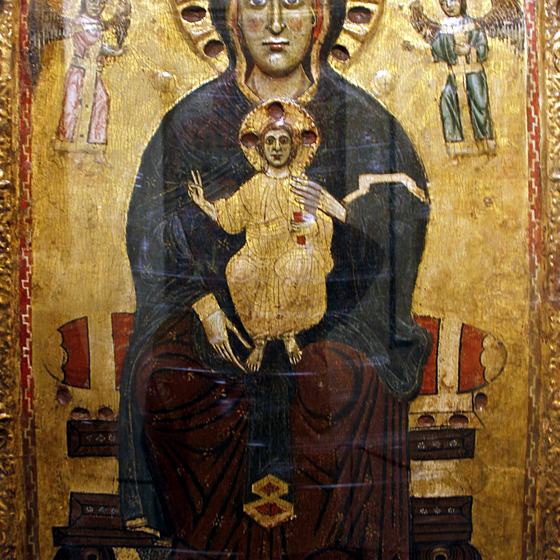
The Virgin Mary was at once a sacred intercessor and a figure through whom Siena imagined its collective life. The link was not abstract. The Madonna degli Occhi Grossi, attributed to the Master of Tressa and painted in the second quarter of the thirteenth century, became associated with the prayer offered before Siena’s victory over Florence at Montaperti on 4 September 1260. The surviving panel is now displayed in the Museo dell’Opera del Duomo as one of the oldest works of the local school. Its historical importance lies as much in what people did before it and remembered about it as in its painted form.[7] [8]
This civic Marian devotion recurs in Siena’s most prominent spaces. Duccio’s Maestà placed the enthroned Virgin above the cathedral’s high altar and asked her, in an inscription on the throne, to be the cause of peace for Siena. The city’s patron saints kneel nearby. Simone Martini’s later Maestà moved a related heavenly court into Palazzo Pubblico, where its written appeals to justice and peace bore upon government. The same image type could therefore act differently within liturgy and civic administration. Repetition was not inertia: changing location, scale, audience and inscription changed the work.
The connection between city and Virgin was neither simple propaganda nor evidence that every Sienese shared one political identity. Governments changed, factions competed, and sacred patrons could be invoked by different institutions. Yet the recurrence of Marian imagery gave Siena a flexible public language. Mary could be queen, mother, protector and judge; the Christ Child could bless a city even as saints, angels and human supplicants created ranks around the throne.
These paintings also remind us that medieval civic identity included religious practice rather than opposing it. Procession, prayer, candles, almsgiving and music were public acts. Images acquired authority through repeated encounters: feast days, crisis, government sessions and ordinary worship. When modern visitors see a gold-ground Madonna isolated on a museum wall, the object’s local memory is easy to miss. In Siena, sacred presence and civic belonging could occupy the same painted surface.
Before Duccio
Duccio is commonly called the father of Sienese painting, but the metaphor should not erase the art already present in the city. The Madonna degli Occhi Grossi, painted Biccherna covers and works associated with Guido da Siena show active workshops before Duccio’s documented career. Dates and attributions in this early material can be difficult: inscriptions may have been altered or interpreted in conflicting ways, and the surviving corpus is only a fraction of what once existed.
The language available to those painters included Byzantine icons and Italian adaptations of them. Gold grounds, frontal enthroned figures and patterned draperies were not the residue of an art incapable of observation. They carried sacred authority, material value and recognisable iconography. At the same time, Tuscan artists encountered Gothic line, southern Italian imagery, classical sculpture and local experiments in body and narrative. Siena’s medieval encyclopaedia history describes the city’s early fourteenth-century painting as a field in which Duccesque invention, Giottesque spatial ideas and the work of Simone and the Lorenzetti interacted rather than forming sealed camps.[6]
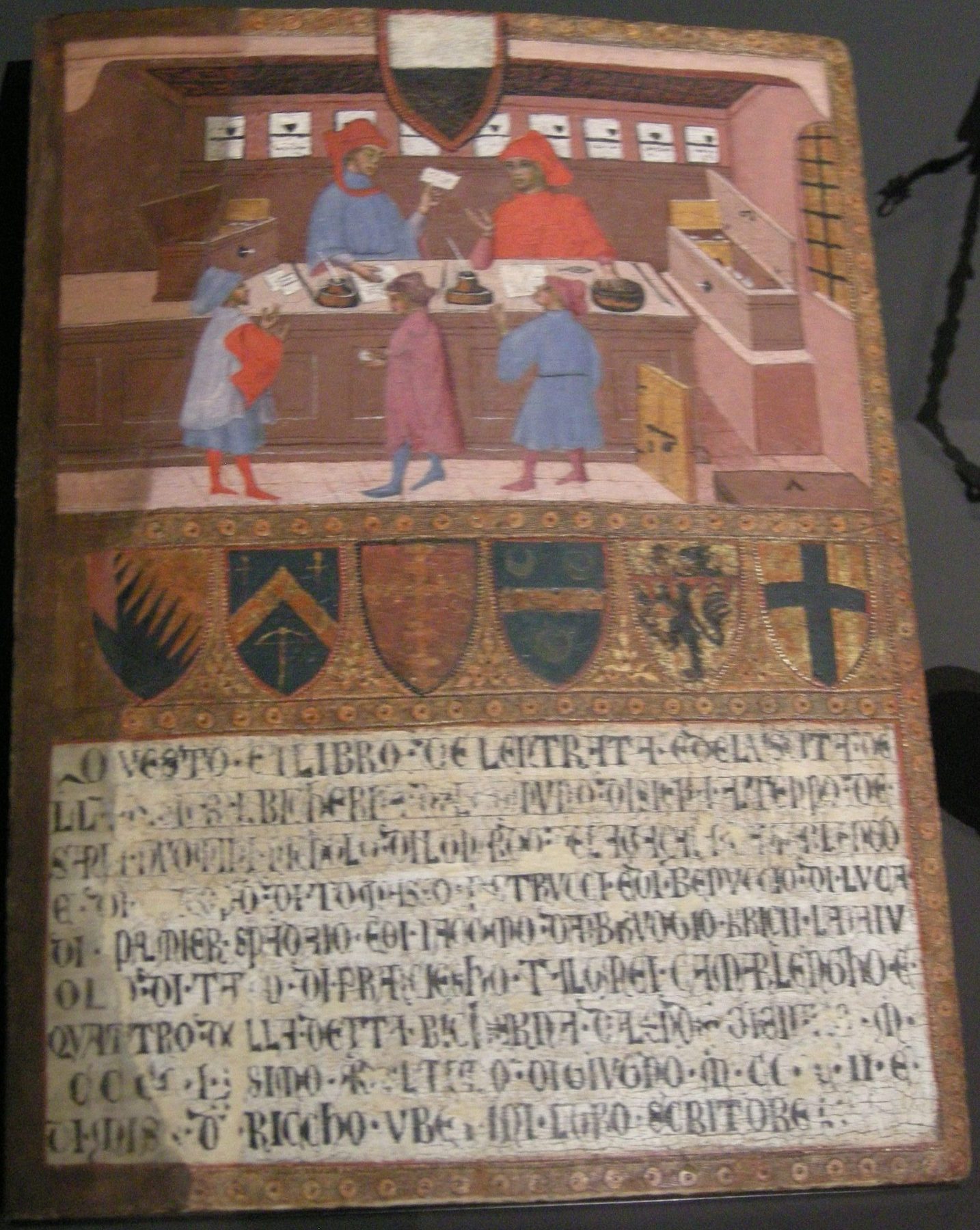
Early civic commissions are particularly revealing. From 1257, officials began asking painters to decorate wooden covers for the financial registers of the Biccherna. A humble administrative binding became a visible record of office, identity and sometimes event. These small works establish a long Sienese habit: images could move between sacred, documentary and political functions, while leading artists might work for institutions that modern categories separate into “art” and bureaucracy.[30]
Duccio and the Maestà
Duccio di Buoninsegna is documented from 1278 and was active as a painter, civic designer and maker of sacred images. His early debt to Byzantine art was profound, but his work cannot be described as the passive survival of an older manner. He made contours soften and tighten around bodies; colour moves through lilac, rose, blue and green; hands touch with extraordinary delicacy; faces register hesitation, grief or attention. His small Madonna and Child now at the Metropolitan Museum was made for close private devotion. Candle burns on its lower edge record use, and the fictive parapet brings mother and child towards the beholder’s world.[10] [11]
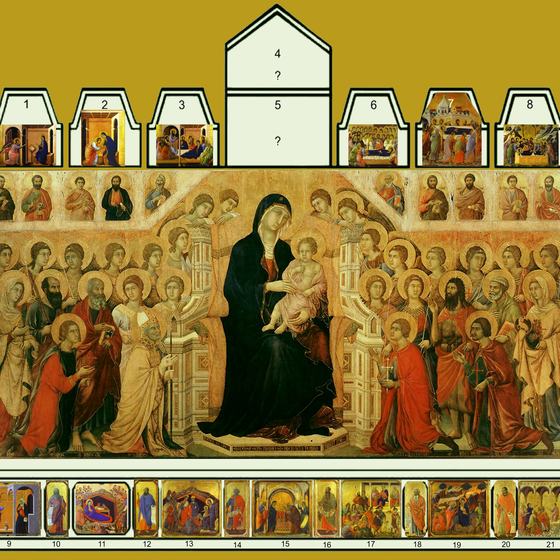
Duccio’s largest surviving undertaking was radically different in scale and function. Commissioned for Siena Cathedral around 1307–08 and completed in 1311, the Maestà was a vast, double-sided altarpiece, approximately five metres square. On the principal face, the Virgin and Child sat within a court of saints and angels. The reverse and subsidiary levels contained an extensive narrative of Christ and the Virgin. Clergy and lay worshippers encountered different aspects of an object built to work in space, not a single frontal picture.[9]
On 9 June 1311, the altarpiece travelled from Duccio’s workshop to the cathedral in a ceremonial procession. A later chronicle describes bishop, clergy, commune officials, women and children participating; contemporary payments to musicians support the account. Shops closed, bells sounded, lights accompanied the work and alms were distributed. The event made completion of an altarpiece into an action by the city. It also makes clear why “style” alone cannot explain the Maestà: movement, sound, institutional representation and public memory belonged to its meaning.[9]
Look closely at the enthroned Virgin and the narrative panels and two kinds of pictorial intelligence appear. The central court uses hierarchy, symmetry and gold to establish sacred order, but individual heads turn, fabrics vary and the Christ Child shifts within his mother’s hold. The small stories use buildings, rocks, doors and crowds to organise time. Space stretches or compresses according to the emotional and theological needs of each episode. Duccio was not approaching a single solution that later linear perspective would complete. He created many provisional stages on which bodies could meet, depart, betray, mourn and recognise.
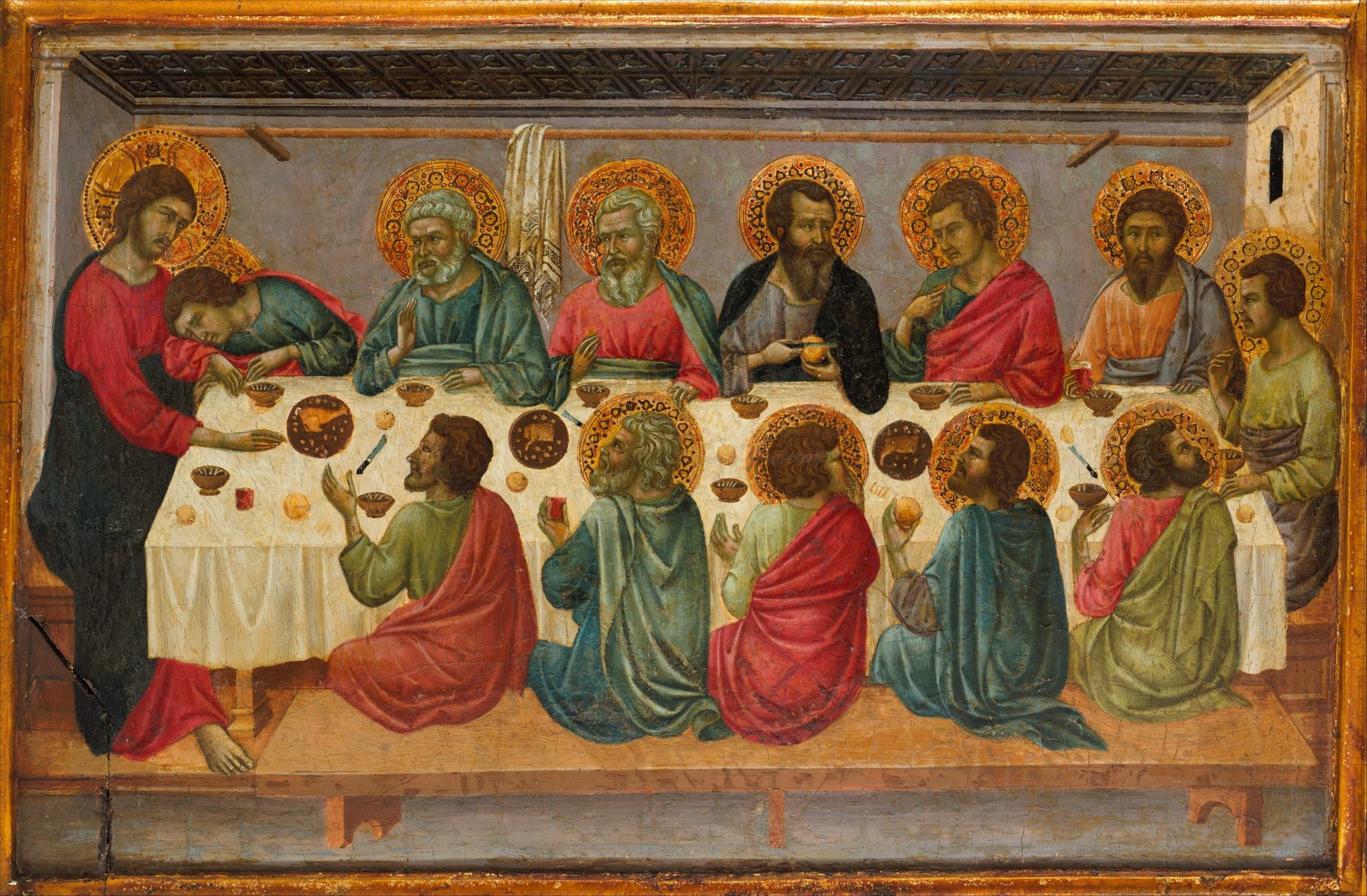
The Maestà was also collaborative. A commission of this magnitude required prepared panels, frames, assistants, repeated figure types and coordinated labour. Duccio’s workshop trained or influenced an exceptional generation. Ugolino di Nerio, for example, adopted the master’s clarity and narrative structures while developing a more enamel-like hardness of form. To call such artists followers is useful, but it should not turn workshop inheritance into mechanical copying.[12] [24]
The object seen today is a reconstruction in fragments. The Maestà was removed from the high altar, altered, and in the eighteenth century sawn apart. Many principal sections remain in Siena, but smaller scenes entered collections elsewhere. A panel in London or Washington is therefore both an individual masterpiece and an amputated component. Joins, dimensions, painted edges, wood grain, iconography and documentary records help scholars recover its likely arrangement. Reconstruction does more than solve a puzzle: it restores relationships among front and back, large and small, public image and narrative sequence.
Duccio’s importance lies precisely in this range. He could make an intimate panel marked by the heat of candles and a cathedral machine carried through streets. He could preserve the hieratic force of an icon while making emotion travel through a glance or fingertip. His achievement gave later Sienese painters a commanding precedent, but not a cage.[1]
Essential works
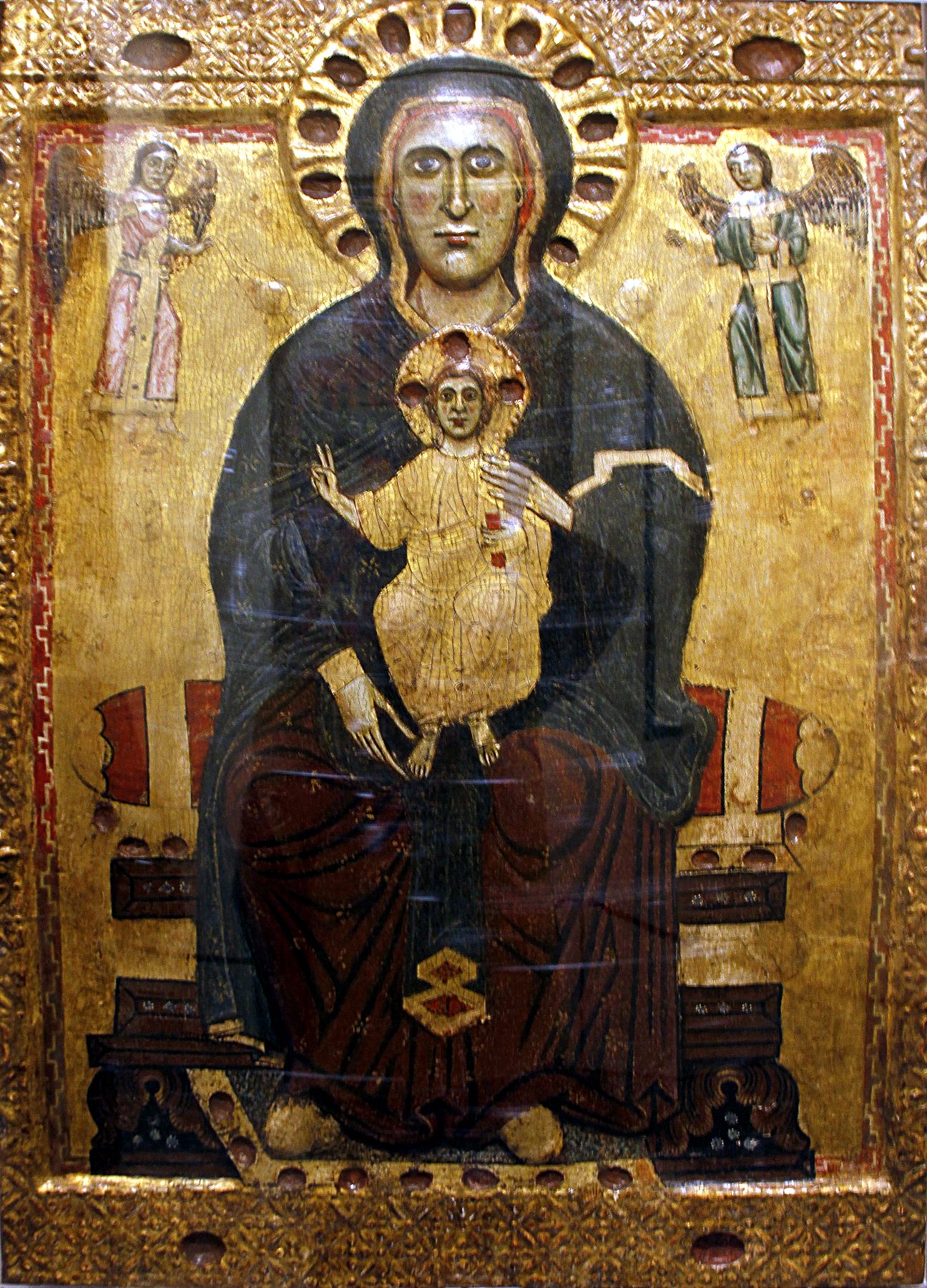
Madonna degli Occhi Grossi
Master of Tressa, c. 1225
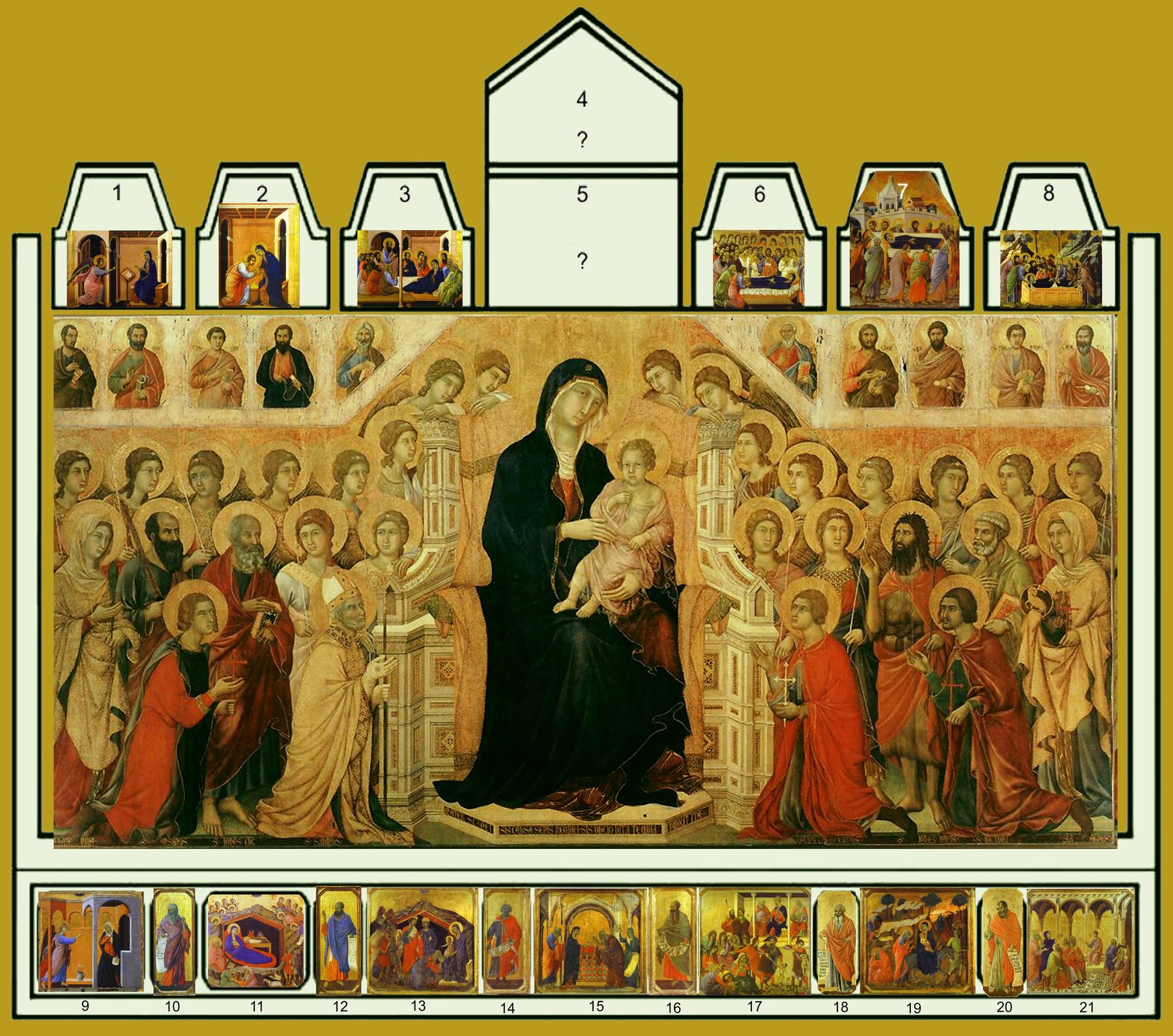
Maestà
Duccio and workshop, 1308–11
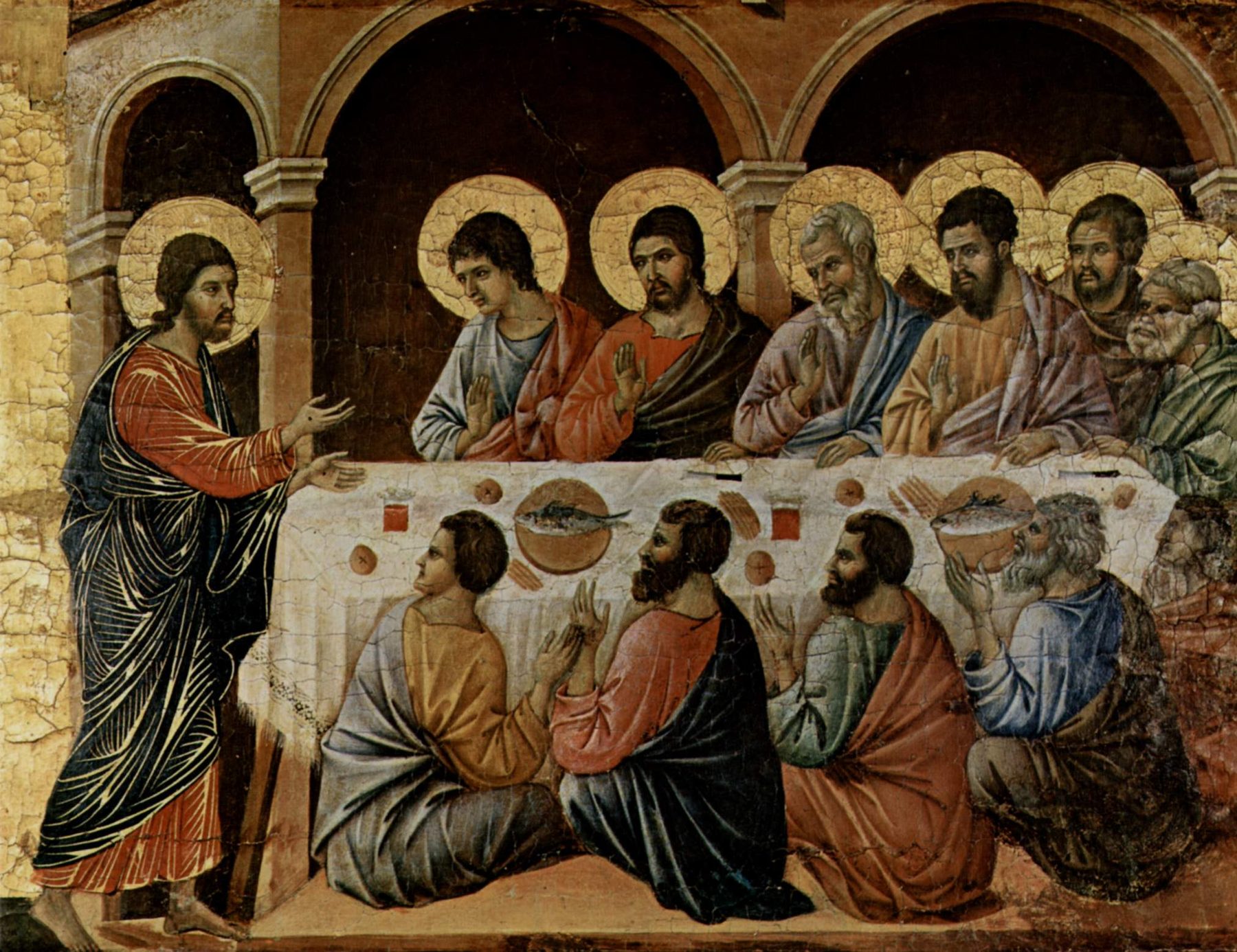
Last Supper
Duccio, Maestà predella, 1308–11
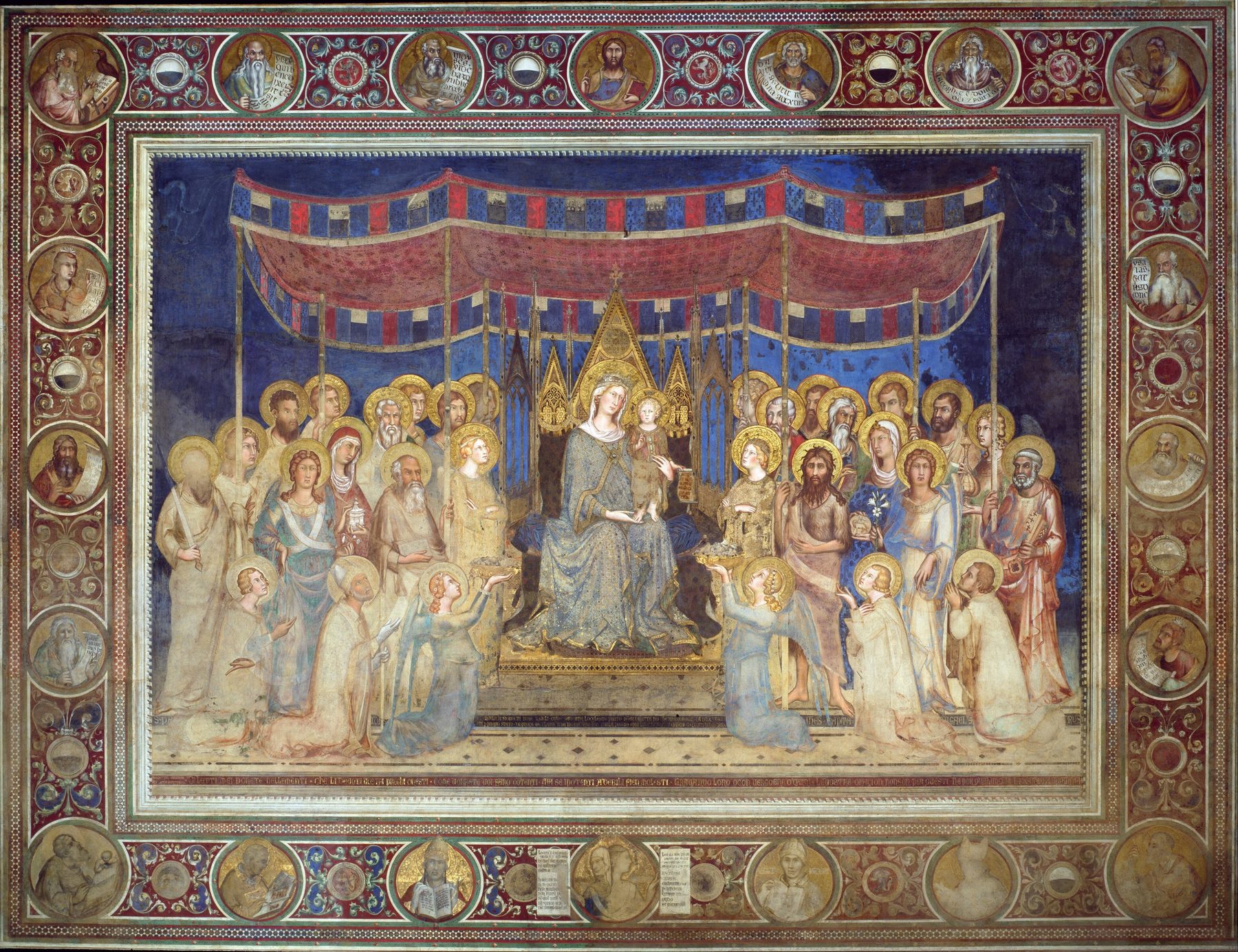
Maestà
Simone Martini and workshop, 1315, revised 1321
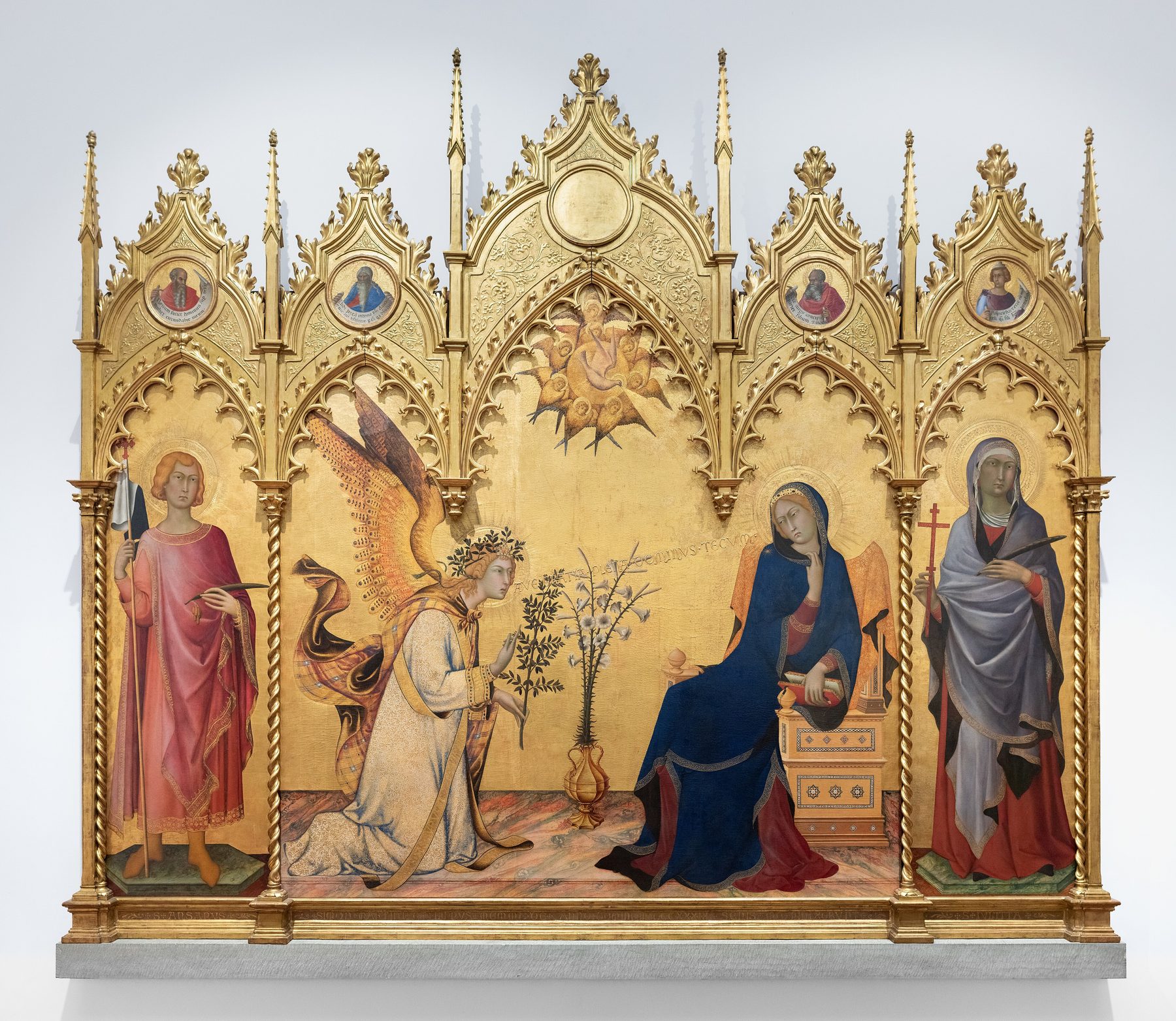
Annunciation with Saints Ansanus and Margaret
Simone Martini and Lippo Memmi, 1333
Simone Martini and international Siena
Simone Martini emerged as a major painter while Duccio was still alive. His earliest training is not securely documented, although a connection with Duccio’s workshop has often been proposed. What survives shows an artist who learned from Sienese painting while developing a distinct command of elongated movement, luxurious surface, heraldic precision and courtly address. In 1315, he signed and dated the monumental Maestà in Palazzo Pubblico. Its canopy, saints and angels form a heavenly assembly, yet the inscriptions turn that assembly towards the behaviour of Siena’s rulers.[6] [13]
Simone’s career unfolded across very different environments. He painted at Assisi, worked for Angevin Naples and, by the mid-1330s, was at Avignon, where the papal court gathered clerics, diplomats, writers and artists from across Europe. His movement does not mean that a complete “Sienese style” was simply exported. Each court and religious site posed new requirements. But his career demonstrates how readily a painter formed in Siena could participate in international artistic networks, and how Sienese line, colour and precious material became part of a wider Gothic vocabulary.[5] [23]
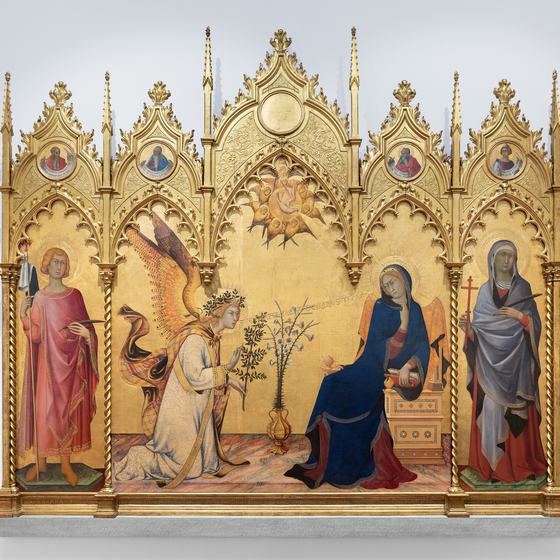
The Annunciation of 1333, signed by Simone and his brother-in-law Lippo Memmi, condenses that mobility into a single surface. Made for the altar of Saint Ansanus in Siena Cathedral and now in the Uffizi, it places Gabriel and Mary against worked gold. The angel’s cloak still seems to carry the force of his arrival; his greeting runs in raised letters across the interval between them. Mary recoils and folds her mantle close, turning the conventional book in her hand into a sign of interrupted attention. Lilies, patterned textiles and the punched haloes make splendour active rather than still.[14]
The painting is sometimes admired only for elegance. Yet its line is dramatic. Gabriel advances while Mary withdraws; the words travel where no continuous room has been described; the vase establishes a fragile centre; two lateral saints remain formally present but psychologically outside the event. Gold suppresses ordinary atmosphere while catching real light from the viewer’s environment. The sacred message appears at once heard, read and materially reflected.
Collaboration is visible in the signature and family workshop. Lippo Memmi was not simply an anonymous assistant, and Simone’s brothers and associates helped sustain production across commissions. The modern desire to isolate one master hand can understate how reputation, labour and style moved through kinship and partnership. Simone’s own death at Avignon in 1344 preceded the Black Death. His influence nevertheless survived through objects, collaborators and the prestige of a career that linked commune, mendicant basilica and court.
Pietro and Ambrogio Lorenzetti
Pietro and Ambrogio Lorenzetti were brothers, but “the Lorenzetti” should not become another single style. Both absorbed Sienese painting and developments associated with Giotto and sculpture; each built a different artistic intelligence from them. Their work shows why the school is better understood as an argument among alternatives than as a procession of artists repeating Duccio.[18]
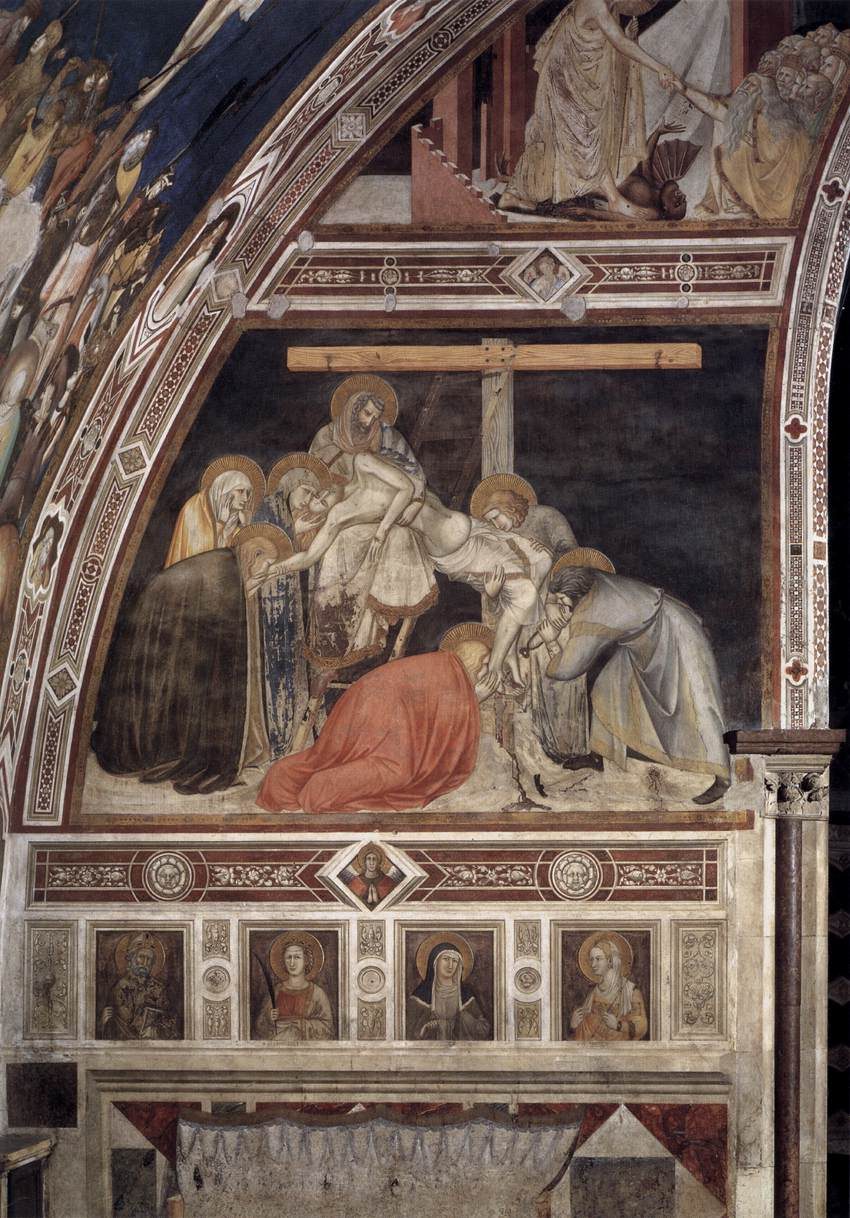
Pietro’s paintings often make sacred events physically and emotionally forceful. In his Assisi Passion frescoes, bodies overlap, bend and strain; architecture encloses crowds; mourners press grief into gesture. A Madonna and Child at the Uffizi gives the enthroned Virgin considerable volume, while light and modelling make her body inhabit the seat. The attribution and original ensemble remain subjects for scholarship, reminding us that even a compelling individual image can survive without a settled biography.[21] [22]
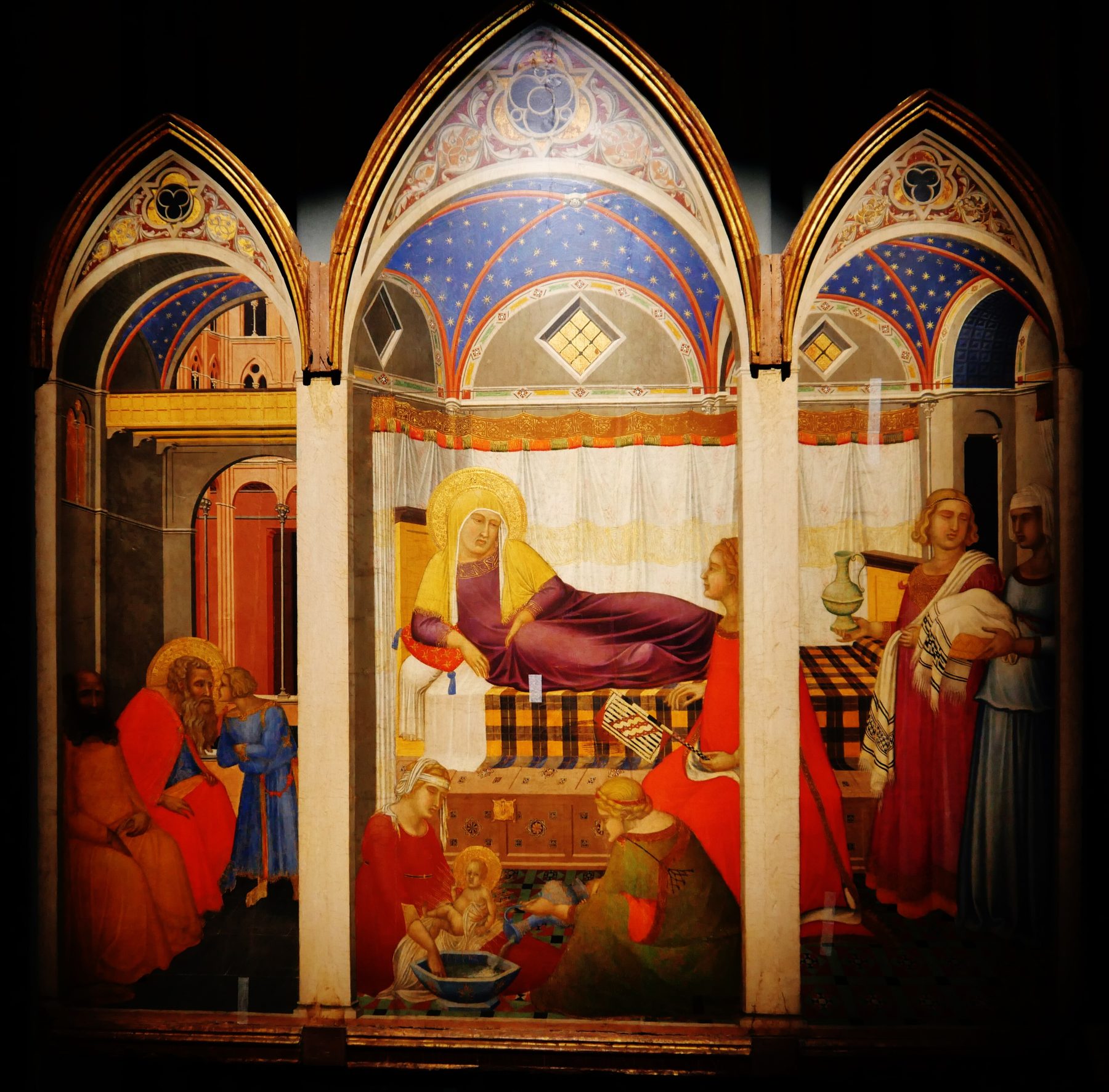
Pietro’s Birth of the Virgin, made in 1342 for Siena Cathedral and now in the Museo dell’Opera, converts a triptych into a continuous domestic interior. Painted columns correspond to the real divisions of the panel, yet the room appears to run behind them. Women attend Saint Anne, servants carry objects, and Joachim waits in an adjoining space. The picture uses architecture not as an exercise detached from life but as a means of distributing work, conversation, separation and arrival.
Ambrogio’s experiments were equally varied. His Presentation in the Temple of 1342 constructs an elaborate church interior where coloured marble, vaults and pavement lead the eye through ritual space. His scenes from the life of Saint Nicholas arrange several moments within complex buildings, asking viewers to track narrative through walls, floors and openings. Such spaces are not mathematically unified in the later Florentine sense, but they are carefully purposeful. Ambrogio bends architecture so that moral action can remain visible.[19] [20]
The brothers also complicate the idea of Florence and Siena as opposites. Ambrogio is documented in Florence several times, and his paintings respond to Giottesque volume and Arnolfo’s sculptural world. Pietro’s work at Assisi placed him in a site where Tuscan and Roman painters, Franciscan patrons and international visitors converged. Exchange did not erase local identity. It gave both artists more possibilities with which to define it.
Neither brother is documented after 1348, and both are generally thought to have died during the plague, though exact circumstances remain unknown. Their loss mattered because workshops transmit more than designs: they transmit habits of preparation, judgement, correction and collaboration. Yet later Sienese painting did not simply stop. Artists preserved Lorenzettian ways of describing weight, place and civic life while combining them with other inherited languages.
Good and Bad Government
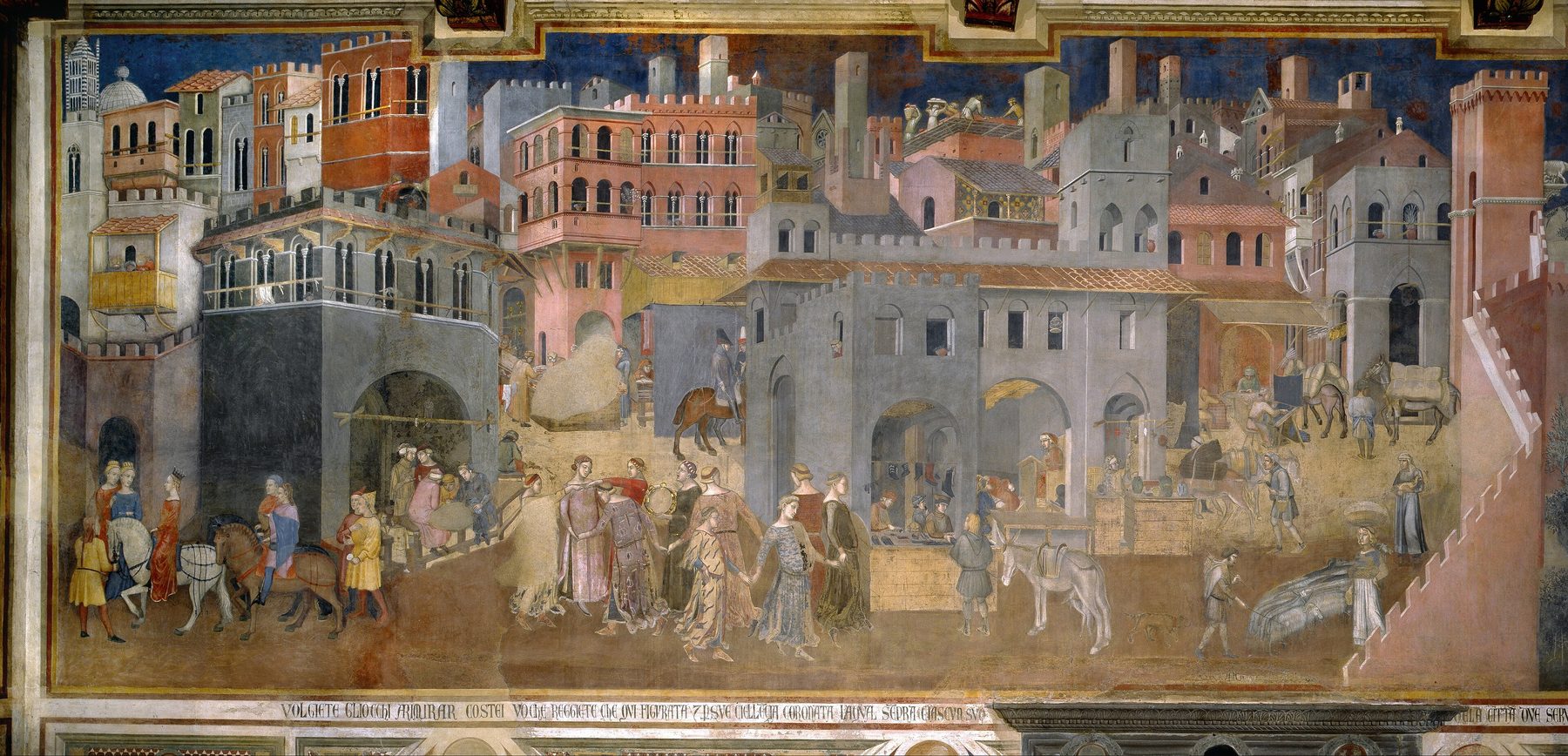
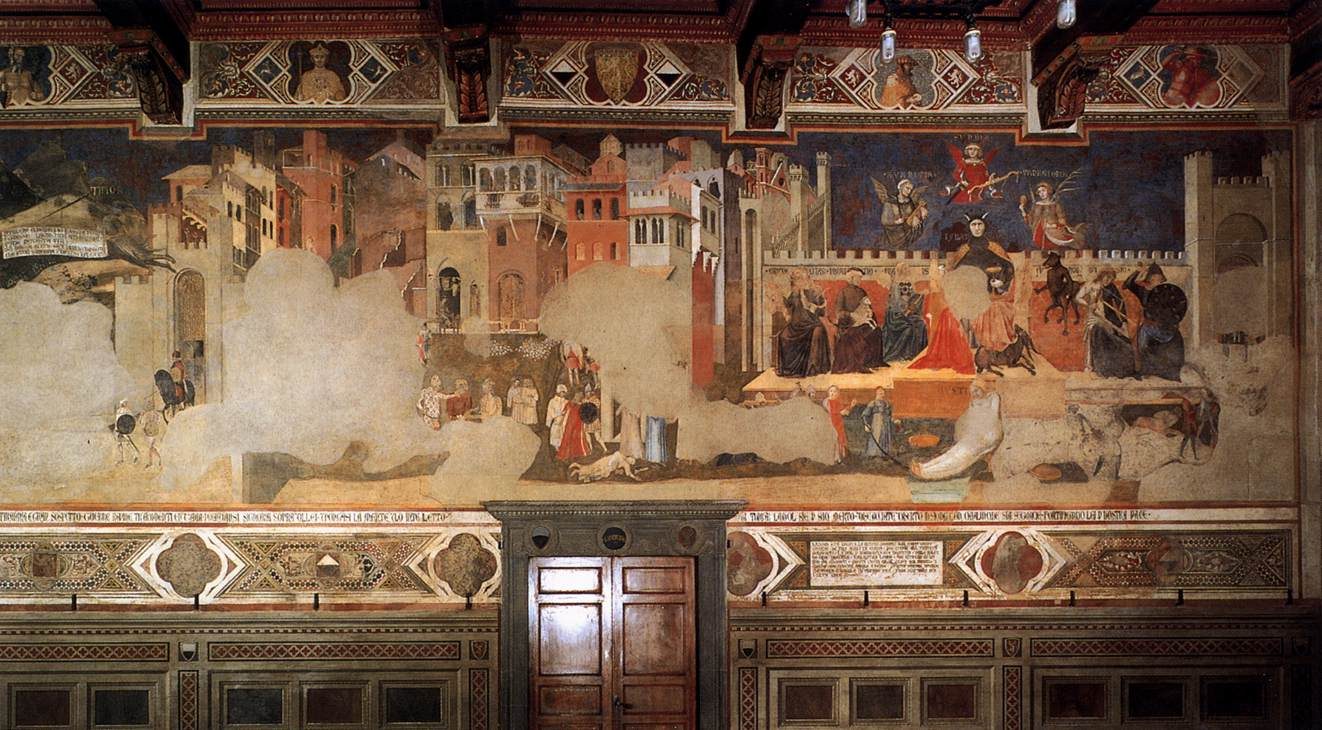
Ambrogio Lorenzetti’s fresco cycle in the Sala dei Nove of Palazzo Pubblico, painted in 1338–39, is often illustrated with the busy city and countryside under good rule. That celebrated view makes better sense when read as one part of a room-sized argument. On other walls, allegorical figures identify good government and tyranny, while their effects show political principles becoming lived consequences. The work addressed the Nine, the mercantile government whose members occupied the palace and conducted business in the room.[15] [16]
In the allegory of good rule, Justice looks upward towards Wisdom and balances forms of justice below. A cord passes from acts of justice to Concord and onward to the citizens, making social agreement visible as connection. The Commune sits enthroned among virtues. Security hovers over the well-governed territory, while the opposite wall presents Tyranny surrounded by vices. These are not detached personifications. They construct chains of cause: justice enables concord; concord supports common rule; rule permits security and productive life.[18]
The city of good government is dense with differences. Builders work above the street. Traders sell goods. A teacher faces pupils. A wedding procession moves through the urban fabric. A ring of dancers creates a conspicuous interval within daily traffic. Beyond the gate, riders enter a cultivated countryside of fields, vineyards, roads and settlements. The boundary between city and contado is permeable because Siena’s security and economy depended upon both.
Ambrogio did not paint a neutral snapshot of fourteenth-century life. The scene is selective and idealising. Work proceeds, travel is safe and the landscape yields produce because government is just. On the wall of bad rule, violence, damaged buildings and barren terrain reverse these conditions. The contrast makes political ethics visible through ordinary acts rather than through rulers alone. A roof under construction and a farmer on a road become evidence in an argument about power.
The room also asks viewers to move. No reproduction captures the physical relation among its walls, windows and officials’ positions. Natural light changes the surfaces; figures exceed a single field of vision; the good and bad alternatives remain present around the beholder. Ambrogio’s achievement is therefore spatial in two senses: he creates painted environments, and he makes the actual government chamber part of their operation.
The cycle has sometimes been treated as an early step towards landscape painting or secular modernity. It certainly gives extraordinary attention to city and countryside, but sacred and moral frameworks remain integral. Wisdom, Justice and the virtues govern the reading of observed labour. “Secular” should not imply freedom from theology, any more than “medieval” should imply indifference to material life. The paintings bind ethical abstraction to roads, walls, animals, clothes and crops.
Conservation and diagnostic study continue to refine knowledge of the cycle. Its damaged passages remind visitors that fresco is not a portable image. Pigment is bound to architectural plaster that experiences moisture, structural movement, restoration and changing use. The Comune’s recent conservation work and reopening of the Sala della Pace reaffirm that the paintings remain part of Siena’s civic inheritance, not only an art-historical landmark.[16]
Follow the school through four stages
–1300
Foundations in image, city and devotion
Older Marian images, cathedral commissions, painted account-book covers and expanding workshops establish a civic and sacred visual culture before Duccio’s great altarpiece.
–1348
The great Trecento generation
Duccio, Simone Martini and the Lorenzetti brothers reshape altarpiece, narrative, courtly line, domestic space and civic mural painting.
–1420
Plague, recovery and plurality
The Black Death causes severe disruption but no single stylistic reversal; artists, workshops and civic institutions sustain varied forms of painting.
–1500
A second flowering
Sassetta, Giovanni di Paolo, Sano, Vecchietta, Matteo, Neroccio and Francesco di Giorgio renew Sienese colour, narrative and workshop invention across panels and frescoes.
Workshops, travel and material exchange
Sienese painters rarely worked as solitary authors in the modern studio sense. Large panels required carpenters, gesso preparation, gilding, ornamental punching, painting and frame construction. Fresco campaigns needed plasterers, assistants and careful scheduling. Contracts could name a master while the object preserved many hands. Family partnerships—Simone with Lippo Memmi, or later Francesco di Giorgio with Neroccio—made training and production social.
Artists also travelled. Simone’s work from Siena to Avignon is the best-known example, but Pietro painted at Assisi, Ambrogio worked in Florence, and Sienese commissions reached Naples and other courts. The movement was reciprocal: Gentile da Fabriano’s presence in Siena affected fifteenth-century painters, while Florentine experiments entered local debate. Current scholarship tracks artists abroad not to dilute Siena’s distinctiveness, but to explain how it was made.[3] [5]
Objects moved even when artists did not. Textiles from the eastern Mediterranean, enamelled metalwork, ivory carvings and illuminated books offered patterns, colours and ways of framing sacred bodies. Giovanni di Paolo’s later depiction of an Anatolian animal carpet under the Virgin records imported luxury as both real possession and sign of status or sanctity. A painted textile is never only decorative evidence; it points towards trade, cost and cultural translation.[47]
This exchange helps explain the intensity of Sienese surfaces. Punchwork makes haloes answer real light. Translucent or opaque colour changes the apparent substance of robes. Incised inscriptions give speech a material body. Pattern may flatten one passage while architecture opens another. The resulting pictures do not choose between ornament and space. They use each according to function.
The Black Death and the myth of decline
The plague that reached Siena in 1348 was a profound human and institutional catastrophe. It killed inhabitants across social groups, broke chains of training, removed patrons and altered the labour available to workshops. Ambitious building and artistic projects were interrupted. Political change followed: the Government of the Nine fell in 1355. Any account that treats the epidemic as irrelevant to art would be as misleading as one that makes it explain everything.
For much of the twentieth century, the most influential explanation came from Millard Meiss. He argued that plague was experienced as divine punishment and produced a culture of guilt and penance. In his reading, Tuscan painting turned away from the naturalism and human-centred confidence of the early Trecento towards more abstract, hieratic and supposedly reactionary forms. The thesis joined style, religion and social trauma in a powerful historical narrative.[26] [28]
Specialists challenged that account almost from its publication. Later research questioned whether a uniform stylistic reversal can actually be observed at mid-century, whether the religious response to plague was sufficiently singular, and whether “naturalism” and “abstraction” form reliable measures of progress or retreat. Judith Steinhoff instead emphasised artistic pluralism, workshop reorganisation, political meaning and a changed market. Her argument does not deny catastrophe; it refuses to derive every later picture from collective remorse.[27]
The debate matters beyond Siena. It demonstrates how easily formal preference can become historical verdict. If early Lorenzettian space is defined as progressive, a later painter’s use of gold, hierarchy or older models may be labelled regression before its patron, location and purpose are studied. Revival could be politically strategic, devotional, market-responsive or technically inventive. A format that resembled Duccio might assert Siena’s prestigious past rather than reveal inability to change.
Post-plague conditions were also uneven. Some established patrons disappeared while others gained resources. Workshops collaborated, merged or reached new clients. Surviving documents do not provide direct testimony for every artistic decision, so broad claims about an entire class’s taste remain risky. The safest conclusion is historical rather than deterministic: 1348 changed the circumstances in which art was made, and later painters responded in multiple ways.[25] [26]
The language of decline has proved especially persistent because Siena’s fifteenth-century art does not lead neatly towards the Florentine canon of anatomy, antiquity and unified perspective. Once those outcomes cease to be the only criteria, later Sienese painting looks different. Its selective archaism, intense colour, narrative compression, mystical landscapes and local institutional imagery become choices with histories, not symptoms of belatedness.
The later Trecento and the Biccherne
Bartolomeo Bulgarini shows how much survives behind unstable names. He was regarded highly enough around 1348–49 to be listed among notable Tuscan painters, received commissions connected with Palazzo Pubblico and a city gate, and later advised on moving Duccio’s Maestà. Yet many paintings now associated with him were once divided among invented masters. Reconstructing his career has required documents, stylistic comparison and the dismantling of earlier attribution habits.[29]
Bartolo di Fredi, Andrea Vanni, Paolo di Giovanni Fei and Taddeo di Bartolo similarly combined local inheritances rather than subscribing to one post-plague manner. Bartolo could evoke eastern and western pictorial traditions within the same Nativity and use a cave-like stable to experiment with depth. Taddeo travelled widely and later decorated the chapel in Palazzo Pubblico. Their Siena was politically unstable yet artistically connected to the wider peninsula.[25]
The Biccherna covers offer an unusually continuous view of civic patronage. The State Archive preserves 106 painted boards dating from 1258 to 1682. At first they protected registers for Siena’s principal financial magistracy; other offices and institutions later commissioned them, and by the later fifteenth century painters were producing independent pictures rather than functional bindings. Artists including Ambrogio Lorenzetti, Giovanni di Paolo, Sano di Pietro and Francesco di Giorgio participated in this long series.[30]
Because account covers join names, offices, dates and images, they resist a division between fine art and record keeping. They could identify officials, commemorate an event, personify financial duty or invoke sacred protection. Their changing form tracks the expanding ambition of civic imagery while preserving the archival setting from which it emerged.
Sassetta and fifteenth-century renewal
Stefano di Giovanni, called Sassetta only from the eighteenth century, became the leading Sienese painter of the early fifteenth century. His first documented major commission was an altarpiece for the wool guild, made from 1423 to 1426. It was designed for periodic display and related the Eucharist to the corporate identity of its patrons. Even in this early work, Sassetta drew on the great Trecento tradition while responding to Gentile da Fabriano, Masolino and new Florentine thinking about space.[33] [34]
His masterpiece was the double-sided altarpiece made between 1437 and 1444 for the Franciscan church at Borgo San Sepolcro. Like Duccio’s Maestà, it was an architectural ensemble with different images and viewing conditions on its two faces. Its dispersed panels include episodes from the life of Saint Francis, saints, miracles and devotional figures. Reconstructing their arrangement restores rhythm across scenes that now appear as autonomous pictures in several museums.[35]
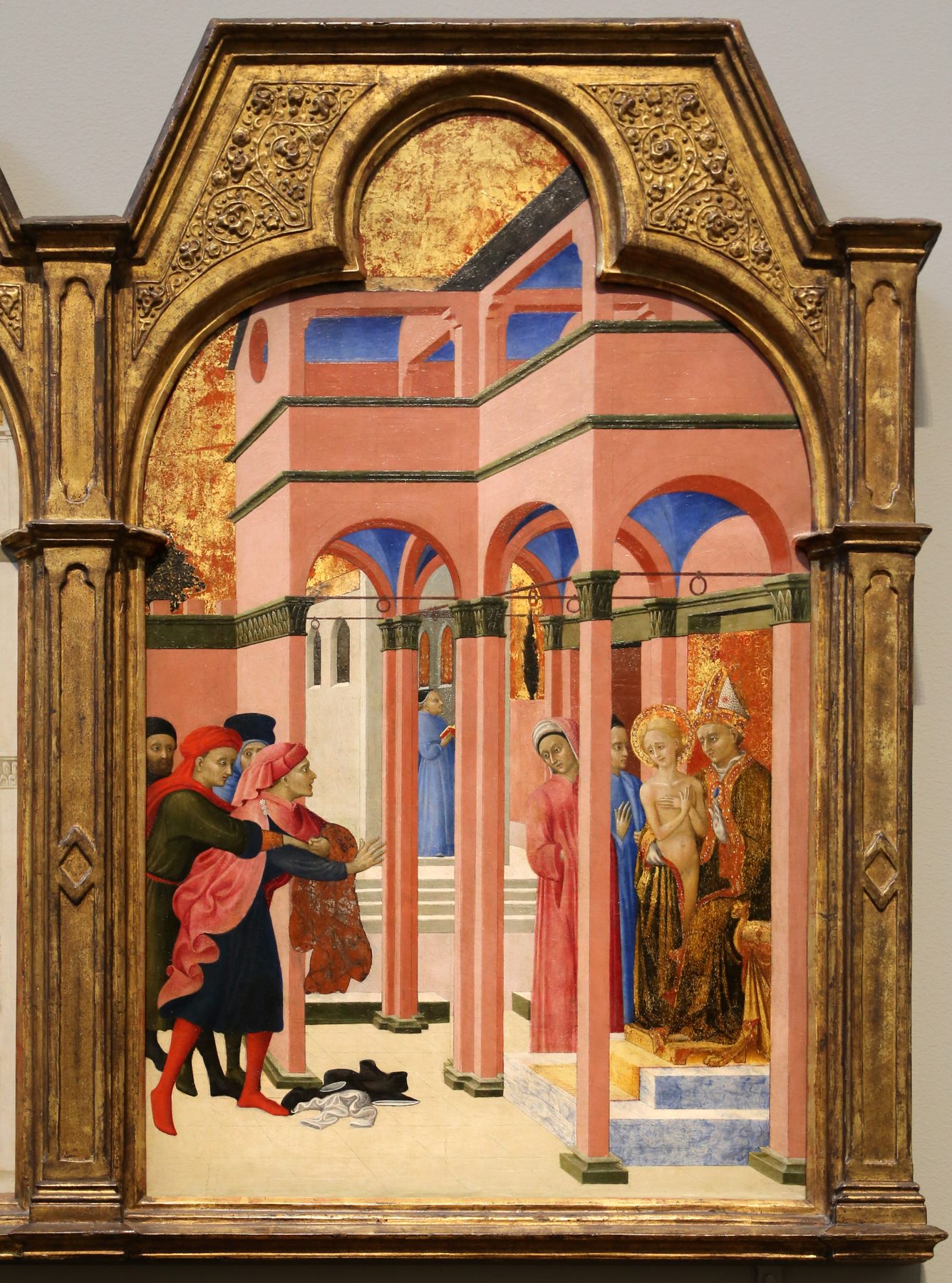
Sassetta’s Franciscan narratives often balance the ordinary and miraculous without forcing them into separate worlds. A saint gives clothing to a poor knight; a vision opens within landscape; buildings establish human scale, but roads may rise like coloured stages. His light can feel atmospheric while gold remains meaningful. Such combinations make the term “traditional” inadequate. Sassetta did not abandon Siena’s past or imitate Florence whole. He chose among both to build a lyrical, spatially alert art.
His career also corrects the idea that Renaissance innovation must look monumental or anatomically forceful. Sassetta’s figures may be slender, his colours pale and his distances dreamlike, yet his sequences are structurally disciplined. He understood how an altarpiece could unfold across liturgy, movement and memory. The innovations lie in relations among panels as much as inside any one scene.
Giovanni di Paolo’s visionary worlds
Giovanni di Paolo was active for most of the fifteenth century and became, after Sassetta, one of Siena’s principal painters. He made altarpieces, predellas and manuscripts, absorbing Gentile da Fabriano, Fra Angelico and Florentine architecture without surrendering his own jagged line or heightened colour. Describing his spaces as inaccurate misses their expressive organisation.[36]
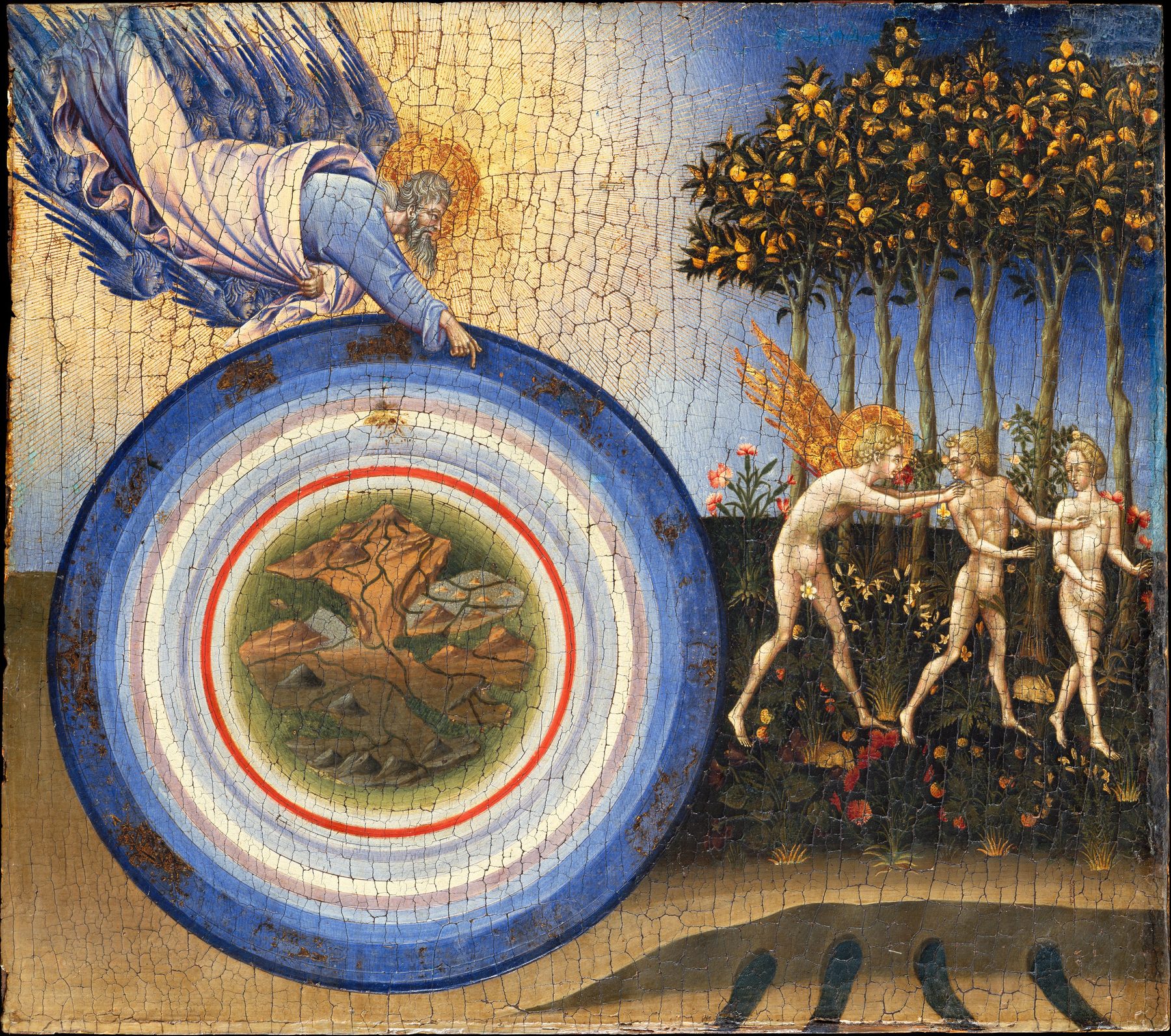
In The Creation of the World and the Expulsion from Paradise of 1445, God is borne by cherubim beside a cosmic disc ringed with elements and the zodiac. To the right, Adam and Eve leave a garden of giant flowers and fruit trees. The panel belonged to a predella made for San Domenico in Siena, paired within its original programme with a scene of Paradise. Theology, cosmology and narrative are made visible at different scales on one field.[37]
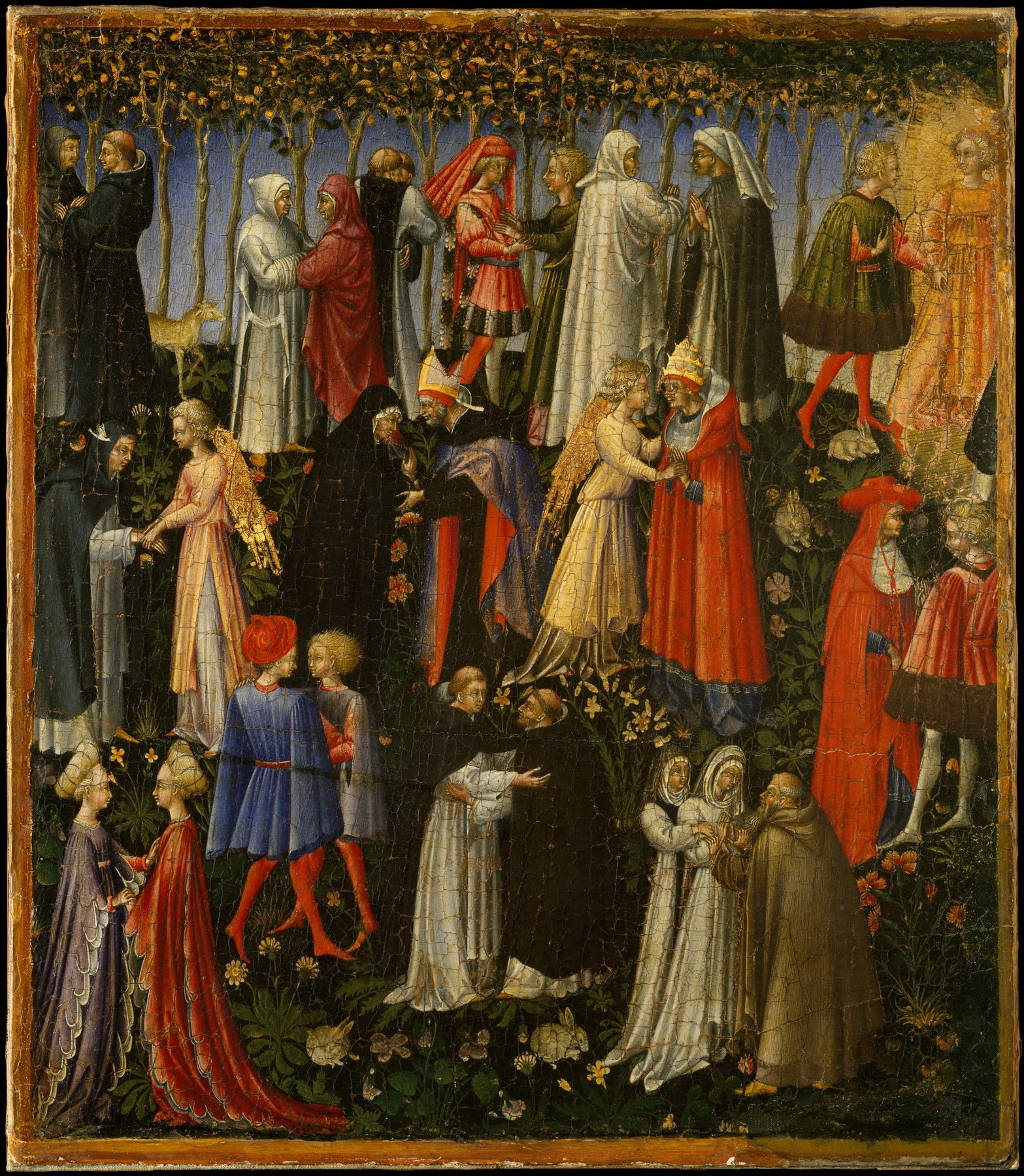
Giovanni’s Paradise arranges the blessed among angels, embraces, animals and immense flowers. Its space is tapestry-like rather than governed by one vanishing point. The Metropolitan Museum notes his knowledge of Fra Angelico but also his preference for compositional rhythm over Florentine spatial naturalism in order to intensify vision. The distinction is crucial: he manipulated space knowingly; he did not fail to understand it.[38]
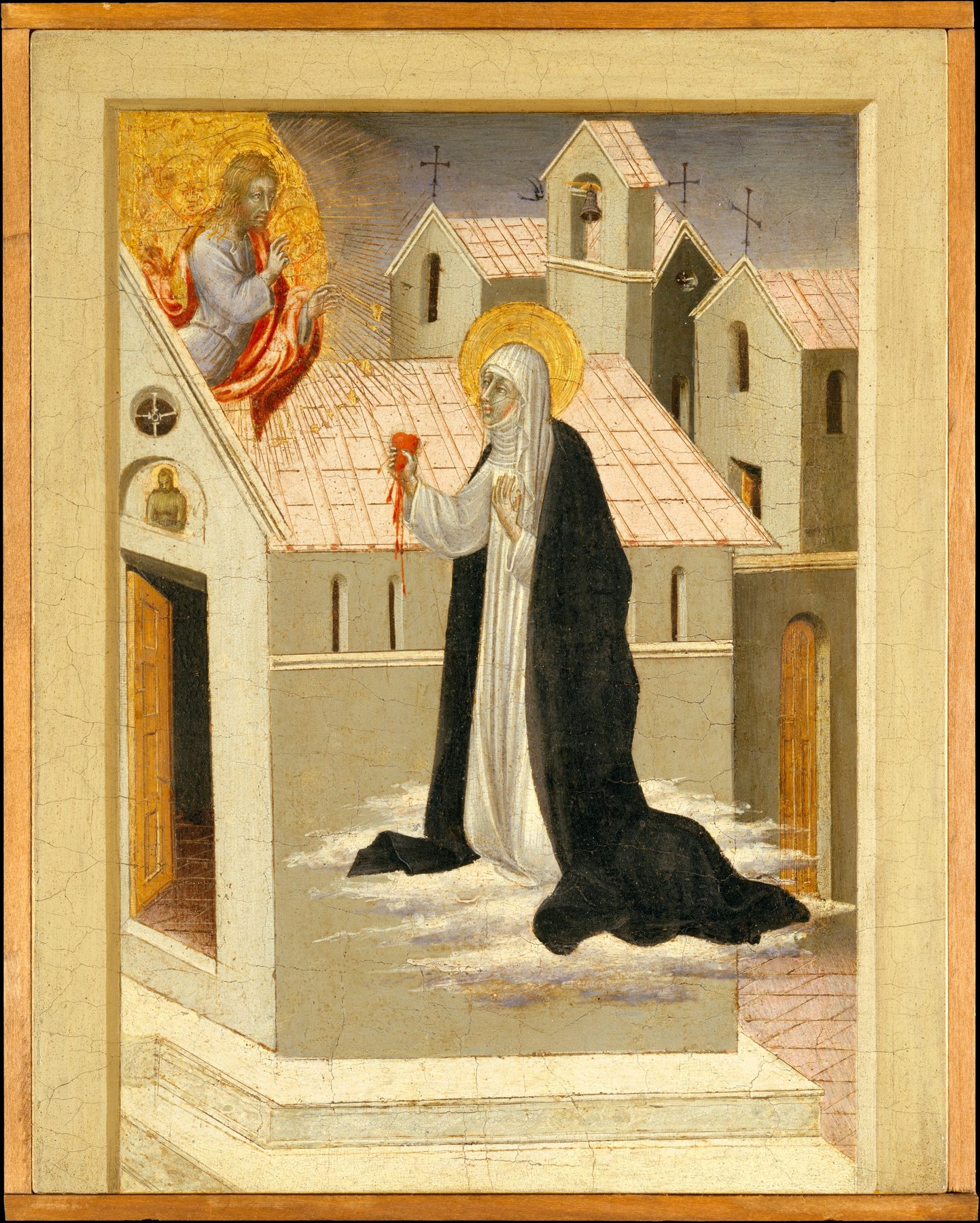
His cycle devoted to Catherine of Siena offers a different kind of experiment. Painted after her canonisation in 1461 and based on the biography by Raymond of Capua, it was the first extensive narrative cycle of her life. In the scene where Catherine exchanges her heart with Christ, architecture and scale yield to mystical encounter. Several panels now divided among collections were once part of a coherent local sacred biography.[39]
Giovanni’s landscapes—steep fields, bare ridges, tiny roads and suspended cities—can make earthly travel feel both difficult and revelatory. Human figures remain fragile within them. The resulting art is psychologically acute precisely because the world is not neutral. Terrain, architecture and colour register solitude, terror, grace and transformation.
Sano di Pietro, Vecchietta and Santa Maria della Scala
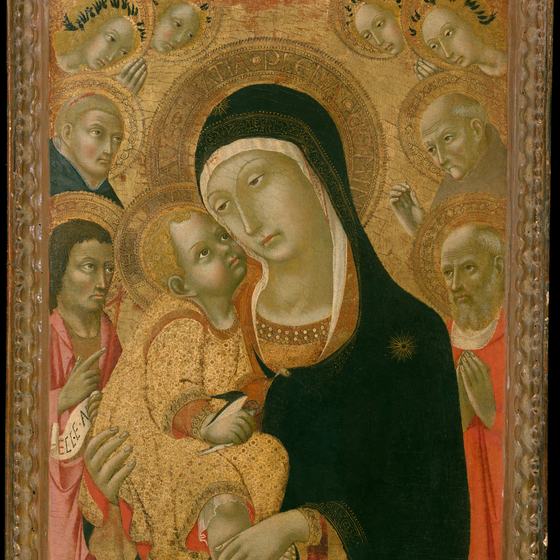
Sano di Pietro was a prolific painter and illuminator whose workshop supplied altarpieces and devotional images for decades. Repetition in such production should be studied economically as well as aesthetically. Bust-length Madonnas, attendant angels and familiar saints answered continuing demand from churches, friars and private patrons. The workshop could preserve accessible sacred types while predella scenes allowed lively storytelling. His work was particularly valued in Franciscan circles.[40]
Two large panels in Siena’s cathedral museum show Saint Bernardino preaching in the Campo and outside San Francesco. The crowds transform a recent Sienese preacher into public history. Bernardino’s sermons and image helped shape fifteenth-century devotion; painters such as Sano turned the city itself into the stage of sacred memory.[7]
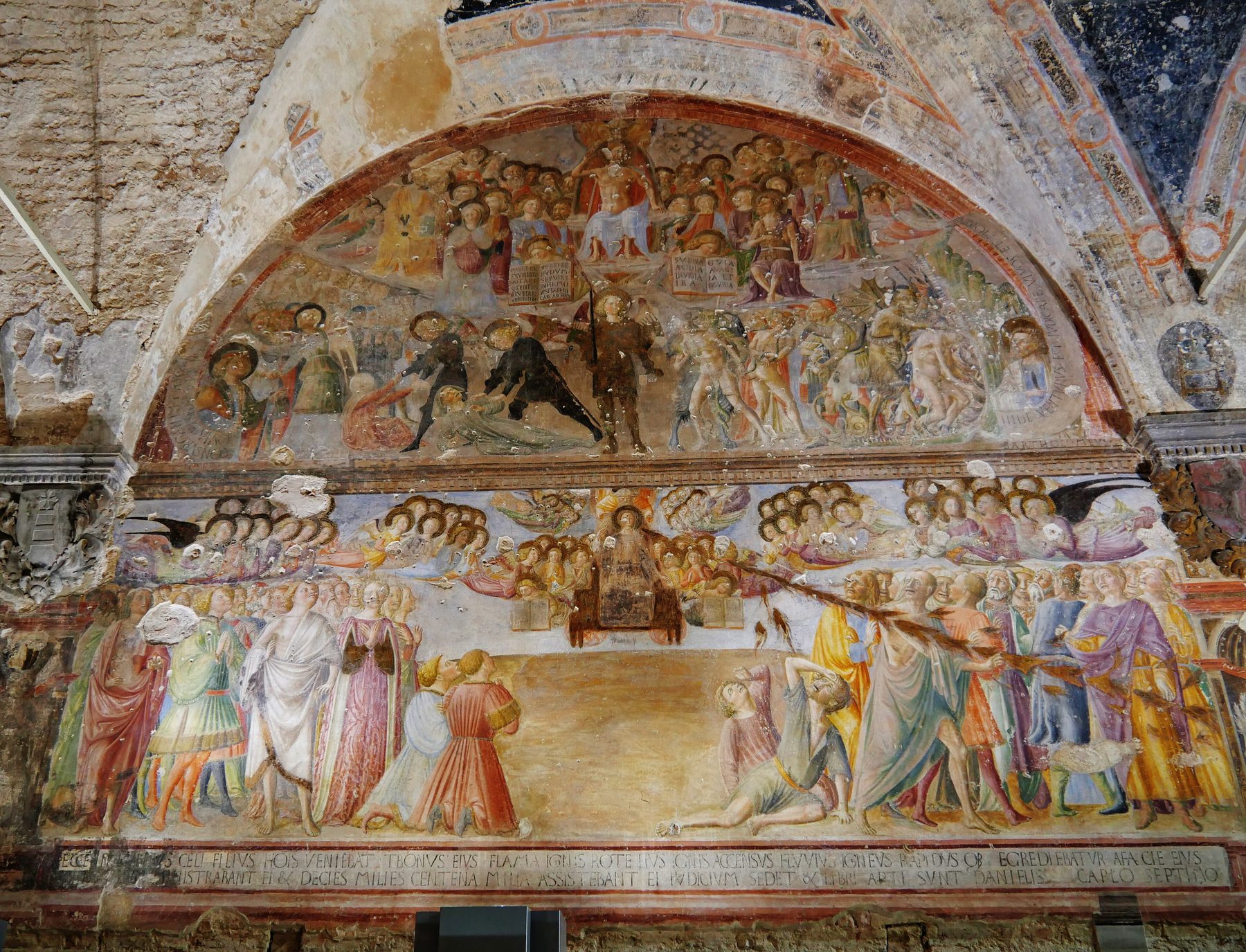
Santa Maria della Scala reveals how painting served another powerful institution. The hospital stood opposite the cathedral and cared for the sick, pilgrims, foundlings and the poor. Under rector Giovanni Buzzichelli, its Pellegrinaio was transformed in the 1430s and 1440s into a grand reception hall. Domenico di Bartolo painted charitable operations, while Vecchietta, Priamo della Quercia and others represented the institution’s history. The programme made administration, care and divine mission mutually reinforcing.[31]
Domenico’s scenes include the marrying of orphaned young women, food distribution, medical care and the reception of foundlings. Architecture organises busy labour while clothing and gesture differentiate participants. These are idealised institutional images, not transparent documentary photographs, but their detail makes charity visible as coordinated human work.[32]
Vecchietta moved between painting, sculpture, metalwork and architecture. His career exemplifies the permeability of media in Renaissance Siena. An artist could design a fresco campaign, model figures and produce a bronze tabernacle; an institution could use those arts together to establish identity. The Sienese School is narrowed when it is made synonymous with gold-ground panel painting alone.
Matteo di Giovanni, Neroccio and Francesco di Giorgio
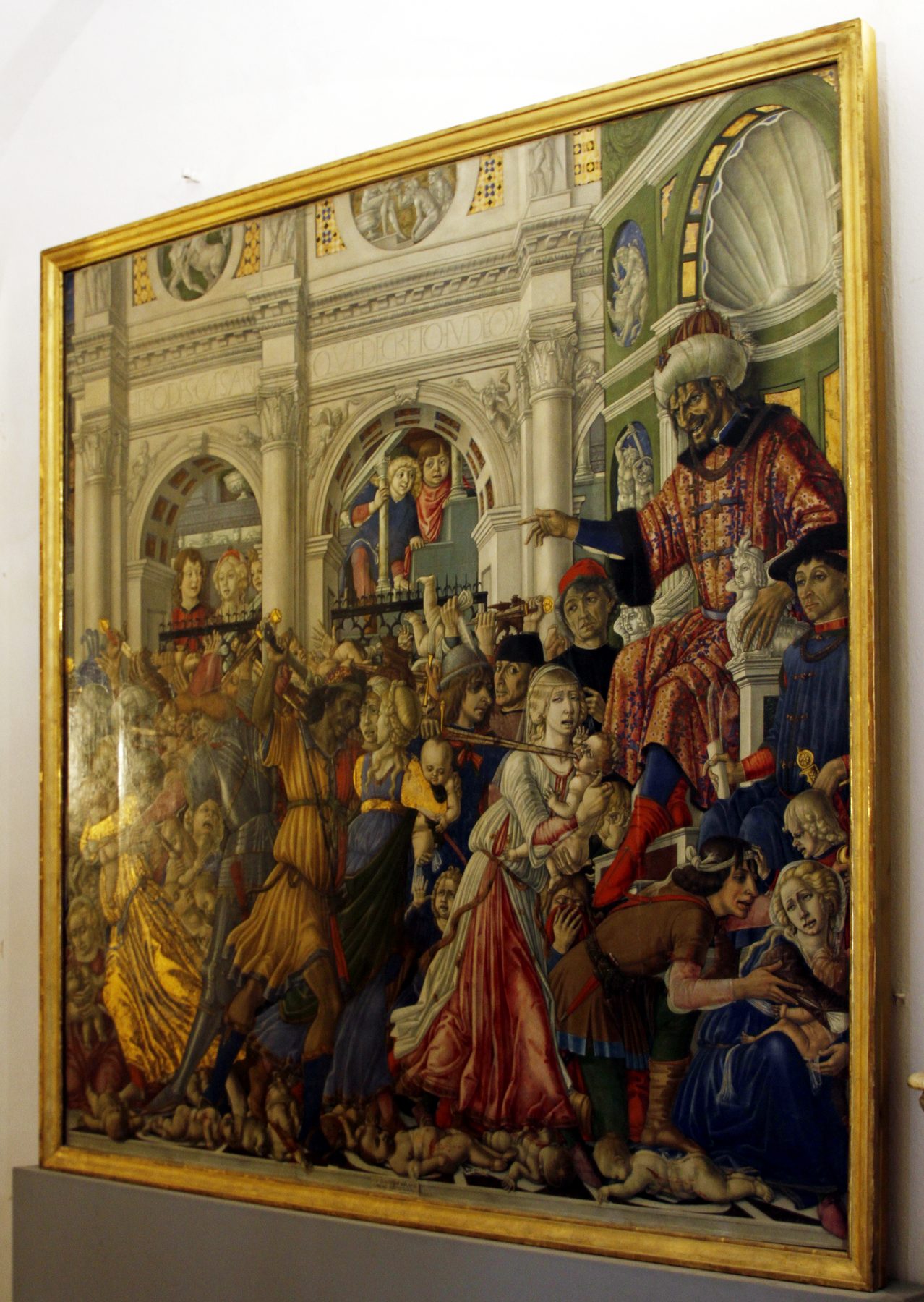
By the later fifteenth century, Sienese artists participated in a broad Renaissance culture while maintaining vigorous local workshops. Matteo di Giovanni, probably born in Borgo San Sepolcro, worked in partnership in Siena and responded to Florentine art, including Pollaiuolo. He supplied side panels for the Sansepolcro polyptych whose centre was Piero della Francesca’s Baptism of Christ. Such mixed authorship undermines any fantasy of perfectly isolated city schools.[41]
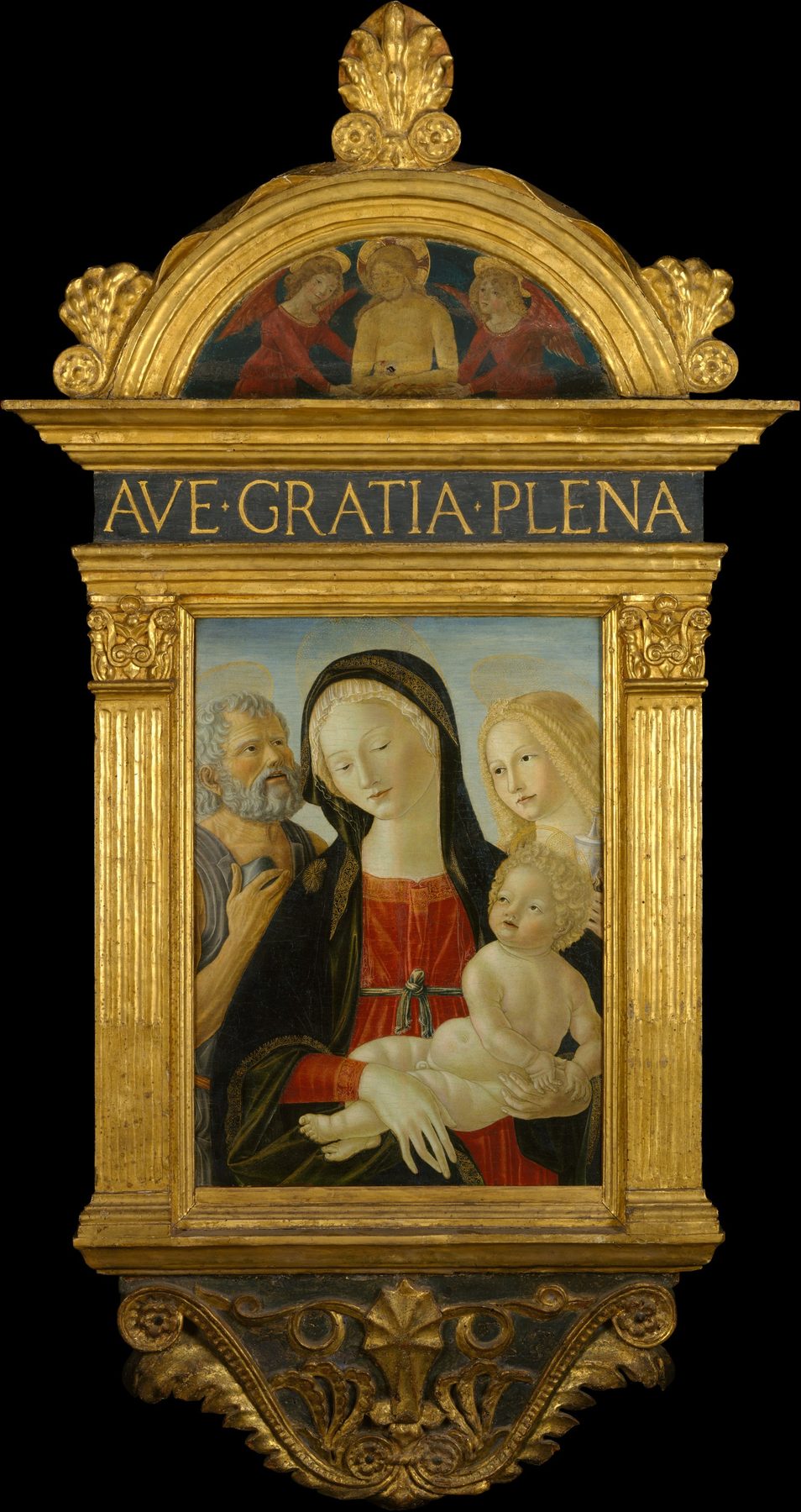
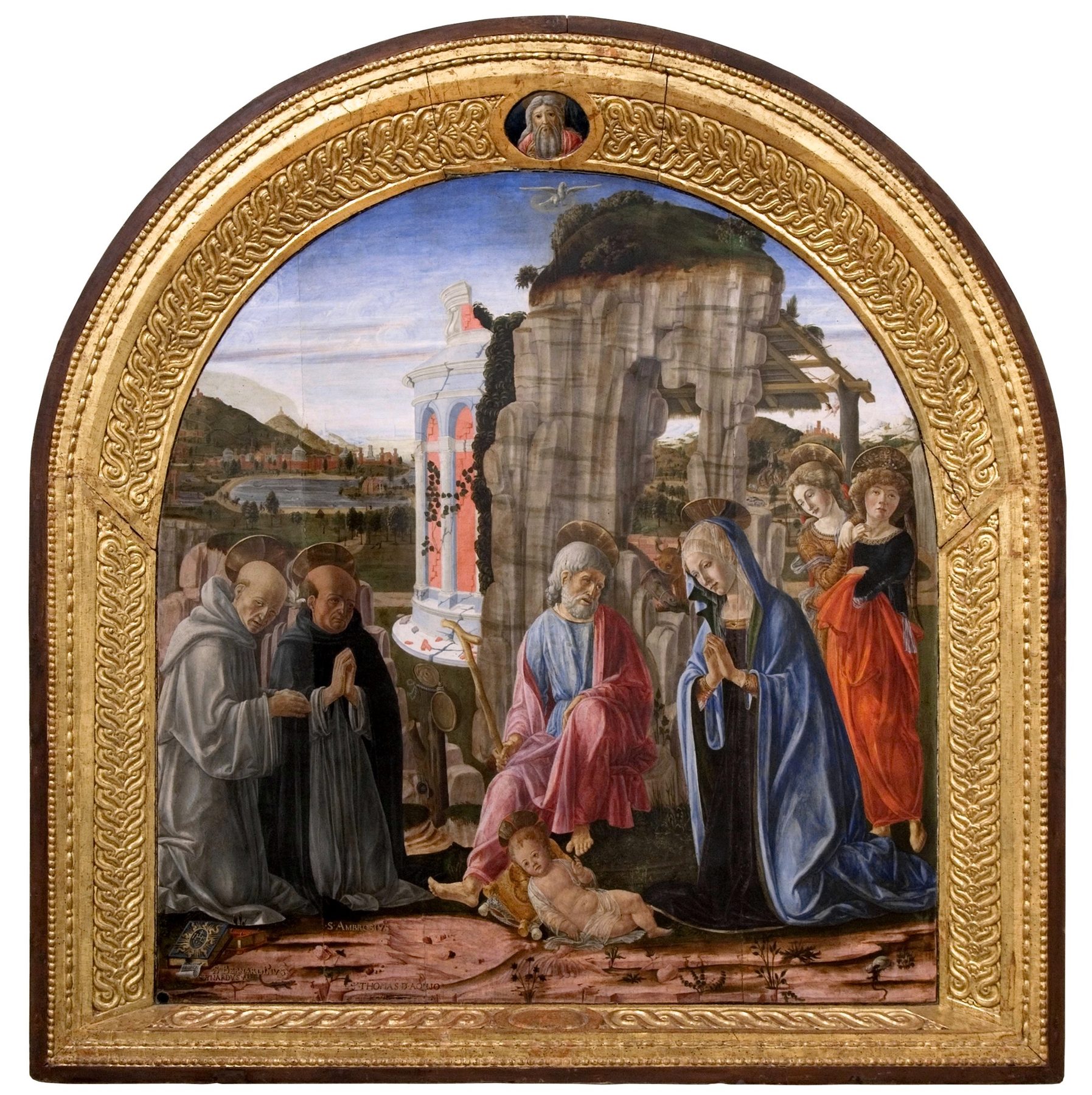
Neroccio de’ Landi was both painter and sculptor. His refined Madonnas translate the Sienese devotional image into low, relief-like groupings, with saints placed behind the Virgin and surfaces held in exquisite tension. Between 1468 and 1475 he shared a workshop with Francesco di Giorgio, an engineer, architect, sculptor and painter. The partnership linked sacred panels to design practices that ranged far beyond them.[43]
Technical study of paintings made for Sienese palaces shows leading artists working as teams. Francesco, Matteo, Neroccio, Pietro Orioli and the anonymous Master of the Story of Griselda could contribute to related decorative schemes. Infrared reflectography and material analysis reveal shared methods as well as differences in underdrawing and gilding. Courtly or domestic narrative painting therefore belonged beside public and ecclesiastical commissions in the city’s artistic economy.[44]
Later Siena has often been left outside general Renaissance histories because its painters do not fit a Florence-led sequence. Yet their art addresses humanist stories, portraiture, ancient virtue, perspective, engineering and courtly patronage while preserving strong devotional markets. The city’s 1500 is not the exhausted end of a medieval school; it is a point where several Sienese traditions enter the High Renaissance on their own terms.[42]
How Sienese paintings were made and reconstructed
A panel began as carpentry. Boards were joined and stabilised; frames or mouldings might be integral to the structure. Layers of animal glue and gesso created a pale ground. The artist or workshop drew the design, prepared areas for gold with bole, laid and burnished leaf, punched ornament, and built colour with egg tempera. Technical study of Giovanni di Paolo has identified charcoal-like underdrawing beneath gilding, while samples and imaging clarify pigments, changes and repairs.[46]
Gold changes with the observer. Burnished passages flash; punched haloes break reflection into patterns; matte and painted areas absorb light differently. Candlelight and daylight would animate these contrasts. Gold can deny ordinary atmosphere, but that does not make the surrounding picture spatially naive. Simone’s Annunciation, Ambrogio’s architectural interiors and Giovanni’s cosmic landscapes all combine non-natural material brilliance with highly deliberate placement.
Workshop production complicates the idea of a single hand. A master might establish design and paint principal passages while assistants prepared grounds, repeated figures or completed subsidiary areas. Partners could divide tasks. Later restoration can further disguise those boundaries. Attribution is therefore a historical argument made from documents, technique, comparison and judgement—not a signature secretly waiting in every brushstroke.
Many Sienese altarpieces were dismantled when liturgical arrangements and tastes changed. Frames were lost, panels were cut, and individual scenes entered the art market. Museum display preserves and reveals extraordinary surfaces, but it also encourages viewers to treat a predella episode as a self-contained easel picture. Current research reconstructs ensembles through scale, carpentry, painted edges, punch patterns, narrative order and provenance.[4] [35]
The Pinacoteca Nazionale in Siena is particularly important because it preserves an unrivalled concentration of local gold-ground painting from the fourteenth and fifteenth centuries. Alongside the cathedral museum, civic museum, hospital and archive, it allows the school to be seen as a city-wide ecology. No single building tells the whole story.[45]
Women, devotion and audiences
The surviving documentary record names overwhelmingly male painters, but women are not absent from the history. The Virgin was Siena’s civic patron and most powerful recurring image. Female saints structured cathedral altars and conventual devotion. Women joined the Maestà procession, worshipped before panels, entered religious communities, donated objects and appeared among hospital beneficiaries and patrons.
Catherine of Siena is the clearest case of a Sienese woman shaping later visual culture. A Dominican tertiary, writer, mystic and political actor, she became the subject of extensive cycles after canonisation. Giovanni di Paolo’s panels did not merely illustrate a private spirituality; they helped establish her public sacred biography for local and wider audiences.[39]
Hospital scenes also show women as caregivers, recipients and institutional subjects, although idealisation must be distinguished from a complete social record. Workshops almost certainly depended on forms of family labour that documents do not name evenly. Responsible history should acknowledge that limit rather than manufacture individual women artists unsupported by evidence.
People and places to know
Duccio di Buoninsegna
established the Maestà as Siena’s supreme civic and cathedral image while transforming narrative painting through colour, touch and flexible space.
Simone Martini
carried Sienese painting between commune, mendicant basilica and court. His art makes line, gold, heraldry and psychological gesture mutually dependent.
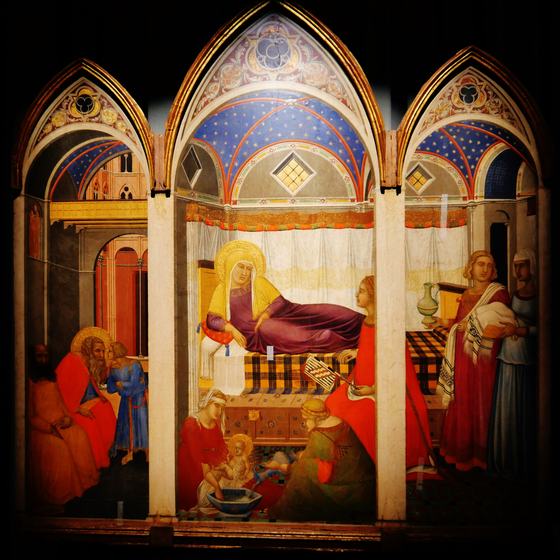
Pietro Lorenzetti
developed physically persuasive bodies and emotionally crowded narratives, especially in Assisi and cathedral commissions.
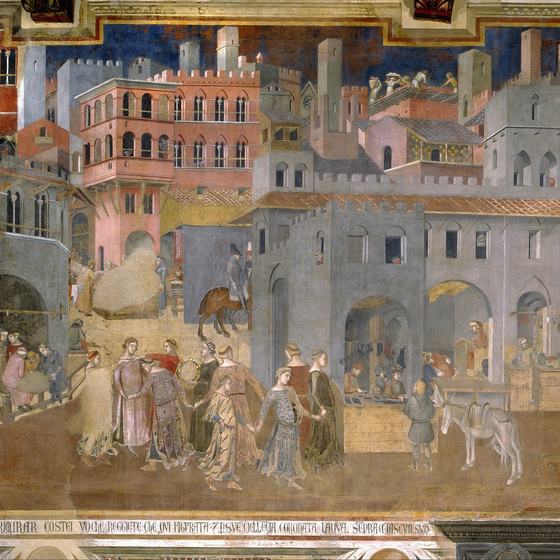
Ambrogio Lorenzetti
joined architectural experiment and observed daily life to civic and sacred thought. His Palazzo Pubblico cycle is a political environment, not merely an early cityscape.
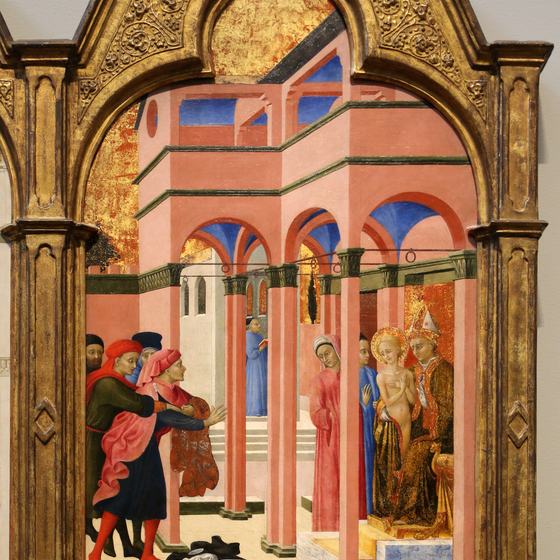
Sassetta
made fifteenth-century renewal from Trecento memory, international Gothic exchange, atmospheric light and selective spatial experiment.
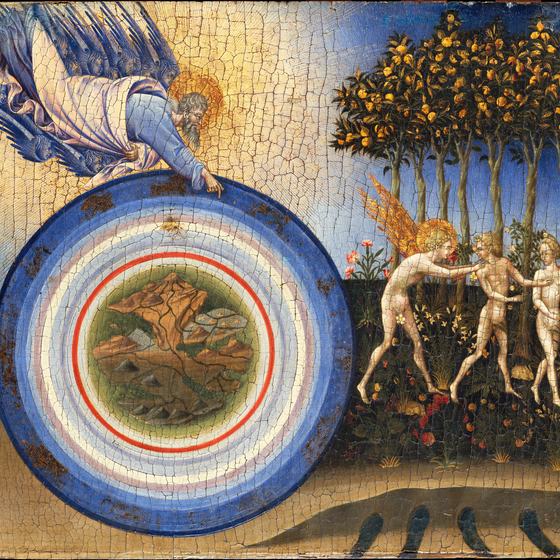
Giovanni di Paolo
created visionary landscapes and mystical narratives whose deliberate distortions intensify meaning.
Further people and places
Sano di Pietro
ran a prolific workshop that supplied accessible devotional imagery and public narratives for Franciscan and other patrons.
Vecchietta, Matteo di Giovanni, Neroccio and Francesco di Giorgio
demonstrate the school’s later variety across fresco, panel, sculpture, bronze, palace decoration, architecture and engineering.
Siena Cathedral and its museum
preserve the school’s Marian centre: the Madonna degli Occhi Grossi, Duccio’s Maestà and window, Pietro’s Birth of the Virgin, later altarpieces and sculpture.
Palazzo Pubblico
retains images made for government, including Simone’s Maestà and Ambrogio’s Good and Bad Government.
Santa Maria della Scala
shows painting as hospital identity, social care, institutional memory and public display.
The State Archive’s Biccherna Museum
preserves the union of administration and image across centuries.
Major artists directory
| Name | Nationality | Key Works |
|---|---|---|
| Ambrogio Lorenzetti | Italian | Presentation in the Temple, Effects of Good Government in the City, Bad Government and its Effects |
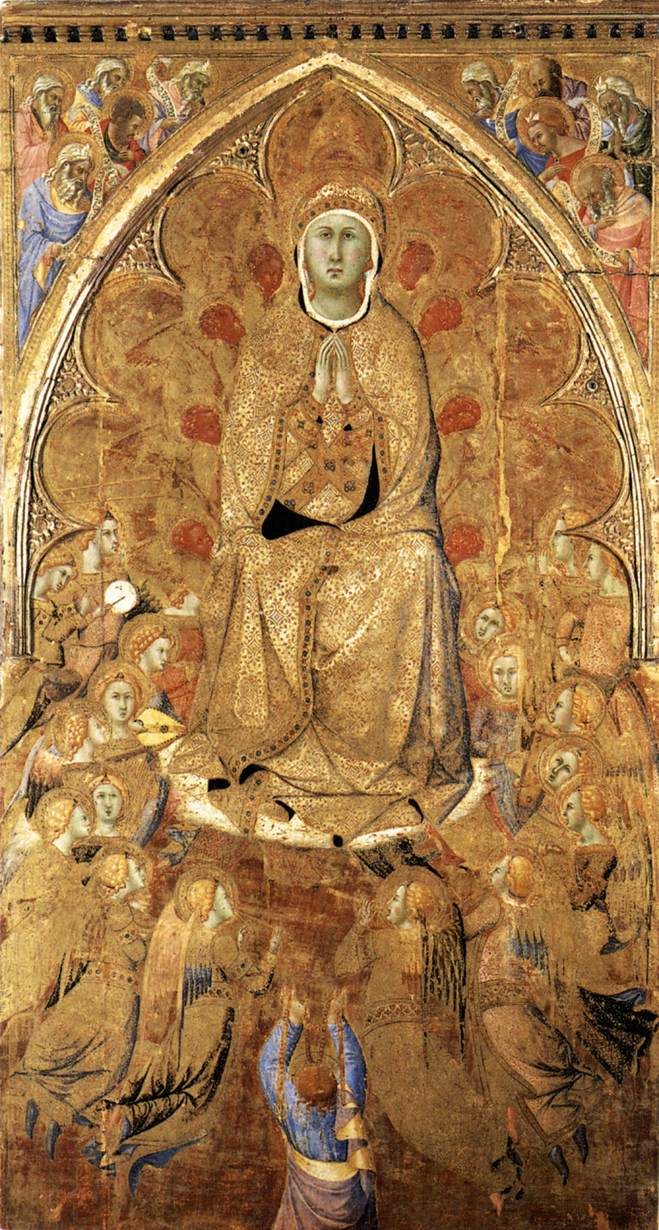
| Bartolomeo Bulgarini | Italian | Assumption of the Virgin |
| Duccio di Buoninsegna | Italian | Maestà, Last Supper |
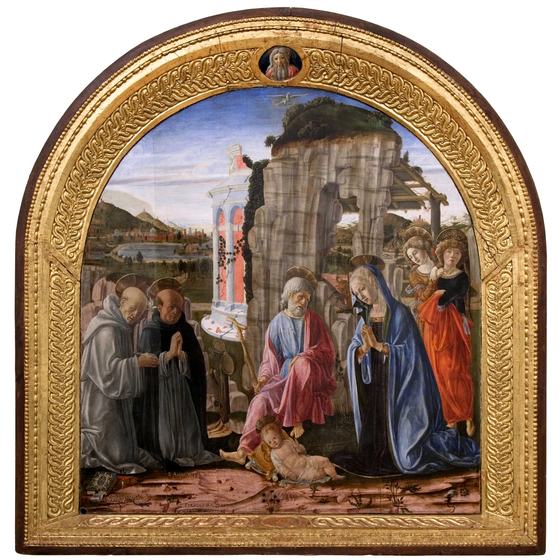
| Francesco di Giorgio | Italian | Nativity |
| Giovanni di Paolo | Italian | Creation and Expulsion from Paradise, Paradise, Saint Catherine Exchanges Her Heart with Christ |
| Lippo Memmi | Italian | Annunciation with Saints Ansanus and Margaret |
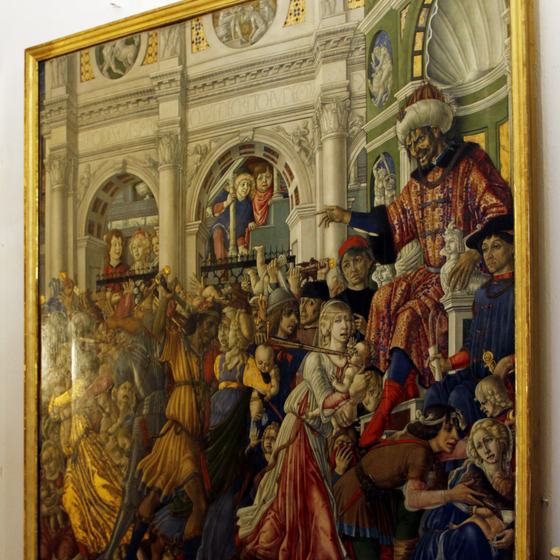
| Matteo di Giovanni | Italian | Massacre of the Innocents |
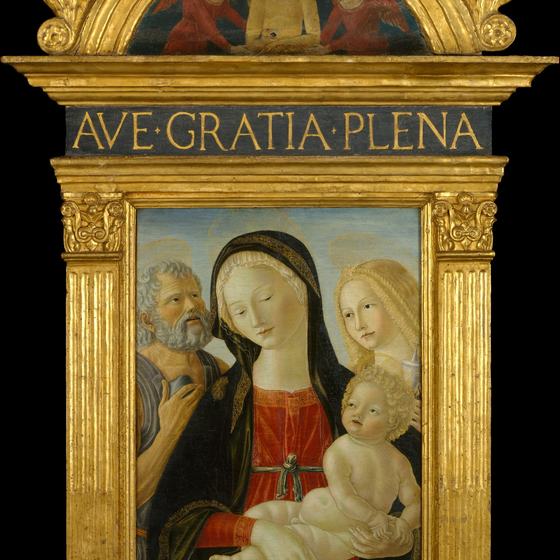
| Neroccio de’ Landi | Italian | Madonna and Child with Saints |
| Pietro Lorenzetti | Italian | Birth of the Virgin, Deposition from the Cross |
| Sano di Pietro | Italian | Madonna and Child with Saints |
| Sassetta | Italian | Saint Francis Renounces His Earthly Father |
| Simone Martini | Italian | Maestà, Annunciation with Saints Ansanus and Margaret |
| Ugolino di Nerio | Italian | Last Supper |
| Vecchietta | Italian | Old Sacristy fresco cycle |
How to look at Sienese painting
Begin with the object’s original job. Was it a high-altarpiece face, a low predella scene, a fresco surrounding officials, an account cover or a panel held close in prayer? Scale and position determine what kinds of detail mattered.
Watch the gold instead of looking past it. Move sideways and notice how burnishing and punchwork alter reflection. Ask where real light would have entered the original church or room.
Follow gestures. A recoiling shoulder, touching fingers or turned head may carry more narrative force than facial expression. Sienese painters often distribute emotion across a group rather than concentrate it in one protagonist.
Read architecture as action. Walls can separate simultaneous episodes, direct a procession or expose an interior. Do not measure every room against later linear perspective; ask what the space lets the story reveal.
Compare repeated subjects. Duccio’s cathedral Virgin and Simone’s civic Maestà share a type, but their inscriptions, settings and audiences make different claims. Recurrence can be argument, remembrance or institutional identity.
Look for the fragment. A small museum panel may once have sat beneath a monumental Madonna or on the back of a double-sided structure. Its edges, scale and narrative direction can retain clues to absent neighbours.
Finally, resist the choice between beauty and thought. Pattern, colour and grace are not an escape from history. In Sienese painting, they can organise theology, political ethics, status, compassion and fear.
Frequently Asked Questions
It was a long artistic tradition centred on Siena, not a formal organisation. The term groups workshops and artists connected by place, training, patronage, shared models and institutional commissions. Their work is too varied to define by one style.
For a useful survey, about 1250 to 1500 is the core range. The early date includes painters before Duccio and the first Biccherna covers; the later one allows the fifteenth-century Renaissance school to receive proper weight. Important Sienese traditions continued into the sixteenth century.
There was no absolute divide. Siena is associated with gold, linear elegance, colour and Gothic exchange, while Florence is often associated with bodily mass and spatial naturalism. In practice artists travelled, borrowed and competed. Ambrogio worked in Florence, and Sassetta or Giovanni di Paolo responded to Florentine innovations selectively.
Mary was both sacred intercessor and civic patron. Sienese tradition connected her protection to Montaperti, Duccio’s Maestà asked her to bring peace to the city, and Marian images occupied cathedral and government settings. The imagery helped institutions describe Siena as a protected Christian community.
The altarpiece was moved, removed from the high altar and eventually sawn apart. Major portions remain in Siena, while smaller narratives entered collections around the world. Scholars reconstruct it using documents, dimensions, carpentry, edges and iconographic sequence.
No. The plague caused enormous loss and disrupted workshops, patrons and projects, but art continued. Later painters worked in varied styles, and the fifteenth century produced Sassetta, Giovanni di Paolo, Sano di Pietro, Vecchietta and other major figures. The idea of a sudden artistic regression is now heavily qualified.
Gold signified cost, sacred distinction and unearthly light. Burnishing and punchwork also made the surface responsive to candles and moving viewers. It was an active optical and material choice, not proof that painters were unable to create space.
Religion dominated much surviving production, but the school also served government, finance, hospitals, palaces and private homes. Good and Bad Government, the Biccherna covers and later palace decorations show its civic and secular range, although medieval civic life itself remained entangled with religious belief.
Siena itself offers the fullest context. The Pinacoteca Nazionale holds an exceptional sequence of panels; the Museo dell’Opera preserves works from the cathedral; Palazzo Pubblico retains civic frescoes; Santa Maria della Scala has its hospital programme; and the State Archive displays the Biccherne. Major fragments are also in London, New York, Washington, Paris and other collections.
Discussion
If you had to introduce Sienese painting through one object, would you choose a public monument such as the Maestà or Good Government, an intimate devotional panel, or a visionary narrative by Giovanni di Paolo—and what would your choice reveal that the others might hide?
Reader Insights
Notice punchwork, incision and changing reflections before treating the background as empty or archaic.
Imagine separated panels reunited as a many-part altarpiece made for a particular altar, institution and ritual.
Compare Sassetta and Giovanni di Paolo with the Trecento masters to see renewal rather than simple decline.
Join the Conversation
Which Sienese work most changes your sense of what medieval and Renaissance painting could do? Share your view below.
References
- “Sienese Painting”, Metropolitan Museum of Art. View Source
- “Siena: The Rise of Painting, 1300–1350”, Metropolitan Museum of Art. View Source
- “Siena: The Rise of Painting, 1300–1350” press release, Metropolitan Museum of Art, (Italian). View Source
- “Siena: The Rise of Painting, 1300–1350”, National Gallery, London. View Source
- “Seven reasons to visit Siena: The Rise of Painting”, National Gallery, London. View Source
- “Siena”, Treccani, (Italian). View Source
- “Cathedral Museum”, Opera Duomo Siena. View Source
- “Museo dell’Opera”, Opera Duomo Siena, (Italian). View Source
- “Maestà Predella Panels”, National Gallery, London. View Source
- “Duccio’s Madonna and Child”, Metropolitan Museum of Art. View Source
- “Duccio di Buoninsegna”, National Gallery of Art, Washington. View Source
- Duccio and the Origins of Western Painting, Metropolitan Museum of Art. View Source
- “Simone Martini”, National Gallery, London. View Source
- “Annunciazione e i santi Ansano e Massima”, Gallerie degli Uffizi, (Italian). View Source
- “Museo Civico”, Comune di Siena, (Italian). View Source
- “Allegoria del Buon Governo”, Museo Civico Siena, (Italian). View Source
- “Il Palazzo”, Museo Civico Siena, (Italian). View Source
- “I Lorenzetti”, Treccani, (Italian). View Source
- “Presentazione al Tempio”, Gallerie degli Uffizi, (Italian). View Source
- “Storie di San Nicola”, Gallerie degli Uffizi, (Italian). View Source
- “Pietro Lorenzetti”, National Gallery of Art, Washington. View Source
- “Madonna col Bambino in trono e angeli”, Gallerie degli Uffizi, (Italian). View Source
- “Assisi, the Basilica of San Francesco and Other Franciscan Sites”, UNESCO World Heritage Centre. View Source
- “Ugolino da Siena: The Last Supper”, Metropolitan Museum of Art. View Source
- “Italian Painting of the Later Middle Ages”, Metropolitan Museum of Art. View Source
- review of Sienese Painting after the Black Death, College Art Association Reviews. View Source
- Sienese Painting after the Black Death excerpt, Cambridge University Press. View Source
- “Millard Meiss and painting after the plague, 70 years later”, Collège de France. View Source
- “Bartolomeo Bulgarini”, National Gallery of Art, Washington. View Source
- “Museo delle Biccherne”, Archivio di Stato di Siena, (Italian). View Source
- “Vecchietta at Santa Maria della Scala”, Santa Maria della Scala. View Source
- “The Marriage of the Maidens”, Santa Maria della Scala. View Source
- “Sassetta”, National Gallery, London. View Source
- “Stefano di Giovanni”, Treccani, (Italian). View Source
- Painting in Renaissance Siena, 1420–1500, Metropolitan Museum of Art. View Source
- “Giovanni di Paolo”, National Gallery, London. View Source
- “The Creation of the World and the Expulsion from Paradise”, Metropolitan Museum of Art, (Italian). View Source
- “Paradise”, Metropolitan Museum of Art. View Source
- “Saint Catherine of Siena Exchanging Her Heart with Christ”, Metropolitan Museum of Art. View Source
- “Sano di Pietro: Madonna and Child with Saints”, Metropolitan Museum of Art. View Source
- “Matteo di Giovanni”, National Gallery, London. View Source
- “Renaissance Siena: Art for a City”, National Gallery, London. View Source
- “Neroccio de’ Landi: Madonna and Child with Saints”, Metropolitan Museum of Art. View Source
- “The Master of the Story of Griselda and Paintings for Sienese Palaces”, National Gallery, London. View Source
- “The Pinacoteca Nazionale di Siena reopens”, Direzione regionale Musei nazionali Toscana, (Italian). View Source
- “Giovanni di Paolo’s SS Fabian and Sebastian”, National Gallery, London. View Source
- “Islamic Carpets in European Paintings”, Metropolitan Museum of Art. View Source
- Siena: The Rise of Painting catalogue, National Gallery, London. View Source
- Image references 49–70: open-access reproductions and institutional collection records.
View 22 image sources
01 · commons.wikimedia.org02 · commons.wikimedia.org03 · commons.wikimedia.org04 · commons.wikimedia.org05 · commons.wikimedia.org06 · commons.wikimedia.org07 · commons.wikimedia.org08 · commons.wikimedia.org09 · commons.wikimedia.org10 · commons.wikimedia.org11 · commons.wikimedia.org12 · commons.wikimedia.org13 · commons.wikimedia.org14 · commons.wikimedia.org15 · commons.wikimedia.org16 · commons.wikimedia.org17 · commons.wikimedia.org18 · commons.wikimedia.org19 · commons.wikimedia.org20 · commons.wikimedia.org21 · commons.wikimedia.org22 · commons.wikimedia.org