


 by Tom Gurney
Tom Gurney BSc (Hons) is an art history expert with over 20 years experience
Published on June 19, 2020 / Updated on July 9, 2026
Email: tomgurney1@gmail.com / Phone: +44 7429 011000
Florence Cathedral Dome by Filippo Brunelleschi: Introduction
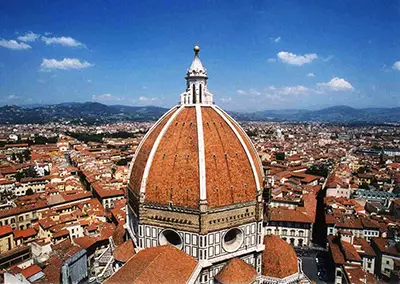
The dome of Florence Cathedral is Filippo Brunelleschi's most famous achievement and one of the defining architectural projects of the early Renaissance. It rises above Santa Maria del Fiore, changing the skyline of Florence and completing a problem that had challenged the cathedral project for generations. Opera di Santa Maria del Fiore presents Brunelleschi's dome as both a technical solution and a turning point in the story of the cathedral. [1]
The dome matters because it was not simply designed as an attractive roof. It had to cover the vast crossing of Florence Cathedral, and it had to do so in a way that was structurally possible, visually commanding and worthy of the city's civic ambition. The official Opera del Duomo account emphasises several features that make the project so important: its scale, its double-shell structure, its relationship to earlier architectural knowledge and the famous herringbone brickwork that helped organise the masonry. [1]
For readers coming to Brunelleschi for the first time, the dome is a useful warning against simple labels. He was not only an architect, not only an engineer and not only a Renaissance genius in the abstract. The dome shows him as a designer of built processes: someone who had to think about form, materials, labour, sequence, structure and civic expectation at the same time.
At a Glance
- Architect: Filippo Brunelleschi
- Project: Dome of Florence Cathedral / Cupola of Santa Maria del Fiore
- Location: Florence Cathedral, Florence
- Building: Cathedral of Santa Maria del Fiore
- Key completion milestone: 1436, according to Opera di Santa Maria del Fiore's chronology
- Main structure: large masonry dome with a double-shell system
- Important visual features: octagonal form, ribs, rising profile and lantern
- Cluster role: flagship Brunelleschi project and core architecture page
Contents
- Why the Dome Matters
- The Building Problem
- Looking Carefully
- The Double Shell and Herringbone Brickwork
- 1436 and the Completion of the Dome
- Museum Perspective
- The Lantern
- Comparison Works
- Things You Might Miss
- Interpretation
Why the Dome Matters
The dome matters first because it solved a real architectural problem. Florence Cathedral had been planned on an enormous scale, but the crossing needed a covering that could match the ambition of the building. Brunelleschi's solution did not merely finish the cathedral. It transformed the building's identity and gave Florence one of its most recognisable forms. [1]
It also matters because the dome is visible at two very different scales. From within the cathedral complex, it belongs to the structure of the building. From across Florence, it becomes a civic sign. The dome is not simply something placed above a church; it is part of how the city is seen and remembered.
The project also reveals the limits of a purely stylistic account of Renaissance architecture. It is not enough to say that Brunelleschi revived classical forms or made buildings more harmonious. Here, the question is construction. How could such a span be built? How could masonry be organised as it rose? How could the profile be completed without collapsing the ambition into an impossible design?
That is why the dome remains so compelling. It joins beauty to problem-solving. It is an object of admiration, but also a record of planning, risk and practical intelligence.
The Building Problem
Before Brunelleschi, Florence Cathedral already existed as a vast unfinished ambition. The dome was not an isolated artwork made from a blank beginning. It was a response to a pre-existing building problem: the need to cover the cathedral crossing in a way that matched the scale and prestige of the project.
This is one reason the dome should not be described as a sudden miracle. Brunelleschi's achievement was extraordinary, but it belonged to a long civic and architectural process. The cathedral had a history before him; his dome completed and transformed that history. Opera di Santa Maria del Fiore's account situates the project within that broader development rather than treating it as a freestanding invention. [1]
The scale of the problem also explains why the dome had to be more than a drawing. It required an answer to structure and method. A design that looked impressive but could not be built would have been useless. Brunelleschi's importance lies partly in the fact that he joined design imagination to construction intelligence.
Looking Carefully
The first thing to notice is the octagonal form. The dome does not sit as a smooth circular hemisphere. It rises in sections, with ribs that make its structure visible from the outside. Those ribs give the dome a strong vertical movement, drawing the eye upward from the drum toward the lantern.
The second thing to notice is the double effect of mass and lightness. The dome is enormous, but it does not feel like a dead weight. Its profile rises sharply and decisively. The ribs, surfaces and lantern all contribute to the sense that the structure is pressing upward as well as resting on the building below.
The third thing to notice is the relationship between exterior and interior logic. From the city, the dome is a skyline image. From the cathedral complex, it is a structural answer to the crossing. The same object works as civic symbol, architectural solution and visual climax.
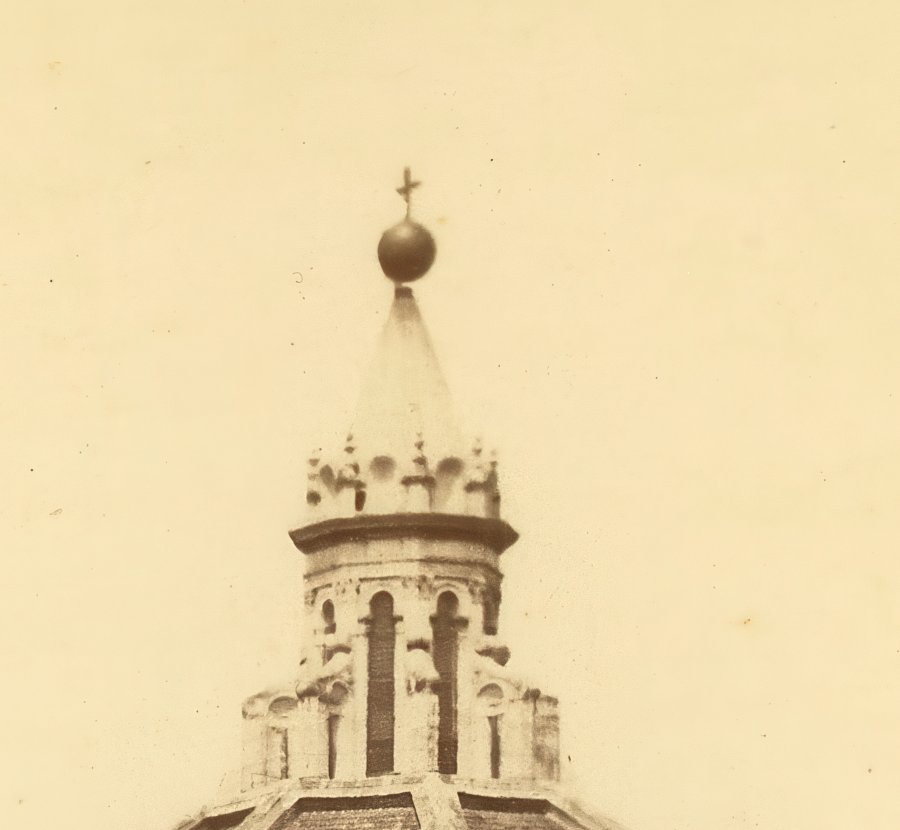
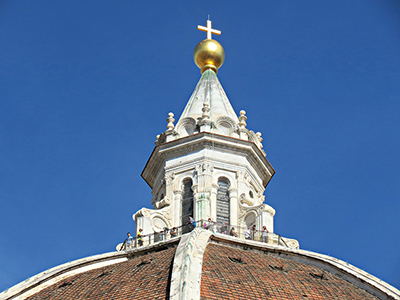
The fourth thing to notice is the lantern. It is easy to treat the lantern as a finishing detail, but the Opera del Duomo gives it its own history as part of the dome's continuation and completion. [3] Visually, the lantern tightens the upward movement of the dome and gives the profile a final point of focus.
Annotated Details from the Florence Cathedral Dome
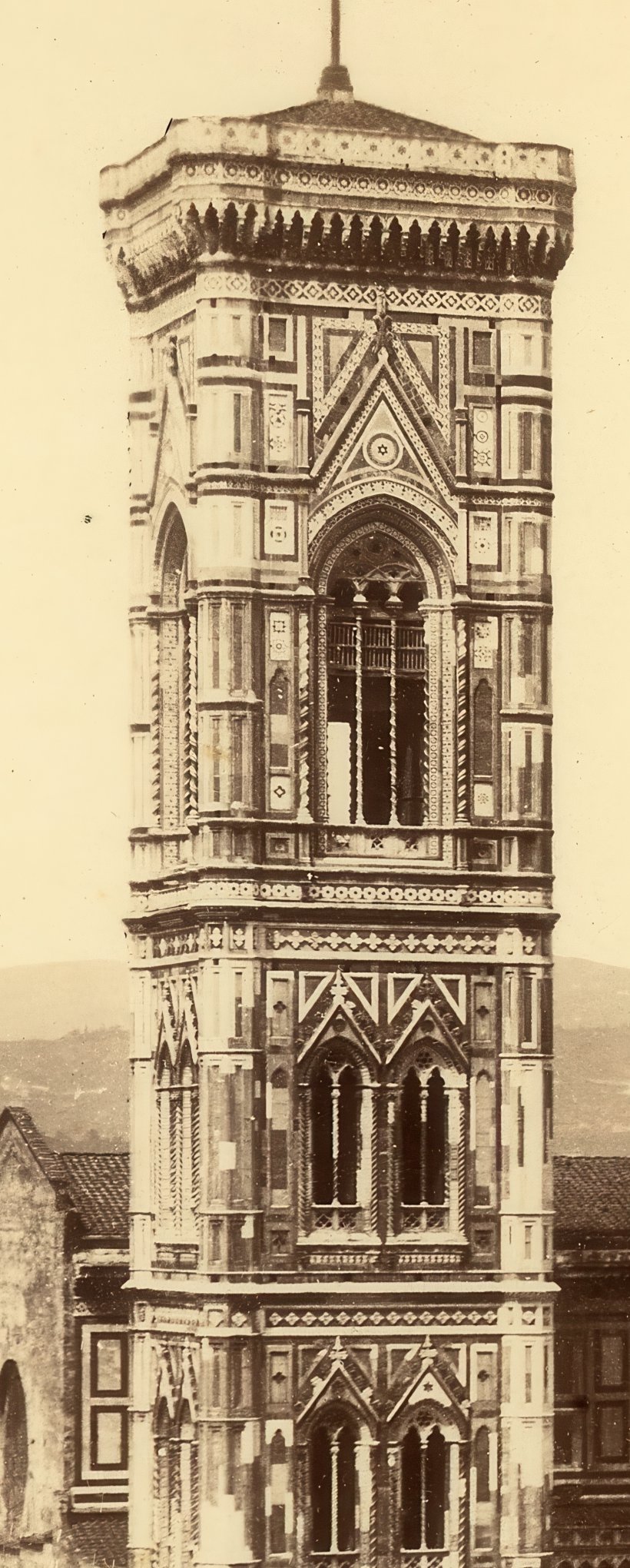
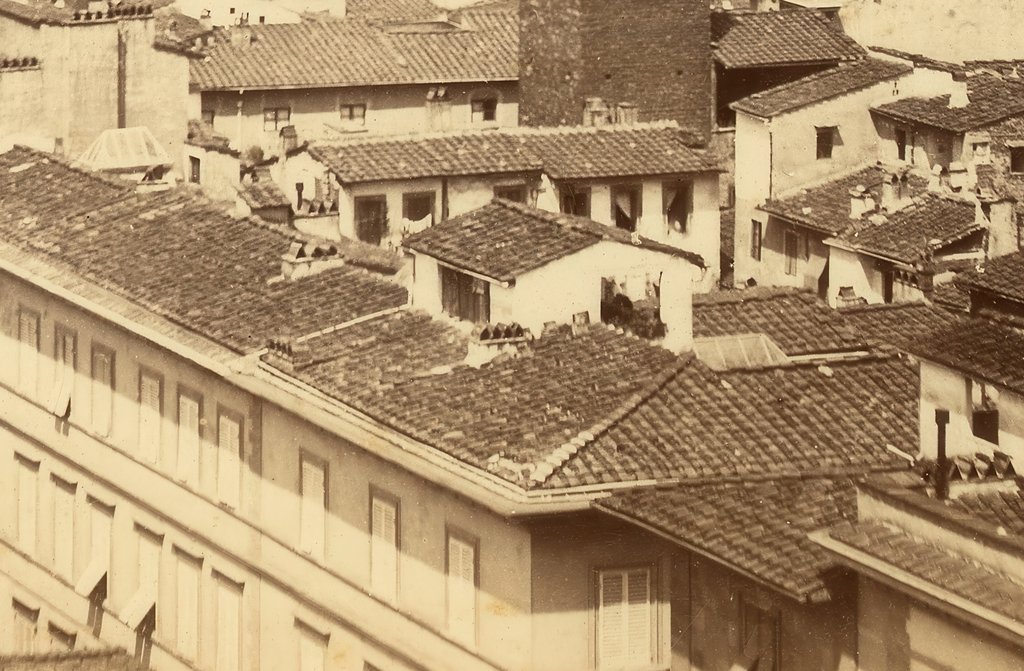
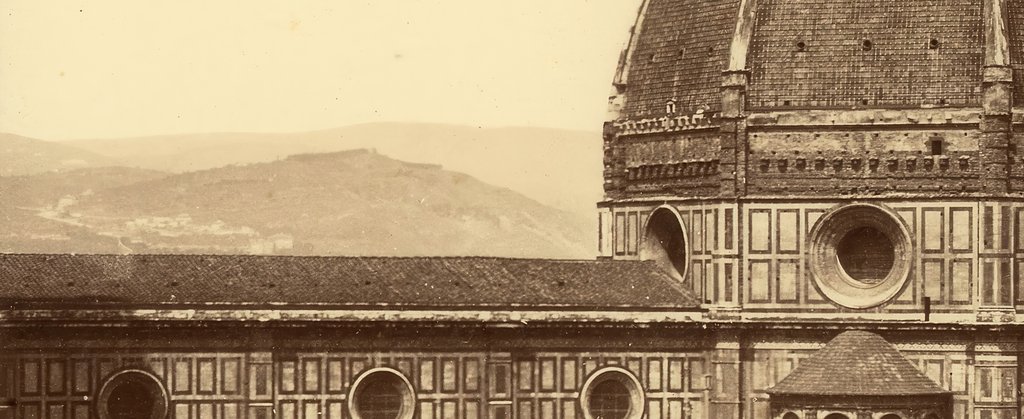
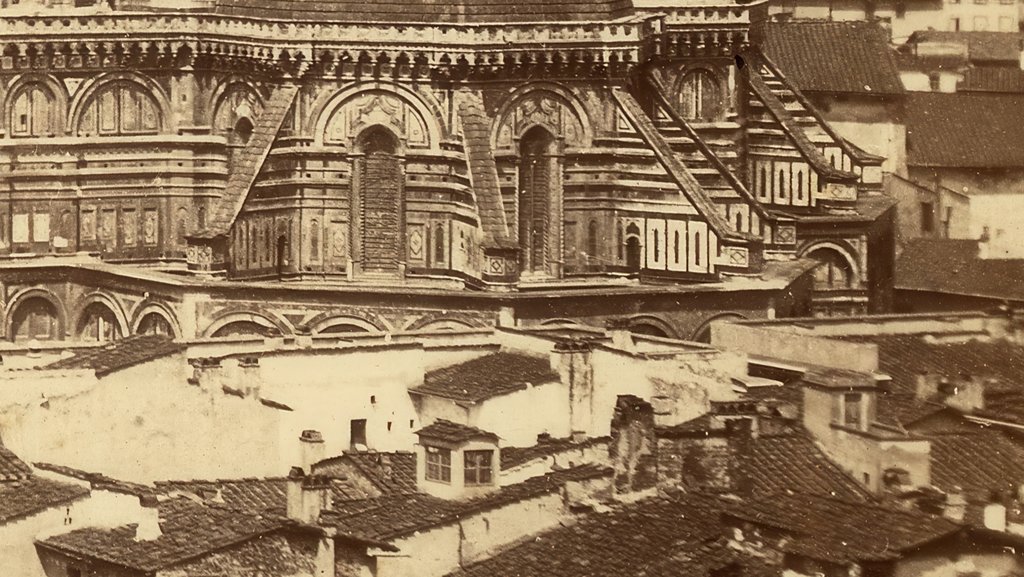
This annotated view uses a historic 1860 photograph to look at Brunelleschi's dome in its wider cathedral and city setting. It helps show why the dome is not only a technical achievement, but also a skyline image, a civic landmark and the visual climax of Santa Maria del Fiore. [1]
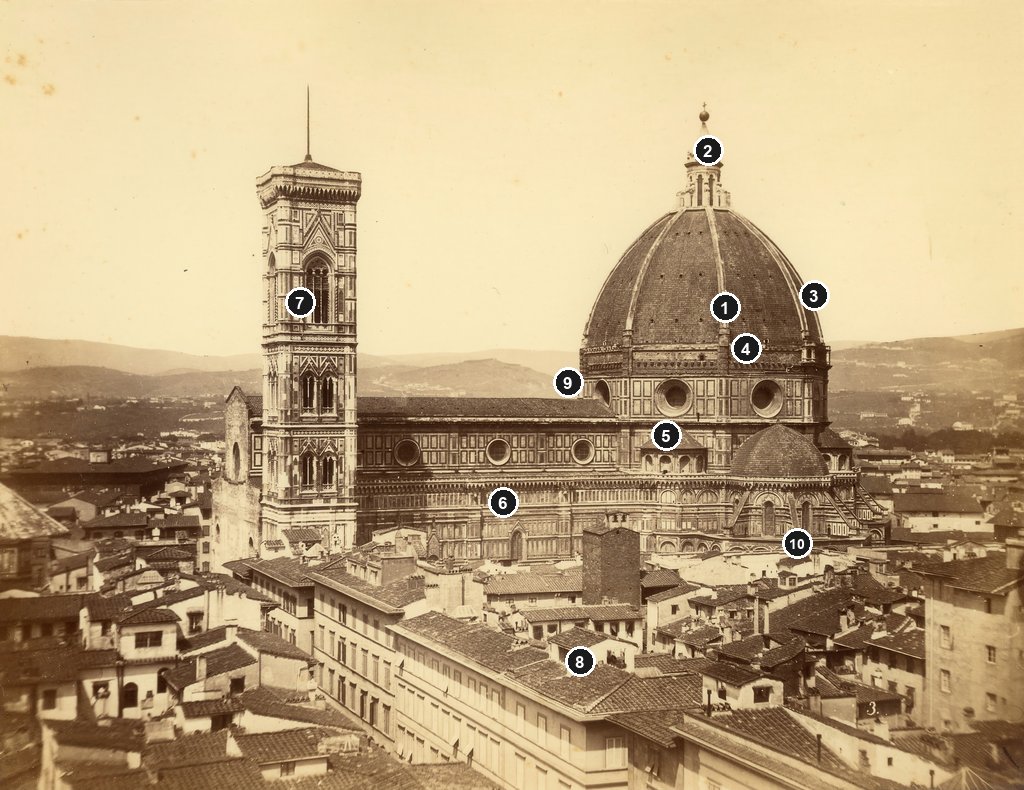
On desktop and tablet screens, click a number on the image to jump to the matching detail below.
10 DETAILS to Notice
The details below move from the dome and lantern to the cathedral body, surrounding city and wider horizon. Together they show how Brunelleschi's solution became part of Florence's visual identity.
The Dome as Skyline
Seen from a distance, the dome reads as more than a roof. It becomes the dominant architectural form in the city view, which is why the page treats it as structure, skyline and civic image at once. [1]
The Lantern
The lantern gives the dome its final upward point. Opera di Santa Maria del Fiore treats the lantern as a dedicated part of the dome's continuing story, not merely as a small decorative top. [3]
Eight-Part Ribbed Structure
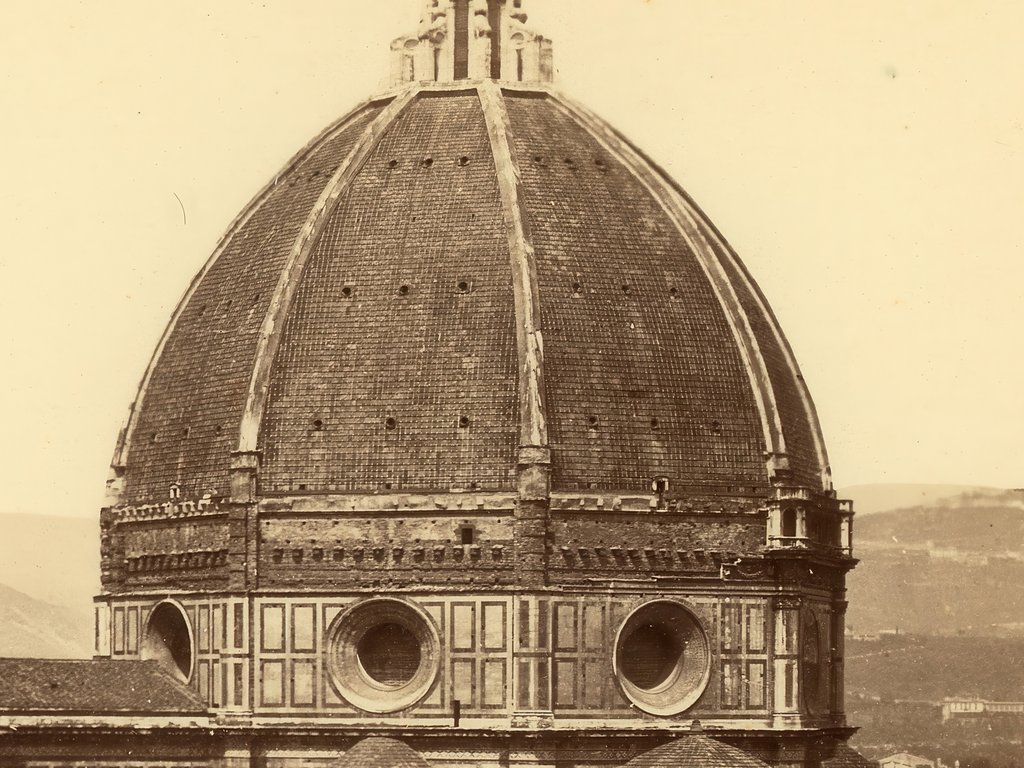
The exterior ribs make the dome's divided structure visible. Instead of appearing as a smooth hemisphere, the cupola rises in strong sections that guide the eye from the drum toward the lantern.
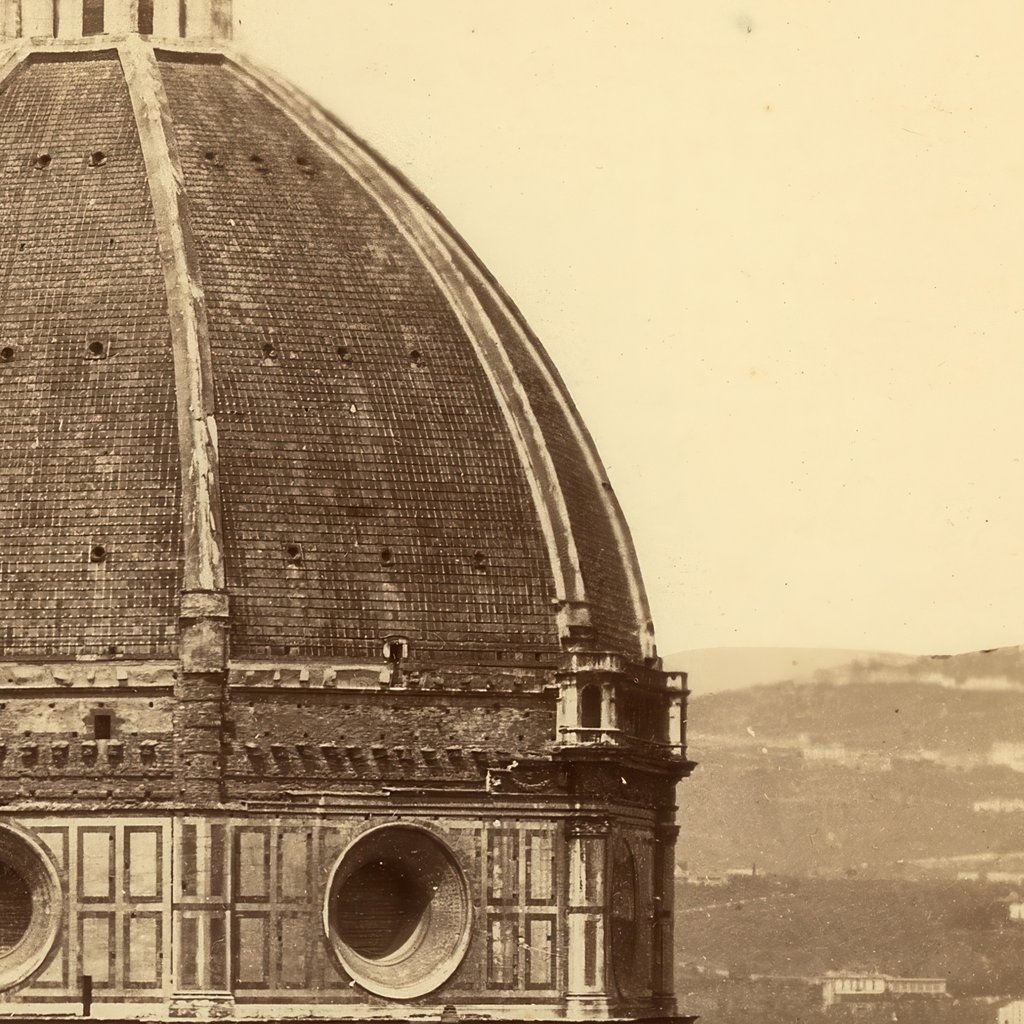
Masonry Surface
The surface reminds us that the dome is not only a silhouette. Opera di Santa Maria del Fiore identifies technical features such as the double-shell structure and herringbone brickwork as central to Brunelleschi's solution. [1]
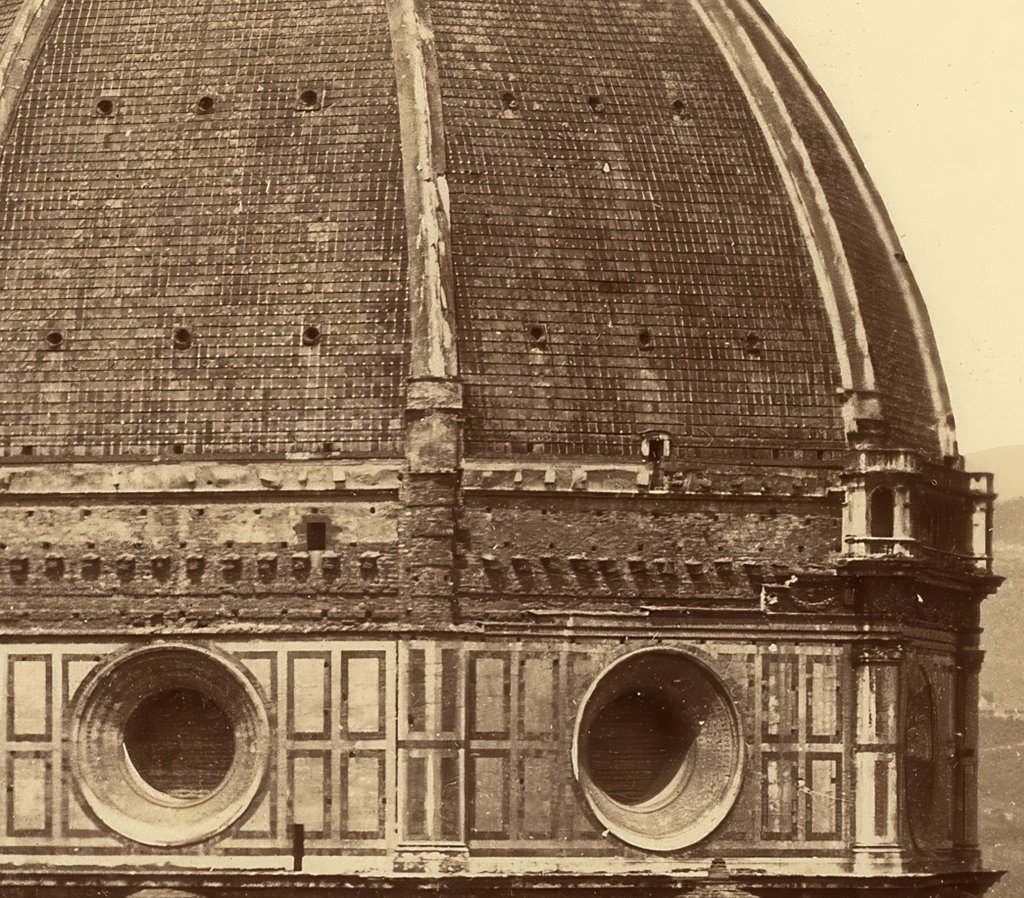
The Drum and Oculi
The drum below the dome gives the cupola its architectural base. In the photograph, the circular openings help separate the great rising dome from the lower cathedral structure.
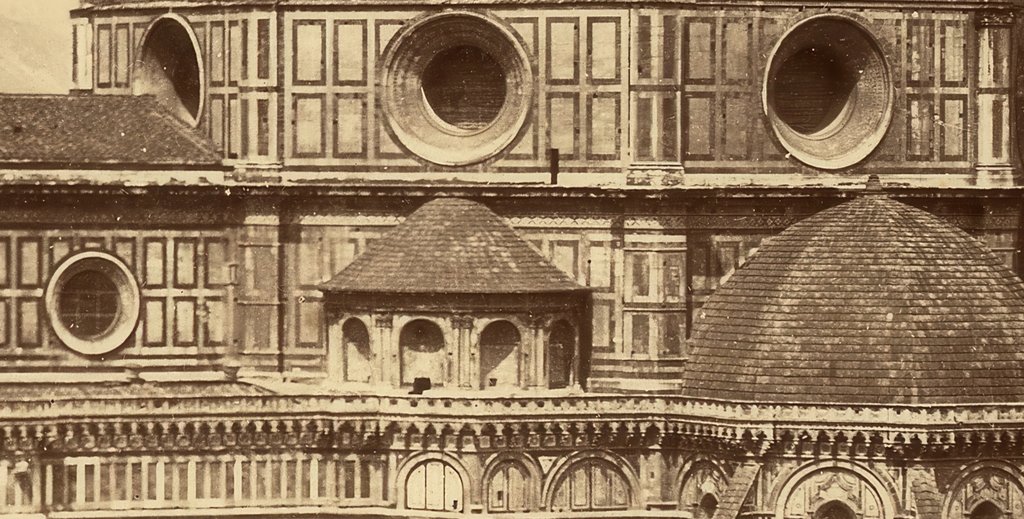
The Cathedral Nave Below
The long nave below helps explain the inherited building problem. Brunelleschi's dome was not designed in isolation; it completed a vast cathedral already shaped by earlier phases of construction. [1]
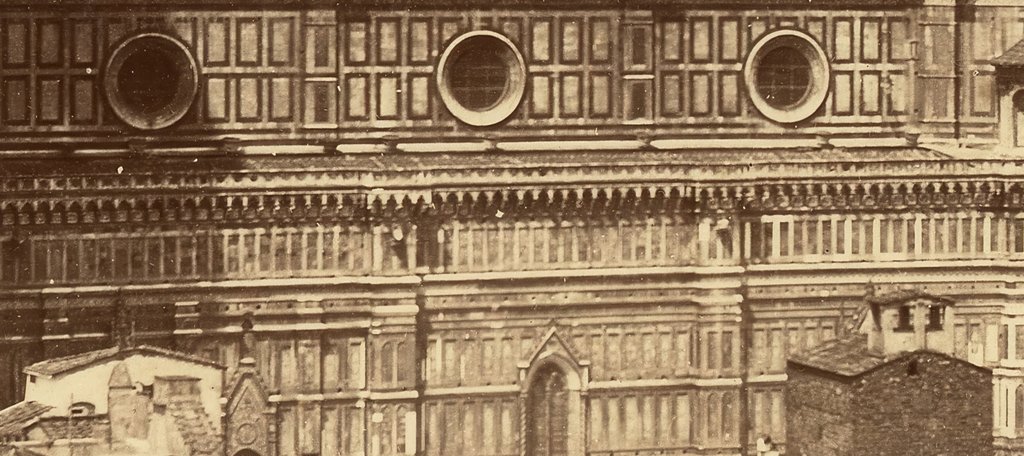
Giotto's Campanile
The bell tower is not Brunelleschi's work, but it matters in the view. The photograph shows the dome as part of a larger cathedral complex, where different medieval and Renaissance elements stand beside one another.
Florentine Rooftops
The foreground rooftops show why the dome works so powerfully as a city image. It is seen above ordinary buildings, turning architectural engineering into part of Florence's daily horizon.
Hills Beyond Florence
The distant hills widen the scale of the image. The dome can be read from the cathedral precinct, from streets and rooftops, and from wider views across Florence.
East-End Structures
The smaller structures below the dome keep the great cupola connected to the body of the cathedral. They help the photograph show a layered building rather than a dome floating by itself.
The Double Shell and Herringbone Brickwork
The dome is often discussed through two famous technical features: the double-shell structure and the herringbone brickwork. Opera di Santa Maria del Fiore identifies both as important parts of Brunelleschi's solution. [1]
The double shell matters because it helps explain how the dome could be both monumental and buildable. Rather than thinking of the dome as a single solid mass, readers should understand it as a more complex structure. The relationship between the inner and outer parts belongs to the technical intelligence of the project.
The herringbone brickwork is visually and structurally interesting because it reminds us that construction is not only about overall shape. It is also about the arrangement of materials. The brick pattern helped organise the masonry as the dome rose. [1]
But the page should avoid a common simplification: the dome was not built by one trick alone. Herringbone brickwork is memorable, but it was part of a wider system of design, materials, geometry, sequencing and site organisation. The best reading of the dome keeps the technical story broad rather than reducing it to a single clever device.
1436 and the Completion of the Dome
The year 1436 is central to the story of the dome. Opera di Santa Maria del Fiore marks 30 August 1436 as a key date in the conclusion of the dome works, making it a secure milestone for the page's chronology. [2]
That date matters because it turns the dome from an ambitious undertaking into a completed civic achievement. The completion was not merely a construction event. It changed the way the cathedral and the city could be understood. Florence now had a monumental architectural form that could be seen from far beyond the building itself.
The date also helps readers understand Brunelleschi's career. The dome was not an early experiment left on paper. It was a project carried through into built reality, large enough to define his reputation and complex enough to keep attracting technical study centuries later.
Museum Perspective
The strongest museum perspective for this page comes from Opera di Santa Maria del Fiore, because the dome is still part of the cathedral complex and the institutional history of the site. The reader should not feel that the dome is only a textbook image. It is a living heritage object, encountered through the cathedral, the museum, the climb, the skyline and the continuing interpretation of the site.
This museum perspective also helps balance two kinds of awe. One is visual: the dome's scale and profile. The other is historical: the process by which it was conceived and built. A strong page should hold both together.
The dome is also one of the best pages for explaining that architecture can be experienced from many distances. A painting usually asks the viewer to stand in front of it. The dome can be seen from streets, hills, squares, rooftops, the cathedral interior and the museum context. Each distance changes the experience.
The Lantern
The lantern deserves more attention than a passing mention. It completes the upward movement of the dome and forms part of the later continuation of Brunelleschi's project. Opera di Santa Maria del Fiore has a dedicated account of the lantern, which makes it a strong internal link and a natural companion page in the cluster. [3]
Visually, the lantern changes the dome's silhouette. Without it, the dome would still be massive and impressive, but the rising profile would feel less resolved. The lantern gives the structure a crown and a point of completion.
Historically, the lantern also helps readers see the dome as a process rather than a single date. The 1436 milestone is crucial, but the architectural story continued. A separate lantern page can explain that continuation in more detail without overloading the main dome article.
Comparison Works
The Hospital of the Innocents is a useful comparison because it shows Brunelleschi working at a different scale. The hospital is civic, measured and horizontal; the dome is monumental, vertical and structurally dramatic. Together, they show that Brunelleschi's importance was not confined to one type of problem. [4]
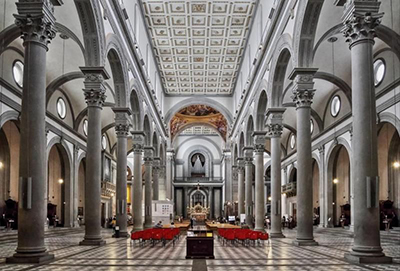
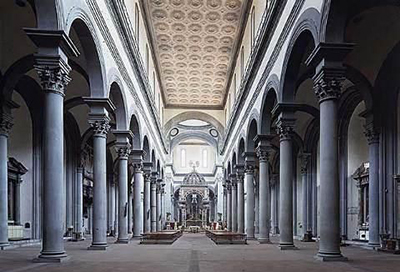
San Lorenzo Basilica offers another contrast. In San Lorenzo, the emphasis is on modular interior order, repeated arches and a calm rhythm of space. The dome is instead a vast structural and skyline solution. Both projects depend on clarity, but their architectural tasks are very different. [5]
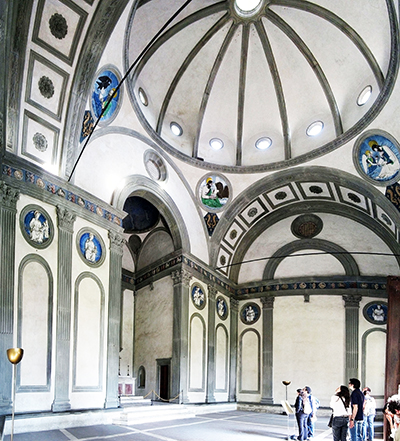
The Old Sacristy gives a smaller domed comparison. It can help readers understand that Brunelleschi's interest in domed and geometrically ordered spaces was not limited to the cathedral. The cathedral dome, however, magnifies the problem into a public and civic scale.
Later domes, including Michelangelo's work at St Peter's, belong to the dome's long legacy, but those comparisons should be handled carefully in the final HTML only after local internal URLs are checked.
Things You Might Miss
The dome was a solution to an inherited problem, not a project invented from nothing.
Its technical importance is broader than herringbone brickwork alone.
The double shell helps explain why the dome is structurally more complex than its exterior silhouette might suggest.
The lantern is part of the dome's architectural story, not merely a small ornament at the top.
The dome works as structure, skyline and civic identity at the same time.
Interpretation
Brunelleschi's dome is best understood as a union of ambition and method. It is visually magnificent, but its deeper importance lies in the fact that the visual form had to be made buildable. The project required an answer to scale, structure, material arrangement and public expectation.
That combination is why the dome remains central to any account of Renaissance architecture. It did not simply imitate the ancient world. It used knowledge, observation and practical invention to solve a modern Florentine problem.
The dome also helps explain why Brunelleschi's career should not be reduced to a single label. He was an architect, but the dome required engineering judgement. He was a designer, but the project depended on construction sequence and site organisation. He was associated with Renaissance proportion and clarity, but this work also demanded risk, persuasion and technical discipline.
The result is a building that still feels alive in the city. It is not only the roof of Florence Cathedral. It is one of the great architectural images of Florence itself.
FAQs
Brunelleschi's solution involved a complex masonry structure, including a double-shell system and herringbone brickwork identified by Opera di Santa Maria del Fiore. [1] The full engineering story should be treated carefully because the dome depended on more than one technique.
The dome had to cover a huge cathedral crossing and complete a building project whose scale created a major architectural challenge. It was not simply a matter of adding a decorative top to the cathedral; it required a buildable structural solution. [1]
Opera di Santa Maria del Fiore identifies 30 August 1436 as a key date in the conclusion of the dome works. [2]
Herringbone brickwork is a brick arrangement associated with the dome's construction. It is important, but it should be understood as part of a larger construction system rather than as the only reason the dome succeeded. [1]
The lantern completes the dome's upward profile and forms part of the continuation of the dome story after the main structure. Opera di Santa Maria del Fiore treats the lantern as important enough for a dedicated account. [3]
Discussion
The dome of Florence Cathedral still raises practical and imaginative questions. Is its greatest achievement technical, civic or visual?
Reader Insights
The dome is compelling because it solves a construction problem at a scale that still feels daring, even when seen through modern eyes.
Would the dome be as powerful if it were not also part of Florence's skyline and civic identity?
Join the Conversation
Have a thought or observation about Florence Cathedral Dome? Share it below. Thoughtful responses may be added to this section.
References
- Opera di Santa Maria del Fiore, Brunelleschi e la genesi di un capolavoro, https://duomo.firenze.it/it/opera-magazine/post/4743/brunelleschi-e-la-genesi-di-un-capolavoro (in Italian).
- Opera di Santa Maria del Fiore, Il 30 agosto 1436 si concludevano i lavori della Cupola di Brunelleschi, https://duomo.firenze.it/it/opera-magazine/post/4649/il-30-agosto-1436-si-concludevano-i-lavori-della-cupola-di-brunelleschi (in Italian).
- Opera di Santa Maria del Fiore, Una Lanterna per la Cupola del Duomo di Firenze, https://duomo.firenze.it/it/opera-magazine/post/4459/una-lanterna-per-la-cupola-del-duomo-di-firenze (in Italian).
- Museo degli Innocenti, Architettura, https://www.museodeglinnocenti.it/museo/percorsi-espositivi/architettura/ (in Italian).
- San Lorenzo Firenze, La Basilica di San Lorenzo, https://sanlorenzofirenze.it/la-basilica-di-san-lorenzo/ (in Italian).
 Filippo Brunelleschi.jpg)
 Filippo Brunelleschi.jpg)
 Filippo Brunelleschi.jpg)