


 Filippo Brunelleschi.jpg)
 by Tom Gurney
Tom Gurney BSc (Hons) is an art history expert with over 20 years experience
Published on June 19, 2020 / Updated on July 9, 2026
Email: tomgurney1@gmail.com / Phone: +44 7429 011000
Old Sacristy of San Lorenzo by Filippo Brunelleschi: Introduction
The Old Sacristy of San Lorenzo, or Sagrestia Vecchia, is one of the best places to see Filippo Brunelleschi's architecture at a concentrated scale. It belongs to the San Lorenzo complex in Florence, but it offers a different experience from the basilica nave. Where San Lorenzo unfolds through repeated arches and bays, the Old Sacristy gathers architectural order into a smaller, more geometric space.
The San Lorenzo source places the Old Sacristy within the wider history of the basilica and connects the reconstruction of San Lorenzo with Brunelleschi's direction. [1] That context matters because the Old Sacristy is not an isolated jewel. It belongs to a larger architectural and religious setting.
The space is important because it makes Brunelleschi's interest in clarity visible. Square, circle, dome, arch and stone line all work together. The result is not theatrical decoration, but an architecture of proportion and calm.
At a Glance
- Architect: Filippo Brunelleschi
- Building: Old Sacristy / Sagrestia Vecchia
- Location: San Lorenzo, Florence
- Type: sacristy / chapel-like sacred space
- Key architectural interest: compact geometry, dome, square plan, clear stone articulation
- Related page: San Lorenzo Basilica
- Later context: Medici and later San Lorenzo history
- Editorial caution: distinguish Brunelleschi's architecture from later decorative and sculptural layers
Contents
- Why the Old Sacristy Matters
- Looking Carefully
- Relation to San Lorenzo
- Geometry and Space
- Later Decoration and Attribution
- Comparison with San Lorenzo Basilica
- Comparison with Santo Spirito
- Comparison with the Cathedral Dome
- Things You Might Miss
- Interpretation
Why the Old Sacristy Matters
The Old Sacristy matters because it shows Brunelleschi working with a more intimate architectural problem. The dome of Florence Cathedral is public, vast and technically dramatic. The Old Sacristy is smaller, quieter and more concentrated. Yet both works reveal an architect interested in how space can be ordered.
This page is especially useful because it teaches readers to look slowly. The Old Sacristy does not rely on scale alone. Its power comes from relationships: square to circle, wall to dome, stone line to pale surface, arch to supporting order.
The space also helps explain why Brunelleschi's architecture became so influential. He did not only design individual effects. He created architectural systems in which parts relate clearly to the whole. In the Old Sacristy, that system is easier to grasp because the room is compact.
Looking Carefully
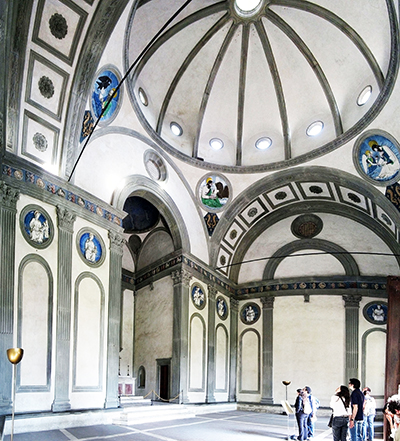
The first thing to notice is the sense of geometric control. The room feels ordered before the viewer begins naming the parts. The square and the dome create a clear relationship between earthly enclosure and overhead form.
The second thing to notice is the use of architectural lines. Brunelleschi's spaces often make structure readable through darker stone set against lighter wall surfaces. This contrast helps the eye understand the organisation of the room.
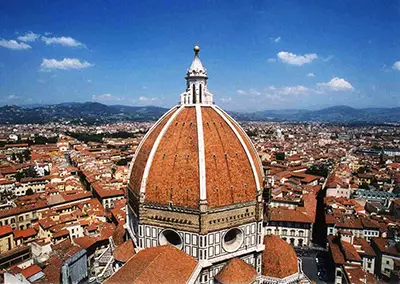
The third thing to notice is the dome. In the cathedral, the dome dominates the city. In the Old Sacristy, a dome organises a smaller sacred space. The comparison helps readers understand that Brunelleschi's interest in domed forms was not only about monumentality. It was also about proportion.
The fourth thing to notice is restraint. The Old Sacristy is not empty, but its architectural power comes from measured clarity rather than decorative overload. This makes it one of the strongest examples of Brunelleschi's disciplined spatial language.
Relation to San Lorenzo
The Old Sacristy belongs to the San Lorenzo complex, and it is best understood beside the basilica. The San Lorenzo source connects the basilica's reconstruction with Brunelleschi's direction and later completion by Manetti. [1] That broader context helps place the sacristy within a living architectural site rather than treating it as a detached object.
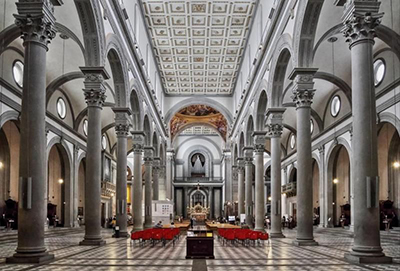
San Lorenzo and the Old Sacristy show two different kinds of order. The basilica nave works through sequence: columns, arches and bays repeating through a church interior. The Old Sacristy works through concentration: a compact space organised by geometry and architectural articulation.
Together, they make San Lorenzo one of the essential Brunelleschi sites. The basilica teaches rhythm; the sacristy teaches geometry.
Geometry and Space
The Old Sacristy is often discussed through geometry because its forms are so clearly organised. The square is one of the basic experiences of the room. It gives the space stability and containment.
The dome changes that experience. It lifts the eye and introduces a circular or curved order above the square. This relationship between lower enclosure and upper form is central to the space's effect.
The stone articulation also matters. Lines, arches and frames help the viewer understand how the parts relate. The room does not need to shout. It allows order to become visible.
This is why the Old Sacristy is a strong page for close looking. It lets readers see Brunelleschi's architecture almost diagrammatically, but without turning the room into an abstract exercise. It remains a sacred architectural space.
Later Decoration and Attribution
The Old Sacristy has a rich later artistic and decorative context, including works associated with figures beyond Brunelleschi. For Brunelleschi, the central issue is the architectural framework rather than every later decorative element in the space.
That distinction matters because Renaissance buildings are often layered. Architecture, sculpture, painting, patronage and later restoration can all occupy the same site. If the page treats every visible feature as Brunelleschi's, it becomes misleading.
The safest interpretation is to say that Brunelleschi's architectural framework gives the room its order, while later decorative or sculptural elements belong to the broader history of the space.
Comparison with San Lorenzo Basilica
San Lorenzo Basilica is the closest comparison because it provides the wider architectural setting. The basilica shows Brunelleschi's order extended through a church interior. The Old Sacristy shows order compressed into a focused sacred room. [1]
The comparison is useful because it keeps scale in view. Brunelleschi's architecture was not one-size-fits-all. Similar principles could organise a nave, a sacristy, a hospital facade or a cathedral dome, but each project asked for a different response.
Comparison with Santo Spirito
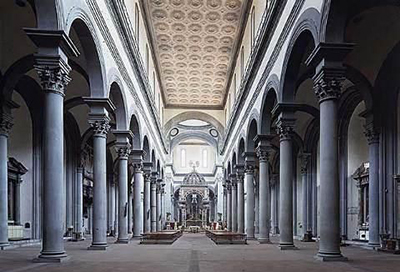
Santo Spirito gives another comparison for Brunelleschi's spatial rhythm. Its official architecture page presents the basilica through proportion, rhythm and light. [2] The Old Sacristy is more compact, but it shares the same concern for order.
Santo Spirito also reminds readers that buildings connected with Brunelleschi often have complex histories of design, construction and later completion. [3] The Old Sacristy benefits from the same kind of careful reading.
Comparison with the Cathedral Dome
The Florence Cathedral Dome is the most dramatic comparison. It shows Brunelleschi at the scale of the city. The Old Sacristy shows him at the scale of a room.
Both involve domed form, but their meanings are different. The cathedral dome solves a vast engineering and civic problem. The Old Sacristy uses domed geometry to organise a compact sacred space. [4]
This comparison helps readers avoid thinking of Brunelleschi as only an engineer of huge structures. He was also an architect of measured interiors.
Things You Might Miss
The Old Sacristy is small compared with the cathedral dome, but it is not minor.
Its architecture depends on the relationship between square, dome and stone articulation.
It belongs beside San Lorenzo Basilica, not apart from it as an isolated room.
Later decorative elements need to be separated from Brunelleschi's architectural framework.
The space shows how Renaissance order can be quiet rather than spectacular.
Interpretation
The Old Sacristy is best interpreted as an architecture of concentration. Brunelleschi's larger works show order across facades, naves and city skylines. Here, the same architectural intelligence is gathered into a compact room.
Its importance lies in the way geometry becomes experience. The viewer does not only understand the space intellectually. They feel its balance through the relationship of wall, arch, dome and line.
This makes the Old Sacristy essential to the Brunelleschi cluster. It reveals the intimate side of an architect often remembered for a monumental dome.
FAQs
The Old Sacristy, or Sagrestia Vecchia, is a sacred architectural space within the San Lorenzo complex in Florence. It is closely connected with Brunelleschi's architectural work at San Lorenzo. [1]
The Old Sacristy is closely associated with Brunelleschi and belongs to the San Lorenzo context linked with his direction. Later decorative and sculptural elements are best separated from his architectural framework.
It is important because it shows Brunelleschi's architecture at a compact scale, using geometry, dome, square and clear stone articulation to create a balanced sacred space.
San Lorenzo Basilica shows Brunelleschi's architectural order across a church interior, while the Old Sacristy concentrates related ideas into a smaller room. Both belong to the same wider architectural setting. [1]
Discussion
The Old Sacristy compresses Brunelleschi's architectural order into a smaller sacred room. Which details make the space feel so carefully controlled?
Reader Insights
The room rewards slow looking because square, circle, dome, arch and stone line are all made to work together.
Does the Old Sacristy feel intimate because of its size, or monumental because of its geometry?
Join the Conversation
Have a thought or observation about Old Sacristy of San Lorenzo? Share it below. Thoughtful responses may be added to this section.
References
- San Lorenzo Firenze, La Basilica di San Lorenzo, https://sanlorenzofirenze.it/la-basilica-di-san-lorenzo/ (in Italian).
- Basilica di Santo Spirito, Architecture of the Basilica of Santo Spirito, https://www.basilicasantospirito.it/en/the-basilica/architecture-of-the-basilica-of-santo-spirito/.
- Basilica di Santo Spirito, History, https://www.basilicasantospirito.it/en/the-basilica/history-of-the-basilica-of-santo-spirito/.
- Opera di Santa Maria del Fiore, Brunelleschi e la genesi di un capolavoro, https://duomo.firenze.it/it/opera-magazine/post/4743/brunelleschi-e-la-genesi-di-un-capolavoro (in Italian).
 Filippo Brunelleschi.jpg)
 Filippo Brunelleschi.jpg)