.jpg)
 by Tom Gurney
Tom Gurney BSc (Hons) is an art history expert with over 20 years experience
Published on June 19, 2020 / Updated on November 6, 2026
Email: tomgurney1@gmail.com / Phone: +44 7429 011000
Introduction
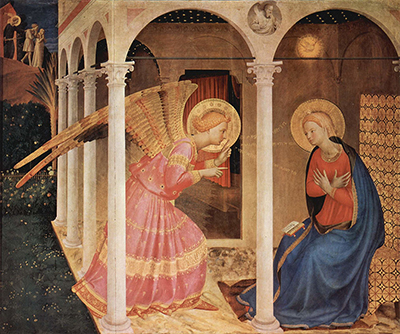
Fra Angelico’s Annunciation in the north dormitory corridor of San Marco is one of the defining images of the Early Renaissance and perhaps the painting most closely associated with his name. The fresco is commonly dated to around 1442. Gabriel kneels before the Virgin Mary beneath a quiet Renaissance loggia. Mary sits on a simple stool and crosses her arms over her chest.
Behind them lies a green enclosed garden. At first sight, almost nothing happens. That apparent simplicity is the source of the painting’s power. Angelico has reduced the Annunciation to encounter, architecture, light and attention. The fresco also demonstrates why original architectural history matters. Modern visitors approach it dramatically from the monumental staircase leading to the upper floor. That staircase did not exist when Angelico painted the work.
Research from the Museo di San Marco has specifically corrected the popular story that the fresco was positioned to greet friars arriving by the same staircase used today. In the fifteenth century, the dormitory was accessed by other routes, including a principal stair from the sacristy area. The present staircase was created later. The modern encounter is therefore historically layered: a Renaissance fresco is now framed by a later architectural approach. This correction does not reduce the importance of location.
It makes location more interesting. Angelico designed the Annunciation for the dormitory corridor itself, within the friars’ upper-floor devotional environment. The painting belonged to daily Dominican life rather than to a later scenographic staircase. Its inscription makes that function explicit. Beneath the image, the viewer is instructed that when passing before the image of the Virgin, he should not continue without saying an Ave. The fresco was therefore not simply intended to be admired. It asked for an action. [1]
At a Glance
- ArtistFra Angelico [1]
- TitleThe Annunciation [1]
- Datecommonly c. 1442 [1]
- MediumFresco [1]
- Locationnorth dormitory corridor, Museo di San Marco, Florence [1]
- Original functioncommunal devotional image within the Dominican dormitory [1]
- Principal figuresArchangel Gabriel and Virgin Mary [1]
- SettingRenaissance loggia and enclosed garden [5]
- Inscriptioninstructs the passer-by to say an Ave before the Virgin [2]
- Important architectural cautionthe monumental staircase used by visitors today was added after the fresco [3]
- Modern significanceemblematic image of Museo di San Marco and one of Angelico’s most famous works [7]
- Technical researchsubject of modern non-invasive imaging and diagnostic study [4]
Contents
- Introduction
- The Biblical Annunciation
- The Dormitory Corridor
- The Modern Staircase Myth
- The Inscription beneath the Fresco
- The Loggia
- Light
- Fresco Technique
- Comparison with the Prado Annunciation
- Why the San Marco Annunciation Matters
The Biblical Annunciation
The Annunciation is described in the Gospel of Luke. The angel Gabriel is sent to Nazareth to tell Mary that she will conceive and bear Christ. Mary initially asks how this can happen. Gabriel explains that the Holy Spirit will come upon her. Mary accepts. The event is therefore a dialogue about impossible transformation. Christian theology interprets it as the moment when the Incarnation begins. The divine Word becomes human through Mary’s consent. Renaissance painters repeatedly represented the subject because it allowed theology to be communicated through two bodies, a room and a gesture. Few artists returned to it as often as Fra Angelico. [1]
Angelico painted multiple Annunciations across his career. The Prado, Cortona and San Marco versions are among the most famous. Their differences are as important as their similarities. The Prado painting was an altarpiece. Cortona belonged to another public religious setting. The San Marco fresco was made for a Dominican dormitory. The same Gospel event therefore changes according to function. At San Marco, the scene becomes exceptionally quiet. There is no elaborate predella. No large donor group. No expulsion of Adam and Eve appears within the principal field. The narrative is concentrated almost entirely on Gabriel and Mary. [10]
The Dormitory Corridor
The fresco was painted on the north corridor of the upper dormitory. This setting distinguishes it from the cell frescoes nearby. It was communal rather than private. Individual friars passed it while moving through the dormitory. The inscription confirms this relationship with movement. The image addresses the passer-by directly. It therefore operates almost like a devotional threshold. A friar does not merely look. He is reminded to pray. [1]
The Modern Staircase Myth
One of the most persistent modern stories about the Annunciation is that Angelico deliberately placed it at the top of the main staircase so that friars would encounter it while ascending to their cells. The idea is attractive. It is also historically incorrect. Museo di San Marco research has emphasised that the monumental staircase used by visitors today was built later.
At the time of Angelico’s fresco, the dormitory was accessed differently. A principal staircase connected the sacristy and church area with the upper corridor near the cells associated with Cosimo de’ Medici. A secondary service stair also existed. The present dramatic sightline is therefore a later architectural creation. [3]
This distinction changes interpretation. The fresco was not conceived as a theatrical endpoint to a grand staircase. It belonged to the ordinary circulation of the dormitory. That makes the work, if anything, more Dominican. The image was embedded in daily religious movement rather than staged for spectacular arrival. Its meaning depended upon repetition. Friars passed it again and again. The inscription asks them to repeat an Ave. The fresco became part of habit. [3]
The Inscription beneath the Fresco
A Latin inscription beneath the Annunciation instructs the viewer not to pass before the image of the intact Virgin without saying an Ave. The wording has been translated approximately as: when you come before the image of the untouched Virgin, take care not to pass by silently without an Ave. This is one of the most important pieces of evidence for the fresco’s intended function. The painting tells the viewer how to use it. Modern museum visitors tend to approach paintings visually. The Dominican friar was expected to respond vocally and devotionally. Image and prayer were linked. [2]
Another inscription associated with the image addresses Mary as Mother of mercy or piety and as the noble dwelling of the Trinity. Such language places the fresco within a broader tradition of Marian theology. Mary is not simply the young woman receiving Gabriel. Her body becomes the place through which the Incarnation occurs. The architecture surrounding her can therefore be read alongside the language of dwelling and enclosure. [2]
Mary
Mary sits on a simple stool. Her posture is contained. Her arms cross over her chest. Her head inclines towards Gabriel. The effect is humility rather than surprise. Angelico chooses a moment of receptive response rather than dramatic fear. This makes the painting particularly suited to Dominican meditation. Mary models attention. She listens. She accepts. The friar is invited to imitate the same disciplined receptivity. [1]
Gabriel kneels. His body mirrors Mary’s restraint. The angel does not burst into the scene in flight. He is already present within the loggia. His wings provide the strongest visual reminder that this is a supernatural messenger. Otherwise, the encounter is almost conversational. Gabriel’s humility is important. Although he carries divine authority, he kneels before Mary. The sacred hierarchy is communicated through posture. [1]
Gabriel and Mary create a visual dialogue through their bodies. Both are inclined. Both hold their arms close. Their gestures correspond without being identical. The architecture reinforces the balance. Columns divide the space into measured intervals. The two figures occupy a relationship of separation and unity. This controlled reciprocity gives the fresco its famous calm. [1]
The Loggia
The Annunciation takes place beneath a Renaissance loggia. The architecture is clear, pale and restrained. Corinthian columns support rounded arches and ribbed vaults. Older scholarship often compared the loggia directly with Michelozzo’s architecture at San Marco. Modern museum research cautions against oversimplifying that relationship. Angelico had already used similar architectural forms in earlier Annunciations. The loggia therefore belongs to a broader Florentine architectural and pictorial vocabulary rather than being simply a painted copy of the convent below. [1]
Even with that caution, the architecture is unmistakably part of the new Renaissance interest in coherent space. Columns recede. Vaults establish depth. Figures occupy a measurable floor. The supernatural event happens inside a believable architectural environment. This does not secularise the subject. It makes the Incarnation spatially present. The sacred enters a world governed by intelligible order. [1]
The clarity of the loggia has often prompted comparison with Brunelleschi. Antonio Paolucci described it as seeming almost designed by the architect of the Ospedale degli Innocenti. The comparison is useful if treated as visual analogy rather than literal documentary dependence. Angelico shares the broader Florentine language of measured arches, slender supports and perspectival clarity. The fresco demonstrates how quickly architectural innovation entered painting. [1]
The Enclosed Garden
Behind the loggia lies a green garden bounded by a fence. The garden belongs to the long Marian tradition of the hortus conclusus, the enclosed garden. Christian interpretation connected this image with the Song of Songs and with Mary’s virginity. The garden therefore functions both as believable landscape and theological symbol. Angelico makes the metaphor visible without cluttering the scene with excessive symbolic objects. [5]
The enclosed garden can also evoke Paradise. In earlier Angelico Annunciations, Adam and Eve may be shown explicitly leaving Eden. At San Marco, the Fall is absent from the principal scene. The garden preserves the theological memory more quietly. The Annunciation opens the possibility of redemption. What was lost through sin can be restored through the Incarnation. The green space therefore carries salvation history without requiring another narrative episode. [5]
The garden contains plants and flowers rendered with delicate attention. These details recall Angelico’s background in illumination. Small natural forms are carefully observed but remain subordinate. They bring life to the enclosed space. The natural world seems ordered rather than wild. This harmony reinforces the contemplative tone. [5]
Light
Light is one of the most important elements in the fresco. It moves gently across columns, walls and figures. The architecture becomes understandable through light and shadow. Mary and Gabriel occupy the same luminous environment. The miracle does not require a violent supernatural beam. Divine meaning is expressed through ordinary visible light made unusually clear. This is one reason later writers have described Angelico as a painter of light. [1]
The fresco also interacted historically with natural light from the dormitory. The exact fifteenth-century window arrangement has changed. Later construction altered the wall and the approach. The altered architectural history makes any single reconstruction of the original lighting effect necessarily approximate. What remains secure is the importance of light within the painted architecture itself. Angelico uses tonal variation to reveal depth. [1]
Gabriel and Mary wear soft but luminous colours. The palette is controlled compared with Angelico’s gold-ground altarpieces. Fresco encourages a different relationship with colour. Pigment becomes part of plaster rather than precious material laid onto a movable panel. The result suits the Dominican dormitory. Colour is beautiful without becoming materially luxurious. [1]
Fresco Technique
The Annunciation was painted in fresco. Pigments applied to fresh plaster bond with the wall as the surface dries. The technique requires planning. The painter cannot work indefinitely on one area once plaster begins to set. Sections must be prepared and executed systematically. This technical discipline suits the apparent simplicity of the image. Its calm surface is the result of careful organisation. [1]
The architectural framework required accurate preparatory design. Columns, arches and vaults need to align convincingly. The figures also had to fit the constructed space. Angelico’s mastery is visible in how little the viewer notices this labour. Perspective does not announce itself as virtuoso demonstration. It quietly supports the encounter. [1]
The Gospel contains several stages within the Annunciation. Gabriel arrives. Mary is troubled. The angel reassures her. Mary questions. Gabriel explains. Mary consents. Angelico does not create a narrative sequence. He chooses one concentrated encounter. The precise verbal instant can be debated. What matters visually is acceptance rather than disruption. The image presents a dialogue already entering harmony. [1]
Silence
Silence is perhaps the fresco’s most famous quality. The architecture is empty. The garden is empty. No servants, donors or secondary saints interrupt the exchange. Even the supernatural messenger is physically restrained. This visual silence makes the painting ideal for a convent corridor. The image does not compete with prayer. It creates space for prayer. [1]
Dominican constitutions historically warned against excessive luxury within religious houses. This makes San Marco’s beauty especially interesting. Angelico creates extraordinary aesthetic refinement without excessive material display. The fresco uses proportion, colour, gesture and light rather than gold or expensive framing. Beauty becomes disciplined. This is one of the central achievements of the San Marco programme. [1]
The Annunciation occupied a communal corridor rather than a private cell. This difference matters. A cell image addressed one friar within one room. The corridor Annunciation addressed movement within the community. Its inscription is therefore communal. Anyone passing is instructed to pray. The fresco becomes part of the shared rhythm of the dormitory. [1]
San Marco contains another Annunciation within cell 3. That fresco includes Saint Peter Martyr and belongs more directly to an individual meditative setting. The comparison demonstrates Angelico’s ability to adapt the same subject within one convent. The corridor image is spacious and architectural. The cell version is more compressed and explicitly Dominican. Repetition becomes variation. [1]
Comparison with the Prado Annunciation
The Prado Annunciation is earlier and more elaborate. Adam and Eve appear visibly. The architecture belongs to a monumental altarpiece. Predella narratives extend the Marian cycle. San Marco removes much of this narrative apparatus. The theological structure remains, but the image becomes quieter. The difference reflects function as much as chronology. [8]
The Cortona Annunciation likewise retains a more elaborate relationship between architecture, text, landscape and predella. San Marco represents a later stripping away of narrative density. The comparison shows why it is misleading to describe Angelico’s mature art simply as becoming more complex. At San Marco, maturity often means knowing what to remove. [9]
Mary’s humility made her an especially powerful model for friars. She accepts divine command without self-assertion. She listens before acting. Her response embodies obedience. For an Observant Dominican community committed to discipline, these qualities had institutional relevance. The Annunciation therefore models religious behaviour as well as recounting sacred history. [1]
Gabriel likewise embodies service. He carries a message not his own. He kneels. The angel’s beauty does not produce pride. His role is obedience to divine command. The paired figures therefore create two models of humility facing one another. [1]
Incarnation and the Body
The Annunciation announces that divine Word will become flesh. Angelico represents this theological claim through bodies occupying real space. Mary is not an abstract symbol. Gabriel is not merely decorative. Their physical presence matters. Renaissance naturalism becomes useful to theology because the Incarnation itself concerns divine entry into material human existence. [1]
This gives perspective more than technical significance. A measurable room makes the event materially plausible. The divine occurs somewhere. Mary occupies a body in a space. The Incarnation enters the visible world. Angelico’s Renaissance spatial language therefore supports rather than threatens religious meaning. [1]
Although the modern staircase was not original, the fresco still occupied a transitional communal zone within the dormitory. It was not hidden inside a cell. The instruction to say an Ave confirms that passing was central to its function. The work therefore operates as a threshold image in a broader sense. It interrupts ordinary movement and turns it briefly into prayer. [1]
Repetition of the Ave
The inscription transforms one painted event into repeated devotional practice. The Annunciation happened once in sacred history. The Ave can be repeated every time a friar passes. Image and prayer therefore connect historical event with daily religious time. This is one of the most elegant relationships between text, painting and architecture at San Marco. [2]
Most modern museum paintings do not tell viewers what to do. The San Marco Annunciation does. Its inscription makes its original use unusually explicit. This helps prevent modern aesthetic admiration from replacing historical function. The fresco was meant to be beautiful. It was also meant to produce prayer. [1]
The Annunciation has been the subject of modern non-invasive scientific and digital analysis. The Museo di San Marco collaborated with research institutions to examine the fresco using advanced imaging technologies. This work has helped document materials and condition while allowing study without damaging the surface. The project demonstrates the continuing scholarly importance of the painting. Even one of the most famous images of the Renaissance can still generate new technical evidence. [4]
The museum has also improved the modern presentation of the fresco through updated lighting and changes to protective elements. Such interventions affect how contemporary visitors encounter the painting. These modern display interventions are distinct from restoration of the fifteenth-century painted surface itself. Museum display is another layer in the fresco’s long architectural history. [6]
The later staircase should not simply be treated as an error contaminating the original. It has created one of the most memorable museum approaches in Florence. Modern visitors see the Annunciation gradually appear as they climb. This dramatic sightline has shaped photography, guidebooks and popular memory. The false historical story arose partly because the later architectural effect is so persuasive. The staircase therefore belongs to the reception history of the painting even though it was not Angelico’s original plan. [3]
Why the San Marco Annunciation Matters
The San Marco Annunciation matters because it demonstrates how little Fra Angelico needed in order to create profound religious meaning. Two figures. A loggia. A garden. Light. An inscription. The apparent simplicity is the result of extraordinary selection. Earlier Annunciations could include Adam and Eve, elaborate objects, extensive predellas and multiple narrative clues. At San Marco, Angelico compresses theology into spatial and psychological clarity. The fresco also shows why historical context must be reconstructed carefully.
Its modern staircase approach is spectacular but later. Its original meaning belongs to the dormitory corridor and repeated Dominican movement. The inscription tells passing friars to say an Ave. The painting was therefore an active component of religious life. It transformed circulation into prayer. Architecturally, the work belongs fully to the Early Renaissance. The loggia is measured and coherent. Bodies occupy real space. Light defines form.
Yet these innovations are not displayed for their own sake. Perspective serves Incarnation. Architecture serves silence. Nature serves Marian symbolism. Beauty serves devotion. That synthesis is why the Annunciation deserves its iconic status. It is not simply one of the most beautiful paintings at San Marco. It is one of the clearest demonstrations of Fra Angelico’s ability to make Renaissance visual truth and Dominican spiritual discipline become the same artistic language. [1]
Frequently Asked Questions
Discussion
Which part of the San Marco Annunciation most shapes its contemplative character?
Reader Insights
How does the loggia connect the painted event to the convent around it?
What do Mary and Gabriel’s mirrored postures contribute to the scene?
How does knowing the staircase was added later change your reading?
Join the Conversation
Share your reading of the fresco below.
References
- Museo di San Marco / Direzione regionale Musei nazionali Toscana, institutional collection and visitor resources for Fra Angelico’s Annunciation. Museo di San Marco.
- Museo di San Marco, Salve Mater: L’Annunciazione di Beato Angelico a San Marco, Quaderni del Museo di San Marco, 2017. Salve Mater research project.
- Museo di San Marco, research correcting the later-staircase interpretation of the north-corridor Annunciation. Salve Mater research project.
- Museo di San Marco, “Arte e tecnologie a San Marco,” non-invasive scientific study of the Annunciation. Scientific imaging project.
- Museo di San Marco, resources on the Annunciation and the enclosed garden / hortus conclusus. Museo di San Marco collection.
- Museo di San Marco, resources on the new lighting and modern presentation of the Annunciation. New lighting and presentation.
- Direzione regionale Musei nazionali Toscana, visitor resources identifying the Annunciation as the emblematic image of San Marco and Dominican faith. Museum dormitory visitor record.
- Museo Nacional del Prado, Fra Angelico, The Annunciation, for comparison with the 1425–26 Fiesole altarpiece. Prado collection record.
- Museo Diocesano di Cortona and Comune di Cortona, Fra Angelico’s Cortona Annunciation, for comparison. Museo Diocesano di Cortona.
- National Gallery, London, Fra Angelico artist biography and Early Renaissance context. National Gallery artist record.
 Fra Angelico.jpg)