 by Tom Gurney
Tom Gurney BSc (Hons) is an art history expert with over 20 years experience
Published on June 19, 2020 / Updated on November 6, 2026
Email: tomgurney1@gmail.com / Phone: +44 7429 011000
Introduction
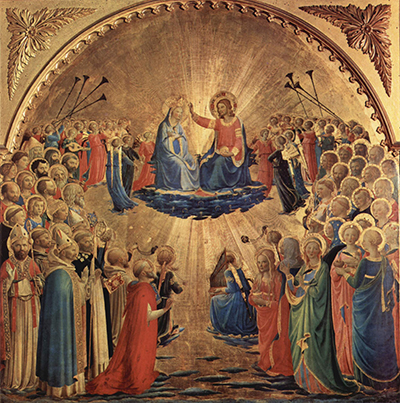
Fra Angelico’s Glorification of Mary in the Uffizi, painted between 1431 and 1435, is one of the most dazzling examples of his ability to combine medieval gold-ground splendour with a new Renaissance sense of spatial depth. The work is often described as a Coronation of the Virgin. The Uffizi’s current title, Glorification of Mary, is more precise. Christ does not simply place the crown on Mary’s head. He appears to adorn her diadem with a precious stone.
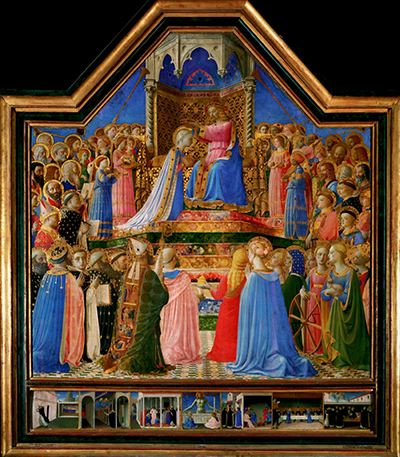
This rare iconographic variation distinguishes the painting from more conventional Coronations. The panel was made for an altar dedicated to Saint Giles in the church of Sant’Egidio, associated with the hospital of Santa Maria Nuova in Florence. Saint Giles appears prominently among the sacred assembly. The painting originally included a predella divided into two principal scenes: the Marriage of the Virgin and the Funeral of the Virgin. Those panels were separated from the main work centuries ago.
After the Second World War, main panel and predella again followed different museum histories. The predella remained at San Marco for decades. In spring 2024, the Uffizi reunited the components for display for the first time since the war. This recent physical reunion has transformed the modern understanding of the work. What had long been seen as one independent gold-ground panel can once again be encountered as a Marian altarpiece with narrative foundation. [1]
At a Glance
- ArtistFra Angelico [1]
- Current titleGlorification of Mary [1]
- Traditional titleCoronation of the Virgin [1]
- Date1431–35 [1]
- Mediumtempera on wood, gold ground [1]
- Dimensions112 × 114 cm [1]
- Current locationUffizi Galleries, Florence [1]
- Original locationaltar dedicated to Saint Giles, Sant’Egidio, Santa Maria Nuova [1]
- Principal figuresChrist and Virgin Mary [1]
- Distinctive iconographyChrist adds a precious stone to Mary’s diadem [3]
- PredellaMarriage and Funeral of the Virgin [1]
- Historical separationpredella detached in the sixteenth century [1]
- Modern reunionmain panel and predella reunited at Uffizi in spring 2024 [2]
- Key artistic significancegold-ground tradition combined with spatial recession and figure hierarchy [1]
Contents
- Introduction
- The Title “Glorification of Mary”
- Mary as Queen of Heaven
- The Precious Stone
- The Heavenly Assembly
- Saint Giles
- The Predella
- Reunion in 2024
- Medieval and Renaissance
- Why the Glorification of Mary Matters
The Title “Glorification of Mary”
The title matters because it shapes how viewers understand the central action. A traditional Coronation usually shows Christ placing a crown on Mary. Here the Virgin is already crowned. Christ appears to add a precious stone. The action is therefore one of further glorification. The Uffizi’s terminology reflects the unusual iconography. Using the museum’s current title prevents the work from being forced into a more conventional category than the image actually supports. [3]
Mary as Queen of Heaven
Mary sits enthroned beside Christ. Her crown identifies her as Queen of Heaven. The theme developed through medieval devotional tradition rather than one explicit Gospel passage. It became associated with the triumph of Mary and, more broadly, the triumph of the Church. Angelico turns the idea into a luminous celestial assembly. [1]
Christ sits beside Mary in equal compositional prominence while retaining theological authority. His gesture towards the crown creates the central action. The relationship is intimate rather than dramatic. Heavenly glory is represented through calm ceremonial refinement. [1]
The Precious Stone
The precious stone is the most distinctive iconographic detail. Christ’s action suggests completion or enhancement of Mary’s glory. The object also gives Angelico an opportunity to connect spiritual value with precious material. The painted jewel exists within a panel already filled with real gold. Material and symbolic preciousness reinforce one another. [3]
The Heavenly Assembly
Angels and saints fill the surrounding space. The crowd is large but organised. Figures form semicircular ranks. Their scale decreases slightly with distance. This creates depth even though the background remains uniform gold. The painting therefore demonstrates how Renaissance spatial thinking can operate without abandoning medieval sacred materials. [1]
The Uffizi specifically notes the semicircular arrangement of figures and slight diminution in scale. These devices produce a sense of recession. The heavenly court is therefore not flat. It occupies pictorial depth. This is one of the work’s most important formal innovations. [3]
The gold ground belongs to a long medieval tradition. It removes ordinary earthly environment. Light reflects from the real metal surface rather than being simulated entirely through paint. Angelico uses this material deliberately. A heavenly subject benefits from a space unlike ordinary Florence. Yet the figures still inhabit organised depth. Gold and Renaissance space coexist. [1]
The gold surface includes engraved or worked halos. These respond to real light. As a viewer moves, the surface changes subtly. The altarpiece therefore had a material presence impossible to reproduce fully in photographs. Its sacred luminosity was partly physical rather than illusionistic. [1]
Saint Giles
Saint Giles stands out through his blue mantle. His prominence is explained by the original location. The altar at Sant’Egidio was dedicated to him. This is another example of saint selection being tied directly to institutional setting. The modern viewer needs provenance in order to understand iconography. [1]
The church of Sant’Egidio belonged to the hospital complex of Santa Maria Nuova. This placed the altarpiece within one of Florence’s important charitable and medical institutions. The context is especially interesting because religious care, hospital practice and sacred imagery intersected. The Glorification therefore belonged to an active institutional environment rather than private devotion. [1]
Santa Maria Nuova was one of Florence’s most important hospitals. Its artistic patronage created a substantial visual culture. Angelico’s panel formed part of that world. The heavenly court therefore existed within a building serving sickness, care and death. This original context gives Marian glorification a particularly powerful devotional resonance. [1]
The Predella
The altarpiece originally included two principal predella compartments. They represented the Marriage of the Virgin and the Funeral of the Virgin. These scenes frame Mary’s earthly life. The main panel then presents heavenly glorification. The object therefore moves from biography below to eternal destiny above. [1]
The Marriage establishes Mary’s earthly social and sacred identity. It belongs to a narrative tradition surrounding her life rather than direct Gospel detail alone. At predella scale, Angelico could use small figures and architecture to create a clear ceremonial scene. [1]
The Funeral represents the end of Mary’s earthly life. Placed beneath the Glorification, it creates a direct theological sequence. Death is followed by heavenly exaltation. The relationship between lower narrative and upper sacred vision is therefore exceptionally coherent. [1]
The vertical structure matters. The predella tells events. The principal panel suspends time. Marriage and death belong to earthly chronology. The heavenly assembly belongs to eternity. Angelico’s altarpiece therefore uses physical height to organise sacred time. [1]
The predella was separated from the principal panel in the second half of the sixteenth century, probably during modernisation of the church. This was a common fate for Renaissance altarpieces. Changing architectural taste could destroy the original ensemble even while individual paintings survived. The object’s fragmentation began long before modern museums. [2]
Medici Collections
The predella compartments entered Medici collections and are documented in inventories by 1629. The main panel remained at Santa Maria Nuova much longer. The parts therefore acquired different ownership histories. Once separated, memory of their original unity weakened. [2]
The main panel eventually reached the Uffizi in the nineteenth century. There it was displayed independently. Museum visitors therefore encountered only the heavenly section of a once larger Marian programme. The work’s meaning became concentrated on Angelico’s gold-ground vision. [2]
During the Second World War, the work was removed from Florence to protect it from bombing and looting. It was hidden in secure locations in the surrounding region, including Poppi and the Medici villa at Poggio a Caiano. This survival history demonstrates the vulnerability of museum collections during war. The altarpiece’s biography includes not only Renaissance devotion but modern cultural protection. [2]
After the war, the principal panel returned to the Uffizi. The predella went to the Museo di San Marco. The pieces therefore remained in different Florence museums for decades. This division was administrative rather than historical. It continued the fragmented modern identity of the object. [5]
Reunion in 2024
In spring 2024, the Uffizi reunited the principal panel and predella. The museum described the event as the first reassembly after many decades and the first time since the Second World War that the parts could again be appreciated together. This was not simply a display change. It restored the visual logic of the altarpiece. [2]
Seeing the predella beneath the main panel changes interpretation. Mary’s earthly life reappears. The heavenly vision gains narrative cause. Saint Giles can be understood through the original altar. The painting becomes an object rather than isolated masterpiece. Physical reunion therefore produces historical knowledge. [2]
The Uffizi has described the painting evocatively as a “miniature Paradise”. The phrase captures the extraordinary density of sacred figures within a relatively compact panel. The work combines the precision of an illuminator with the scale of an altarpiece. This connection is central to Angelico’s art. [3]
Musical Angels
Angels play instruments and celebrate. Music becomes visible through gesture and object. The heavenly court is therefore not silent. Unlike the contemplative stillness of San Marco, the Glorification imagines Paradise as ceremonial joy. Angelico’s sacred world has multiple emotional registers. [4]
Some angels appear to dance or move rhythmically. This connects the work with the joyous movement found in the Last Judgement’s Paradise. Angelico repeatedly imagines heaven as harmonious communal motion rather than static splendour alone. [4]
The large assembly includes many saints. Their individual identities create a sacred community. Some are tied to the original institution, especially Saint Giles. Others belong to the wider Church. The painting therefore combines local devotion with universal heaven. [1]
No natural landscape is required. Depth comes from people. Figure arrangement itself creates space. This is an important alternative to architectural perspective. Angelico can make recession through scale and grouping. The gold remains uninterrupted. [1]
Medieval and Renaissance
The painting is one of the best examples of why the medieval/Renaissance division can be misleading. Gold ground is traditionally medieval. Spatial recession is Renaissance. Angelico uses both simultaneously. The work is not transitional because one system is gradually failing. It is synthetic because both remain useful. [1]
The Louvre Coronation creates another great Marian heavenly court. Both works use gold and large saintly assemblies. Their iconography differs. The Uffizi panel presents the unusual enhancement of Mary’s crown. The Louvre work presents a more conventional Coronation. The comparison demonstrates how Angelico could vary even closely related celestial subjects. [1]
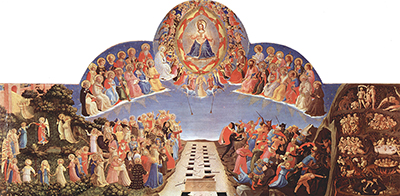
The Last Judgement also contains a populated Paradise. There, heaven contrasts with damnation. In the Glorification, heaven fills almost the entire conceptual world. The mood becomes pure celebration. These two paintings show Angelico’s repeated interest in heavenly community. [1]
Comparison with San Marco
San Marco’s cell frescoes famously remove material splendour. The Glorification does the opposite. Gold, crowds and music dominate. This difference again proves that Angelico adapted style to function. A hospital-church altarpiece required public sacred magnificence. A friar’s cell required meditative restraint. [1]
Gold makes real environmental light part of the work. Candles, church windows and changing illumination would have activated the surface differently throughout the day. The heavenly vision therefore changed physically as light moved. This material interaction is difficult to reproduce digitally. [4]
Tempera supports Angelico’s precise modelling and brilliant colour. Figures can be sharply defined against gold. The technique also connects the work with his broader panel practice of the 1430s. [1]
Why the Glorification of Mary Matters
The Glorification of Mary matters because it overturns several simplistic ideas about Fra Angelico. It is not quiet. It is not visually austere. It is not moving away straightforwardly from gold towards naturalistic Renaissance space. Instead, it is brilliant, crowded, musical and materially precious. Yet it is also spatially sophisticated. Figures recede. Ranks form a coherent celestial court. Depth emerges inside gold. The work also demonstrates the importance of original object reconstruction. For centuries, principal panel and predella lived separate lives.
The 2024 reunion restored the relationship between Mary’s earthly narrative and heavenly glorification. This changes the painting from an isolated “Coronation” into a much more complex Marian altarpiece. Its original setting at Sant’Egidio adds another layer. The heavenly triumph stood within the church of a major Florentine hospital. Sacred glory therefore belonged to an institution concerned daily with illness, charity and death. Angelico’s miniature Paradise was not escape from human vulnerability. It was placed directly beside it. [1]
Frequently Asked Questions
Discussion
What changes when the Uffizi panel is understood as a Glorification of Mary rather than a conventional Coronation?
Reader Insights
How does Christ adding a jewel to Mary’s diadem reshape the central action?
How do angels, saints and Saint Giles connect Paradise to the original altar?
What becomes newly visible when the predella is restored beneath the principal panel?
Join the Conversation
Share your reading of the Glorification of Mary below.
References
- Uffizi Galleries, Fra Angelico, Glorification of Mary, collection entry. Uffizi Glorification of Mary collection entry.
- Uffizi Galleries, “The Coronation of the Virgin by Fra Angelico rejoins its predella,” March 2024. Uffizi 2024 reunion announcement.
- Uffizi Galleries, The Glorification of the Virgin by Beato Angelico, curatorial video and interpretation. Uffizi curatorial video and interpretation.
- Uffizi Galleries, In the Light of Angels, online exhibition. Uffizi In the Light of Angels online exhibition.
- Museo di San Marco, historical custody of the predella before the 2024 reunion. Museo di San Marco institutional collection record; Uffizi record of the predella’s San Marco custody.
.jpg)
 Fra Angelico.jpg)