 by Tom Gurney
Tom Gurney BSc (Hons) is an art history expert with over 20 years experience
Published on August 6, 2026 / Updated on October 2, 2026
Email: tomgurney1@gmail.com / Phone: +44 7429 011000
Pontormo's Deposition from the Cross: Introduction
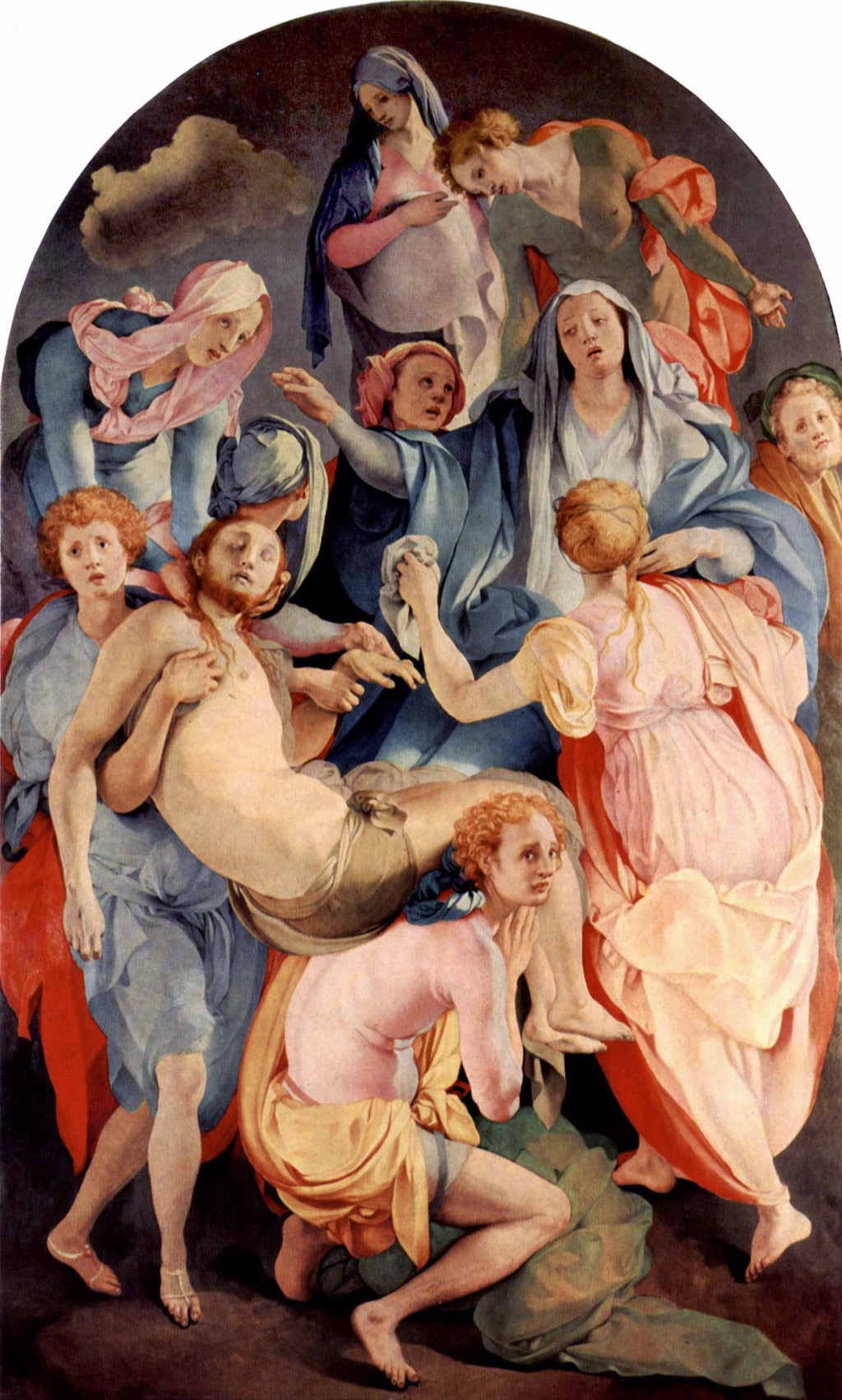
Pontormo's Deposition from the Cross, painted about 1525–28 for the Capponi Chapel in Santa Felicita, Florence, is one of the defining works of early Florentine Mannerism. Christ's body is carried across the foreground as the Virgin and a close crowd of mourners respond above and around him. Pale light, brilliant pinks, blues and greens, and an uncertain sense of weight turn the scene into an image of grief suspended between earthly action and spiritual vision.[1][2][3]
The familiar title is not a simple description of what can be seen. There is no visible cross, ladder or tomb. For that reason the painting has also been called an Entombment, a Lamentation and a transport of Christ to burial. The name Deposition from the Cross remains the clearest public title, but the alternatives reveal how deliberately Pontormo left the narrative moment open.[2]
At a Glance
- ArtistPontormo, also known as Jacopo Carucci
- Dateabout 1525–28
- Mediumoil on poplar panel
- Locationaltar of the Capponi Chapel, Santa Felicita, Florence
- CommissionerLodovico Capponi
- Chapel decorationcommissioned in 1526 and completed by 1528
- Alternative titlesEntombment, Lamentation and transport of Christ to burial
Contents
- Introduction
- At a Glance
- Why the title is debated
- The Capponi Chapel setting
- A composition without stable ground
- Colour, light and Mannerist space
- Drawings and a possible self-portrait
- Restoration of the chapel and panel
- Why Pontormo's Deposition matters
Why the title is debated
The Uffizi's Euploos catalogue traces the problem through several major interpretations. Giorgio Vasari described the dead Christ as having been taken down from the cross and carried toward burial. Janet Cox-Rearick preferred Lamentation, while John Shearman located the scene after Christ's separation from the Virgin but before his burial, making Entombment an appropriate term.[2]
Each title directs attention differently. Deposition implies an action that has just occurred outside the frame. Entombment points toward a destination that is not shown. Lamentation shifts the emphasis from movement to emotional response. Pontormo gives evidence for all three without settling on one. Christ is being borne by two youthful figures, yet the procession has no clearly marked path. The Virgin's grief forms the psychological centre, even though her son's body occupies the lower half of the panel.
This ambiguity is not a defect in the storytelling. It stretches the moment between separation and burial, allowing physical movement and mourning to coexist. The scene is less a snapshot of a single ritual moment than a sustained meditation on what it means to part from the body of Christ.
The Capponi Chapel setting
The painting was conceived as part of an entire chapel rather than as an independent gallery picture. The chapel, immediately to the right on entering Santa Felicita, had been designed by Filippo Brunelleschi for the Barbadori family around 1420. The Capponi family acquired it in 1525, and Lodovico Capponi commissioned Pontormo to redecorate it in 1526. Vasari's account says the work took three years and was completed in 1528.[1]
Pontormo's scheme included the altar panel, an Annunciation painted on the entrance wall, Evangelists in the four tondos beneath the dome and a now-lost image of God the Father with patriarchs above. The young Bronzino assisted with parts of the Evangelist group, but the altar panel itself is securely Pontormo's. The original gilded frame, carved by Baccio d'Agnolo, remains an important part of its presentation.[1][2]
The chapel setting changes the experience of the painting. Seen above the altar, the bearers at the bottom occupy the worshipper's immediate field of vision. The painted body of Christ is brought close to the liturgical space, while the rising group of mourners fills the tall panel above. Interpretations connecting the image with the Eucharist remain scholarly proposals, but the altar location makes the relationship between Christ's body, sacrifice and worship impossible to ignore.[1][2]
A composition without stable ground
Two young men support Christ. One stands at the left edge, turning his face outward; the other kneels low in the foreground, his body twisted beneath the weight. Their bare feet touch the earth, yet their poses do not communicate ordinary physical strain. Christ's pale body appears to float horizontally through the crowd.
Behind him, hands, faces and coloured fabrics overlap in a tightly joined chain. The Virgin, dressed in cool blue, seems to sink backward amid the group. Other figures reach toward her, toward Christ or into the spaces between them. Pontormo does not give the mourners a firm architectural setting. The darkened ground and curved upper field provide little depth, so the figures carry almost the entire structure of the image.
The effect depends on carefully varied reactions. Some faces turn outward, some bend toward Christ and others focus on the Virgin. Grief is not represented by one repeated gesture. It moves through shock, support, inward attention and outward appeal. The Uffizi catalogue describes this range as an amplification of the Virgin's psychological suffering across the surrounding figures.[2]
Colour, light and Mannerist space
Pontormo used unusually clear, high-key colour and reduced the heavy modelling that would make every body feel firmly solid. Pink, turquoise, pale blue, green and orange form large linked passages across the panel. Light does not fall from one strongly defined source. It seems to belong to the figures and fabrics themselves.[3]
This is why the painting can feel weightless despite its crowded composition. Bodies overlap, but the normal cues of distance and mass are weakened. The result is not disorder: heads, arms and draperies create a controlled rhythm that rises from the carriers through Christ and the Virgin to the figures above. Pontormo's design is exacting even when the space appears impossible.
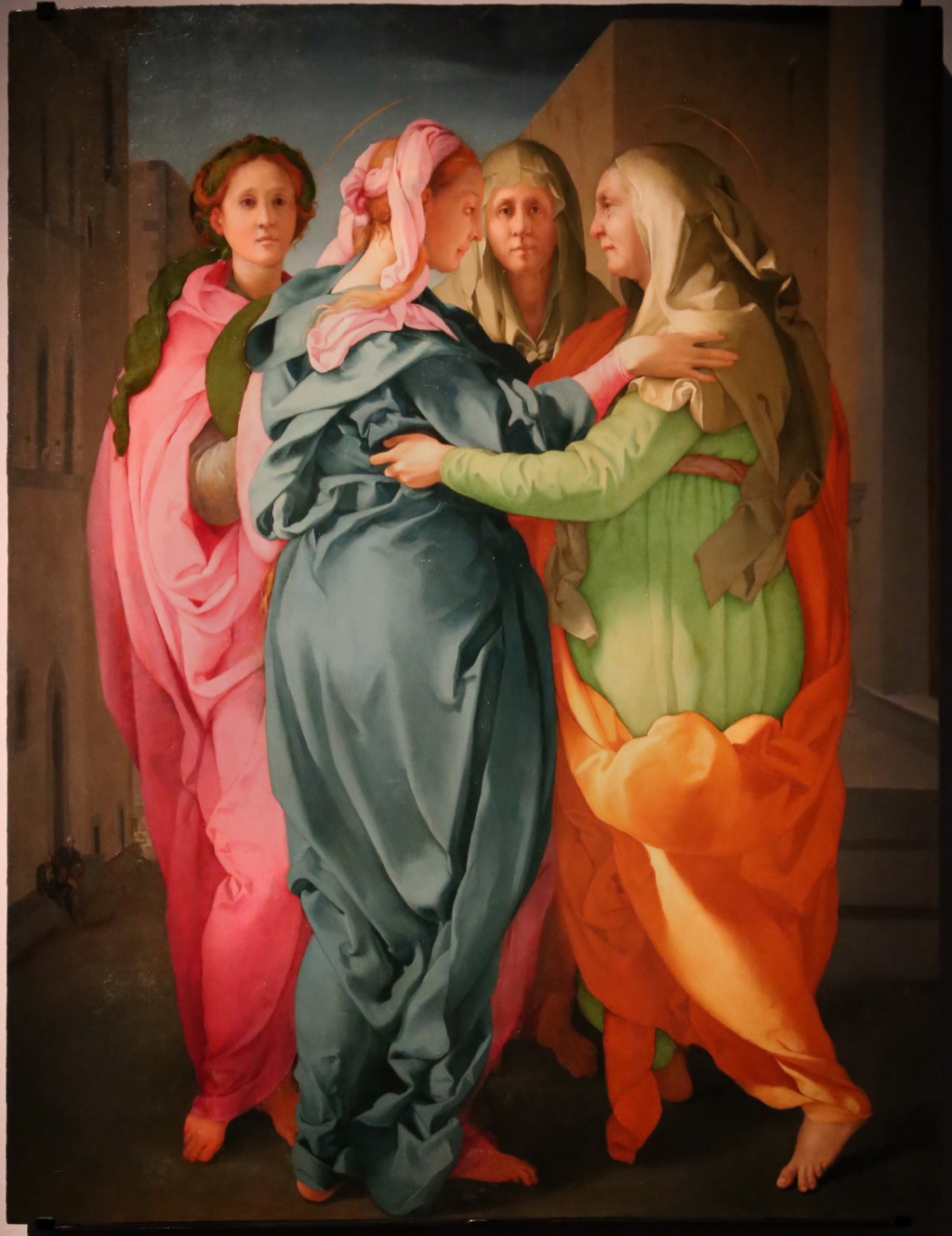
The nearby Visitation, painted soon afterwards, offers a useful comparison. Both works use monumental figures and luminous colour, but the Carmignano painting concentrates on a greeting between four women. The Capponi panel disperses emotion through a larger group, making uncertainty itself part of the experience. Together they show the range of Pontormo's mature paintings.
Drawings and a possible self-portrait
Pontormo prepared the chapel scheme through drawings that tested figures, faces and emotional expression. Uffizi sheet 6587 F, a red-chalk study of an older man, is connected with the figure who appears at the far right of the altar panel. The catalogue identifies the sheet as a self-portrait and describes the painted figure as a probable self-image adapted to the role of Joseph of Arimathea.[2]
The distinction matters. Pontormo may have begun from his own reflection, but the figure belongs to a sacred narrative and was adjusted for that role. It is therefore safer to speak of a probable self-portrait element than to treat the painting as a straightforward likeness. His outward gaze adds another kind of witness to the scene: a face at the edge, close to the action but not absorbed into it.
Restoration of the chapel and panel
A comprehensive conservation project led by Daniele Rossi addressed the Capponi Chapel and its works in 2018. Examination of the panel found cracks, small areas of lifting paint around old wooden dowels, unevenly oxidised varnish and excessive earlier repainting. The gilded frame also showed woodworm damage, lifting gold leaf and accumulated dust.[1]
The project treated the painting as part of a fragile ensemble. Its conservation history cannot be separated from the frescoed Annunciation, the tondos, frame, stonework and altered dome. Chemical and stratigraphic analysis and other diagnostic work examined its materials and condition. The published restoration account describes those investigations, but it does not report a newly discovered hidden scene beneath the paint.[1]
Why Pontormo's Deposition matters
The painting is powerful because it refuses to choose between movement and stillness. Christ is being carried, yet time seems arrested. The mourners gather densely, yet the space between their glances and gestures feels immense. Pontormo makes colour, not conventional perspective, hold the scene together.
Its title debate, chapel setting and possible self-portrait all deepen the work without exhausting it. At the centre remains a simple human problem: how a group bears a body and a loss that none of its members can contain. For Pontormo's wider life and career, see the Pontormo biography and Pontormo overview.
Frequently Asked Questions
Discussion
Does the painting's emotional force depend more on the physical carrying of Christ, the Virgin's grief, the unusual colour or the absence of a clearly defined place—and how does the uncertain title affect what you see?
Reader Insights
What visual detail most changes how you read Deposition from the Cross?
How do source, setting and image history affect the interpretation?
Which internal link gives the most useful next step through the Pontormo cluster?
Join the Conversation
Share your reading of this page below.
References
- Friends of Florence, “Cappella Capponi Restoration Project in the Church of Santa Felicita”: View Source, 2018.
- Uffizi Galleries, Euploos, “6587 F — Autoritratto”: View Source, updated 2020. Italian.
- Silvia Meloni Trkulja, “Carucci, Iacopo, detto il Pontormo”: View Source, Dizionario Biografico degli Italiani, vol. 20, Treccani, 1977. Italian.
- Yorck Project via Wikimedia Commons; Public Domain Mark.