 by Tom Gurney
Tom Gurney BSc (Hons) is an art history expert with over 20 years experience
Published on August 6, 2026 / Updated on October 2, 2026
Email: tomgurney1@gmail.com / Phone: +44 7429 011000
Pontormo Drawings: Introduction
Pontormo's drawings are among the clearest records of how his art was made. His paintings can seem suspended, strange and emotionally remote, but the drawings show patient experiment: a head turned again, a body tested in chalk, a drapery mass pushed toward greater force, or a face studied until expression becomes structure.[1][2][3]
Drawing was not a secondary activity for Pontormo. It was the place where he worked through problems that later appeared in altarpieces, portraits and frescoes. Red chalk, black chalk, wash and repeated study allowed him to test pose, movement, emotion and scale before committing an idea to panel, canvas or wall. The surviving sheets also reveal how closely his practice was tied to Andrea del Sarto, Northern prints, the Certosa works, the Capponi Chapel and his late San Lorenzo project.[1][4][5]
At a Glance
- Main mediared chalk, black chalk, brush and wash
- Common subjectsheads, standing figures, seated figures, monks, sacred figures and compositional studies
- Key collectionsUffizi Galleries, Metropolitan Museum of Art and British Museum
- Important works connected by drawingSupper at Emmaus, Deposition from the Cross, Visitation and the lost San Lorenzo frescoes
Contents
- Introduction
- At a Glance
- Drawing as Florentine design
- Heads, expression and red chalk
- Drawings and paintings
- Northern prints and invention
- Late designs and the lost San Lorenzo frescoes
- Why Pontormo's drawings matter
Drawing as Florentine design
Pontormo belongs to a Florentine tradition in which drawing, or disegno, carried intellectual as well as practical weight. A drawing could be a rehearsal for a figure, a record of observation, a search for expression or a way to translate another artist's example into a new form. The Met describes his drawings, especially red- and black-chalk figure studies, as a high point within Florentine design.[3]
His early sheets still show the influence of Andrea del Sarto. The Met's Virgin and Child with Saint Elizabeth, the Infant Baptist, Saint Anthony of Padua, and a Female Martyr, dated 1514-22, is in red chalk with brush and red wash. Its soft modelling and red-chalk handling belong close to the period when Pontormo was absorbing Andrea's lessons, but the complex arrangement already suggests a more restless imagination.[3]
The drawing's later reputation is also revealing. The Met notes that a copy in the Louvre records its early fortune. That does not prove a direct painting destination for every line, but it shows that Pontormo's drawn inventions circulated as works worth studying in their own right.[3]
Heads, expression and red chalk
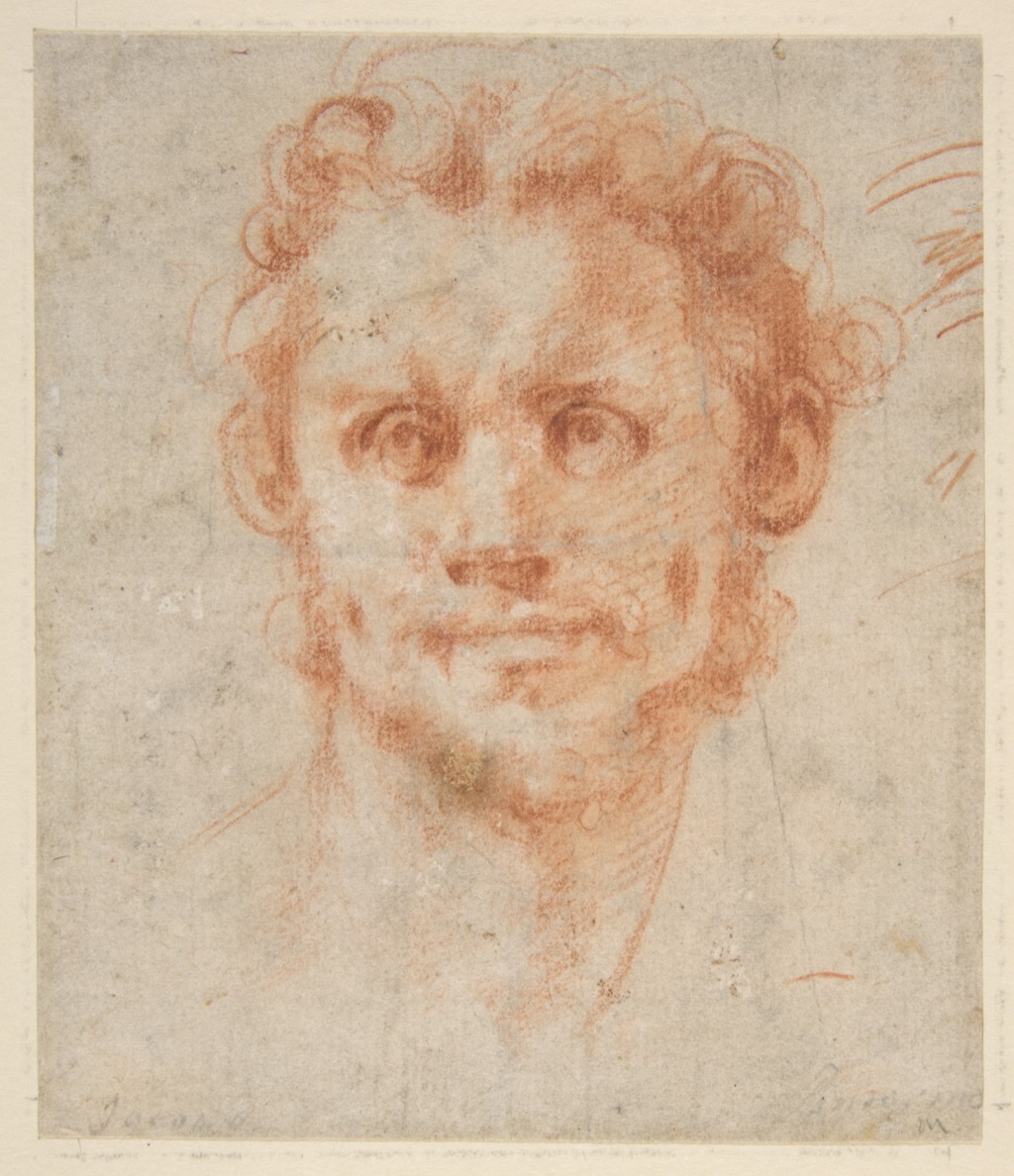
The Met's Study of a Man's Head, dated 1520-25, is smaller and more concentrated. It is drawn in red chalk with stumping on a sheet only 13.3 x 11.4 cm. The head is not a finished portrait in the public sense. It is a study of turn, pressure and expression.[4]
Red chalk mattered because it could create both line and tone. Pontormo could sharpen a feature, soften an edge or let a face emerge from repeated touches. In the Uffizi's record for 6587 F, a red-chalk sheet catalogued as Autoritratto, the commentary describes Pontormo's fine luminous hatching and his ability to create a nearly atmospheric vibration around the figure.[2]
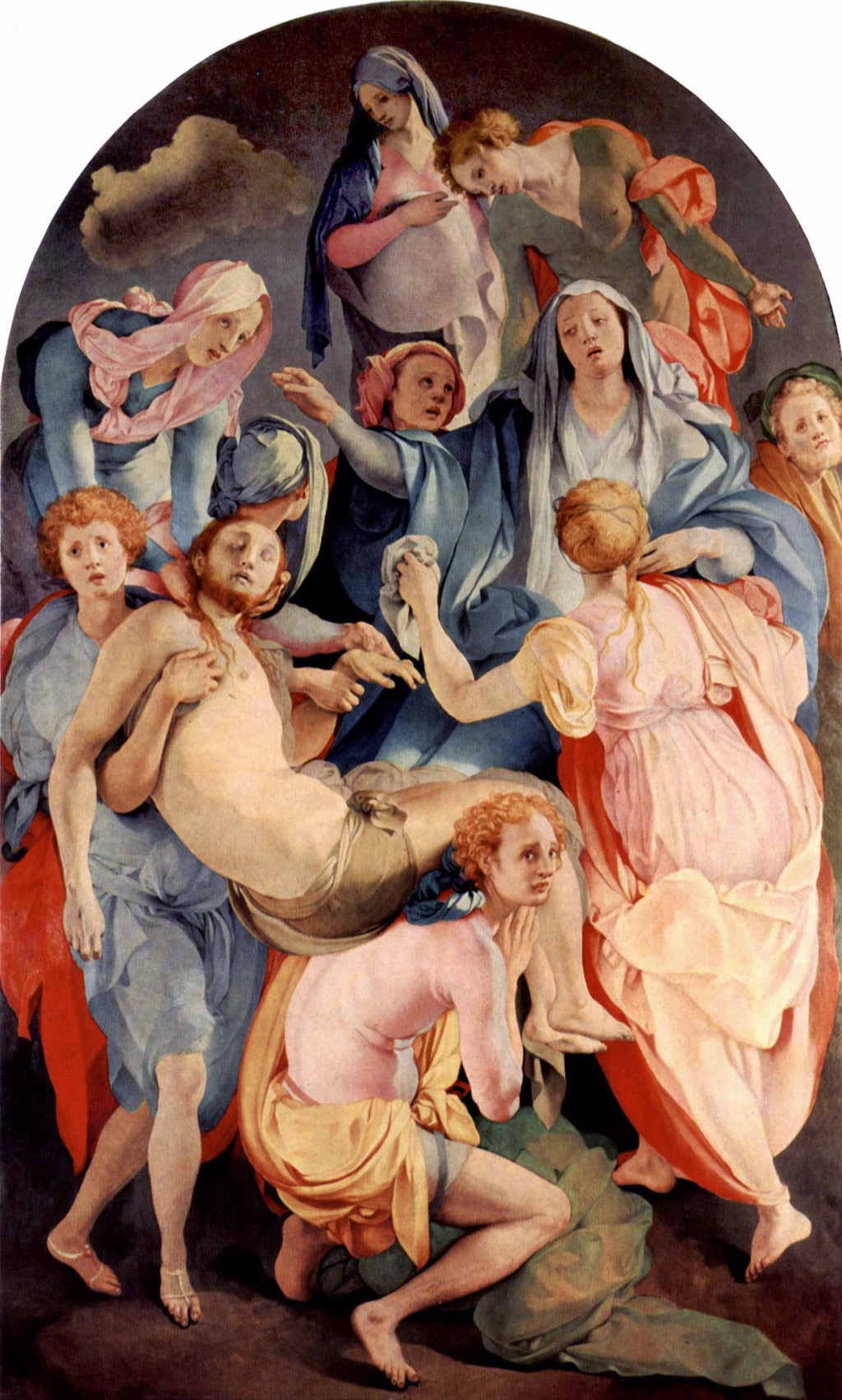
That Uffizi sheet is especially important because it is connected with the Deposition from the Cross in the Capponi Chapel. The catalogue presents it as a self-portrait study associated with the older male figure at the edge of the painting, probably adapted to the role of Joseph of Arimathea. The wording should remain cautious: it is a drawing with self-portrait significance, not a simple replacement for a secure artist portrait.[2]
Drawings and paintings
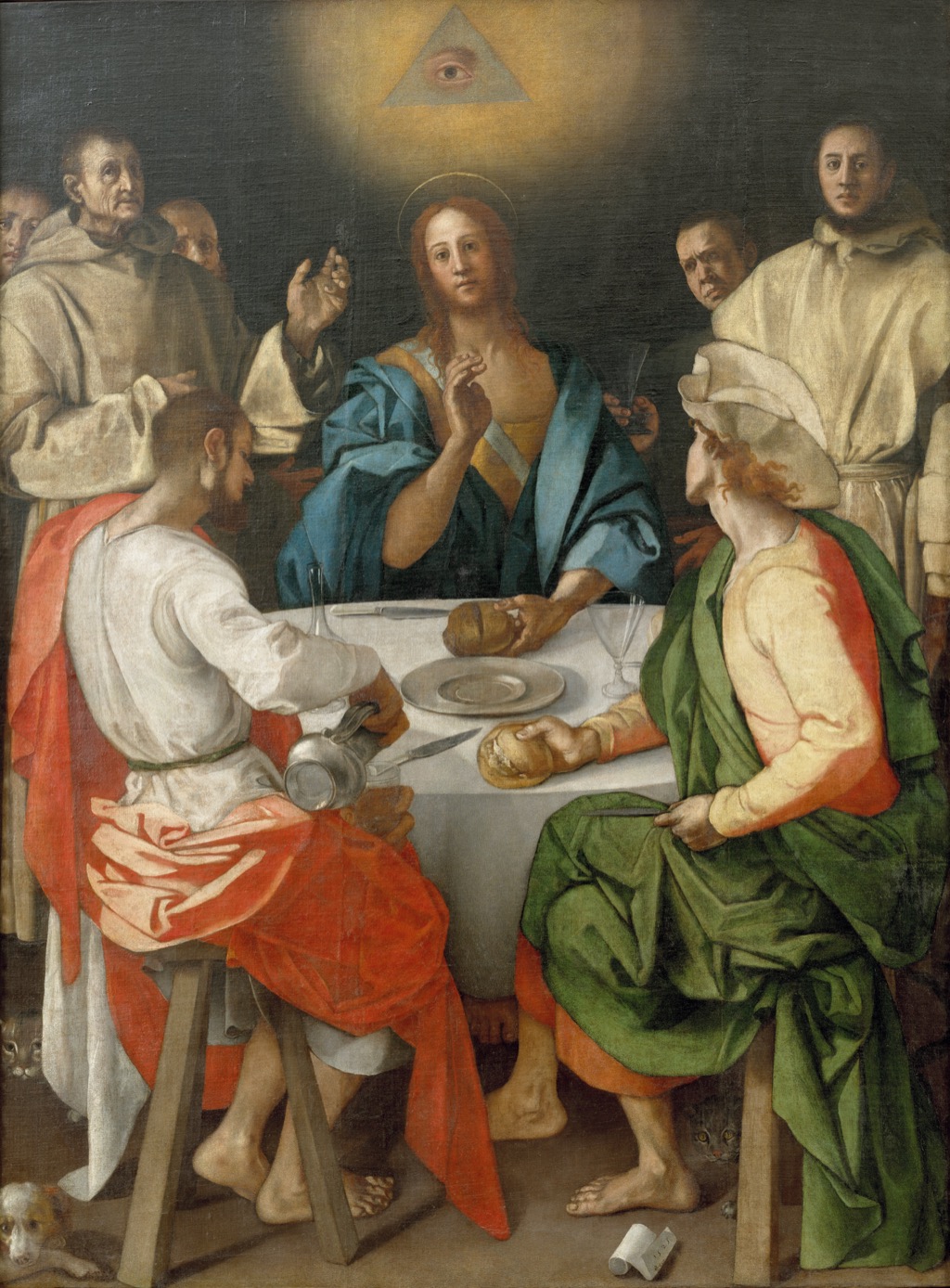
Some of Pontormo's most useful drawings are valuable because they show how a painting was worked out. The British Museum sheet 1936,1010.10 has a study of a man standing in profile on the recto and two monks on the verso. The Museum connects the verso studies with the monks standing on the left in Pontormo's Supper at Emmaus, painted in 1525 for the Certosa di Val d'Ema at Galluzzo.[5]
That connection gives the finished painting a practical foundation. The monks in the Supper at Emmaus are not generic background figures. They are part of a process of observed study, and Vasari's account that Pontormo portrayed Carthusians from life becomes more credible when read alongside the drawing. The Museum still distinguishes between the figure used in the painting and another monk who differs from the final picture, which is a useful reminder that preparatory drawing is not mechanical transfer.[5]
The British Museum sheet 1933,0803.13 shows a seated woman on the recto and studies of a youth on the verso. The Museum relates the seated woman to a lost Pieta by Pontormo and connects the verso studies with the figure of Christ in the Capponi Chapel Deposition. The same record stresses the impact of Durer's Small Passion on Pontormo's work at the Certosa, while treating Vasari's criticism of that Northern influence as culturally biased rather than straightforward evidence of failure.[6]
Northern prints and invention
Pontormo's drawings make his dialogue with Northern art visible. Durer's prints supplied models for compressed grief, angular drapery and intensely expressive narrative. The British Museum's commentary on the seated woman sheet argues that Pontormo's response was creative rather than merely imitative.[6]
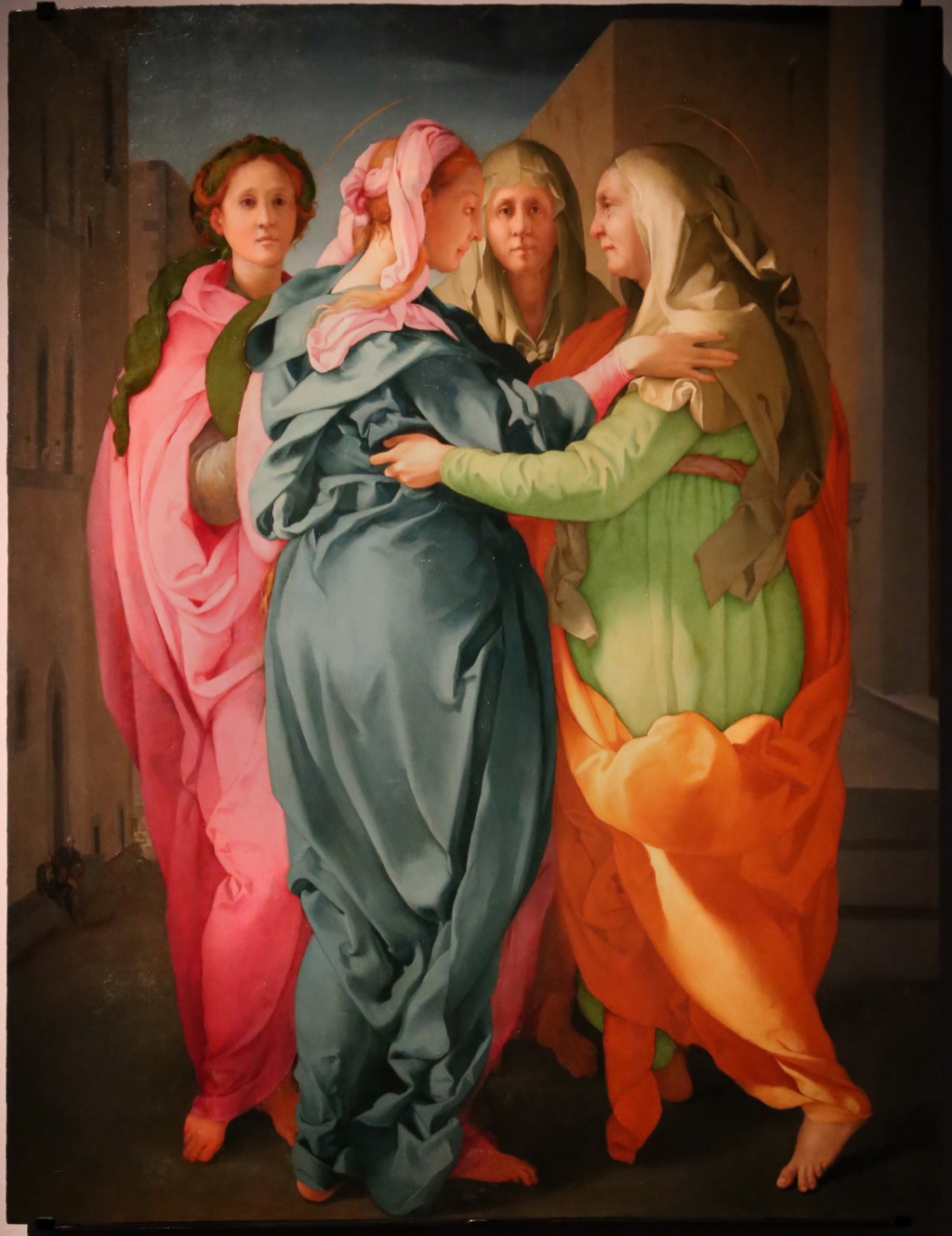
That point matters for Pontormo's art as a whole. The Supper at Emmaus draws on Durer, but it remains a Florentine monastic painting. The Visitation has been compared with Northern figure groupings, yet its scale, colour and stillness are Pontormo's own. Drawings help us see how outside models entered his thinking and were remade through his hand.
Late designs and the lost San Lorenzo frescoes
Uffizi 6609 F, catalogued as Creazione dei Progenitori; Cristo in Gloria circondato da angeli, is a black-chalk sheet on paper measuring 326 x 179 mm. Its long bibliography connects it with Pontormo's late San Lorenzo work and with the destroyed fresco cycle that occupied him near the end of his life.[1]
Because the San Lorenzo frescoes were destroyed in the eighteenth century, drawings and written records carry unusual weight. They do not replace the lost walls, but they preserve evidence of the scale and ambition of the project. The Uffizi 6609 F sheet shows how a single drawing can belong to a much larger problem: imagining bodies, angels, creation and glory for a monumental setting that can no longer be seen directly.[1]
This is why Pontormo's drawings are not only preparatory. They are witnesses to works that survive, works that have changed and works that have disappeared. They give the Pontormo biography a material backbone.
Why Pontormo's drawings matter
Pontormo's drawings reveal the discipline behind paintings that often feel unstable. They show an artist who used line to search, not simply to outline. Red chalk could probe the psychology of a head; black chalk could construct figures for a lost fresco; studies from life could move into religious scenes without losing their observational force.
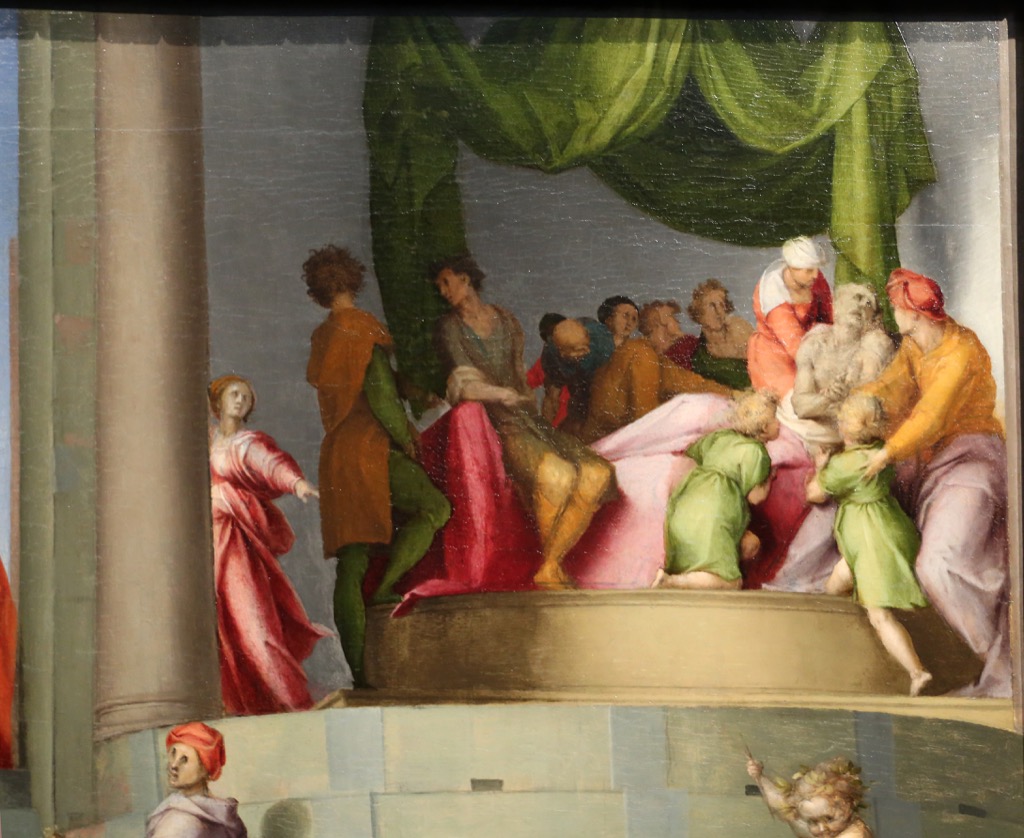
They also show continuity across the career. The early red-chalk Holy Family study, the Certosa monk studies, the Capponi self-portrait sheet and the late San Lorenzo designs all belong to one working mind. For related paintings, see Joseph with Jacob in Egypt, Supper at Emmaus, Deposition from the Cross and Visitation.
Frequently Asked Questions
Discussion
Do Pontormo's drawings make his finished paintings feel more controlled or more experimental? Where do you see a line between preparation and independent invention?
Reader Insights
How do the drawings change your understanding of Pontormo's finished paintings?
Which drawing example best supports the route: the Met head study or the Virgin and Child sheet?
Where would a future glossary link for pentimenti help readers most?
Join the Conversation
Share your reading of this page below.
References
- Uffizi Galleries, Euploos, “6609 F — Creazione dei Progenitori; Cristo in Gloria circondato da angeli”: View Source, updated 2020. Italian.
- Uffizi Galleries, Euploos, “6587 F — Autoritratto”: View Source, updated 2020. Italian.
- Metropolitan Museum of Art, “Virgin and Child with Saint Elizabeth, the Infant Baptist, Saint Anthony of Padua, and a Female Martyr”: View Source, 19.76.11.
- Metropolitan Museum of Art, “Study of a Man's Head”: View Source, 1998.361.
- British Museum, “Study of a man standing in profile to right”: View Source, registration 1936,1010.10.
- British Museum, “A woman seated, slightly to left, looking to front”: View Source, registration 1933,0803.13.
- Metropolitan Museum of Art Open Access/Public Domain, object 1998.361.