 by Tom Gurney
Tom Gurney BSc (Hons) is an art history expert with over 20 years experience
Published on August 6, 2026 / Updated on October 2, 2026
Email: tomgurney1@gmail.com / Phone: +44 7429 011000
Pontormo's Portrait of a Halberdier: Introduction
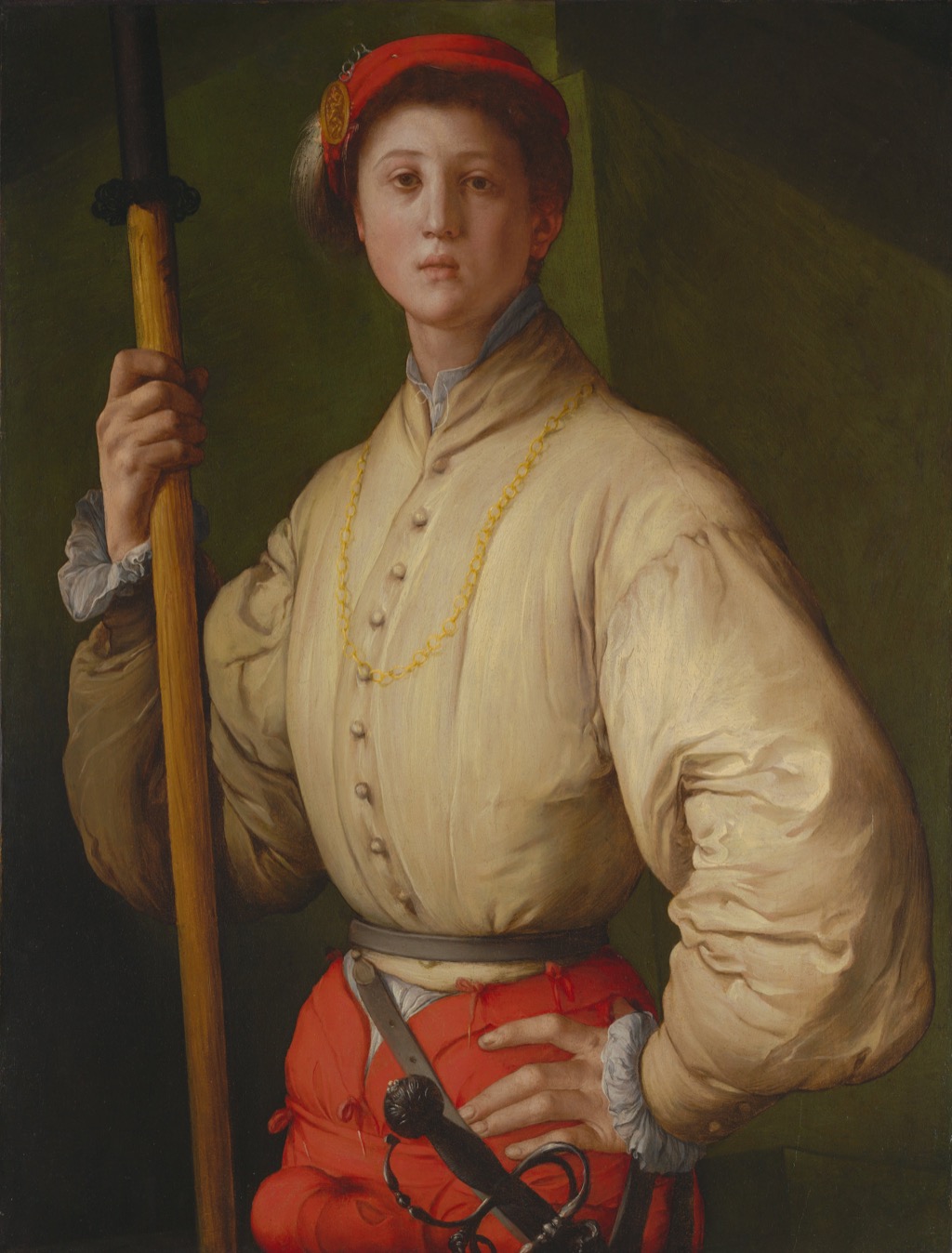
Pontormo's Portrait of a Halberdier, painted about 1529-30, turns a young soldier into one of the most compelling portraits of sixteenth-century Florence. The sitter stands before a fortress wall, elegantly dressed and holding a halberd: a weapon that combines a spear and battle-axe. His pose is assertive, but his smooth face and slight body make that confidence feel fragile.[1][2]
The Getty's current title, Portrait of a Halberdier (Francesco Guardi?), keeps the central question open. Francesco Guardi is now the leading proposal for the sitter, while Cosimo I de' Medici was an important earlier identification. The uncertainty matters because the painting's power depends partly on the tension between public role and private presence. Pontormo gives the youth costume, weapon and stance, but he does not reduce him to a solved name.[1][3]
At a Glance
- ArtistPontormo, also known as Jacopo Carucci
- Dateabout 1529-30
- Mediumoil or oil and tempera on panel, transferred to canvas
- Dimensions95.3 x 73 cm
- CollectionJ. Paul Getty Museum, Los Angeles
- Object number89.PA.49
- Likely sitterFrancesco Guardi, proposed but not certain
- Former sitter proposalCosimo I de' Medici
Contents
- Introduction
- At a Glance
- A young soldier in a fortified world
- Francesco Guardi, Cosimo I and the sitter question
- Florence during the siege
- Pontormo's portrait style
- The object and its present collection
- Why the Halberdier matters
A young soldier in a fortified world
The halberd gives the sitter his public identity. It marks him as a foot soldier and links the portrait to military service at a moment when Florence was under severe political pressure. Pontormo does not show battle. He places the young man before a wall, close enough to the viewer for costume, hands and weapon to carry the drama.[1][2]
The sitter's body is narrow and upright. One hand grips the halberd, while the other rests near the waist, helping to create a controlled diagonal across the figure. The dark wall behind him presses the space forward. There is no broad landscape, no elaborate architectural setting and no narrative action. Instead, Pontormo concentrates attention on the contrast between the role the youth performs and the face that looks out from within it.
That contrast is the portrait's emotional centre. The sitter's direct gaze and planted stance suggest self-possession. At the same time, his youthful features resist the full authority implied by his weapon and clothing. Getty's CONA record describes this combination as both arrogance and vulnerability, and that balance is visible even without accepting any single sitter identification as final.[2]
Francesco Guardi, Cosimo I and the sitter question
The identification of the sitter has been debated for centuries. Giorgio Vasari reported that Pontormo painted a portrait of the young nobleman Francesco Guardi as a soldier during the siege of Florence. A later Riccardi family inventory, recorded in 1612, attached the name of Cosimo de' Medici to a description of the picture. Both traditions have shaped how the portrait has been understood.[2][3]
Francesco Guardi remains plausible because a documented child of that name was born into the Guardi family in 1514. He would have been about fourteen or fifteen during the siege, close to the apparent age of Pontormo's sitter. Elizabeth Cropper's Getty monograph gives sustained attention to this evidence and argues for Francesco Guardi, while also explaining why the Cosimo identification became influential.[3][4]
The public wording should therefore stay careful. Getty's title uses a question mark, and this manuscript follows that lead. It is fair to say that Francesco Guardi is the current leading proposal and that Cosimo I was a serious former proposal. It is not safe to present either as certain. The painting's attribution to Pontormo is not the disputed point; the uncertainty concerns the name of the youth he portrayed.
Florence during the siege
The date about 1529-30 places the portrait near the siege of Florence, when the restored republican government resisted forces aligned with Emperor Charles V and the Medici. That context helps explain why a teenage sitter could be represented with a halberd and a fortified wall. Military readiness became a language of civic identity as well as physical defence.[3]
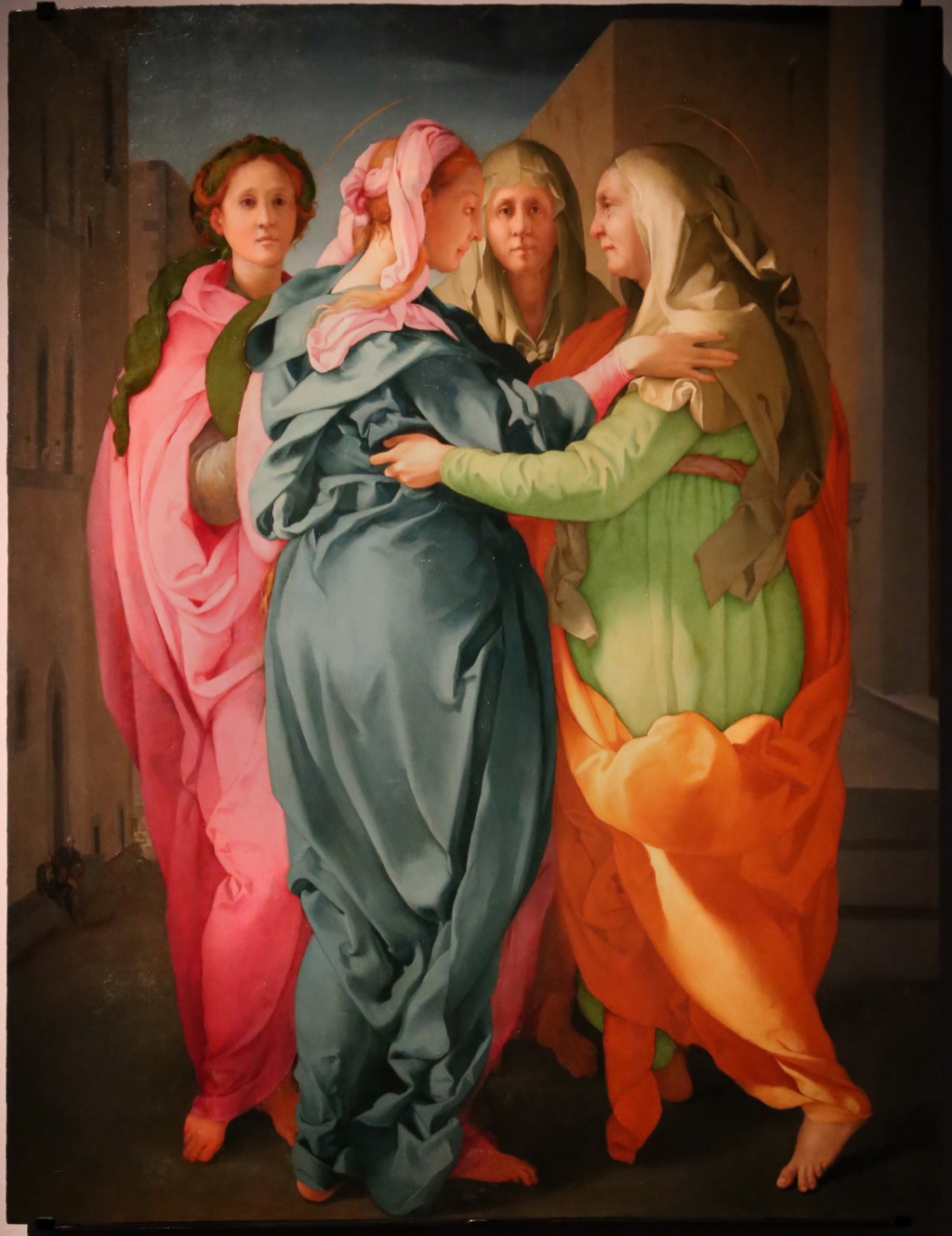
Pontormo had already shown how public events could shape private images. The nearby Visitation, made in the same concentrated period of his career, turns a sacred meeting into a scene of intense psychological stillness. The Portrait of a Halberdier applies a related concentration to portraiture. It does not narrate the siege, but it lets the political moment enter through costume, weapon and guarded expression.
This is why the sitter question cannot be separated from historical setting. If the youth is Francesco Guardi, the portrait becomes an image of a young nobleman participating in Florentine defence. If viewers follow the older Cosimo proposal, the picture takes on a different political charge. The safest reading is to recognise that both histories have mattered, while keeping the current Getty title and the Guardi proposal clearly qualified.
Pontormo's portrait style
Pontormo's portraits often withhold as much as they reveal. Sitters appear close to the viewer, yet they remain psychologically reserved. In the Halberdier, that reserve is sharpened by the mismatch between youthful body and soldierly display. Clothing, weapon and wall create status; the face complicates it.
The painting also shows Pontormo's command of Mannerist form. The body is elongated, the pose slightly artificial and the colour relationships refined rather than naturalistic. These choices do not make the portrait decorative in a shallow sense. They heighten the sitter's uneasy self-presentation. The youth seems to know he is being seen, but not entirely to possess the role he performs.[2]
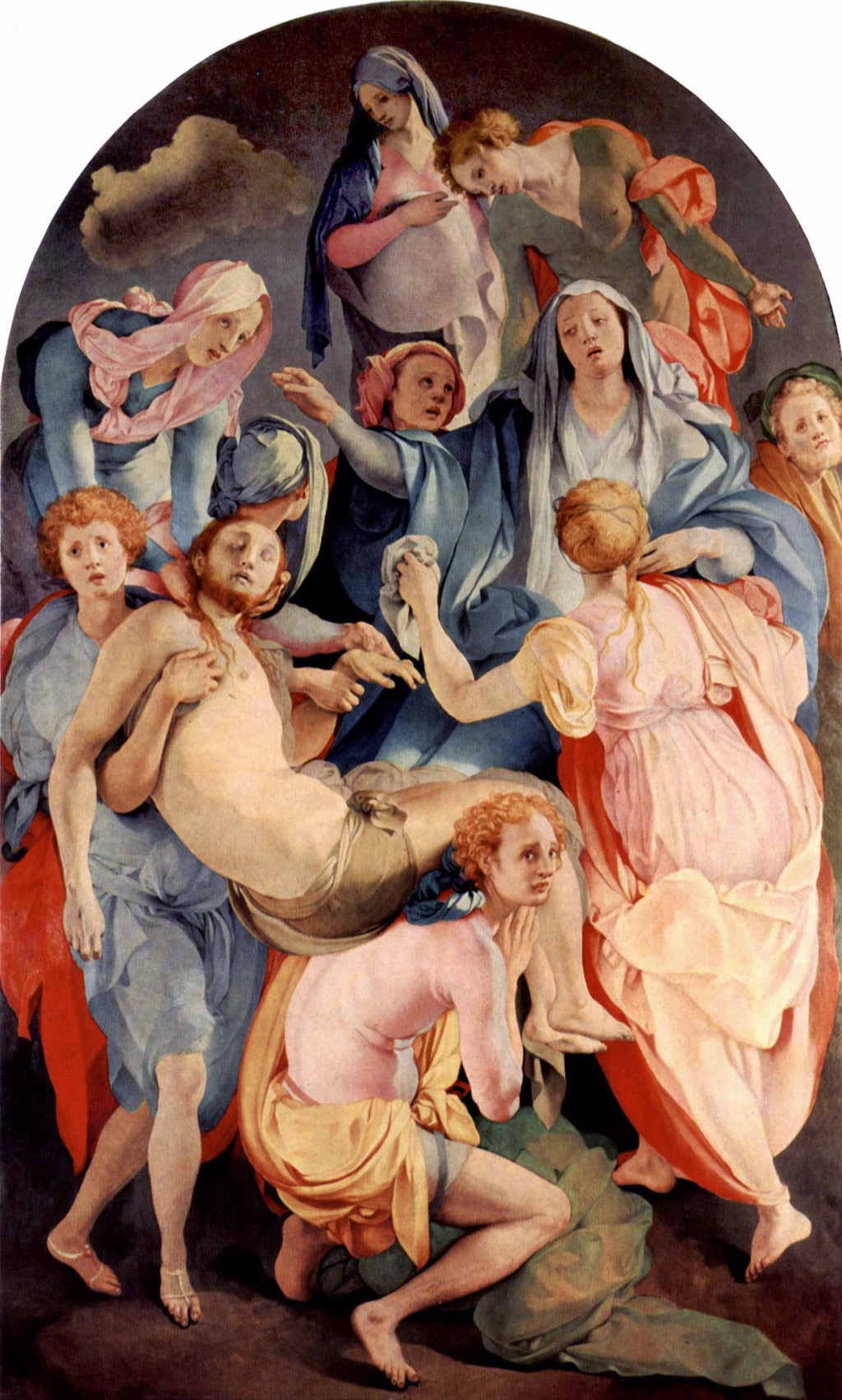
The work belongs beside Pontormo's mature religious paintings because it uses the same discipline for a different purpose. In the Deposition from the Cross, colour and uncertain space intensify collective grief. In the Halberdier, compression and elegance intensify an individual encounter. The portrait's stillness is active: a moment of looking, judging and being judged.
The object and its present collection
The Getty records the painting as Italian, about 1529-30, measuring 95.3 x 73 cm. Its medium is given as oil or oil and tempera on panel transferred to canvas, a wording that should be preserved because it reflects the object's material history rather than a simple modern support label.[1]
The painting entered the J. Paul Getty Museum in 1989 and carries the object number 89.PA.49. Its modern fame has been shaped not only by scholarship on the sitter, but also by the fact that a major, securely attributed Pontormo portrait rarely appears in the modern market. That ownership history should not displace the Renaissance questions, but it explains why the work became a focus for Getty study and public interpretation.[1][4]
Why the Halberdier matters
The Portrait of a Halberdier matters because Pontormo makes social identity unstable without dissolving it. The sitter is dressed, armed and posed to project confidence. Yet the portrait remains open to youth, hesitation and vulnerability. Its unresolved identity is not merely a catalogue problem; it reinforces the painting's deeper uncertainty about role, age and political performance.
The work also shows why Pontormo's art cannot be reduced to religious intensity alone. His paintings include sacred encounters, chapel decorations and complex narratives, but his portraiture brings the same alertness to a single figure. For the artist's wider career, see the Pontormo biography and Pontormo overview.
Frequently Asked Questions
Discussion
Does the portrait feel more confident or vulnerable? How do the halberd, costume, wall and direct gaze change your sense of the sitter's age and public role?
Reader Insights
What visual detail most changes how you read Portrait of a Halberdier?
How do source, setting and image history affect the interpretation?
Which internal link gives the most useful next step through the Pontormo cluster?
Join the Conversation
Share your reading of this page below.
References
- J. Paul Getty Museum / Google Arts & Culture, “Portrait of a Halberdier (Francesco Guardi?)”: View Source, 89.PA.49.
- Getty Vocabulary Program, CONA, “Portrait of a Halberdier (Francesco Guardi?)”: View Source, CONA ID 700000103.
- J. Paul Getty Museum, “Pontormo: Miraculous Encounters”: View Source, 2018-19.
- Elizabeth Cropper, Pontormo: Portrait of a Halberdier: View Source, J. Paul Getty Museum, 1997.
- Wikimedia Commons, “Pontormo (Jacopo Carucci) - Portrait of a Halberdier (Francesco Guardi?) - Google Art Project”: View Source, Public Domain Mark 1.0.
- Google Art Project / J. Paul Getty Museum, via Wikimedia Commons; Public Domain Mark.