 by Tom Gurney
Tom Gurney BSc (Hons) is an art history expert with over 20 years experience
Published on August 6, 2026 / Updated on October 2, 2026
Email: tomgurney1@gmail.com / Phone: +44 7429 011000
Pontormo's Visitation: Introduction
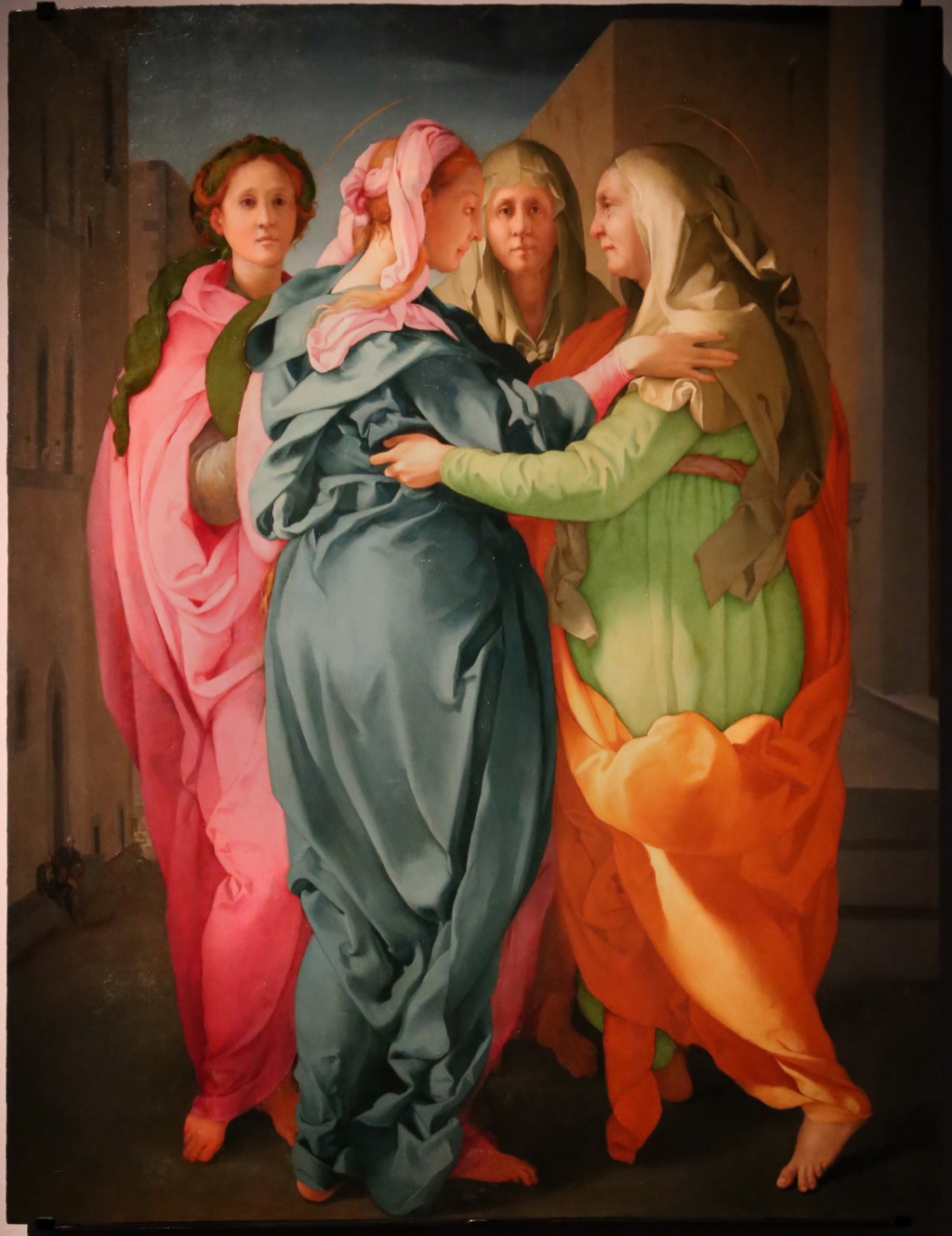
Pontormo's Visitation, painted about 1528–29, turns a meeting between two women into one of the most arresting images of sixteenth-century Florence. Mary and her older cousin Elizabeth embrace at the centre, while two attendants stand close behind them and look outward. Monumental figures fill a narrow street, their pink, blue, green and orange draperies almost displacing the architecture around them.[1][2]
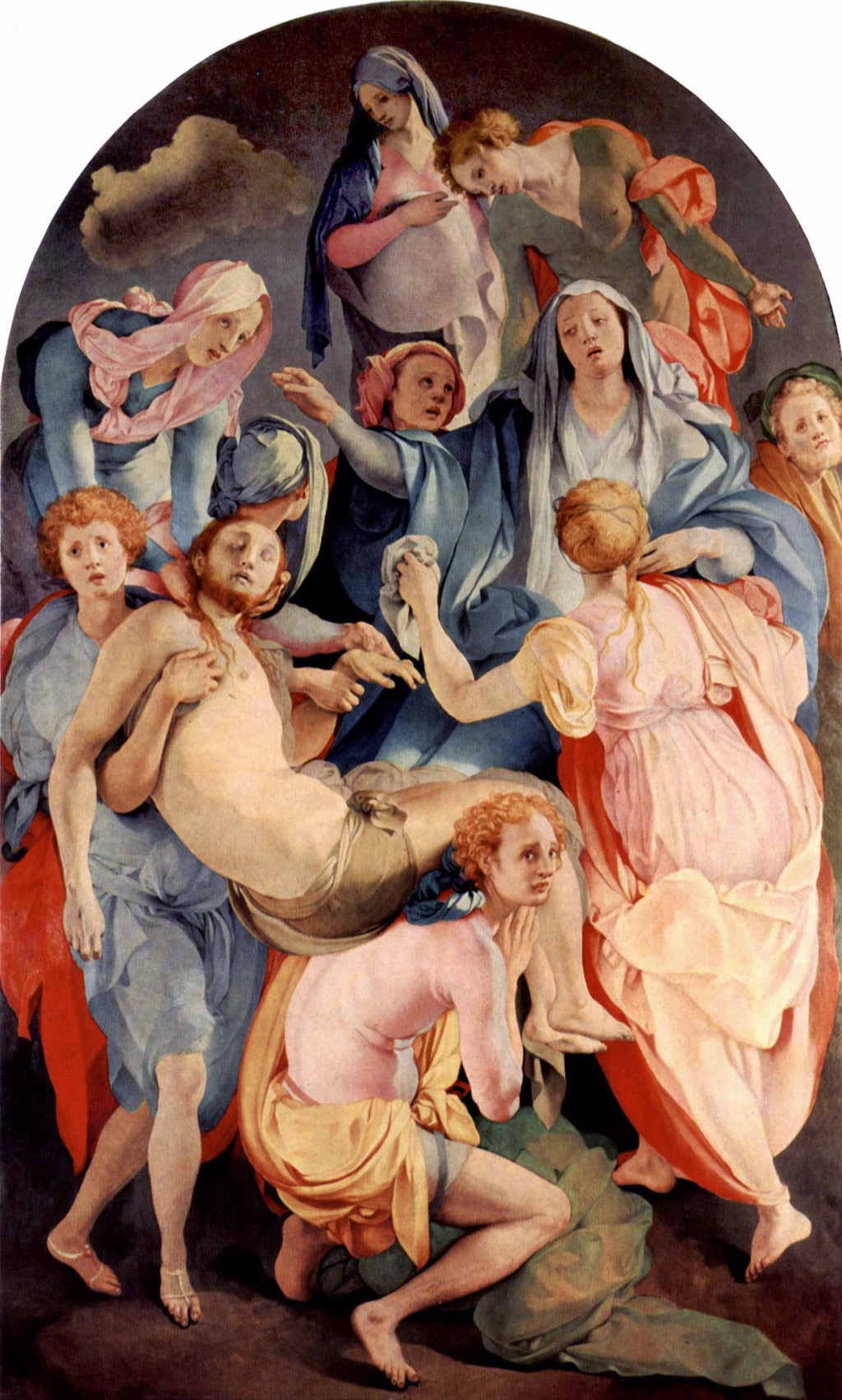
The altarpiece remains associated with the Pieve di San Michele in Carmignano, west of Florence. It belongs to the same mature period as Pontormo's Deposition from the Cross, yet the emotional temperature is different. Instead of collective mourning, the Visitation presents recognition: a private greeting made public through colour, scale and concentrated attention.
At a Glance
- ArtistPontormo, also known as Jacopo Carucci
- Dateabout 1528–29
- Mediumoil on poplar panel
- Dimensionsapproximately 207 × 159 cm in the Getty conservation record[2]
- LocationPieve di San Michele, Carmignano, Tuscany[1][2]
- Subjectthe meeting of the Virgin Mary and Saint Elizabeth
- Related workPontormo's squared preparatory drawing in the Uffizi[2][3]
Contents
- Introduction
- At a Glance
- The meeting of Mary and Elizabeth
- Four figures in a compressed street
- From preparatory drawing to painted panel
- What restoration revealed
- Carmignano, rediscovery and exhibition
- Why the Visitation matters
The meeting of Mary and Elizabeth
The Visitation is the moment when Mary, expecting Christ, meets Elizabeth, who is expecting Saint John the Baptist. Pontormo makes their encounter immediately legible. The two haloed women incline toward one another, and the crossing curves of their arms bring the greeting to the centre of the panel. Their faces are close, but their bodies remain distinct beneath broad, layered robes.[2]
The two younger attendants complicate this intimacy. They repeat the position and scale of the principal women without taking part in the embrace. Instead, they face the viewer. The Uffizi's exhibition account interprets their expressions as carrying an awareness of the suffering that lies beyond the joyful meeting. That reading is persuasive, but the attendants are not supplied with secure individual identities by the painting itself. Their stillness works visually whether they are understood as witnesses, echoes or a second register of emotion.[3]
Pontormo therefore binds two kinds of time together. Mary and Elizabeth respond to one another in the present tense of the greeting; the attendants seem to hold the scene open to reflection. What might have been a simple narrative exchange becomes an image about recognition, expectation and knowledge.
Four figures in a compressed street
The four women form a dense, almost diamond-shaped group. The Uffizi has compared this organisation with Albrecht Dürer's Four Naked Women, a print whose tightly joined figures offered a Northern model familiar to Florentine artists. The comparison does not require the painting to be treated as a copy. Pontormo transformed the compact group through clothing, gesture, scale and Christian subject matter.[3]
The street around them is unusually empty. Tall, plain façades rise on either side, while the pavement recedes sharply into the distance. Because the women occupy so much of the foreground, this perspective does not create the calm, measurable space associated with earlier Renaissance painting. It makes their scale feel more extraordinary. Small background figures and architecture establish a believable town, but the principal group seems to operate by a different order.
Colour strengthens that effect. Large passages of rose, blue-green and orange meet in abrupt, luminous combinations. Drapery folds describe the turn of bodies, yet they also create an almost abstract pattern across the surface. The figures appear solid enough to embrace and strangely weightless at the same time. This tension—between observed gesture and improbable visual intensity—is central to Pontormo's mature paintings.[2][4]
From preparatory drawing to painted panel
The survival of Pontormo's preparatory drawing makes the Visitation unusually revealing. The black-chalk study is crossed by a red-chalk grid. Scientific examination showed that Pontormo reproduced that grid on the prepared ground of the panel, then enlarged the design square by square. According to the Getty conservation account, he did not rely on a full-size cartoon transferred directly at one-to-one scale.[2]
Infrared reflectography exposed the precise underdrawing beneath the paint. It also revealed pentimenti—places where Pontormo reconsidered the composition while working. The feet of the attendant in pink, for example, changed orientation between the study, the underdrawing and the finished surface. Such adjustments matter because they show that the squared design was a framework rather than a rigid instruction. Pontormo could plan carefully and continue searching as he painted.[2]
The relationship between sheet and panel also explains why drawing was fundamental to his art. Line established the pose, spacing and rhythm of the group; colour then altered how those bodies meet the eye. The finished painting does not conceal the discipline behind its strangeness. Conservation imaging makes that discipline visible again.
What restoration revealed
Before conservation, smoke from candles, discoloured varnish and earlier repainting had obscured parts of the altarpiece. Treatment led by conservator Daniele Rossi recovered the brightness and distinctions within Pontormo's palette. It also made small background details easier to see: two men seated on a bench, a grey donkey appearing around a building, and a woman hanging laundry at a window.[2]
These details change the balance of the scene. They do not compete with the four women, but they prevent the architecture from becoming a completely unreal setting. Ordinary street life continues at a reduced scale around a sacred encounter. The contrast between the immense foreground figures and the small activities behind them makes the greeting feel both local and visionary.
Infrared examination did not reveal a single secret meaning hidden beneath the paint. Its greater contribution was practical: it documented transfer, revision and the material history of the panel. Restoration likewise did more than make the colours brighter. By removing visual interference from later coatings and additions, it allowed relationships between colour, drawing and minor detail to be studied more accurately.[2]
Carmignano, rediscovery and exhibition
The original commission is not securely documented, and no patron can currently be named with confidence. The painting's long association is with the parish church at Carmignano. Getty records that it was first mentioned in 1677 by Giovanni Cinelli and was little known until its rediscovery in the church in 1904.[1][4]
Following conservation, the altarpiece travelled for the Pontormo: Miraculous Encounters exhibition organised with the Getty, Uffizi and Morgan Library & Museum. The project reunited it with its Uffizi preparatory drawing and placed it beside portraits and studies from around 1528–30. This temporary movement clarified the painting's place within a concentrated period of Pontormo's career; its enduring setting, however, remains Carmignano.[3][4]
Why the Visitation matters
The Visitation brings together the qualities for which Pontormo is now most admired: disciplined draughtsmanship, saturated colour, ambiguous space and restrained but powerful emotion. Its unusual beauty does not come from abandoning structure. It comes from making structure serve an encounter that feels larger than the street in which it occurs.
Modern interest in the painting has also extended beyond Renaissance scholarship. Getty notes its importance to Bill Viola's video work The Greeting and to other twentieth-century responses.[2] Such comparisons are most useful when they return attention to Pontormo's own achievement: four figures, a few gestures and a narrow architectural setting transformed into an image of recognition suspended in time. For the artist's wider chronology, see the Pontormo biography and Pontormo overview.
Frequently Asked Questions
Discussion
The painting makes a quiet greeting feel monumental. Does that power come primarily from the embrace, the outward gaze of the attendants, the compressed architecture or the colour—and how do those elements alter one another?
Reader Insights
What visual detail most changes how you read Visitation?
How do source, setting and image history affect the interpretation?
Which internal link gives the most useful next step through the Pontormo cluster?
Join the Conversation
Share your reading of this page below.
References
- Comune di Carmignano, “The Visitation by Pontormo”: View Source
- J. Paul Getty Museum, “Conservation Work Reveals the Hidden Revisions of an Italian Renaissance Master”: View Source, 2019.
- Uffizi Galleries, “Miraculous Encounters: Pontormo from Drawing to Painting”: View Source, 2018.
- J. Paul Getty Museum, “J. Paul Getty Museum Presents Pontormo: Miraculous Encounters”: View Source, 2019.
- Photograph by Sailko, via Wikimedia Commons, CC BY 3.0; resized from the original.