 by Tom Gurney
Tom Gurney BSc (Hons) is an art history expert with over 20 years experience
Published on August 6, 2026 / Updated on October 2, 2026
Email: tomgurney1@gmail.com / Phone: +44 7429 011000
Pontormo's Joseph with Jacob in Egypt: Introduction
Pontormo's Joseph with Jacob in Egypt, probably painted in 1518, compresses several final episodes from the Old Testament story of Joseph into one brilliant, unsettled panel. It was made for the bedroom of the Florentine banker Pierfrancesco Borgherini, whose marriage to Margherita Accaiuoli in 1515 prompted one of the most elaborate domestic painting schemes of early sixteenth-century Florence.[1]
The painting belongs to the National Gallery, London, where it is catalogued as oil on wood, 96.5 x 109.5 cm, inventory number NG1131. Its date should remain qualified as "probably 1518", following the Gallery's record. The picture is not a single frozen moment. It is a continuous narrative, a format in which different moments from the same story appear together inside one painted world.[1]
At a Glance
- ArtistPontormo, also known as Jacopo Carucci
- Dateprobably 1518
- Mediumoil on wood
- Dimensions96.5 x 109.5 cm
- CollectionNational Gallery, London
- Inventory numberNG1131
- SeriesScenes from the Story of Joseph
- Original contextBorgherini palace bedroom, Florence
- Acquisitionbought in 1882
Contents
- Introduction
- At a Glance
- The Borgherini bedroom series
- Four episodes in one picture
- Architecture, colour and movement
- Joseph, Jacob and Bronzino
- Provenance and collection history
- Why Joseph with Jacob in Egypt matters
The Borgherini bedroom series
The Borgherini commission was a private domestic project with unusually high artistic ambition. The paintings were made to celebrate the marriage of Pierfrancesco Borgherini and Margherita Accaiuoli, and they decorated the couple's bedroom in the Borgherini palace. Pontormo was not working alone in the wider scheme. Bacchiacca, Francesco Granacci and Andrea del Sarto also contributed panels.[1]
The National Gallery describes the series as one of the most sumptuous decorative schemes of its time. Its Joseph subject was well suited to a marriage chamber: the biblical story includes family separation, fidelity, recognition, forgiveness and prosperity after hardship. The panels were originally connected to wall panelling and furniture rather than conceived as isolated museum pictures.[1]
This setting matters for how the painting is read. The panel's complexity was not made for a church altar or a civic hall. It belonged to a room where narrative, family identity, costly craftsmanship and intimate display overlapped. Pontormo turned that domestic commission into a demanding work of visual invention.
Four episodes in one picture
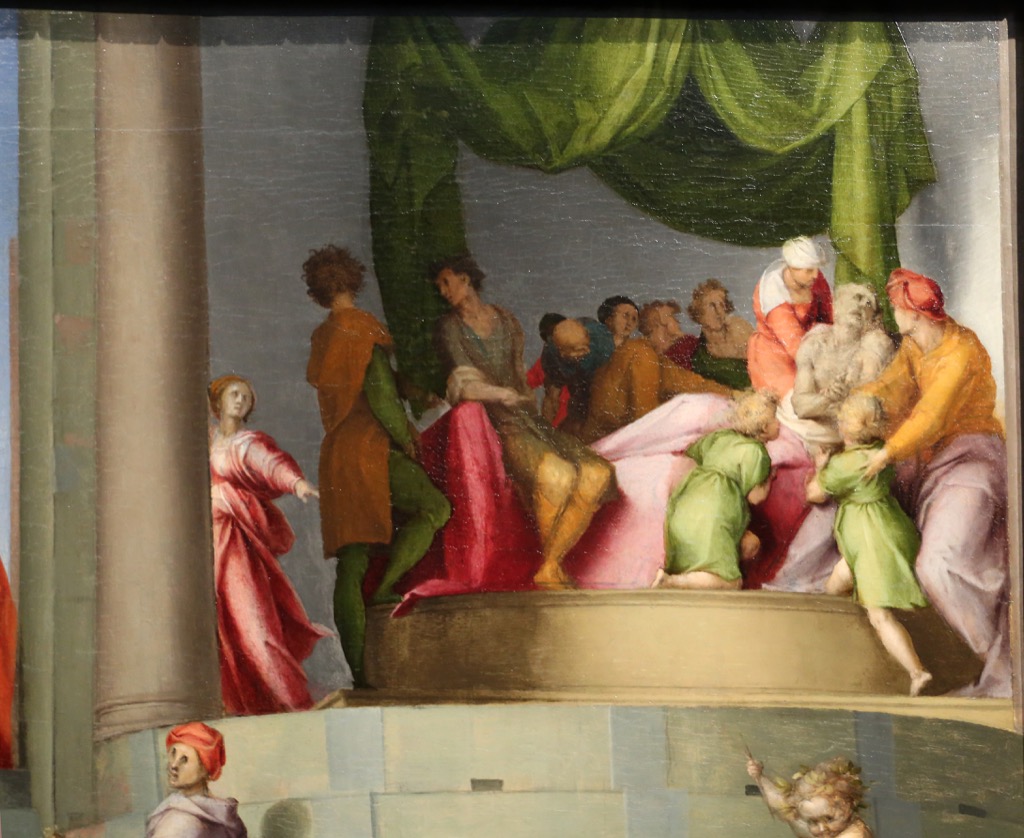
The National Gallery identifies four moments in the painting. Joseph introduces his father Jacob to Pharaoh. Joseph sits on a chariot and hears a petition from victims of famine. Joseph, with his sons, climbs the staircase to visit the dying Jacob. Finally, Jacob blesses Joseph's sons at the upper right.[1]
Pontormo does not separate these episodes into tidy compartments. Jacob appears more than once, and Joseph moves through different roles: son, public official, father and heir to a family story. The viewer has to follow repeated figures, shifts of scale and changing directions of movement. The result can feel like a sequence of remembered scenes rather than a conventional illustration.
That structure is essential to the painting's meaning. Joseph's story is about time: childhood loss, exile, service in Egypt, famine, reconciliation and the return of family bonds. By bringing several late episodes together, Pontormo makes the reunion between father and son part of a larger chain of survival and blessing.
Architecture, colour and movement
The painting's architecture is one of its most striking inventions. Staircases, platforms and curved forms create a setting that looks theatrical but does not settle into a rational place. Figures appear at different scales, and the eye is pulled from the lower corners to the centre and then up through the staircase. The National Gallery describes the space as oddly ill-defined and dreamlike, with sweeping curves and fragmented episodes.[1]
Pontormo's colour increases that sense of controlled instability. Sharp pinks, blues, greens and yellows move across the panel, separating groups while tying the surface together. The figures are carefully drawn, but the whole arrangement refuses the calm balance expected from earlier High Renaissance narrative painting.
This is why the work is often discussed in relation to early Florentine Mannerism. The term should not be used as a substitute for looking. In this painting, Mannerist qualities are specific: elongated bodies, unusual space, difficult movement and colour that clarifies emotion while complicating narrative order. The picture feels lucid in parts and disorienting as a whole.
Joseph, Jacob and Bronzino
Jacob can be recognised as the elderly man in the white hooded gown near the centre, resting with a stick and boulder as he journeys to Egypt. He appears again in blue in the left foreground, kneeling before Pharaoh as Joseph introduces him. Joseph, now Pharaoh's vizier, appears in the chariot at lower right, distributing grain or deciding petitions during famine. At the top right, the story reaches Jacob's blessing of Joseph's sons.[1]
The small boy seated on the bottom step of Pharaoh's palace has a special place in the painting's reception. The National Gallery notes Vasari's statement that this figure is a portrait of the young Bronzino, Pontormo's apprentice and later one of the leading Florentine painters of the next generation.[1]
That identification should be presented carefully. It is supported by Vasari's account, not by an inscription in the picture. Still, the tradition is valuable because it places the painting within Pontormo's workshop world. The Borgherini panel is not only a brilliant narrative experiment; it also belongs to the years when Pontormo's relationship with Bronzino was beginning to matter for Florentine art.
Provenance and collection history
The painting's early history begins with the Borgherini palace. The National Gallery records Pier Francesco Borgherini as an early owner and notes later possible or documented appearances in the hands of Giovan Gherardo de' Rossi, in Aldobrandini inventories and in the collection of the Duke of Hamilton. The Gallery bought the work at the Hamilton Palace sale in 1882.[1]
Such a history is necessarily partial. The painting was made for a room, later separated from that setting, and eventually entered a public collection. Its present museum life can make it look like an independent easel painting. The provenance record helps restore the lost domestic frame: walnut panelling, furniture, family marriage, and a series of related Joseph scenes around it.
The National Gallery also records a substantial technical and bibliographic history for the work, including scholarship on its underdrawing. Those studies should be consulted directly before making detailed claims about hidden revisions or working method. For this manuscript, the technical record is treated as evidence of research depth, not as permission to invent findings not stated in the object text.
Why Joseph with Jacob in Egypt matters
Joseph with Jacob in Egypt shows Pontormo at a point when his art was becoming unmistakably his own. The painting still belongs to a Renaissance culture of learned narrative and elite patronage, but its space, colour and movement point toward a more unstable visual language. It makes a biblical story about family recognition feel intellectually intricate and emotionally charged.
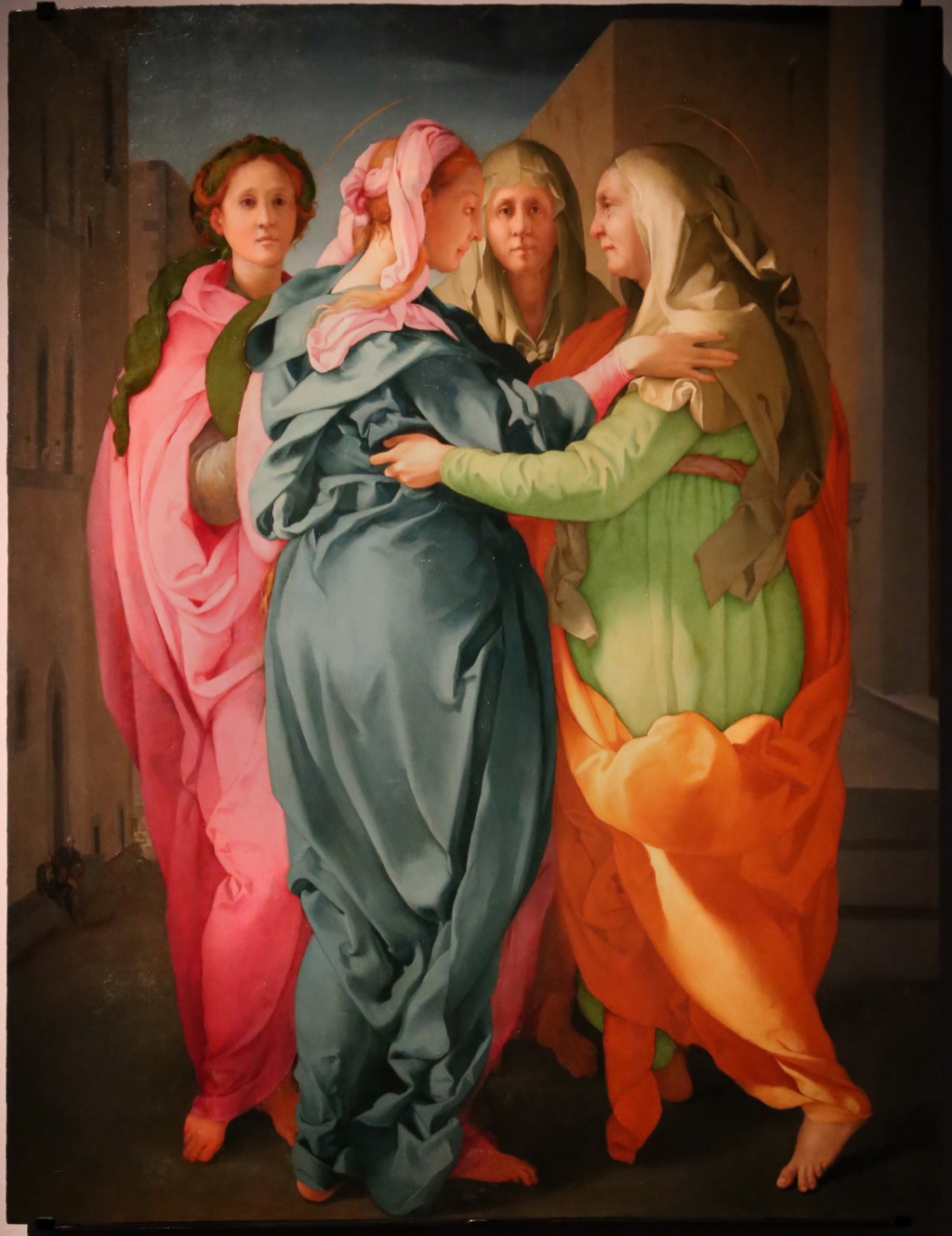
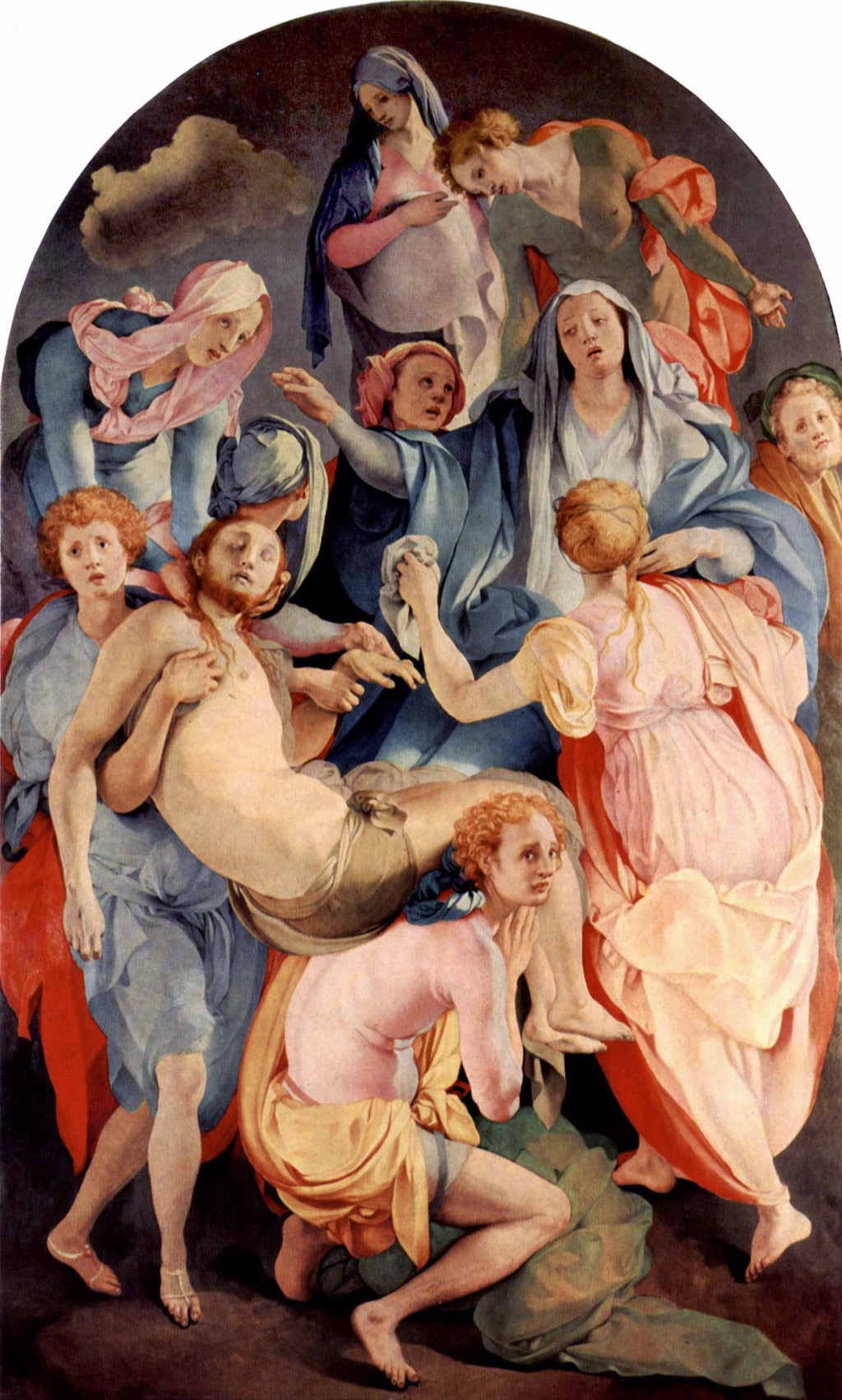
The work also helps explain Pontormo's wider development. Compared with the later Visitation and Deposition from the Cross, the Borgherini panel is earlier and more narrative, but it already shows his interest in compression, repetition and heightened colour. For the artist's broader career, see the Pontormo biography and Pontormo overview.
Frequently Asked Questions
Discussion
Does the painting become clearer or more powerful because several moments happen at once? Where does Pontormo make the story feel ordered, and where does he deliberately make it difficult to follow?
Reader Insights
What visual detail most changes how you read Joseph with Jacob in Egypt?
How do source, setting and image history affect the interpretation?
Which internal link gives the most useful next step through the Pontormo cluster?
Join the Conversation
Share your reading of this page below.
References
- National Gallery, London, “Joseph with Jacob in Egypt”: View Source, NG1131.
- Wikimedia Commons, “Pontormo, giuseppe e giacobbe in egitto, 1518 ca., dalla camera nuziale borgherini 11.jpg”: View Source, photograph by Sailko, CC BY 3.0.
- Photograph by Sailko, via Wikimedia Commons, CC BY 3.0; resized from the original.