


 by Tom Gurney
Tom Gurney BSc (Hons) is an art history expert with over 20 years experience
Published on August 6, 2026 / Updated on October 2, 2026
Email: tomgurney1@gmail.com / Phone: +44 7429 011000
Pontormo Paintings: Introduction
Pontormo's paintings changed the emotional and visual language of Florentine art after the High Renaissance. His works include crowded biblical narratives, monastic images, altarpieces, portraits and scenes of charged encounter. Across them, brilliant colour, compressed space and restless figure design create a world that is carefully planned but rarely calm.[1][2]
This guide focuses on five major paintings already central to this selection: Joseph with Jacob in Egypt, Supper at Emmaus, Deposition from the Cross, Visitation and Portrait of a Halberdier. Together they show the range of his painting between about 1518 and 1530, from domestic narrative to devotional image and psychologically tense portrait.[3][4][5][6][7]
At a Glance
- Main centreFlorence and its surrounding territory
- Active period covered hereabout 1518-30
- Key mediaoil on wood, oil on canvas, oil on panel and transferred panel
- Major settingsBorgherini bedroom, Galluzzo Charterhouse, Capponi Chapel, Carmignano and Florentine portrait culture
- Recurring qualitiessaturated colour, compressed space, elongated bodies, intense gazes and ambiguous emotional tone
- Related practicePontormo drawings were fundamental to planning figures, faces and compositions
Contents
- Introduction
- At a Glance
- How to read Pontormo's paintings
- Early narrative: Joseph with Jacob in Egypt
- Monastic painting: Supper at Emmaus
- The Capponi Chapel: Deposition from the Cross
- Carmignano: Visitation
- Portraiture: Portrait of a Halberdier
- What holds the paintings together
- Selected Works
Selected Pontormo Paintings
How to read Pontormo's paintings
Pontormo's paintings are easiest to approach through relationships rather than isolated effects. Figures press close together, but they often seem psychologically distant. Spaces are described by streets, walls, staircases or chapel settings, yet those places rarely behave like stable Renaissance rooms. Colour is brilliant, but it also unsettles the body: pinks, blues, greens and yellows can make flesh and drapery feel almost weightless.
The result is not a rejection of skill or structure. Pontormo planned carefully, using drawings, repeated figures and controlled colour relationships. What changes is the emotional purpose of structure. In these paintings, design becomes a way to hold grief, recognition, uncertainty, youth or sacred encounter under pressure.[1][2]
Early narrative: Joseph with Jacob in Egypt
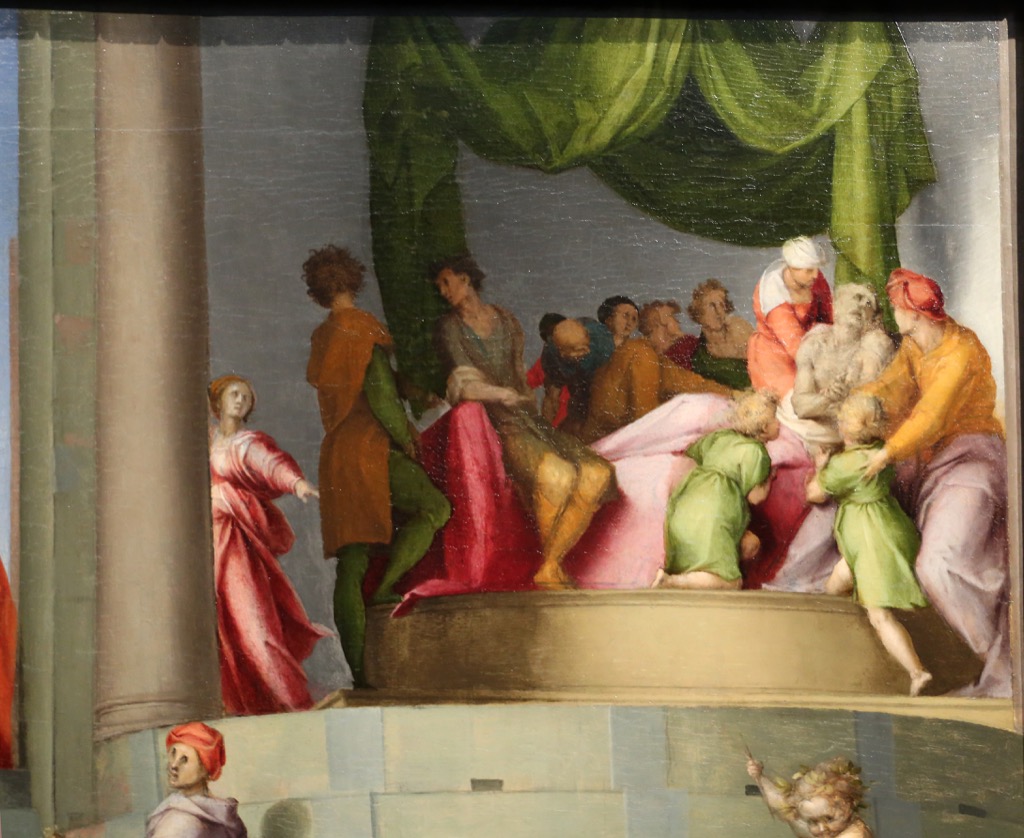
Joseph with Jacob in Egypt is one of the strongest records of Pontormo's early invention. The National Gallery dates it to probably 1518 and catalogues it as oil on wood, 96.5 x 109.5 cm. It was made for the bedroom of Pierfrancesco Borgherini and Margherita Accaiuoli, part of a larger domestic scheme dedicated to the story of Joseph.[3]
The painting is a continuous narrative rather than a single scene. Joseph introduces Jacob to Pharaoh, hears petitioners during famine, climbs toward the dying Jacob with his sons and participates in the blessing of those sons. Pontormo places these episodes in a dazzling architectural setting that is difficult to map but easy to feel. The viewer moves through time by following colour, stairs, repeated figures and shifting scale.[3]
This early panel already shows the traits that would define Pontormo's mature art. The space is inventive rather than stable. Narrative clarity competes with visual intensity. The painting belongs to elite Florentine domestic culture, yet its colour and movement make the biblical story feel unstable, urgent and emotionally compressed.
Monastic painting: Supper at Emmaus
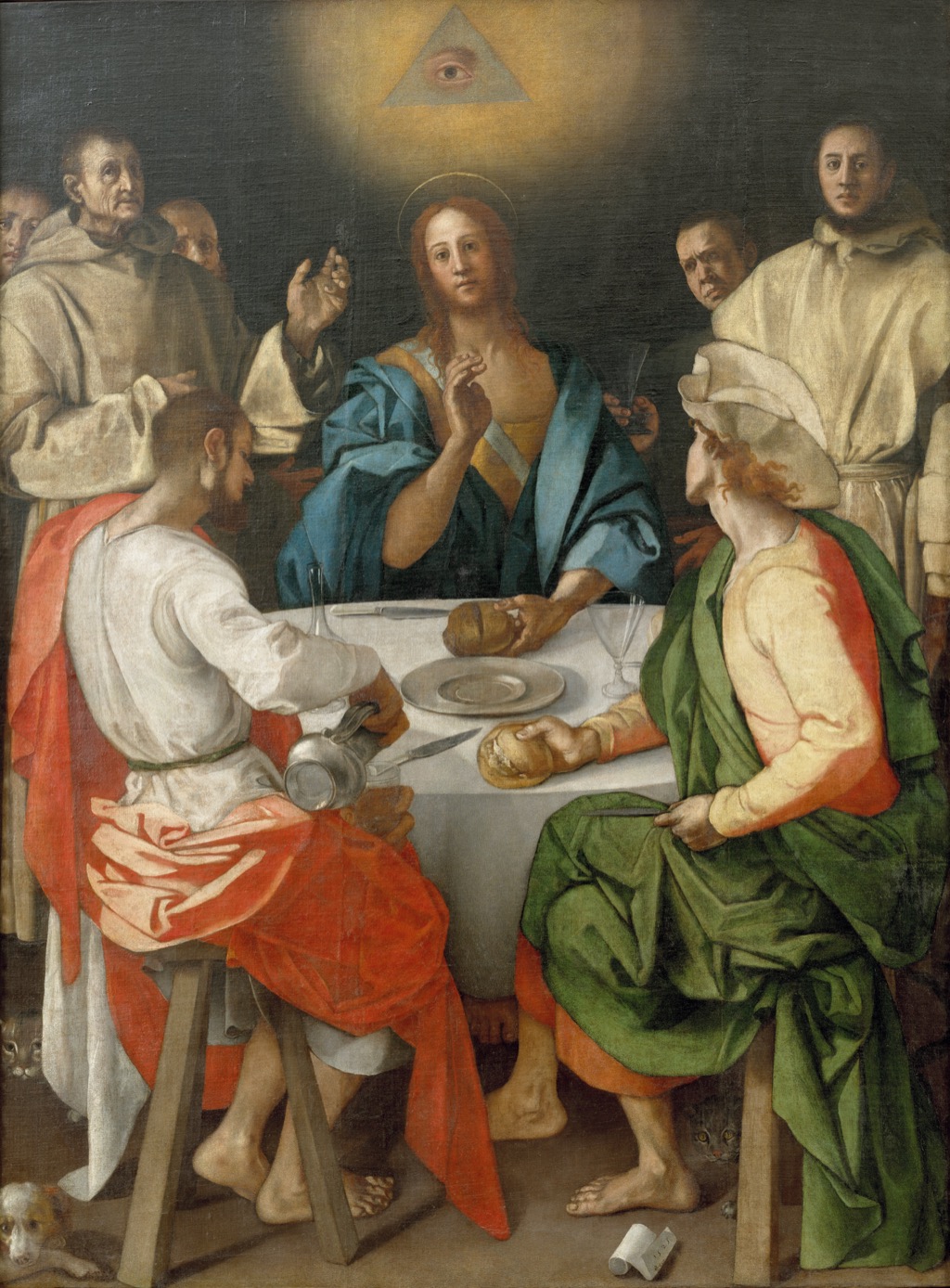
Supper at Emmaus, painted in 1525, belongs to Pontormo's work for the Galluzzo Charterhouse, or Certosa, near Florence. The Uffizi records it as oil on canvas, 230 x 173 cm, and connects the composition with Albrecht Durer's engraved version of the subject in the Small Passion series.[4]
Christ sits at the centre of the table and breaks bread, the moment when the disciples recognise him after the Resurrection. Around the table, Pontormo includes naturalistic details such as a metal jug, clear glasses, a dog and cats waiting below. Behind the scene stand Carthusian monks, including the old prior Leonardo Buonafede according to the Uffizi.[4]
The painting shows how Pontormo could turn a monastery commission into an image of recognition. It also carries an important later caveat. The divine eye visible today is described by the Uffizi as a posthumous repainting over an earlier Trinitarian motif. It should therefore be read as part of the picture's history, not simply as Pontormo's original design.[4]
The Capponi Chapel: Deposition from the Cross
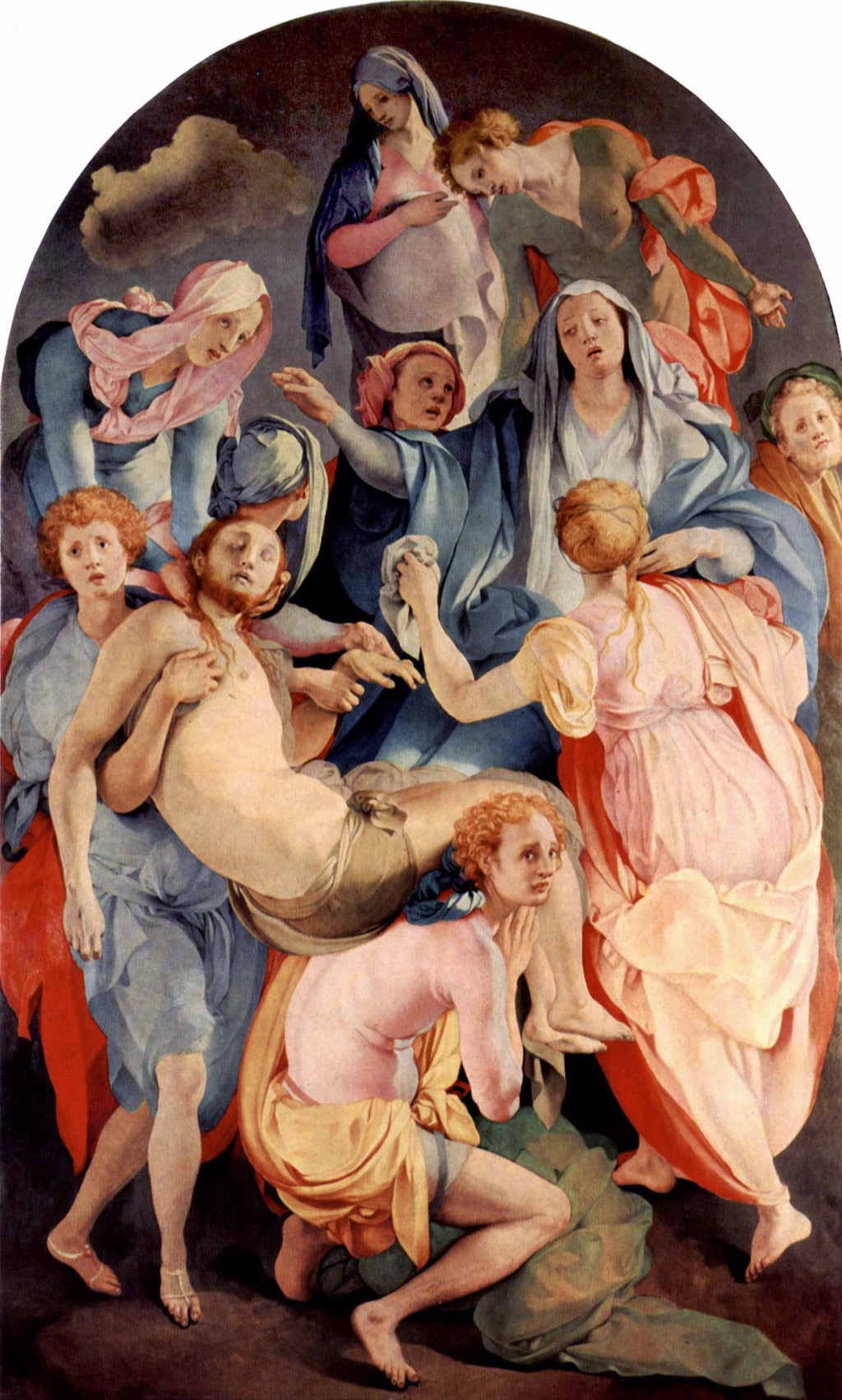
The Deposition from the Cross was painted about 1525-28 for the Capponi Chapel in Santa Felicita, Florence. Friends of Florence records the panel as oil on poplar and places it within the chapel scheme commissioned by Lodovico Capponi. The altar painting remains part of an ensemble that also included an Annunciation, Evangelist tondos and a gilded frame.[5]
The title is traditional but not simple. The painting does not show a visible cross, ladder or tomb, which is why it has also been discussed as an Entombment, Lamentation or transport of Christ to burial. Pontormo leaves the event suspended between actions. Christ's body is carried, the Virgin collapses in grief and surrounding figures turn emotion into a chain of colour and gesture.[5][6]
This is one of the clearest examples of Pontormo's mature style. Space is hard to locate, weight seems uncertain and luminous pinks, blues, greens and yellows do much of the expressive work. Yet the painting is not chaotic. Its power depends on control: figures interlock, glances redirect attention and the chapel setting brings Christ's body close to the altar.[5][6]
Carmignano: Visitation
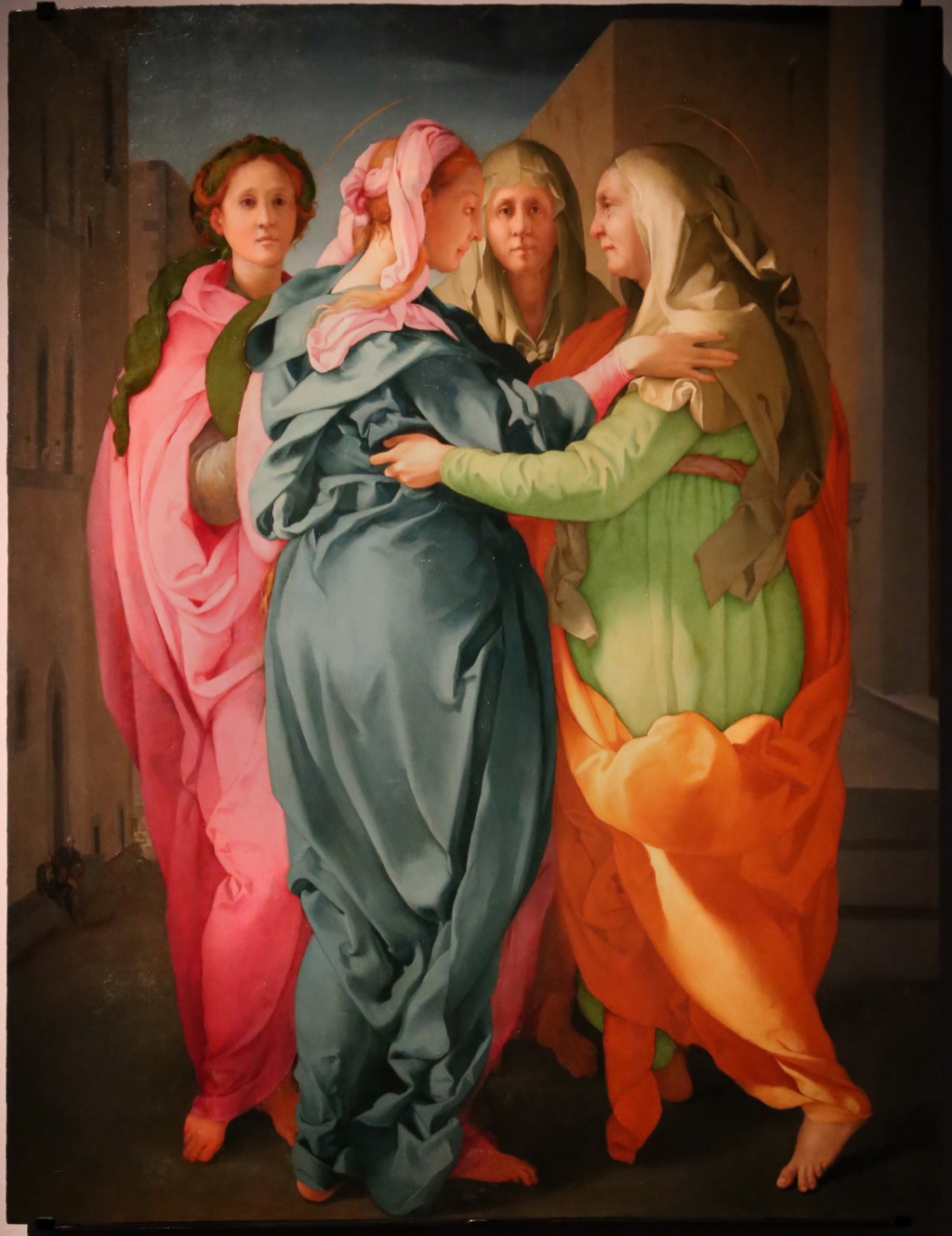
The Visitation, usually dated about 1528-29, remains associated with the Pieve di San Michele in Carmignano. It shows the meeting of Mary and Elizabeth, with two younger attendants standing behind them and facing outward. The figures fill a narrow street in saturated pink, blue-green, orange and green.[7][8]
The painting belongs close in time to the Capponi Chapel, but its emotional centre is different. The Deposition turns grief into suspended movement. The Visitation turns greeting into monumental stillness. Mary and Elizabeth embrace at the centre, while the attendants seem to hold the event open to reflection and foreknowledge.[7][8]
Conservation and exhibition research have made the painting especially revealing. Getty's conservation account explains the squared transfer from Pontormo's preparatory drawing and the infrared evidence for changes made during painting. The Visitation therefore connects finished colour with the disciplined drawing process behind it.[8]
Portraiture: Portrait of a Halberdier
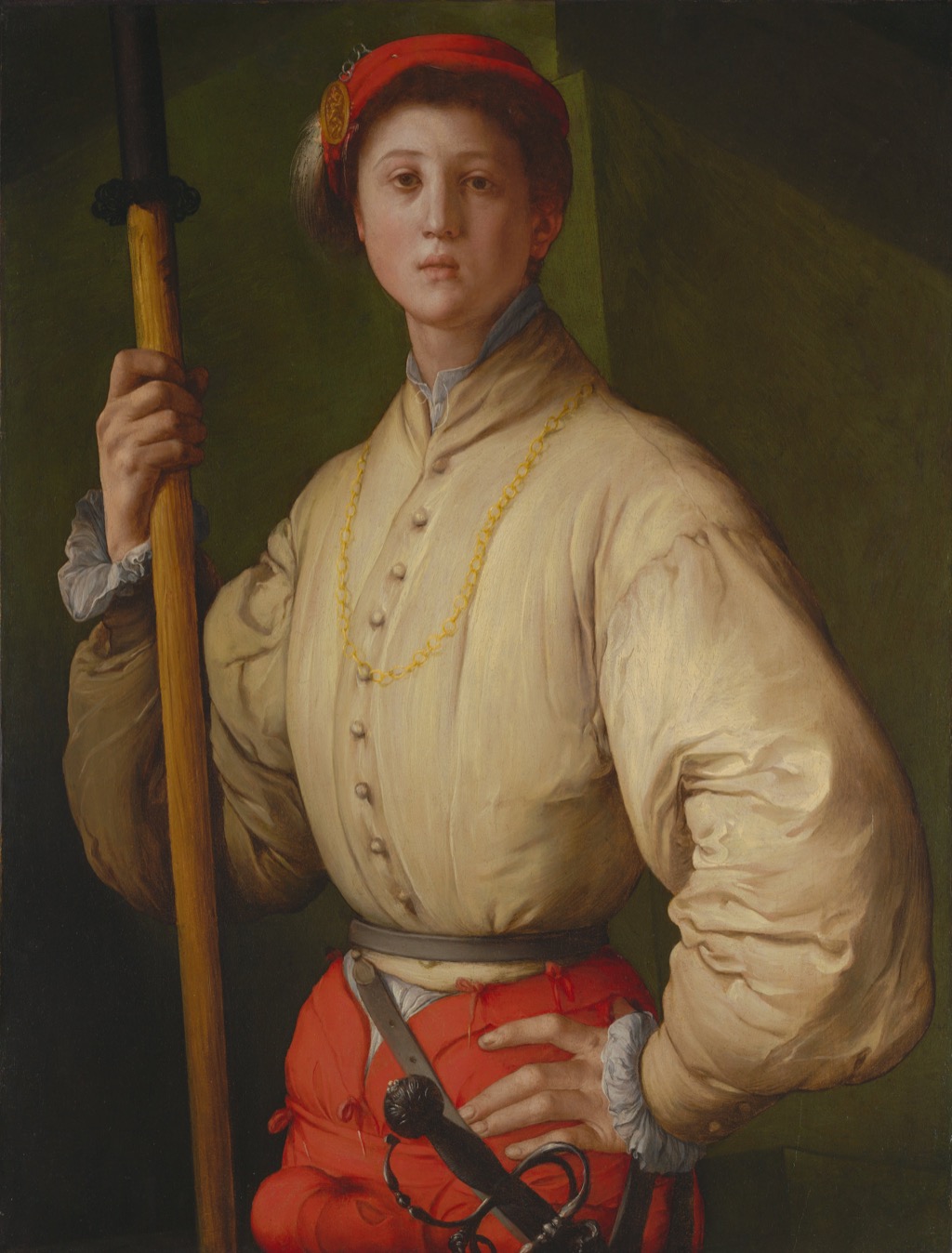
Portrait of a Halberdier, about 1529-30, shows Pontormo working in a different register. The Getty's current title, Portrait of a Halberdier (Francesco Guardi?), keeps the sitter identification open. Francesco Guardi is the leading proposal, while Cosimo I de' Medici was a significant earlier identification. Neither should be stated as certain.[9][10]
The portrait presents a young man standing before a fortified wall and holding a halberd. The weapon, clothing and stance project confidence, but the sitter's youth makes that confidence unstable. Pontormo's portraiture often keeps sitters psychologically reserved. Here that reserve is sharpened by the tension between public role and private vulnerability.[9]
Placed beside the religious paintings, the Halberdier shows that Pontormo's intensity was not limited to sacred subjects. He could make a single figure as charged as a narrative group. Costume, hand, weapon, wall and gaze become the portrait's structure.
What holds the paintings together
Taken together, these five paintings show Pontormo changing familiar formats from within. A domestic Joseph cycle becomes a complex narrative field; an Emmaus scene becomes a monastic recognition; an altar image becomes suspended grief; a Visitation becomes a monumental encounter; and a soldier portrait becomes a study of status, youth and uncertainty.
Colour is often the fastest way into this world. Pontormo used clear, sometimes startling combinations not merely for decoration but to organise feeling. Space is just as important. Architecture, streets, walls and chapels rarely settle the figures completely. Instead, they create pressure around them. For Pontormo's wider life and career, see the Pontormo biography and Pontormo overview.
Frequently Asked Questions
Discussion
Which part of Pontormo's painting feels most radical: his colour, his space, his emotional intensity or his way of making a clear story feel unstable?
Reader Insights
Which of the five selected paintings most clearly shows Pontormo changing familiar formats from within?
Does the hub give enough orientation before moving into the browse rows?
Which painting-page link should a first-time reader follow next?
Join the Conversation
Share your reading of this page below.
References
- National Gallery, London, “Pontormo (1494-1556/7)”: View Source
- Silvia Meloni Trkulja, “Carucci, Iacopo, detto il Pontormo”: View Source, Dizionario Biografico degli Italiani, vol. 20, Treccani, 1977. Italian.
- National Gallery, London, “Joseph with Jacob in Egypt”: View Source, NG1131.
- Uffizi Galleries, “Supper at Emmaus by Pontormo”: View Source, inventory 1890 no. 8740.
- Friends of Florence, “Cappella Capponi Restoration Project in the Church of Santa Felicita”: View Source, 2018.
- Uffizi Galleries, Euploos, “6587 F — Autoritratto”: View Source, updated 2020. Italian.
- Comune di Carmignano, “The Visitation by Pontormo”: View Source
- J. Paul Getty Museum, “Conservation Work Reveals the Hidden Revisions of an Italian Renaissance Master”: View Source, 2019.
- J. Paul Getty Museum / Google Arts & Culture, “Portrait of a Halberdier (Francesco Guardi?)”: View Source, 89.PA.49.
- Getty Vocabulary Program, CONA, “Portrait of a Halberdier (Francesco Guardi?)”: View Source, CONA ID 700000103.
- Photograph by Sailko, via Wikimedia Commons, CC BY 3.0; resized from the original.