 by Tom Gurney
Tom Gurney BSc (Hons) is an art history expert with over 20 years experience
Published on August 6, 2026 / Updated on October 2, 2026
Email: tomgurney1@gmail.com / Phone: +44 7429 011000
Pontormo Biography: Introduction
Pontormo was one of the artists who changed the direction of Florentine painting after the High Renaissance. Born Jacopo Carucci in the Tuscan village of Pontorme in 1494, he built a career in and around Florence as a painter of altarpieces, frescoes, portraits and intensely worked drawings. His art absorbed lessons from Andrea del Sarto, Michelangelo and Northern European prints, yet its compressed spaces, luminous colours and emotionally charged figures became unmistakably his own.[1][2][3]
Today Pontormo is usually described as a leading figure of Florentine Mannerism. The label is useful if it identifies a generation that moved beyond the balance and spatial clarity associated with the High Renaissance. It is less useful when it makes his paintings seem like exercises in artificiality. In Pontormo's strongest works, unusual colour, elongated bodies and unstable arrangements are ways of intensifying human encounter: a reunion, a farewell, a revelation or the guarded presence of a sitter.[3][9]
At a Glance
- Full nameJacopo Carucci
- Known asPontormo, after his birthplace
- Born24 May 1494, Pontorme, near Empoli
- Diedaround the turn of 1556–57, Florence; conventionally shown as 1557
- Principal centreFlorence and its surrounding territory
- Known forreligious paintings, portraits, fresco cycles and drawings
- Key relationshipstrained with Andrea del Sarto; later taught and collaborated with Bronzino
- Associated movementFlorentine Mannerism
Contents
- Introduction
- At a Glance
- Childhood and training in Florence
- Early success and the Borgherini paintings
- Medici patronage and Poggio a Caiano
- The Certosa and the impact of Northern prints
- The Capponi Chapel and Carmignano
- Portraits, drawings and the workshop
- San Lorenzo and Pontormo's diary
- Reputation and legacy
Childhood and training in Florence
Pontormo was the son of Bartolomeo Carucci, a painter, and Alessandra di Pasquale. His father died in 1499 and his mother in 1504. Documents place the boy in Florence by 1503 and living there more permanently by 1508, when his maternal grandmother placed him under the protection of the city's wardship authorities. These losses are securely part of his early biography, but they should not be used to explain every later feature of his art or personality.[1]
His path through Florentine workshops is partly reconstructed from Giorgio Vasari, who knew Pontormo and drew information from Bronzino. Vasari associated the young artist with Leonardo da Vinci, Piero di Cosimo and Mariotto Albertinelli before his arrival in Andrea del Sarto's workshop in 1512. The exact nature and length of every early apprenticeship are not equally documented. Andrea's importance, however, is visible in Pontormo's early paintings and red-chalk drawings, even as the younger artist began to pull away from his master's calm structures.[1][2][9]
By 1513 Pontormo was receiving independent work, including decorations connected with Florentine civic and papal celebrations. His early frescoes at Santissima Annunziata brought him into one of the city's most active artistic settings. The Visitation painted there between 1514 and 1516 still engages with the monumental language of Andrea del Sarto and Raphael, but its shifting poses and nervous energy already point toward a less settled kind of composition.[1]
Early success and the Borgherini paintings
Pontormo's rise can be followed through commissions that placed his work beside that of established Florentine painters. For the bedchamber of Pierfrancesco Borgherini and Margherita Accaiuoli, he contributed panels illustrating the story of Joseph. The ensemble, commissioned around the couple's 1515 marriage, involved Andrea del Sarto, Francesco Granacci and Bachiacca as well as Pontormo.[2][4]
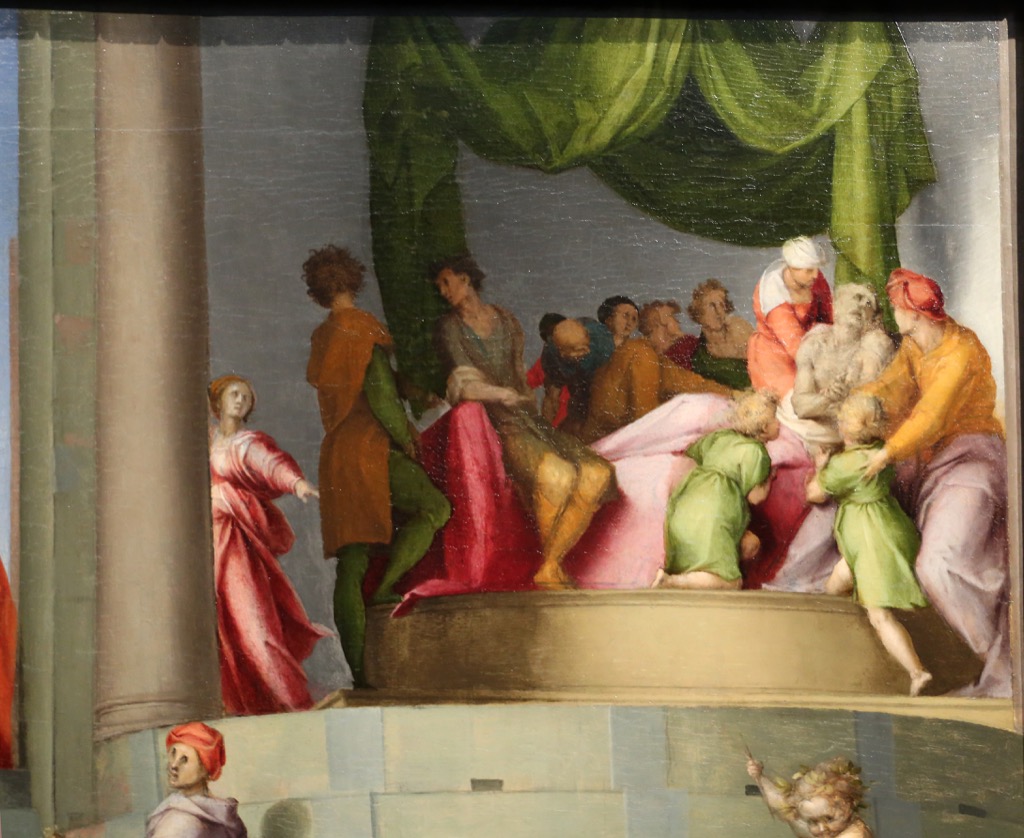
The most complex of Pontormo's surviving contributions is Joseph with Jacob in Egypt, probably painted in 1518. Instead of isolating one event, he arranged several moments from the biblical story within a single architectural setting. Brilliant colour, abrupt changes of scale and winding movement guide the eye through the narrative. The National Gallery connects the figure of a boy seated on the steps with the young Bronzino, following Vasari's identification. The panel therefore stands at an important intersection of patronage, experiment and workshop history, although the boy's identity ultimately rests on an early written account rather than an inscription in the painting.[3][4]
The Joseph panels also demonstrate how widely Pontormo looked. Michelangelo's Sistine Ceiling offered a model of powerful figure design, while prints by Lucas van Leyden and other Northern artists encouraged densely packed storytelling and unusual spatial turns. These sources did not produce imitation. Pontormo reorganised them into a visual language in which clarity and disorientation could operate together.[1][3]
Medici patronage and Poggio a Caiano
The Medici were important patrons across Pontormo's career, although his relationship with Florentine power should not be reduced to simple loyalty or opposition. In 1519 he joined the programme for the great hall of the Medici villa at Poggio a Caiano. His lunette, commonly called Vertumnus and Pomona, presents an open landscape populated by figures whose identities and narrative have prompted differing interpretations. Work on the wider decorative scheme was interrupted after the death of Pope Leo X in 1521.[1][2]
The commission shows that Pontormo was trusted with a prominent Medici site while still in his twenties. It also reveals a side of his art that can be missed when attention centres only on anxious figures and compressed interiors: clear daylight, spacious landscape and a measured pastoral rhythm. His career was not a straight progression toward ever greater strangeness. He adjusted his language to setting, patron and subject.
The Certosa and the impact of Northern prints
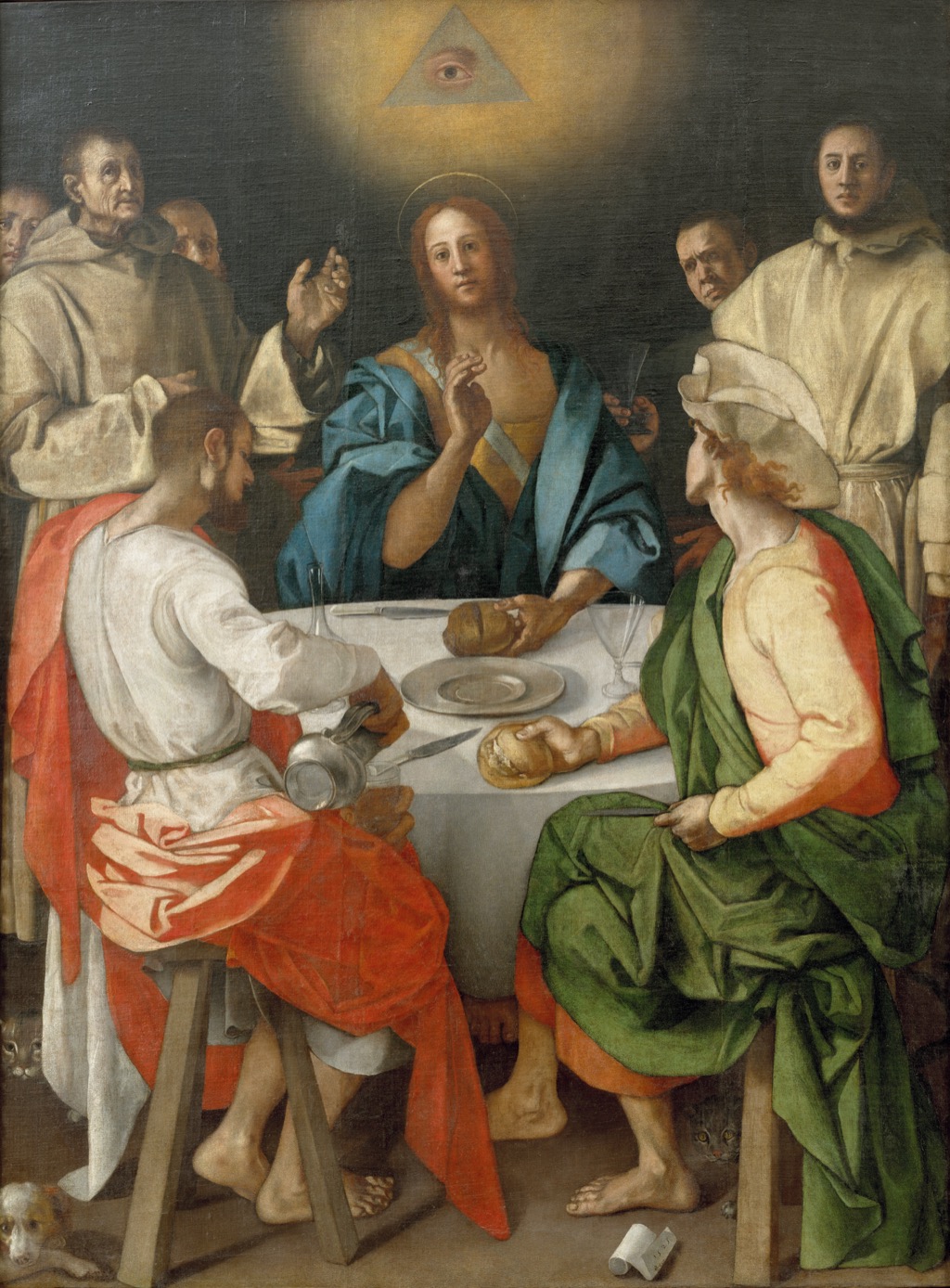
During an outbreak of plague Pontormo withdrew to the Certosa del Galluzzo, the Carthusian monastery outside Florence. From 1523 he worked on a cycle of Passion frescoes there and painted the Supper at Emmaus in 1525. The frescoes drew closely on Albrecht Dürer's printed Passion imagery. Pontormo used those models selectively, translating the concentrated drama and angular movement of small woodcuts into large painted scenes.[1][2][3]
The Certosa works matter because they challenge the idea of Florence developing in isolation. Printed images crossed borders more easily than paintings, and Pontormo's response to Dürer shows Northern art entering the centre of Florentine practice. At the same time, the monastery supplied a particular devotional environment. The Supper at Emmaus places Christ among plainly dressed Carthusian figures, bringing the biblical recognition into the world of the community for which the picture was made.[5]
The Capponi Chapel and Carmignano
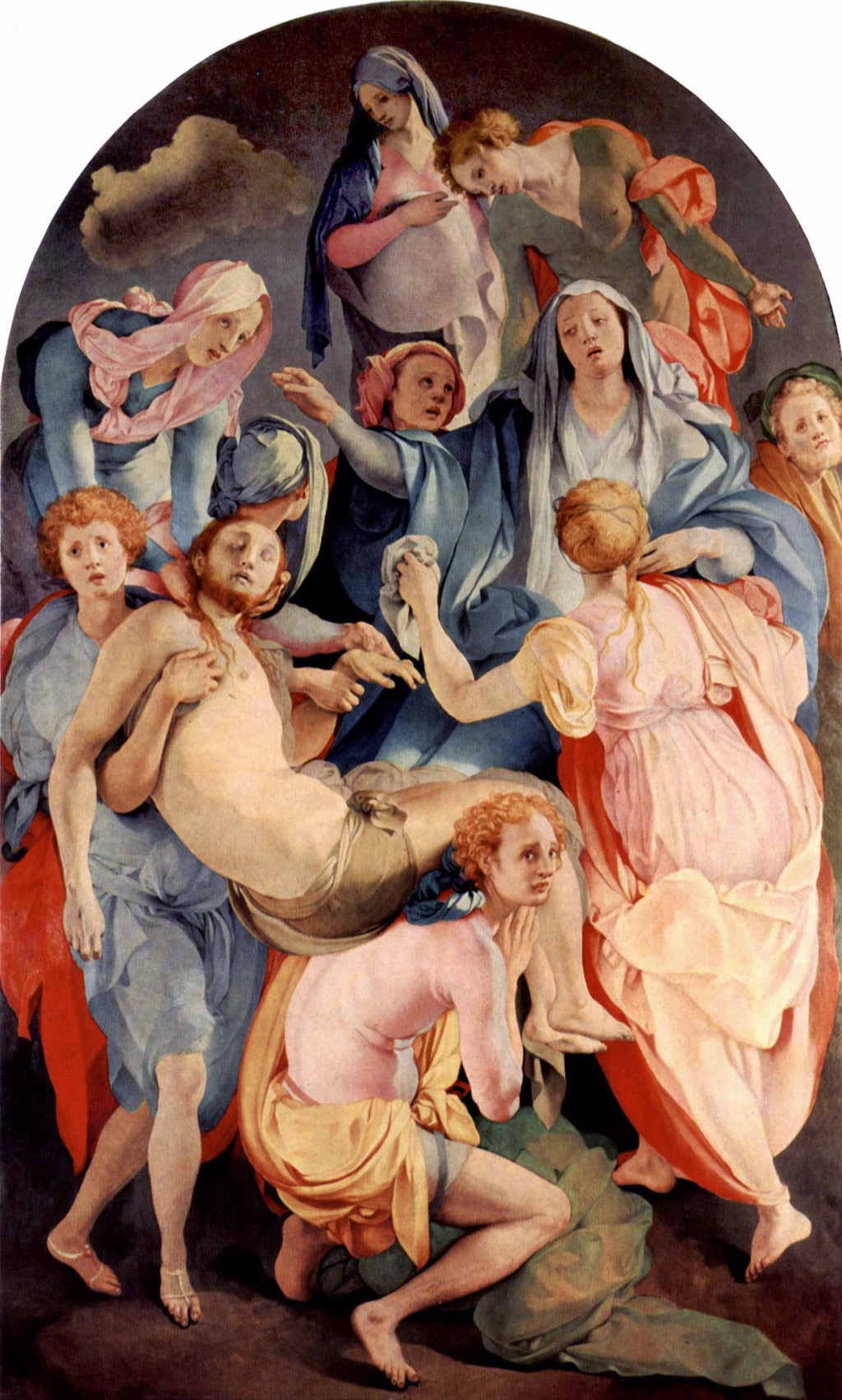
In 1526 Lodovico Capponi commissioned Pontormo to decorate the family chapel in Santa Felicita, Florence. The project included an Annunciation, Evangelist tondos made with assistance from the young Bronzino, and the large altar panel conventionally known as the Deposition from the Cross. The painting is also discussed as an Entombment, Lamentation or transport of Christ because it does not present an unambiguous descent from a visible cross.[1][6]
The Capponi painting turns grief into a structure of colour and suspended movement. Figures crowd around Christ's pale body, yet the scene lacks the firm architectural setting or heavy modelling that might anchor them. Pinks, blues and greens carry much of the emotional force. The result is not simply a rejection of Renaissance naturalism; it is a carefully designed alternative in which bodies, glances and intervals create an atmosphere of shock and weightlessness.
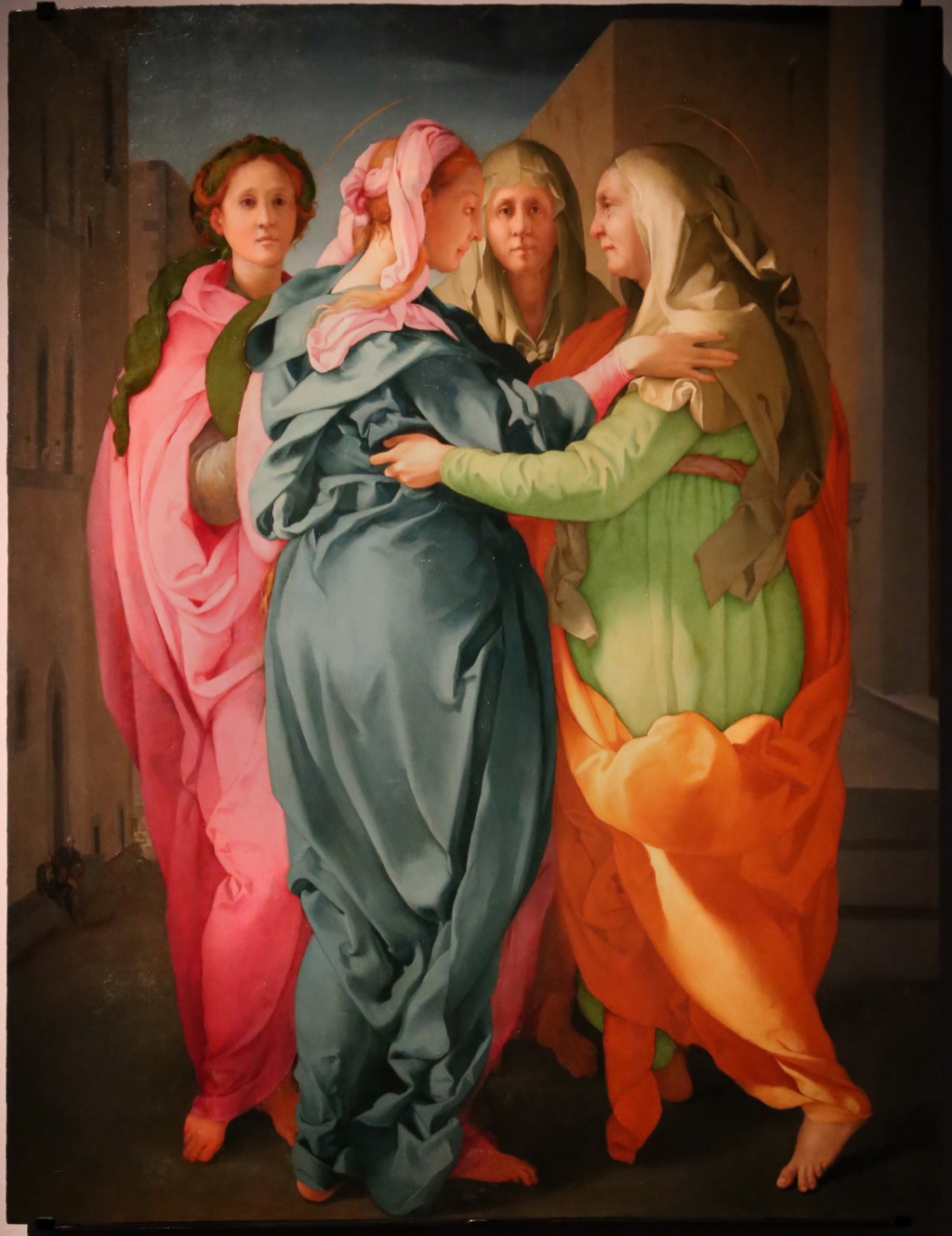
Soon afterwards Pontormo painted the Visitation at Carmignano, usually dated about 1528–29. Mary and Elizabeth meet at the centre while two younger women face outward with arresting stillness. Recent exhibition and conservation research has reunited the painting conceptually with its squared preparatory drawing, making it possible to follow Pontormo's movement from a worked design to the large panel. The picture's intense colour and interlocking figures belong to the same mature period as the Capponi Chapel, but its emotional centre is recognition and greeting rather than mourning.[7][10]
Portraits, drawings and the workshop
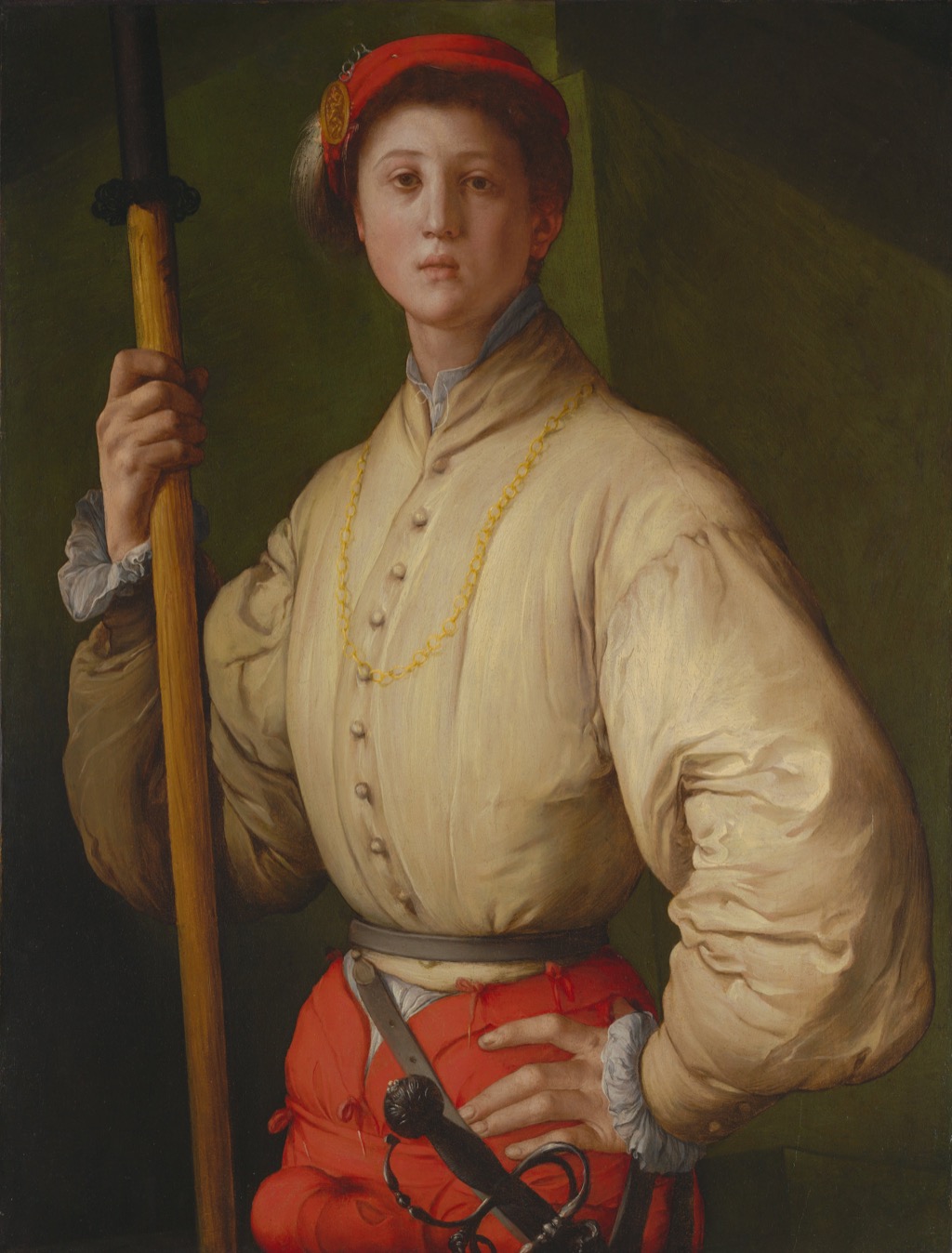
Pontormo was also a penetrating portraitist. His sitters often meet the viewer with reserve rather than easy sociability, while clothing, hands and accessories define status without dissolving the individual's psychological distance. The Portrait of a Halberdier, painted around 1529–30, is among the most celebrated examples. The Getty currently presents Francesco Guardi as a tentative identification; Cosimo I de' Medici is an important earlier proposal. Neither name should be treated as certain.[7][10][11]
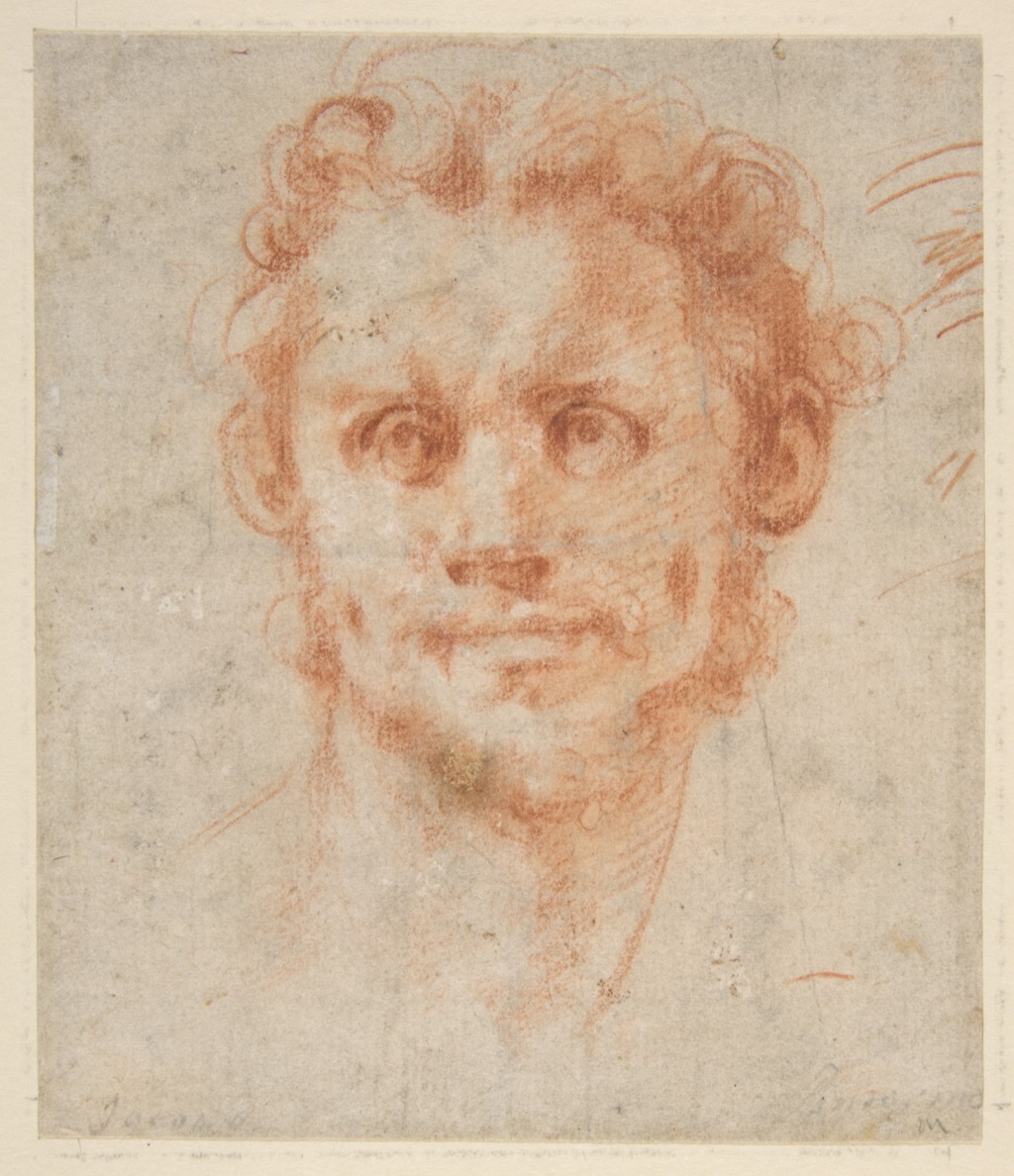
Drawing was fundamental to Pontormo's practice. His surviving sheets include rapid searches for poses, carefully modelled figure studies and designs related to paintings and frescoes. Red and black chalk allowed him to test the turn of a head, the balance of a body or the fall of drapery before committing the form to a wall or panel. These drawings are not merely supplements to the paintings: they preserve stages of thought that finished works often conceal.[8][9]
Bronzino was Pontormo's most important pupil and collaborator. The Metropolitan Museum of Art places Bronzino's apprenticeship around 1515–18 and describes a professional and personal association that continued for almost four decades. Their drawings sometimes come so close that attribution remains difficult, a reminder that Renaissance workshop practice involved copying, collaboration and shared visual problems. Bronzino developed a distinct, more controlled manner, but Pontormo's attention to figure studies and chalk technique remained important to him.[8]
San Lorenzo and Pontormo's diary
Pontormo's largest late commission was the decoration of the choir of San Lorenzo, the Medici church in Florence. From 1546 until his death he worked on a vast sequence of biblical scenes. Bronzino completed portions after him, but the frescoes were destroyed in the eighteenth century. Their scale and appearance must now be approached through surviving drawings, early descriptions and the artist's diary rather than direct experience.[1][2][3]
Pontormo kept a diary during his final two years while the San Lorenzo project was under way, noting the progress of the work. Because the entries survive in the artist's own voice, the document is valuable evidence of his daily process. It is not, however, a transparent psychological diagnosis. Vasari's influential portrait of an eccentric, isolated painter shaped Pontormo's reputation for centuries, while modern scholarship has treated that characterisation more critically.[1][3][7]
The diary shows sustained attention to bodies, movements and the practical rhythm of work during Pontormo's final years. It also reveals contact with other people, complicating the idea of complete withdrawal. The surviving evidence supports a cautious picture: an artist capable of solitude and self-scrutiny, but also embedded in workshops, patronage networks, religious institutions and long professional relationships.
Pontormo died in Florence around the turn of 1556–57 and was buried at Santissima Annunziata. The compact life-date convention 1494–1557 reflects the turn-of-year evidence without claiming certainty for a disputed day.[1][2][8]
Reputation and legacy
Pontormo's reputation has often been filtered through what later viewers expected Renaissance art to be. When harmony, stable space and ideal proportion were treated as the period's natural destination, his distortions could appear like decline. Seen on their own terms, they are purposeful choices made by an artist responding to changing patrons, devotional settings, political disruption and an expanding world of visual sources.
His influence is clearest in Bronzino, but it extends beyond one pupil. Pontormo demonstrated how Florentine disegno—the disciplined development of an idea through drawing—could support radical colour, unstable space and heightened emotion. His paintings can feel both meticulously planned and strangely immediate. That tension is central to their continuing power and to the broader Pontormo overview.
Frequently Asked Questions
Discussion
Pontormo repeatedly used colour and bodily movement to intensify encounters between figures. Comparing the crowded narratives of the Joseph panels with the suspended grief of the Capponi Chapel and the concentrated greeting at Carmignano, where does his art feel most emotionally direct—and where does its strangeness become part of that effect?
Reader Insights
Which career phase best explains the shift from early Florence to the Capponi Chapel and Carmignano?
Where does the manuscript balance documentary caution and readable biography most successfully?
Which relationship matters most for Pontormo's story: Andrea del Sarto, Michelangelo, Dürer or Bronzino?
Join the Conversation
Share your reading of this page below.
References
- Silvia Meloni Trkulja, “Carucci, Iacopo, detto il Pontormo”: View Source, Dizionario Biografico degli Italiani, vol. 20, Treccani, 1977. Italian.
- British Museum, “Jacopo da Pontormo” artist authority record: View Source
- National Gallery, London, “Pontormo (1494–1556/7)”: View Source
- National Gallery, London, “Joseph with Jacob in Egypt”: View Source, NG1131.
- Uffizi Galleries, “Supper at Emmaus by Pontormo”: View Source
- Friends of Florence, “Cappella Capponi Restoration Project in the Church of Santa Felicita”: View Source
- Uffizi Galleries, “Miraculous Encounters: Pontormo from Drawing to Painting”: View Source, 2018.
- Metropolitan Museum of Art, “The Drawings of Bronzino”: View Source, 2010.
- Metropolitan Museum of Art, “Virgin and Child with Saint Elizabeth, the Infant Baptist, Saint Anthony of Padua, and a Female Martyr”: View Source, 19.76.11.
- J. Paul Getty Museum, “Pontormo: Miraculous Encounters”: View Source, 2019.
- J. Paul Getty Museum, “Portrait of a Halberdier (Francesco Guardi?)”: View Source, 89.PA.49.
- Metropolitan Museum of Art Open Access/Public Domain, object 1998.361.