


 by
Tom Gurney
Tom Gurney BSc (Hons) is an art history expert with over 20 years experience
Published on June 19, 2020 / Updated on October 22, 2026
Email:
tomgurney1@gmail.com
/ Phone:
+44 7429 011000
Christ Bearing the Cross (Small Passion): Introduction
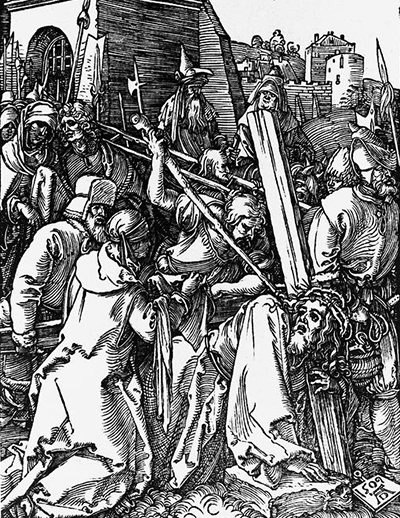
Christ’s outstretched hand almost reaches the lower edge of Albrecht Dürer’s Christ Bearing the Cross . His fingers rest on a low slab, his body bends towards the ground, and the cross rises heavily above his shoulder. Beside him, Veronica kneels with a cloth. Their encounter occupies the foreground while an armed procession presses out of the city behind them. The woodcut is dated 1509 on the small tablet at the lower right; the Cleveland Museum of Art identifies its impression as Meder 146, from the Small Passion . [1]
Dürer published the completed woodcut cycle as a book in 1511. Its small quarto format brought an extensive sequence into a portable devotional volume: thirty-six narrative woodcuts, a title image and a colophon, spread across thirty-eight leaves. Benedictus Chelidonius supplied Latin verses. The date on this particular design therefore precedes the book’s publication. Within that compact format, Dürer makes a public execution feel close enough for the viewer to notice the placement of individual fingers. [2]
At a Glance
This work across Albrecht Dürer’s career
Young Hare
1502Praying Hands
1508Melencolia I
1514Four Apostles
1526Contents
- Weight, movement and a crowded street
- The Gospel journey and Veronica’s legend
- From the encounter to the image
- An image with more than one material life
- Frequently Asked Questions
Weight, movement and a crowded street
The cross divides the image with a broad, pale beam. Its long edge descends towards Christ’s head, directing attention from the skyline to his face and then towards the foreground. His robe gathers into heavy folds around his bent leg. Hair and thorns crowd his forehead; below, the extended arm gives his body a precarious connection with the ground. Although the beam carries the most forceful straight lines, the impression of weight comes from the whole arrangement: the low head, the folded body and the small area available for support.
Veronica’s kneeling figure answers his lowered position. Her ample clothing spreads across the left foreground, creating another large pale shape beside his robe. Between them the cloth hangs in narrower folds. Christ turns towards her, making their faces a point of exchange within the surrounding crush. She has stopped to attend to one person. The figures immediately behind her and beside Christ seem to leave scarcely enough room for the gesture.
Above them, the procession breaks into heads, hats, weapon shafts and fragments of bodies. A man at the right stands with his back partly towards us, his curling hair, fitted clothing and hanging equipment creating a busy silhouette. Farther back, faces emerge from dark interlocking lines. The pointed weapons continue upwards against a strip of open sky, while spectators appear above the wall. Dürer gives the crowd several heights, allowing it to fill the scene without becoming a single flat band.
The city gate at the upper left supplies a place from which the procession emerges. Its dark arch and the closely hatched wall hold the background together. Beyond, walls and a round tower establish a fortified urban setting. The passage from that architecture to the stony foreground is abrupt: the people occupy almost everything between. This compressed space makes the stopping of Christ’s body consequential. The procession seems to bear down on the very place where he has lost his footing.
Such differences in tone belong to the structure of woodcut. The lines that receive ink stand above the areas cut away from the block; the paper remains light where ink does not reach it. Here, fine lines can suggest hair, curved folds or the roughness of the ground, while closely packed marks produce larger dark masses. The open areas of Veronica’s clothing and Christ’s robe remain readable against the crowded middle distance. Light and dark give the small image a clear emotional centre. [13]
Sabine Siemer, discussing this woodcut in her study of Dürer’s Passion imagery, connects Christ’s exhausted glance towards Veronica and his low position with an appeal to compassio , the viewer’s sharing in his suffering. The arrangement makes that appeal tangible. We look down towards the fallen figure, yet his face remains available to us through its turn towards Veronica. Her response offers a way into the scene: attention can take the form of a modest act of care. [14]
The Gospel journey and Veronica’s legend
The Gospel accounts provide different emphases for the journey to the place of execution. John 19:17 describes Jesus going out carrying his cross. Mark 15:21 names Simon of Cyrene, compelled to carry it. Luke 23:26–32 also names Simon and describes a following crowd, including women who lament; Jesus addresses them as the daughters of Jerusalem. These passages establish the cross-bearing journey and its witnesses. They do not narrate Veronica’s meeting with Christ or the miraculous impression of his face on her cloth. [15] [16]
Veronica belongs to the later devotional tradition. In the familiar Calvary version, she offers a cloth to wipe Christ’s blood and sweat, and his features appear upon it. The National Gallery’s account of Ridolfo Ghirlandaio’s Procession to Calvary , painted around the same period as Dürer’s woodcut, explains this tradition. In Dürer’s scene the cloth is offered close to the suffering face. The meeting inserts a compassionate exchange into the movement towards execution. [17]
The legend had more than one form. In the Golden Legend , as transmitted in William Caxton’s English translation, Veronica recalls wanting a painted likeness because Christ’s preaching often took him away from her. Carrying a linen kerchief, she encounters him; he asks for it and impresses his face upon it. Later she takes the image to the sick emperor Tiberius, who is healed after seeing and reverencing it. This version places the making of the image during Christ’s ministry, rather than on the road to Calvary. [18]
Reading the older story beside the woodcut clarifies the importance of the cloth. It carries the promise that a person’s bodily presence can survive through an image. Dürer places this promise at a moment when Christ’s body appears exhausted and vulnerable. The offered fabric is soft, portable and handled by another person; the cross is rigid, massive and imposed upon him. Both enter the immediate space around his face, giving the encounter a powerful contrast of materials and purposes.
From the encounter to the image
A surviving sheet in the Rijksmuseum makes the connection between this episode and the next design unusually clear. It preserves four Small Passion woodcuts together, uncut. Christ Bearing the Cross occupies the upper left; at the upper right Veronica displays the cloth between Peter and Paul. Below are the nailing to the cross and the Crucifixion. The museum dates the sheet 1509–10 and records the individual images at approximately 12.7 × 9.7 centimetres, within a sheet measuring 35.2 × 25.2 centimetres. [19]
Looking across its upper pair, the difference in presentation is striking. The bustling procession becomes a quiet group facing the viewer. Christ’s moving, suffering body gives way to a frontal likeness held up for inspection. The sheet allows us to see together the offered cloth and the resulting sacred image. Its generous blank intervals also make the small scale of each scene apparent. These are concentrated designs surrounded by paper, capable of being separated and handled individually.
The cloth-display scene introduces a pause before the violence continues below. Its symmetry, large haloes and exposed face differ from the overlapping heads and unstable diagonals of the cross-bearing. This change of pace matters when considering the earlier scene by itself. Veronica’s gesture anticipates a further act of looking: the face towards which she bends will become an image presented to others.
Art historian Shira Brisman takes this relation between contact and image-making further. In “A Touching Compassion: Dürer’s Haptic Theology,” she reads the meeting of face and cloth alongside Christ’s hand pressing the slab. She proposes that the slab resembles a woodcutter’s block and that the two contacts evoke the transfer of an image through printing. For Brisman, the print reflects on its own capacity to transmit Christ’s presence and suffering. [20]
The slab’s appearance cannot establish that it depicts a printing block, and the argument is not supported by a statement from Dürer. Brisman’s proposal joins the hand, cloth and printed sheet: a viewer handles an image made through contact while looking at a story in which contact makes an image.
An image with more than one material life
The survival of separate impressions also requires care with dates. Cleveland describes its Christ Bearing the Cross as an impression without text. That designation does not automatically make it a leaf from the 1511 book. The dated design, the publication of the cycle and the printing of an individual sheet are related events, but they are not interchangeable. A small monochrome reproduction can make these distinctions invisible. [1]
The blocks themselves had a long subsequent history. The British Museum’s account of the Small Passion records thirty-five surviving blocks in its collection. By 1612 the remaining group was in Venice, where Daniel Bissuccio issued an Italian edition; the museum acquired its blocks in 1839. This history helps explain how a design could continue to appear after Dürer’s lifetime. An impression printed from a surviving block has a different relationship to the original matrix from a newly engraved copy. [21]
Copying supplied another route of transmission. The Klassik Stiftung Weimar’s corpus record identifies Marcantonio Raimondi’s Small Passion as a thirty-seven-sheet engraved copy after Dürer. Even when a composition remains recognisable, changing the medium involves a fresh matrix and a different way of forming the marks. The persistence of the scene therefore encompasses both renewed printing and reinterpretation by another printmaker. [22]
Those histories return attention to the precise construction of the 1509 image. Dürer gives the crowd energy through accumulation, but he gives Christ’s encounter with Veronica room through pale surfaces and directed glances. A hand meeting a slab and a cloth lifted towards a face become the stillest points in a crowded passage. They allow an image of bodily collapse to contain an equally concentrated account of human attention.
Frequently Asked Questions
Artworks directory
These 187 records include individual works, reverse sides, detail views, paired panels and reconstructed arrangements. Three additional catalogue images repeat works already listed. Related views are not counted as separate originals; qualified attributions and published dating are retained.
Discussion
Look again at the images and ideas explored in Christ Bearing the Cross (Small Passion). These editorial prompts invite your observations.
Reader Insights
Which detail or idea in Christ Bearing the Cross (Small Passion) most changed your reading, and why?
How does the discussion of “Weight, movement and a crowded street” affect your understanding?
What comparison would you bring to the discussion of “An image with more than one material life”?
Join the Conversation
Share a detail, comparison or question about Christ Bearing the Cross (Small Passion) below.
References
- Cleveland Museum of Art , The Small Passion: Christ Bearing the Cross , 1509, accession 1961.274. View source .
- Bridwell Library , Southern Methodist University, “The Small Passion,” Books and Prints by Albrecht Dürer . View source .
- ALBERTINA, Selbstbildnis als Dreizehnjähriger, inv. 4839 (German). View source.
- Metropolitan Museum, Four Horsemen from The Apocalypse, 19.73.209 (English). View source.
- Bayerische Staatsgemäldesammlungen, Selbstbildnis im Pelzrock, inv. 537 (German). View source.
- ALBERTINA, Feldhase, inv. 3073 (German). View source.
- ALBERTINA, Das große Rasenstück, inv. 3075 (German). View source.
- Metropolitan Museum, Adam and Eve, 19.73.1 (English). View source.
- ALBERTINA, Betende Hände, inv. 3113 (German). View source.
- Metropolitan Museum, Knight, Death, and the Devil, 43.106.2 (English). View source.
- Metropolitan Museum, Melencolia I, 43.106.1 (English). View source.
- Bayerische Staatsgemäldesammlungen, inventory 545: current collection record (German; descriptive citation). View source.
- Suzanne Boorsch and Nadine M. Orenstein , The Print in the North: The Age of Albrecht Dürer and Lucas van Leyden , The Metropolitan Museum of Art Bulletin 54, no. 4 (Spring 1997), pp. 3–4. View source .
- Sabine Siemer , Die Passionsdarstellungen von Albrecht Dürer: Theologie und Rezeptionsästhetik (Heidelberg: arthistoricum.net, 2023), section 4.2.22, p. 156 (German). View source .
- Mark 15:21 and John 19:17 , King James Version. View source .
- Luke 23:26–32 , King James Version. View source .
- National Gallery , London, Ridolfo Ghirlandaio, The Procession to Calvary , NG1143. View source .
- Jacobus de Voragine , “The Passion of Our Lord,” The Golden Legend , William Caxton translation, F. S. Ellis edition, vol. 1, Veronica and Volusian episode. View source .
- Rijksmuseum , Kruisdraging, Veronica met de zweetdoek, Kruisoprichting, Kruisiging , RP-P-OB-1362 (Dutch description; English catalogue fields). View source .
- Shira Brisman , “A Touching Compassion: Dürer’s Haptic Theology,” Open Arts Journal 4 (Winter 2014–15), pp. 9–27, especially pp. 20–25. DOI: 10.5456/issn.2050-3679/2015w01. View source .
- British Museum , The Entombment of Christ , Small Passion printing block, 1839,0608.3.44, collection history of the blocks. View source .
- Klassik Stiftung Weimar , Kleine Passion, Bartsch XIV.401.584–620 (German). View source .
- Germanisches Nationalmuseum, Barbara Dürer (German and English). View source.
- Web Gallery of Art, Tucher–Rieter reverse (English). View source.
- National Gallery of Art, Portrait of a Clergyman (English). View source.
- Dürer Art, Portrait of a Man (English). View source.
- Hessen Kassel Heritage, Elsbeth Tucher (German). View source.
- Web Gallery of Art, Hans Tucher (English). View source.
- Germanisches Nationalmuseum, Emperor Maximilian I (German and English). View source.
- National Gallery of Art, Lot and His Daughters, reverse (English). View source.
- Bayerische Staatsgemäldesammlungen, Glim Lamentation (German). View source.
- Museo Nacional del Prado, Portrait of a Man (Spanish). View source.
- Bayerische Staatsgemäldesammlungen, Madonna of the Carnation (German). View source.
- Städel Museum, Job on the Dungheap (German). View source.
- Wallraf-Richartz-Museum, Piper and Drummer (German). View source.
- Italian Ministry of Culture / Uffizi, Head of Saint James (Italian). View source.
- Klassik Stiftung Weimar, Dresden Altarpiece (German). View source.
- Staatliche Museen zu Berlin, Girl with a Red Beret (German and English). View source.
- Dresden State Art Museums / Roland Enke, Bernhard von Reesen (German). View source.
- Royal Collection Trust, Burkhard von Speyer (English). View source.
- Dresden State Art Museums, Seven Sorrows of the Virgin (English). View source.
- Bayerische Staatsgemäldesammlungen, Mater Dolorosa (German). View source.
- Bayerische Staatsgemäldesammlungen, Lucretia (German). View source.
- Städel Museum, Young Woman with Her Hair Down (English). View source.
- ALBERTINA, Portrait of a Young Man (German). View source.







