by
Tom Gurney
Tom Gurney BSc (Hons) is an art history expert with over 20 years experience
Published on June 19, 2020 / Updated on October 22, 2026
Email:
tomgurney1@gmail.com
/ Phone:
+44 7429 011000
Albrecht Dürer Prints: Introduction
A rider passes between a cliff and a tangle of bare trees. His armour catches the light; the horse beneath him seems to push its head towards the edge of the picture. In another print, a scholar works quietly behind a desk while a lion sprawls across the foreground. Dürer's prints invite both kinds of attention: the quick recognition of an unforgettable scene and the slower discovery of how black marks can describe metal, hair, wood and air. [2]
To understand the object as well as the picture, begin with an impression : one example printed from a prepared surface, or matrix. Several sheets may carry the same design while preserving different moments in its production. Friedrich Lippmann's handbook explains this relationship between an incised plate and the impressions taken from it. A photographic reproduction adds another stage. It shows the appearance of a particular printed sheet; the historical impression itself received ink from the matrix. That difference matters whenever an online image is called a “Dürer print.” [3]
The British Museum's Saint Michael Fighting the Dragon , 1895,0122.554, is a particular German Apocalypse leaf of 1498, with German letterpress on its reverse. Its accession identifies that object. The design's name alone would not distinguish it from another museum's sheet. [4] [5]
At a Glance
- Original impression Ink transferred from a printing matrix [3] [4]
- Processes Woodcut and intaglio techniques [3] [4]
Contents
- Woodcut: a surface left standing
- Engraving, drypoint and etching
- What changes between impressions?
- When the print is a book leaf
- Reading paper and printing
- Sales, gifts and exchanges
- Copies and close looking
- Frequently Asked Questions
Woodcut: a surface left standing
Woodcut leaves lines raised: surrounding wood is removed. Whether Dürer carved particular blocks himself remains debated; designing and cutting require separate credits. [6] [5]
The British Museum preserves the pearwood Entombment block, c.1509–10, measuring 129 × 99 × 25 millimetres. Thirty-five of the Small Passion 's thirty-seven blocks survive there. The remaining group served Daniel Bissuccio's Venetian edition of 1612 before its museum acquisition in 1839. [7] [5]
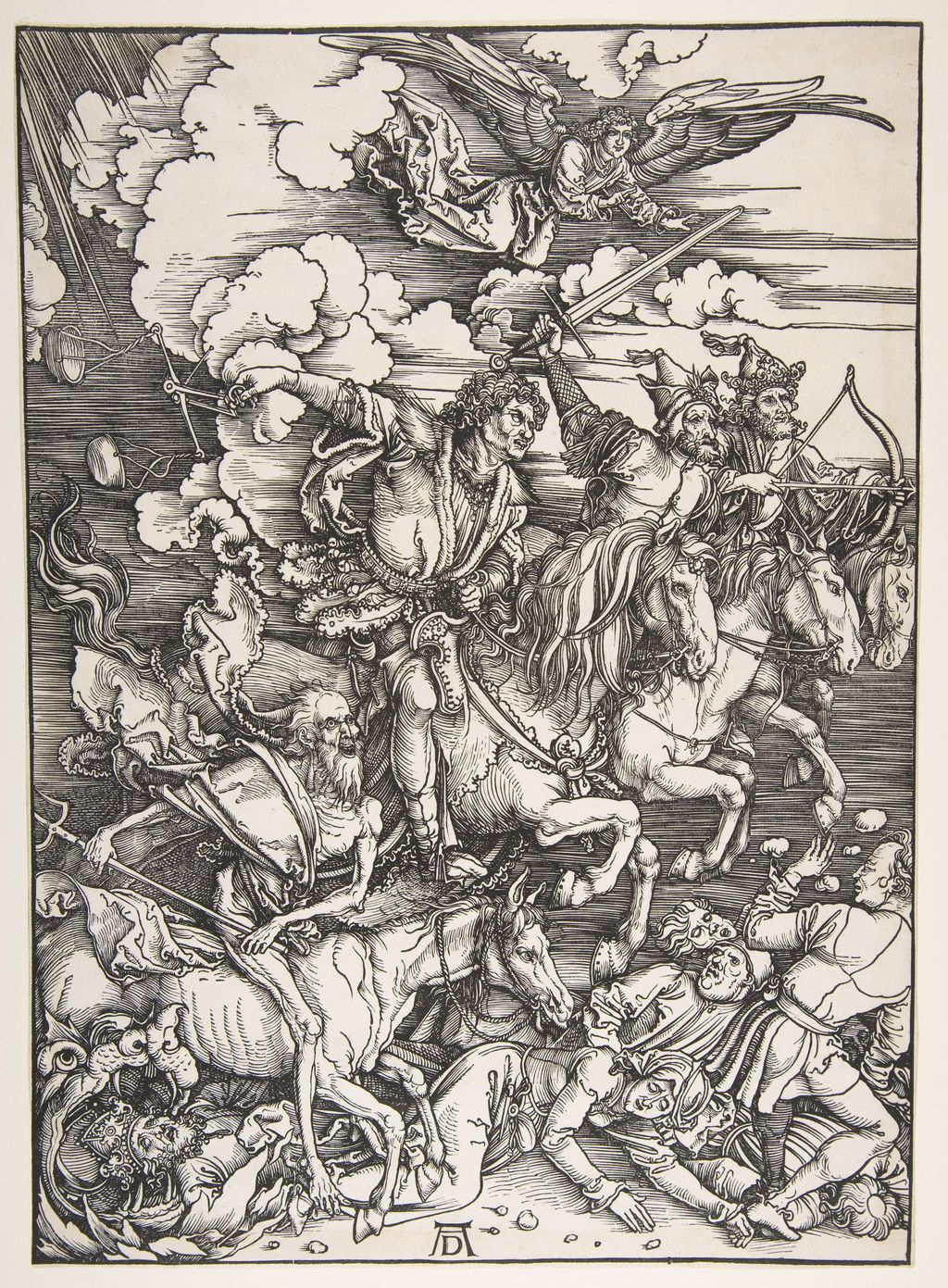
Look at The Four Horsemen and follow the white spaces between the horses. A pale strip separates one neck from another; an open patch makes a falling head legible. Above the riders, broad white clouds interrupt long horizontal strokes. Below them, lines coil around hair, reins and drapery. The scene feels crowded, but it remains possible to disentangle bodies and follow their movement. Dark passages do more than provide outlines: they establish a field against which the smaller white shapes can register. [5]
The comparison with Rhinoceros is revealing. Here the animal stands almost squarely across the page, its head lowered. Large pale compartments cross its flank, while the underside carries much denser hatching. Rings, scales and short curves give neighbouring parts of the body different patterns. The eye can move from the animal's massive outline to the small marks within it. Both images repay viewing first at a distance, then closely; their black-and-white organisation carries the subject before the details become apparent. [5]
Explore selected prints






Engraving, drypoint and etching
Engraving prints from below the surface. A burin pushes a groove into a metal plate; ink held in that groove supplies the printed line. Lippmann illustrates the tool with its handle seated against the palm and its point driven forwards. The hand and plate must cooperate to produce a controlled turn. A dark line on paper is consequently the result of work in metal, even when it looks as fluent as a pen stroke. [3]
Cutting the groove is only part of the operation. The plate is inked, its smooth surface is wiped, and dampened paper is pressed against it. The handbook gives the printer an active role in controlling the distribution of ink. The sheet does not emerge merely because a design exists on the plate: the printer must bring out that design through repeated material decisions. This is one reason an impression deserves attention as an individual object. [3]
In Knight, Death and the Devil , the horse's neck carries a broad pale band. Its fine curved strokes differ from the much tighter marks along the belly and from the broken hatching in the cliff. The knight's shin presents another abrupt transition, from a narrow dark edge to a shining pale centre. Across the image, changes of direction and spacing keep horse, armour and stone distinguishable. Looking for these transitions is often more rewarding than trying immediately to decipher every symbol. In the finished Adam and Eve , the pale bodies stand against tightly worked trees and foliage. The nearer trunks have broad light bands; the cat below the figures is divided into short, dark and pale patches. Compare those marks with the long curls in Eve's hair. Similar black ink and pale paper can establish quite different kinds of surface. [2] [6]
Drypoint begins with a needle scratching metal. It can leave displaced metal, or burr, beside the incision. Retaining that burr changes the printed effect; scraping it away changes it again. The handbook distinguishes this drawn scratch from the burin's pushed cut, while explaining that techniques can be combined on one plate. The Met identifies particularly rich burr effects in the branches and monogram of Dürer's 1512 Saint Jerome by a Pollard Willow . [3] [6] [2]
Etching makes the incision chemically. The artist opens lines through an acid-resistant ground, exposing metal to the biting action. Areas protected by the coating remain protected while the exposed lines deepen. Lippmann describes how further covering and biting can vary the result, and how etched work can subsequently receive engraved or drypoint additions. The familiar family resemblance between old prints can therefore conceal quite different ways of making their marks. [3]
Dürer also worked on iron: Berlin's exhibition identifies The Desperate Man , c.1515, as an iron etching. The Met's Landscape with a Cannon , 19.73.111, is a 1518 etching, first state of three. Its 1984.1201.19 is the third, posthumous state, printed 1600–1680. [8] [9] [2]
A design date does not necessarily date the sheet. [9]
What changes between impressions?
A state is a recognisable stage of the printing surface. Lippmann describes additions and alterations made after a plate has already yielded impressions. Changes need not reconstruct the whole picture: an inscription or publisher's address may distinguish one stage from another. Several sheets can represent the same state, while a later state can preserve most of what was already present. A catalogue's state number belongs to its identification of a specific object. [3]
A proof can preserve an earlier point in the work. By printing the plate before completion, its maker can inspect effects that the metal surface alone cannot fully show. The handbook treats these working impressions as evidence of decisions and development. The opportunity is easy to understand: a passage that looks sufficiently cut on the plate may read differently once transferred to paper. Printing can thus participate in the making of the image, rather than simply following its completion. [3]
The ALBERTINA labels Adam and Eve , DG1930/1450, a unique second trial proof in Meder's system. Its account identifies two unfinished proofs showing successive work on the plate. That designation applies to this trial impression, rather than every reproduction of the finished composition. [10] [2]
An edition concerns a group issued together, or an issue distinguished from earlier and later issues. Getty’s cataloguing guidance cautions that editions can be difficult to identify in older prints: plates were sometimes printed as impressions were needed. It also separates changes of state from differences in the application of ink. Keep the questions distinct when reading a record. “Impression” directs attention to a sheet; “state” to a stage of the matrix; “edition” to an issuing history. More ink does not, by itself, create another state. [11]
The printed AD monogram also belongs to this history of repeatable marks. Lippmann includes monograms, names and dates among the features that can distinguish states. They are marks on the matrix that recur in its impressions. The presence of AD therefore does not imply a separate pen signature on every sheet. A description of an inscription should be read literally before it is treated as evidence of a personal act of signing. [3]
When the print is a book leaf
The Apocalypse appeared in German and Latin in 1498, and again in Latin in 1511 with a new frontispiece. The British Museum also records loose impressions issued without text. Textless does not automatically mean torn from a book. [4] [5]
Shinfuji Atsushi describes the National Museum of Western Art's 1511 Latin set as sixteen sheets: title plus fifteen narratives, including Saint John's martyrdom before fourteen Revelation scenes. Images face printed text. Its Morocco binding is modern, and the leaves retain mounting-hinge traces. Watermarks and other evidence lead Shinfuji to propose a historically coherent set, without establishing original binding. The difference between the set's history and its present binding remains essential to its description. [12]
The Met's 41.1.229 is a 1511 volume combining Apocalypse , Large Passion and Life of the Virgin ; other impressions need not belong to identical assemblies. [13] [14] [5]
The practical question is what the catalogue is describing: an image, a printed leaf, a sequence or a volume. These are related things, but they are encountered differently. On a screen, individual images can appear in any order. In a book, a reader opens, turns and returns through an arrangement of pages. Establishing the surviving object's format helps recover that distinction without assuming that every later binding preserves its first arrangement. [12]
Reading paper and printing
The printer dampens paper so it can receive ink from recessed lines under pressure. The handbook also makes clear that a matrix can be corrected: scraping, burnishing and further cutting can change its surface. The relationship between paper and plate is therefore dynamic. An impression preserves a contact between a prepared sheet, an inked surface and a particular printing operation. [3]
The NGV explains watermarks as thinner areas formed over wire designs in the papermaking mould; chain and laid lines record its structure. Cutting a sheet can separate watermark and countermark; trimming can leave partial marks. Its guidance combines paper evidence with catalogue and provenance research. A missing watermark proves neither an early nor a lifetime impression, and a familiar motif needs comparison rather than an automatic date. [15]
The Pushkin dates the Prodigal Son design c.1496, but its specific impression Г-2097 to the first quarter of the sixteenth century, with no watermark. Other museum impressions receive different proposed dates from combined paper and printing evidence. Those dates cannot be transferred merely because the subjects match. [16]
Lippmann already warned that similar watermarks could occur in papers traded across different regions. His caution is useful for readers too: a recognisable motif does not eliminate the need to identify the paper more closely. A record's confidence and its qualifying words deserve equal attention. “Probably,” “circa” and “this impression” tell us what kind of conclusion the evidence supports. [3]
The Met records recutting of its Samson Rending the Lion block to strengthen the worn image. The ALBERTINA's Rhinoceros , DG1934/509, is Meder's fourth edition: woodcut with letterpress, image 21.2 × 29.6 centimetres, sheet 24.7 × 30. Its account describes Willem Janssen's seventeenth-century addition of a tone block for a chiaroscuro reissue. Reuse could change the printing surface and the image's material presentation. [6] [17] [5]
“Sheet” includes surviving margins; “image” measures the design. “Plate” concerns the metal matrix or its extent. Overall measurements may include a mount or frame. The different image and sheet sizes above show why matching measurement labels matters. [17] [11]
Screen images introduce another distinction. A close photograph can omit the paper beyond the design, and enlarging a small picture changes its apparent scale. Before interpreting a missing margin as physical trimming, establish whether the photograph includes the whole sheet. A digital comparison can prompt useful questions while leaving the physical answers unresolved.
Sales, gifts and exchanges
Rangsook Yoon distinguishes Contz Swytzer's contract of 7 July 1497 from Georg Koler's of 26 July. Both concerned Dürer's woodcuts and engravings; Jacob Arnold's contract followed in 1500. Yoon proposes advance Apocalypse sales as a motive and challenges the idea that Koberger's network was the sole outlet. The agents are documented; the publication-specific motive remains her interpretation. [18]
Dürer's own correspondence brings distribution into the household. In the letter of 6 January 1506, he reckoned the money available to his mother and wife while he was away in Venice. His wife's receipts at Frankfurt formed part of that calculation. The figures appear amid the ordinary obligations of rent, repayment and living expenses. They reveal a business supported by people at home as well as by the artist working abroad. [19]
A letter that spring makes the coordination clearer. He asked Pirckheimer to tell his mother to prepare for sales at Nuremberg's Crown Fair and said that he was arranging his wife's return. He had written to her about the details. The passage preserves instructions, timing and the movement of people: selling pictures required someone to be present when customers arrived. These are specific glimpses of household work. [19]
The Netherlands diary supplies a different setting. At Bamberg in 1520, Dürer presented the bishop with a Madonna painting, a Life of the Virgin , an Apocalypse and engravings. The bishop received him as a guest, paid his inn bill, and provided letters of introduction and a toll pass. Dürer's subsequent entries repeatedly record presenting the pass and being allowed through. Books and sheets had become part of the practical arrangements of a journey. [19]
In Antwerp, Sebald Fischer bought batches of prints: sixteen Small Passions , thirty-two large books, six engraved Passions and assorted sheets. Dürer ended the entry by recording payment. The grouping matters as much as the individual prices. His stock could be sold in quantities, with different formats and subjects included in one transaction. It is a concrete view of repeatable images moving through trade. [19]
Elsewhere, the same diary records his exchange of eight florins' worth of his prints for a set of Lucas van Leyden's engravings. Nearby gifts went to a glass painter, a sculptor and a secretary; a packing case and bags also entered the expenses. Dürer was distributing his own images while acquiring things, rewarding acquaintances and preparing to travel. Prints could pass between artists as objects worth possessing, as well as between seller and customer. [19]
These passages are available in William Martin Conway's 1889 English translation, on pages 47, 52, 93, 97 and 123 respectively. Their valuations and favours belong to the particular exchanges he recorded. They provide no complete balance sheet and cannot simply become a modern price list. What they preserve especially well is the variety of situations in which a print could be useful. [19]
Copies and close looking
Kislykh's Pushkin essay distinguishes copies bearing other makers' marks, altered or reversed versions, and close imitations that complicate attribution. Copying a design and printing again from its matrix describe different relationships. Deception requires further evidence about how an object was presented. A printed monogram alone cannot authenticate a sheet. [16]
Read “after Dürer” together with the named maker, medium and date. An accession identifies the museum item; a catalogue number connects it with a classified work or version. A collection credit describes an acquisition relationship and need not supply the object's entire earlier history. These fields are most useful when read together, rather than letting a familiar title or monogram settle every question. [16]
Then return to the image. In Saint Jerome in His Study , the ovals of window light cross the wall beside the seated scholar. The small crucifix rises above the desk; the lion's huge paws rest near the lower edge. Furniture, animals and working figure occupy different distances, but the lines bring them into one room. Step back, then look closely again. A print rewards both the understanding of its particular material history and the renewed experience of seeing what its marks can do. [2]
Frequently Asked Questions
Artworks directory
These 187 records include individual works, reverse sides, detail views, paired panels and reconstructed arrangements. Three additional catalogue images repeat works already listed. Related views are not counted as separate originals; qualified attributions and published dating are retained.
Discussion
Look again at the images and ideas explored in Albrecht Dürer Prints. These editorial prompts invite your observations.
Reader Insights
Which detail or idea in Albrecht Dürer Prints most changed your reading, and why?
How does the discussion of “Woodcut: a surface left standing” affect your understanding?
What comparison would you bring to the discussion of “Copies and close looking”?
Join the Conversation
Share a detail, comparison or question about Albrecht Dürer Prints below.
References
- S. R. Koehler, A Chronological Catalogue of the Engravings, Dry-Points and Etchings of Albert Dürer, as Exhibited at the Grolier Club (New York: Grolier Club, 1897), p. 5, cat. 5. English. View source.
- S. R. Koehler, A Chronological Catalogue of the Engravings, Dry-Points and Etchings of Albert Dürer, as Exhibited at the Grolier Club (New York: Grolier Club, 1897), selected entries: 5 (p. 5), 14 (p. 14), 16–17 (pp. 17–18), 32–33 (pp. 32–35), 34 (pp. 37–38), 35 (p. 42), 38 (p. 44), 55 (p. 51), 65 (p. 55), 69–70 (pp. 58–61), 71 (p. 63), 89 (p. 77), 95 (p. 81). English. View source.
- Friedrich Lippmann , Engraving and Etching: A Handbook for the Use of Students and Print Collectors , revised by Max Lehrs, translated by Martin Hardie (New York: Charles Scribner's Sons, 1906), pp. 1–5, 10–15. English. View source .
- British Museum, Saint Michael Fighting the Dragon, 1895,0122.554, including Giulia Bartrum’s 2002 exhibition catalogue (descriptive citation), London: British Museum Press, cat. 57. English. View source.
- Campbell Dodgson, Catalogue of Early German and Flemish Woodcuts Preserved in the Department of Prints and Drawings in the British Museum, vol. 1 (London: British Museum, 1903). Original English edition Selected pp. 246, 260, 262, 272, 274, 288, 290, 294–296, 299–300, 302, 307. Additional selected introduction p. 3. View source.
- Suzanne Boorsch and Nadine M. Orenstein, a study of northern European prints (descriptive citation), Metropolitan Museum of Art Bulletin 54, no. 4 (New York: Metropolitan Museum of Art, Spring 1997), pp. 3–12, 25, 35. English. View source.
- British Museum, Entombment block, 1839,0608.3.44, including Giulia Bartrum’s 2002 catalogue block history (descriptive citation), cat. 115. English. View source.
- Berlin Kupferstichkabinett/Freie Universität , Albrecht Dürer – 500 Jahre Meisterstiche , Der Verzweifelnde . German. View source .
- Metropolitan Museum , Landscape with a Cannon : 19.73.111; 1984.1201.19. English. View source 1 . View source 2 .
- ALBERTINA , Adam und Eva , DG1930/1450, including the 2003 catalogue essay. German/English. View source .
- Getty Research Institute, “State”, “Edition” and “Measurements”, Categories for the Description of Works of Art, revised by Emily Benoff: “State” and “Edition”, 4 January 2024; “Measurements”, 21 December 2023, general discussion and sections 6.1, 6.5 and 6.7. English. View source 1. View source 2. View source 3.
- Shinfuji Atsushi , “Albrecht Dürer, Apocalypsis cum figuris”, Annual Bulletin of the National Museum of Western Art 55 (2022), pp. 12–14. Japanese/English. View source .
- Metropolitan Museum , The Life of the Virgin, Great Passion, and Apocalypse , 41.1.229. English. View source .
- Albrecht Dürer and Benedictus Chelidonius, Epitome in Divae Parthenices Mariae Historiam ab Alberto Durero Norico per figuras digestam cum versibus annexis Chelidonii (Nuremberg: Albrecht Dürer, 1511); Vatican Library, Cicognara.IX.2022, scans 7–46, including all twenty designs, facing texts and final imprint. Latin. View source.
- National Gallery of Victoria , “Watermarks in the NGV's Collection of Prints by Albrecht Dürer”. English. View source .
- Pushkin Museum , Prodigal Son , Г-2097; G. Kislykh, “Albrecht Dürer and His Prints”. English translations; Russian originals. View source 1 . View source 2 .
- ALBERTINA , Rhinocerus , DG1934/509. German/English. View source .
- Rangsook Yoon , “Distribution and Sales of Dürer's Apocalypse”, author's online version; Gutenberg-Jahrbuch 85 (2010), pp. 138–142. English. View source .
- William Martin Conway, Literary Remains of Albrecht Dürer (Cambridge: University Press, 1889), letters, diary and family chronicle, selected pp. 34–35, 37, 40–41, 47, 51–52, 93, 97, 122–123. English translation from German; manuscript transcripts and notes by Lina Eckenstein. View source.
- Charles Ephrussi, Albert Dürer et ses dessins (Paris: A. Quantin, 1882), selected pp.2,14–16,20,78–80,107,109,120,153,178,188,298,302; index pp.399,403,405–406,409–410; additional selected pp. 86, 111–112, 152, 158 (footnote 1) and 202. Original French edition. View source.
- T. Sturge Moore, Albert Dürer (London: Duckworth and Co.; New York: Charles Scribner’s Sons, 1905), part III, portrait discussion and caption of the 1500 Munich self-portrait; additional selected Part III, II Portraits, subsection III, Hans Tucher paragraph. Original English edition. View source.
- National Gallery of Art, Annual Report 1974 (Washington: National Gallery of Art, 1975), p. 23; title and copyright pages. English. View source.
- Maud Cruttwell, Andrea Mantegna, London: George Bell and Sons, 1901, pp. 110–112. View source.
- Hermann Knackfuß, Dürer, 12th edition (Bielefeld and Leipzig: Velhagen & Klasing, 1921), printed pp. 19–20, 24–26, 45–46, 58–60 and 138; plates 22, 30, 36 and 61. Original German edition. View source.
- Heinrich Wölfflin, Die Kunst Albrecht Dürers, second enlarged edition (Munich: F. Bruckmann, 1908), pp. 110, 298. Original German edition. View source.
- Joachim von Sandrart, L’Academia Todesca della Architectura, Scultura & Pittura: oder Teutsche Academie der Edlen Bau- Bild- und Mahlerey-Künste (Nuremberg, 1675), II, book 3, p. 224; facsimile and transcription. View source 1. View source 2.
- Moriz Thausing, Dürer: Geschichte seines Lebens und seiner Kunst (Leipzig: E. A. Seemann, 1876). Original German edition Selected pp.303, 306, 308–309. View source.
- Burlington Fine Arts Club, Exhibition of Early German Art (London: Burlington Fine Arts Club, 1906). Original English catalogue P.24, no.38. View source.
- Albrecht Dürer, Records of Journeys to Venice and the Low Countries, edited by Roger Fry, translated by Rudolph Tombo (Boston: Merrymount Press, 1913), pp. 62–65. English translation from German. View source.
- Germanisches Nationalmuseum, Katalog der im Germanischen Museum befindlichen Gemälde (Nürnberg: Verlag des Germanischen Museums, 1893), pp.34–35, nos.206–209. Original German catalogue. View source.
- Moriz Thausing, Albert Dürer: His Life and Works, translated from German, edited by Fred. A. Eaton, vol. II (London: John Murray, 1882), pp. 16–18. Original English edition. View source.
- Moriz Thausing, Albert Dürer: His Life and Works, translated from German, English edition edited by Fred. A. Eaton, vol. I (London: John Murray, 1882), pp. 119–120. Historical English edition. View source.
- Heinrich Weizsäcker, Catalog der Gemälde-Gallerie des Städelschen Kunstinstituts in Frankfurt am Main, Erste Abtheilung: Die Werke der älteren Meister vom vierzehnten bis zum achtzehnten Jahrhundert (Frankfurt am Main: Druckerei von August Osterrieth, 1900), nos. 83 and 85, pp. 91–98. Original German edition. View source.
- Joseph Heller, Das Leben und die Werke Albrecht Dürer's, vol. II, part 1 (Bamberg: C. F. Kunz, 1827), p. 118, no. 138; pp. 160–162, Florence entry 13; pp. 196–197, Munich entry 17; additional selected pp. 230–231, no. 6 and p. 260, entry e. Original German edition. View source.
- Hans W. Singer, Drawings of Albrecht Dürer (London: G. Newnes; New York: C. Scribner’s Sons, 1906), p. 8; Little Owl (Schönbrunner and Meder no. 829). Original English edition. View source.
- “Ein wiederaufgefundenes Gemälde von Albrecht Dürer”, Hamburgischer Correspondent, no. 473, Abend-Ausgabe (9 October 1900), p. 5, centre column (German). View source.
- Stijn Alsteens and Freyda Spira, with Maryan W. Ainsworth, Dirk H. Breiding, George R. Goldner, Guido Messling, Marjorie Shelley and Joshua P. Waterman, Dürer and Beyond: Central European Drawings in The Metropolitan Museum of Art, 1400–1700 (New York: Metropolitan Museum of Art; New Haven and London: Yale University Press, 2012), p. 15, fig. 2, Three Studies of a Left Hand, ALBERTINA 26327. English. View source.
- Johann Carl Sigmund Kiefhaber, ed., Nachrichten zur ältern und neuern Geschichte der freyen Reichsstadt Nürnberg: ein Beytrag zur Geschichte der Reichsstädte in Teutschland, vol.1 (Nuremberg: Lechner, 1803), first quarter, pp.6–9,14–16. Original German historical edition of correspondence and inventory. View source.
- Friedrich Winkler, Die Zeichnungen Albrecht Dürers, II (Berlin: Deutscher Verein für Kunstwissenschaft, 1937), no. 357, pp. 73–74. German. View source.
- The Metropolitan Museum of Art, Handbook of the Benjamin Altman Collection, with painting descriptions by Bryson Burroughs, other object descriptions by Durr Friedley and William M. Milliken, and introduction by Edward Robinson (New York: The Metropolitan Museum of Art; printed by The Gilliss Press, November 1914), no. 32, pp. 50–52; staff credits, pp. xiv–xv. Original English edition. View source.
- Germanisches Nationalmuseum, Barbara Dürer (German and English). View source.
- Web Gallery of Art, Tucher–Rieter reverse (English). View source.
- National Gallery of Art, Portrait of a Clergyman, object 1952.2.17 (English). Associated catalogue: John Oliver Hand, with the assistance of Sally E. Mansfield, an illustrated collection catalogue of late medieval and early modern German painting (descriptive citation) (Washington: National Gallery of Art, with Cambridge University Press, 1993), pp. 61–66. View source.
- Dürer Art, Portrait of a Man (English). View source.
- Hessen Kassel Heritage, Elsbeth Tucher (German). View source.
- Web Gallery of Art, Hans Tucher (English). View source.
- Germanisches Nationalmuseum, Emperor Maximilian I (German and English). View source.
- National Gallery of Art, Lot and His Daughters, reverse (English). View source.
- Bayerische Staatsgemäldesammlungen, Glim Lamentation (German). View source.
- Museo Nacional del Prado, Portrait of a Man (Spanish). View source.
- Bayerische Staatsgemäldesammlungen, Madonna of the Carnation (German). View source.
- Städel Museum, Job on the Dungheap (German). View source.
- Wallraf-Richartz-Museum, Piper and Drummer (German). View source.
- Italian Ministry of Culture / Uffizi, Head of Saint James (Italian). View source.
- Klassik Stiftung Weimar, Dresden Altarpiece (German). View source.
- Staatliche Museen zu Berlin, (entry description) collection record for painting 557I (1507), object 870760 (German and English). View source.
- Dresden State Art Museums / Roland Enke, Bernhard von Reesen (German). View source.
- Royal Collection Trust, Burkhard von Speyer (English). View source.
- Dresden State Art Museums, Seven Sorrows of the Virgin (English). View source.
- Bayerische Staatsgemäldesammlungen, Mater Dolorosa (German). View source.
- Bayerische Staatsgemäldesammlungen, Lucretia (German). View source.
- Städel Museum, Young Woman with Her Hair Down (English). View source.
- ALBERTINA, Portrait of a Young Man (German). Embedded essay credited to Eva Michel, no. 48, p. 98, fig. 48, in Sabine Haag, Christiane Lange, Christof Metzger and Karl Schütz (eds.), Dürer – Cranach – Holbein. Die Entdeckung des Menschen: Das deutsche Porträt um 1500 (Munich: Hirmer, 2011), inv. 3122. View source.