 by Tom Gurney
Tom Gurney BSc (Hons) is an art history expert with over 20 years experience
Published on June 19, 2020 / Updated on November 6, 2025
Email: tomgurney1@gmail.com / Phone: +44 7429 011000
Michelangelo and the Sistine Chapel
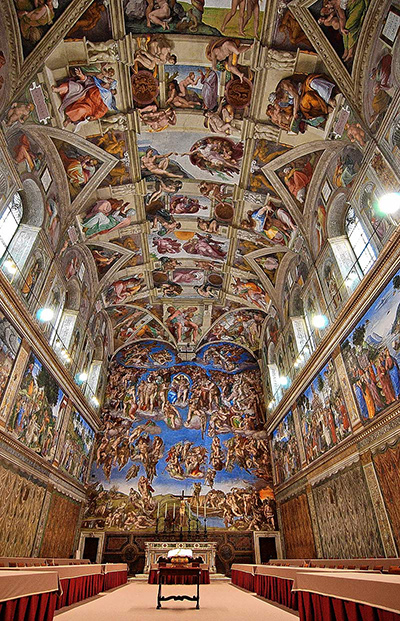
The Sistine Chapel asks the eye to do more than seems possible. Stories unfold along the walls. Painted prophets and sibyls turn enormous books beneath the curve of the vault. Families gather in the shallow spaces above the windows. Nude youths sit on ledges that do not exist. At the centre of the ceiling, God divides light from darkness, reaches toward Adam and drives creation forward; on the altar wall, more than twenty years later, Christ brings history to its end. The room is full of different times at once.
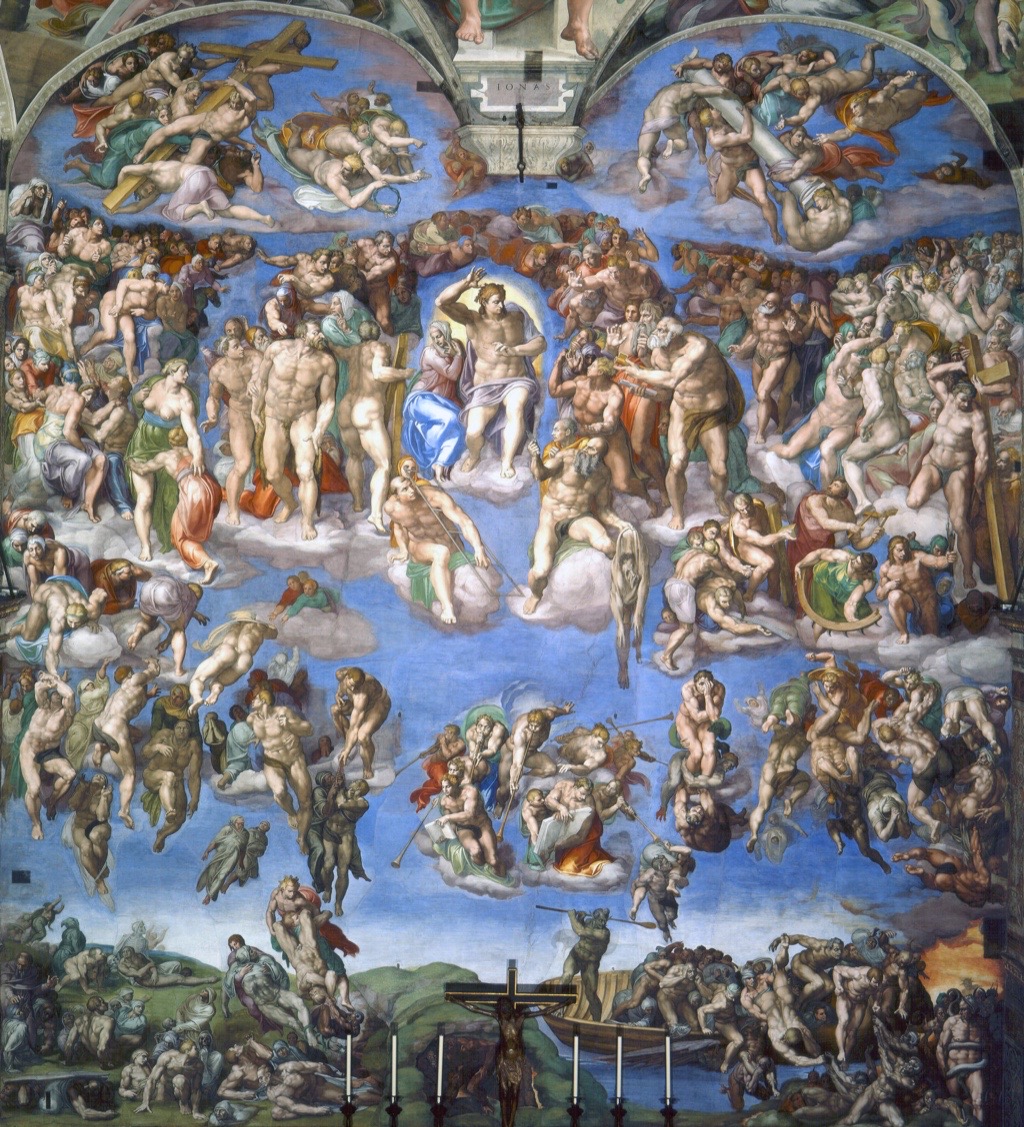
Michelangelo is responsible for the two interventions that dominate modern memory: the ceiling, painted between 1508 and 1512, and The Last Judgment, painted from 1536 to 1541. He did not build the chapel or paint all its decoration. The walls already carried a magnificent fifteenth-century cycle by Perugino, Botticelli, Ghirlandaio, Rosselli and their collaborators when Pope Julius II asked him to replace the damaged starry vault. Understanding the chapel begins with that layered history. Michelangelo entered an existing sacred and ceremonial room, transformed it twice, and left the work of earlier artists visible around his own.[1]
At a Glance
- LocationFirst floor of the Papal Palace, Vatican City
- DedicationOur Lady of the Assumption
- Rebuilding under Sixtus IV1477–1480
- DimensionsApproximately 40.23 metres long, 13.40 metres wide and 20.70 metres high
- Fifteenth-century decorationParallel wall histories of Moses and Christ, papal portraits, painted hangings and an original starry ceiling
- Michelangelo's ceiling commissionPope Julius II, contract signed 8 May 1508
- Ceiling completed31 October 1512; Mass celebrated beneath it on 1 November
- Central ceiling sequenceNine episodes from Genesis
- Other ceiling familiesSeven prophets, five sibyls, ancestors of Christ, four pendentive narratives, ignudi and medallions
- Altar-wall commissionBegun under Clement VII and continued under Paul III
- *The Last Judgment*Painted 1536–1541
- Current functionPapal ceremonial chapel and setting of papal conclaves
- Recent conservationExtraordinary maintenance of The Last Judgment, 1 February–27 March 2026[2][3][4]
Contents
- A Room Made Before Michelangelo
- The Stories Already Facing One Another
- Why Julius II Repainted the Ceiling
- Painted Architecture Across a Curved Vault
- Scale, Light and the Long Axis
- The Nine Stories of Genesis
- Prophets and Sibyls: Twelve Forms of Expectation
- Ancestors in the Margins
- Pendentives: Deliverance at the Four Corners
- The Ignudi and Medallions
- Fresco as a Daily Commitment
- A Design That Learned as It Grew
- Returning to Paint the End of Time
- Nudity, Covering and Alteration
- Restoration and the Return of Colour
- The Chapel as a Space of Looking
- Artist Up Close
- Why the Sistine Chapel Still Feels Unfinished
Watch: Ceiling of the Sistine Chapel
This focused video introduces the ceiling's Genesis sequence, prophets, sibyls and painted architecture.[14]
“My beard turns up to heaven...”
Michelangelo’s comic poem makes the labour of the ceiling vivid: aching body, bent posture and dry humour rather than later myth.
Annotated Details from the Sistine Chapel Ceiling
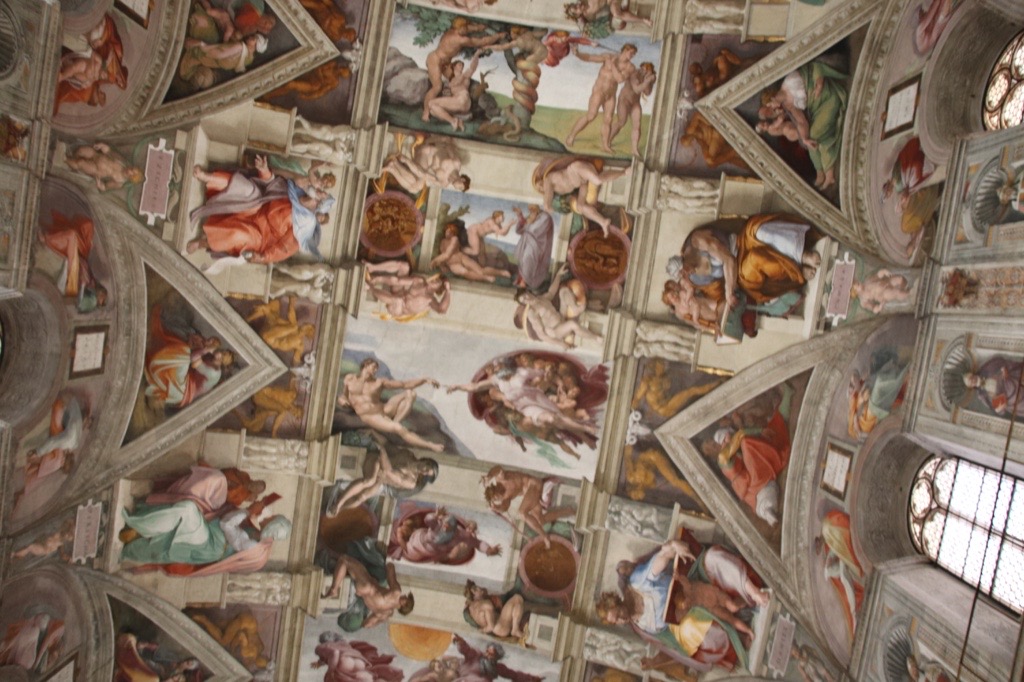
The annotated ceiling view helps readers locate the main narrative spine, surrounding figures and painted architecture that organise Michelangelo’s vast ceiling programme.[16]
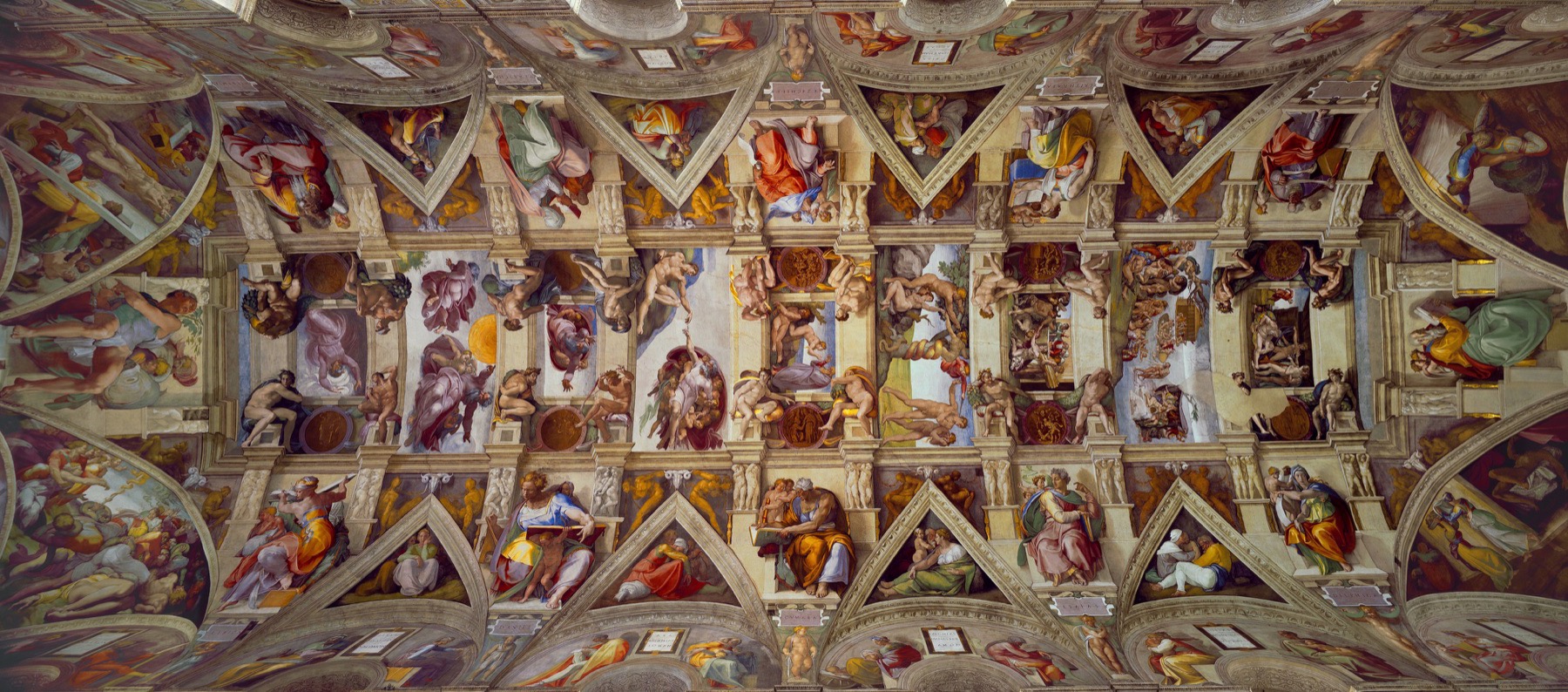
Details from THE SISTINE CHAPEL CEILING
Close looking turns the ceiling’s enormous painted programme into a readable sequence of figures, scenes and painted architecture.
Central Genesis spine
The central panels run along the vault and give the ceiling its narrative axis from Creation to Noah.
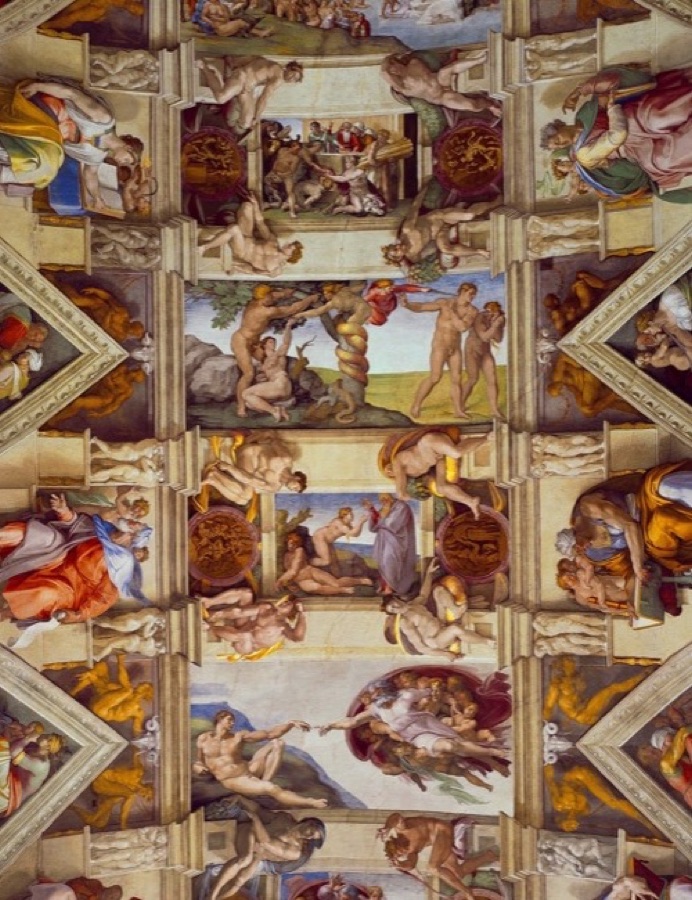
Prophets and Sibyls
The prophets and sibyls occupy the larger seated positions around the central field, enlarging the ceiling’s theological frame.
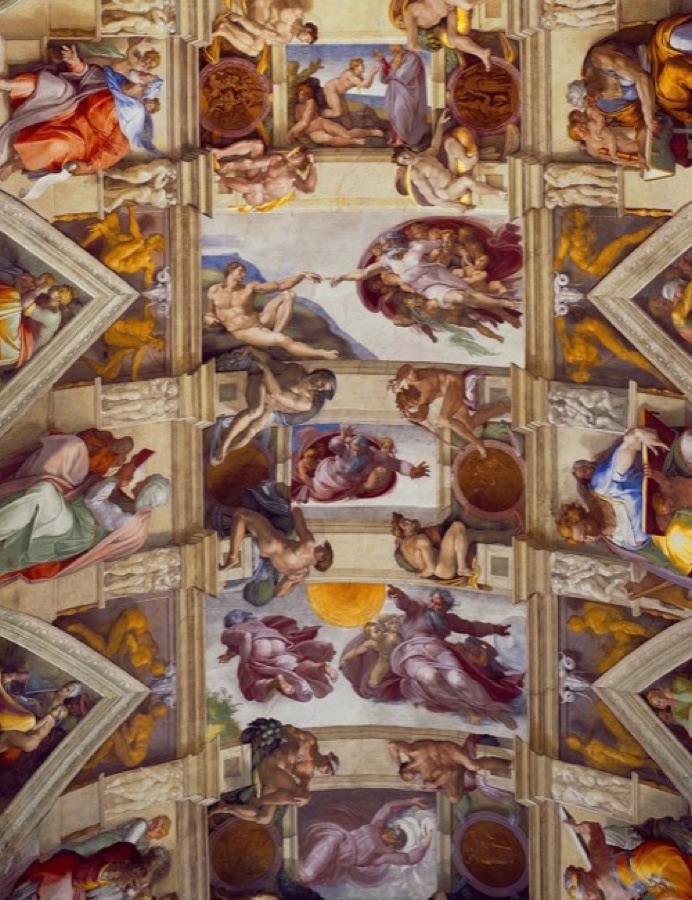
Ignudi and medallions
Ignudi and medallions create rhythm and tension between narrative scenes and ornamental support figures.
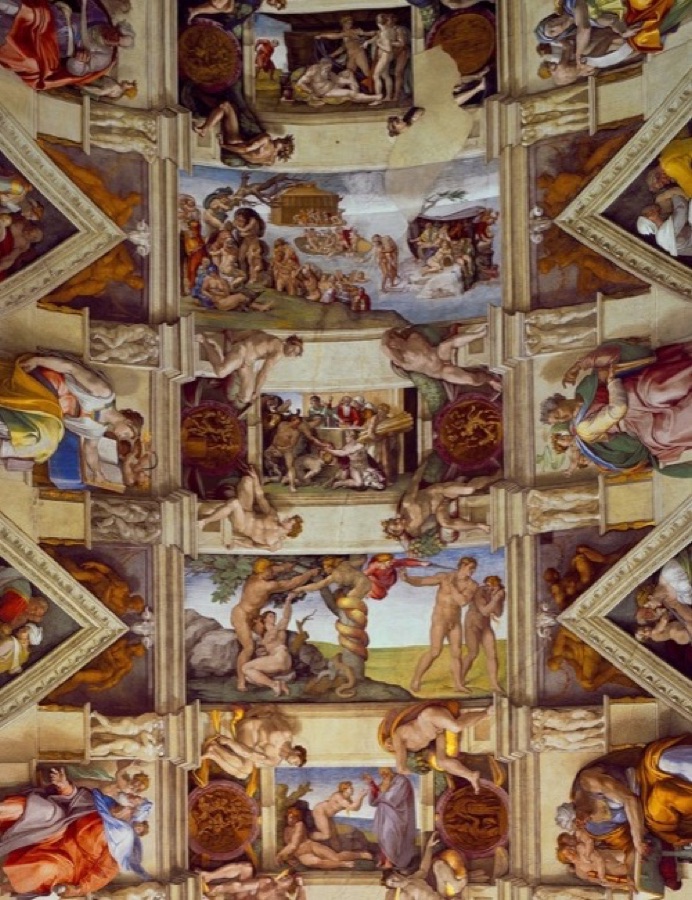
Painted architectural frame
Painted architecture divides the vault into legible zones while making the flat surface feel monumental.
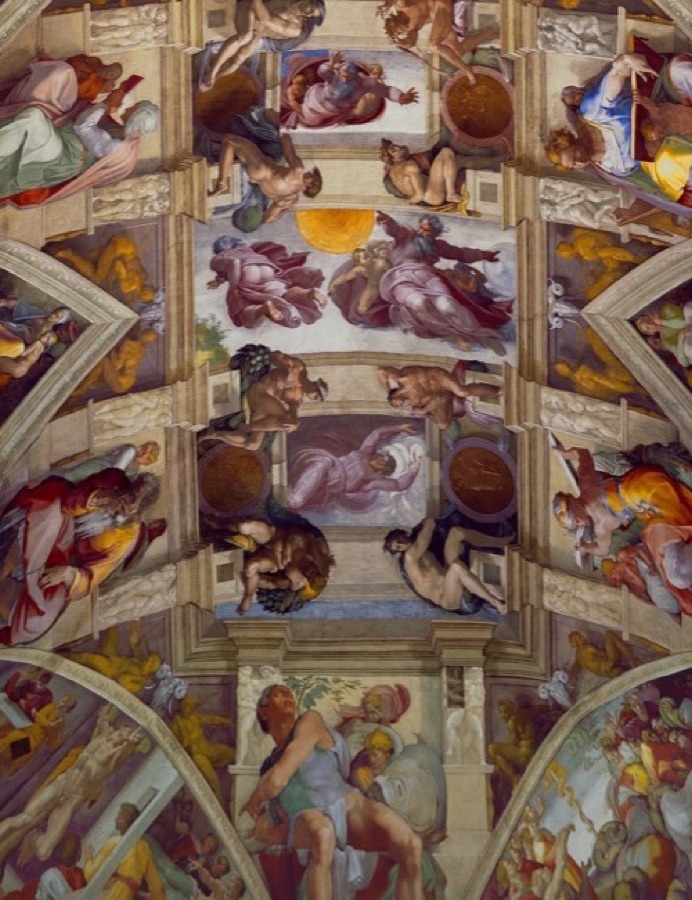
A Room Made Before Michelangelo
The chapel took its present name from Sixtus IV della Rovere. Between 1477 and 1480, the older Cappella Magna was rebuilt as a long, high rectangular space within the Papal Palace. The Holy See associates the work with Giovannino de' Dolci and Baccio Pontelli. Its proportions—about three times as long as it is wide—encourage processional movement and divide the congregation along a strong longitudinal axis. Windows high in the side walls illuminate a room whose vault rises more than twenty metres above the floor.[3]
Decoration followed swiftly. In 1481 and 1482, a team of leading painters covered the long walls with corresponding narratives from the lives of Moses and Christ. Perugino, Botticelli, Ghirlandaio and Cosimo Rosselli worked with workshops and collaborators that included Pinturicchio, Luca Signorelli, Bartolomeo della Gatta and Biagio d'Antonio. Above the narratives ran a sequence of early popes; below them were painted curtains. Pier Matteo d'Amelia gave the vault a blue sky scattered with golden stars.[1]
The parallel wall histories were designed to be read across the chapel as well as along it. Episodes from the life of Moses faced events from the life of Christ, joining the old law to the new. Papal portraits above the narratives extended this account into the government of the Church. Michelangelo's later work did not erase this structure. Even when the ceiling and altar wall seize attention, the fifteenth-century walls remain essential to the room's original argument.
Sixtus IV consecrated the chapel to the Assumption of the Virgin on 15 August 1483. It was never merely a decorated chamber. It hosted papal liturgy and ceremony, and its dimensions, screens, altar and entrances served those functions. Since 1878 it has been the regular location of papal conclaves, though several elections had taken place there earlier. During a conclave, the chapel becomes one of the most consequential working rooms in the Catholic Church. Its familiar images surround an event that is private, ritualised and directed toward a public result.[3]
This continuing use changes the way the art exists. The frescoes have become museum masterpieces, yet they still belong to an active chapel. Visitors see them within architecture made for worship, procession and government. The altar is not a display pedestal, and the spatial pull toward it long preceded Michelangelo's immense painting above it.
The Stories Already Facing One Another
The older wall cycle established a disciplined correspondence. Scenes from the life of Moses run along one side and scenes from the life of Christ along the other. The arrangement brings actions under the old covenant into relation with actions under the new: leadership, law, testing, vocation and the transfer of authority can answer one another across the room. The architecture does not force a visitor to follow only one line. Looking sideways becomes a method of interpretation.
Perugino's Delivery of the Keys is among the best-known survivors. Christ gives keys to Peter in a broad, ordered space whose paving directs the eye toward an ideal church. The scene contributes to a sequence concerned with Christ's authority and its continuation. Across the chapel, episodes from Moses establish leadership and law in the history of Israel. The papal portraits above bind this parallel structure to the succession of the Church.
Other scenes produce more turbulent correspondences. Botticelli's Punishment of the Rebels and Temptations of Christ distribute several moments across continuous landscapes. Ghirlandaio's Calling of the First Apostles uses water, shore and gathering crowds to turn vocation into public movement. Rosselli's Last Supper and Descent from Mount Sinai organise sacred law and ritual within complex groups. Their visual language differs from Michelangelo's later concentration on monumental bodies, but the comparison is part of the chapel's effect rather than an old style merely awaiting replacement.[1]
Michelangelo's ceiling revised the vertical relation among these zones. Above the papal portraits and paired wall narratives, the lunettes introduced the ancestors of Christ. Genealogy now mediated between the institutional succession below and the prophets, sibyls and creation histories above. The ceiling did not simply add more biblical illustrations; it gave the existing walls a new upper horizon of ancestry, foretelling and origin.
The altar wall later disrupted the symmetry more dramatically. Before The Last Judgment, Perugino's Assumption of the Virgin stood at the liturgical focus, fitting the chapel's dedication. Nearby were the opening episodes of the Moses and Christ histories. Their removal meant that the parallel wall cycles no longer began as originally designed. The immense final event replaced both beginnings and the Marian altarpiece.[1]
That change makes the surviving walls poignant. They testify to an earlier complete conception while participating in the transformed one. Michelangelo's judgement scene seems to gather the histories toward itself, yet its authority depends partly on the works it interrupted. The chapel holds not just successive styles but successive decisions about what sacred history should look like in the same room.
Why Julius II Repainted the Ceiling
The immediate cause of Michelangelo's first intervention was physical damage. A long crack appeared in the vault in May 1504, probably connected with building activity around the chapel. Bramante, architect of the papal palace, installed tie rods above it. The old starry decoration had suffered, and Julius II eventually decided on a new scheme.[2]
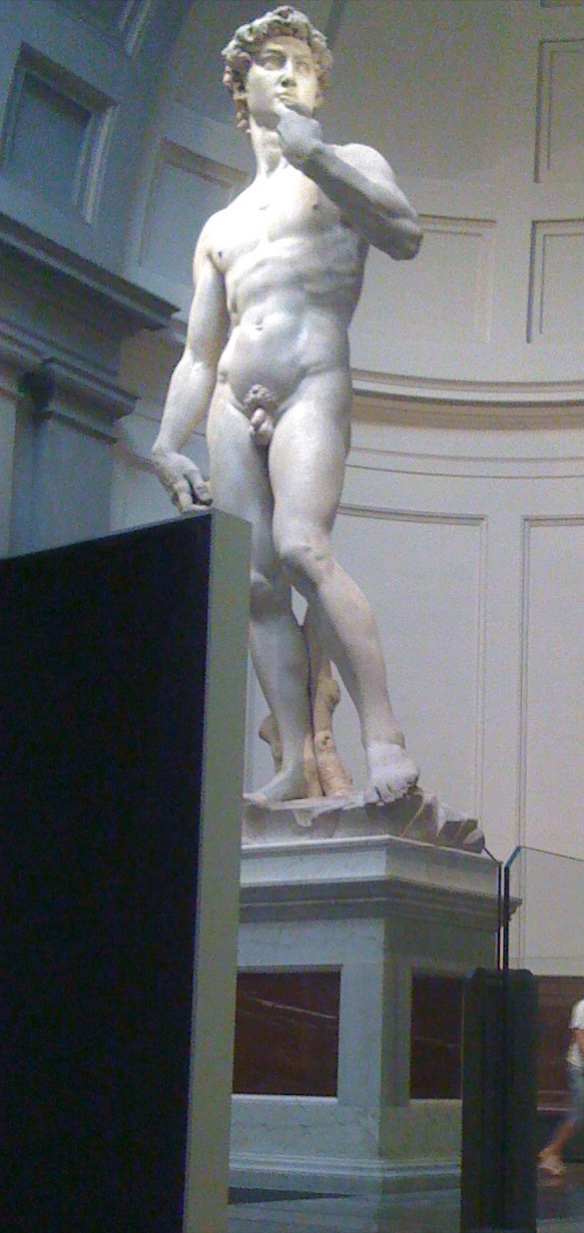
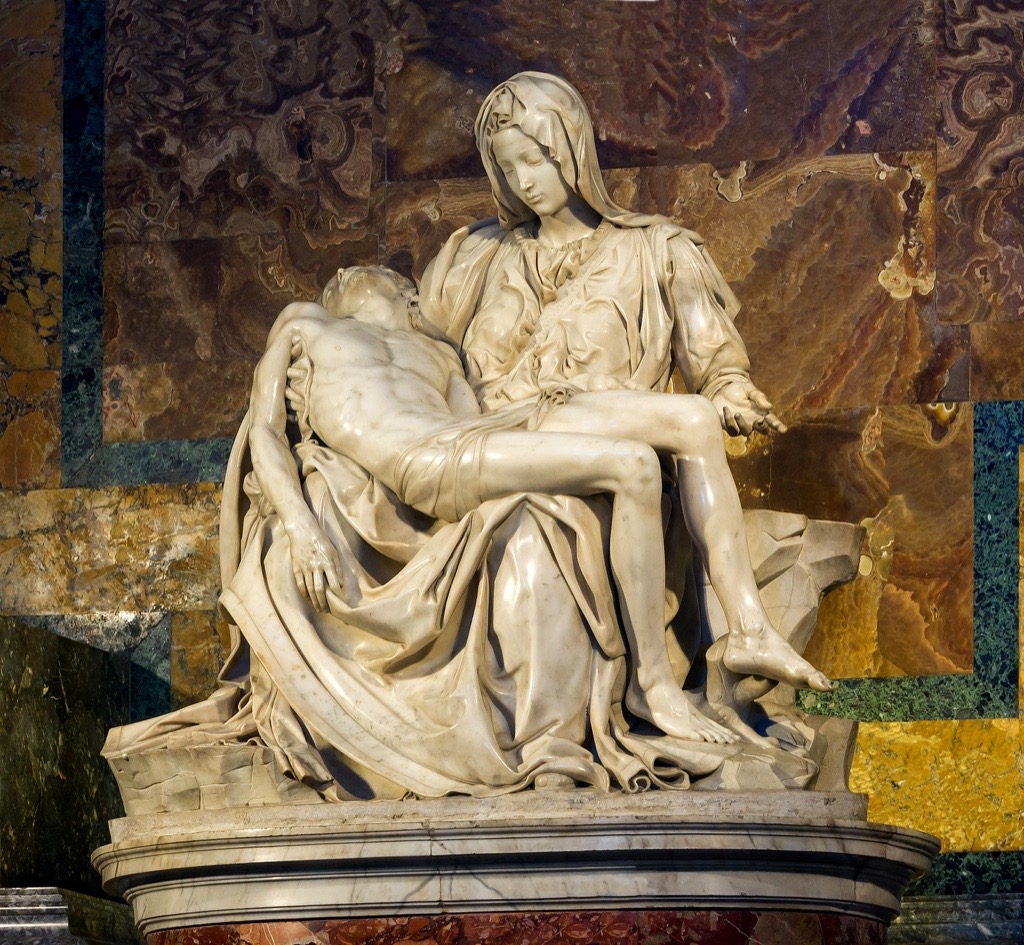
Michelangelo was already celebrated as a sculptor. The Pietà in St Peter's and the colossal David in Florence had established his ability to make marble bodies carry tenderness, tension and public meaning. A vast frescoed vault, however, presented a different set of problems: curved architecture, distant viewpoints, wet plaster, large teams of practical workers and a programme that had to converse with a revered existing chapel.
On 8 May 1508 he signed a contract for a comparatively modest design. Twelve apostles were to occupy the pendentives, with ornament filling much of the remaining surface. Michelangelo objected that the proposal was too meagre. The surviving ceiling belongs to an expanded commission in which he gained much greater responsibility for the programme, probably in consultation with theologians of the papal court.[2] The qualification matters: the intellectual scheme is extraordinarily coherent, but no surviving document names a committee that dictated every figure and relationship.
The project was interrupted and developed as it proceeded. The Vatican Museums record that Michelangelo completed the first half, from the entrance wall to the Creation of Eve, by August 1510. Work then resumed toward the altar end. The ceiling was complete by 31 October 1512, and Julius celebrated Mass in the chapel on All Saints' Day.[2]
Those milestones reveal a campaign rather than a single feat performed in continuous isolation. Design, plastering, transfer and painting advanced by sections. The pause made part of the ceiling visible from below and gave Michelangelo an opportunity to judge what worked at the room's immense distance. Changes in the later portions suggest that he responded decisively: figures grew larger, compositions became less crowded and gestures carried farther.
Painted Architecture Across a Curved Vault
The ceiling's first achievement is to make a difficult surface legible. Michelangelo did not treat the vault as an open sky. He created a fictive architectural system of cornices, piers, thrones, ledges, frames and sculptural supports. None of these forms is built in stone, but their painted shadows and projections divide the surface so persuasively that the eye accepts them as a structure.[5]
At the summit runs the central spine of nine Genesis histories. Alternating larger and smaller fields are bordered by seated nude youths, medallions and simulated marble figures. Around this core, seven Hebrew prophets and five ancient sibyls occupy monumental thrones. Below them, in lunettes and triangular spandrels, groups associated with the ancestors of Christ inhabit compressed domestic spaces. The four corners expand into pendentives containing narratives of Israel's deliverance.[2][5][6][7]
This hierarchy lets different kinds of time coexist. The Genesis pictures narrate beginnings. Prophets and sibyls anticipate what is to come. The ancestors extend genealogy through generations of waiting. The pendentives show mortal threats overcome. The pre-existing wall cycles relate Moses to Christ, while the later altar wall declares the last judgement. The chapel becomes an arc from creation to the end of time, though that arc was assembled through separate commissions under different popes.
The painted architecture also manages bodily scale. A figure that appears monumental from the floor may occupy a small part of the actual vault. Michelangelo enlarged heads, limbs and gestures so they would remain intelligible at a distance. Seated figures twist beyond the apparent depth of their thrones. Limbs cross painted frames, turning the architecture into something bodies can press against or exceed.
Looking from below creates unavoidable distortions. The eye cannot take in the entire ceiling frontally; it moves, tilts and reorients. Michelangelo exploited this mobile attention. Repeated thrones establish rhythm, while variations in pose interrupt it. Alternating panel sizes slow and accelerate the central sequence. The whole design is ordered, but it never becomes mechanically regular.
Scale, Light and the Long Axis
The chapel's measurements are facts, but Michelangelo turns them into an experience. At roughly 40.23 metres long and 20.70 metres high, the room creates two very different distances: the horizontal journey toward the altar and the vertical reach toward the vault.[3] The ceiling must govern both. It has to unfold as a sequence along the length while remaining forceful through more than twenty metres of air.
Natural light enters through the upper side windows, below much of the vault. It crosses the painted surface obliquely and changes with hour and weather. Michelangelo's fictive architecture answers that real illumination with painted highlights and shadows, creating projections that remain intelligible even as actual light shifts. Simulated marble, bronze, cloth, paper, hair and flesh occupy the same plaster but respond differently in paint.
The windows also interrupt the walls rhythmically. Above them, the lunettes turn architectural openings into genealogical spaces. Between and above those lower zones, prophets and sibyls establish another, slower rhythm. The central histories then alternate large and small fields at the summit. What looks from a reproduction like one crowded rectangle is a sequence of nested tempos fitted to the room.
The long axis culminates at the altar. In the ceiling programme, Jonah sits above that end, while the first acts of Genesis occupy the nearby central fields. After the 1530s, The Last Judgment made the same destination visually overwhelming. Approaching the altar thus brings beginning and ending into increasing proximity: creation overhead and final judgement ahead.
The entrance end produces the opposite experience. Noah's troubled histories lie closest above, and Zechariah reads near the threshold. A visitor who turns back from the altar can see the sequence disperse from cosmic action toward densely inhabited scenes. Michelangelo did not create a single direction that cancels the other. The chapel can be read as an advance or a return.
Modern electric lighting creates a more even field than Michelangelo knew. It allows colour and detail to remain visible, yet it can make the frescoes seem independent of changing daylight. The conservation systems discussed by the Vatican Museums balance visibility with heat, ultraviolet exposure and environmental stability.[14] Looking conditions are therefore part of the work's continuing care, not a neutral addition outside its history.
Scale also explains why photographic familiarity can be deceptive. A book may reproduce Jeremiah, an ignudo and a small Genesis panel at similar dimensions, erasing the hierarchy Michelangelo built. In the chapel, bodily size, architectural placement and distance tell viewers what kind of figure they are seeing before an attribute or title is recognised.
The Nine Stories of Genesis
The central histories are divided into three groups. Closest to the altar are acts of cosmic creation: the Separation of Light from Darkness, the Creation of the Sun, Moon and Plants, and the Separation of Land from Sea. The middle group concerns human creation and the Fall: Adam's creation is followed by Eve's, then by the double episode of Original Sin and Banishment from the Garden of Eden. Noah's family occupies the entrance end, where sacrifice, deluge and the patriarch's drunkenness form the final triad.[5]
The sequence is most clearly understood from the altar toward the entrance, but viewers entering the chapel encounter it in the opposite direction. That reversal is expressive. From the doorway, the first panels are crowded, earthly and troubled. Passing toward the altar, human disorder gives way to the creation of humanity and then to the solitary force of God moving through the universe.
The Noah scenes belong to the earlier painting phase and contain comparatively small figures. The Flood is filled with bodies trying to climb, carry possessions, rescue relatives or reach unstable boats while the ark sits far in the distance. The scene demands close attention yet was designed for a ceiling viewed from far below. In later panels Michelangelo increasingly trusted fewer and much larger figures. The cosmic scenes can communicate through a single divine body that turns, rises or cuts through the field.[5][8]
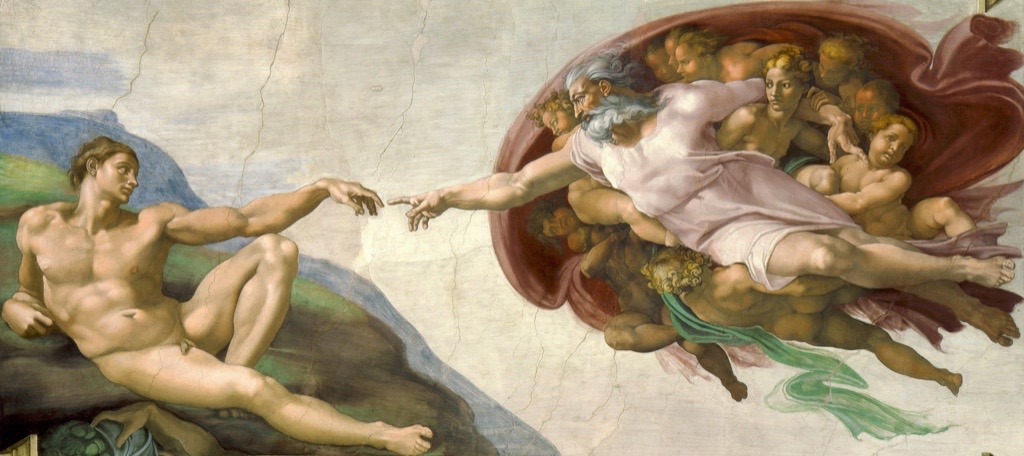
The middle triad gives human origin a bodily form. In the Creation of Adam, the almost-touching hands have become one of the world's most reproduced details, but the complete panel depends on the opposition between Adam's earthbound weight and God's airborne surge. Creation of Eve presents a different awakening: Eve rises from the side of the sleeping Adam and turns in prayer toward God. In the joined scene of temptation and expulsion, a central tree divides transgression from consequence. Adam and Eve appear twice, transformed from reaching nudes into bent, grieving exiles.
The physical order is not identical to biblical chronology. Noah offers sacrifice after the waters recede in Genesis, yet the ceiling places the Sacrifice of Noah before The Flood when read from the altar toward the entrance. Michelangelo's sequence is an artistic and theological arrangement, not a set of numbered illustrations mechanically following the text.
Neither is it the whole ceiling. Famous fragments can make the nine panels seem like independent pictures laid along a neutral ground. In the chapel, every central scene is held within the larger system of youths, medallions, thrones, ancestors and corner narratives. Its meaning and scale change with that neighbourhood.
Prophets and Sibyls: Twelve Forms of Expectation
Seven prophets of Israel alternate with five sibyls from the ancient pagan world: Zechariah, Joel, Isaiah, Ezekiel, Daniel, Jeremiah and Jonah appear with the Delphic, Cumaean, Libyan, Persian and Erythraean Sibyls. Inscriptions identify them, while their bodies, attendants, books and scrolls give each a distinctive temperament.[6]
Within the Christian programme, both groups belong to expectation. The Hebrew prophets anticipate redemption within Scripture; the sibyls embody the Renaissance belief that intimations of Christ also appeared beyond Israel. Their alternation widens the field of prophecy without making their traditions identical.
Michelangelo resists a single visual type. Zechariah reads with absorbed gravity near the entrance. The Delphic Sibyl turns abruptly, as though a sound has reached her. The Cumaean Sibyl is aged and massively muscular, concentrating on an enormous book. Isaiah twists while an attendant addresses him. Jeremiah folds inward beneath the weight of thought. The Libyan Sibyl rises or settles in a complex rotation, lifting a vast volume behind her. Jonah, placed over the altar, leans back and looks upward, his body pulling against the curve of the vault.
Their books are physical burdens as well as signs of knowledge. Pages have thickness; arms brace heavy volumes; attendants hold, point and peer. Prophecy is represented as an act of reading, listening and bodily response. The monumental figures may possess foreknowledge, but Michelangelo does not make that knowledge serene. They strain beneath it, turn toward it or withdraw into it.
Surviving drawings reveal how such bodies were built. The Metropolitan Museum's studies for the Libyan Sibyl examine a male model's twisting back, shoulder, hand and foot in red chalk. Michelangelo converted that observed anatomy into a female prophetic figure at colossal scale. The drawing is neither a tiny copy of the fresco nor evidence that the final sibyl is “really” male. It records the flexible passage from model to invented body.[9]
Ancestors in the Margins
Below the prophets and sibyls, the lunettes and spandrels contain families associated with the ancestors of Christ. Names painted on tablets in the lunettes refer to the genealogy in the Gospel of Matthew. The figures themselves sit, turn, sleep, work and care for children in shallow, awkward spaces.[7]
Their mood differs markedly from the heroic centre. These are bodies occupied by waiting and ordinary duration. A woman bends over cloth; an adult stares outward; children cling or sleep; families seem joined physically yet separated in thought. Michelangelo gives sacred ancestry the texture of domestic life without illustrating a sequence of recognisable biblical events.
Specific identifications must remain cautious. The inscriptions organise the genealogy, but they do not label every body. The Vatican Museums note that scholars disagree over the identities of figures in the eight spandrels. Their uncertainty is not a defect to be solved by confident guessing. It directs attention toward what the paintings communicate without names: succession, fatigue, intimacy and generations inhabiting the edge of a larger history.[7]
Their marginal position is meaningful. They sit closest to the real windows and furthest from the central acts of creation. Yet the Christian claim of incarnation depends upon genealogy—divine history enters human descent. The families' compressed spaces therefore provide a quiet human counterweight to the impossible energy above them.
Pendentives: Deliverance at the Four Corners
The four great corner pendentives depict the Brazen Serpent and the Punishment of Haman at one pair of corners, with David and Goliath and Judith and Holofernes at the other. Each concerns a mortal danger from which Israel is delivered. Their subjects connect the ceiling's histories with the narratives already painted on the walls.[10]
The corners are broad, curved and structurally awkward. Michelangelo fills them with violent diagonals. In David and Goliath, the younger figure bends over the fallen giant, turning the familiar Florentine subject into a compact struggle. In Judith and Holofernes, movement between the severed head, the maid and the looming tent distributes suspense across separate groups. The Brazen Serpent is a mass of bitten and twisting bodies, while the Punishment of Haman drives a foreshortened figure across its field.
These are not additional Genesis panels. They belong to a different scriptural family and occupy a different architectural zone. Their placement at the corners gives them a connective function: they turn the eye from the vault toward the long walls and make episodes of rescue answer the wider history of salvation.
The Ignudi and Medallions
Twenty nude youths, now usually called ignudi, sit in pairs beside the smaller central panels. They hold ribbons, garlands and great simulated bronze medallions. Their bodies are more immediately legible than their precise theological role.[11]
No two repeat the same pose. Some turn inward toward a medallion; others stretch, lean, recoil or look away. Cloth coils around limbs; garlands cross shoulders; one body's outward thrust answers another's compression. The variations form an anatomy of seated movement.
Their scale increases through the campaign. Near the entrance, they appear more contained; toward the altar, their bodies expand and their gestures become more forceful. Like the central histories, they register Michelangelo's growing confidence in what could be seen from the floor.
The medallions resemble bronze reliefs and contain scenes associated with the Books of Kings. Their dark, metallic appearance contrasts with the vivid flesh of the youths. Yet the ignudi should not be reduced to attendants who merely hold labels for these stories. They create transitions between narrative panels and painted architecture, bringing idealised human bodies into the very machinery that organises sacred history.
Their meaning has attracted elaborate theories—angels without wings, embodiments of beauty, spirits, prisoners or markers of a lost antique age. Some readings may illuminate aspects of the programme, but the frescoes do not supply a single definitive explanation. Their visible work is already rich: they hold, balance, frame, animate and disrupt.
Fresco as a Daily Commitment
Painting the ceiling required Michelangelo to translate drawing into wet plaster on a curved surface. In true fresco, pigment is applied to a fresh finishing layer, the intonaco. As the plaster carbonates, colour becomes bound into its surface. The artist must complete a manageable section before it dries. Each day's area, or giornata, therefore represents a practical boundary and a sequence of decisions that cannot be postponed indefinitely.
Large figures could be transferred from full-scale cartoons. Lines might be pricked and dusted through, or incised into the plaster. Smaller studies solved individual poses, hands, feet, heads and draperies. Only a fraction of the drawings needed for so great a work survives, but those sheets show sustained preparation rather than spontaneous painting across an unplanned ceiling.[9][11]
Michelangelo's paint could be surprisingly thin. Vatican conservator Fabrizio Mancinelli described water-like applications and networks of brushstrokes whose density could be adjusted across a form. Seen from the floor, separate strokes merge into modelling and colour; seen close during conservation, they reveal an economy suited to the demands of fresco.[12]
The palette disclosed by modern cleaning challenged the old idea of Michelangelo as a reluctant painter who thought only like a sculptor. Acid greens, violets, orange, yellow and rose establish strong colour relations across the vault. Drapery may set one hue against its complement; shadows can shift colour rather than merely darken. The bodies have sculptural weight, but colour is one of the means that makes them legible.
The famous story that Michelangelo painted lying flat on his back is misleading. He worked on scaffolding constructed below the vault, generally standing and craning upward. His own comic poem complains of the discomfort: paint dripped on his face, his neck bent backward and his belly pressed forward. The humour confirms strain, not a reclining technique.[8]
A work of this scale also required material support. Plaster had to be mixed and laid; pigments, water and tools had to reach the platform; scaffolding had to be built and adjusted. Michelangelo controlled the conception and is the painter credited with the ceiling, but that authorship need not be inflated into the physically impossible claim that no one assisted the enterprise in any capacity.
A Design That Learned as It Grew
The ceiling preserves evidence of Michelangelo's adaptation. The entrance half, painted first, contains the crowded Noah narratives. The Flood has many small bodies competing at great distance. By contrast, later scenes such as the Creation of Adam and the cosmic acts reduce the cast and enlarge every movement.
This change is not a decline in narrative interest. It is a discovery about monumental visibility. A single hand crossing a narrow gap can carry farther than dozens of desperate gestures. God's twisting body in the Separation of Light from Darkness can fill a small panel because its foreshortening compresses vast action into one form.
The surrounding figures change too. Later prophets, sibyls and ignudi grow bolder in scale and more complex in rotation. Jonah's backward lean appears to deny the actual surface on which it is painted. The Libyan Sibyl combines a vast back, turning neck and precisely placed feet within a throne that feels barely able to contain her.
The division of the campaign therefore becomes part of the viewer's experience. Walking from the entrance toward the altar is also moving broadly from the earlier toward the later work. Without reading the ceiling as a simple autobiography, one can see Michelangelo testing the room and revising his visual language in response.
Returning to Paint the End of Time
More than two decades after the ceiling's completion, Michelangelo returned to the chapel under very different circumstances. Clement VII commissioned a Last Judgment for the altar wall late in 1533. After Clement's death in 1534, Paul III sustained the project. Preparations altered the wall, scaffolding was erected in 1535, and Michelangelo painted from 1536 until the unveiling in 1541.[1][4]
The wall was not empty. The new fresco caused the loss of Perugino's Assumption of the Virgin and the first scenes of the Moses and Christ cycles, as well as earlier papal portraits at that end. Michelangelo's intervention completed a vast chronological arc but broke part of the fifteenth-century symmetry. Transformation came at the price of destruction.[1]
The Last Judgment abandons the ceiling's fictive compartments. Hundreds of bodies occupy a continuous blue field around Christ. The blessed rise at the left; the damned are forced downward at the right; angels sound trumpets and the dead struggle from the earth. Above, angels carry the instruments of Christ's Passion. The movement is not a calm diagram of separate heavenly ranks. It behaves like a vortex in which every body is affected by the judge at its centre.[4]
Christ's raised arm commands the composition. The Virgin turns close beside him. Saints cluster with the instruments of their martyrdom: Catherine with the wheel, Lawrence with the gridiron, Sebastian with arrows, Bartholomew with knife and flayed skin. The features on that hanging skin are widely read as a self-reference by Michelangelo, while the saint's living face remains distinct.[4]
At the lower edge, Charon ferries and strikes the damned, and Minos judges them with a serpent coiled around his body. These figures come through Dante's Inferno from classical mythology. Their presence shows Michelangelo combining Christian eschatology with the poetic imagination through which Renaissance Italy pictured hell.
The difference from the ceiling is profound. The earlier work builds order through painted architecture, successive narratives and seated witnesses. The later wall dissolves those boundaries. Its bodies share a single climatic instant. Creation is expansive and sequential above; judgement is simultaneous and inescapable before the altar.
Nudity, Covering and Alteration
The abundance of naked bodies drew criticism before and after the fresco's unveiling. The issue was not simply that Renaissance viewers had never seen nudity in sacred art: the ceiling had displayed monumental nudes for decades. The altar wall's scale, location and mixing of exposed saints, resurrected bodies and damned figures made its nakedness newly confrontational.
Criticism intensified in the climate of Catholic reform. In January 1564, shortly before Michelangelo's death, a decision was taken to cover figures judged indecorous. Daniele da Volterra began adding draperies in 1565 and acquired the lasting nickname Braghettone, the “breeches maker.” Further coverings and modifications accumulated in later centuries.[4][13]
These interventions complicate the idea of an untouched masterpiece. Some additions were painted dry over Michelangelo's surface; in other places parts were removed and repainted. During the twentieth-century restoration, conservators retained selected historic coverings, including those associated with the earliest post-Tridentine campaign, while removing some later additions. What visitors see is Michelangelo's design carrying a visible history of censorship, adaptation and conservation.
Restoration and the Return of Colour
Centuries of candle smoke, dust, grime, glue-based coatings and earlier interventions changed the appearance of the chapel. A major modern conservation programme began in 1979 and continued across different areas until 1999. Work on Michelangelo's ceiling and Last Judgment was concentrated between 1980 and 1994.[1][13]
Cleaning disclosed colours far brighter and more varied than many viewers expected. The result altered scholarly understanding. Michelangelo's reputation as a sculptor who modelled primarily through dark and light had encouraged a subdued image of the frescoes. Restored violets, greens, blues, oranges and pinks revealed colour contrasts integral to their design.
The campaign also provoked debate. Critics questioned whether some dark passages represented original finishing rather than accumulated material, and whether cleaning had weakened modelling. Supporters pointed to technical investigation and the fresco method. Such arguments are not an embarrassing footnote. They show that restoration is an interpretive act grounded in material evidence, documentation and judgements about later layers.
Conservation did not end when the scaffolding came down. New lighting, climate control, air filtration, monitoring and regular inspection became essential as visitor numbers placed pressure on the chapel's environment. Heat, humidity, airborne particles and carbon dioxide enter with crowds; the frescoes cannot be protected by treating the room as if it were sealed and empty.[14]
In 2024, Vatican scientists identified a widespread pale film on The Last Judgment as calcium lactate. Analysis detected lactic acid in the chapel atmosphere; its reaction with calcium ions in the fresco produced the soluble salt. From 1 February to 27 March 2026, a multidisciplinary team carried out extraordinary maintenance while the chapel remained open. Japanese paper and distilled water removed the film, restoring stronger colour and chiaroscuro without repeating the major 1994 restoration. The operation also allowed a complete condition review and examination of earlier reintegration.[15]
The episode makes the chapel's living material state unusually clear. The paintings are neither fixed images nor surfaces that can be cleaned once for all time. Their preservation depends upon continuing observation, scientific explanation and small, timely interventions.
The Chapel as a Space of Looking
Reproductions make the frescoes familiar while flattening their relationships. A book can rotate a ceiling scene, crop it square and enlarge it until it looks like an easel painting. In the chapel, the same scene is curved, high above, surrounded by bodies of very different scales and visible only through sustained upward looking.
The room also resists a single ideal viewpoint. From the entrance, the altar wall commands the long axis while the Noah stories are nearest overhead. Moving forward changes the angles of every central panel. The prophets and sibyls become alternately prominent, and the lunettes settle closer to eye level than the vault. Near the altar, The Last Judgment overwhelms peripheral vision while Jonah strains above its upper edge.
Michelangelo designed for this unstable experience. Foreshortening, emphatic outlines and enlarged movements answer the distance. Painted ledges organise what the eye cannot see all at once. Repeated forms help orientation, while differences reward movement.
The visitor's physical discomfort—neck bent, attention divided, time limited—ironically echoes something of the ceiling's making. It cannot reproduce Michelangelo's labour, and it should not be romanticised, but it reminds us that the frescoes were conceived through bodies for other bodies in a demanding space.
Silence, when possible, changes the room. The stories become less a collection of famous motifs and more a sequence of pauses, collisions and acts of attention. Zechariah's reading can answer Jeremiah's withdrawal; a family in a lunette can temper the ideal ignudi above; the almost-contact in Adam can appear suspended beneath the finality of Christ's raised arm.
Artist Up Close
Michelangelo's two Sistine campaigns span more than thirty years of his career. The ceiling began when he was in his early thirties, already famous but still fighting to secure his position between Florence and Rome. The Last Judgment was unveiled when he was sixty-six, after the Sack of Rome, the death of patrons and friends, and profound changes in the religious and political world around him.
The difference between the works should not be reduced to youthful optimism and elderly despair. The ceiling includes sin, catastrophe and drunkenness; the altar wall includes resurrection and salvation. Yet their structures do express different ideas of historical time. The ceiling unfolds through generations and promises. The wall collapses time into a final event from which no body can remain detached.
Both campaigns reveal an artist who thought through drawing and the human figure. Painted architecture, landscape and attributes matter, but bodies carry the decisive meanings. God creates by turning and reaching. Prophets know through the way they hold a book or withdraw into thought. The damned descend through weight, grip and terror; the saved rise through assistance as much as personal effort.
Michelangelo's sculptural intelligence is evident in the figures' mass, but calling the ceiling “sculpture in paint” is insufficient. Fresco allowed him to coordinate colour across enormous distances, make simulated materials differ from flesh, and bind hundreds of bodies into architecture. The chapel displays not a sculptor reluctantly filling surfaces, but an artist adapting bodily invention to painting's own conditions.
His return also altered his relationship to predecessors. In 1508, Michelangelo painted above the Quattrocento wall cycle. In the 1530s, he removed part of that cycle to make the altar wall continuous. Respect, rivalry, institutional demand and destruction coexist. Renaissance renewal did not always preserve the works it superseded.
The chapel ultimately refuses the idea of isolated genius even while making Michelangelo's achievement undeniable. Popes commissioned and changed it; architects built and stabilised it; earlier painters established its walls; assistants and artisans sustained the fresco campaigns; later artists covered parts of the altar wall; conservators continue to care for every surface. Michelangelo's imagination dominates the room because it transformed this history, not because it stood outside it.
Why the Sistine Chapel Still Feels Unfinished
The frescoes are complete, but the experience of them is not. The room continues to change with liturgy, conclave, conservation, lighting and the bodies passing through it. Scholarship revises identifications and reconstructs lost stages. Restoration reveals colours that alter interpretation. Every generation inherits both the images and decisions made about them.
Michelangelo's own designs encourage this openness. The hand of Adam does not close the interval with God. Prophets turn as if a message has just arrived. Ancestors wait without knowing their place in a completed genealogy. On the altar wall, bodies are caught in the process of rising or falling rather than arranged after judgement has settled.
The chapel is therefore less a static encyclopaedia of Christian subjects than a field of transitions: darkness into light, matter into life, innocence into knowledge, danger into rescue, history into eternity. Painted bodies hold each transition at the point where it is still happening.
That quality survives overwhelming fame. The most familiar gestures recover their force when returned to the room around them. Adam's hand belongs between the Flood and the prophets; Jonah's backward body belongs over the altar; Christ's raised arm belongs on a wall already marked by loss. The whole chapel changes every fragment, and every fragment makes the whole harder to exhaust.
Frequently Asked Questions
Discussion
The Chapel becomes clearer when its building, earlier walls, ceiling zones, altar wall and conservation history remain distinct.
Reader Insights
Locate the entrance, altar wall, central Genesis band, prophets and sibyls, ancestors and corner pendentives. How does position change the role of each group?
Compare one fifteenth-century wall fresco with a ceiling scene and the Last Judgment. What differences in scale, framing and movement reveal their separate campaigns?
Compare a Libyan Sibyl study with the fresco, then consider a later surface change. What evidence distinguishes artistic preparation from conservation treatment?
Join the Conversation
Which distinction most changes your understanding of the Chapel: the earlier wall cycle, the ceiling’s internal hierarchy, the later date of the Last Judgment, or the continuing history of restoration?
References
- Vatican Museums, Sistine Chapel: History, View source.
- Vatican Museums, Sistine Chapel: Ceiling, View source.
- The Holy See, Sistine Chapel, View source.
- Vatican Museums, The Last Judgment, View source.
- Vatican Museums, Central Stories, View source.
- Vatican Museums, Sibyls and Prophets, View source.
- Vatican Museums, Spandrels, View source.
- Smarthistory, Michelangelo, Ceiling of the Sistine Chapel, View source.
- Metropolitan Museum of Art, Studies for the Libyan Sibyl, View source.
- Vatican Museums, Pendentives, View source.
- Metropolitan Museum of Art, Michelangelo: Divine Draftsman and Designer—Exhibition Galleries, View source.
- Vatican Museums, Fabrizio Mancinelli, The Sistine Chapel, View source.
- Vatican Museums, The Sistine Chapel Twenty Years Later: New Breath, New Light, View source.
- Vatican Museums, The Sistine Chapel Twenty Years Later: Conference Proceedings, View source.
- Vatican Museums, Completion of the Extraordinary Maintenance of Michelangelo's Last Judgment, View source.
- Annotated image source: Michelangelo, Sistine Chapel Ceiling, 1508–1512, Vatican City. Page-ready overview and detail crops prepared from the accepted Wikimedia Commons source, Sistine ceiling.jpg, documented there as a public-domain reproduction of a public-domain work. Detail crops preserve the approved source-led vertical orientation for overlay review, View source.
- Michelangelo Buonarroti and Tommaso Campanella, The Sonnets of Michael Angelo Buonarroti and Tommaso Campanella, translated by John Addington Symonds, Project Gutenberg, Symonds translations, View source.