 by Tom Gurney
Tom Gurney BSc (Hons) is an art history expert with over 20 years experience
Published on June 19, 2020 / Updated on November 6, 2025
Email: tomgurney1@gmail.com / Phone: +44 7429 011000
The Doni Tondo by Michelangelo
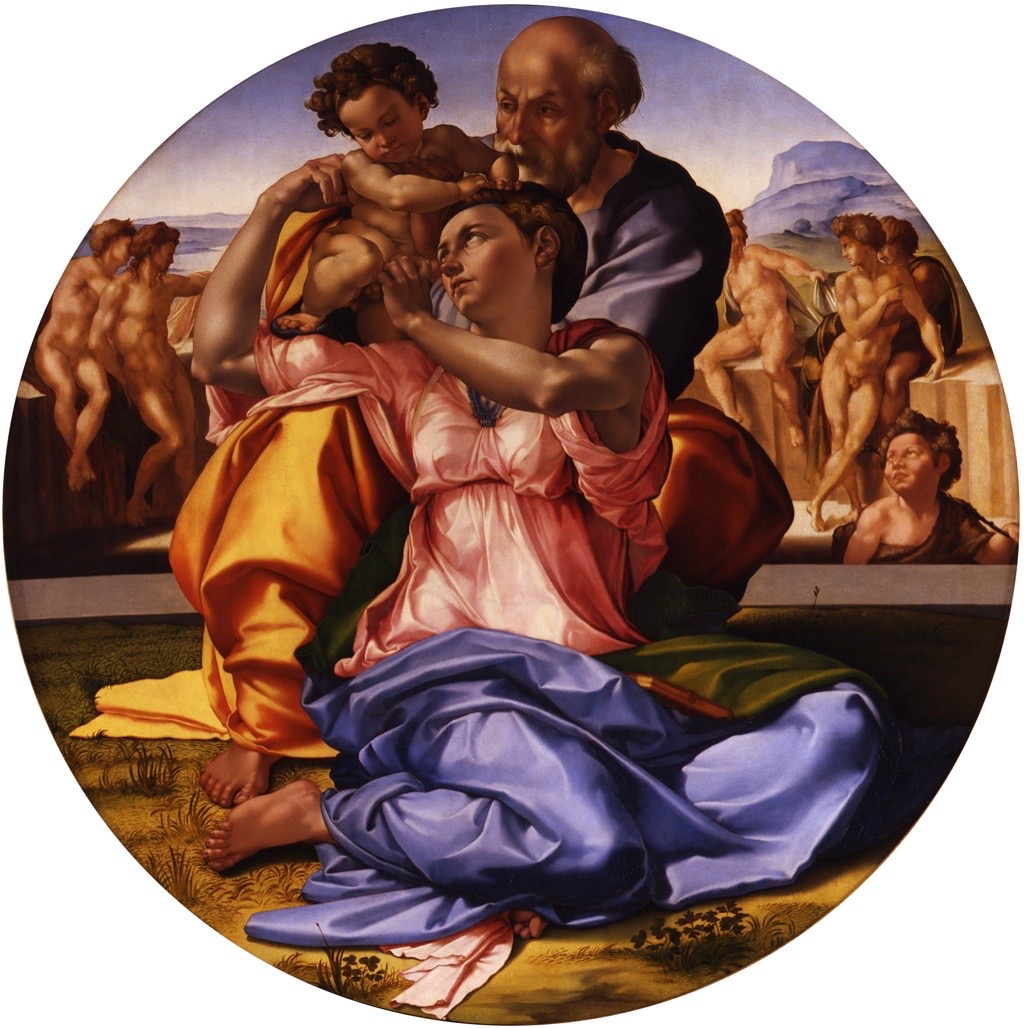
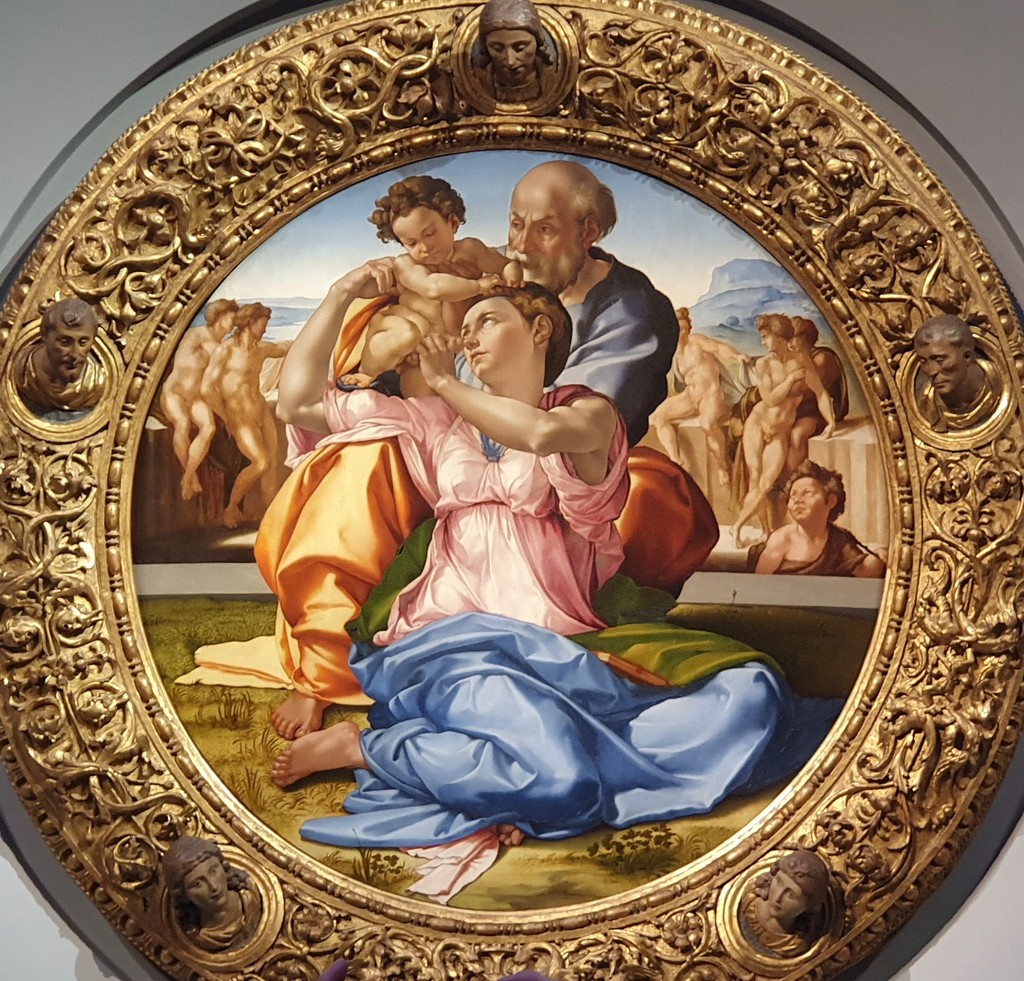
Michelangelo’s Doni Tondo compresses the Holy Family into a circular painted panel. Mary turns across her own body to receive the Christ Child from Joseph, whose head and shoulders rise behind her. The three figures interlock so tightly that their arms, legs and glances seem to rotate inside the frame. Beyond a low wall, the infant Saint John the Baptist watches. Five nude youths occupy a still more distant zone.
The work is both intimate and monumental. It was made for the Florentine merchant Agnolo Doni, probably in connection with his marriage to Maddalena Strozzi or the family’s early children. Yet the domestic format contains bodies on the scale of sculpture, intense colour and an iconographic puzzle that has never produced one uncontested solution.
The Uffizi dates the panel to 1505–1506 and identifies it as Michelangelo’s only finished panel painting to survive. The museum also discusses a possible date around the birth of Maria Doni in September 1507. That tension is important: title, medium, size and present location are secure, while the exact occasion and year remain open to interpretation.[1]
At a Glance
- ArtistMichelangelo Buonarroti
- TitleHoly Family, commonly known as the Doni Tondo
- Catalogue date1505–1506
- Dating cautionThe Uffizi also discusses a possible 1507 context; no surviving contract fixes an exact execution date
- MediumTempera grassa on wood
- FormatCircular panel, or tondo
- Diameter120 centimetres
- Current locationUffizi Galleries, Florence, Room A38
- Inventory1890 no. 1456
- PatronAgnolo Doni
- Principal figuresVirgin Mary, Christ Child and Saint Joseph
- Middle-ground figureInfant Saint John the Baptist
- Background figuresFive nude youths whose meaning remains disputed
- FrameCarved by Francesco del Tasso and probably designed by Michelangelo
- Primary cautionPatronage occasion, exact chronology and the background nudes must not be reduced to one settled explanation
Contents
- The original panel in the Uffizi
- What a tondo is
- Agnolo Doni, Maddalena Strozzi and the date problem
- The Holy Family as a turning group
- Saint John, the wall and the spaces between
- Why are there nude youths in the background?
- The frame as part of the object
- Wood, tempera grassa and Michelangelo’s colour
- Technical study, condition and reproduction
- From sculpture to the Sistine ceiling
- Artist Up Close
Annotated Details from Doni Tondo
The annotated view keeps the whole circular panel visible while isolating four key relationships: the Child crossing between Joseph and Mary, Mary’s twisting colour-built body, Saint John beyond the wall and the disputed background nudes.
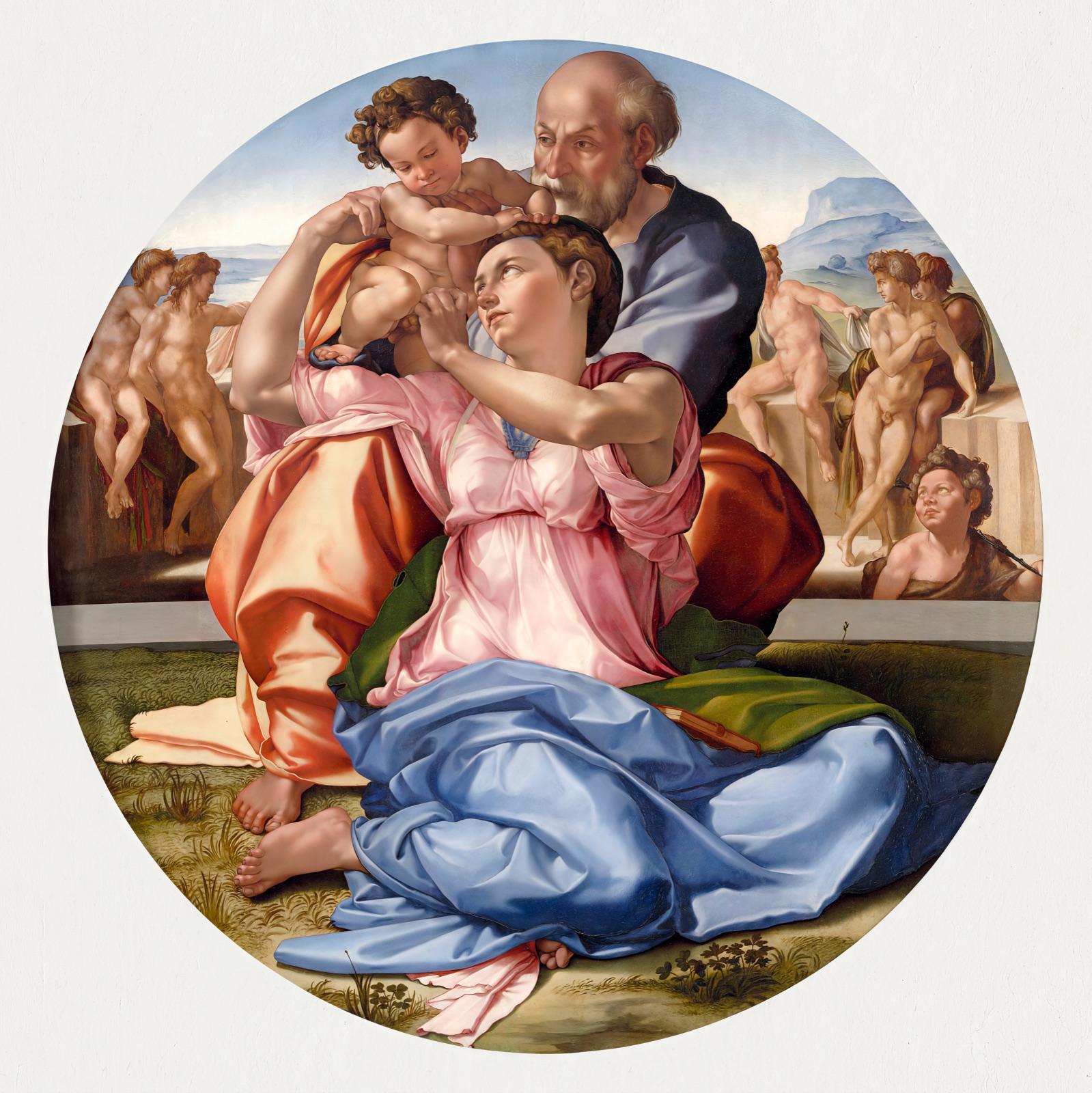
Details from DONI TONDO
Close looking highlights visible details in the panel while keeping image-source and rights notes in the references.
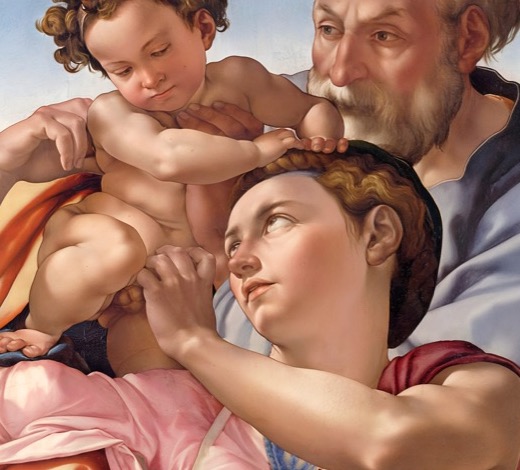
Child between Joseph and Mary
The Christ Child crosses the space between Joseph and Mary, making touch and transfer the centre of the Holy Family group.
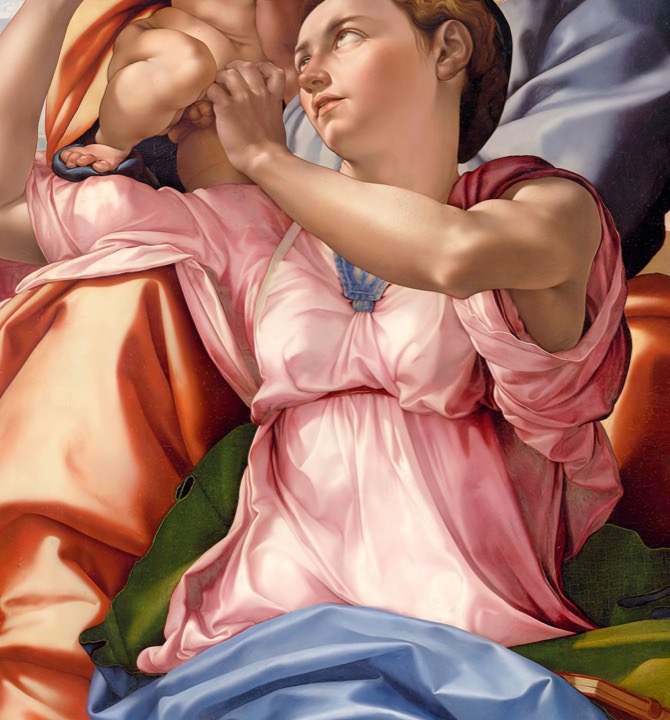
Mary's twist and colour
Mary’s muscular turn is built with bright pink, orange, green and blue passages that separate planes as strongly as contour.
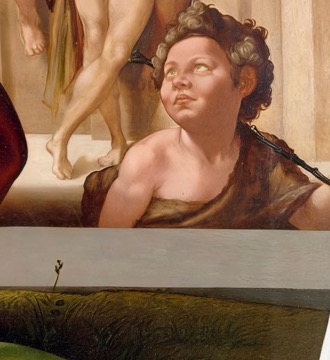
Saint John and the wall
The young Baptist sits beyond the foreground group, close to the wall that separates the Holy Family from the rear figures.
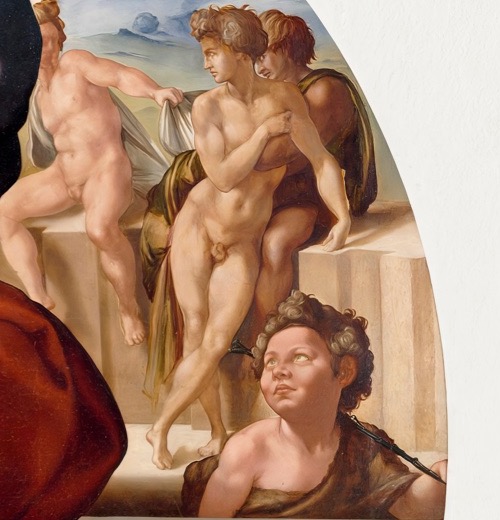
Background nudes
The nude youths occupy a more distant band of space and remain one of the painting’s most debated interpretive problems.
The original panel in the Uffizi
The Uffizi catalogue identifies the painting as Holy Family, known as the “Doni Tondo.” Michelangelo painted it on a wooden panel in tempera grassa, a paint medium containing tempera with an oily component. The circular image measures 120 centimetres across and is displayed in the Uffizi in Florence, inventory 1890 no. 1456.[1]
“Doni Tondo” is a useful name because it joins patron and shape. “Doni” refers to Agnolo Doni, for whom Michelangelo made the work. “Tondo” is the Italian term commonly used for a circular painting or relief. The subject is the Holy Family: Mary, Christ and Joseph, with the young John the Baptist and a separate group of nudes.
That identity distinguishes the original from several things that may reproduce it:
| Object or image | Relation to the original |
|---|---|
| Uffizi wooden panel | Michelangelo’s painted object |
| Carved circular frame | A separate but historically integrated wooden structure |
| Full-panel photograph | A two-dimensional record of panel and possibly frame |
| Detail crop | A selected portion that changes the composition |
| Print, poster or digital recolouring | A later derivative |
| Another Holy Family by Michelangelo or a follower | A separate object |
The distinction is especially important online. A square file may add pale corners around the circular painting. A crop may remove the frame, the background nudes or the infant John. A saturated reproduction may make the orange, blue, pink and green more intense than a neutral record. None of these transformations changes the physical panel, but each changes what a viewer can learn from it.
The Uffizi calls the Doni Tondo Michelangelo’s only finished panel painting to survive.[1] That does not mean it was the only panel he ever began or the only easel painting associated with his name. The unfinished Manchester Madonna and Entombment survive in the National Gallery, while the early Torment of Saint Anthony has its own attribution history. “Only finished surviving panel” is therefore a precise institutional distinction, not a claim that Michelangelo painted this one image and nothing else.
What a tondo is
A tondo is an artwork organised within a circle. In fifteenth- and early-sixteenth-century Florence, circular paintings and reliefs were strongly associated with domestic religious display. The Uffizi describes the format as especially valued for devotional decoration in the home.[1]
The circle does not function as a rectangular picture with its corners removed. It changes composition. Figures must answer a boundary with no stable top, bottom or side edge. Limbs can follow arcs, heads can establish a curved rhythm and bodies can seem to turn around a centre.
Michelangelo fills almost the entire diameter with the Holy Family. Mary’s knees spread across the lower field. Her torso twists upward and backward. Joseph closes the group from above, while the Child crosses between them. The three bodies form a pyramid, but the pyramid is animated by rotation. Stable geometry and difficult movement coexist.
The Uffizi compares the compact group to a dome and describes the Child as passing from Joseph’s hands to Mary’s.[1] The exact instant can still feel ambiguous. Mary may seem to receive, lift, turn or present him depending on where the eye begins. The work fixes no single before-and-after sequence as clearly as a narrative strip would.
Circularity also affects distance. Mary’s body presses close to the front edge, while Joseph and Christ rise toward the upper arc. The nudes remain within the same circle but occupy a narrower band farther away. Instead of opening a deep continuous landscape, Michelangelo stacks figure zones within the disc.
The format carries devotional implications without mechanically determining the commission. A round Holy Family could suit a marriage chamber, household chapel or celebration of birth. The circle itself does not prove which event caused Agnolo Doni to order this particular work.
Agnolo Doni, Maddalena Strozzi and the date problem
Agnolo Doni was a wealthy Florentine cloth merchant and collector. He married Maddalena Strozzi on 31 January 1504. The Uffizi preserves Raphael’s paired portraits of the couple and now displays them near Michelangelo’s tondo. The museum dates those portraits to about 1504–1507 and connects their imagery to marriage, fertility and the Doni household.[2]
The Doni Tondo belongs to that same world of patronage. The Uffizi states that Michelangelo painted it for Agnolo and that the family could celebrate marriage and the birth of a first child through major works by Michelangelo and Raphael.[1] The safest conclusion is that marriage, household identity and hopes or experience of children shaped the commission. It is less safe to name one exact occasion as proven.
The date has a similar structure of certainty and uncertainty:
- the Uffizi catalogue field gives 1505–1506;
- nolo and Maddalena married in 1504;
- e Laocoön was excavated in Rome in January 1506;
- e Uffizi text notes resemblances to the Laocoön among the background figures;
- at text also discusses a date coinciding with Maria Doni’s birth in September 1507;
- surviving contract gives a day, price and delivery deadline for the painting.
It is therefore reasonable to use 1505–1506 as the current catalogue date while explaining the museum’s own 1507 proposal. The image may contain responses to classical sculptures visible after January 1506, but visual resemblance is not a signed receipt.
Chiara Franceschini’s study stresses that the dates of both commission and execution remain undocumented and that the painting has been placed in different early-sixteenth-century moments. Her approach returns the object to Doni family history, private devotion, baptism and the function of a Marian tondo.[3] The study does not make every debate disappear; it demonstrates why chronology and meaning must be considered together.
The frame adds patronage evidence. Strozzi half-moons appear among its carving, linking the object to Maddalena’s family. That emblem supports the marriage-and-household context without proving that the panel was delivered on the wedding day.
The Holy Family as a turning group
Mary dominates the foreground. She is seated or kneeling low to the ground, her legs folded beneath and beside her. One bare arm reaches upward; the other helps secure the Child. Her head turns over her shoulder toward Joseph and Christ, while her torso twists against the direction of her lower body.
Joseph rises behind her in a dense red garment. He bends toward the Child and completes the upper part of the group. The Child is neither calmly enthroned on Mary’s lap nor standing independently. His body crosses the space between the adults, creating the work’s most important chain of touch.
The Uffizi reads the movement as Christ passing gently from Joseph to Mary.[1] That interpretation gives the gestures a sequence, but the visual force lies in their interdependence. Remove one body and the other two poses cease to make sense. Mary’s turn answers Joseph’s lean; the Child’s horizontal movement connects them.
The group can be described through several linked shapes:
- Mary’s knees and robe create a broad lower base;
- r torso, Joseph and the Child establish an upward triangle;
- e arc of her arms answers the circular panel;
- seph’s head, the Child’s head and Mary’s face form a compact cluster;
- d, yellow, blue and pink garments divide the mass without breaking it apart.
Mary’s muscular arms and forceful turn have sometimes been treated as evidence that Michelangelo could only conceive painted bodies as sculptures. The comparison is useful but incomplete. Volume matters, yet colour also carries structure. The bright yellow-orange of her sleeve, pink bodice and blue-violet lower drapery separate planes that would merge in monochrome.
Joseph’s position should not be translated into an unsupported social diagram. He is physically higher because the group needs a figure behind Mary to complete the rotation and pass the Child. The pose may support theological or marital interpretations, but “higher” does not prove a simple message that he is the family’s ruler.
The same caution applies to Mary’s relation to the earth. She occupies the low foreground without a throne, recalling the broad tradition of the Madonna of Humility. That formal observation does not establish a private statement by Michelangelo about femininity, nature or social rank.
Saint John, the wall and the spaces between
The infant Saint John the Baptist appears beyond the Holy Family, near the centre-left of the panel. He is smaller because he occupies a more distant zone. His gaze and position connect the foreground group to the nudes behind him.
John is an important hinge in Christian narrative. He precedes Christ’s public ministry, announces him and baptises. In a painting associated with marriage, birth and domestic devotion, the young Baptist can activate ideas of recognition, preparation and baptism without proving that the panel was commissioned for one documented christening.
A low wall or ledge separates the foreground from the rear. The Uffizi interprets it as a boundary associated with original sin and reads the nudes as pagan humanity beyond the Holy Family.[1] In that scheme, John occupies a transitional position between worlds.
The wall also performs formal work. It establishes a horizontal pause beneath the curved movement of the principal figures. It prevents the nudes from appearing directly beside Mary and Joseph. It changes scale and distance, turning one circular field into layered zones.
The relation can be mapped without fixing its theology:
| Zone | Visible figures | Formal role | Possible religious role |
|---|---|---|---|
| Foreground | Mary, Christ and Joseph | Compact turning group | Holy Family and Christian present |
| Middle ground | Infant John and wall | Scale and spatial transition | Forerunner, baptism, boundary |
| Background | Five nude youths | Distant frieze of bodies | Pagan humanity, catechumens, the unbaptised or another pre-Christian state |
The last column contains interpretations. The first two describe what is visible. Keeping those categories separate allows the image to remain intelligible even when scholars disagree.
Why are there nude youths in the background?
Five nude young men sit or lean behind the wall. They do not look like ordinary witnesses gathered around a family. Their bodies are idealised, separated from the sacred group and arranged like a frieze of ancient sculpture.
The Uffizi says their identity is complex and proposes that they represent pagan humanity, divided from the Holy Family by original sin.[1] This reading fits the classical nudity, the wall and John’s intermediate position.
Other scholars have sharpened or revised the baptismal interpretation. Franceschini argues that the youths may allude to the resurrected bodies of the unbaptised dead in limbo. Her case draws on Florentine theology, Doni family history, other Marian tondi and images connected with baptism.[3] Livio Pestilli instead supports readings of the figures as catechumens awaiting baptism or pagans born before Christ who could not receive it.[4]
These proposals overlap, but they are not identical. “Pagan humanity,” “catechumens” and “resurrected unbaptised bodies” assign different conditions to the figures. A responsible account should show the debate rather than combine all three into one confident label.
The nudes can also be studied formally:
- their smaller scale pushes them back;
- eir exposed bodies contrast with the Holy Family’s vivid drapery;
- eir lateral arrangement differs from the foreground pyramid;
- eir twisting poses echo the principal group at a distance;
- e wall interrupts physical contact between the zones.
Classical reference does not make the nudes religiously empty. Renaissance Christian art repeatedly used ancient forms within sacred arguments. Nor does nudity by itself prove erotic, pagan or condemned status. Meaning comes from placement, gesture, relation and the wider devotional context.
The young Baptist helps prevent the background from becoming a decorative sculpture gallery. He faces or attends to the Holy Family while standing near the boundary. Whatever the nudes mean, John makes the distance between them and Christ part of the subject.
The frame as part of the object
The carved frame is not a neutral ring added only to hold the panel. The Uffizi attributes its carving to Francesco del Tasso and says it was probably designed by Michelangelo.[1] “Probably” matters: Del Tasso’s execution is part of the object record, while Michelangelo’s design role remains qualified.
Five projecting heads appear around the frame. The Uffizi identifies the upper head as Christ and the others as four prophets. Grotesques, plant scrolls and Strozzi half-moons fill the surrounding field.[1] The structure therefore links sacred history, Renaissance ornament and family identity.
The heads project into real space. Their relief catches light differently from the painted bodies. The frame establishes a transition from room to image: carved faces and foliage surround a painted circle in which figures themselves appear almost sculptural.
The number five should not be converted into a numerical code without evidence. Nor should every grotesque be assigned a hidden meaning. Some features can be named from the institutional record; a complete symbolic programme is not documented.
Removing the frame in reproduction changes the work in four ways:
1. it erases the Doni–Strozzi household emblems; 2. it removes the dialogue between carved and painted heads; 3. it alters the apparent scale and boundary of the circle; 4. it makes the panel look like an autonomous round image rather than a composite object.
The complete panel and frame reveal relationships that isolated details of Mary’s turn, the Child, John, the nudes or brushwork necessarily omit.
Wood, tempera grassa and Michelangelo’s colour
The Uffizi identifies the support as wood and the paint as tempera grassa.[1] The term generally describes tempera modified with an oily component, but it should not be treated as a simple modern recipe applied uniformly to every passage.
The Smithsonian’s Museum Conservation Institute records Ezio Buzzegoli’s account of the cleaned Doni Tondo. It describes a tempera with an oleoresinous component, a strong chromatic correspondence with the Sistine ceiling, thin and liquid paint in the more unfocused background, highly finished foreground forms and fine gold strokes in the hair of Mary and Christ. X-ray fluorescence identified a broad range of period pigments.[5]
This evidence corrects two easy assumptions. First, Michelangelo’s colour was not merely sculpture filled in after the fact. Colour separates bodies, turns planes and regulates focus. Second, the softer background is not necessarily accidental fading. Differences in paint handling helped distinguish spatial zones.
The principal figures use abrupt changes of hue across folds and muscles. Yellow turns toward orange and green; pink meets cooler blue-violet; Joseph’s red anchors the upper group. Light and colour make the bodies appear faceted without dissolving their mass.
It is tempting to label every shift cangiante and then treat the term as a complete explanation. The important visible point is that Michelangelo changes colour where a conventional painter might simply darken one hue. Technical language should clarify that choice, not replace looking.
The gold hair strokes are equally revealing. They add a reflective material to selected details within an otherwise painted field. A digital photograph may flatten or exaggerate that effect depending on illumination. The physical work changes subtly as the viewer or light moves.
The medium also distinguishes panel from fresco. The Doni Tondo was painted on a portable wooden support for a private patron. The Sistine ceiling was painted into wet plaster across a vast chapel. Similarities of colour, muscular form and twisting pose do not make the two processes identical.
Technical study, condition and reproduction
More than twenty years after a conservation intervention, the Uffizi and Opificio delle Pietre Dure collaborated on a new non-invasive investigation. The project used full-scale X-radiography of painting and frame, infrared reflectography, multispectral and hyperspectral imaging, colour measurement and X-ray fluorescence. Its aims included comparing condition over time and recovering new information about preparatory drawing and painting technique.[6]
This study is important for what it does and does not permit. It shows that the panel and frame can be examined as material structures and that planning exists beneath the visible paint. It does not provide a simple photograph of Michelangelo’s private intention.
Infrared reflectography and X-radiography translate properties invisible to normal sight. They may reveal changes, drawing or construction, but they are not “truer colour” versions of the finished painting.[6]
Conservation history also complicates comparison with the Sistine ceiling. Cleaning can recover relationships previously obscured by altered coatings and dirt, but a shared bright palette should not be explained as if both objects underwent the same treatment at the same time. Panel and fresco have different materials, environments and intervention histories.
Modern reproductions introduce further variables:
- the round panel may be placed inside a square canvas;
- e carved frame may be cropped out;
- lour balance may warm or cool the flesh;
- ntrast can erase the softer rear landscape;
- arpening can make the background nudes appear as crisp as the foreground;
- mpression may lose gold strokes and fine transitions;
- detail can conceal John or the wall and change the iconographic argument.
The Met’s study of Michelangelo’s disegno—drawing joined to conceptual design—offers a useful career-wide framework for the technical evidence.[7] X-radiography and infrared study belong to the history of making, but they should be related to visible composition rather than used to manufacture a complete lost cartoon or assistant roster.
The legacy claim that this was the only time Michelangelo painted without an assistant is not supported by the accepted evidence. The finished panel is securely his, but lack of a workshop diary prevents an absolute statement about every stage of preparation, support, framing or studio labour.
From sculpture to the Sistine ceiling
The Doni Tondo belongs to a period in which Michelangelo moved between major sculptural and pictorial problems. Its circular design has especially close institutional comparisons with the marble Pitti Tondo and Taddei Tondo. The Uffizi itself identifies those reliefs as earlier studies in how Mary, Christ and the infant John can occupy a circle.[1]
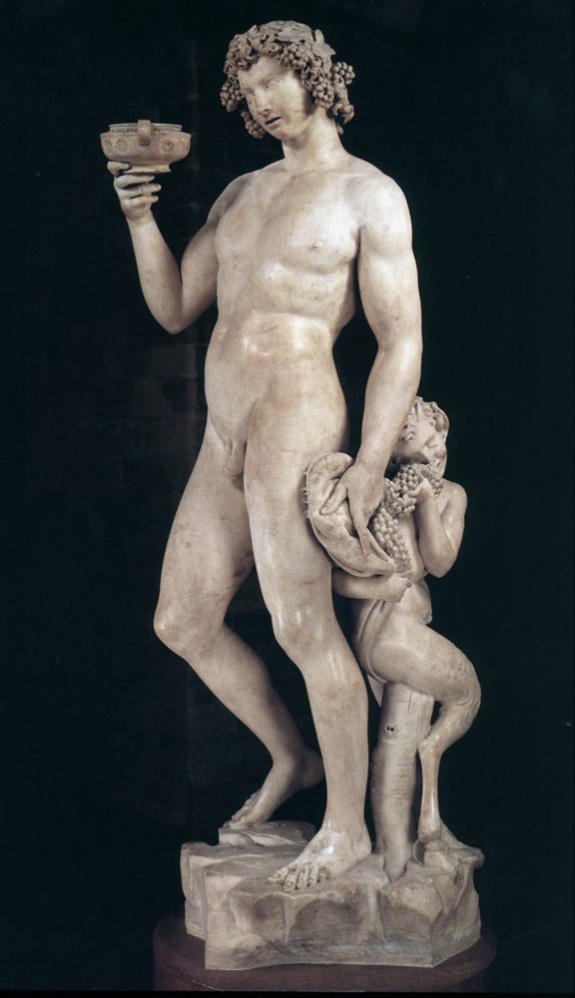
The Bargello describes the Pitti Tondo as a round relief of the Madonna and Child whose unfinished surface creates an atmospheric effect. The same museum holds the earlier Bacchus, a standing marble built around unstable balance.[8] The painted tondo differs from both: it uses colour, spatial zones and a finished panel surface, yet retains the pressure of bodies answering shape and support.
The Royal Academy’s Taddei Tondo is Michelangelo’s only marble in Britain and remains partly unfinished. Its physical carving and experimental surface make it a useful comparison, not a preparatory model for which a direct transfer to the painted panel has been proved.[9]
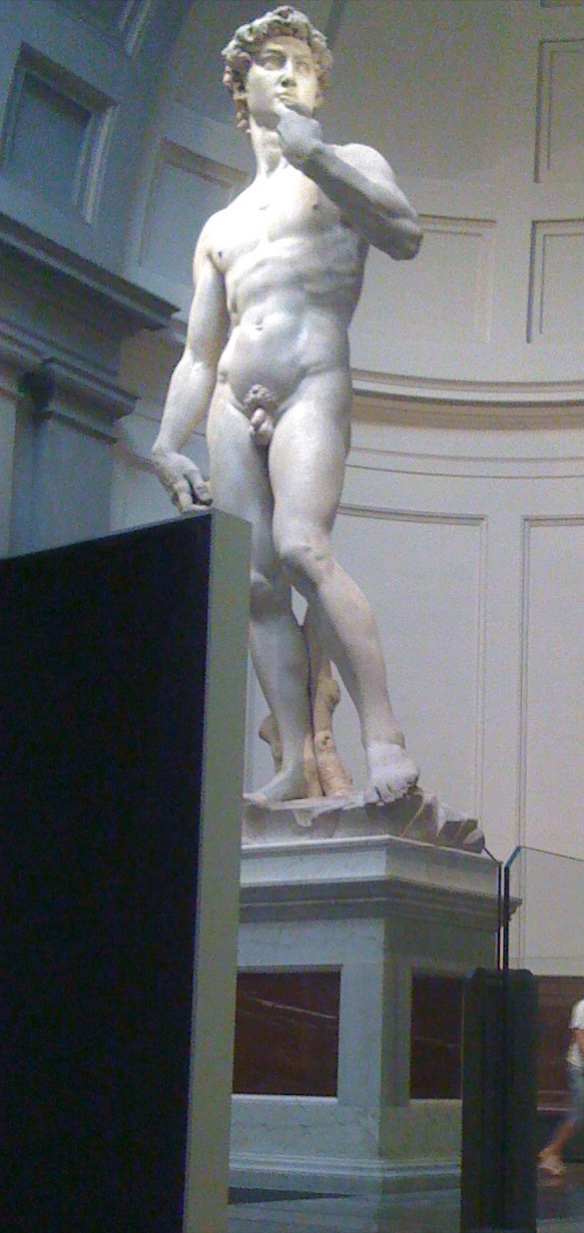
David, completed in 1504, supplies another comparison. The Accademia records a colossal 517-centimetre white-marble figure whose weight, turn and concentrated gaze were designed for a public Florentine setting.[10] The Doni Tondo brings powerful bodies into a private devotional object. That change of medium, scale and destination matters as much as the shared muscularity.
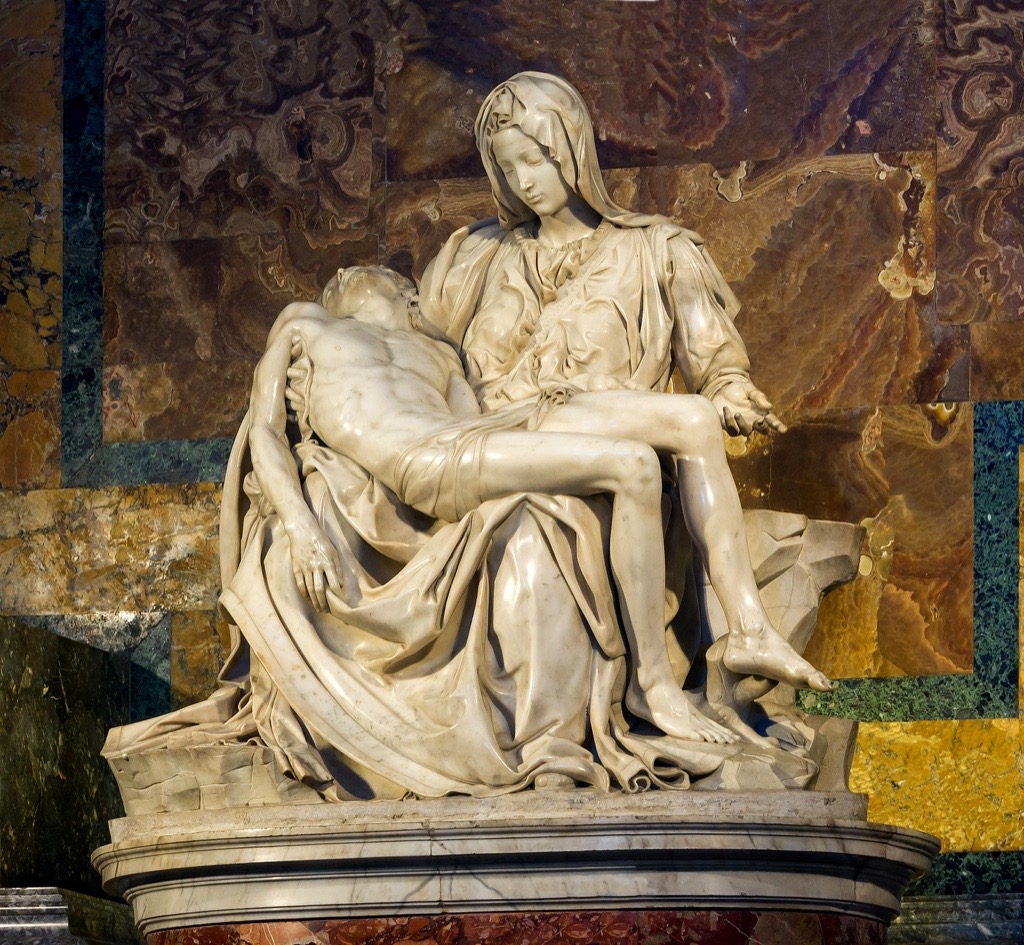
The Vatican Pietà belongs slightly earlier. Its Mary supports Christ within a stable pyramidal marble group, while the painted Mary twists to receive the living Child. The Vatican Museums’ comparative record dates the Pietà to 1498–1499 and stresses its polished finish.[11] The comparison shows Michelangelo returning to mother-and-son contact without repeating pose, emotional register or material.
Bacchus tests a standing body that seems to lose balance. The tondo tests a family whose balance depends upon three interlocked bodies. In each, support is both physical and expressive.
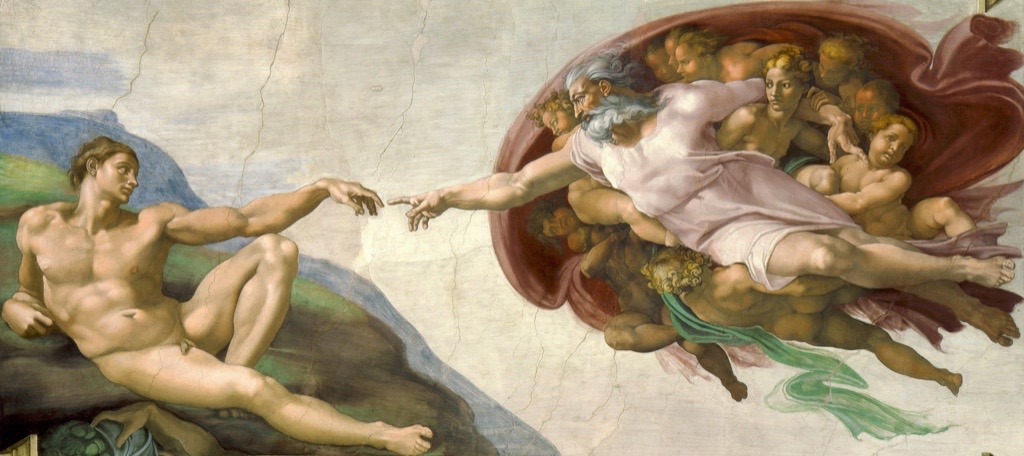
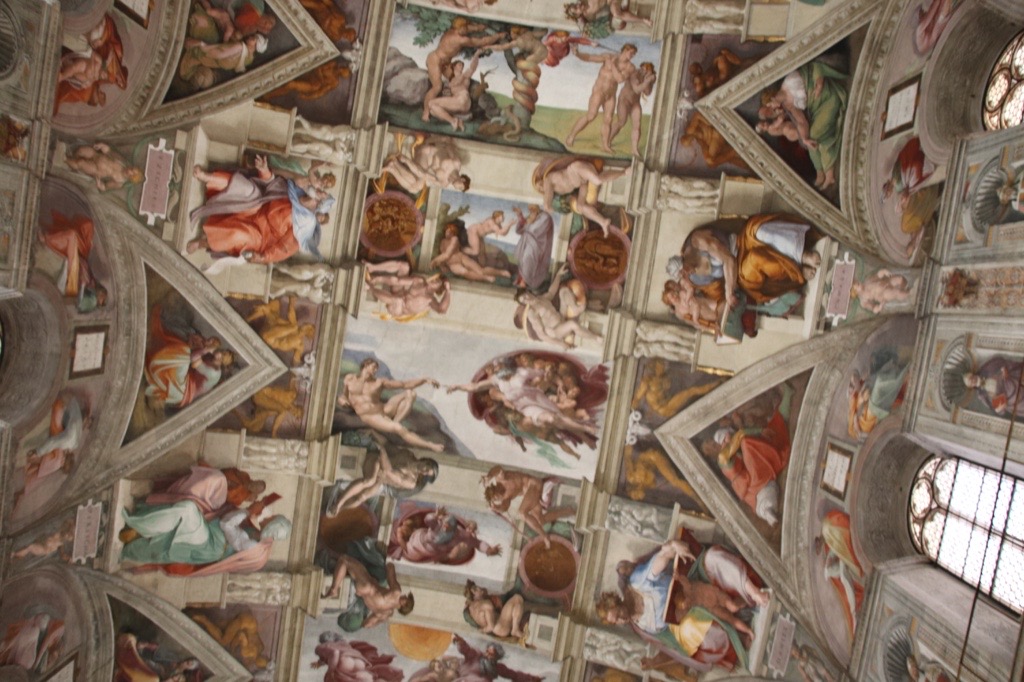
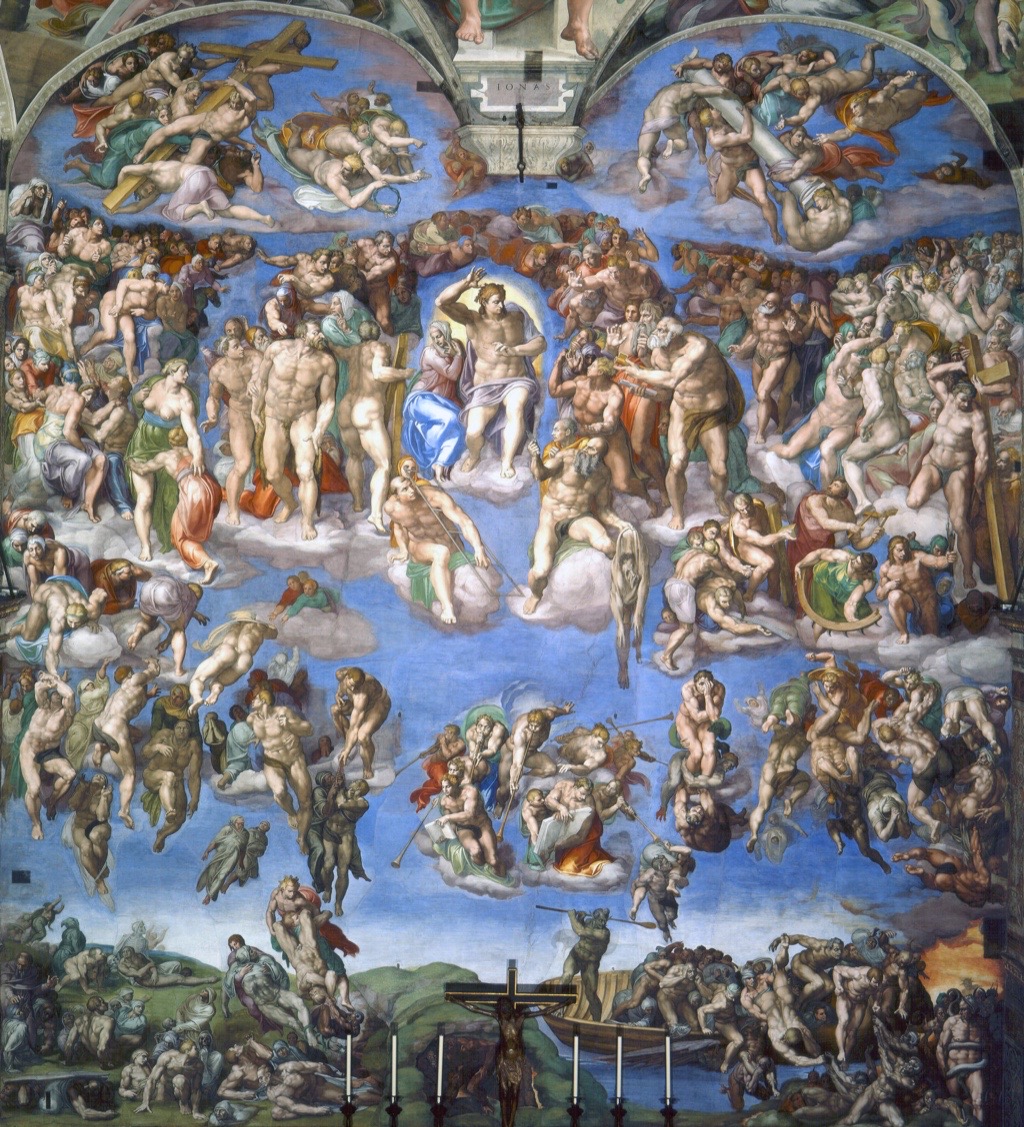
The Sistine ceiling began later. The Vatican Museums records Michelangelo’s 1508 contract and completion in 1512.[12] The ceiling expands qualities already visible in the panel—twisting bodies, strong contour, abrupt colour changes and classical nudity—across a painted architecture containing hundreds of figures.
The relation should not be reversed into prophecy. The Doni Tondo did not “predict” every feature of the ceiling, and its five background nudes are not automatically the same as the ceiling’s ignudi. One is a domestic panel with a Holy Family; the other is a papal chapel programme organised around Genesis, prophets, sibyls, ancestors and Israelite salvation.
Seen within Michelangelo’s biography and paintings, the tondo is a concentrated demonstration of cross-media design. The circle recalls carved relief; the foreground group has sculptural mass; the paint creates effects stone cannot; the frame adds another carved register; and the iconography turns domestic devotion into an argument viewers still debate.
Its importance does not depend on calling it the single origin of Mannerism. Later artists responded to its difficult poses, compressed space and colour, but a movement is not created by one panel in one instant. The more defensible achievement is already large enough: Michelangelo made a round household painting behave like a complex meeting of sculpture, colour, theology and family identity.
Artist Up Close
The Doni Tondo shows Michelangelo treating paint as a medium capable of sculptural pressure without imitating stone. Colour separates and joins bodies; the circular boundary forces every projection back into a turning system; the frame carries the image into the physical room.
Its disagreements are equally revealing. The precise date, occasion and background nudes remain contested because the painting sustains several relationships at once—domestic and theological, ancient and Christian, intimate and monumental. Michelangelo made a finished object that refuses a finished interpretation.
Frequently Asked Questions
Discussion
Set the pagan-humanity, catechumen and limbo readings beside the visible evidence. What does each explain, and what remains unresolved?
Reader Insights
Trace Mary’s legs, torso, arms and gaze, then Joseph and the Child. Where does the movement begin, and where does it appear to reverse?
Imagine the same figures in a rectangle. Which pressures, arcs and overlaps depend upon the tondo format?
Compare the Holy Family, John and the background nudes. How do scale, clothing, wall and focus establish distance?
Join the Conversation
Compare the Doni Tondo with the Pitti Tondo, Pietà, David or Sistine ceiling. What can paint, carved marble, relief and fresco each do with bodily weight, colour and surface?
References
- Uffizi Galleries, Holy Family, known as the “Doni Tondo”, View source.
- Uffizi Galleries, Portraits of Agnolo and Maddalena Doni, View source.
- Chiara Franceschini, The Nudes in Limbo: Michelangelo’s Doni Tondo Reconsidered, View source.
- Livio Pestilli, Revisiting Michelangelo’s Doni Tondo, View source.
- Smithsonian Museum Conservation Institute, Michelangelo as a Colourist, Revealed in the Conservation of the Doni Tondo, View source.
- National Gallery, Studying Old Master Paintings — Book of Abstracts, View source.
- Metropolitan Museum of Art, Michelangelo: Divine Draftsman and Designer, View source.
- Musei del Bargello, Michelangelo: the Bloom of Renaissance Art, View source.
- Royal Academy of Arts, Michelangelo Buonarroti: The Taddei Tondo, View source.
- Galleria dell’Accademia di Firenze, Michelangelo’s David, View source.
- Vatican Museums, The Casts of the Three Pietà, View source.
- Vatican Museums, Sistine Chapel Ceiling, View source.