


 by Tom Gurney
Tom Gurney BSc (Hons) is an art history expert with over 20 years experience
Published on June 19, 2020 / Updated on November 6, 2025
Email: tomgurney1@gmail.com / Phone: +44 7429 011000
Noah's Ark in Michelangelo's Flood
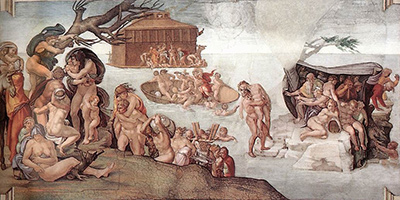
Noah's ark is not the frantic boat at the centre of Michelangelo's Flood. It is the distant, box-like vessel beyond it: small in the painted field, structurally stable and carrying the remnant that will survive.
The distinction is essential. The overloaded central craft belongs to doomed humanity and is close to sinking. The ark was built at God's command and holds Noah, his family and pairs of animals. Michelangelo separates human improvisation from divinely ordered preservation through distance, shape and scale.[1]
This page examines that single detail within the larger Sistine fresco. The full work includes foreground hills, a rocky shelter, swimmers, families and a collapsing world. The ark matters because it is visually minor but narratively decisive.
At a Glance
- DetailNoah's ark
- Parent workMichelangelo's The Flood, also called The Deluge
- DatePainted during the Sistine ceiling campaign, 1508–12
- TechniqueFresco
- LocationOne of the nine central Genesis scenes on the Sistine Chapel vault
- Biblical sourceGenesis 6–8
- Position in the sceneDistant background, beyond the central open boat
- OccupantsNoah, his family and preserved animal life according to Genesis
- Key visual distinctionEnclosed, box-like ark versus unstable open craft
- Theological rolePreservation through judgement and the beginning of renewed humanity
Contents
- The Vessel God Commands
- Finding the Ark
- Ark and Boat Are Not the Same
- Why the Ark Is So Small
- A Box on the Water
- Noah Is Present Through Architecture
- Animal Life in the Distance
- The Flood and Baptism
- The Ark in the Ceiling Sequence
- Scale, Crowds and Michelangelo's Changing Method
- Human Sympathy and Divine Selection
- How to Look at the Ark
- Why the Ark Matters
The Vessel God Commands
Genesis describes a world filled with violence. God tells Noah to make an ark of gopher wood, provide rooms and cover it within and without.[2]
The biblical vessel is not designed as a fast rescue boat. It is an enclosure built to preserve life through waters no navigator could master.
Noah enters with his household, animals and provisions. The ark rises with the Flood while life outside it perishes.[3]
Michelangelo therefore gives it a different shape from the open central boat. The ark resembles a large floating structure or chest more than a conventional ship.
Its visual strangeness is faithful to function. It carries a future rather than pursuing an escape route.
Finding the Ark
From the chapel floor, the ark can be difficult to locate. It sits in the background near the centre, beyond the more dramatic foreground clusters.[1]
The eye naturally goes first to larger naked bodies, the tree, the raised shelter and the boat where men fight for control. Those events provide immediate human crisis.
The ark requires a second stage of looking. Once found, it reorganises the entire scene. The nearby efforts are no longer simply multiple forms of rescue; they are alternatives to the one vessel that will endure.
High-resolution reproductions can make the detail obvious, but they also risk giving it a prominence absent from the original viewing situation.
Michelangelo's choice depends upon delayed recognition. Salvation is present, but it does not dominate by physical size.
Ark and Boat Are Not the Same
The open boat at centre is crowded with struggling figures. One man raises a club or pole, bodies pull at the sides and the vessel appears unstable.
The Vatican Museums explicitly distinguishes that boat, “about to sink,” from the ark in the background.[1]
Confusing them changes the story. If the central craft is Noah's ark, the chosen vessel appears to be overwhelmed by conflict and failure. Genesis states the opposite: the ark preserves its occupants through the waters.
Michelangelo uses two kinds of maritime form to make that contrast legible. Open boat means exposed contest; enclosed ark means protected continuity.
The difference also has an ethical edge. Human ingenuity and strength are not enough within divine judgement. The central boat's drama cannot produce the covenantal future carried by Noah.
Why the Ark Is So Small
The ark's small scale follows pictorial distance, but it also establishes narrative hierarchy in an unexpected way.
The physically largest people are not the most secure. Nearness makes their bodies vivid but cannot save them. The smallest architecture contains the future of human and animal life.
This reverses the ordinary relationship between scale and importance. Michelangelo asks viewers to distinguish visual urgency from theological consequence.
The ark is stable partly because its occupants are not individually dramatised. We do not study Noah's face or count visible species from the chapel floor.
Its reduced form operates almost as a sign within a crowded history: the one enduring container amid failed refuges.
A Box on the Water
The Latin arca can mean a chest or box, and the Vulgate uses the term for Noah's ark. Michelangelo's block-like structure recalls containment more than seafaring elegance.
This shape distinguishes the ark from Renaissance ships with masts, sails and shaped hulls. It has little need to steer because divine preservation, not navigation, determines its course.
The apparent upper level or enclosure gives the vessel architectural character. It is a temporary house for a household and for living kinds.
That architectural quality also links it to the gathered shelter on the right foreground. Both promise cover, but only one has been built according to God's command.
Similarities of roof and enclosure intensify rather than erase the difference between refuge and ark.
Noah Is Present Through Architecture
Michelangelo does not make Noah a foreground hero in this scene. His identity is concentrated in the vessel associated with him.
The omission is striking because Noah appears in two adjacent ceiling histories: the Sacrifice of Noah and Drunkenness of Noah.
In The Flood, the catastrophe's victims occupy attention while Noah survives at a distance. His righteousness is narrated through position rather than expressive anatomy.
This prevents the scene from becoming a conventional heroic rescue. Noah cannot reach the drowning groups, and the ark is not shown collecting late arrivals.
The separation preserves Genesis's hard boundary between those inside and outside.
Animal Life in the Distance
Genesis emphasises the preservation of animal kinds alongside Noah's family. Michelangelo does not turn the ark detail into a procession of paired creatures.
At ceiling distance, such a catalogue would be illegible and would compete with the human catastrophe.
The vessel stands for its occupants collectively. Viewers bring knowledge of the animals from scripture even when they cannot identify them pictorially.
This is an example of productive incompleteness. The fresco does not need to illustrate every verse to activate the full story.
The ark's enclosure is itself enough to suggest a densely held living world.
The Flood and Baptism
The Vatican Museums notes the likely relevance of 1 Peter 3:20–22, which connects the few saved through water in Noah's time with baptism.[4]
Within Christian interpretation, the Flood therefore prefigures both judgement and the water through which a renewed people emerges.
The ark can also be understood typologically as an image of the Church, carrying believers through destructive waters. That association developed across Christian art and preaching.
Michelangelo does not paint a literal church building afloat, so typology should remain a framework rather than an object description.
Still, the distant enclosure gains meaning from the chapel around it. Painted within the pope's principal sacred space, the preserved community speaks to Christian ideas of salvation and rebirth.
The Ark in the Ceiling Sequence
The Flood belongs to the three Noah scenes at the entrance end of the central sequence. In biblical chronology, Noah sacrifices after leaving the ark, but on the ceiling The Sacrifice of Noah appears before The Flood when read from altar toward entrance.[5]
The reversal has generated interpretations about typology, visual arrangement and the direction in which the ceiling should be read.
For the ark detail, the important point is that its story does not stand alone. Preservation leads to sacrifice and covenant, then to the troubling episode of Noah's drunkenness.
Survival is not presented as a permanent end to human weakness. The renewed family remains human.
The tiny ark therefore carries both hope and the narrative complication that follows.
Scale, Crowds and Michelangelo's Changing Method
The Flood contains many relatively small figures and is associated with the earlier broad phase of the ceiling campaign. Later central scenes often use fewer, larger bodies.
The ark is the most compressed element within an already crowded design. It depends more upon silhouette and placement than anatomical description.
That difference shows Michelangelo working across scales. The artist famous for colossal nudes could also make a distant geometric form carry the outcome of an entire narrative.
Its economy is not lesser artistry. It is a solution to hierarchy: foreground bodies deliver compassion; background architecture delivers consequence.
Both are necessary to the fresco's moral tension.
Human Sympathy and Divine Selection
The ark creates the scene's hardest emotional division. Viewers know it holds the saved, yet their attention is drawn to families who help one another outside it.
Michelangelo does not visibly mark every drowning person as monstrous. They carry children, support elders and seek shelter.
The tiny vessel guarantees that the biblical judgement remains intact while the foreground refuses emotional simplicity.
Salvation is certain at the level of story; pity is powerful at the level of sight.
The distance between ark and victims prevents either truth from cancelling the other. That unresolved tension is central to The Flood.
How to Look at the Ark
First identify the unstable open boat in the middle distance. Then look beyond it for the larger enclosed form.
Compare the ark's geometric stability with the diagonals and crowded limbs around the boat.
Notice how little individual action is legible inside the ark. Its role is collective.
Zoom back out and allow the vessel to become small again. The relationship between near suffering and distant preservation is the detail's true scale.
Finally place it within the three Noah scenes. The ark carries the family that will sacrifice, plant, drink and begin human history again.
Why the Ark Matters
Noah's ark matters because Michelangelo makes narrative importance almost inversely proportional to size. The distant box carries the future while foreground strength fails.
It clarifies the difference between refuge and salvation, invention and obedience, immediate sympathy and scriptural outcome.
Seen correctly, the detail is not an accessory behind the “real” drama. It is the quiet fact that makes every other struggle tragic.
Frequently Asked Questions
Discussion
What details, sources or comparisons stand out to you in Noah's Ark?
Reader Insights
Which formal detail changes how the work reads?
Which documented source or collection history feels most useful?
Which related Michelangelo work should readers compare next?
Join the Conversation
Add a source-led observation, comparison or question for other readers.
References
- Vatican Museums, The Flood., View source.
- United States Conference of Catholic Bishops, Genesis 6, View source.
- United States Conference of Catholic Bishops, Genesis 7, View source.
- Vatican Museums, Sistine Chapel,” programme and baptismal interpretation of the Flood, View source.
- Vatican Museums, Central Stories., View source.