


 by Tom Gurney
Tom Gurney BSc (Hons) is an art history expert with over 20 years experience
Published on June 19, 2020 / Updated on November 6, 2025
Email: tomgurney1@gmail.com / Phone: +44 7429 011000
Michelangelo's Crucifix of Santo Spirito
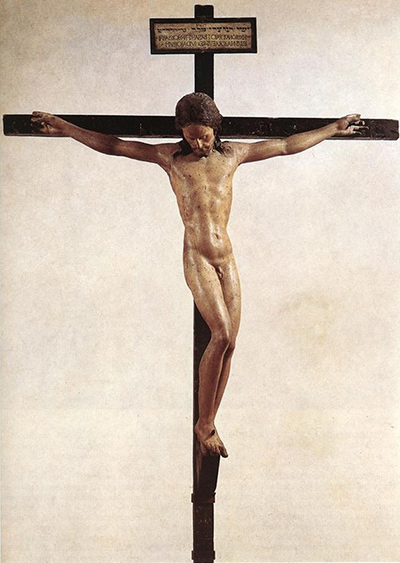
Michelangelo's wooden Crucifix in Santo Spirito presents Christ without the monumental force usually associated with the artist. The body is slender and nearly life-size. The head falls quietly, the knees bend, and the feet descend without the emphatic struggle found in many late medieval crucifixes. Most remarkably, Christ is fully nude. Nothing separates bodily vulnerability from the sacred meaning of the figure.
Carved around 1492–1493, when Michelangelo was about eighteen, the sculpture belongs to his formative relationship with the Augustinian convent of Santo Spirito in Florence.[1] Early accounts say that he made a wooden crucifix for the convent's prior after receiving hospitality and access to bodies in its hospital for anatomical study. The work disappeared from modern recognition, survived under later paint in the convent, and was identified by the scholar Margrit Lisner in 1962.
Its rediscovery joins written and physical histories with unusual force. This is not simply an object assigned to Michelangelo because it resembles his mature art. The site, early testimony and surviving sculpture meet—though the identification still had to be argued, restored and debated. Today the crucifix is again in Santo Spirito, where a youthful investigation of the body continues to function as an image of prayer.
At a Glance
- ArtistMichelangelo Buonarroti
- TitleCrucifix of Santo Spirito
- DateAbout 1492–1493
- MediumCarved and polychromed wood
- SizeApproximately life-size; published measurements are about 139–142 centimetres high and 135 centimetres across
- Current locationSacristy of the Basilica di Santo Spirito, Florence
- Original contextMade for the prior of the Augustinian convent of Santo Spirito
- Distinctive featureChrist is shown completely nude
- RediscoveryIdentified by Margrit Lisner in the convent refectory in 1962
- ReturnRestored to Santo Spirito in 2000 after several decades at Casa Buonarroti
Contents
- The Young Michelangelo at Santo Spirito
- A Completely Nude Christ
- Anatomy Without Heroism
- Wood, Colour and Presence
- Restraint, Weight and Death
- Lost in Its Original Home
- What the Early Biographies Actually Establish
- Restoration and Public Reappearance
- Return to Santo Spirito
- How to Look at the Crucifix
- Why the Santo Spirito Crucifix Matters
The Young Michelangelo at Santo Spirito
Lorenzo de' Medici's death in 1492 ended the period in which the adolescent Michelangelo had enjoyed access to the Medici household and its humanist circle. His connection with Santo Spirito offered a different kind of support. The Augustinian community provided lodging and, according to early biographies, permitted him to study bodies in the convent hospital.[1][2]
The traditional account names the prior Niccolò Bichiellini as his protector. Michelangelo made a wooden Christ for him in gratitude. Because the records connect artist, object type, recipient and place, they form an unusually strong base for identifying the rediscovered sculpture.
Anatomical study at this moment should not be imagined as modern medical training. Renaissance artists learned from workshop practice, living models, ancient sculpture, drawings and occasional dissection. Direct access to the dead body could clarify the structures beneath the skin: the relation of rib cage to abdomen, the pull of tendons, the articulation of joints and the difference between active muscle and released weight.
Those observations mattered to Michelangelo throughout his career, but the crucifix does not display them as a technical demonstration. Christ's anatomy is quiet. The body has ceased to resist gravity; knowledge appears through restraint.
The convent context also joins study with devotion. The young artist's investigation of mortal flesh served an image of incarnation and sacrifice. The same body could be examined as material structure and contemplated as the body of Christ. The work's power lies partly in refusing to separate those modes completely.
A Completely Nude Christ
Christ hangs without a loincloth. This is startling not because Renaissance artists ignored nudity, but because an image intended for Christian worship had strong conventions governing the display of the crucified body. Painted or sculpted crucifixes normally covered the hips with a perizoma, whose folds could communicate movement and dignity.
Michelangelo instead presents the whole body as vulnerable. Nudity connects the figure with the theological claim that Christ assumed human flesh fully and submitted it to death. It can also evoke a state before shame and the exposure inflicted by execution. No decorative cloth interrupts the vertical passage from torso to legs.
The choice may have been managed liturgically with a removable covering at some stages of the object's use, but no lost cloth or original mounting should be reconstructed as fact. What survives is an uncompromising nude sculpture. The carving of the hips and pelvis is integral rather than an area designed merely to disappear.
This feature anticipates Michelangelo's persistent use of the nude for sacred meaning. In the Sistine Ceiling, bodily form becomes a language of creation, prophecy and ancestral history. In the Last Judgement, exposure makes resurrection and judgment physically immediate. The Santo Spirito Christ is far quieter than those vast ensembles, yet it begins from a related conviction: the body is not incidental to the sacred subject.
Anatomy Without Heroism
The figure's physique differs from the enlarged bodies of David, the Slaves or the Sistine ignudi. The chest is defined but not inflated. The waist narrows; the abdomen relaxes; arms extend with little muscular resistance. The legs are long and lightly modelled, with bent knees preventing a rigid frontal axis.
This youthful slenderness suits both the material and the subject. Wood can sustain extended arms with less weight than marble, while its grain encourages continuous, sensitive transitions. Polychromy completes the illusion of flesh, wounds and hair without requiring every detail to be cut deeply.
The head is especially restrained. It inclines rather than being thrown back. Facial expression does not turn suffering into theatrical display. The slight movement gathers attention toward the body as a whole.
Anatomical credibility appears in relations, not isolated muscles. Shoulders respond to the outstretched arms; the rib cage encloses volume; the soft abdomen answers the body's suspension; knees and ankles release. Death is conveyed through the loss of active coordination.
This makes direct study relevant without reducing the crucifix to evidence that Michelangelo dissected corpses. Many artists knew anatomy, and no single muscle functions as a signature. Here the documented Santo Spirito relationship gives bodily observation its historical setting. The sculpture shows how knowledge could be transformed into devotional naturalism.
Wood, Colour and Presence
Michelangelo is usually encountered through marble, fresco and drawing. The Santo Spirito work reminds viewers that carved wood formed an important part of Florentine sacred culture. Crucifixes occupied churches, chapels, processions and private spaces; their painted surfaces brought sculpture close to the appearance of living flesh.
Wood changes both making and perception. A carver works with grain, knots, joined elements and the risk of splitting. Extended forms may be made and attached separately. A layer of preparation receives colour, concealing much of the raw carved surface. The finished object is therefore collaborative in material terms even when one sculptor's name governs its design.
Polychromy distinguishes wound from skin and hair from flesh. It can intensify naturalism, but later repainting can also obscure original modelling and colour. The Santo Spirito crucifix survived through such changes. Its eventual restoration was essential to the modern attribution because scholars could see the underlying quality more clearly.[1]
The cross itself creates meaning through contact. Arms become a horizontal measure against the vertical support; the body hangs at their intersection. Although museum photography may isolate Christ as sculpture, the figure was conceived within that instrument of execution and salvation.
In Santo Spirito, the material object also participates in place. Wood, paint, architecture and ritual light make a different encounter from a white-marble figure on a gallery plinth. The crucifix's return restored not an exact original installation, which no longer exists, but a living relationship with the community for which it was made.
Restraint, Weight and Death
Many crucifixes organise the Passion through visible agony: strained arms, sharply twisted torso, abundant blood and a face contorted by pain. Michelangelo's image is composed. This does not make suffering absent. It places the emphasis after struggle, when the body's stillness signals death.
The bent knees break symmetry gently. The head's inclination answers them, preventing the body from becoming a diagram. From a distance, the silhouette remains legible; from close range, small transitions keep the flesh alive to light.
The body is also young. Smooth surfaces and slight proportions avoid the aged or massively heroic Christ found in some traditions. Youth can intensify pathos because physical potential has been stopped. Yet the work does not seek pity through exaggeration. Its appeal is contemplative.
This balance between exactness and idealisation is characteristic of Renaissance sacred naturalism. The figure must appear truly dead without becoming merely a corpse. It must remain beautiful without making execution decorative. Michelangelo allows anatomical order to persist while active life has left it.
The nudity sharpens this balance. Clothing cannot carry emotion through folds; bodily structure must do everything. Every shift in chest, abdomen, hip and knee participates in the theological image.
Lost in Its Original Home
Early biographers preserved knowledge that Michelangelo had made a wooden crucifix at Santo Spirito, but the physical work ceased to be recognised. Changes to the church and convent, altered devotional practices and layers of repainting separated the sculpture from its name.
What the Early Biographies Actually Establish
Giorgio Vasari and Ascanio Condivi wrote with different aims and at different distances from Michelangelo, but both preserve the essential link among the young artist, Santo Spirito, anatomical study and a wooden crucifix.[1][2] Their testimony matters because it predates the modern rediscovery by centuries. Lisner did not invent the existence of a lost Santo Spirito work; she proposed that a surviving object answered an old description.
Biographical evidence is not the same as a contract. Vasari shaped artists' lives into narratives of talent and progress, while Condivi wrote with Michelangelo's cooperation and defended his reputation. Details can be selective, compressed or made exemplary. The gratitude story—hospital access answered by a gift to the prior—has the satisfying structure of moral exchange.
Even with those cautions, the agreement on material, subject and institution is unusually useful. “A wooden crucifix somewhere in Florence” would permit many candidates. A wooden Christ made for the prior of the very convent where an early figure survived is substantially narrower.
The sources do not describe every visual feature. They do not give measurements, record polychromy layer by layer or explain the complete nudity. Those questions must be answered from the sculpture. Nor do they prove that the rediscovered figure remained unaltered from Michelangelo's hands.
The attribution therefore works in two directions. Text gives the object a historically documented category and place. The object's age, quality, form and location make it a persuasive material answer to the text. This reciprocal fit distinguishes identification from a stylistic resemblance followed by a famous name.
In 1962 Margrit Lisner encountered a wooden crucifix in the convent refectory while cataloguing Tuscan examples.[1] Its quality and unusual form led her to identify it with the object described in the sources. Restoration revealed modelling obscured by later paint and allowed a fuller assessment.
The discovery demonstrates that “lost” does not always mean physically absent. An object can remain near its place of origin yet lose its documentary identity. It becomes visible in daily life while invisible to scholarship.
Identification required several kinds of fit. The sculpture was in the correct institution. It matched the material and subject described by early sources. Its date, anatomical intelligence and style aligned with Michelangelo's youth. None alone would have been conclusive; together they produced a strong case.
The attribution generated debate, as any major rediscovery should. Questions about restoration, dating and stylistic comparison were not obstacles to knowledge but part of establishing it. The work's present acceptance rests on accumulated evidence rather than the drama of a single recognition.
Restoration and Public Reappearance
After restoration, the crucifix was presented publicly in Rome and Florence in 1964.[1] The displays brought a formerly obscure convent object into the literature on Michelangelo. It was then housed for decades at Casa Buonarroti, the Florentine museum devoted to the artist and his family.
That setting made the work accessible for study and placed it among objects documenting Michelangelo's formation. But it also shifted the crucifix from devotional environment to monographic museum. The body could be inspected as an artistic beginning rather than encountered primarily above an altar.
Conservation raises difficult questions for any polychromed wood. Removing later paint may reveal earlier layers but can also alter a history of use. Decisions about which surface to present shape the figure modern viewers call original. A responsible account recognises restoration as part of the sculpture's visible history, not a transparent reversal of time.
The recovered work nevertheless transformed understanding of the young Michelangelo. It demonstrated a capacity for tender, near-life-size carving that neither the compact Madonna of the Stairs nor the crowded Battle of the Centaurs reveals. It also gave material form to the biographical account of his anatomical work at Santo Spirito.
Return to Santo Spirito
The crucifix returned to the basilica in 2000.[1] Its original position above the high altar could not be reinstated because seventeenth-century alterations, including Giovan Battista Caccini's elaborate altar, had changed the space. Instead it was installed in the sacristy designed by Giuliano da Sangallo.
The solution acknowledges historical change. “Return” does not mean pretending that the church remains as it was in 1493. The object belongs to a building with its own centuries of additions, removals and reordered worship.
The sacristy offers a more intimate encounter. Viewers can approach the figure at a scale suited to its restrained modelling. The architectural setting is Renaissance, but the primary gain is functional: a sacred image once again inhabits the religious community that generated it.
This distinguishes Santo Spirito from several later crucifixes attributed to Michelangelo. The Gallino Crucifix at the Bargello has no comparable early site history and remains disputed. The ivory Christ at Montserrat was proposed as Michelangelo only in the twenty-first century and is dated by its museum about a century later. Similar subject matter must not erase different evidence.
How to Look at the Crucifix
Begin with the silhouette. Notice how little the body twists and how the bent knees keep it from rigidity. Follow the arms inward toward the shoulders and ask where tension gives way to weight.
Then look at the torso. The rib cage is present without becoming armour. The abdomen does not flex heroically. The narrow waist and youthful hips make the whole figure more fragile than Michelangelo's later nudes.
Observe how colour guides the eye. Flesh tone unifies the body; hair and wounds provide accents. Consider how different the figure would be as unpainted wood. Polychromy is not secondary decoration but part of its naturalistic effect.
Finally, attend to distance. From across the sacristy, the body is an emblem on the cross. From nearby, it becomes a sequence of physical adjustments. Devotional and anatomical looking coexist without becoming identical.
Why the Santo Spirito Crucifix Matters
The sculpture matters because it gives Michelangelo's beginnings an unexpected emotional register. The young artist is often imagined through competitive ambition, antique models and muscular force. At Santo Spirito, his knowledge serves quiet vulnerability.
It also records a formative exchange. The Augustinians provided hospitality and access to study; Michelangelo returned a sacred object. Whether every detail of the traditional story can be reconstructed, early testimony binds work and institution with unusual closeness.
Its rediscovery offers a lesson in evidence. Text alone preserved a work without locating it. Material survival alone preserved a figure without a name. Lisner's identification brought them together, and restoration made the comparison more legible.
Above all, the crucifix makes the body carry meaning without disguise. Christ is young, nude, anatomically credible and dead. No monumental setting or display of virtuosity is needed. Michelangelo's later art would fill some of the world's largest surfaces. Here, at nearly human scale, sacred force comes through restraint.
Frequently Asked Questions
Discussion
What details, sources or comparisons stand out to you in Crucifix?
Reader Insights
Which formal detail changes how the work reads?
Which documented source or collection history feels most useful?
Which related Michelangelo work should readers compare next?
Join the Conversation
Add a source-led observation, comparison or question for other readers.
References
- Basilica di Santo Spirito, Michelangelo's Crucifix”:, View source.
- Basilica di Santo Spirito, Il Crocifisso di Santo Spirito”:, View source.
- Ministero della Cultura, Dalla Chiesa di Santo Spirito di Firenze al Museo Diocesano di Napoli anche il Crocifisso ligneo di Michelangelo”:, View source.