


 by Tom Gurney
Tom Gurney BSc (Hons) is an art history expert with over 20 years experience
Published on June 19, 2020 / Updated on November 6, 2025
Email: tomgurney1@gmail.com / Phone: +44 7429 011000
The Gallino Crucifix and the Michelangelo Attribution
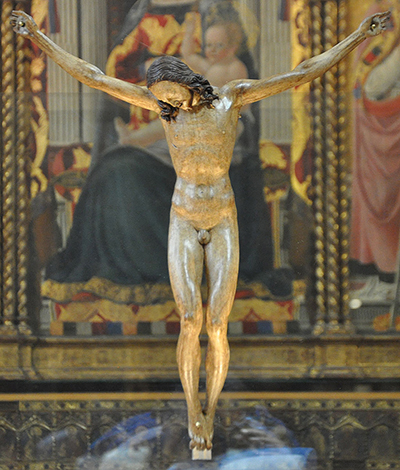
The Gallino Crucifix is a small body with an enormous attribution attached to it. Only 41.3 centimetres high and 39.7 centimetres across, the polychromed limewood Christ hangs without the cross for which it was made. His arms spread, his narrow waist contracts beneath a projecting chest, and his head falls deeply toward one shoulder. At close range the figure combines physical exactness with an almost weightless silhouette.
A group of scholars presented it publicly in 2004 as a work by the young Michelangelo, probably from around 1495. The Italian state bought it from the dealer Giancarlo Gallino in 2008, and it has been displayed at the Museo Nazionale del Bargello since 2012.[1] Yet the museum and state language remains “attributed to Michelangelo.” No document connects the object with him, its early provenance is unknown, and specialists have proposed other Florentine carvers or rejected the attribution altogether.
The controversy is inseparable from the work's public life, but it should not overwhelm the carving. The attributional case deserves to be reconstructed from anatomy, construction, comparison and historical possibility. Its limits deserve equal clarity. Scientific examination can reveal how a sculptor revised the head and modelled the body below the painted surface. It cannot, by itself, supply the carver's name.
At a Glance
- Proposed artistMichelangelo Buonarroti
- StatusAttributed and disputed; not a universally accepted autograph work
- TitleGallino Crucifix
- Proposed dateAbout 1495
- MediumCarved limewood with polychromy
- Dimensions41.3 × 39.7 centimetres
- Current locationMuseo Nazionale del Bargello, Florence
- Named afterGiancarlo Gallino, the dealer from whom the Italian state acquired it
- Public attributionPresented at the Museo Horne in 2004
- AcquisitionPurchased by the Italian state in 2008
- Technical landmarkCT examination in 2011 revealed internal construction and helped isolate the carved wood beneath preparation and paint
- Major cautionNo early document, commission or continuous provenance connects it with Michelangelo
Contents
- A Small Christ Conceived at Monumental Scale
- Christ Without the Cross
- Limewood, Assembly and Revision
- Looking Beneath Paint with CT
- The Anatomical Argument
- The 2004 Attribution
- Alternative Attributions and Dissent
- Acquisition by the Italian State
- Installation at the Bargello
- Comparing Gallino and Santo Spirito
- Why the Gallino Crucifix Matters
A Small Christ Conceived at Monumental Scale
The figure's reduced dimensions do not make it delicate in conception. The outstretched arms establish a broad horizontal measure, while the long legs pull downward. Chest, abdomen and hips are organised with enough structural clarity that the sculpture can appear larger in reproduction than it is.
Christ's head is the most dramatic departure from a static front. It falls toward his right shoulder, turning the face away from the body's central axis. The motion makes death visible as release: neck and head no longer sustain themselves. Hair follows the turn and deepens shadow around the face.
The torso balances strength and collapse. The rib cage remains broad, but the abdomen contracts and the waist narrows. Legs are elongated rather than massively muscular. These proportions have been compared with the Santo Spirito Christ and the dead Christ in the Vatican Pietà, both securely associated with Michelangelo's youth.[1]
Comparison can illuminate a shared understanding of bodily weight. It cannot decide authorship by resemblance alone. Florentine carvers worked within overlapping religious types, learned from one another and repeated successful models. The question is whether the Gallino figure's particular solutions are sufficiently inventive and sufficiently close to Michelangelo to identify his hand.
Christ Without the Cross
The wooden body survives without its original cross. This changes the way it is perceived. Displayed in a glass case, it can be circled and inspected as an independent sculpture. Originally the arms, hands and feet would have been fixed in relation to a cross, and the figure's apparent suspension would depend on that support.
The lost mounting also removes contextual evidence. The cross's scale, wood, inscriptions or attachments might have helped identify an intended setting and date. Without it, the body has no secure institutional history before the modern market.
Its small format suggests intimate devotion rather than a monumental church installation, though this cannot be proved. Compact crucifixes could serve convent cells, domestic rooms, small chapels or portable devotional needs. Their proximity made bodily detail available to one or a few viewers rather than a distant congregation.
That scale matters for technique. A slight cut can change expression; a narrow ridge can articulate a tendon; paint can complete details too fine to carve deeply. The maker needed to maintain grandeur without the physical amplitude of a life-size figure.
The modern case at the Bargello protects the object and permits viewing from all sides. It also creates an experience unlike original use. Christ appears to hover, and the museum visitor judges making where a worshipper would have confronted cross and Passion together.
Limewood, Assembly and Revision
Technical study established that the figure was not simply cut from one block. It is assembled from at least two pieces of limewood of very different sizes.[1] Joined construction was normal in wooden sculpture, especially where arms extend across the grain or where a carver needed to reduce the risk of splitting.
More unusual is a wedge-shaped insertion in the lower head and neck. Examination suggests that the head's pronounced inclination was revised during carving rather than completely planned in the initial block.[1] Supporters of the Michelangelo attribution regard this as evidence of active invention: the sculptor transformed a more conventional posture into a deeply fallen head.
The revision is genuinely important. It shows that the object was not produced mechanically from a fixed pattern. Its maker recognised an expressive possibility and altered the structure to achieve it. Related crucifixes sometimes repeat the inclined head more routinely, leading supporters to suggest that the Gallino work could be an archetype rather than one repetition among many.[1]
But invention is not unique to Michelangelo. A skilled Florentine specialist could revise a figure during work. Establishing priority within a family of related crucifixes requires secure dates and workshop relationships, which are not always available.
The internal evidence therefore identifies process more securely than person. A carver assembled the figure, changed the neck and created a new fall of the head. Whether that carver was Michelangelo remains the next, harder question.
Looking Beneath Paint with CT
After touring exhibitions, the crucifix underwent conservation review and was scanned by computed tomography at Careggi in 2011.[1] Digital processing allowed researchers to distinguish the carved wood from preparation and polychromy, effectively examining modelling that the finished skin partially conceals.
The scan clarified joins, inserted elements and the relation between surface and core. It also showed that anatomical transitions were present in the carving rather than created only by painted shading. Supporters argued that the sculptor built muscles and skeletal landmarks with an exceptional understanding of bodily structure.[1]
This is a strong answer to a limited question. The quality seen by eye belongs substantially to the wood, not solely to later decoration. The revised head is a structural act, not a superficial effect. Construction differs from some related examples.
CT cannot identify an artist directly. Scans do not contain a recognisable individual gesture in the way a signature might. Interpretation still depends on comparison with other sculptures, and even accepted Michelangelos provide a small sample in wood.
Technical findings can exclude implausible accounts, reveal restoration and establish the sequence of manufacture. They are most persuasive in attribution when joined to documents or a secure provenance. Here those external anchors are missing, so science sharpens the case without closing it.
The Anatomical Argument
The research team compared the Gallino Christ with the Santo Spirito crucifix and David, works whose anatomy has been studied closely. Massimo Gulisano and Pietro Antonio Bernabei argued that the small figure did not merely reproduce visible muscles. It coordinated skeletal landmarks, muscular connections and the body's response to gravity in a manner consistent with Michelangelo's anatomical thinking.[1]
The distinction is significant. An artist can copy the appearance of a chest yet fail to understand how shoulder, ribs and abdomen alter when arms spread and the body hangs. Structural knowledge operates through relationships.
The Gallino figure's head and torso are central to that argument. The fall of the head is not an isolated expressive device; it affects neck, shoulder and upper chest. The rib cage projects while the abdomen recedes, describing both bodily construction and death's loss of resistance.
Yet Renaissance Florence contained many sophisticated sculptors. Benedetto da Maiano, Baccio da Montelupo, Giuliano da Sangallo, Andrea Sansovino and specialist woodcarvers participated in a rich culture of sacred sculpture. They could study bodies, sculptures and workshop models. Michelangelo's example also became rapidly influential.
Anatomical coherence supports the judgment that the crucifix is exceptional. It does not convert excellence into identity. The attribution is strongest when specific anatomical habits align with date, expressive revision and comparison; it is weakest when the reasoning becomes “only Michelangelo could carve this well.”
The 2004 Attribution
Giancarlo Gentilini, Luciano Bellosi and Umberto Baldini were among the scholars who developed the Michelangelo proposal before the work's public presentation at the Museo Horne in Florence in 2004.[1] Their case placed the sculpture in the mid-1490s, shortly after the Santo Spirito crucifix and around Michelangelo's movements between Florence, Bologna and Rome.
The Horne exhibition enabled comparison with other Florentine wooden crucifixes. Supporters saw a figure both rooted in that tradition and distinguished by proportion, anatomical continuity and the revised head. They connected its tender but grave treatment with Michelangelo's early sacred bodies.
Historical plausibility also entered the case. A young sculptor without a continuous monumental commission could make small devotional works. Michelangelo had demonstrable experience carving wood at Santo Spirito. Early biographies acknowledge that not everything he produced or gave away was recorded.
Plausibility again has limits. The absence of a document cannot be dismissed simply because small objects often went unrecorded. The same conditions apply to many potential makers. Nor does Michelangelo's ability to carve a small crucifix mean that every unusual Florentine example belongs to him.
The 2004 proposal was therefore a connoisseurial attribution strengthened by technical and anatomical research. It was not the recovery of a lost contract. That is why careful public language retained a qualification from the beginning.
Alternative Attributions and Dissent
Margrit Lisner, whose work was fundamental to the Santo Spirito rediscovery, proposed Andrea Sansovino for the small crucifix.[1] The alternative recognises high quality while locating it within another major Florentine sculptural intelligence. It has not achieved universal acceptance either.
Other critics have questioned whether the work rises sufficiently above a family of related carved crucifixes to be assigned to Michelangelo. A model could circulate through workshops, with individual carvers varying head, hair and anatomy. The Gallino figure's innovations might identify a leading specialist without identifying the most famous possible artist.
Tomaso Montanari became a prominent public critic of both the attribution and the state's acquisition, arguing that publicity and the authority of Michelangelo's name outran scholarly consensus.[2] His intervention helped expose a wider issue: when government purchases a disputed object at a price shaped by a great name, attributional debate becomes entangled with accountability.
Dissent should be reported without assuming that controversy disproves authorship. Scholars can disagree in good faith over specific visual evidence. Political criticism of an acquisition is not a technical examination of the carving, just as state ownership is not authentication.
The present label—attributed to Michelangelo—holds this evidence in balance. It allows the affirmative case to remain visible while acknowledging that no consensus equivalent to the Santo Spirito crucifix has formed.
Acquisition by the Italian State
The Italian Ministry for Cultural Heritage acquired the crucifix from Giancarlo Gallino in 2008 for a widely reported €3.2 million.[2][3] The purchase made an attributional hypothesis a matter of public spending and national patrimony.
Before its permanent installation, the object travelled to exhibitions in Rome, Trapani, Palermo, Milan and Naples.[1] These displays amplified public familiarity but also risked making repetition look like confirmation. Exhibition beneath Michelangelo's name can establish cultural fact faster than scholarly agreement.
The acquisition generated sharp argument over valuation, procedure and expertise. Supporters saw the preservation of a rare early Michelangelo for the public. Critics saw the state paying a Michelangelo-level price for a work lacking documentation and consensus.
Market value cannot resolve that dispute. A high price may reflect scarcity, hope and institutional competition; it does not change the wood. Likewise, subsequent public ownership does not oblige scholars to accept the attribution.
The episode belongs in the manuscript because it shaped the work's modern identity. It also demonstrates why calibrated language is ethical as well as scholarly. Readers should know when a famous name is proposed rather than secured.
Installation at the Bargello
The crucifix was assigned to the Museo Nazionale del Bargello and, after conservation and CT study, installed in the Chapel of the Podestà in April 2012.[1] A climate-controlled case permits views from multiple directions while supporting the figure without passing pins through its palms.
Conservators redesigned the support so the hands were freed from damaging traction and the body's weight was carried at the torso.[1] This practical intervention is quietly appropriate to the subject: a sculpture of suspension must itself be supported safely.
The chapel gives the work a sacred architectural resonance within a museum. Fresco fragments and the historic room prevent the figure from appearing wholly detached from devotional culture. At the same time, the Bargello's great collection of Renaissance sculpture encourages close attributional comparison.
Nearby works can discipline judgment, but the museum setting again exerts authority. A visitor may see “Michelangelo” before seeing “attributed.” The sculpture benefits when its label and interpretation keep the difference unmistakable.
Comparing Gallino and Santo Spirito
Both figures are carved wooden Christs connected with Michelangelo's youth, but their evidence is not equivalent. Santo Spirito is nearly life-size, remains tied to the institution named in early accounts and matches the recorded gift to its prior. The Gallino figure is small, lacks its cross and has no known early provenance.
Formal comparison remains productive. Both favour slender bodies and restrained suffering. Both organise anatomy as an integrated structure rather than a catalogue of wounds. The Gallino Christ's deeper head fall and more compressed torso can be understood as a development of related concerns.
Those connections support a common artistic environment. Whether they support one hand depends on the specificity of execution. A follower could adapt Santo Spirito; a workshop model could mediate; another sculptor could arrive at similar solutions through shared Florentine practice.
The comparison should therefore lead to exact questions rather than inherited certainty. How are the rib cages built? Where do shoulders turn under suspension? How does the head's weight affect the neck? How do chisel and paint describe skin at different scales? Attribution advances through those differences.
Why the Gallino Crucifix Matters
The sculpture matters first because it is an accomplished Renaissance object. Its small scale concentrates bodily knowledge. Its revised neck records invention during carving. Its polychromy and lost cross preserve the devotional culture in which sculpture was handled, mounted and prayed before.
It also matters as a case study in how attribution enters public life. A scholarly proposal led to exhibition, acquisition, scientific study, political controversy and permanent museum display. Each stage generated new knowledge and new pressures.
The Michelangelo attribution is serious but unresolved. Strong scholars have argued from particular anatomical and formal evidence; technical research has revealed unusual construction; the object's date and type are compatible with his activity. Against this stand the missing provenance and documents, capable alternative carvers and persistent disagreement about whether similarities are personal or cultural.
Uncertainty should not be treated as failure. It preserves the distinction between what the object demonstrates and what scholars infer. The Gallino Christ was conceived with extraordinary attention to the moment a living body becomes dead weight. Its maker's name remains under debate; the carving's intelligence does not.
Frequently Asked Questions
Discussion
What details, sources or comparisons stand out to you in Gallino Crucifix?
Reader Insights
Which formal detail changes how the work reads?
Which documented source or collection history feels most useful?
Which related Michelangelo work should readers compare next?
Join the Conversation
Add a source-led observation, comparison or question for other readers.
References
- Città Metropolitana di Firenze, Esposto al Bargello il Crocifisso attribuito a Michelangelo,” 4 April 2012:, View source.
- Tomaso Montanari, Il ‘finto Michelangelo’: dossier sulle responsabilità e le spese inutili,” Il Fatto Quotidiano, 20 February 2012:, View source.
- *Corriere Fiorentino*, Michelangelo, inchiesta sul crocifisso,” 13 December 2009:, View source.