 by Tom Gurney
Tom Gurney BSc (Hons) is an art history expert with over 20 years experience
Published on June 19, 2020 / Updated on November 6, 2025
Email: tomgurney1@gmail.com / Phone: +44 7429 011000
Michelangelo's Sculptures
Michelangelo's sculpture begins, in the surviving record, with marble surfaces scarcely deeper than a hand and ends with two figures almost fused into one narrowing stone. Between the youthful Madonna of the Stairs and the Rondanini Pietà, he made a drunken god, a grieving mother, a colossal republican guardian, imprisoned bodies, prophets, dukes and personifications of time. Some are polished to a softness that seems to deny their material. Others preserve drill holes, rough planes, fractures and abandoned limbs.
The variety makes a simple gallery of masterpieces inadequate. Many sculptures belonged to architecture: cathedral façades, tombs, altars and chapels. Several were displaced when commissions changed. Some were partly completed by other hands; others were recut, damaged, restored or reattributed. The word “unfinished” names a visible condition but not a single artistic intention.
Michelangelo's central material was marble, yet he never treated it as neutral. A block arrived with dimensions, grain, veins, flaws and sometimes another sculptor's cuts. Carving removed stone irreversibly while leaving every decision vulnerable to what the material disclosed. His sculptures are bodies, but they are also biographies of blocks.
At a Glance
- Principal materialMarble
- Earliest surviving reliefsMadonna of the Stairs and Battle of the Centaurs, about 1490–1492
- Early Roman sculptureBacchus, about 1496–1497; Vatican Pietà, 1498–1499
- Florentine colossusDavid, 1501–1504
- Exported devotional sculptureMadonna of Bruges, 1503–1505
- Longest sculptural commissionTomb of Pope Julius II, begun in 1505 and repeatedly redesigned
- Major ensembleNew Sacristy, San Lorenzo, Florence
- Three securely documented Pietà projectsVatican, Bandini and Rondanini
- Shared executionSecond Risen Christ begun by Michelangelo and completed in Rome by assistants
- Attributed workPalestrina Pietà, presented by the Accademia as “Michelangelo (attr.)”
- Important conservation historiesCasa Buonarroti reliefs, Louvre Slaves and Bandini Pietà[1–18]
Contents
- Why the Corpus Has No Honest Single Number
- Two Young Reliefs, Two Kinds of Depth
- Bacchus: Balance Made Uncertain
- The Vatican Pietà: Two Bodies, One Base
- David: A Cathedral Block in Civic Space
- The Madonna of Bruges: A Child Stepping Away
- The Tomb of Julius II: One Commission, Many Monuments
- The Louvre Slaves and the Problem of Meaning
- Tondi, Standing Figures and Shared Hands
- The New Sacristy: Sculpture as Architecture's Time
- Brutus and the Political Bust
- Three Pietàs Across a Lifetime
- The Palestrina Pietà: Attribution Must Stay Visible
- What Non-Finito Can and Cannot Explain
- Movement, Restoration and the Lives of Objects
- Artist Up Close
- Marble as Memory
- Explore Michelangelo’s Sculpture
Why the Corpus Has No Honest Single Number
Counting Michelangelo's sculptures requires choices. Does one count each figure in the Medici tombs separately, or the chapel as an ensemble? Is an unfinished block a work? What of the second Risen Christ, completed by assistants, or the Palestrina Pietà, still attributed rather than securely autograph? Lost bronzes and unrealised commissions enlarge the historical corpus without becoming surviving objects.
A useful vocabulary preserves those conditions. “Autograph” identifies carving accepted as Michelangelo's. It does not mean untouched, finished or still in its original setting. “Attributed” acknowledges substantial evidence or tradition without pretending that authorship is settled. “Shared execution” identifies a real division of labour. “Associated with” may connect a figure to a changing project without fixing its position in every version.[1]
These distinctions matter particularly because Michelangelo's reputation attracts uncertain works. Fame can make resemblance look like proof. Institutional catalogues instead build attribution from material, provenance, documents and style. The result may change as evidence changes.
The corpus is therefore better understood as a set of object histories than as a score. Each history asks what Michelangelo designed, what he carved, who else intervened, what remains and where it is now.
Two Young Reliefs, Two Kinds of Depth
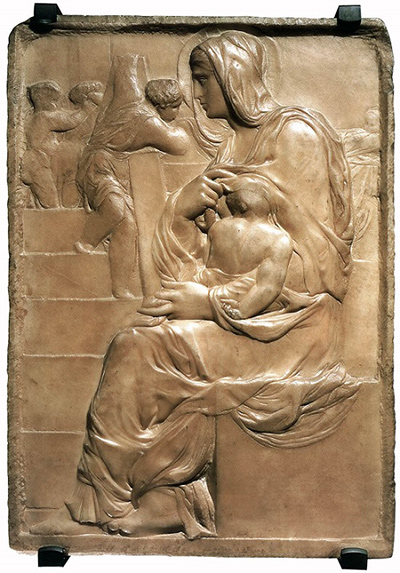
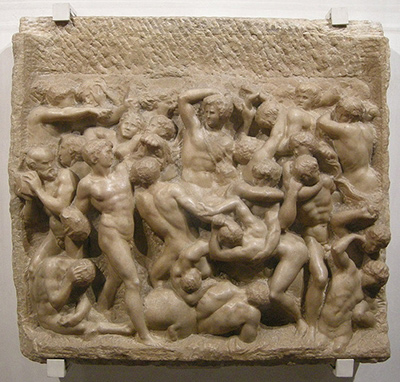
Casa Buonarroti preserves the Madonna of the Stairs and Battle of the Centaurs, made when Michelangelo was still in his teens. Their modest dimensions conceal an ambitious contrast. The Madonna relief creates spatial recession through exceptionally shallow cutting; the battle presses a knot of bodies through deeper, more forceful planes.[2]
In the Madonna of the Stairs, Mary sits in profile upon a block-like seat while the Child turns away across her lap. Steps recede behind attendants. Michelangelo uses rilievo schiacciato, compressed relief associated especially with Donatello, to make marble behave almost like drawing in light. Minute changes of depth produce overlapping limbs and architectural distance.
The Child's back and the broad geometry of Mary's body already reveal Michelangelo's preference for mass, but the emotional effect is quiet. Her large hand rests close to the sleeping figure; the profile withdraws from the viewer. Monumentality is compressed rather than absent.
The Battle of the Centaurs moves in the opposite direction. Nude bodies collide across the field without a stable landscape. Torsos, heads and arms emerge at different depths, and incompletion leaves the edges and some central passages open. The subject has been connected with a classical battle and with the intellectual world of Lorenzo de' Medici's household.[2]
Its unfinished state should not be made to predict every later rough surface. No document tells us that Michelangelo deliberately stopped to announce a theory of liberation from stone. What the relief securely shows is a young sculptor discovering how bodies can make their own space through collision.
Recent care is part of both objects. Casa Buonarroti's 2020–2022 conservation and new display improved their legibility while respecting their different surface states.[2] Cleaning is not completion; it helps the original cuts and later history become visible.
Bacchus: Balance Made Uncertain
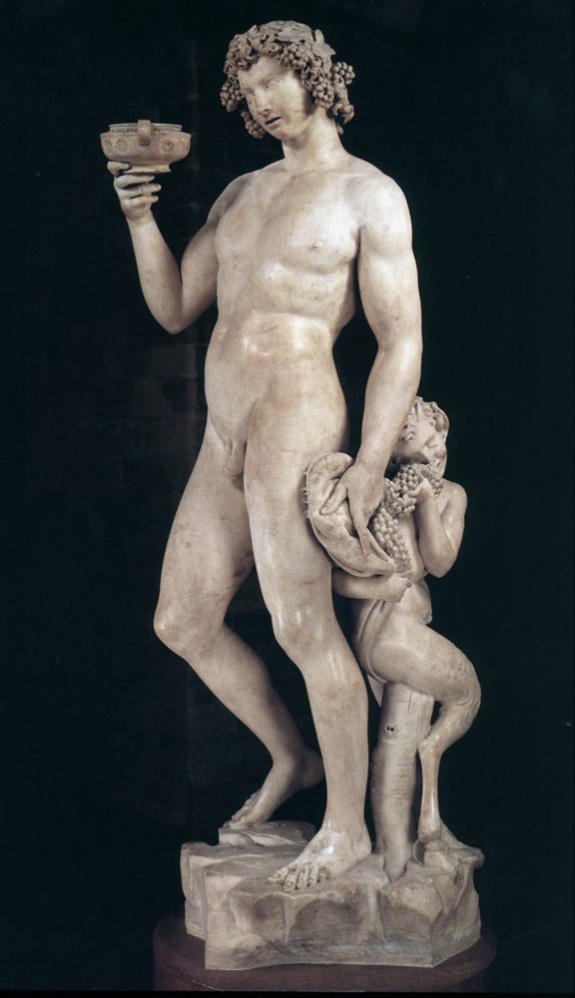
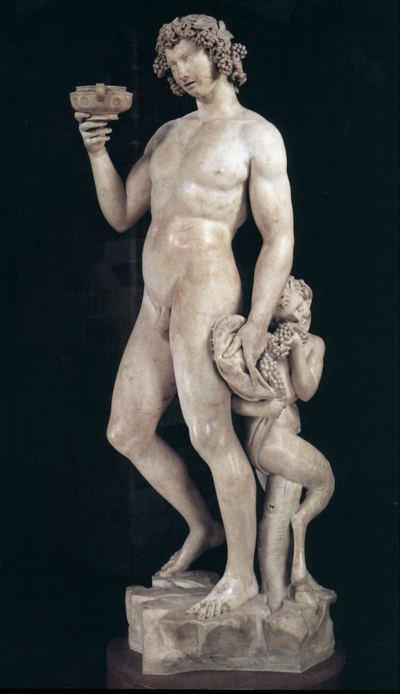
Carved in Rome around 1496–1497, Bacchus is a life-size pagan god whose body appears on the edge of losing equilibrium. He raises a cup, turns his head and lets his weight settle ambiguously through hips and legs. A small satyr at the rear eats grapes and supplies both narrative mischief and structural support.[3]
Michelangelo had studied antique sculpture, but he refuses a simple ideal of stable divinity. Soft abdomen, raised arm and slightly unfocused gaze make intoxication physical. The statue invites movement around it: the satyr, animal skin and grapes disclose relations unavailable from the front.
This early work expands the emotional range of Michelangelo's nude. The body is neither the poised future combatant of David nor a resurrected saint. Strength and instability coexist. Marble appears capable of swaying.
The work's history also resists a triumphal beginning. Cardinal Raffaele Riario, for whom it was apparently made, rejected or did not retain it; the sculpture entered the collection of Jacopo Galli. Patronage, placement and later museum display shaped the course by which an experiment in antique subject became one of Michelangelo's foundational works.[3]
Explore Michelangelo’s Sculpture
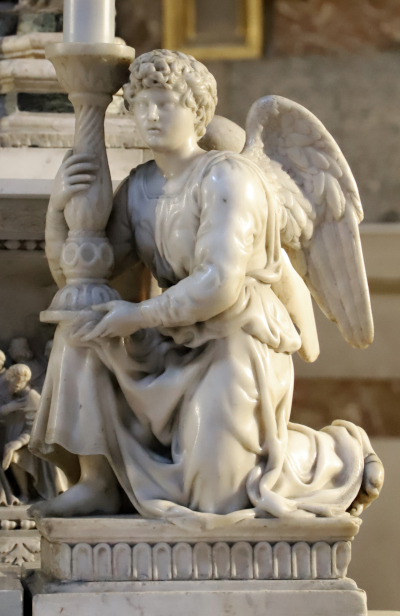
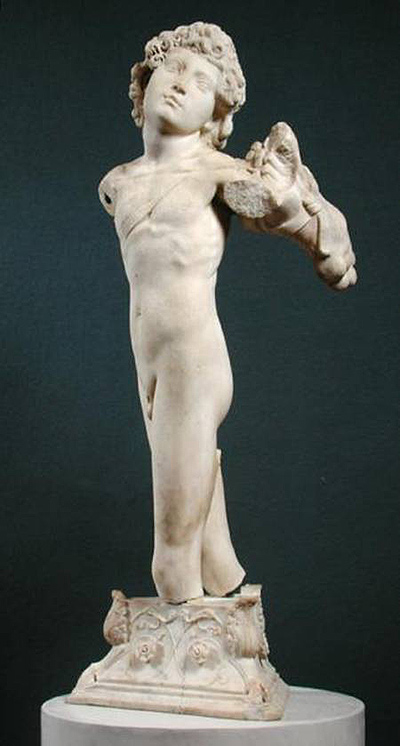
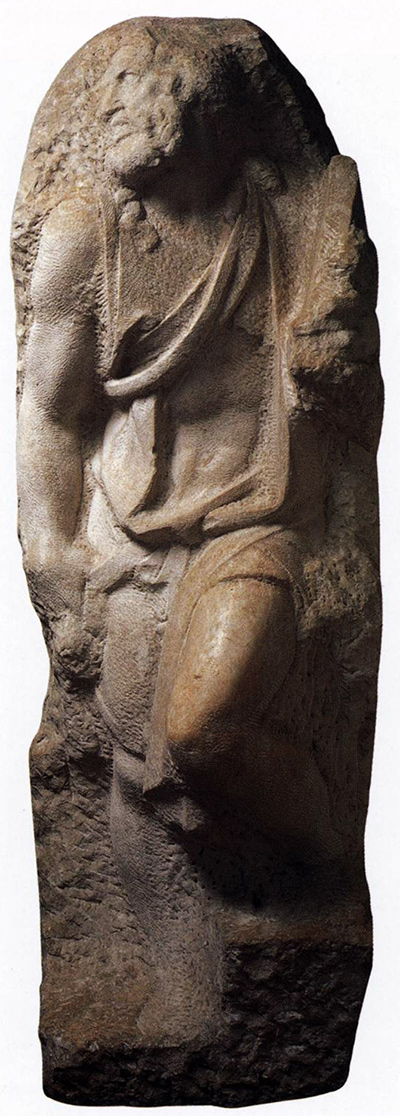
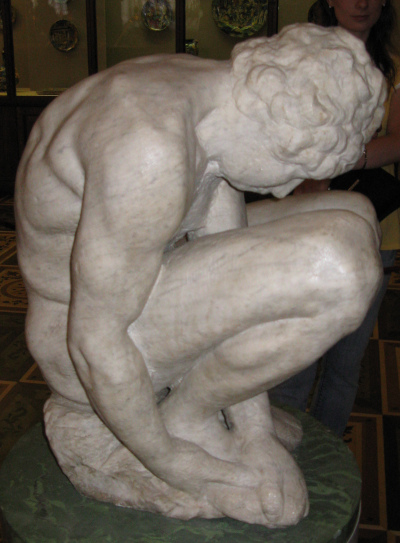
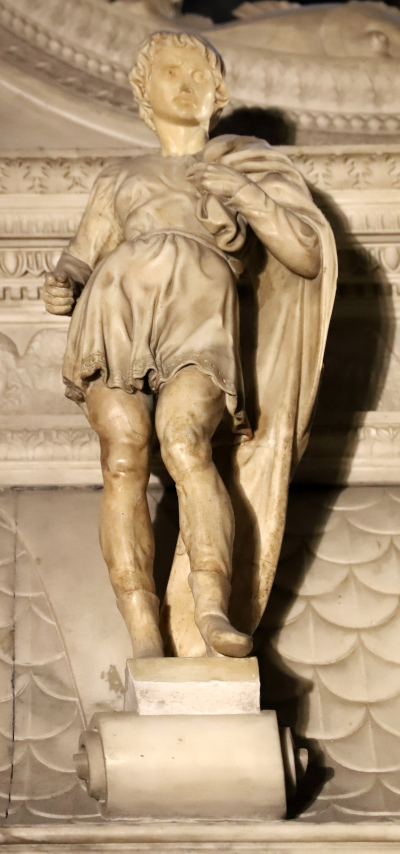
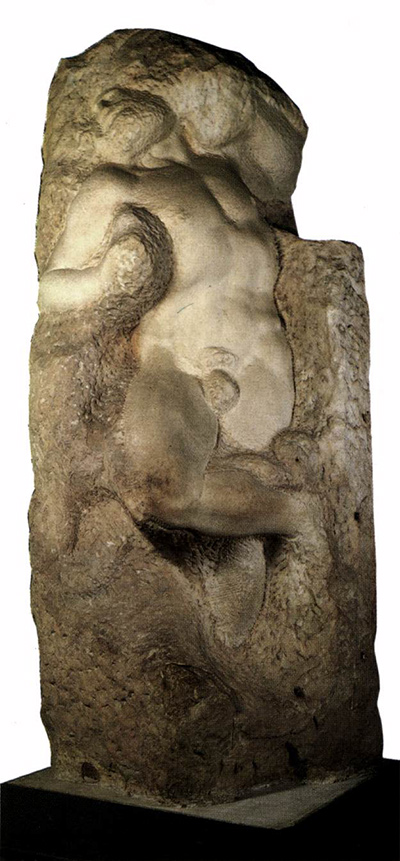
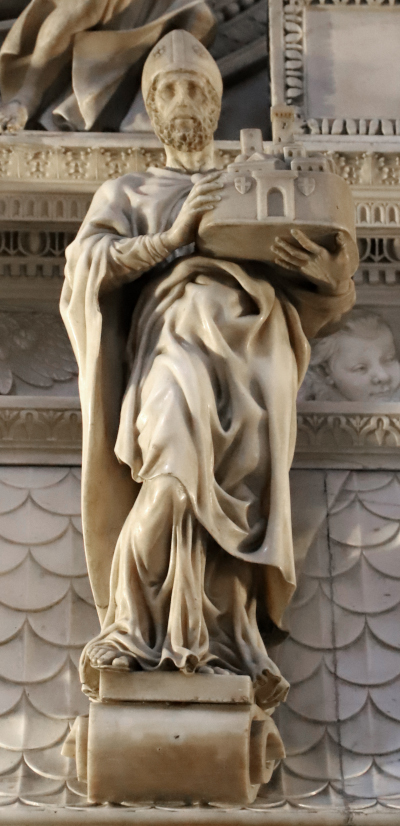
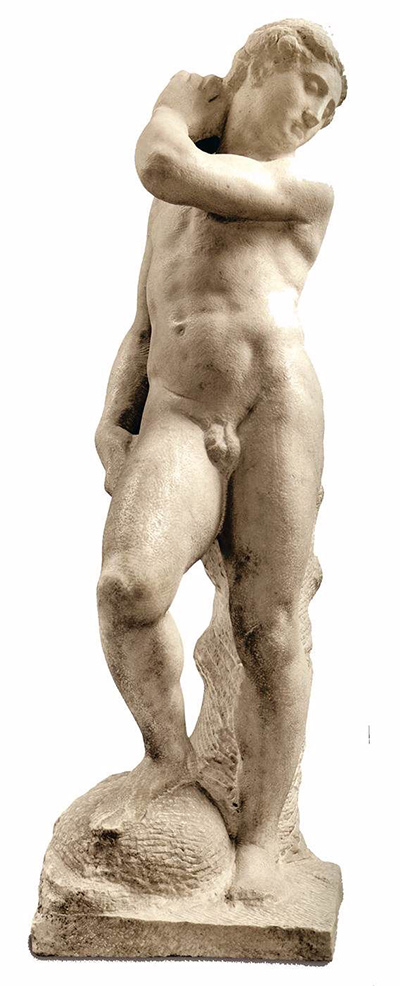
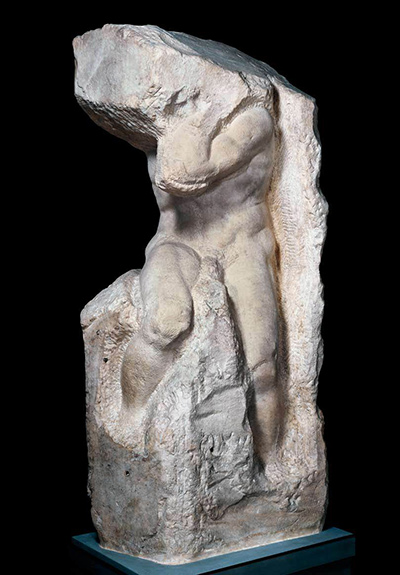
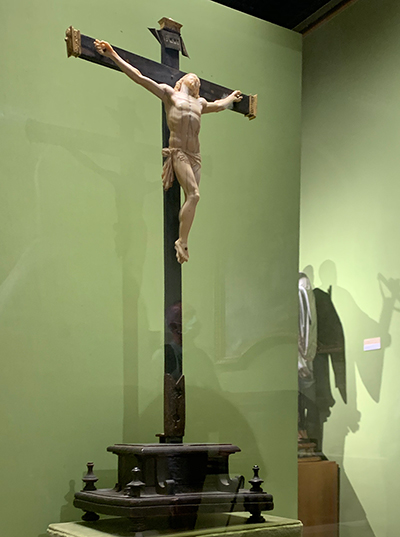
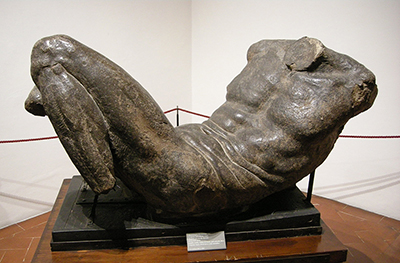
Use this section as the main route into Michelangelo’s sculpture pages, from early reliefs and independent statues to tomb projects, Medici Chapel figures, Slaves and attributed works.
 Michelangelo.jpg)
 Michelangelo.jpg)
 Michelangelo.jpg)
 Michelangelo.jpg)
The Vatican Pietà: Two Bodies, One Base
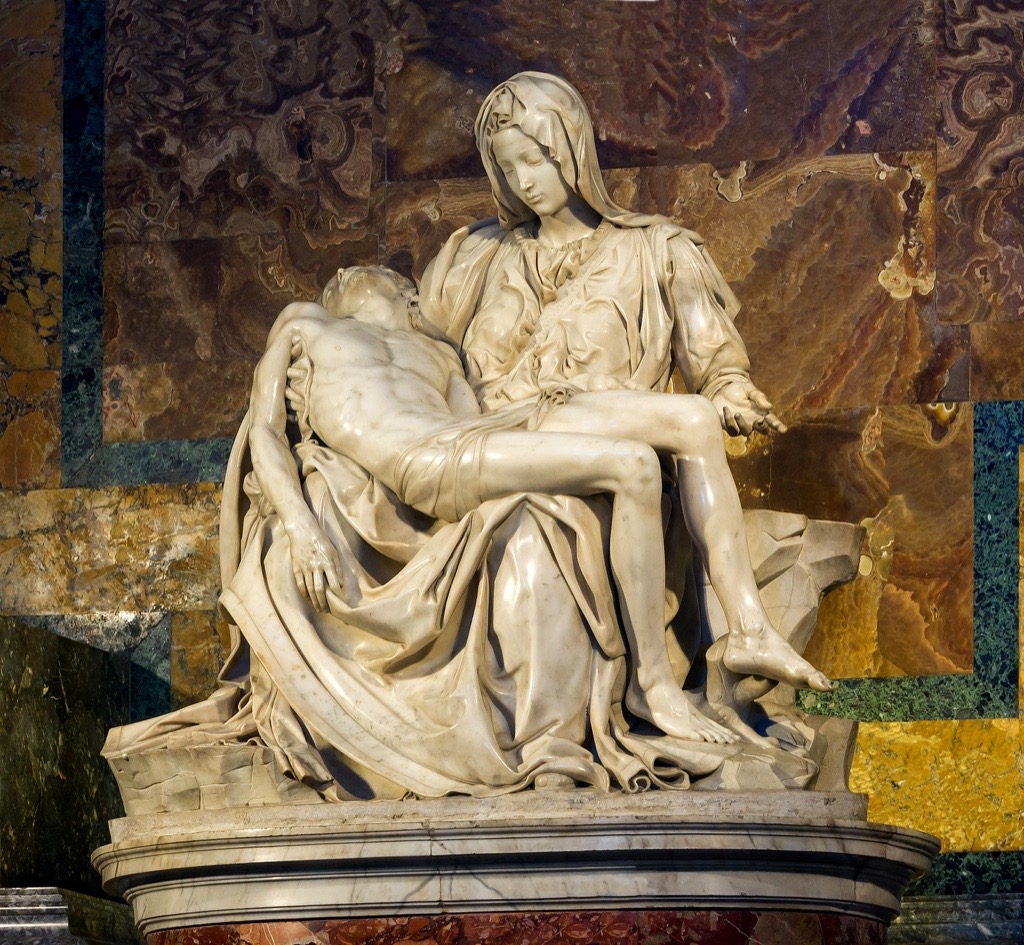
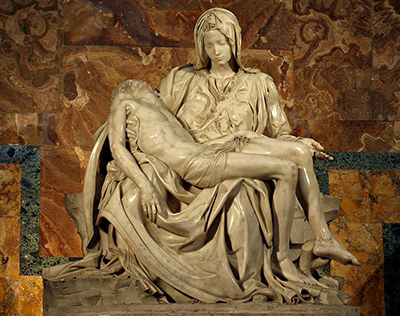
The Vatican Pietà was commissioned in 1498 by the French cardinal Jean de Bilhères for his tomb near Old St Peter's. Mary supports the dead Christ across her lap. The group is carved from one block, but Michelangelo makes it read as a broad pyramid capable of bearing a full-grown male body.[4]
Mary's lap is enlarged beneath complex drapery. Christ's torso lies diagonally, his right arm falling toward the base while his head tips back. Flesh is highly polished; cloth breaks light through deeper folds; the rocky base remains different again. Surface variety distinguishes body, garment and ground without colour.
Michelangelo limits the visible violence of death. Wounds are present but not sensational. Mary's face is idealised and youthful, a feature long explained through theological readings of purity and incorruptibility. Such interpretations belong to reception and should not become a single documented private statement by the sculptor.
His name crosses Mary's sash. This is the only sculpture he signed. The well-known story that he added it after hearing the group attributed to another artist comes from later biography and remains unproven. The inscription itself is material fact; its motive is not.[4]
The sculpture's current place behind protective glazing in St Peter's follows centuries of movement, damage and care. Modern fame can make that setting appear timeless, but the group was designed for a tomb chapel in the old basilica. Its devotional intimacy originally served commemoration.
David: A Cathedral Block in Civic Space
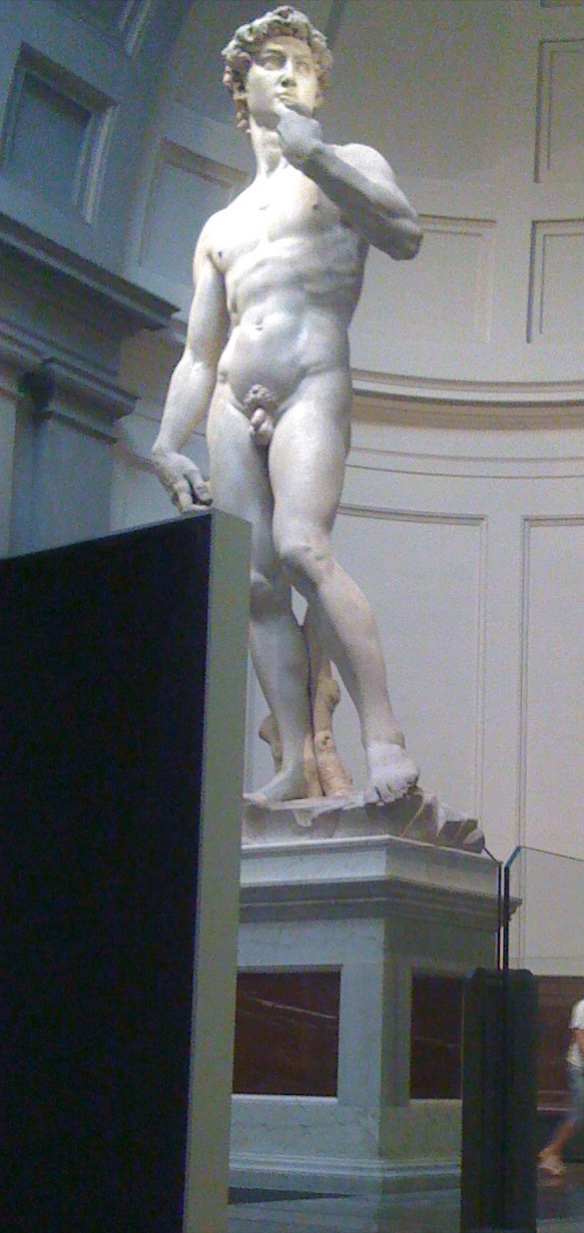
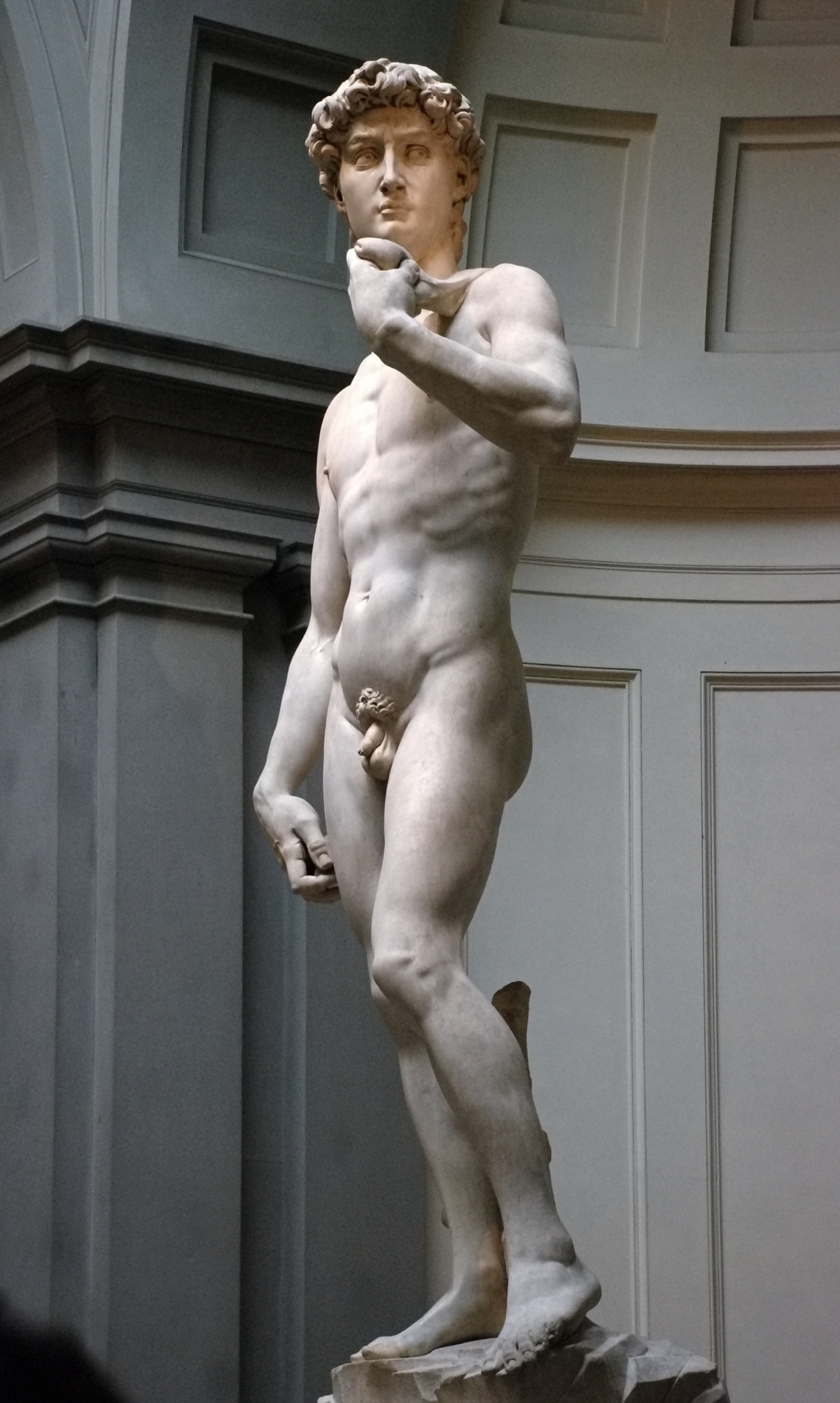
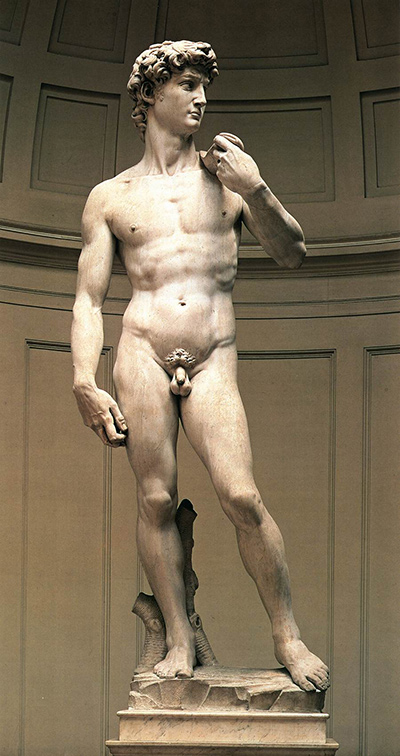
In August 1501 the Opera del Duomo entrusted Michelangelo with a huge marble block that Agostino di Duccio had begun decades earlier. Intended for the cathedral's sculptural programme, it was tall, narrow and already reduced. Michelangelo worked within another maker's cuts and the stone's long exposure.[5]
He represented David before the fight with Goliath. The giant is absent. David turns his head, tightens his brow and holds sling and stone with remarkable discretion. The pose keeps the body still while attention reaches beyond it.
The completed figure was judged too compelling for its intended high position. A committee debated alternatives, and it was installed in 1504 beside the entrance of Palazzo Vecchio. A sacred architectural commission became a civic guardian at Florence's seat of government.[5]
Scale transforms the biblical youth. At about 5.17 metres including the carved base, he is himself colossal, yet the underdog story survives through the hidden sling and unseen enemy. Enlarged head and right hand may answer an elevated viewpoint, expressive emphasis or both; no document fixes one optical theory.
The original moved indoors to the Galleria dell'Accademia in 1873. The figure beside Palazzo Vecchio is a later marble copy. Movement protected the weathered original but severed it from the political threshold that had shaped centuries of meaning.[5]
The Madonna of Bruges: A Child Stepping Away
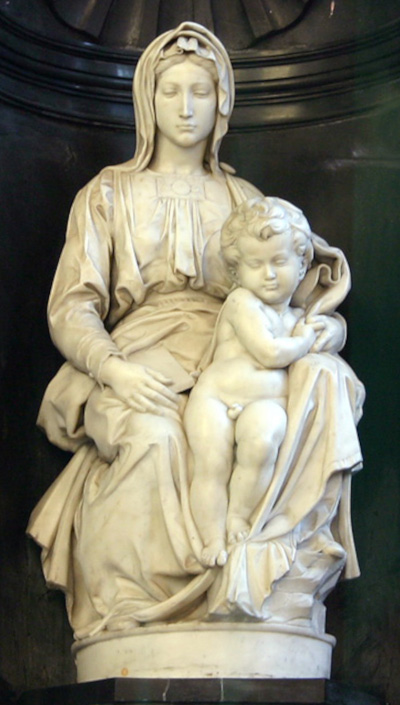
Michelangelo carved the Madonna of Bruges around 1503–1505. Christ stands upright between Mary's knees rather than resting passively across her lap. He seems to step forward while holding her hand or garment; she looks downward, withdrawn into thought.[6]
The vertical composition distinguishes it from the Vatican Pietà even though both join mother and son. Here separation is anticipated, not mourned. The Child's independent movement gives devotion a future tense.
The sculpture left Italy early. The Mouscron family acquired it and gave it to the Church of Our Lady in 1514 under conditions intended to keep it there. It became the exceptional Michelangelo marble exported from Italy during his lifetime.[6]
Its later displacement is dramatic. French forces took it to Paris in 1794; it returned in 1816. German forces removed it in September 1944; Allied recovery from the Altaussee salt mine led to its return to Bruges in November 1945.[6]
These journeys are not incidental adventures added to a timeless object. They explain present identity, protection and civic attachment. A devotional sculpture became war booty twice and survived through recovery.
The Tomb of Julius II: One Commission, Many Monuments
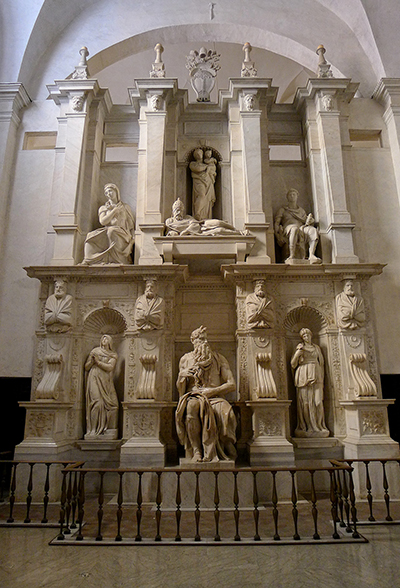
Julius II commissioned his tomb in 1505, initially imagining a vast freestanding monument for the new St Peter's. Over roughly forty years, contracts, patrons, available space and Michelangelo's other obligations repeatedly reduced and altered the project. The monument completed at San Pietro in Vincoli is not the unchanged execution of the first design.[7]
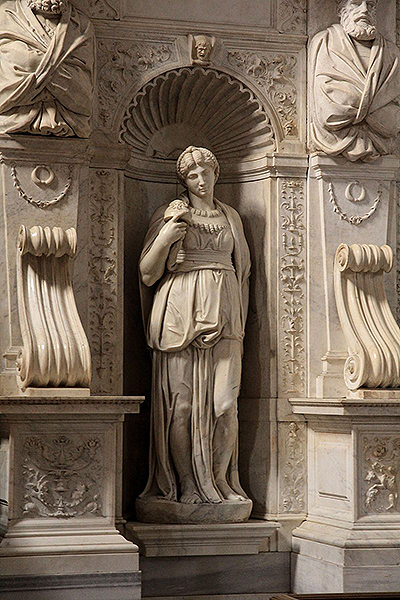
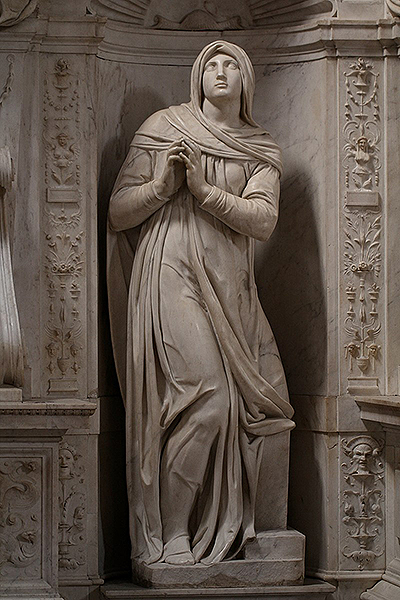
This unstable history generated some of Michelangelo's greatest sculptures. It also makes their intended identities difficult. Drawings record different architectural organisations. Figures carved for one phase might be excluded from the next. The final wall tomb gathers Moses, Leah, Rachel and other sculptures within a programme profoundly different from the original colossal scheme.
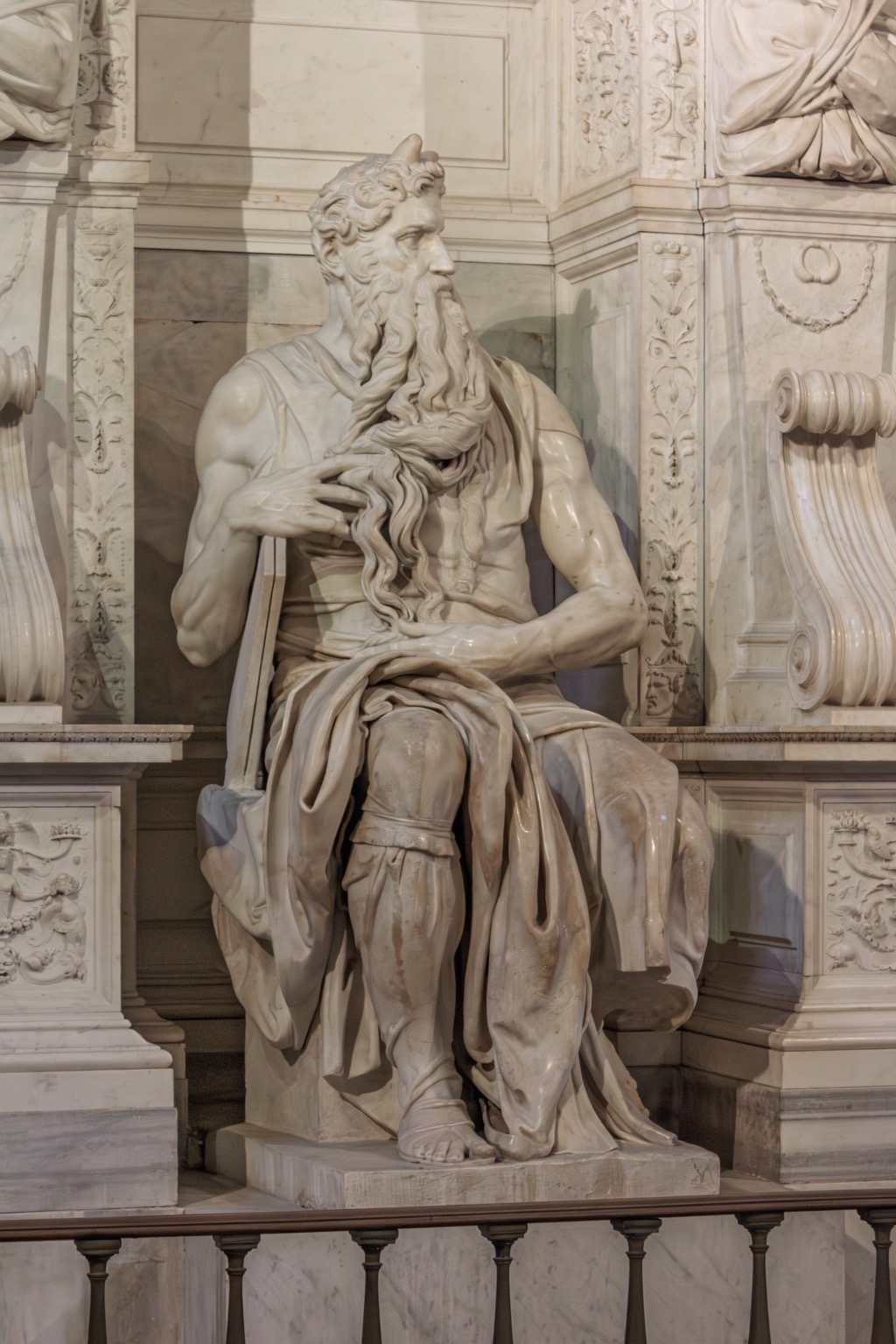
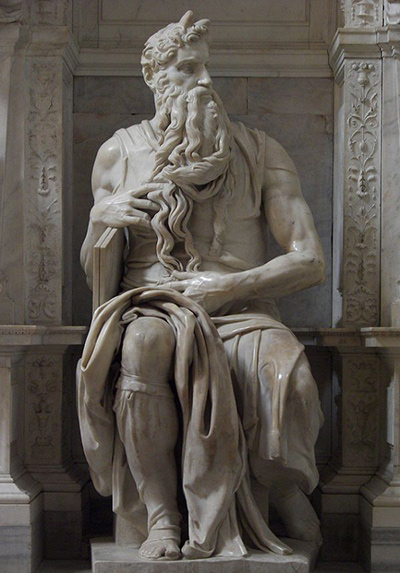
Moses sits in the lower centre, head turned and tablets held against his body. One leg draws back while the other plants forward, compressing the possibility of rising. The horns derive from a traditional Latin rendering of the radiance described after Moses descended from Sinai; they are neither demonic attributes nor Michelangelo's private invention.[10]
The figure's intensity cannot be separated from its bay. Knees, beard, tablets and turn push against a restricted architectural space. Isolated photographs magnify the head but remove the tomb that gives the stored movement pressure.
The long project also reveals the cost of changing patronage. Michelangelo's frustration became legendary, but the “tragedy of the tomb” should not obscure practical history. Large memorials depend upon money, architecture, heirs, contracts, politics and available labour as well as one artist's will.[7]
The Louvre Slaves and the Problem of Meaning
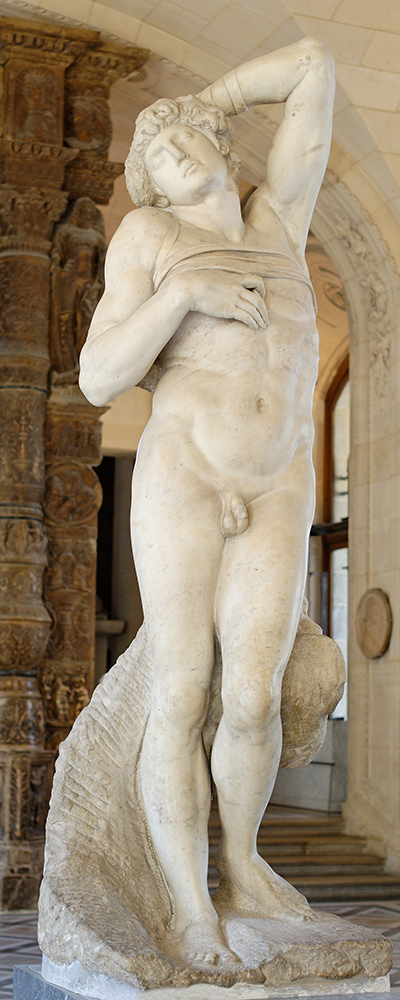
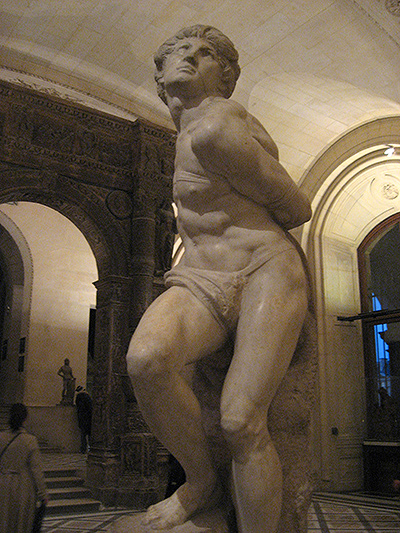
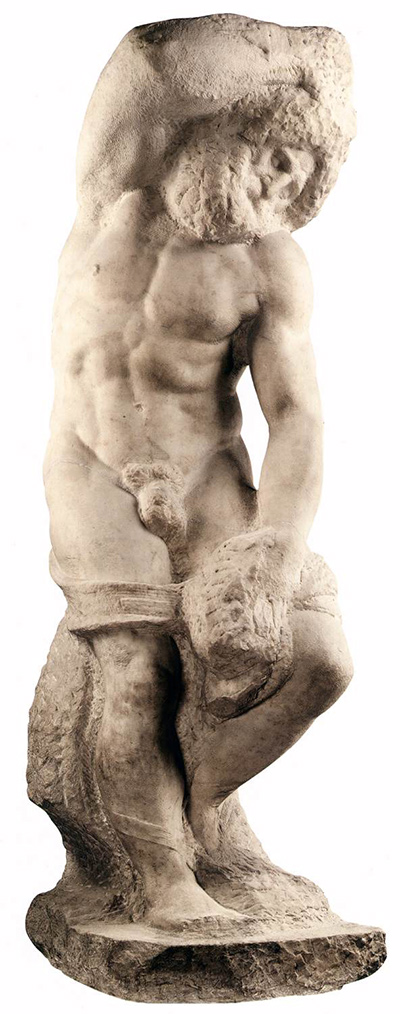
The Dying Slave and Rebellious Slave were carved about 1513–1515 for an early revision of the Julius tomb and later excluded. Michelangelo gave them to Roberto Strozzi; they eventually entered the French royal collection and the Louvre.[8][9]
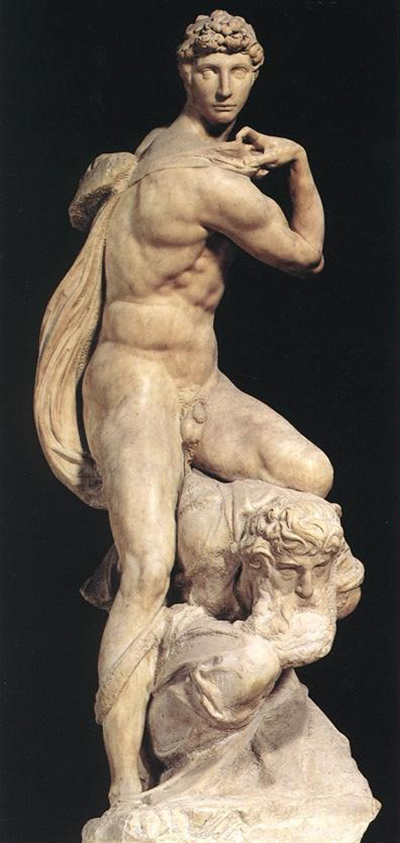
Their modern titles are conventional. One youth lifts an arm behind his head and appears languid, though the body contains taut passages. The other twists against a band crossing his torso and seems actively restrained. Neither pose establishes exactly what the figures meant within every tomb design.
Interpretations have called them captives, provinces, arts made powerless by the pope's death, embodiments of the soul or demonstrations of matter resisting form. The Louvre presents this history without selecting one settled iconographic code.[9] Their physical contrast is secure; their original symbolic names are not.
Both remain unfinished, but not in the same way. Polished torsos meet rough supports, abbreviated limbs and tool-marked stone. The surface lets viewers follow stages of emergence while also recording abandonment after the tomb changed.
Conservation preceded their return to display in 2022, restoring legibility without answering their original meaning.[18] Cleaning can disclose surfaces; it cannot resolve an iconography no document securely names.
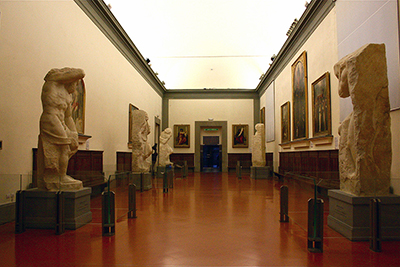
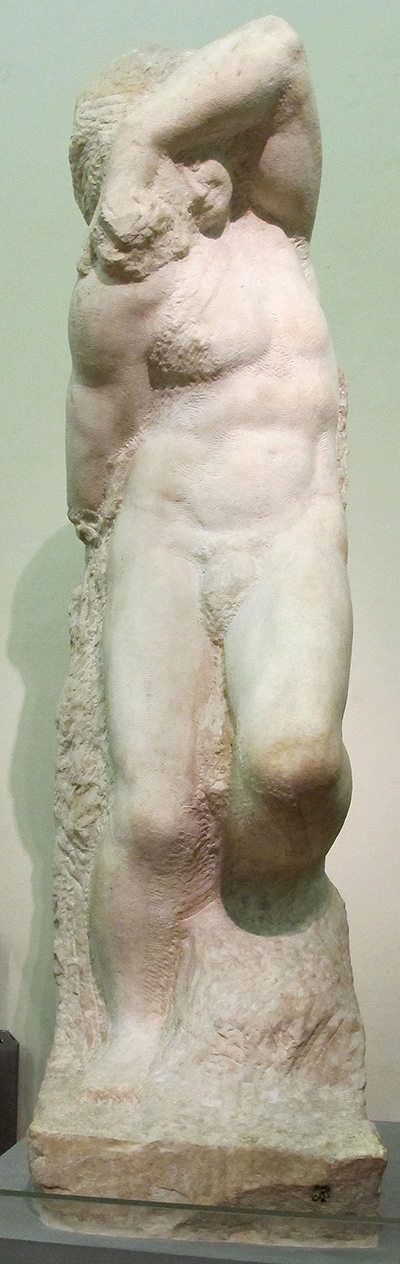
The four unfinished Prisoners now in the Accademia extend this problem. Their bodies appear caught within massive blocks, inspiring the famous metaphor of figures liberated from stone. Yet they, too, belonged to changing tomb plans. Their roughness is historical before it is philosophical.
Tondi, Standing Figures and Shared Hands
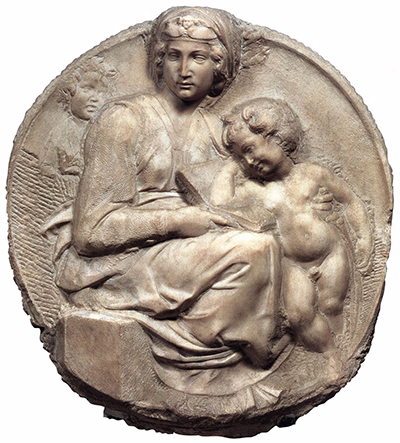
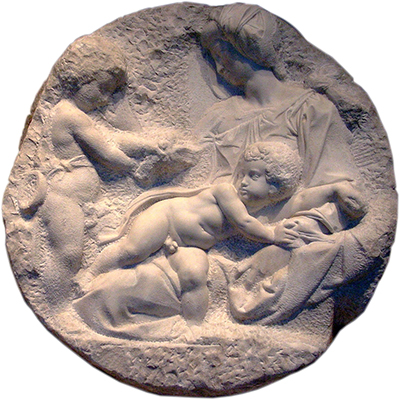
Michelangelo's circular reliefs explore how bodies can press against a boundary. In the Bargello's Pitti Tondo, Mary, Christ and the young John occupy a rounded field, with areas of finish set beside visible tool marks. The figures seem simultaneously contained by and emerging from the marble disc.[3]
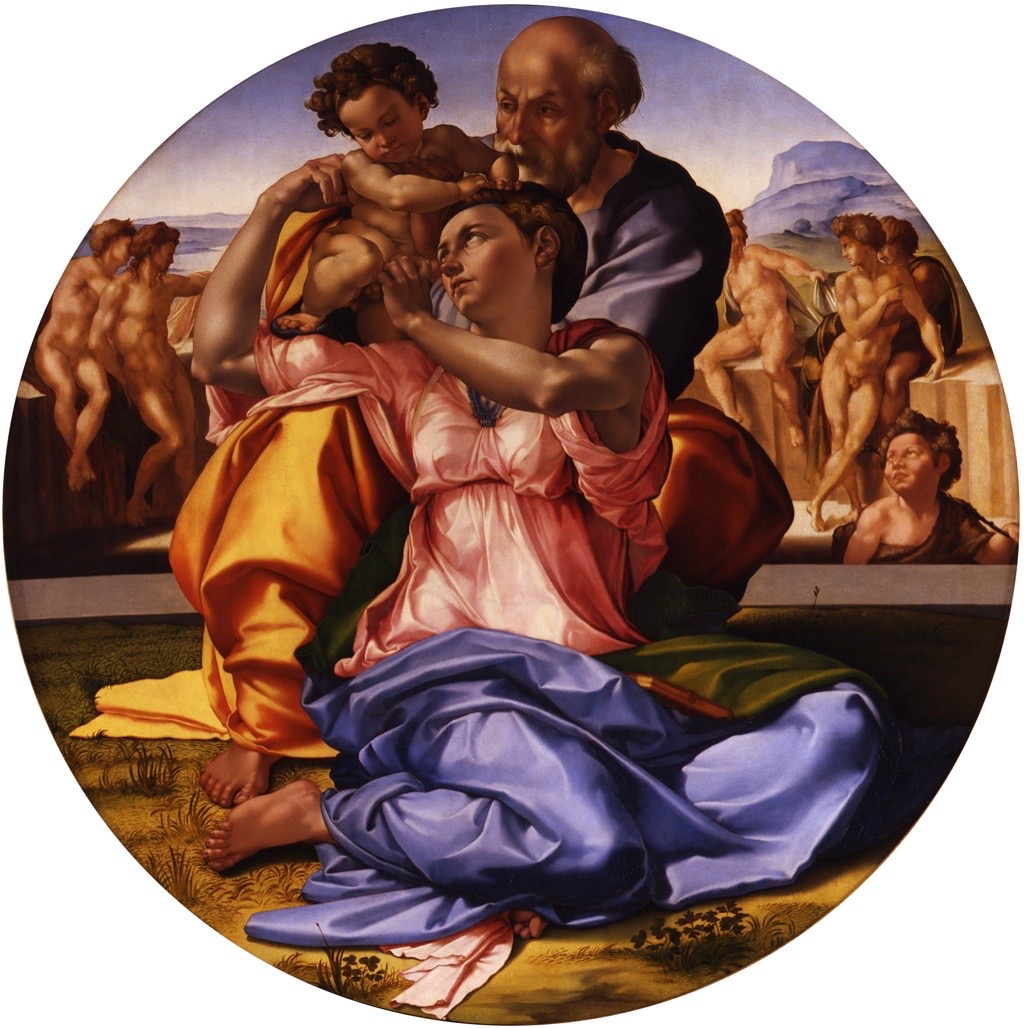
The unfinished Taddei Tondo, now at the Royal Academy, develops a different child movement and surface rhythm. Together with the Doni Tondo in paint, these works show the circle acting not as decoration but as a constraint against which bodies turn.
The Bargello's David-Apollo preserves uncertainty in both title and finish. Attributes and surviving evidence have supported identifications as David or Apollo, producing the compound modern name. The ambiguity should not be solved by preference; it is part of the object's documented reception.[3]
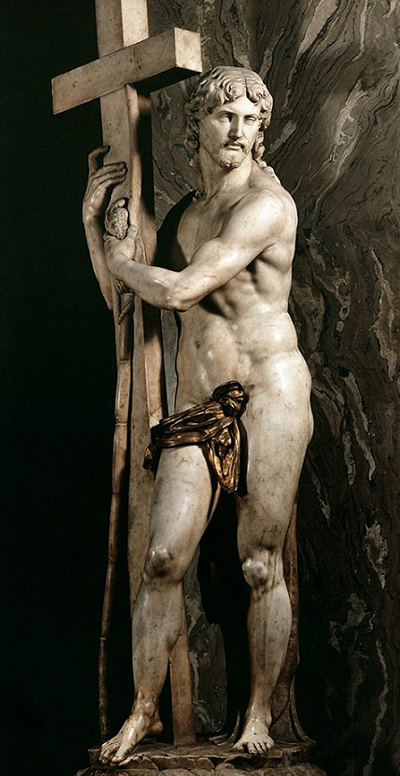
The two versions of the Risen Christ demonstrate material contingency. Michelangelo abandoned the first after a dark vein appeared in the marble. For the second, now in Santa Maria sopra Minerva, he roughed out the body in Florence and assistants completed it in Rome. Later bronze drapery further changed its appearance.[11]
The finished object is therefore not a simple measure of one hand. Michelangelo selected, designed and began the figure; assistants brought passages to completion; later authority clothed it. Authorship and object history overlap without becoming identical.
The New Sacristy: Sculpture as Architecture's Time
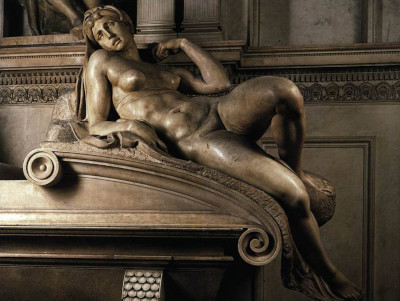
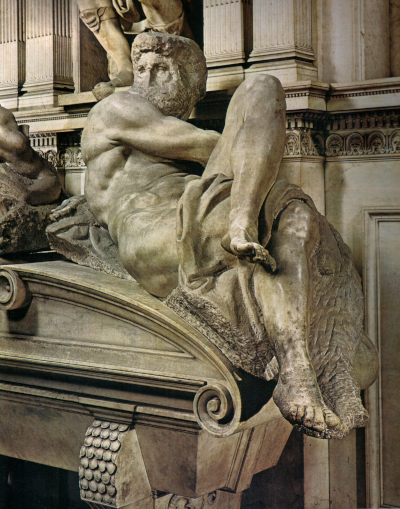
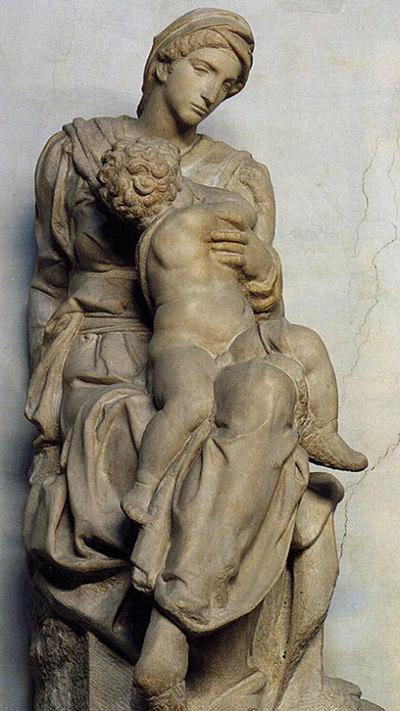
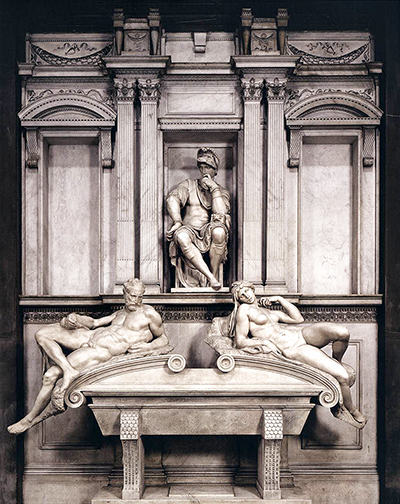
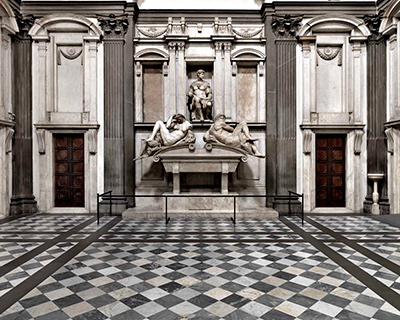
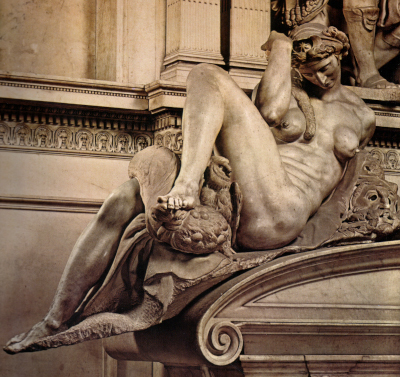
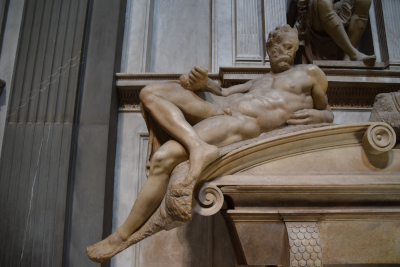
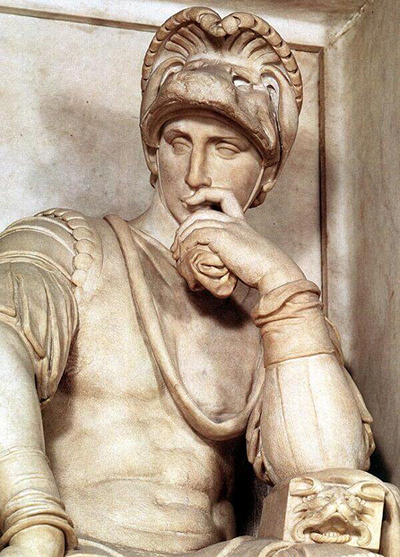
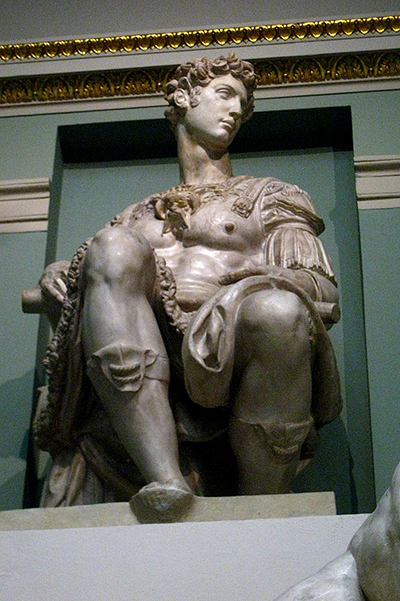
At San Lorenzo's New Sacristy, Michelangelo designed the room, tombs and major sculptures as an ensemble. Idealised seated figures of Giuliano, Duke of Nemours, and Lorenzo, Duke of Urbino, occupy wall tombs. Night and Day recline below Giuliano; Dawn and Dusk lie beneath Lorenzo. The Medici Madonna provides a devotional centre on the facing wall.[12]
The ducal figures are not straightforward portraits. Their armour, poses and idealisation present roles and temperaments beyond likeness. Lorenzo withdraws beneath shadowed helmet; Giuliano turns outward holding a baton and coins or symbolic objects. Their gaze does not meet the reclining times below.
The personifications make mortality structural. Night sleeps above a mask and owl; Day turns a massively unfinished face; Dawn wakes painfully; Dusk sinks. Their bodies slip across curved sarcophagi that could never comfortably support them. Time is beautiful, unstable and indifferent to the dead named by the tombs.
Michelangelo left Florence permanently in 1534 with the chapel incomplete. Later installation shaped the present ensemble. Intended position, partial execution and current arrangement must therefore be distinguished even while the room remains the fullest surviving fusion of his architecture and sculpture.[12]
The Medici Madonna's vertical relation between Mary and Christ echoes, without repeating, Bruges and the Pietàs. The chapel makes such comparison spatial. Bodies across separate walls address mourning, intercession, lineage and time through the viewer standing among them.
Brutus and the Political Bust
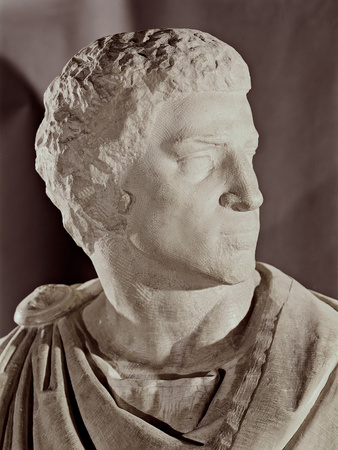
Michelangelo's marble Brutus at the Bargello adopts the form of an ancient portrait bust. The head turns sharply above drapery left incomplete. The unfinished lower passage contrasts with the concentrated face and strong neck.[3]
Made after the assassination of Duke Alessandro de' Medici, the bust has been read through Florentine republican resistance and the antique tyrannicide. Those associations are compelling within Michelangelo's political world, but no surviving inscription turns the sculpture into a complete manifesto in his own words.
Its classicism is not simple imitation. Michelangelo uses the bust format to make thought and decision appear bodily: the head turns as though attention has just shifted, while the incomplete clothing leaves civic identity less settled than the face.
The work expands his portrait practice. Unlike the colossal biblical David or idealised dukes, Brutus concentrates political possibility into head, neck and fragmentary torso. Its very incompletion has become part of the severity viewers read.
Three Pietàs Across a Lifetime
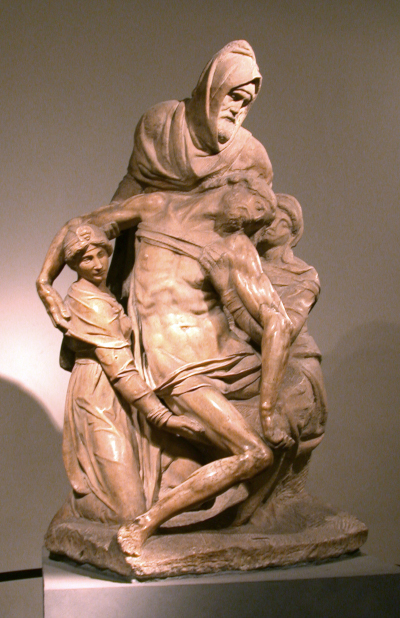
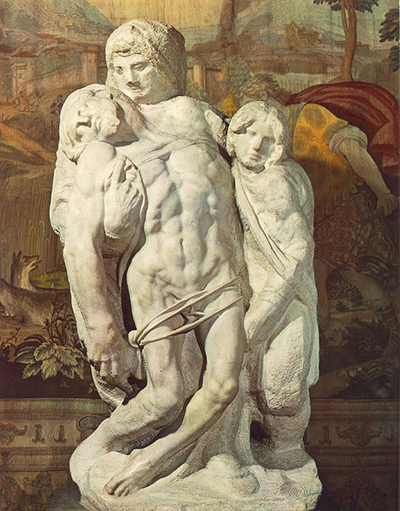
Michelangelo returned to the dead Christ in three securely documented sculptural projects. The polished Vatican group belongs to his twenties. The Bandini and Rondanini groups belong to old age. They are not stages of one progressive simplification but distinct structures with separate histories.[4][13][15]
The Bandini Pietà, carved about 1547–1555, contains four figures. Mary and Mary Magdalene help sustain Christ beneath a hooded Nicodemus whose face the Opera del Duomo identifies with Michelangelo's likeness. The sculptor may have intended the group for his own burial.[13]
Work stopped after damage and radical intervention. Tiberio Calcagni repaired and completed passages, including much of the Magdalene. The familiar story that Michelangelo attacked the marble with a hammer out of frustration has never been securely proven.[13][14]
The 2019–2021 restoration supplied better material evidence. Analysis identified Seravezza marble, pyrite inclusions and microfractures. These weaknesses make stone quality a plausible factor in abandonment. Conservators did not find certain hammer marks, while acknowledging that Calcagni's recutting could have removed evidence.[14]
The findings replace psychological certainty with a more interesting mixture of material difficulty, changing purpose, dissatisfaction and later repair. They also recovered distinctions between Michelangelo's and Calcagni's surfaces without pretending that the object can be separated into pristine halves.
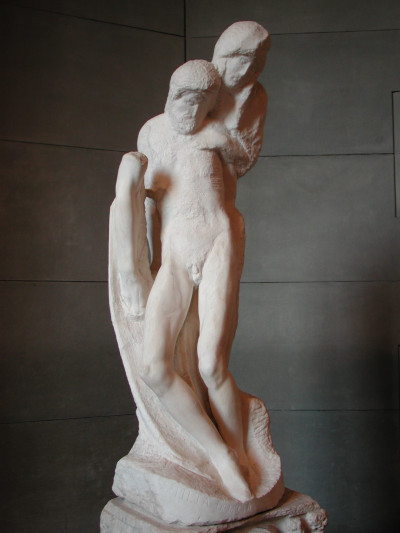
The Rondanini Pietà underwent even more radical transformation. Michelangelo cut back an earlier composition and developed a narrow vertical union of Mary and Christ. Parts of the first conception remain visible, including an isolated arm, while the later bodies seem to lean into and emerge from one another.[15]
He continued revising it near the end of his life, and it remained unfinished at his death in 1564. The stone does not preserve a single linear journey toward abstraction. It holds incompatible stages at once: an earlier robust body, a later attenuated group and surfaces at different degrees of definition.[15]
Its provenance was uncertain for centuries. The work entered the Rondanini collection, was at times misunderstood or dismissed, and returned to scholarly attention before the City of Milan purchased it in 1952. Since 2015 it has occupied a dedicated museum at the Castello Sforzesco.[16]
The modern display gives the unfinished group an almost funerary solitude. That atmosphere is effective but not original. Museum architecture is the latest setting in a history that began with private late carving rather than a commissioned chapel.
The Palestrina Pietà: Attribution Must Stay Visible
The large Palestrina Pietà entered the Accademia in 1939 and is displayed as “Michelangelo (attr.).” Carved from a reused ancient marble block, it shows Christ supported by two figures in a steep composition.[17]
The work has long been connected with Michelangelo, but scholars have also proposed a follower or assistant. Its provenance and documentary record do not provide the security attached to the Vatican, Bandini and Rondanini projects.[17]
Attribution affects counting and interpretation. If the sculpture is approached as an unquestioned late Michelangelo, roughness may be woven into a narrative of his final style. If authorship is open, those same surfaces must be evaluated without using the desired conclusion as evidence.
The correct caution does not make the object minor. It allows its unusual ancient support, scale and devotional form to be studied while the maker remains an active question.
What Non-Finito Can and Cannot Explain
Michelangelo's unfinished works have made non-finito one of the most seductive terms in sculpture. It can describe visible conditions: a form only partly detached from the block, claw-chisel tracks, drill channels, coarse point work, an unmodelled face or a polished torso meeting raw stone.
It cannot explain all those conditions by itself. The Battle of the Centaurs was left early in Michelangelo's life. The Slaves were displaced by a changing tomb. David-Apollo has an uncertain commission and identity. Day remained incomplete when Michelangelo left Florence. The Bandini stone contained flaws and received another sculptor's work. The Rondanini group was still being recut near death.
These histories produce different roughnesses. Abandonment, redesign, material failure, workshop division and death do not look or mean the same, even when each leaves tool marks.
The popular idea that Michelangelo merely released a finished figure already trapped inside every block also needs restraint. Carving is subtractive, but the outcome developed through measurement, drawings, models, changes and response to stone. The block constrained invention without containing a predetermined body.[1]
Unfinished surfaces are most powerful when their particular evidence remains intact. They let viewers see sequence and resistance, but they do not eliminate the need for documents.
Movement, Restoration and the Lives of Objects
Michelangelo's sculptures were made for places. Movement changes scale, lighting, approach and meaning. David left the Palazzo Vecchio threshold for an indoor tribune. The Julius tomb figures dispersed between Rome, Paris and Florence. The Madonna of Bruges was seized twice and returned twice. The Bandini group moved through Roman possession, San Lorenzo and Florence Cathedral before reaching the Opera del Duomo Museum.[5][6][8][9][13]
Present museum display can protect an object while obscuring an intended relation. A sculpture carved for a high façade is seen at floor level; a tomb figure becomes freestanding; a civic guardian becomes an art-historical icon beneath controlled light. Neither setting is neutral.
Restoration produces evidence as well as visual change. The Casa Buonarroti campaign clarified the youthful reliefs. Louvre care returned the Slaves to display in 2022. Bandini conservation identified quarry source, inclusions, fractures and later deposits.[2][14][18]
Such work can overturn a familiar story. Material analysis made the Bandini marble's difficulty concrete and weakened confidence in the hammer anecdote. Conservation of the Slaves, however, cannot decide their lost symbolism. Each investigation has a proper evidential reach.
The modern history of Michelangelo's sculpture is therefore not merely protection after creation. Movement, repair, cleaning, replication and reinstallation participate in what each object now is and what can be known about it.
Artist Up Close
Michelangelo's career repeatedly returned to carving even when papal architecture and painting consumed his time. Sculpture offered an intimate negotiation with resistance. A line in a drawing could be revised or erased; a major cut in marble permanently changed the available body.
That irreversibility did not produce caution alone. David was extracted from a compromised block. The Rondanini Pietà was radically cut back late in its making. Michelangelo could accept material risk when a new conception demanded it.
He also understood sculpture as relational. Even celebrated single figures were made for buildings and viewers. David watches an enemy outside the marble; Moses turns within a tomb bay; Night and Day slide above a sarcophagus; Christ steps from Mary's knees at Bruges. The surrounding space completes the action.
His surfaces resist a single signature finish. The Vatican Pietà uses polish to join ideal flesh and devotional stillness. The Slaves oppose polish to blockage. Day leaves the face rough while the body carries monumental weight. The Rondanini group uses recutting to make past and present conceptions coexist.
Workshop and later hands belong here too. Calcagni's intervention in the Bandini group and assistants' completion of the second Risen Christ complicate the solitary master without dissolving authorship. Michelangelo's design, carving and decisions remain central; object history makes centrality more exact.
Marble as Memory
Every Michelangelo marble remembers more than the intended figure. It remembers quarry, transport and initial block. It may retain earlier cuts, tool sequences, fractures, exposed weather, another sculptor's repair or a conservator's discovery. Even the smoothest surface carries that concealed history.
The sculptures become most compelling when these material lives meet their subjects. A damaged block becomes David before battle. Flawed stone bears a broken Christ in the Bandini group. A repeatedly reduced block holds Mary and her son at the end of Michelangelo's life.
The rough and polished works are therefore not opposing halves of his achievement. Both show decisions made under pressure. Finish can create impossible tenderness; incompletion can preserve competing futures.
Michelangelo's sculpture is often described as timeless. The objects themselves argue otherwise. They occupy time intensely—in contracts revised, bodies aged, monuments reduced, surfaces weathered, attributions changed and stone conserved. Their endurance is not the absence of history but its accumulation.
Frequently Asked Questions
Discussion
Michelangelo’s sculpture is often discussed through contrasts: finished and unfinished, figure and stone, private devotion and public monument. Which work most changes when its present museum display is compared with its intended architectural or civic setting?
Reader Insights
Compare a polished passage with an unfinished one. What evidence would distinguish a working stage, a change of plan or a later history?
Consider Moses or a Slave as part of the changing Julius II tomb. How does that shift the meaning of pose, scale and direction?
Compare the movement, ownership and conservation histories of the Madonna of Bruges, David and the three Pietàs.
Join the Conversation
Which sculpture would you choose for a close study of Michelangelo’s working process, and would you begin with its surface, original setting, documentary history or later restoration?
References
- Metropolitan Museum of Art, Michelangelo: Divine Draftsman and Designer, View source.
- Fondazione Casa Buonarroti, Michelangelo's Marbles, View source.
- Musei del Bargello, Michelangelo: The Fullness of the Renaissance, View source.
- Papal Basilicas / Holy See, Michelangelo's Pietà, View source.
- Galleria dell'Accademia, Michelangelo's David, View source.
- Musea Brugge, Marble Sculpture, Madonna and Child, View source.
- Rijksmuseum, Michelangelo's Tomb for Julius II: Genesis and Genius, View source.
- Musée du Louvre, Dying Slave, View source.
- Musée du Louvre, The Louvre's Slaves, View source.
- Museo Tattile Statale Omero, Moses, View source.
- Turismo Roma, Michelangelo, View source.
- Musei del Bargello, Medici Chapels, View source.
- Opera di Santa Maria del Fiore, Michelangelo Buonarroti, Pietà Bandini, View source.
- Opera di Santa Maria del Fiore, Michelangelo's Pietà Restored, View source.
- Castello Sforzesco, La Pietà Rondanini, View source.
- Castello Sforzesco, A Sculpture by Michelangelo in Milan, View source.
- Galleria dell'Accademia, Pietà Palestrina, View source.
- Musée du Louvre, Michelangelo's Slaves Regain Their Brilliance, View source.