


 by Tom Gurney
Tom Gurney BSc (Hons) is an art history expert with over 20 years experience
Published on June 19, 2020 / Updated on November 6, 2025
Email: tomgurney1@gmail.com / Phone: +44 7429 011000
Taddei Tondo by Michelangelo
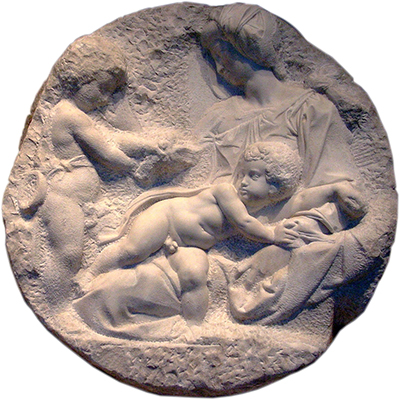
A bird flashes between two children, one reaching toward it and the other recoiling. Around them, marble slips between polished form and rough possibility. This small drama animates Michelangelo’s Taddei Tondo, a circular relief of the Virgin, Christ Child and young Saint John whose sacred subject is inseparable from the physical act of carving. It is not simply an unfinished Madonna. It is a sculpture about attention: one child offers, another reacts, Mary gathers their agitation into a larger stillness, and the stone lets every degree of certainty remain visible.
The roundel was probably made in Florence during the first years of the sixteenth century and takes its modern name from Taddeo Taddei, the cultivated Florentine patron associated with it. It now belongs to the Royal Academy of Arts in London, which presents it as the only marble sculpture by Michelangelo in the United Kingdom.[1] That remarkable afterlife should not overshadow the object itself. Within a shallow circle, Michelangelo created a group whose emotional movement seems to exceed both the relief’s depth and its unfinished state.
Why is Taddei Tondo more than a round Madonna relief? The page focuses on a specific marble tondo where devotional subject, circular design, relief depth and source-led finish language all matter together.
At a Glance
- ArtistMichelangelo Buonarroti
- TitleTaddei Tondo, also known as The Virgin and Child with the Infant Saint John
- DateEarly sixteenth century, usually about 1504–1505
- MediumMarble relief
- FormatTondo, or circular roundel
- SubjectMary with the Christ Child and young Saint John the Baptist
- Associated patronTaddeo Taddei
- Present collectionRoyal Academy of Arts, London
- StatusUnfinished, with deliberately observed differences in carving depth and resolution
- Collection distinctionThe Royal Academy identifies it as the only Michelangelo marble in the United Kingdom[1]
- Central actionChrist recoils from the bird presented by Saint John
Contents
- A Sacred Encounter Set in Motion
- Mary as Stillness and Shelter
- The Circle as an Active Boundary
- Carving in Unequal Depths
- What Unfinished Does—and Does Not Tell Us
- Taddeo Taddei and Florentine Patronage
- From Florence to the Royal Academy
- Beside the Pitti Tondo
- Beside the Doni Tondo
- How to Look at the Taddei Tondo
- Why the Taddei Tondo Matters
- Artist Up Close
A Sacred Encounter Set in Motion
Michelangelo constructs the group around a moment of reaction. The young John offers a bird toward Christ. Rather than accept it serenely, Christ draws back. The movement is small but charged, and it prevents the relief from settling into the stable affection often expected of a Madonna and Child. Mary does not merely display the infant; she contains an encounter whose emotional meaning reaches forward into Christian history.
The bird is commonly understood in relation to Christ’s Passion. In Renaissance devotional imagery, a goldfinch could evoke the Crown of Thorns through the red marking around its head and its supposed appetite for thistles. Whether every viewer identified the species immediately matters less than its role in the composition. It is an offered creature that triggers Christ’s recoil, turning prophecy into bodily instinct. The Child responds before language.
John occupies a subsidiary place but performs a decisive act. His future vocation as the herald of Christ is compressed into a childhood exchange. He presents the sign; Christ recognises or fears it; Mary encloses both children within her protective scale. Michelangelo therefore makes sacred foreknowledge tangible through distance, gesture and touch rather than through an elaborate setting.
Mary as Stillness and Shelter
The Virgin anchors the children’s agitation. Her larger body curves around the centre, establishing the broad stability from which their smaller movements depart. She is neither detached from the encounter nor theatrically alarmed by it. Her role is more structural and more affecting: she holds the restless Child while the relief’s emotional energy passes across her.
That containment is especially important in a circular composition. The round edge could encourage an even rotation of figures, but Michelangelo builds a hierarchy. Mary’s mass stabilises the field. The children create sharper, quicker directions inside it. The relationship between those tempos gives the scene its force. Without the children, her stillness would be inert; without Mary, their interaction would lose its gravity.
Her relative calm also gives time depth. John’s bird points toward a future sacrifice, Christ’s recoil makes that future momentarily present, and Mary’s embrace connects infant vulnerability with maternal knowledge. It would be excessive to assign a precise thought to her expression. The relief is powerful because it makes recognition possible without narrating exactly what each figure consciously understands.
The Circle as an Active Boundary
The term tondo describes the work’s round format, but the circle does more than name its shape. A rectangular panel offers corners and horizontal divisions. A roundel continually bends back upon itself. Figures must be organised without the stable architecture of a top, base and four quiet edges.
Michelangelo uses that constraint to concentrate attention. Mary’s enveloping form answers the circumference, while the children’s gestures cross its inward pull. Christ’s recoil creates a sudden diagonal; John’s offering reaches into it. The circle contains the movement but does not calm it. It behaves like a vessel under pressure.
The outer limit also affects how incomplete forms are perceived. At some points, figures seem to emerge from a broad stone ground; at others, the edge nearly meets their contours. The round boundary keeps the unworked marble from reading as merely leftover material. It belongs to the design’s field and governs the distance between bodies.
Carving in Unequal Depths
Relief requires an artist to turn small variations of depth into convincing bodies. The Taddei Tondo makes those variations unusually available to inspection because its surface is not uniformly finished. More resolved forms advance; lightly worked ones recede; rough areas catch light in broken patterns rather than smooth transitions. The spectator sees both the sacred scene and some of the means by which it was made.
The effect is not simply a contrast between “finished figures” and “unfinished background.” Degrees of resolution occur within forms as well as around them. One contour may sharpen while its neighbouring plane remains broadly worked. A face can become legible before all the stone surrounding it has been brought to the same state. This unevenness produces an atmosphere in which bodies seem to gather rather than appear all at once.
Because marble cannot be replaced once removed, every advance carries risk. Relief adds a further difficulty: cut too deeply and the figure may lose its material support; leave too much and projection may fail. The tondo preserves Michelangelo negotiating that balance. Its low physical depth becomes a field of remarkably large perceptual changes.
What Unfinished Does—and Does Not Tell Us
The Royal Academy describes the carving as unfinished and experimental, language that rightly directs attention toward its changing surface.[1] Yet the condition cannot prove a single motive. Michelangelo may have stopped because of altered circumstances, competing demands, patronage or dissatisfaction; the surviving object does not choose one explanation for us.
Nor should roughness automatically be described as an intended final effect. Modern taste has learned to prize the non-finito, especially in Michelangelo, and it is easy to project that admiration backwards as certainty about his decision. The sounder distinction is between cause and consequence. The reason the relief remained incomplete is not securely reduced to one story. The consequence is visible: we encounter carving at several stages, and those stages now intensify the subject.
Christ’s recoil seems especially alive because his body is not sealed within a perfectly finished surface. John’s presentation has the delicacy of something still arriving. Mary’s greater continuity steadies them. The present condition makes those differences eloquent, even if it did not originate as a programme to demonstrate incompletion.
Taddeo Taddei and Florentine Patronage
The name preserves an important association. Taddeo Taddei was a Florentine patron and collector connected with Michelangelo and Raphael. The roundel’s identification through his family distinguishes it from the Pitti Tondo, named through a separate Florentine lineage. These titles remind us that devotional marble existed within networks of ownership, cultivated exchange and domestic display, not only within churches and public monuments.
The patronal association should nevertheless be handled without invented intimacy. A named owner does not supply a transcript of conversations with the sculptor, an exact original hanging place or an undisputed explanation for the work’s condition. What it does provide is a social setting in which a technically audacious sacred relief could be valued as both devotional image and exceptional art.
Such double status is crucial. The bird and children invite meditation on sacrifice and recognition. The marble simultaneously invites admiration for Michelangelo’s control of depth and his visible process. Renaissance ownership did not require those responses to be separated as modern categories of religion and aesthetics often imply.
From Florence to the Royal Academy
The work’s presence in London gives it a distinctive modern history. The Royal Academy’s care and interpretation have made it a central object in the study of Michelangelo outside Italy.[1] Its significance was further highlighted when the National Gallery announced an exceptional loan, allowing the relief to enter a different setting of comparison and public encounter.[2]
A loan can change what viewers notice. In the Academy, the tondo carries the institutional distinction of a singular Michelangelo marble. In a National Gallery context, it can be compared more readily with painting, devotional imagery and other Renaissance works. Neither display exhausts its identity. The object retains its Florentine material and patronal history even as institutional settings create new conversations around it.
This mobility also distinguishes the tondo from Michelangelo sculptures that remain embedded in their architectural or funerary sites. The Angel at San Domenico or the New Sacristy figures cannot be separated conceptually from their monuments. The Taddei Tondo has acquired a life as a collectible relief, carried across borders and reinterpreted through successive locations.
Beside the Pitti Tondo
The Pitti and Taddei tondi share material, format and principal figures, and both remain unfinished. Those similarities make comparison unavoidable, but not identity. The Pitti relief is dominated by Mary’s massive presence; its sacred group feels compressed into a monumental unity. The Taddei relief derives more of its emotional organisation from the bird and the exchange between the two children.
Their surfaces also create different rhythms of emergence. In the Pitti work, the young John can seem to hover at the margin of formation while Mary holds the field. In the Taddei, the children’s interaction pulls attention laterally across the centre. Michelangelo was not repeating a circular formula. He was testing how the same broad subject could be reordered through gesture, depth and degrees of finish.
Collection history reinforces the distinction. One belongs to the Bargello in Florence; the other to the Royal Academy in London. Each institution supplies the governing record for its object. The most useful comparison therefore preserves two separate marbles and asks how each makes a circle behave.
Beside the Doni Tondo
Michelangelo’s painted Doni Tondo expands the comparison from one carved circle to another kind of tondo altogether. The Uffizi’s panel shows the Holy Family in intense colour, with bodies modelled through paint and a complex spatial setting beyond them.[3] Shared format and approximate period make the works natural companions, but no secure evidence makes the marble a simple preparatory study for the painting.
In carved relief, actual projection produces shadow; in painting, colour and modelling simulate volume. The Taddei Tondo can leave areas physically rough or only partly cut, whereas the Doni Tondo completes a pictorial surface. Christ’s movement in the marble is constrained by stone that remains literally attached to the ground. The painted figures may appear sculptural, but their space is optical rather than cut.
The comparison demonstrates Michelangelo’s interest in carrying powerful bodies around and against a circular edge. It also demonstrates why material specificity matters. “Tondo” identifies a shape, not a single solution.
How to Look at the Taddei Tondo
Begin with the action rather than the finish. Locate John, the bird and Christ’s recoil. Notice how little physical displacement is needed to turn a devotional group into a charged event. Then widen the view to Mary and the circumference. Her body absorbs the smaller motions and keeps the composition from splintering.
Only after grasping that structure, move across the surface. Watch where shadows deepen, where tool marks scatter light, and where outlines fade into the marble field. Changing position or illumination can cause forms to advance and withdraw. That instability is not a distraction from the subject. It makes recognition unfold in time, echoing the children’s moment of recognition within the image.
Finally, resist the urge to mentally polish every rough area. The surviving states are not obstacles to imagining a hypothetical completed object; they are the material evidence we actually possess. Looking carefully means allowing resolution and irresolution to operate together.
Why the Taddei Tondo Matters
The Taddei Tondo gives a familiar sacred theme an unusually concentrated emotional structure. A tiny bird connects play with prophecy. Christ’s recoil turns future suffering into present bodily knowledge. John offers a sign of his vocation, and Mary holds the encounter within a form large enough to steady it without neutralising it.
It also reveals what relief can do. Shallow depth need not produce a quiet image, and incomplete carving need not prevent precise relationships. Michelangelo organises hierarchy through projection, scale, contact and the changing response of stone to light. The circle, far from being a decorative container, becomes the force that binds those decisions.
Its later history adds another distinction. The only Michelangelo marble in the United Kingdom carries Florentine devotion and patronage into an Academy founded centuries later.[1] Yet neither rarity nor institutional prestige supplies the ultimate reason to look. The object earns sustained attention because it remains alive at every level: sacred narrative, human gesture, compositional pressure and marble still visibly becoming form.
Artist Up Close
Michelangelo was in his late twenties when he made the Taddei Tondo, already celebrated for the Roman Pietà and the Florentine David. The relief shows why those triumphs did not confine him to colossal or fully freestanding sculpture. He could transfer monumental thinking into a domestic-scale circle and make a few centimetres of projection carry bodily weight, emotional reaction and sacred time. His achievement here is not that an unfinished object anticipates everything to come, but that each level of carving remains directed toward a particular encounter.
Frequently Asked Questions
Discussion
What feels most revealing in Taddei Tondo: the circular field, the Madonna-and-Child subject, or the unfinished marble surface?
Reader Insights
How does the circular field change the sculptural problem?
Where does the familiar subject become specifically Michelangelo's?
How should a page discuss unfinished marble without overclaiming intention?
Join the Conversation
Compare circular form, devotional subject and unfinished marble while keeping this page distinct from other Michelangelo tondo and Madonna pages.
References
- Royal Academy of Arts, Michelangelo Buonarroti: The Taddei Tondo”:, View source.
- National Gallery, London, “Exceptional loan announced”:, View source.
- Uffizi Galleries, Holy Family known as the Doni Tondo”:, View source.