 by Tom Gurney
Tom Gurney BSc (Hons) is an art history expert with over 20 years experience
Published on June 19, 2020 / Updated on November 6, 2025
Email: tomgurney1@gmail.com / Phone: +44 7429 011000
Michelangelo’s Moses
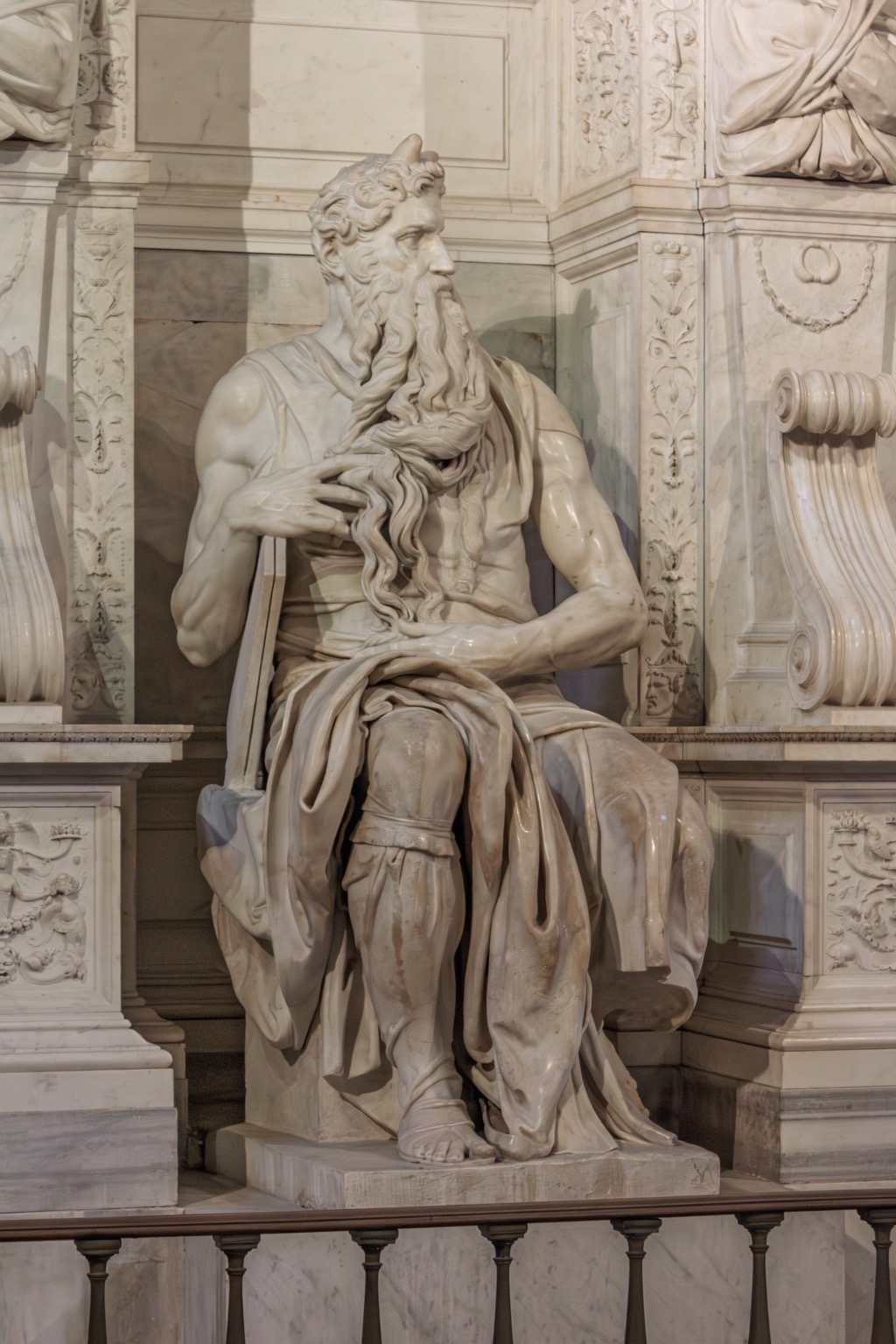
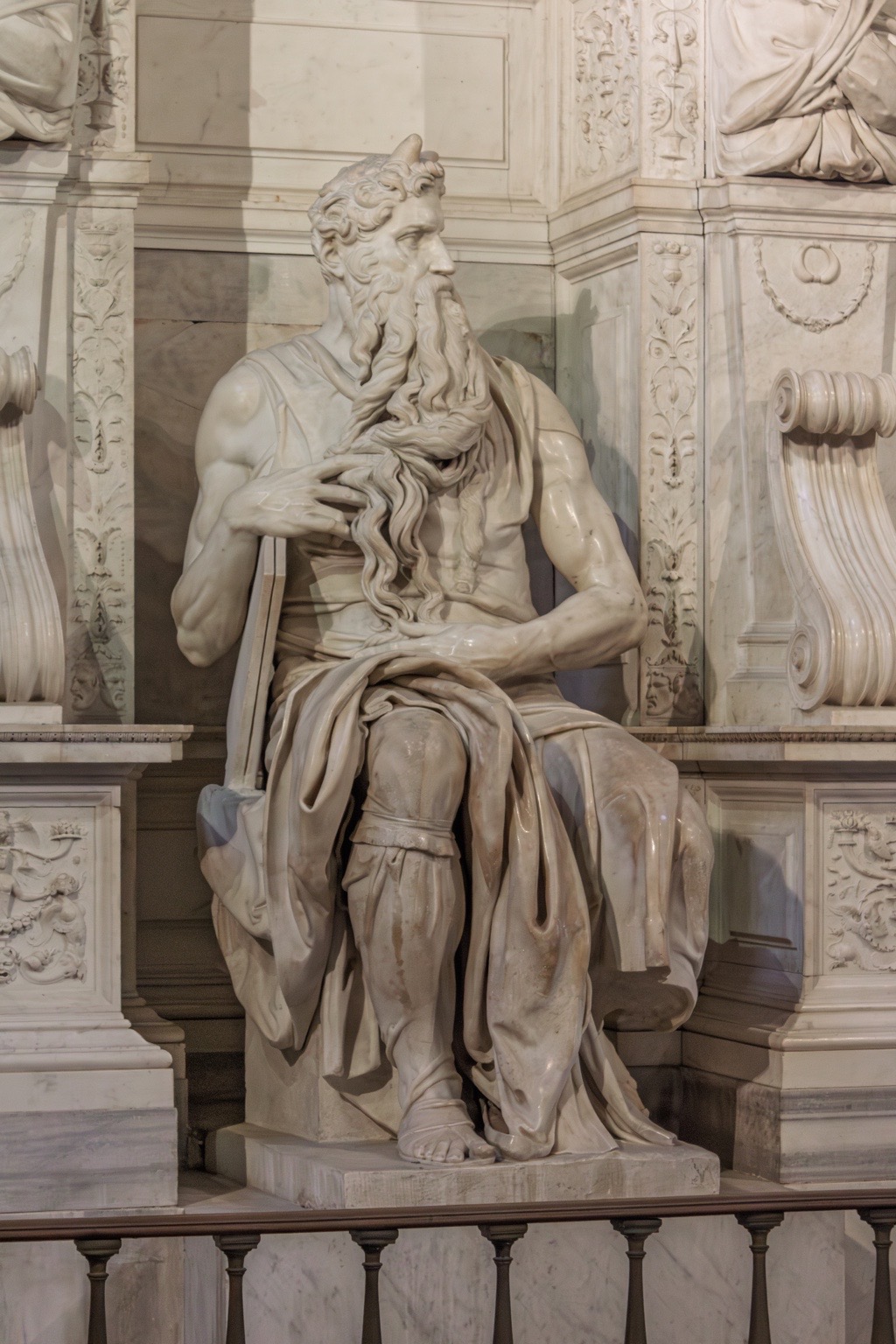
Michelangelo’s Moses sits, but nothing about him feels settled. His torso faces outward while his head turns sharply. One foot is planted; the other has drawn back until its toes find the ground. A hand travels through the heavy fall of his beard, and the tablets of the law are held close against his side. The enormous figure appears to have registered something beyond the niche. Whether he is about to rise, has just restrained himself, or is gathering the force to speak is left unresolved.
That uncertainty is one source of the sculpture’s power. The marble does not give us a complete scene with Mount Sinai, the Israelites or the golden calf. Instead, Michelangelo concentrates a story of revelation, law and human anger into the arrested movements of a single body. Details associated with different passages in Exodus coexist: the tablets recall Moses’s descents from Sinai, while the horns on his head belong to the textual and visual tradition surrounding the radiance of his face. Viewers have repeatedly tried to name the precise second represented, yet the statue continues to exceed those names.
The figure also carries a second, historical tension. Principally carved in 1513–1515, it was made for the changing tomb of Pope Julius II and finally installed in the reduced monument at San Pietro in Vincoli in 1545. The tomb had first been intended for St Peter’s Basilica and had undergone decades of redesign. Moses survived those transformations, but not unchanged: institutional accounts record later work, including a forceful turn of the head. What now appears inevitable was partly the result of adaptation.[1][2]
At a Glance
- ArtistMichelangelo Buonarroti
- TitleMoses
- DatePrincipally 1513–1515; later completed and altered, with work recorded in 1542
- MediumMarble
- Height235 centimetres
- SubjectMoses holding the Tablets of the Law
- CommissionThe funerary monument of Pope Julius II
- Current locationBasilica of San Pietro in Vincoli, Rome
- Position in the monumentCentre of the lower level
- Monument installed1545
- Important distinctionJulius II was buried in St Peter’s Basilica; the memorial containing Moses stands at San Pietro in Vincoli
- Narrative questionThe statue has often been connected to the golden calf, but no single instant in Exodus is securely established
- Iconographic featureThe horns arise from the long scriptural and artistic history of Moses’s radiant face
Contents
- A Colossus in a Roman Church
- From Julius II’s Great Project to the Final Monument
- A Body Held Between Rest and Action
- Face, Drapery and the Authority of Age
- Seeing the Statue from Below
- Which Moment Does Moses Represent?
- Why Michelangelo Gave Moses Horns
- The Turned Head and the Work of Revision
- Light, Cleaning and the Experience of the Surface
- From Vasari’s Wonder to Freud’s Interpretation
- An Image of Controlled Power
- Artist Up Close
Annotated Details from Moses
The annotated view reads Moses as a seated figure charged with contained movement: head, tablets, beard and drapery all press against stillness.[16]
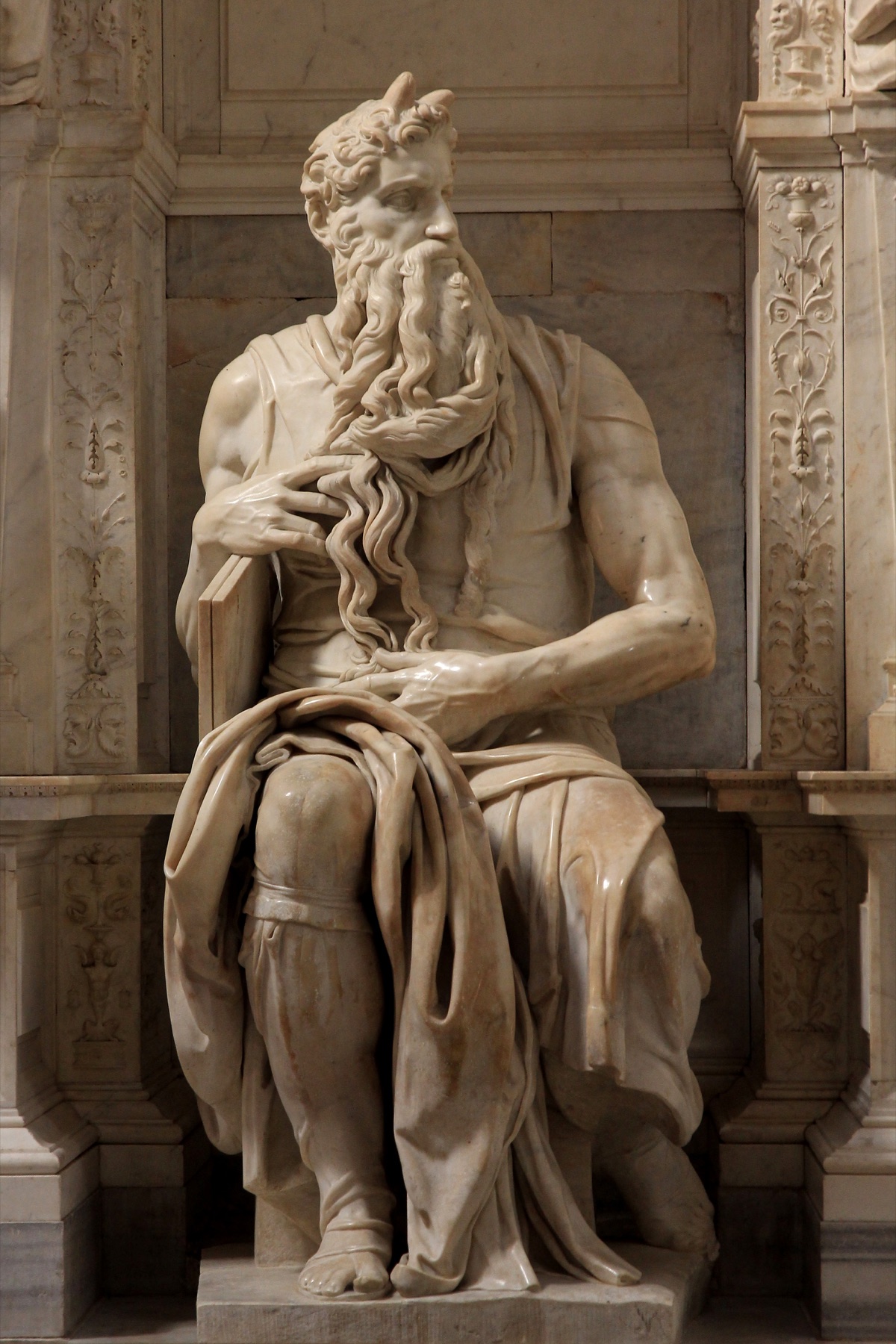
Details from MOSES
Close looking highlights the head, tablets, beard and seated turn that give the marble its force.
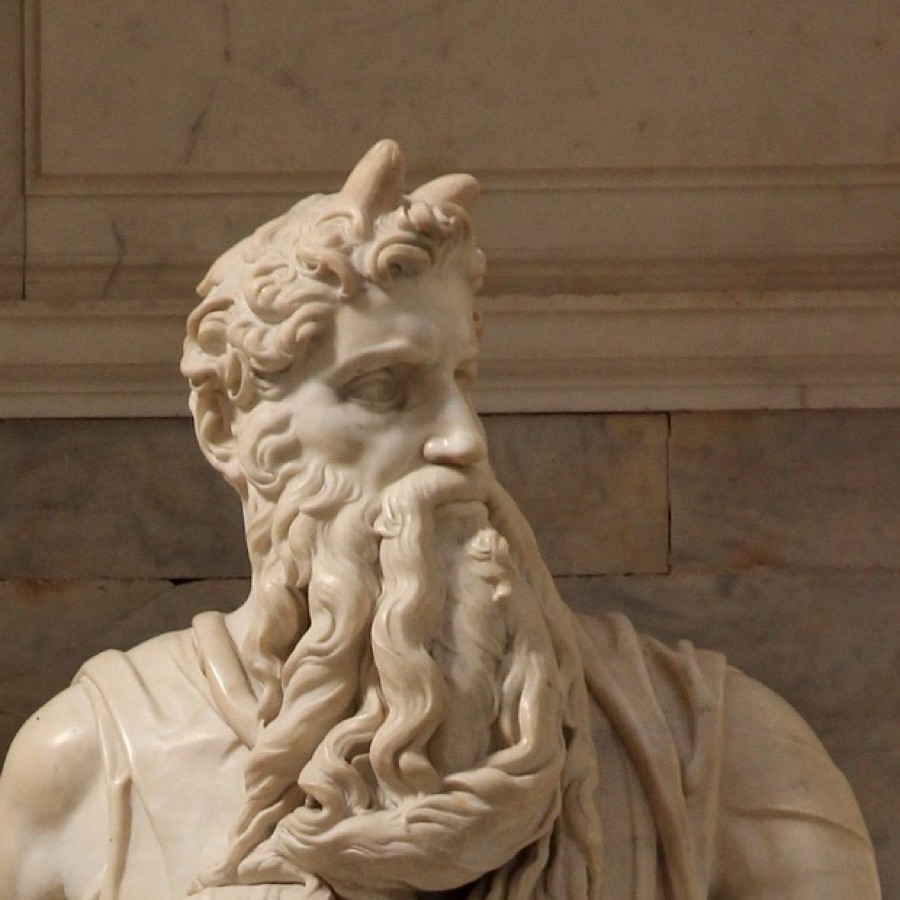
Horned head
The horned head follows a long visual tradition from the Latin Bible and gives the figure an unmistakable profile.
Tablets
The tablets identify Moses as lawgiver while remaining partly absorbed into the body and drapery.
Beard
The deeply carved beard turns spiritual authority into a powerful sculptural mass.
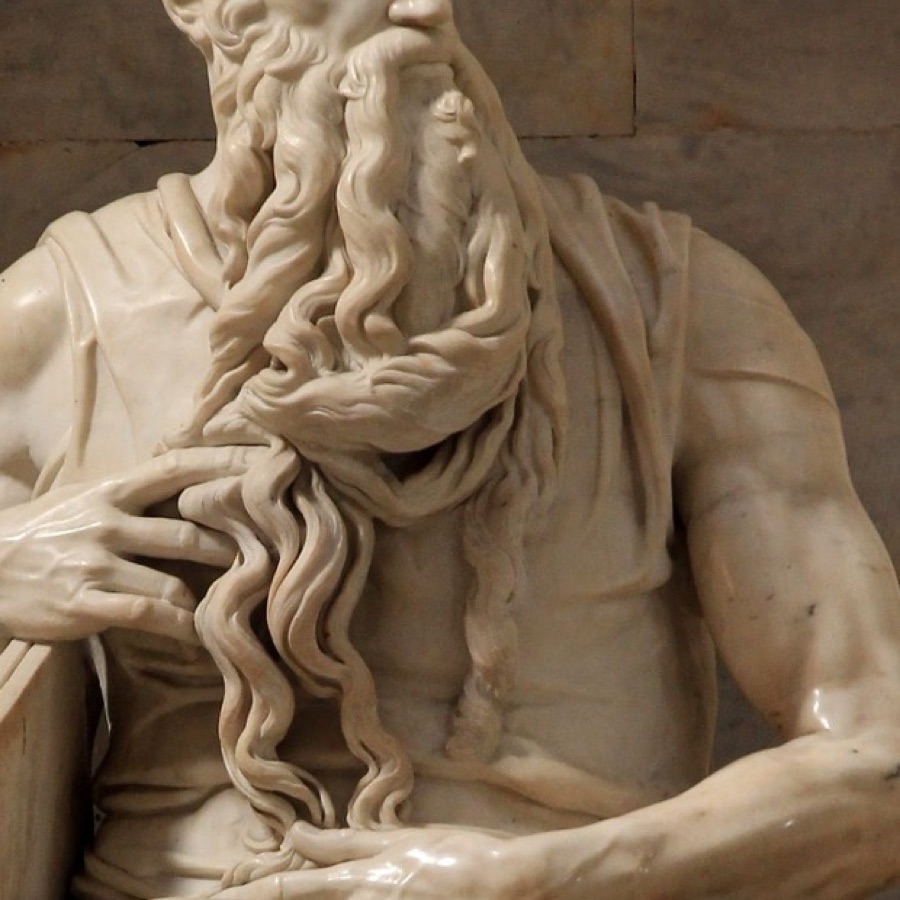
Seated turn
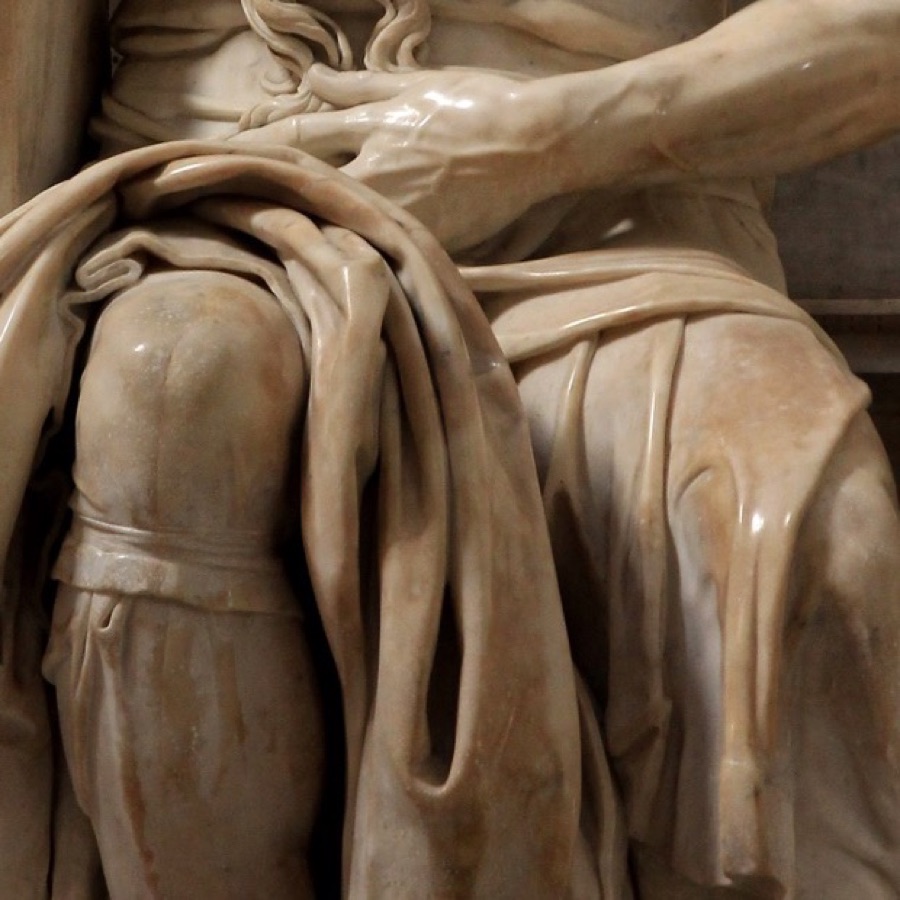
The seated pose is not passive; the torso, knee and drapery imply a turn held in reserve.
A Colossus in a Roman Church
The original Moses occupies the central lower niche of Julius II’s wall monument in the right transept of San Pietro in Vincoli. The church is named for the chains believed to have bound Saint Peter, but Michelangelo’s marble has become its most famous work. Rome’s municipal record notes that the basilica has housed the colossal figure since the completion of the monument in 1545.[2][3]
At 235 centimetres high even while seated, Moses is larger than a standing human being.[1] Michelangelo uses that scale without allowing it to become inert. The knees project beyond the compact upper body; the beard spreads over the chest; the turned head presses toward the boundary of the niche. Straight architectural edges make the body’s directional changes more legible. A viewer encounters a figure contained by the monument yet visually straining against frontal stillness.
The setting matters. A close photograph can isolate the head, hands or knees and make the sculpture appear autonomous. In the church, however, Moses is one part of a two-level memorial. Rachel and Leah stand in the flanking lower niches, while the pope’s recumbent effigy and sacred figures occupy the register above. Moses dominates this assembly, but its force depends partly on the adjacent bodies, the frame, the depth of the niche and the low position from which most visitors look.
The location also requires a distinction between memorial and burial. Julius II’s remains are in St Peter’s, not beneath the monument at San Pietro in Vincoli.[1][2] The sculpture therefore belongs to a commemorative ensemble at the church from which Julius had held the cardinal title. It is neither an independent statue later placed there by accident nor a literal marker immediately above the pope’s body.
Some museum records introduce Moses through casts. Museo Omero, whose mission centres on tactile access, describes a true cast in its collection before giving the history of the Roman original.[1] The National Gallery of Denmark has likewise used casts and reproductions to explore Michelangelo’s practice.[6] Such objects can communicate scale and three-dimensional form with unusual directness, especially through touch, but they are not Michelangelo’s marble. They do not preserve the original stone’s translucency, staining, repairs, polish or response to the church’s light.
From Julius II’s Great Project to the Final Monument
Pope Julius II commissioned his tomb from Michelangelo in 1505. The first project was associated with the rebuilding of St Peter’s and imagined on a scale very different from the surviving wall monument. Because the earliest contract is lost, that design must be approached through later descriptions, surviving drawings and scholarly reconstruction.[4]
A large drawing in the Metropolitan Museum of Art, dated 1505–1506, gives a sense of the project’s early ambition. It shows an architectural monument populated by figures and crowned by a scene in which angels raise the dead pope. Yet even this apparently foundational sheet is not a transparent blueprint. Its attribution to Michelangelo and its exact place among the designs have been debated. The evidence allows us to see an evolving design practice, not one master plan waiting forty years to be built.[4]
Julius died in 1513, after which a reduced agreement opened a major phase of sculptural work. Moses is principally dated to 1513–1515.[1] The Louvre’s Dying Slave belongs to the same years and to a proposed lower part of a reduced tomb scheme, although it was excluded from the monument eventually installed in Rome.[14] Their shared origin is important, but their histories diverged: Moses became the centre of the final ensemble; the Dying Slave entered a museum collection in Paris.
The Metropolitan Museum describes Michelangelo’s work on tomb drawings and figure studies as especially concentrated from 1505 into the early 1520s.[5] During the much longer life of the commission, contracts changed, patrons died, other papal work intervened, and sculptures intended for abandoned arrangements remained in Florence or moved elsewhere. The final monument, unveiled in February 1545, was a collaborative work on two levels rather than the vast structure first associated with St Peter’s.[2][5]
This history helps explain the authority of Moses without turning it into a survivor from a ruined golden age. Michelangelo did not simply take a finished statue from an immutable original plan and squeeze it into a smaller frame. The figure was worked on again and made to function in a later architectural solution. It embodies continuity across the project, but also revision.
A Body Held Between Rest and Action
The sculpture’s action begins in its asymmetry. Moses’s right foot presses down and forward. His left leg pulls back so that the heel rises and the toes touch the ground. This unequal footing has often made the figure seem ready to stand.[6] But the seat still bears his weight, and the torso remains firmly vertical. The pose generates possibility rather than completing an action.
Above the legs, several movements cross. The chest is broadly frontal, the face turns to Moses’s left, and the beard descends before being drawn sideways through the fingers. One arm holds the tablets close; the other interrupts and gathers the hair. The sculpture therefore never moves in only one direction. Michelangelo has made attention travel through the body as a series of deflections.
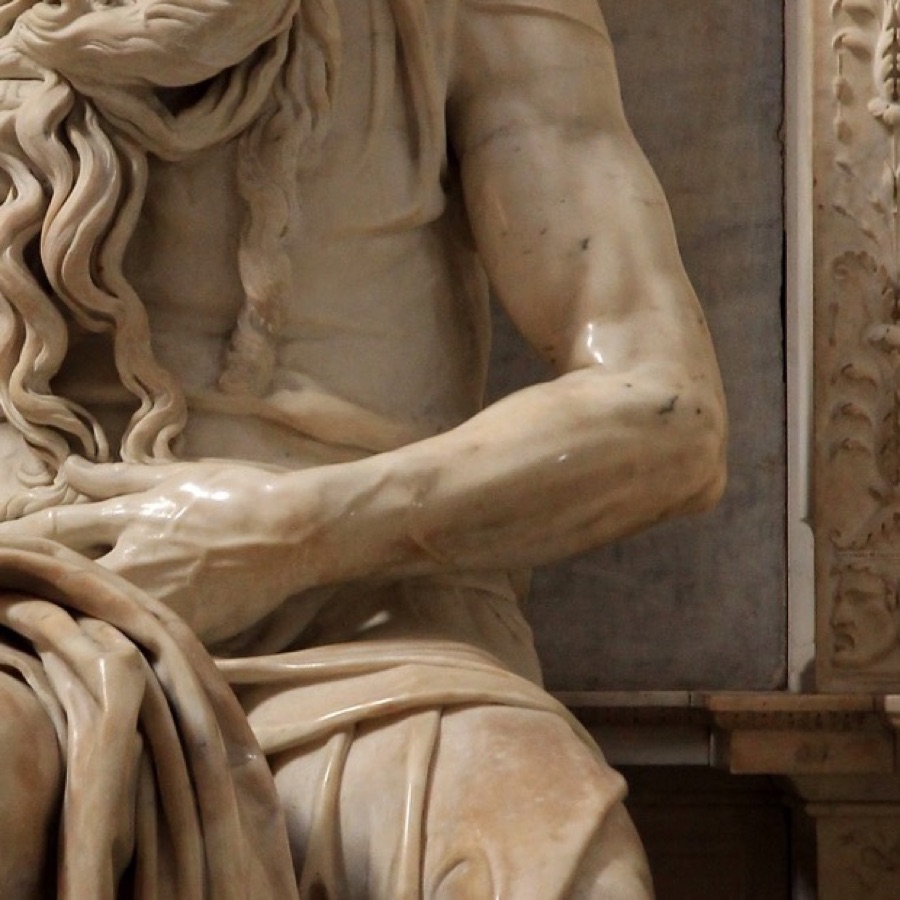
The hands are central to this effect. They neither perform a grand declarative gesture nor rest passively. The arm beside the tablets presses them against the body, turning divine law into something physically carried and protected. The other hand becomes entangled in the beard. Its touch makes the hair a record of movement: long vertical strands are redirected across the chest, carrying the head’s turn downward.
The beard has often prompted wonder at Michelangelo’s technique. Vasari praised its softness and compared the effect to work made with a brush rather than a chisel.[1] The flourish is rhetorical, yet it identifies a real feat. Deep drilling, undercut channels and alternating ridges cause a single block of stone to register as layered hair. Beside it, the broad tablets read as hard and planar, flesh as taut, and drapery as folded weight.
These contrasts are especially effective because the figure is not polished into uniform smoothness. Areas that catch light sharply sit beside deep recesses that almost disappear from below. The face is framed by shadow under the brow and within the beard. The knee and forearm push into brighter zones. A change of illumination can therefore alter not just visibility but apparent mood.
Face, Drapery and the Authority of Age
Moses’s face does not depend on beauty in the youthful, idealised sense. The broad forehead, tightened mouth, heavy brow and strongly modelled cheeks give age an active presence. Michelangelo does not show weakness. The prophet’s years seem to have accumulated as judgement and endurance, making the face an answer to the massive torso rather than a contrast with it.
The eyes are difficult to detach from their setting. Deep sockets make the gaze appear darker than the surrounding marble, especially when the statue is lit from above. Their direction follows the turn of the head, but the pupils do not provide the precise focus available in a painted portrait. Moses looks beyond the niche in a general field of attention. The object of the look remains unavailable.
His mouth intensifies that reserve. The lips are pressed rather than opened in command. The famous demand that the statue should speak reverses what Michelangelo actually carved: a moment in which speech has not yet been released. The closed mouth places more expressive weight on the turn, the hands and the uneven feet.
The drapery is equally important to the figure’s authority. It crosses the lap in broad masses, descends between the legs and gathers around the seat, giving the lower body a monumental base. Yet its folds do not conceal the pose. They reveal the change of level between the knees and trace the pressure of limbs beneath cloth. Where the beard breaks into narrow channels, the drapery is organised in larger planes; where the tablets remain rigid, cloth bends and compresses.
The exposed arms and one largely uncovered knee prevent the robes from turning Moses into a remote enthroned emblem. Flesh enters the architecture. Michelangelo balances the prophet’s status as receiver of divine law with the physical fact of a body that must carry it. This is one reason the figure can appear both superhuman and intensely vulnerable to a moment of anger.
Seeing the Statue from Below
Most close photographs correct the viewer’s disadvantage. They raise the camera, isolate details and flatten the angle of vision. In the church, the visitor looks upward from outside the niche. The knees appear particularly large, the upper surfaces of the tablets become harder to see, and the projections on the head may overlap the hair.
Michelangelo’s forms answer that low viewpoint. Important edges are emphatic: the line of the shin, the tablet’s corner, the beard’s deeply cut channels and the silhouette of the turned face. Fine detail remains present, but the principal relationships survive distance. The sculpture can be read first as an arrangement of great masses and only later as a feat of carving.
Moving sideways changes the alignment. The beard’s depth becomes clearer, the face separates from the chest, and the withdrawn leg reads less as a flat pattern than as an action carried back into space. Yet the architectural setting restricts any fully circular encounter. Unlike a marble placed alone in a modern gallery, Moses belongs to a controlled frontal zone with partial oblique views.
This limitation is expressive. The viewer cannot resolve every angle or discover one position from which all the bodily directions align. The figure’s withheld action is reinforced by withheld access. Casts and digital models can supplement that encounter, but their freedom of movement creates a different object experience.[1][6]
Which Moment Does Moses Represent?
The familiar answer is that Moses has seen the Israelites worshipping the golden calf and is restraining his anger. Exodus 32 describes Moses descending from Sinai with tablets written on both sides. When he sees the calf and the dancing, his anger burns; he throws down the tablets and breaks them at the foot of the mountain.[7] The turned head, compressed energy and insecure-looking tablets make this reading plausible.
Plausibility is not certainty. The calf, the crowd and the mountain are absent. The tablets remain intact. No surviving inscription attached to the sculpture by Michelangelo names the instant. Museo Omero therefore describes the golden-calf reading as a hypothesis rather than a documented caption.[1]
Exodus 34 provides another context. After the broken tablets, Moses prepares a second pair and ascends Sinai again. When he returns following the renewal of the covenant, his face is radiant because he has spoken with God. He later veils it before the Israelites.[8] The National Gallery of Denmark has connected the sculpture with this second descent and the renewed law.[6]
The statue can sustain elements of both narratives because it gathers the identity of Moses into a compact set of attributes. The tablets make him the bearer of the law. The horns make visible his transformed face. The head’s turn suggests response. Yet Michelangelo withholds the surrounding story that would convert those elements into illustration.
This withholding does not leave the sculpture empty. It shifts the emphasis from event to moral pressure. Moses holds a law received from beyond himself while reacting as a leader among fallible people. Anger, vigilance, judgement and restraint can all be felt in the pose, even if no one word owns it. The uncertainty prompts looking: every interpretation must return to the tablets’ stability, the foot’s readiness and the hands’ control.
Why Michelangelo Gave Moses Horns
The two projections on Moses’s head are intentional. They are neither signs of evil nor damage to the marble. They belong to a long Christian tradition that rendered the transformation described in Exodus 34 as horns.
The underlying history is linguistic. A Hebrew term associated with rays or radiance is closely related in form to the word for horns. The USCCB’s note to Exodus explains the connection, while its modern translation says that the skin of Moses’s face became radiant.[8] Latin tradition helped establish the horned Moses in European art, giving artists a compact bodily attribute for divine encounter.
It is common to dismiss the feature as a simple translation mistake. That explanation is too neat. It treats centuries of textual interpretation and image-making as though one careless word had been copied without thought. For Michelangelo and his first viewers, the horned type was established, intelligible and connected to scriptural authority. The marble projections translate radiance into permanent form.
Their scale is also revealing. Michelangelo did not turn Moses into a fantastic creature. The horns are relatively small and emerge from the hair. From a low frontal viewpoint they can partly merge with the head; from the side or above they become clearer. Modern close crops often enlarge them until they seem like the work’s defining mystery, but within the whole figure they are one controlled sign among the tablets, beard and commanding body.
The Turned Head and the Work of Revision
The standard date of 1513–1515 names the sculpture’s principal campaign, not a perfectly fixed object finished once. Museo Omero says that Michelangelo finally completed it in 1542 and that the head was originally frontal before being turned.[1] Rome’s municipal account similarly reports a later modification confirmed through restoration.[2]
The change was consequential. A frontal head would have reinforced the throne-like stability of the seated body. The turn separates face from chest, intensifies the crossed directions of the pose and sends Moses’s attention beyond the central axis. It may also have helped the statue operate within the final niche and in relation to the light or approach of the church.
The physical alteration is better grounded than any single explanation for it. A municipal interpretation associates the change with the religious climate around the Council of Trent.[2] That proposed motive should remain attributed, since neither the surviving marble nor the date alone proves why Michelangelo recut the head. Sightlines, narrative emphasis and changed placement are also relevant possibilities.
Revision complicates the idea that a masterpiece is the untouched product of one flash of inspiration. Michelangelo’s own later intervention became part of the sculpture’s expressive logic. The result feels coherent precisely because recarving was not merely correction; it was redesign in stone.
Detailed claims about the operation require specialist evidence. The Getty publication Michelangelo’s Tomb for Julius II: Genesis and Genius brings together documents, drawings, sculptures and findings associated with the modern restoration.[9] The Rijksmuseum library catalogue confirms the volume’s scope and bibliographic identity.[10] These records establish the depth of scholarship, but a catalogue description cannot replace passage-specific consultation when assigning exact cuts, dates or hands.
Light, Cleaning and the Experience of the Surface
Moses has never been seen under one permanent condition. Daylight in the basilica changed when windows were altered or blocked, and electric illumination can produce effects unlike those encountered by sixteenth-century viewers. Museo Omero’s accessibility project used a virtual reopening of a blocked window to explore an earlier lighting condition and created tactile and audio resources around the monument.[1]
In 2021, Italy’s Ministry of Culture described a supervised cleaning of the statue and study of natural light at San Pietro in Vincoli. Around the spring equinox, sunlight entering the church was observed to illuminate parts of the monument in sequence.[12] This behaviour is a real feature of the present building and object. The further suggestion that Michelangelo calculated the sequence exactly is an interpretation of that evidence, not a surviving statement of intent.
Cleaning can reveal tonal relationships obscured by surface deposits, but it should not be confused with the earlier, broader restoration of the monument. Nor does a newly brightened surface recreate a single original appearance. Marble ages; architecture changes; artificial light and photography mediate what can be seen. Each intervention adds to the object’s history.
Under a strong spotlight, the brows can darken, the forehead can blaze and the beard can break into dramatic black-and-white channels. Softer daylight permits slower transitions across the torso and drapery. The apparent psychology of the face can shift with these conditions. What looks like fury in one photograph may appear like distant attention in another.
From Vasari’s Wonder to Freud’s Interpretation
The response to Moses has often blurred description into legend. Vasari’s admiration for the beard and the figure’s lifelike presence celebrates Michelangelo’s ability to overcome the resistance of stone.[1] A still more famous anecdote says that the sculptor struck the knee and ordered the statue to speak. No commission record cited here verifies the act. It belongs to the afterlife of the sculpture rather than secure biography.
The story persists because it dramatises something viewers really experience. Moses seems silent by choice, not because stone cannot speak. His lips are closed, his attention is engaged and his body stores an answer. The anecdote invents an impatient creator to release that withheld voice.
Sigmund Freud approached the sculpture differently. The Freud Museum records his substantial 1914 study and his wider preoccupation with Moses.[13] Freud tried to understand the figure’s sequence of movement and emotional self-command. His essay is a major moment in twentieth-century reception, but it cannot serve as evidence of Michelangelo’s intention. It reveals how one powerful viewer organised the marble’s ambiguities.
That distinction applies to every psychological account. Anger, disappointment, restraint and prophetic concentration are interpretations prompted by visible form. They become convincing when they explain the relation of head, hands, tablets, beard and legs; they become fragile when they claim privileged access to an inner state.
An Image of Controlled Power
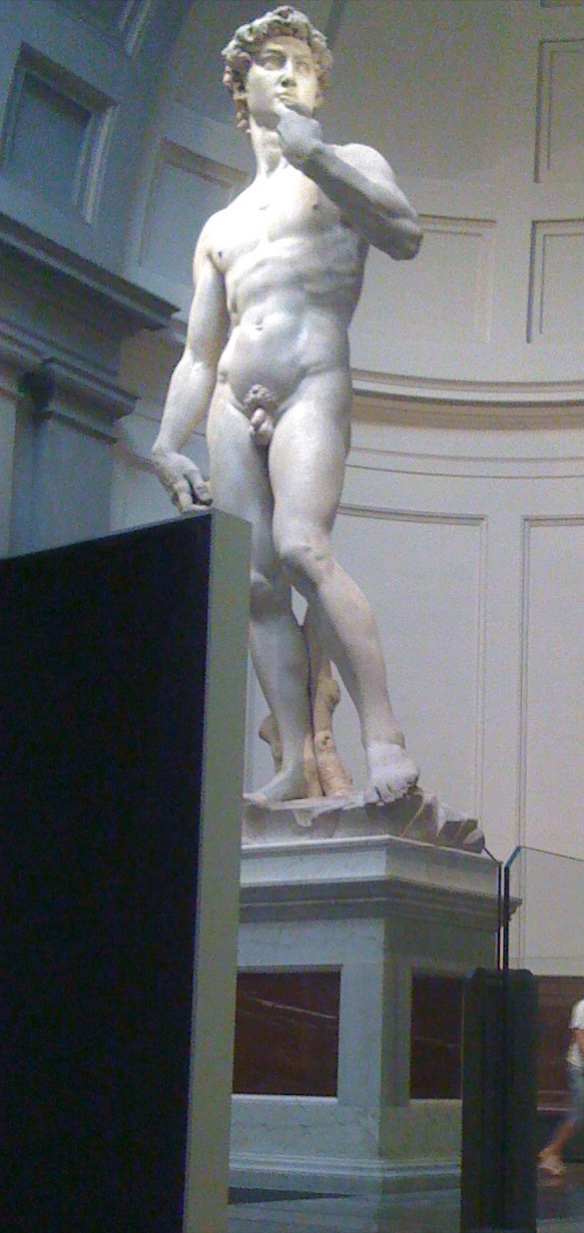
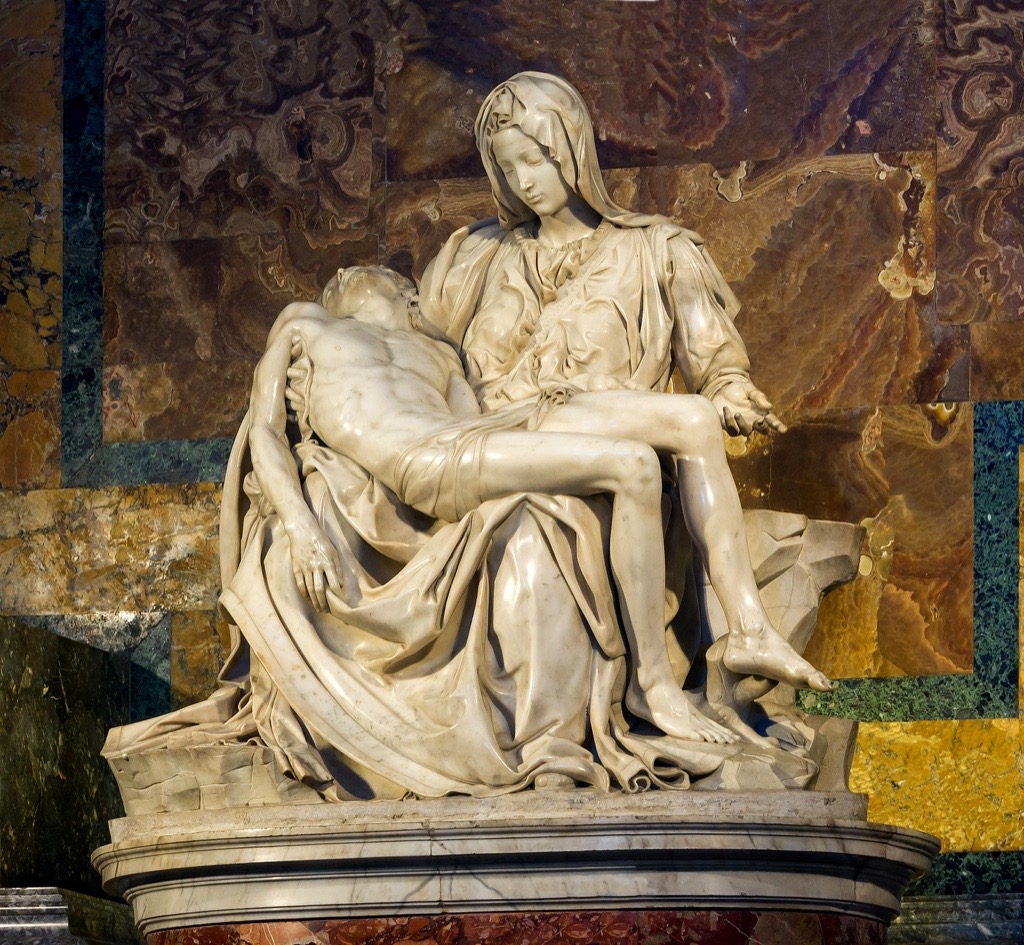
Compared with Michelangelo’s David, Moses is an older lawgiver rather than a youthful civic hero, seated within a papal memorial rather than exposed as a freestanding public statue. Compared with the Vatican Pietà, it replaces the closed exchange between Mary and Christ with attention directed beyond the frame. These differences matter more than a general claim that all three display genius.
The closest historical comparisons are the figures made for abandoned stages of Julius II’s tomb. The Dying Slave shares the 1513–1515 dating but converts the body into an image of yielding ambiguity; the later Florence Prisoners leave large areas visibly uncarved. None should be imagined as once installed around the present Moses.[14]
The final monument includes sculpture and architectural work by collaborators as well as Michelangelo. Yet Moses supplies its visual centre. His size, compressed movement and frontal authority bind the lower level while the turn of his head opens it outward. The figure is both anchored and interrupted.
That dual condition makes the long history of the tomb visible without requiring viewers to know every contract. A marble begun for one version was altered for another; a prophet bearing permanent law became the most adaptable element in an unstable commission. Michelangelo’s achievement lies not in making movement explode, but in making immense power remain seated.
Artist Up Close
Michelangelo’s sculptural intelligence often appears most clearly in transitions: where a polished limb meets rough support, where a straight architectural edge sets off a twisting body, or where one gesture redirects the movement of another. In Moses, the decisive transitions are concentrated around the beard and tablets. One is luxuriant, organic and mobile; the other is planar, compact and binding. The hands negotiate between them.
This is disegno in a broad Renaissance sense—not just preliminary drawing, but the organising conception that joins thought, figure and material. The Metropolitan Museum’s career catalogue traces that principle across Michelangelo’s media.[11] Here it is embodied in a sculpture revised across decades: an idea strong enough to survive alteration because its meaning depends on a system of relationships rather than one frozen gesture.
Frequently Asked Questions
Discussion
Use these questions to separate visible form, biblical text, documented object history and later interpretation.
Reader Insights
Which parts of the seated figure suggest restraint, and which suggest imminent movement?
How does the meaning change if the tablets belong to the first descent rather than the renewed covenant?
How does the niche affect the original compared with a museum cast seen from every side?
Join the Conversation
Share an evidence-led reading and identify which viewpoint, source or comparison supports it.
References
- Museo Tattile Statale Omero, Moses”:, View source.
- Roma Capitale / Turismo Roma, Michelangelo’s Locations”:, View source.
- Roma Capitale / Turismo Roma, The Basilica of San Pietro in Vincoli”:, View source.
- Metropolitan Museum of Art, Design for the Tomb of Pope Julius II della Rovere”:, View source.
- Metropolitan Museum of Art, Michelangelo: Divine Draftsman and Designer — Exhibition Galleries”:, View source.
- National Gallery of Denmark, Michelangelo Imperfect — English Guide:, View source.
- United States Conference of Catholic Bishops, Exodus, Chapter 32”:, View source.
- United States Conference of Catholic Bishops, Exodus, Chapter 34”:, View source.
- J. Paul Getty Museum / Getty Publications, Michelangelo’s Tomb for Julius II: Genesis and Genius:, View source.
- Rijksmuseum Research Library, Michelangelo’s Tomb for Julius II: Genesis and Genius:, View source.
- Metropolitan Museum of Art, Michelangelo: Divine Draftsman and Designer:, View source.
- Ministero della Cultura, La luce di Michelangelo”:, View source.
- Freud Museum London, Moses: The Return of the Repressed”:, View source.
- Musée du Louvre, The Dying Slave”:, View source.
- Annotated image source: Michelangelo, Moses, San Pietro in Vincoli, Rome. Photograph by Jörg Bittner Unna, CC BY 3.0, via, Wikimedia Commons, Prepared from the accepted option C source image at 2,751 × 4,127 pixels; page-ready image resized proportionally and detail images cropped for the annotated module, View source.