 by Tom Gurney
Tom Gurney BSc (Hons) is an art history expert with over 20 years experience
Published on June 19, 2020 / Updated on November 6, 2025
Email: tomgurney1@gmail.com / Phone: +44 7429 011000
Michelangelo’s Life and Career
Michelangelo Buonarroti lived for almost eighty-nine years, from 1475 to 1564, and worked through repeated changes of government, patronage and artistic fashion. He trained in Florence, established his reputation through sculpture, painted two of the defining fresco cycles of the Renaissance, wrote poetry throughout his adult life and ended his career directing the rebuilding of Saint Peter’s Basilica. The familiar image of a solitary genius captures only part of that history. His achievements grew out of workshops, friendships, family obligations, demanding commissions and long negotiations with some of the most powerful patrons in Italy.
His life is unusually well documented for a Renaissance artist. Letters, contracts, drawings, poems and family papers survive alongside biographies written during his lifetime. Those sources make a detailed account possible, but they must be read with care. Michelangelo helped to shape his own reputation, while early biographers presented him through the moral and literary conventions of their age. A sound biography therefore distinguishes documented events from later anecdote and allows uncertainty to remain where the evidence does not settle it.[2][4][21]
At a Glance
- Full nameMichelangelo di Lodovico Buonarroti Simoni [1][2]
- Born6 March 1475, Caprese, in the Florentine Republic [2]
- Died18 February 1564, Rome [2][23]
- Principal centres of workFlorence and Rome, with important early periods in Bologna [1][2]
- FieldsSculpture, painting, drawing, architecture and poetry [1][22]
- Early trainingThe workshop of Domenico Ghirlandaio and the sculpture garden at San Marco associated with Lorenzo de’ Medici [1][2]
- Major patronsLorenzo de’ Medici, Pope Julius II, Pope Leo X, Pope Clement VII and Pope Paul III [1][2][15]
- Best-known worksPietà, David, the Sistine Chapel ceiling, the Medici tombs, The Last Judgment and the architectural design of Saint Peter’s Basilica [6][7][11][12][15][18]
- Documentary recordLetters and family papers in the Buonarroti Archive, surviving drawings, poems, contracts and contemporary biographies [2][21][22]
Contents
- Early life and training
- The Medici garden and first sculptures
- Rome, the Pietà and a rising reputation
- David and republican Florence
- Julius II and the Sistine Chapel ceiling
- Medici commissions and the defence of Florence
- The last thirty years in Rome
- Architecture, late sculpture and poetry
- Working methods, assistants and reputation
- Death, burial and legacy
Early life and training, 1475–1490
Michelangelo was born on 6 March 1475 in Caprese, a small town governed from Florence, where his father Lodovico Buonarroti was serving a temporary administrative post. The Buonarroti regarded themselves as an old Florentine family, although their finances and status were less secure than Michelangelo later liked to suggest. Soon after his birth, the family returned to the Florentine area. He grew up in a world where civic identity, family reputation and patronage shaped a person’s opportunities as powerfully as talent did.[1][2]
The artist’s earliest years have often been narrated as if his vocation announced itself from childhood. The evidence is less theatrical. His family initially expected a course of education suited to their social ambitions, while the visual culture of Florence offered a different path. Churches, public buildings and workshops made recent achievements by Giotto, Masaccio, Donatello, Ghiberti and others part of the city’s daily environment. Michelangelo’s decision to enter an artist’s workshop was therefore both a practical choice and, for a family conscious of status, a potential source of tension.
By the late 1480s Michelangelo had entered the large workshop of Domenico Ghirlandaio, one of Florence’s leading painters. The Metropolitan Museum of Art dates this formative association to approximately 1487–1490 or 1491. There he could learn the disciplined processes behind a major commission: preparing surfaces, transferring compositions, grinding and handling pigments, organising figures within architectural space and drawing from models and earlier art. Later biographical tradition tended to minimise Ghirlandaio’s importance because it suited the idea that Michelangelo’s ability was innate and unteachable. His command of fresco in the Sistine Chapel makes more sense when this early workshop training is taken seriously.[1][2]
Drawing was central to that education. It was not simply a preliminary activity but a means of analysing bodies, testing movement and coordinating the different arts. Michelangelo would later become one of the most influential exponents of disegno, a term that embraces both drawing and design. His career repeatedly moved from small marks on paper to marble figures, painted narratives and entire buildings. The continuity between those media is one reason a biography organised only by “sculptor,” “painter” and “architect” can be misleading.[1]
The Medici garden and first sculptures, about 1490–1496
Around 1490 or 1491, according to the contemporary biographical tradition assessed by modern museum scholarship, Michelangelo’s friend Francesco Granacci introduced him to the sculpture garden at San Marco. Lorenzo de’ Medici had assembled ancient and modern works there under the supervision of Bertoldo di Giovanni, a sculptor trained in Donatello’s orbit. The garden was an exceptional place to study sculpture and to meet members of the Medici circle, but describing it as a formal “Humanist Academy” gives it an institutional shape the evidence does not support.[2]
Two surviving reliefs at Casa Buonarroti reveal the speed of Michelangelo’s development. The Madonna of the Stairs responds to Donatello’s shallow-relief technique, while the Battle of the Centaurs turns the nude body into a dense field of interlocking action. Casa Buonarroti dates the works to Michelangelo’s adolescence and connects them with his study of Donatello, classical art and the Medici environment. They are not merely prodigious juvenilia. Their compression, twisting figures and tension between finished and roughly worked surfaces anticipate questions that occupied him for the rest of his life.[3]
Lorenzo de’ Medici’s death in 1492 disrupted this protective setting. Florence then entered a volatile decade marked by the French invasion of 1494, the expulsion of the Medici and the rise and fall of Girolamo Savonarola. Michelangelo moved between Florence, Venice and Bologna before establishing himself in Rome. The exact motives attached to every journey are not always recoverable, but the pattern is clear: his early career was formed amid political instability as well as artistic opportunity.[1][2]
Accounts of these years contain vivid stories about Michelangelo’s character and body, including the broken nose visible in later portraits. Such details derive largely from early biographies and recollections rather than a modern documentary record. They can illuminate how contemporaries remembered him, but they should not be treated as transparent access to his personality. Giorgio Vasari and Ascanio Condivi wrote with particular aims: Vasari made Michelangelo the culmination of a history of Italian art, while Condivi produced an authorised account close to the artist’s own preferred version of events.[4]
Rome, the Pietà and a rising reputation, 1496–1501
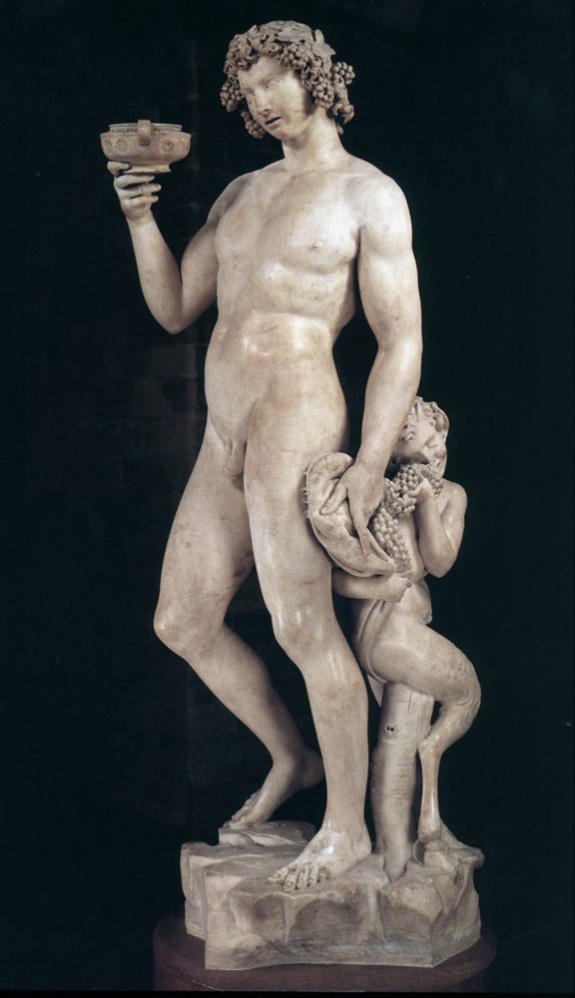
Michelangelo reached Rome in 1496. The city exposed him to ancient sculpture on a scale unavailable elsewhere and to an international network of cardinals, bankers and collectors. His marble Bacchus, now in the Bargello, belongs to this first Roman period. Its unsteady balance and sensuous surface demonstrate close engagement with antiquity without becoming a simple imitation of an ancient statue.[5]
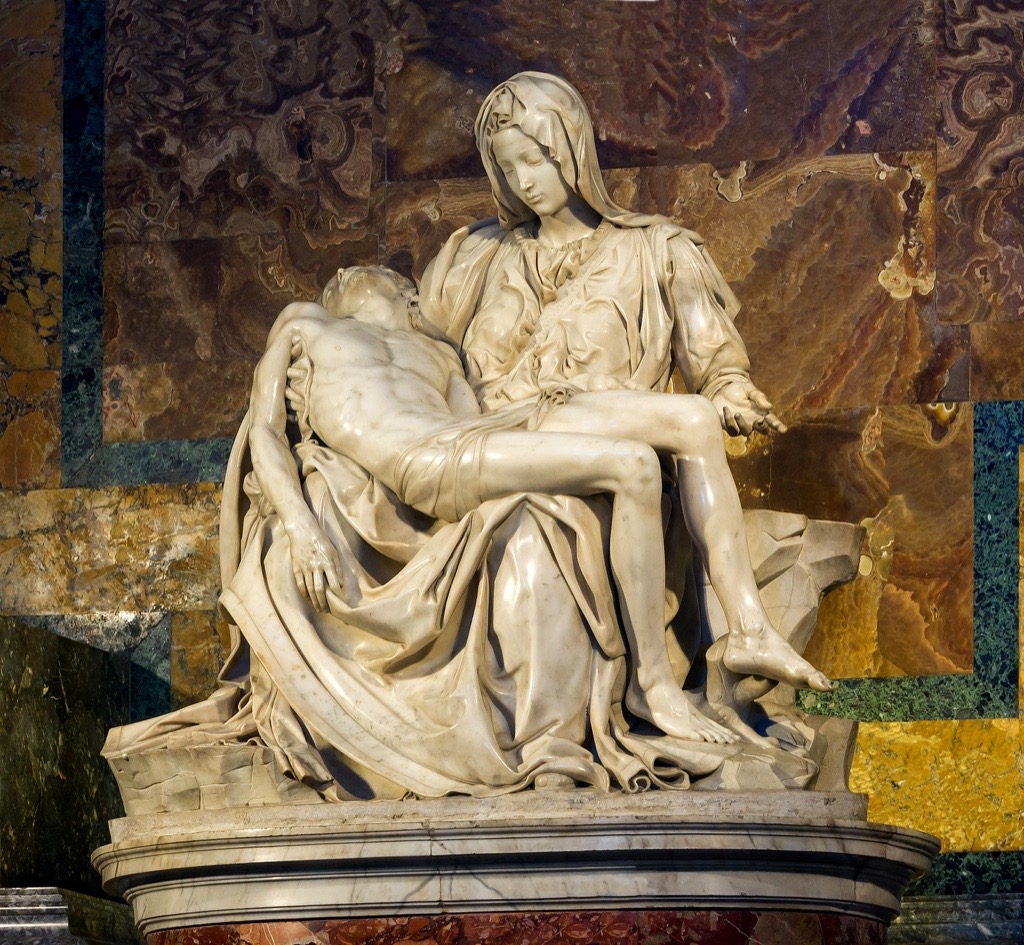
The commission that transformed his public standing was the marble Pietà for the French cardinal Jean Bilhères de Lagraulas. Made around 1498–1499 and now in Saint Peter’s Basilica, the sculpture presents the dead Christ across the Virgin Mary’s lap. Michelangelo created a stable pyramidal group while making Christ’s extended body seem both physically weighty and almost weightless. The Virgin’s youthful appearance and expansive drapery do not attempt documentary realism; they give the devotional image an ideal and contemplative form.[6]
The Pietà is also the only sculpture Michelangelo signed. The signature across the Virgin’s sash has generated memorable stories about wounded pride and mistaken attribution, but the durable fact is the inscription itself and its unusual place in his work. At the age of about twenty-four, Michelangelo had made a monument of extraordinary technical finish for a prominent Roman setting. The commission announced that he could rival both ancient sculpture and the most admired modern masters.[6]
When he returned to Florence in 1501, he did so with a reputation extending beyond his native city.[2] Yet success did not produce a smooth ascent from one masterpiece to the next. Michelangelo’s career was repeatedly shaped by abandoned plans, revised contracts and patrons whose ambitions exceeded available money, time or political stability. The gap between conception and completion is not an incidental frustration in his biography; it is one of its central themes.
David and republican Florence, 1501–1505
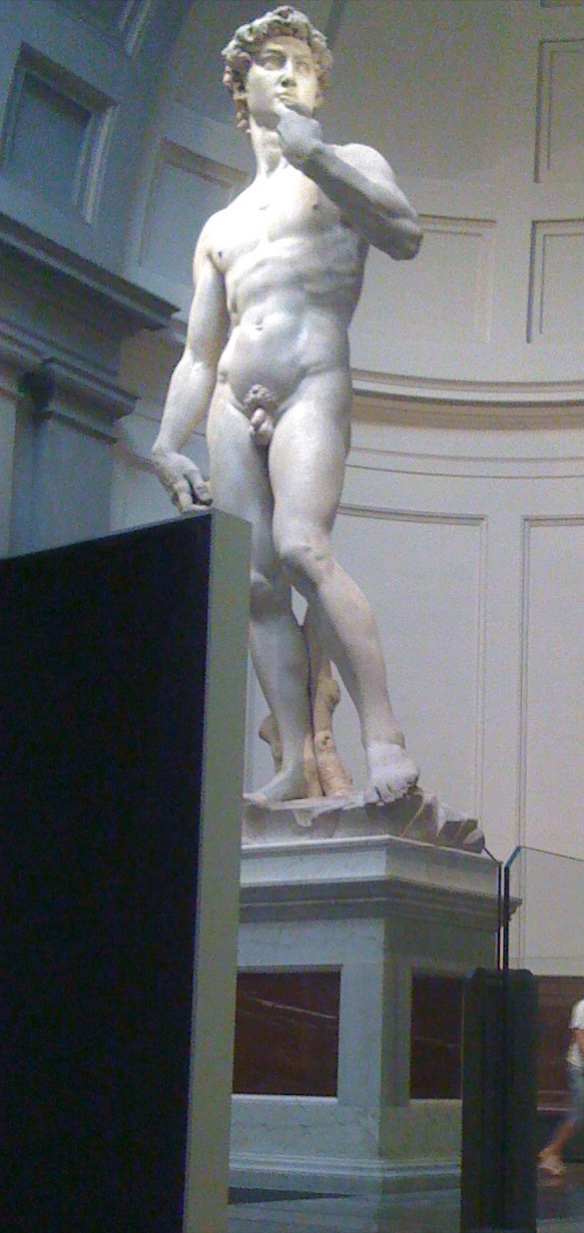
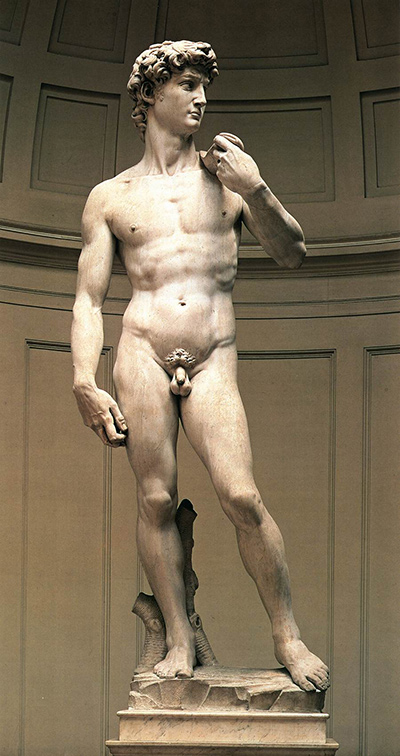
In August 1501 Michelangelo received the block of marble from which he carved David. Earlier sculptors had worked or considered the difficult, tall block, which had been intended for Florence Cathedral. Michelangelo completed the statue in 1504. A committee then debated its location, and it was installed outside the Palazzo della Signoria rather than high on the cathedral. There the biblical hero acquired a civic meaning within the Florentine Republic as a vigilant defender facing more powerful opponents.[7]
The statue’s scale, concentrated gaze and enlarged hands and head answered both the constraints of the marble and the demands of public visibility. Michelangelo represented David before combat, alert rather than triumphant. The body refers to ancient ideals but is charged with asymmetry and potential movement. Its anatomy helped establish Michelangelo as the leading sculptor of his generation, while its political setting tied his reputation to Florence’s contested public life.[7]
Florence in these years brought Michelangelo into direct competition with Leonardo da Vinci. In 1504 both men were commissioned to design battle scenes for the council hall in the Palazzo della Signoria: Leonardo the Battle of Anghiari and Michelangelo the Battle of Cascina. Neither mural was completed, and Michelangelo’s full-scale cartoon is lost, but studies and copies transmitted its muscular soldiers to later artists. The episode helped define the rivalry between two very different conceptions of art, even though later retellings have often embroidered their personal hostility.[2]
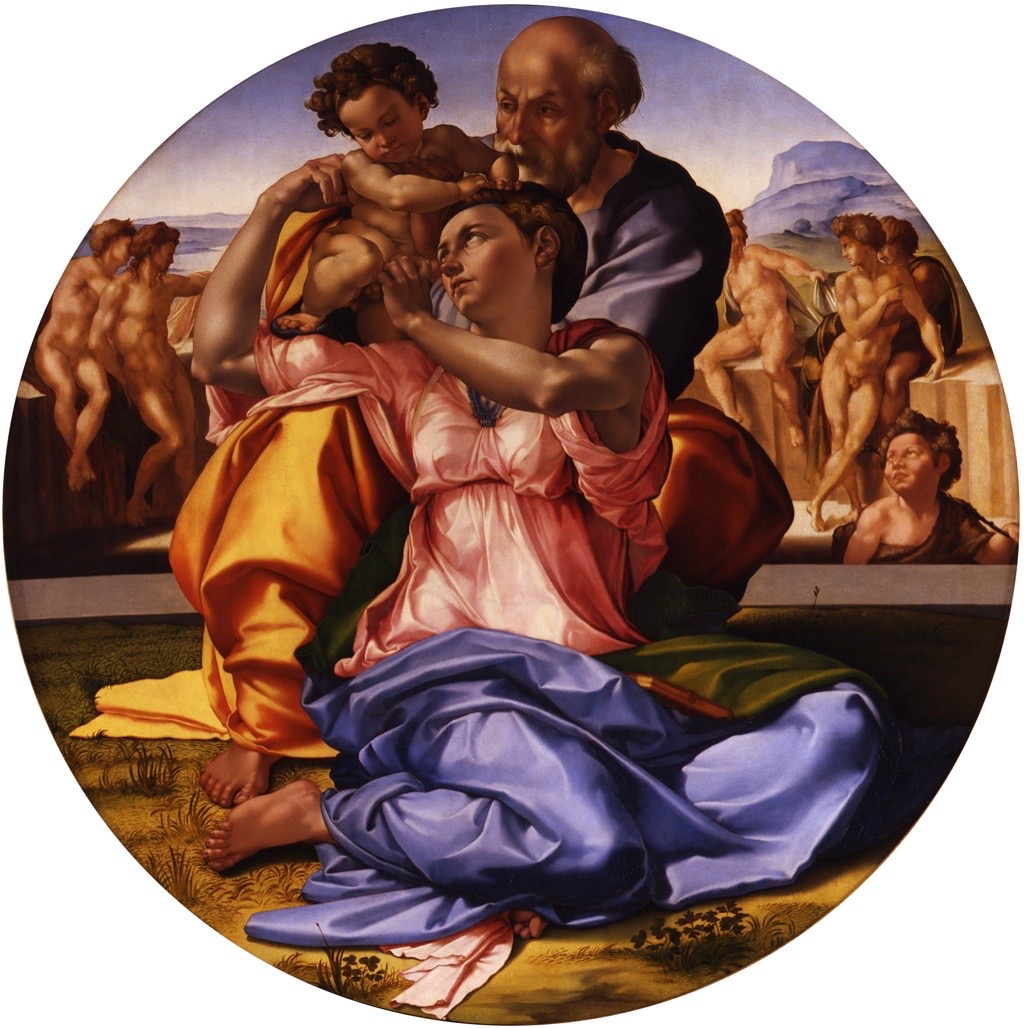
Michelangelo also painted the Doni Tondo, generally dated to about 1505–1506, for Agnolo Doni and Maddalena Strozzi. The Uffizi identifies it as his only securely attributed finished panel painting. Its twisting Holy Family, intensely modelled colour and ring of nude figures show him treating paint through a sculptor’s understanding of bodies while also engaging with contemporary Florentine painting.[8]
This concentrated Florentine period established several elements of his mature career: monumental anatomy, competition across media, complicated civic meanings and a refusal to regard drawing, painting and sculpture as separate intellectual worlds. It also drew the attention of Pope Julius II, whose patronage would dominate the next phase of Michelangelo’s life.
Julius II, the papal tomb and the Sistine Chapel ceiling, 1505–1512
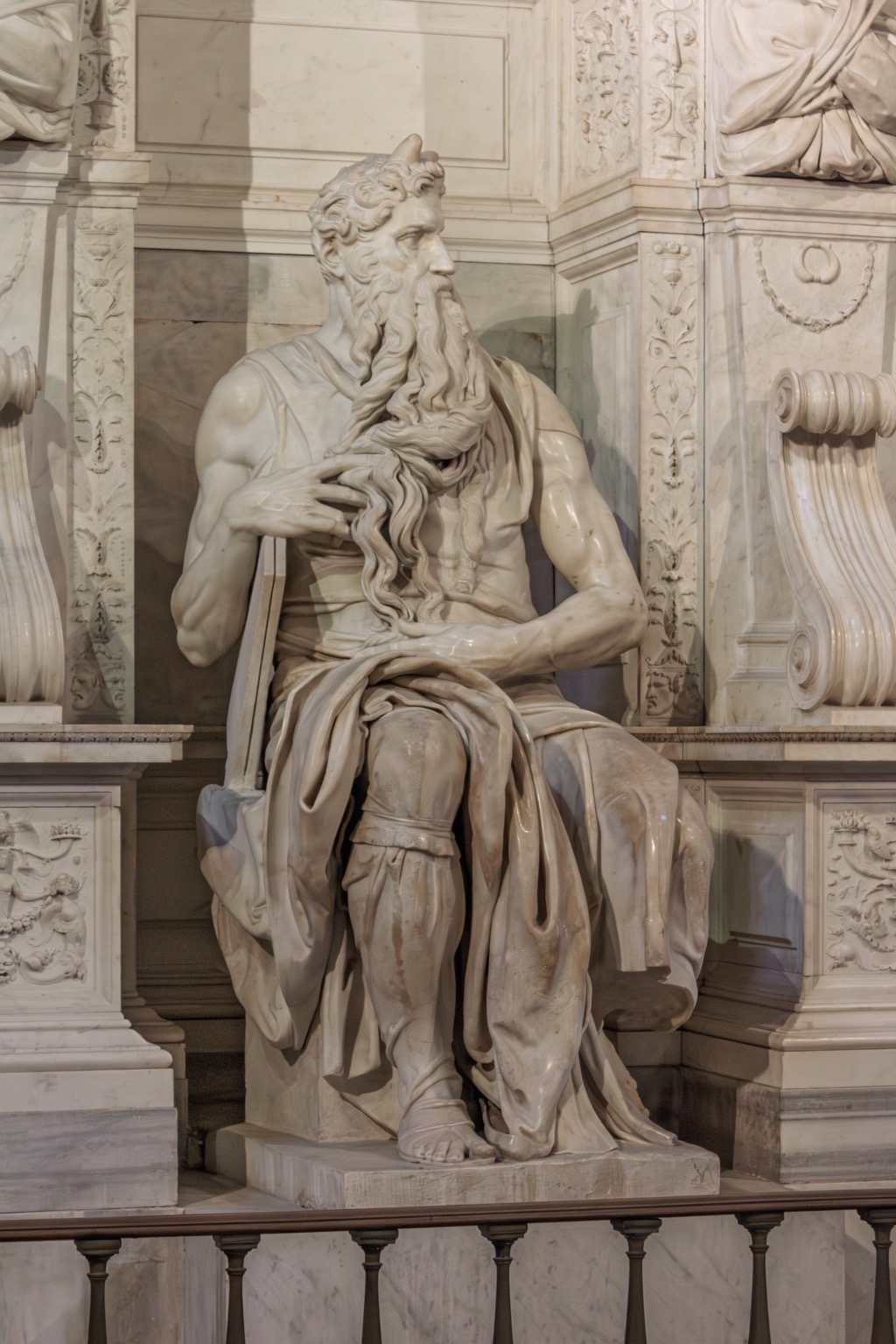
Julius II summoned Michelangelo to Rome in 1505 to design the pope’s tomb. The initial scheme was enormous, conceived as a free-standing monument with many marble figures. Work soon became entangled in altered priorities, money, architecture and the difficult relationship between artist and patron. Michelangelo left Rome after a rupture with Julius, later returned, and continued to revise the tomb under successive contracts. The reduced wall monument in San Pietro in Vincoli was unveiled in 1545, forty years after the first commission. Its commanding Moses preserves only one part of an ambition that had once been much larger.[2][9]
The long history of the tomb produced some of Michelangelo’s most compelling sculpture. The two figures known as the Dying Slave and Rebellious Slave, now in the Louvre, were associated with a revised project but never entered the installed monument. Their unfinished and highly finished passages make visible different stages of carving. Yet it would be too simple to treat every incomplete surface as a deliberate philosophical statement. In Michelangelo’s work, incompletion could result from changes of plan, flaws in marble, pressure of other commissions or a conscious decision to stop.[10]
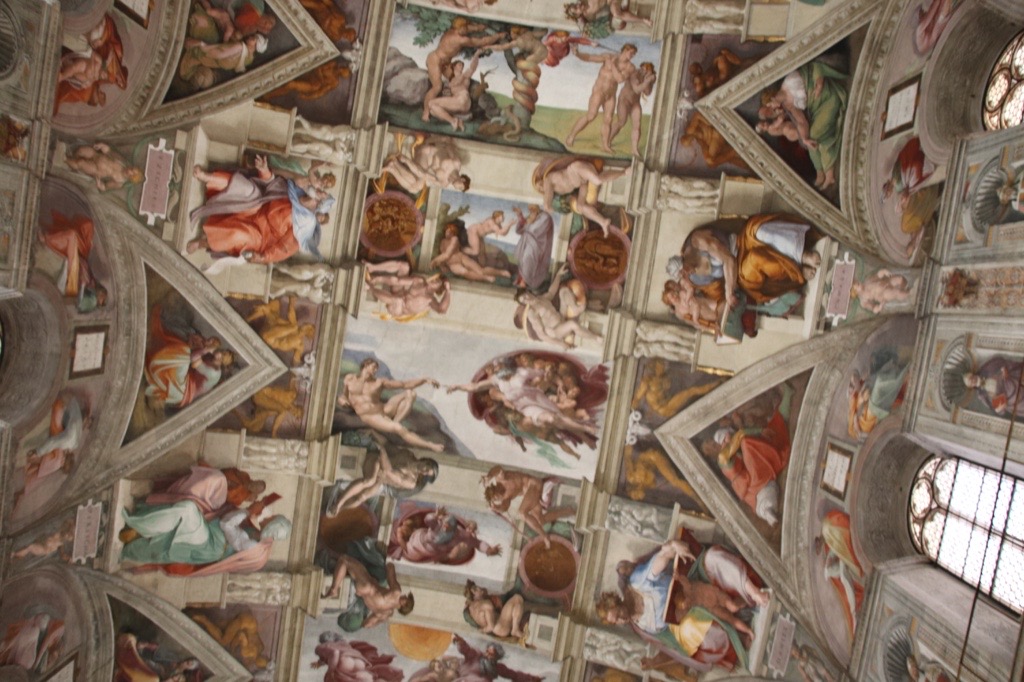
While the tomb remained unresolved, Julius commissioned Michelangelo to paint the ceiling of the Sistine Chapel. Work took place from 1508 to 1512. The existing chapel already contained an important fifteenth-century fresco cycle on its walls, so the ceiling entered a space with established liturgical and visual meanings. Michelangelo organised the vast surface through painted architecture, central narratives from Genesis, prophets and sibyls, the ancestors of Christ and numerous nude youths commonly called ignudi.[11]
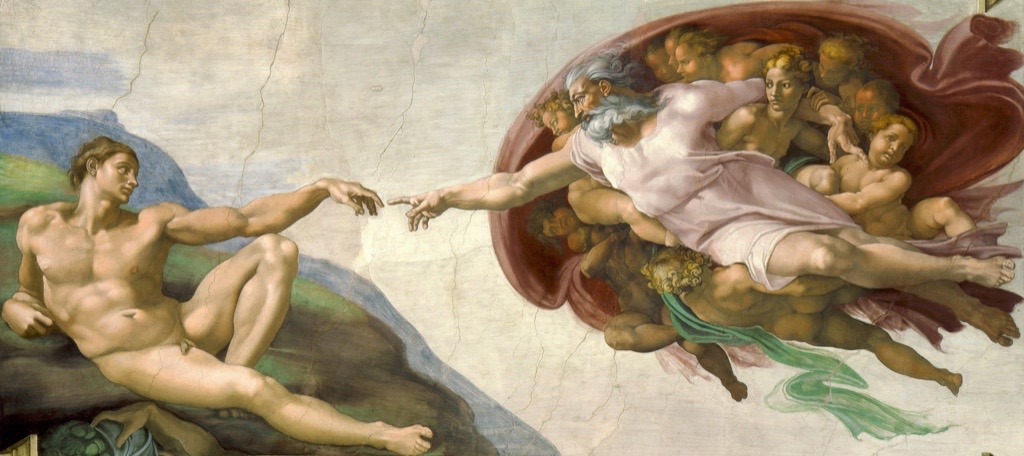
The central sequence moves from the separation of light and darkness through creation, the fall of humanity and episodes from Noah. The Creation of Adam has become the most familiar scene, but its meaning depends on the larger structure: the near-touching hands sit within a history of divine creation, human disobedience and anticipated redemption. The ceiling’s bodies are not independent displays of anatomical skill. Gesture, scale and placement carry theological and narrative work.[11]
Several myths obscure the practical achievement. Michelangelo did not paint the ceiling while lying flat on his back. He worked on scaffolding, looking upward and enduring an exhausting physical position. Nor did he complete the project as a lone hand untouched by workshop practice. Assistants participated at different stages, even though the design and execution became increasingly concentrated around Michelangelo. His earlier fresco training under Ghirlandaio mattered, as did the technical knowledge available within Renaissance workshops.[1][2]
The ceiling secured Michelangelo’s fame far beyond sculpture. It also hardened the later image of a superhuman artist capable of mastering every field. That reputation was real in his lifetime, but it can hide the specific conditions under which the work was made: papal authority, an active chapel, a demanding medium, collaborative labour and continual design decisions across an irregular architectural surface.
Medici commissions and the defence of Florence, 1513–1534
After Julius II died in 1513, Michelangelo’s obligations to the tomb continued, but Medici patrons redirected much of his attention to Florence. Pope Leo X, a son of Lorenzo de’ Medici, commissioned a façade for San Lorenzo. Michelangelo produced designs and invested heavily in the project, including the difficult organisation of marble supply, but the façade was never built. Its cancellation is a reminder that the scale of his surviving achievement coexists with a substantial history of unrealised work.
More enduring Medici projects followed at San Lorenzo. The New Sacristy, begun in 1519, brought architecture and sculpture into a single funerary setting. Michelangelo designed the space, tomb structures and major figures associated with Giuliano de’ Medici, Duke of Nemours, and Lorenzo de’ Medici, Duke of Urbino. The reclining personifications commonly called Day, Night, Dawn and Dusk turn the passage of time into bodies that are powerful, unstable and difficult to contain.[2][12]
Nearby, the Laurentian Library allowed him to rethink the movement between rooms. The reading room is ordered and horizontal; the vestibule is compressed by columns set into the walls and a staircase that seems to pour into the available space. Michelangelo left Florence before the complex was finished, and later architects carried out parts of the design from his instructions and models. The building therefore demonstrates both his authorship and the dependence of architecture on communication and continued construction by others.[13]
These commissions unfolded amid renewed political crisis. The Medici were expelled from Florence again in 1527, and the restored republic prepared for war. Michelangelo supported its defence. In 1529 he served on the committee responsible for fortifications and was appointed governor and procurator general of the works. Casa Buonarroti preserves studies for strengthening the city gates, while institutional research connects him with defensive work around San Miniato. Many proposals remained on paper or were only partly realised, but the drawings document serious engagement with military architecture and with the republic’s survival.[14]
Michelangelo’s service complicates any simple description of him as a compliant Medici artist. His livelihood and greatest Florentine projects depended on the family, yet he acted for the republic that expelled them. After the city capitulated in 1530, he resumed work on Medici commissions under Clement VII. Patronage did not erase political danger; nor did political allegiance free him from the networks through which large works could be funded.
In 1534 Michelangelo left Florence and settled permanently in Rome. The move marked a decisive division in his life. The New Sacristy sculptures and Laurentian Library remained incomplete in important respects, and he would never return to his native city. The last three decades nevertheless opened new fields of work and produced some of his most ambitious art.[2]
The last thirty years in Rome, 1534–1564
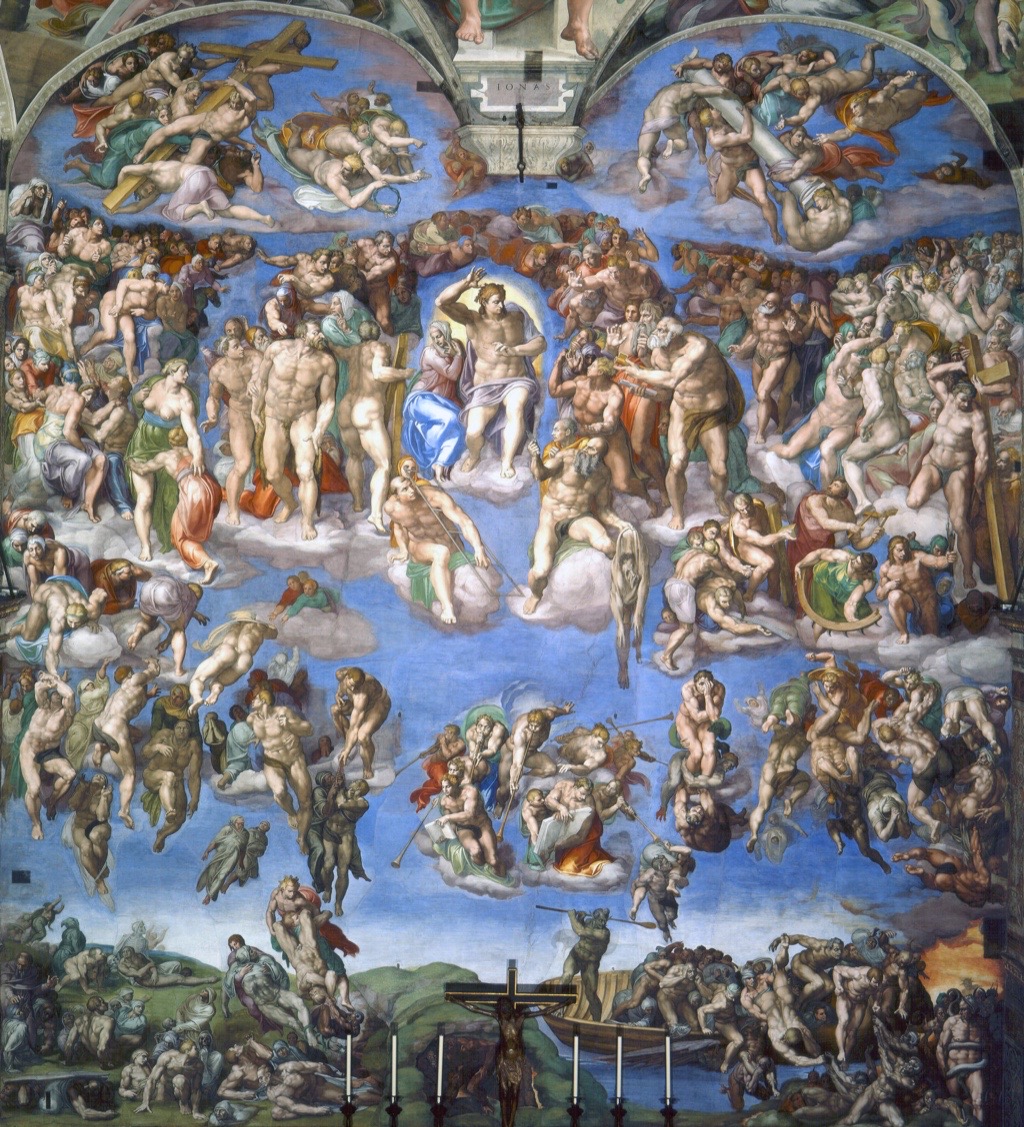
Pope Clement VII had commissioned The Last Judgment for the altar wall of the Sistine Chapel, and Pope Paul III continued the project after Clement’s death. Michelangelo painted the fresco principally between 1536 and 1541. Rather than extending the ceiling’s clear architectural compartments, he created a turbulent field centred on Christ as judge. The resurrected rise, the damned fall and saints display the instruments of their martyrdom. The scale and nudity of the bodies generated controversy almost immediately.[15]
The fresco belongs to a different historical moment from the ceiling. Rome had endured the catastrophic sack of 1527, religious division had deepened across Europe and debates about sacred images were intensifying. Michelangelo’s design should not be reduced to a single reaction to those events, but its compressed, unstable humanity is far removed from the ceiling’s ordered framework. Later interventions, including draperies painted over some nudes, form part of the work’s reception history rather than Michelangelo’s original conception.[15]
Michelangelo then painted the Conversion of Saul and Crucifixion of Saint Peter in the Pauline Chapel. These late frescoes are less accessible to the public and less widely known, but they extend his investigation of bodies under spiritual and physical pressure. Museum scholarship also identifies Daniele da Volterra among the trusted artists who helped translate Michelangelo’s ideas into finished works and, after Michelangelo’s death, became entangled in the alteration of The Last Judgment.[2]
The Roman years were sustained by friendships and exchanges as well as papal commissions. Michelangelo met the Roman nobleman Tommaso de’ Cavalieri in 1532. He gave Cavalieri highly finished presentation drawings and addressed poems to him; their friendship lasted for the rest of Michelangelo’s life. Michelangelo’s later friendship with the poet Vittoria Colonna brought a different but equally important exchange of poems, devotional ideas and drawings. The Metropolitan Museum associates his most prolific period of poetic writing, roughly 1536–1546, with this circle of personal and spiritual relationships.[2][16]
These relationships deserve neither erasure nor sensationalism. Michelangelo wrote love poems addressed to men, and later editors changed pronouns in ways that obscured that history. The surviving poems and gifts are evidence of intense affection, artistic exchange and Renaissance conventions of friendship and love. They do not give simple access to every private act or justify forcing a modern identity category onto evidence produced in a different social world. A responsible biography can acknowledge desire and attachment without pretending that the archive answers every intimate question.[16][17]
Architecture, late sculpture and poetry
Architecture occupied an increasing part of Michelangelo’s later career. He worked on the Campidoglio, Palazzo Farnese, Porta Pia and other Roman projects, often transforming existing sites rather than designing in isolation. The Campidoglio reorganised Rome’s civic hill around an axial space and coordinated façades, paving and the ancient equestrian statue of Marcus Aurelius. Much of the ensemble was completed after his death, another case in which his designs were mediated by later builders.[1][2]
In 1546 Michelangelo became chief architect of Saint Peter’s Basilica. The rebuilding had already passed through the hands of Bramante, Raphael, Antonio da Sangallo the Younger and others. Michelangelo simplified and strengthened the centralised conception, reshaped the exterior and developed the design for the dome. He held the post for the final seventeen years of his life, but the dome itself was completed later and modified in execution. Saint Peter’s is therefore neither his invention alone nor a project from which his contribution can be removed. His structural and spatial decisions gave the building a coherence that profoundly influenced its final form.[1][18]
He continued to carve marble into old age. The group now called the Bandini Pietà, probably begun in the late 1540s, includes Christ supported by the Virgin, Mary Magdalene and a hooded man commonly identified as Nicodemus. Michelangelo damaged the sculpture and abandoned it; others intervened later. The Opera del Duomo’s documentation and conservation research reveal both the material history of the marble and the complexity hidden by the simple label “unfinished.”[19]
The Rondanini Pietà, now in Milan, occupied Michelangelo intermittently in his last years. He radically recut the group, reducing physical mass and bringing the bodies of Christ and the Virgin into an attenuated vertical union. Its slender forms look startling beside the polished fullness of the Vatican Pietà, but the contrast should not be narrated as a straightforward journey from realism to modern abstraction. Different purpose, date, working history and unfinished state all matter.[20]
Poetry was not a minor hobby beside these visual works. More than three hundred poems survive, including sonnets, madrigals and fragments concerned with love, artistic creation, ageing, faith and mortality. The poems complicate the stereotype of an artist able to express himself only through stone. They also provide no unfiltered diary: Michelangelo revised texts, used inherited literary forms and addressed particular people within social conventions that require interpretation.[1][16][17]
His letters offer another kind of voice. The Buonarroti Archive preserves extensive family and professional material, including correspondence that records payments, commissions, property, health, travel and Michelangelo’s persistent concern for relatives. This record is the strongest corrective to colourful claims that he lived wholly outside ordinary social obligations. He may have cultivated austerity and complained sharply, but he managed money, negotiated contracts, supported family interests and protected the Buonarroti name.[21]
Working methods, assistants and reputation
Michelangelo’s working process began repeatedly with drawing. Quick sketches could test the direction of a limb; careful figure studies could resolve anatomy; architectural sheets could examine walls, mouldings or stairs; full-scale cartoons could transfer a composition. He also used small models in wax or clay and prepared more finished presentation drawings as independent gifts. The surviving corpus is only a portion of what once existed.[1][22]
The idea that figures were simply waiting inside marble for release is a powerful metaphor, not a sufficient account of carving. Michelangelo selected blocks, arranged transport, established points and depths, used successive tools and sometimes changed a design after work had begun. Tool marks and altered forms preserve decisions made over time. The unfinished works are especially valuable because they expose stages normally removed by final polishing, but their causes must be assessed case by case.[1][10][19][20]
He preferred close control and could be suspicious of interference, yet he did not create an eighty-year career alone. Stone had to be quarried and moved; walls prepared; pigments supplied; architecture measured, engineered and built. Assistants and collaborators appear throughout his projects. Francesco Granacci belonged to his early Florentine circle. The painter Sebastiano del Piombo developed compositions from Michelangelo’s drawings during a collaboration that began around 1516. Daniele da Volterra became a trusted associate in Rome. Architects including Giorgio Vasari and Bartolomeo Ammannati helped carry Florentine designs forward after Michelangelo’s departure.[2]
Recognising this network does not diminish Michelangelo. It explains how work on such a scale became possible and clarifies what was distinctive about his contribution: the governing designs, radical revisions, exacting standards and ability to think across materials. “Solitary” is most useful when it describes a preference or a carefully constructed public identity, not when it erases labour performed by others.
Michelangelo was celebrated during his lifetime to an extent exceptional for an artist. Vasari’s Lives of 1550 placed him at the summit of a story of artistic progress. Condivi’s biography of 1553 offered a version more closely aligned with Michelangelo himself. Vasari revised his account in 1568, after the artist’s death. These texts preserve valuable information, but their praise, rivalry and rhetorical purpose require critical reading. The modern biography rests on a wider base: documents, objects, buildings, technical study and institutional scholarship as well as literary testimony.[2][4]
One famous report says Michelangelo destroyed many of his drawings so that others would not see his labour. Vasari is the source for the motive, while the loss of drawings is also documented around Michelangelo’s death. It is reasonable to conclude that he managed what future viewers could know of his process; it is less safe to turn one reported motive into a complete psychological explanation. The surviving sheets are abundant enough to show that invention for him involved repetition, correction and discarded alternatives rather than effortless inspiration.[2]
Death, burial and legacy
Michelangelo died in Rome on 18 February 1564, with friends present. He was first buried in the church of Santi Apostoli. His nephew Leonardo then transported the body to Florence, where it arrived on 11 March. After public mourning and a funeral ceremony at San Lorenzo, Michelangelo was buried in Santa Croce, the church associated with his family. Vasari designed the monumental tomb raised there between 1564 and 1576.[2][23]
By the time of his death, Michelangelo’s reputation had become inseparable from the idea of artistic genius. Later generations studied and copied his bodies, compositions and buildings, sometimes taking their power and complexity in directions he could not have anticipated. His influence runs through sixteenth-century Italian art and the academic tradition, but it cannot be reduced to a sequence of direct imitations. The example of a single artist mastering sculpture, painting, architecture and poetry also shaped expectations about what an artist could be.
The most productive way to understand that achievement is not to strip away its human conditions. Michelangelo missed deadlines, abandoned designs, quarrelled, revised, depended on others and worked within institutions whose aims were not his own. He also sustained ideas across decades and materials with remarkable intensity. The tension between ambition and circumstance is visible in the tomb of Julius II, the Medici projects, Saint Peter’s and the late Pietà sculptures.
His biography therefore does more than connect a series of masterpieces. It shows Renaissance art emerging through contracts and friendships, religious practice and political crisis, bodily labour and intellectual design. The polished Pietà, the public defiance of David, the crowded Sistine ceiling, the compressed vestibule of the Laurentian Library and the fragile Rondanini Pietà belong to one long career, but not to one unchanging style. Michelangelo’s greatness lies partly in his refusal to repeat an early solution after the conditions of his life had changed.
For a year-by-year view of the same life and commissions, use the standalone Michelangelo Timeline, which follows the chronology from Caprese and Florence to Rome, the Sistine Chapel, St Peter’s and the late Pietà sculptures.
Timeline
- 1475: Born at Caprese on 6 March. [1][2]
- Late 1480s: Trains in Domenico Ghirlandaio’s workshop. [1][2]
- About 1490–1491: Enters the circle around the Medici sculpture garden at San Marco. [2][3]
- 1490–1492: Produces the Madonna of the Stairs and Battle of the Centaurs. [2][3]
- 1494–1495: Works in Bologna during political upheaval in Florence. [2]
- 1496: Arrives in Rome; makes Bacchus during his first Roman period. [2][5]
- About 1498–1499: Carves the Vatican Pietà. [6]
- 1501–1504: Carves David in Florence. [2][7]
- 1504: Receives the Battle of Cascina commission. [2]
- About 1505–1506: Paints the Doni Tondo. [8]
- 1505: Begins work on the tomb of Pope Julius II. [2][9][10]
- 1508–1512: Paints the Sistine Chapel ceiling. [11]
- 1513 onward: Continues revised projects for the Julius monument. [2][9]
- 1519: Work begins on the New Sacristy at San Lorenzo. [12]
- 1520s: Develops the Laurentian Library and Medici tombs. [12][13]
- 1529–1530: Works on the fortifications of republican Florence. [14]
- 1534: Settles permanently in Rome. [2]
- 1536–1541: Paints The Last Judgment. [2][15]
- 1542–1550: Works on the Pauline Chapel frescoes. [2]
- 1545: The reduced monument to Julius II is unveiled. [2][9]
- 1546: Becomes chief architect of Saint Peter’s Basilica. [18]
- Late 1540s–1550s: Works on the Bandini Pietà. [19]
- Last years: Reworks the Rondanini Pietà. [20]
- 1564: Dies in Rome on 18 February; his remains are transferred to Florence. [23]
Frequently Asked Questions
Discussion
Michelangelo’s life is clearest when reputation is balanced with evidence: training, contracts, patrons, political risk, letters, poems and unfinished works. The prompts below use biography as a way into that evidence rather than as a myth of solitary genius.
Reader Insights
Which part of Michelangelo’s life changes most when contracts, letters and workshop evidence replace the solitary-genius myth?
How does knowing why a commission changed affect your response to an unfinished marble?
Which connection between sculpture, painting, drawing, architecture or poetry most changes how you see Michelangelo?
Join the Conversation
Share your reading of Michelangelo’s life and work below.
References
- Carmen C. Bambach, Michelangelo: Divine Draftsman and Designer, Metropolitan Museum of Art and Yale University Press, 2017, Metropolitan Museum of Art publication, View source.
- Metropolitan Museum of Art, “Michelangelo: Divine Draftsman and Designer — Exhibition Galleries.”, Exhibition chronology and themes, View source.
- Fondazione Casa Buonarroti, museum collection and early reliefs, Casa Buonarroti, View source.
- Giorgio Vasari, The Life of Michelangelo, modern scholarly edition and introduction by Hellmut Wohl, Getty Publications, Getty Publications, View source.
- Musei del Bargello, “Michelangelo: the Bloom of Renaissance Art.”, Bargello itinerary, View source.
- Papal Basilicas of the Holy See, “Michelangelo’s Pietà.”, Saint Peter’s Basilica, View source.
- Galleria dell’Accademia di Firenze, “Michelangelo’s David.”, Accademia collection record, View source.
- Uffizi Galleries, “Holy Family, known as the Doni Tondo.”, Uffizi collection record, View source.
- Rijksmuseum Research Library, Michelangelo’s Tomb for Julius II: Genesis and Genius, Bibliographic record, View source.
- Musée du Louvre, “The Louvre’s Slaves.”, Louvre visitor trail, View source.
- Vatican Museums, “Sistine Chapel Ceiling.”, Vatican Museums, View source.
- Musei del Bargello, “Cappelle Medicee.”, Medici Chapels, View source.
- Biblioteca Medicea Laurenziana, “The Visit in Brief.”, Laurentian Library, View source.
- Fondazione Casa Buonarroti, “Study of Fortification for the Porta al Prato of Ognissanti.”, Casa Buonarroti collection record, View source.
- Vatican Museums, “The Last Judgement.”, Vatican Museums, View source.
- Metropolitan Museum of Art, exhibition section “Art and Personal Spirituality.”, Exhibition galleries, View source.
- Metropolitan Museum of Art, “James M. Saslow on Sensuality and Spirituality in Michelangelo’s Poetry.”, Met Perspectives, View source.
- Holy See, “Saint Peter’s Dome and Lantern.”, Vatican architectural record, View source.
- Opera di Santa Maria del Fiore, “Michelangelo Buonarroti, Pietà Bandini.”, Opera del Duomo, View source.
- Castello Sforzesco, “La Pietà Rondanini.”, Comune di Milano museum record, View source.
- Fondazione Casa Buonarroti, “Buonarroti Archive.”, Archive research route, View source.
- British Museum, “Michelangelo Buonarroti.”, Collection and person record, View source.
- Opera di Santa Croce, “Monumental Tomb of Michelangelo Buonarroti.”, Santa Croce collection record, View source.