 by Tom Gurney
Tom Gurney BSc (Hons) is an art history expert with over 20 years experience
Published on June 19, 2020 / Updated on November 6, 2025
Email: tomgurney1@gmail.com / Phone: +44 7429 011000
Michelangelo’s Deposition (Bandini Pietà)
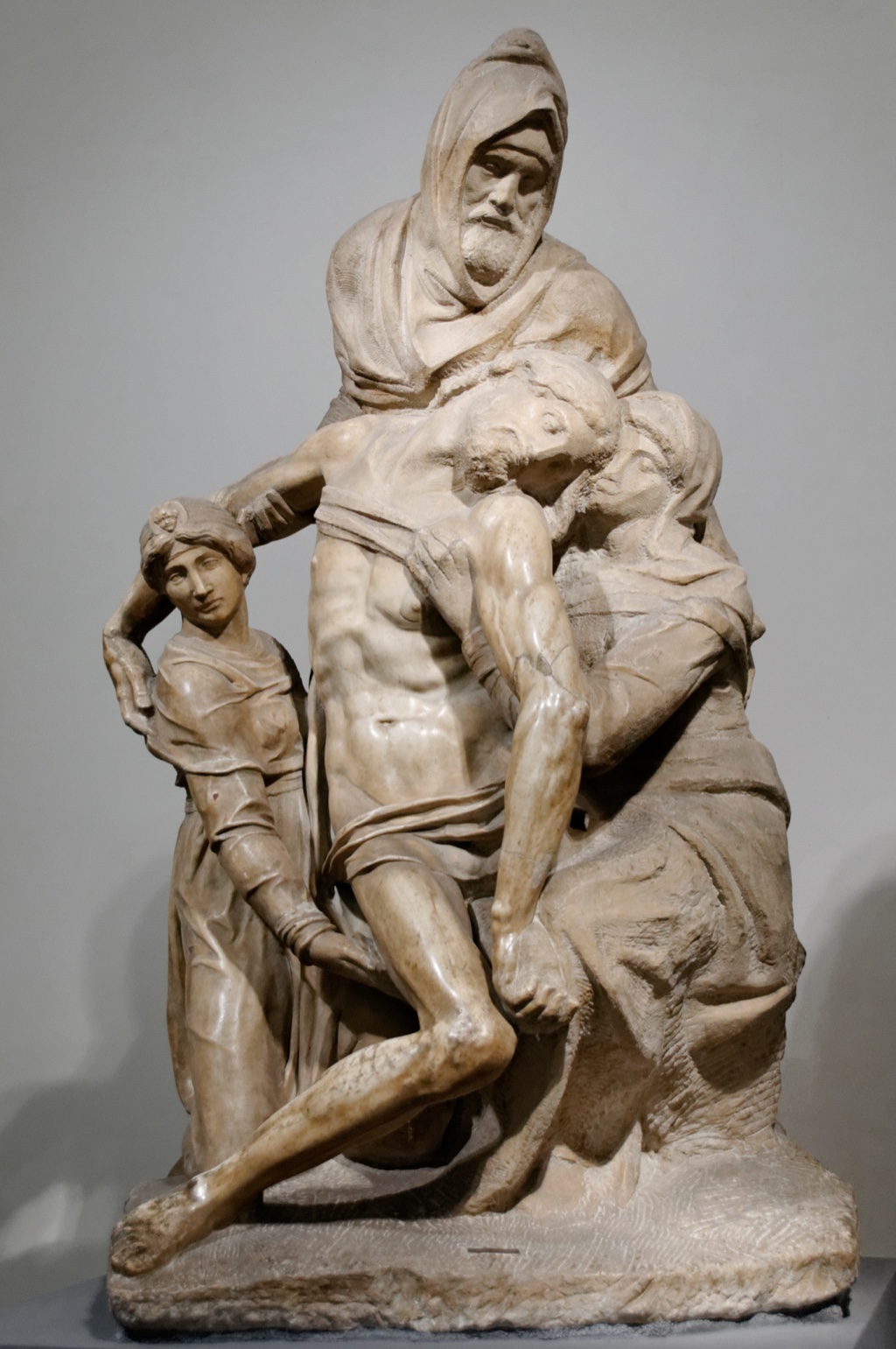
Michelangelo’s Deposition, usually called the Bandini Pietà or Florentine Pietà, is a four-figure marble group carved in Rome in about 1547–1555. It shows the dead Christ supported by the Virgin Mary, Mary Magdalene and a tall hooded man. The work is unfinished, was damaged during Michelangelo’s lifetime and was subsequently altered by Tiberio Calcagni. It is now displayed in the Tribuna di Michelangelo at the Museo dell’Opera del Duomo in Florence.[1]
Several histories meet in this single object. It was conceived for Michelangelo’s own funerary setting, passed through Roman and Florentine collections, stood for centuries in churches, and underwent a major conservation campaign in 2019–2021. Its polished and rough passages do not belong to one simple moment of “non-finito”: they preserve Michelangelo’s carving, his changes of plan, breakages, Calcagni’s intervention and later surface history.
At a Glance
- ArtistMichelangelo Buonarroti, with later intervention by Tiberio Calcagni
- Common titlesDeposition, Bandini Pietà, Florentine Pietà and Pietà dell’Opera del Duomo
- DateAbout 1547–1555
- MediumWhite marble, identified by conservation analysis as originating at Seravezza
- Dimensions277 × 138 × 125 cm
- FiguresChrist, the Virgin Mary, Mary Magdalene and a hooded man usually identified as Nicodemus
- Current locationTribuna di Michelangelo, Museo dell’Opera del Duomo, Florence
- Original intentionA funerary monument for Michelangelo in a Roman church
- StateUnfinished, fragmented and later reworked
- Later sculptorTiberio Calcagni, who reassembled and completed parts of the group
- Identity cautionThe hooded man is usually called Nicodemus, but Joseph of Arimathea has also been proposed
- Damage cautionMichelangelo’s mutilation of the sculpture is historically reported, but the surviving surface does not prove every detail of the familiar hammering story
- Viewing cautionThe group’s depth, joins and changes of finish become clearest from several angles
Contents
- Why the sculpture has several names
- The four-figure composition
- The Mechanics of Carrying the Dead
- Deposition, Pietà and burial
- A sculpture intended for Michelangelo’s tomb
- An Artist Imagining His Own Memorial
- Christ’s descending body
- The Virgin, Magdalene and hooded man
- Michelangelo, damage and unfinished form
- What Tiberio Calcagni changed
- Marble, surface and conservation
- From Rome to Florence
- The three Pietàs and the separate Entombment
- Artist Up Close
Why the sculpture has several names
The title Deposition emphasises Christ’s removal from the Cross and the downward movement of his body. Pietà identifies a devotional image centred on the dead Christ mourned by his mother, sometimes with additional Gospel figures. Florentine Pietà distinguishes the sculpture by its present city, while Bandini Pietà derives from Francesco Bandini, the Roman banker who acquired it after Michelangelo’s servant Antonio da Casteldurante arranged for Calcagni to work on the damaged group.[2]
These names describe different aspects of the same marble. They do not identify separate versions. Nor does the word Pietà require a composition of the Virgin and Christ alone. The Opera del Duomo describes the subject as Christ taken down from the Cross and mourned by his mother and other Gospel figures.[2]
The sculpture’s names also record movement. “Bandini” remembers one owner; “Florentine” reflects its later history; “Pietà dell’Opera del Duomo” points to its current institution. Deposition usefully describes the action, but the object must remain distinct from Michelangelo’s youthful Vatican Pietà, his final Rondanini Pietà and his unfinished panel painting known as the Entombment.
The four-figure composition
The group is arranged as a tall, compressed structure. The hooded man forms its apex. Below him, Christ’s body falls through the centre in a broken, serpentine movement. The Virgin supports Christ beneath his left arm and draws her head near his. Mary Magdalene kneels on the other side and supports the lower body. Together the figures make a roughly triangular mass, but the sculpture never settles into a flat pyramid.[3]
Christ’s weight supplies the composition’s central action. His neck bends sharply, his head turns toward the Virgin and his torso descends across the supporting bodies. The surviving right leg changes direction at the knee. His missing left leg makes the present silhouette more abrupt than Michelangelo’s original block would have been.
The surrounding figures do not simply stand beside Christ. Their arms and bodies enter a network of support. The hooded figure bears weight from behind. The Virgin receives Christ’s upper body. Magdalene steadies him below. The carving turns mourning into a physical problem: how can three living bodies hold a dead one that appears to sink through them?
That question changes with viewpoint. From the front, Christ seems to descend in a continuous line from the hooded figure. From the sides, the depth between the figures, the projections of the limbs and the interruptions caused by breakage become clearer. A single reproduction may make the group look more stable and complete than it is.
The Mechanics of Carrying the Dead
Michelangelo organises grief through weight. Christ cannot answer the hands that hold him. His slack body crosses several supports, so every living figure must adapt to a load that continues downward rather than standing independently.
The hooded man’s height gives the group its upper structure. His arms descend into the cluster and make him seem capable of bearing Christ from behind. The Virgin’s proximity to Christ’s head gives support an intimate scale, while Magdalene’s lower position helps stabilise the falling diagonal.
These supports are not anatomically transparent everywhere because fracture, missing parts and Calcagni’s work have altered the group.[3] The present object combines an intelligible physical action with discontinuities. Viewers can feel the burden without always tracing a complete limb from origin to contact.
Empty space is scarce. Heads, shoulders and arms approach one another until mourning becomes enclosure. Christ’s body both joins the figures and threatens to pull the whole structure apart. The dead body is not displayed at a safe distance; it requires touch, effort and shared support.
Deposition, Pietà and burial
The Gospel of John says that Joseph of Arimathea received permission to remove Christ’s body and that Nicodemus brought myrrh and aloes. Together they wrapped the body and placed it in a nearby tomb. Mary, Christ’s mother, and Mary Magdalene had been present at the Crucifixion earlier in the chapter.[4]
Michelangelo’s sculpture does not illustrate those verses as a literal sequence with a Cross, ladder, burial cloths and tomb. Instead it condenses removal, lamentation and preparation for burial into one vertical group. That is why Deposition, Pietà and even references to entombment can overlap in discussions of the work without becoming interchangeable definitions.
Visual description is safer than forcing the sculpture into one instant. Christ is already dead. He is held by mourners and a male bearer associated with the burial narratives. His body moves downward, but no Cross is visible. The Virgin’s proximity makes the group devotional as well as narrative. The intended altar and tomb setting would have further connected Christ’s body with death, burial, sacrifice and hoped-for resurrection.
The title does not settle the hooded man’s identity. Nicodemus and Joseph both participate in John’s burial account. The holding institution uses Nicodemus, while the scientific catalogue records that some scholars prefer Joseph of Arimathea.[3][4] “Usually identified as Nicodemus” therefore preserves the evidential limit.
A sculpture intended for Michelangelo’s tomb
Michelangelo did not make the group for Francesco Bandini or Florence Cathedral. The Opera del Duomo’s historical account says that he began it in Rome around 1547 for his own funerary monument rather than as a papal commission. Early biographical testimony placed the sculpture above an altar, with Michelangelo’s burial intended nearby.[5]
That proposed setting matters. At 277 centimetres high, the group is larger than life and vertically organised. Seen above an altar, Christ’s descending body would have occupied a liturgical space rather than the neutral floor of a sculpture gallery. The present high base in the Tribuna di Michelangelo evokes that intended relationship without pretending to reconstruct an undocumented chapel exactly.[1][5]
The hooded figure’s face is commonly understood as Michelangelo’s self-portrait. The identification comes from early accounts and has been retained by the Opera del Duomo.[3][5] Its meaning is interpretive. If the bearer is Nicodemus and has Michelangelo’s features, the artist places his own aged face within the act of supporting Christ. The funerary destination makes that choice especially resonant, but it does not give access to one fully documented private intention.
The sculpture should not be reduced to an autobiography in stone. Michelangelo’s age, anticipated burial and self-representation are relevant evidence. They do not prove every modern claim about his fear, faith, temperament or state of mind. The work remains a public Christian image whose material and devotional meanings exceed a psychological reading of its maker.
An Artist Imagining His Own Memorial
A work intended for Michelangelo’s funerary setting inevitably joins Christian subject matter to self-commemoration. The artist was not producing an image for another patron. He was considering how his body, name and faith might be represented after death.[1][5]
If the hooded figure carries his features, Michelangelo placed his likeness inside the sacred action rather than outside it. He would appear neither as donor kneeling at a distance nor as sculptor displaying achievement, but as an aged participant bearing Christ. Artistic fame is translated into service.
The possible identification also changes the upward hierarchy. The tallest figure could first appear to command the group, yet his posture bends into its burden. Height becomes responsibility. Christ’s dead weight governs the supposed self-portrait more strongly than the self-portrait governs Christ.
Resemblance and intended tomb context support this reading, but no surviving text records Michelangelo explaining every gesture. Funerary purpose invites autobiographical thought without turning the group into a confession.
Christ’s descending body
Christ is the group’s most sustained passage of bodily movement. His head drops toward the Virgin, the chest turns and the abdomen continues downward before the surviving leg bends outward. The path is neither the calm horizontal bearing of a conventional bier nor the compact seated relation of Michelangelo’s Vatican Pietà.
The body also moves between degrees of finish. Some areas are relatively smooth; others retain tool marks or remain only broadly established. These contrasts sharpen the experience of flesh emerging from stone, but they are not all intentional final effects. The scientific catalogue states that the work ranges from rough toothed-chisel preparation to polish and that no part can be considered completely finished.[3]
The missing left leg is crucial. It is not an abstract void designed from the beginning. Early sources report that parts were detached, and the sculpture’s later repair history complicates the present anatomy.[3] A restored outline of the lost limb would necessarily be hypothetical and dependent on a particular scholarly proposal.
Christ’s apparent weight must also be read against the altered structure. The body was conceived within a single large block, but breakage and reassembly changed its continuities. What now looks like an expressive fracture may carry evidence of Michelangelo’s revision, later damage, Calcagni’s joins or a combination of them.
The Virgin, Magdalene and hooded man
The Virgin draws close to Christ’s head and supports his left side. Her forms remain comparatively rough, particularly against smoother areas of Christ. That difference need not mean that Michelangelo intended an opposition between spiritual grief and physical beauty. It records an unfinished carving process whose surviving stages have emotional effects.
Mary Magdalene is smaller and more self-contained on the opposite side. Her comparatively finished appearance requires a named intervention history: the scientific catalogue says that Calcagni largely completed her figure.[3] Her surface cannot be used as straightforward evidence of how Michelangelo planned to finish the Virgin or the rest of the group.
The hooded man is architecturally and emotionally central. His height closes the composition above Christ, while his downward gaze and arms make him both witness and support. Michelangelo’s features are recognised in his face, but the figure’s scriptural name remains qualified. Calling him Nicodemus is conventional and institutionally supported; acknowledging Joseph of Arimathea as an alternative keeps the evidence honest.
These three figures do not display grief in the same way. The Virgin presses close, Magdalene turns outward, and the hooded bearer encloses the group from above. Their differences create a collective lament without requiring invented thoughts for each face.
Michelangelo, damage and unfinished form
The most dramatic story about the Bandini Pietà says that Michelangelo attacked it with a hammer in frustration. The surviving evidence demands a more careful account. Early biographies report that he broke or removed parts of the sculpture after encountering difficulties, and the scientific catalogue lists losses involving Christ, the Virgin and Magdalene. It also records a later interpretation that Michelangelo may have been dismantling the composition to redesign the poses rather than simply destroying it in rage.[3]
The 2019–2021 conservation campaign found fractures and defective marble but did not identify certain hammer marks. The restorers allowed that Calcagni’s later work could have removed such traces, so the absence of visible marks does not disprove the historical account. It does, however, prevent the familiar hammering episode from being narrated as if the material surface confirmed every detail.[6]
Several explanations may overlap: difficult stone, changes in composition, dissatisfaction, physical effort and a decision to abandon or radically revise the group. None licenses a diagnosis of Michelangelo’s personality. “Perfectionism,” anger and despair may make a vivid story, but the responsible conclusion is narrower: Michelangelo left the sculpture unfinished and fragmented after substantial work, and another sculptor intervened.
The term unfinished is similarly broad. It includes rough areas never brought to a final surface, forms left incompletely defined, missing pieces, Michelangelo’s revisions and later work by Calcagni. It should not be used as though the object froze at the instant Michelangelo put down his tools.
What Tiberio Calcagni changed
Michelangelo gave the damaged group to his servant Antonio da Casteldurante. It then passed to Francesco Bandini after intervention by Tiberio Calcagni, a sculptor close to Michelangelo. The Opera’s catalogue says that Calcagni reattached mutilated pieces, made modifications and largely finished the Magdalene.[3]
Calcagni’s work is part of the object, not a removable anecdote. It affects the joins between figures, the completeness of limbs and the contrast between surfaces. The group remains securely Michelangelo’s conception and carving, but not every visible passage should automatically be called autograph.
“Restored” and “completed” also need precision. Calcagni did not return the sculpture to a fully documented lost original. He worked on a damaged, changing and unfinished object while Michelangelo was still alive. His intervention preserved and reshaped what survived. A modern viewer encounters that sixteenth-century composite history as well as Michelangelo’s block.
The Magdalene provides the clearest warning. Her relative smoothness once encouraged comparisons with rougher figures as though all four surfaces represented Michelangelo’s deliberate hierarchy of finish. Once Calcagni’s role is restored to the story, the contrast becomes evidence of different hands and phases as well as a visual effect.
Marble, surface and conservation
The 2019–2021 campaign transformed knowledge of the sculpture. Scientific examination identified the block as marble from Seravezza rather than Carrara. It contains pyrite inclusions and numerous microfractures, with significant fractures at the base and near the left arms of Christ and the Virgin.[6]
Those findings give material substance to old reports of difficult stone. They do not prove that one flaw caused Michelangelo to abandon the entire project. Marble, design changes and intervention history must be considered together.
The sculpture also carried later deposits. The restoration report identifies plaster residue associated with an 1882 cast and layers of wax applied at different times. Dust caught in the ageing wax produced an uneven amber tone that obscured the marble’s visual unity. Conservators used gradual, non-invasive cleaning, principally deionised water and, in complex wax areas, careful scalpel work.[6]
A technical note by restorer Paola Rosa describes the approximately 2,700-kilogram block as a map of its own history: fractures, cracks, reworking, scratches, grooves and deposits remain legible across the surface.[7] The phrase is useful because it resists the idea that cleaning returned the object to a single pristine moment. Conservation improved legibility while retaining evidence.
Work began in November 2019, was interrupted during the Covid-19 pandemic and concluded in September 2021. The treatment was carried out as an open conservation project in the museum, commissioned by the Opera di Santa Maria del Fiore with support from Friends of Florence and under the relevant Italian heritage supervision.[6][8]
Current colour should not be compared casually with an older photographic record. Lighting, processing, wax, dust and treatment state can all change apparent tone. The 2019–2021 findings, rather than visual contrast alone, establish what the conservation removed.
From Rome to Florence
After Calcagni’s intervention, the sculpture belonged to Francesco Bandini and stood at his Roman villa. Later owners included Cardinal Luigi Capponi. Cosimo III de’ Medici acquired it in 1671, but transport delayed its arrival in Florence until 1674.[3][6]
Its Florentine history was not one continuous museum display. It was first kept at San Lorenzo, then moved in 1722 to Florence Cathedral behind the high altar. In 1933 it was transferred to the Chapel of Sant’Andrea for greater visibility. It was sheltered during the Second World War, returned to the Cathedral in 1949 and entered the Museo dell’Opera del Duomo in 1981.[3][6]
Since the renewed museum opened in 2015, the sculpture has occupied the Tribuna di Michelangelo. Its elevated installation recalls the altar context for which Michelangelo intended it, while its museum setting permits movement around the block.[1][5]
This provenance changes interpretation. “Florentine Pietà” is historically accurate as a modern identity but does not mean the sculpture was carved in Florence for Florence Cathedral. “Bandini Pietà” records ownership but does not mean Bandini commissioned Michelangelo. “Deposition” identifies subject and movement, not original location.
The three Pietàs and the separate Entombment
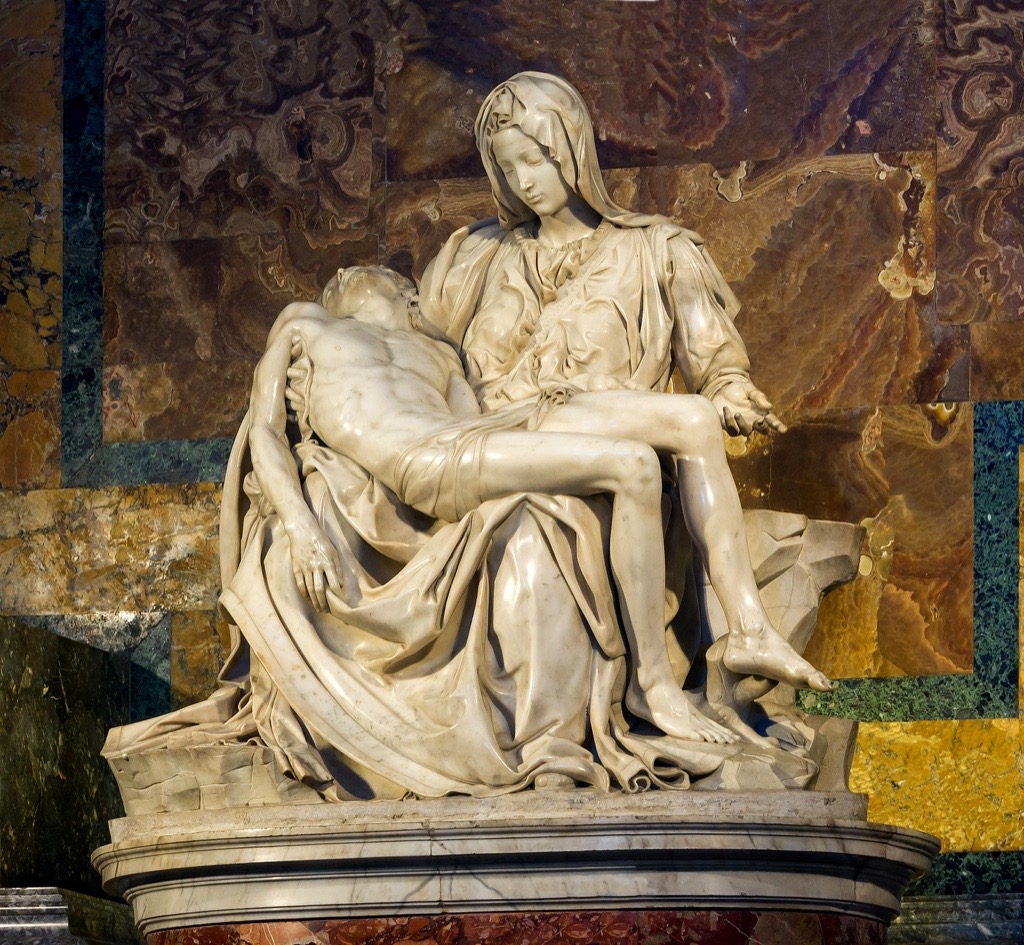
Michelangelo made three securely documented marble Pietà projects at widely separated moments. The Vatican Pietà was commissioned in 1498 and is the polished two-figure group now in St Peter’s Basilica. The Bandini Pietà dates from about 1547–1555 and contains four figures plus Calcagni’s intervention. The Rondanini Pietà, worked on in Michelangelo’s last years and left unfinished in his studio, is now in Milan.[9][10]
They share the dead Christ and the Virgin, but they should not be arranged as three states of one composition. Their destinations, structures, surfaces and histories differ. The Vatican group brings the seated Virgin and Christ into a broad, finished pyramid. The Bandini group makes Christ descend through a crowded vertical support. The Rondanini Pietà binds the two principal figures into a narrow, repeatedly recut column.
The National Gallery’s Entombment (or Christ being carried to his Tomb) is another separate work. It is an unfinished oil-on-wood painting of about 1500–1501, probably intended for a funerary chapel at S. Agostino in Rome. Its figures carry Christ toward a tomb.[11] Similar burial language does not make it the painting version of the Bandini marble or justify combining the two works under one object identity.
Comparison is most useful when it preserves difference. The three Pietàs show Michelangelo returning to Christ’s dead body across more than six decades. The Entombment shows him addressing a related subject in paint. Each work requires its own date, medium, location, commission history and state.
Artist Up Close
The group reveals Michelangelo working by revision rather than pursuing one untouched first idea. Christ’s descending body became the axis through which four figures, a funerary purpose, difficult marble and later intervention were repeatedly negotiated. The surviving work is not a pure snapshot of his hand, but that complexity makes its authorship more historically real.
Michelangelo’s self-representation, if the hooded head is accepted as his likeness, is unusually indirect. He does not appear as triumphant maker or detached witness. He becomes one of the bodies supporting Christ, placing artistic identity inside an act of physical and devotional burden.
Frequently Asked Questions
Discussion
Use these questions to compare visible form with the documentary evidence about carving, intervention and conservation.
Reader Insights
How does Christ’s downward movement organise the four figures?
Which differences of surface can be described securely, and which require knowledge of Calcagni’s intervention?
What does the conservation evidence add to, or withhold from, the traditional destruction story?
Join the Conversation
You might also consider how the intended altar-and-tomb setting changes the hooded self-portrait, and how the three Pietàs can be compared without treating them as stages of one design.
References
- Opera di Santa Maria del Fiore, Michelangelo Buonarroti, Pietà Bandini, View source.
- Opera di Santa Maria del Fiore, 12 Things You May Not Know about Michelangelo’s Pietà in Florence Cathedral, View source.
- Opera di Santa Maria del Fiore scientific catalogue, Pietà (Pietà Bandini), View source.
- United States Conference of Catholic Bishops, John 19, View source.
- Opera di Santa Maria del Fiore, Michelangelo’s Florence Pietà, View source.
- Opera di Santa Maria del Fiore, Michelangelo’s Pietà Restored, View source.
- Opera di Santa Maria del Fiore, The Restoration of Michelangelo’s Pietà, View source.
- Friends of Florence, Michelangelo’s Pietà, Opera del Duomo, View source.
- Vatican Museums, The Casts of the Three Pietà, View source.
- Municipality of Milan, Michelangelo’s Three Pietàs, View source.
- National Gallery, London, The Entombment (or Christ Being Carried to His Tomb), View source.