 by Tom Gurney
Tom Gurney BSc (Hons) is an art history expert with over 20 years experience
Published on June 19, 2020 / Updated on November 6, 2025
Email: tomgurney1@gmail.com / Phone: +44 7429 011000
The Creation of Adam by Michelangelo
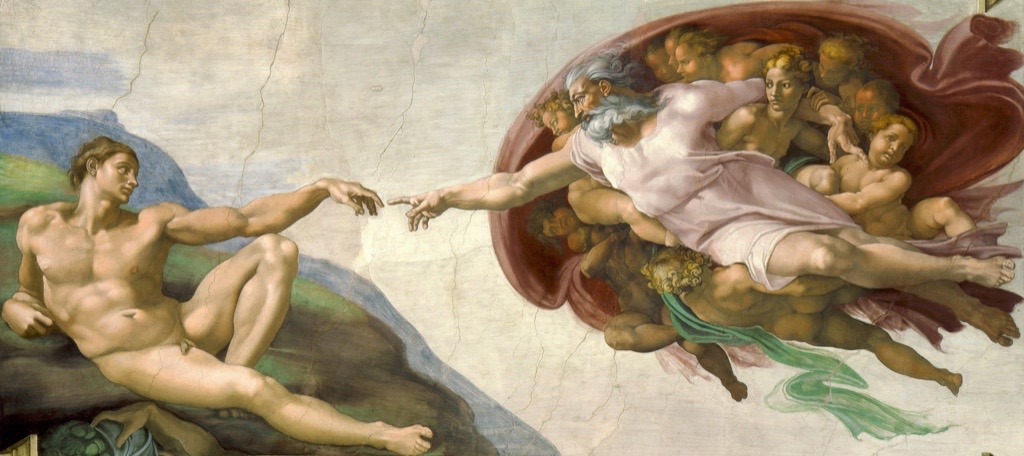
The fingertips do not quite touch. Between Adam's relaxed hand and God's decisive one, Michelangelo left a narrow interval of unpainted air. That gap is one of the smallest and most charged spaces in art: the place where a body already formed appears about to receive the force that will make it fully alive.
Seen in full, The Creation of Adam is much more than its famous hands. Adam stretches along the earth at the left, monumental but still heavy against the ground. God rushes from the right inside a swelling mantle crowded with attendant figures. One side is open, solitary and anchored; the other compressed, communal and airborne. The approaching fingers gather those opposites into a single suspended event.
At a Glance
- ArtistMichelangelo Buonarroti
- TitleThe Creation of Adam
- DateAbout 1511, within the 1508–1512 Sistine ceiling campaign
- MediumFresco
- LocationCentral vault of the Sistine Chapel, Vatican City
- PatronPope Julius II
- SubjectThe creation of the first man, associated by the Vatican Museums with Genesis 1:26–27
- Larger programmeOne of nine central stories from Genesis and one of three scenes concerning the creation and fall of humanity
- Preparatory evidenceMichelangelo's red-chalk Study for Adam, about 1511, British Museum[1][2][3][4]
Contents
- Two Bodies Across an Empty Field
- Where the Fresco Belongs
- Genesis and Michelangelo's Invention
- Adam as a Resting Athlete
- The Red-Chalk Study for Adam
- Painting a Body on the Vault
- From First Life to the Last Judgment
- God and the Figures in the Mantle
- The Brain and Uterus Theories
- The Famous Hands and the Lost Whole
- Artist Up Close
- A Creation Forever About to Happen
Annotated Details from Creation of Adam
The annotated view keeps the whole fresco in sight while isolating the four relationships that make the scene work from the Chapel floor: Adam’s body, the near-touching hands, God’s forward drive and the mantle of attendant figures.
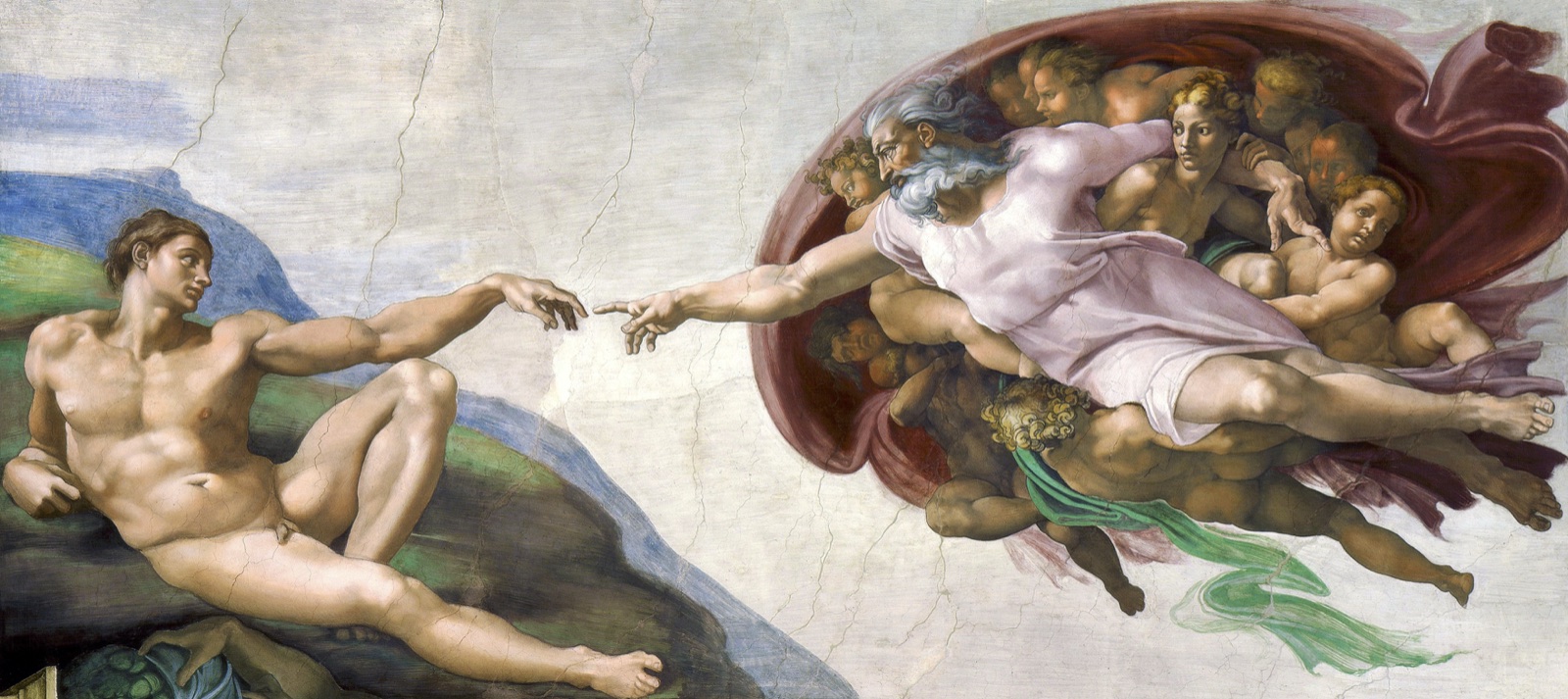
Details from CREATION OF ADAM
Close looking highlights visible details in the fresco while keeping image-source and rights notes in the references.
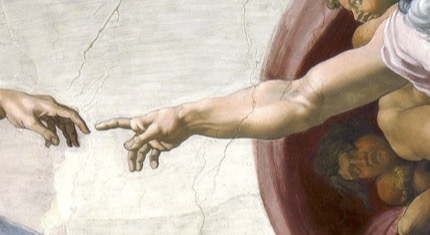
Hands and charged gap
The near-touching fingers concentrate the act of creation without painting a literal spark or completed contact.
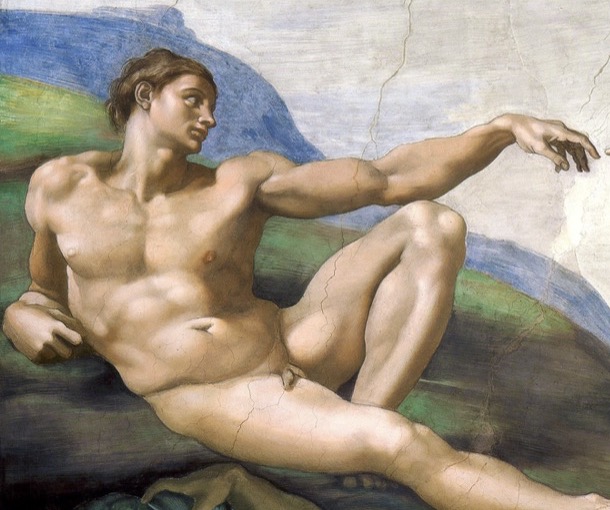
Adam's body and earth
Adam is physically complete yet still low and receptive, his body stretched along the ground before the life-giving encounter.
God reaching forward
God's arm drives across open space with a sharper energy than Adam's softer, rising hand.
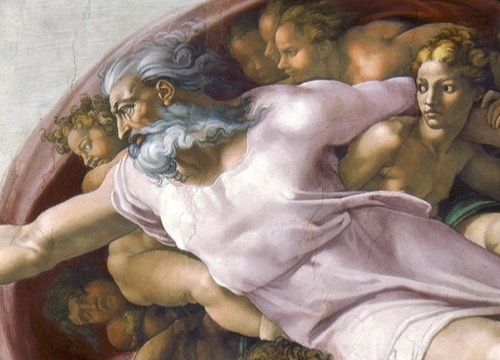
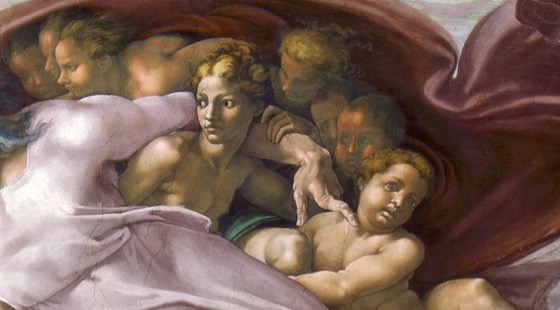
Mantle and attendants
The reddish mantle gathers the attendant figures into a compact airborne mass, contrasting with Adam's solitary contact with earth.
Two Bodies Across an Empty Field
Michelangelo gives the scene an extraordinary economy. At the left, Adam occupies a low sweep of green-brown earth. The landscape is barely described. There are no animals, trees, buildings or distant episodes to explain the beginning of human life. Adam's body is the landscape's great event.
At the right, God moves through pale open space within a reddish mantle. The Vatican Museums describe the surrounding figures as angels who support his flight.[3] Fabric and bodies form a compact mass, driven forward by the reaching arm. A green length of cloth streams away beneath them, reinforcing the sense of speed.
The two halves answer each other asymmetrically. Adam is alone; God arrives with a dense company. Adam's silhouette is open and extended; the divine group is enclosed by cloth. Adam touches the earth along much of his body; God has no visible ground. The human figure appears spacious but inactive, the divine group crowded but forceful.
Their principal diagonals converge at the hands. Adam raises his left arm from a bent elbow and loose wrist. God thrusts out his right arm so that shoulder, elbow, hand and index finger form a continuous direction. The lines nearly meet, and the entire width of the fresco seems to narrow toward that approach.
The gazes matter as much as the fingers. Adam looks toward God; God looks toward Adam. The empty field becomes a field of attention before it becomes a channel of touch. Michelangelo can therefore make the gap feel full without painting a ray, flame or visible breath crossing it.
The bodies also establish likeness. Both are monumental male figures with powerful limbs, broad torsos and commanding scale. God appears clothed but physically active, not remote beneath immaterial robes. Adam's beauty gives visual form to the statement in Genesis that humanity is made in the image of God.[3]
Likeness is not equality. God moves under his own force and brings a company with him. Adam remains supported by created earth. God's finger is straight and directive; Adam's finger rises from a hand that has not yet acquired the same energy. Their resemblance allows relationship, while their postures preserve the difference between creator and created.
Where the Fresco Belongs
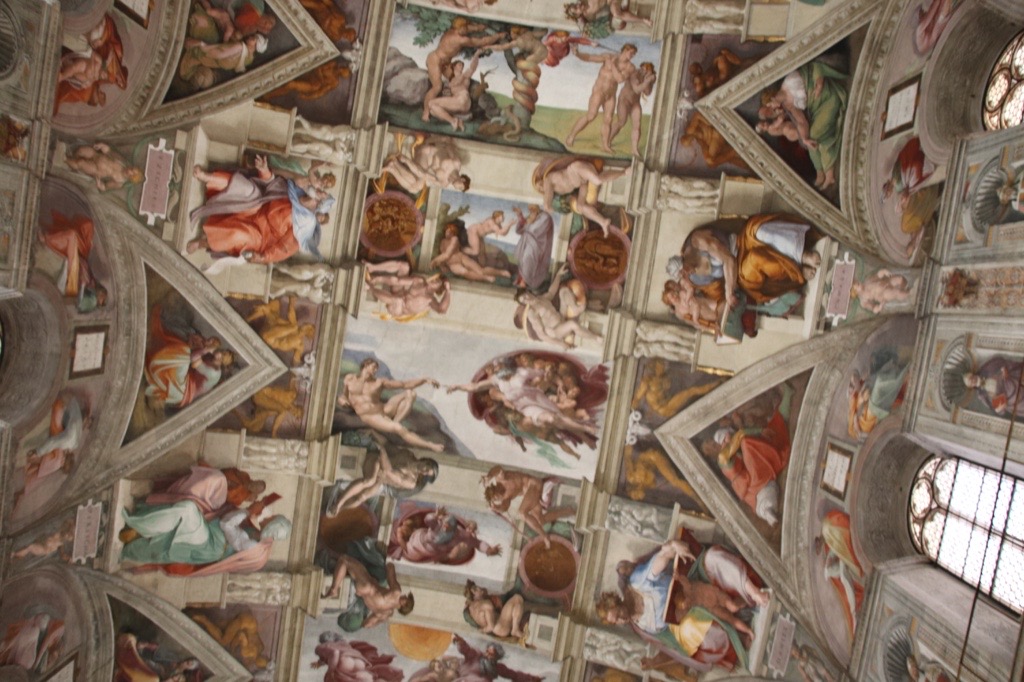
The Creation of Adam occupies the central spine of the Sistine ceiling as one of nine stories from Genesis. The Vatican Museums group those histories into three sets. The first concerns the creation of the cosmos; the second the creation and fall of humanity; the third Noah, destruction and survival.[2]
Michelangelo's panel opens the human group. It is followed, in biblical sequence, by The Creation of Eve and Original Sin and Banishment from the Garden of Eden. This position gives Adam's solitary body a special clarity. Eve has not yet emerged, temptation has not occurred and exile has not begun. The human story appears at the threshold between matter and life.
Around the Genesis panels, the ceiling expands into an immense painted order: prophets and sibyls, ancestors of Christ, youthful ignudi, medallions, scenes of deliverance and fictive architecture. The Creation of Adam belongs to that order without summarising it. Its unusual spareness is more striking because so much surrounding imagery is dense with bodies, structures and prophetic history.[1]
The chapel itself predates Michelangelo's ceiling. Its fifteenth-century walls were already decorated by leading painters when structural trouble damaged the earlier starry vault. Pope Julius II commissioned Michelangelo in 1508. The initial proposal involved twelve apostles and ornamental fields; the final scheme grew into something far more extensive.[1]
An early British Museum design for the vault, dated 1508, preserves planning before the painted arrangement was fully resolved. Its architectural framework differs from the finished ceiling and shows Michelangelo treating the curved surface as a problem still in motion.[5]
The work proceeded in phases. Michelangelo began at the entrance end with the Noah histories and moved toward the altar. The first portion had reached The Creation of Eve by August 1510. After an interval, work resumed, and the complete ceiling was unveiled in 1512.[1] The Creation of Adam belongs to this later part of the execution, even though it comes near the beginning of human history in the biblical narrative.
This distinction between story order and painting order helps explain the fresco's scale and concentration. Compared with the crowded Noah scenes painted earlier, later panels tend to use fewer and larger figures. Michelangelo learned from the distant viewing conditions and made actions increasingly legible across the chapel. In The Creation of Adam, two principal bodies and one almost-touch carry the narrative.[13]
The change is visible across the ceiling. The Flood disperses attention among boats, bodies, rocky ground and several simultaneous struggles. The later creation scenes give God's movements a breadth that can be grasped from the floor. Adam's panel is more radical still: it sets two great profiles of energy against a field cleared of almost everything else.
This simplification does not isolate the fresco from its neighbours. Painted architectural frames, pairs of ignudi and adjacent figures surround it. Their turns and gestures keep the ceiling active beyond the rectangle. Michelangelo gives the central story enough emptiness to remain legible while the wider vault continues to press around it.
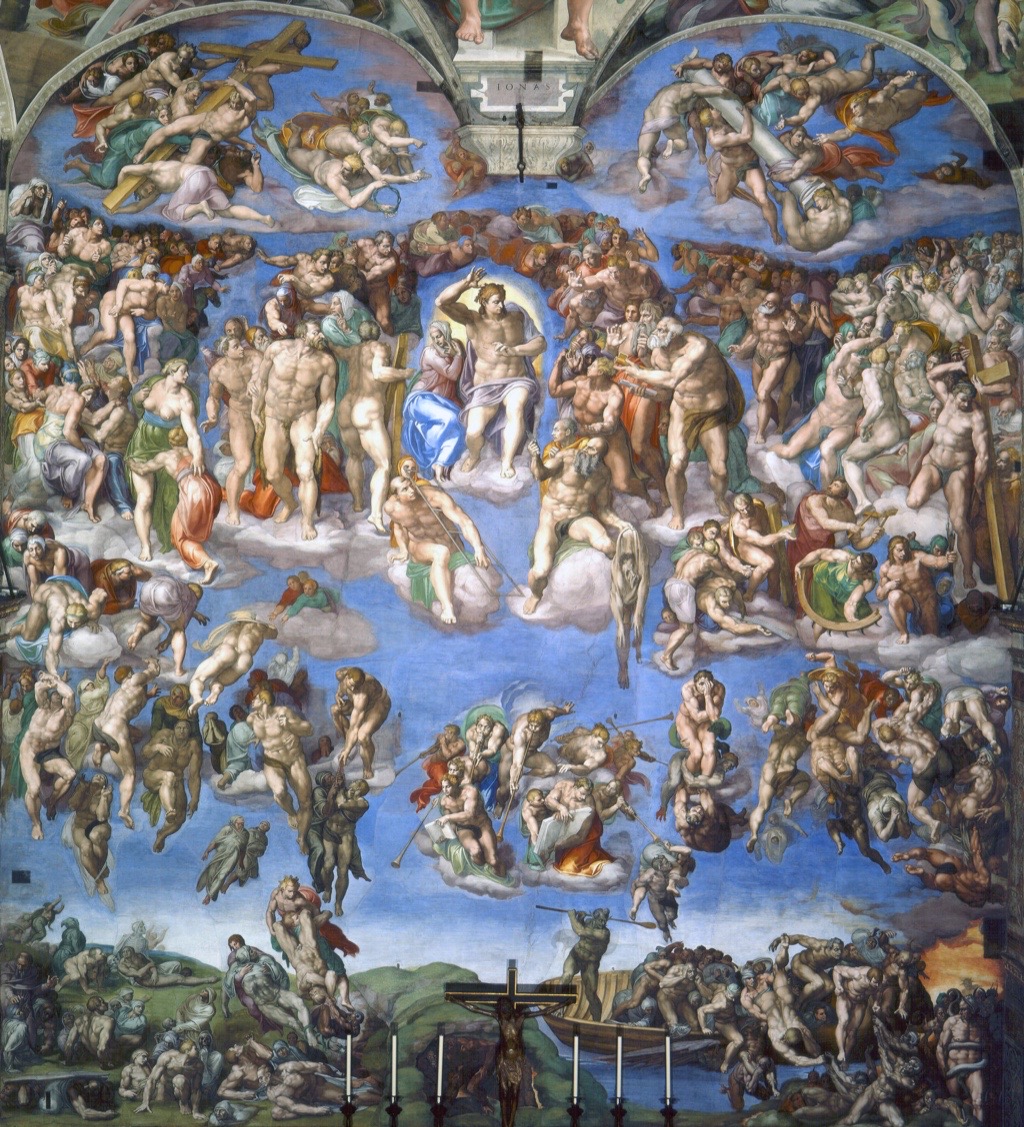
The later Last Judgment is a separate work. Michelangelo painted it on the altar wall from 1536 to 1541, more than two decades after the ceiling. It shares the chapel and the artist, but not the same commission, surface, date or moment in sacred history.[6] Creation on the vault remains distinct from judgment on the wall.
Location also governs the fresco's pace. On a screen or in print, the composition can be taken in instantly as a horizontal rectangle. In the chapel it must be found overhead, among painted ribs, figures and neighbouring histories. Adam and God are foreshortened by the viewer's angle, while architectural divisions keep the panel within the ceiling's larger rhythm.
Michelangelo answered that difficulty with subtraction. The pale space between the bodies is not unfinished background waiting for additional scenery. It gives the limbs room to register at distance and prevents the central approach from dissolving into incident. Adam's low ground is broad but quiet; God's mantle contains complexity rather than scattering it across the field.
The apparent simplicity is therefore a sophisticated response to place. A small panel crowded with explanatory detail might reward close inspection but fail from the floor. Michelangelo lets bodily direction perform the explanation. Even before the subject is identified, viewers can perceive rest on one side, urgent arrival on the other and an encounter concentrated between them.
This architectural intelligence helps distinguish the original from its countless reproductions. The design survives reduction exceptionally well, but it was created to overcome distance, curvature and a visually abundant setting. Its clarity belongs to the ceiling before it belongs to the poster.
Genesis and Michelangelo's Invention
The Vatican Museums connect the panel with Genesis 1:26–27: God's creation of humanity in the divine image.[3] The biblical text states the act with tremendous compression. It does not describe two horizontal figures reaching toward one another, a mantle filled with attendants or an interval between index fingers. These are Michelangelo's inventions.
Other parts of Genesis describe Adam formed from the dust of the ground and animated by God's breath. Michelangelo brings the ideas of formation, likeness and animation together without illustrating a literal mouth-to-mouth breath. Adam already possesses a complete body. What he seems to lack is activation.
The fresco turns that invisible distinction into posture. Adam's torso is strong, his limbs beautifully articulated and his face awake enough to look. Yet his body settles into the slope and his hand lacks God's extension. He is physically present but not fully self-propelled. Creation becomes the passage from formed matter to responsive life.
God's nearness is equally inventive. He does not create from a remote throne or through a command delivered across an immeasurable heaven. He enters Adam's space bodily. Their arms make a bridge across the centre, and their similar scale allows direct encounter.
This intimacy gives the doctrine of divine likeness emotional force. Adam is addressed face to face, beyond the status of an object manufactured below. At the same time, the separation of the fingers prevents intimacy from becoming identity. The gap is a boundary as well as a connection.
The moment remains open. If the fingers visibly met, creation could read as a completed transfer. If they were widely separated, the relation would weaken. Michelangelo chooses imminence. Every viewing returns Adam to the brink of receiving what God brings.
The open interval has encouraged modern analogies with electricity—a spark leaping from one conductor to another. That language can convey visual tension, but it does not describe a painted spark and does not belong to Michelangelo's historical world. The fresco creates energy with drawing: aligned arms, opposing wrists, directed gazes and a measured distance.
Adam as a Resting Athlete
The Vatican Museums call Adam a “resting athlete,” a phrase that captures the mixture of bodily perfection and suspended effort.[3] His musculature is developed, but he is not straining. The right arm props the torso against the earth; the left reaches upward. One leg extends broadly, the other bends, opening the pelvis and turning the body toward God.
The pose makes Adam belong to the ground without merging with it. His lower silhouette follows the slope, and the curve of his back echoes the land. He can be imagined as newly formed earth that has acquired human contour. Yet the lifted head and arm begin to separate him from that support.
Michelangelo avoids a simple progression from limpness to movement. Adam already performs the muscular task of holding himself partly upright. His gaze is engaged. The suspended creation is theological and expressive rather than a clinical stage of bodily function. The figure is complete enough to resemble God and incomplete enough to need him.
The body also carries Michelangelo's encounter with antique art. Its monumental nudity, balanced turns and relaxed strength recall classical sculpture. A Roman cameo showing the emperor Augustus reclining on Capricorn has been connected with the general pose; the British Museum presents the comparison as one possible antique stimulus.[7] Michelangelo did not copy the small gem directly onto the vault. He transformed the idea through life study, Christian narrative and colossal scale.
Adam's nudity differs from the shame that follows the Fall. He has not yet eaten from the tree of knowledge. The body can therefore be displayed without clothing as part of an unfallen creation. Michelangelo makes classical heroic beauty serve humanity's original dignity.
The face is less intensely modelled than the torso, especially at the distance from which the fresco was designed to be seen. It does not need a theatrical expression. The whole pose supplies the psychology: interest awakening through a body still drawn toward rest.
The Red-Chalk Study for Adam
A sheet in the British Museum brings the preparation of Adam unusually close. Dated about 1511, it shows a reclining male nude in dark red chalk over traces of stylus underdrawing. The museum identifies it as a study from life for the Adam in the third bay of the ceiling. The paper measures 193 × 259 millimetres.[4]
The drawing differs markedly from a miniature copy of the finished fresco. Adam's head is absent from the principal study. His reaching hand is investigated separately, as are other details. Michelangelo concentrated on torso, abdomen, hips, thighs and the way a reclining body transfers weight through the supporting arm.
Red chalk allows both line and tone. Firm contours define the outer body, while hatching and softer transitions model the turns of muscle. Revisions show that the pose was discovered through adjustment. The apparently inevitable Adam on the ceiling emerged from repeated decisions on paper.
The British Museum describes the modelling more precisely. Consistently directed hatching builds volume, while stippling—the repeated touch of the chalk point—creates fine tonal gradations. In the deepest shadows Michelangelo worked chalk into the fibres of the paper, allowing the torso to turn through accumulated density rather than outline alone.[4]
Red chalk suited both precision and destination. It could be sharpened to a finer point than black chalk and produced a saturated, lustrous surface. The museum relates these qualities to figures conceived for the luminous colour of buon fresco. A study on paper could begin to anticipate the radiance and distance of the painted body.[4]
The outer contours are repeatedly strengthened and adjusted. A lightly drawn alternative survives along the right thigh, while changes around the other thigh and reaching arm show Michelangelo testing how the body would open. These revisions matter because Adam's apparent relaxation is carefully constructed. Ease was the result of decision, not its absence.
The separation of the hand studies is especially revealing. The central gesture looks spontaneous in fresco, but it was a problem worthy of independent attention. Fingers must remain readable from the floor, the wrist must convey relative passivity, and the hand must align with God's forceful approach without exactly repeating it.
A related drawing in Detroit studies Adam's outstretched left arm and hand in broad black chalk at a larger scale. The British Museum places it at a stage closer to the cartoon used for transfer.[4] Scale therefore increased as the design approached the wall: the complete reclining body could first be solved on a small sheet, then the decisive arm enlarged and clarified.
The evidence does not preserve one complete cartoon for the panel. It preserves a working sequence in fragments. Life study establishes weight and anatomy; separate hands refine the gesture; a larger arm drawing approaches transfer scale; the fresco resolves those experiments on the vault. Missing stages prevent a mechanical reconstruction, but the direction of thought is visible.
The sheet has its own history. It was trimmed and worn, and an old varnish changed the appearance of the chalk. Its attribution was once disputed, though the British Museum now accepts it as Michelangelo's work and records the scholarly history behind that decision.[4] This preparatory drawing is also a material object that has been handled, altered and interpreted, never transparent access to the artist's mind.
On the reverse is a study of a youth's head related to a neighbouring ignudo. The reuse of the sheet connects Adam with the larger labour of designing the vault. Even a drawing strongly associated with this famous panel participated in a broader working process.
The neighbouring figure can be located more closely: the head relates to the ignudo above and to the left of the Persian Sibyl, beside Adam's panel.[4] Recto and verso thus move between central narrative and surrounding frame. Michelangelo did not conceive the Genesis figure in total isolation from the bodies that mediate the ceiling around it.
Other surviving sheets extend the preparation to the right side of the composition. Two related red-chalk sheets in the Teylers Museum in Haarlem contain studies for God and the angels within the mantle.[4] Adam's solitary body and the divine cluster were investigated separately before being brought into their final opposition.
This division of labour on paper helps explain the fresco's clarity. Adam could be developed as a continuous reclining form; God's group required overlapping bodies and compressed movement. The wall joins two distinct drawing problems at the point where their hands nearly meet.
Michelangelo's disegno joined drawing to conception. Life study supplied knowledge of weight and anatomy, while the ceiling demanded alteration for distance, curvature and narrative clarity. The Met's study of Michelangelo as draftsman and designer emphasises this movement among sketches, full-scale planning and finished works.[8] Adam is observed, invented and architecturally adapted at once.
Painting a Body on the Vault
Michelangelo painted the panel in fresco, applying pigment to fresh plaster in planned sections. The surface available for a day's work—often described by the Italian term giornata—had to be prepared and painted before it dried too far for the pigment to bind properly. A ceiling of this scale was therefore built through successive working areas, never as one continuous wet field.
Large designs were developed through drawings and cartoons before transfer to the plaster. Incised or transferred lines could establish contours, after which paint created flesh, fabric and space. The labour joined advance planning to decisions made on the vault.
The position complicated every stage. Michelangelo worked on scaffolding high in the chapel, close to the curved surface but designing for viewers far below. A hand convincing at arm's length on wet plaster might disappear from the floor. Broad silhouettes, clearly separated limbs and strong tonal changes were practical as well as expressive choices.
Technical accounts associated with the Vatican conservation campaign describe Michelangelo using paint with considerable fluidity, sometimes in thin, water-like applications that allow the light ground to contribute to luminosity.[9] The method differs from building a body through thick opaque oil paint on a portable canvas. Colour and plaster become inseparable parts of the wall.
Adam's open setting makes contour especially important. His flesh stands against sparse ground and pale space, so the outer line carries both anatomy and distance. God's group demands a different solution: overlapping bodies, the mantle and shadows must remain distinguishable within a compact moving mass.
The restored ceiling revealed a brighter palette than generations familiar with darkened reproductions expected. The long Vatican conservation programme ran across the final decades of the twentieth century and included the vault and Last Judgment.[6][9] Cleaning removed accumulated material according to the conservators' analysis, while also provoking debate about how later additions and original finishing were understood.
For The Creation of Adam, restoration history matters because reproductions from different periods can vary dramatically. Older photographs may show a darker, more muted surface; modern digital files may heighten colour or contrast. Neither is the same as standing beneath the fresco, where distance, chapel light and the surrounding ceiling affect every colour.
From First Life to the Last Judgment
Michelangelo returned to the Sistine Chapel more than twenty years after completing the ceiling. Between 1536 and 1541 he painted the Last Judgment across the altar wall, replacing an earlier arrangement with a vast field of resurrected, saved and damned bodies revolving around Christ.[16]
The contrast with The Creation of Adam is unusually revealing. Creation stretches horizontally between two principal figures and leaves the centre almost empty. Judgment piles bodies through a vertical wall whose centre is occupied by Christ's commanding action. One fresco suspends the beginning of a single life; the other gathers humanity at the end of history.
Adam's body is defined by openness. His limbs extend across bare ground, and space separates him from God. In the Last Judgment, bodies collide, rise, fall and cluster. Their destinies are expressed through collective movement and compression. Michelangelo's interest in the body remains, but the body now carries consequence rather than untested possibility.
The different architectural positions intensify the distinction. The creation scene is one panel among a measured sequence on the vault. The judgment occupies the altar wall as a single overwhelming field encountered directly by the chapel's ceremonies. Ceiling and wall speak to one another across the room without forming one continuous campaign.
Seen together, they make the chapel hold a vast arc: humanity's first awakening above and its final reckoning ahead. That relationship was created over time, not laid down in one original scheme. Michelangelo's own art changed the building's theological balance when he returned in old age.
God and the Figures in the Mantle
God appears as an elderly bearded man with the physique and momentum of a powerful athlete. His light garment reveals the action of arms and legs rather than enclosing him in heavy ceremonial robes. Age signifies authority without weakening the body.
The reddish mantle gathers a group of smaller figures around him. Their limbs, faces and overlapping bodies turn the right half of the composition into a community in motion. The Vatican description calls them angels, but it does not name each figure individually.[3]
The most prominent attendant, tucked beneath God's left arm, holds a visible place at the edge of the crowd and looks outward. She has often been identified as Eve awaiting her future creation. Other readings have proposed a personification of the human soul, divine wisdom or a figure connected with salvation history. The fresco supplies no inscription that settles the question.
The Eve interpretation has visual appeal. The figure is female, occupies a privileged place beside God and directs attention toward Adam, while Eve is the next human being to appear in the Genesis sequence. That narrative suitability remains unconfirmed by documentary evidence. Many viewers have understood her as Eve, although Michelangelo left no surviving identification.
A smaller figure near God's left hand has likewise been identified by some interpreters as the Christ Child. This can support a Trinitarian reading in which creation anticipates redemption. Again, the theology may be coherent without becoming a securely documented identification of every attendant.
The uncertainty is part of the fresco's richness. Michelangelo makes the group specific enough to invite relationships but not explicit enough to close them. Their principal visual function is clear: they distinguish divine plenitude from Adam's solitude and convert the mantle into a living vehicle.
God's left arm wraps around the prominent attendant while his right reaches out of the enclosure. One arm gathers; the other gives. The crossing actions keep the divine group from becoming a simple projectile. Creation extends outward from a community held together within the mantle.
The Brain and Uterus Theories
The mantle's unusual outline has encouraged anatomical interpretations, partly because Michelangelo possessed deep knowledge of the human body. In 1990, physician Frank Lynn Meshberger published an article in JAMA arguing that the contour and internal arrangement around God resemble a section through the human brain. In that reading, God's approach signifies the gift of intellect.[10]
In 2015, Stefano Di Bella and co-authors proposed a different comparison in Mayo Clinic Proceedings. They argued that the same group resembles a postpartum uterus and related reproductive anatomy, making the scene a visual “delivery” of humankind.[11]
Both are genuine published hypotheses. Neither is established by a surviving note, preparatory design or contemporary statement in which Michelangelo declares that he concealed the relevant organ. Publication proves that an interpretation has been argued; it does not prove the artist's intention.
The disagreement is instructive because the theories use many of the same forms. The mantle can appear brain-like when matched with one anatomical diagram and womb-like when matched with another. Flexible contours, clustered bodies and trailing fabric provide numerous possible points of resemblance.
Michelangelo's anatomical knowledge makes concealment possible in a general sense, but possibility is not evidence of a particular programme. His accepted red-chalk study for Adam demonstrates close study of the body. It does not mark a brain or uterus plan for God's group. No comparable secure sheet currently turns either modern comparison into documentary fact.
These readings need not be banned from looking. They have become part of the fresco's reception and can sharpen attention to the mantle. They become misleading only when introduced as a solved secret. The most securely grounded interpretation remains visible and institutionally recorded: God creates humanity in the divine image, and the encounter of hands focuses the transmission of life.[3]
The Famous Hands and the Lost Whole
The approaching fingers have become an independent emblem. They appear in advertising, film, political cartoons, tattoos and parodies; they can signify contact, creativity, technology, estrangement or the instant before connection. Their simple geometry survives extreme reduction.
That adaptability begins in Michelangelo's design. Two forearms enter from opposite sides, two index fingers approach, and a small interval keeps the action open. The fragment can be recognised without architecture or even faces.
But cropping changes the theology and the bodily logic. Adam's hand looks merely elegant when separated from the heavy body it has only partly lifted. God's hand loses the airborne group and the shoulder that drives it. The difference between earthly rest and divine movement disappears.
The crop also makes the hands seem equal. In the full fresco, Adam and God share scale and form, but the surrounding bodies distinguish their states. Adam's wrist is loose because his whole pose is receptive; God's finger is forceful because his entire group advances. The hands are conclusions of bodily arguments, not free-floating symbols.
Printmaking had already made the ceiling portable long before modern posters and screens. The Metropolitan Museum preserves Domenico Cunego's 1772 engraving after The Creation of Adam, part of Gavin Hamilton's Schola Italica Picturae.[12] The print translates colour and plaster into ink and paper while identifying Michelangelo as the artist whose work is reproduced.
Cunego's plate also translates scale. The fresco becomes a horizontal printed image that can be held, bound and studied at close range. Engraved lines convert Michelangelo's coloured modelling into a network of marks. The design is preserved, but the bodily relation to an overhead chapel disappears.
Later artists did more than reproduce the composition. In Caravaggio's Calling of Saint Matthew, painted for the Contarelli Chapel around 1599–1600, Christ extends a hand whose relaxed wrist and fingers recall Michelangelo's Adam. Smarthistory relates the borrowing to the Christian idea of Christ as a second Adam.[14]
Caravaggio reverses the gesture's role. Michelangelo's Adam receives life; Caravaggio gives the Adam-like hand to Christ as he calls Matthew toward a new spiritual life. The familiar form moves from created man to redeemer, and from the pale openness of the Sistine ceiling to a dark Roman interior.
Auguste Rodin transformed Michelangelo's Adam again in the nineteenth century. His sculpted Adam was developed in connection with The Gates of Hell. A Metropolitan Museum Journal study traces the right arm and hand to the Sistine figure, while also relating other parts to Michelangelo's sculptural bodies.[15]
Rodin's borrowing is physically different from Caravaggio's. A painted gesture becomes a freestanding body encountered in the round. The outstretched hand no longer approaches a visible God; removed from Michelangelo's two-part composition, it can suggest appeal, awakening or abandonment.
The Met study also shows Rodin combining sources rather than copying one figure wholesale. The right arm recalls the Creation of Adam, while the left has been connected with the dead Christ in Michelangelo's Bandini Pietà.[15] Creation and death meet within a new body made for a modern vision of hell.
Cunego, Caravaggio and Rodin represent three kinds of afterlife. The print translates the whole scene into another medium; Caravaggio quotes a gesture and reverses its agency; Rodin extracts and recombines bodily forms. Each reception confirms the power of Michelangelo's invention while changing what the original relation means.
Every reproduction performs a similar translation. A photograph flattens the curved ceiling and freezes one lighting condition. An engraving reinterprets colour as line. A cropped digital detail changes the composition's limits. These versions spread the image, but the original remains a fresco high in a ceremonial chapel, surrounded by other histories and bodies.
The full scene restores scale to the gesture. The hands matter because an entire created world seems to pause around them. Adam's weight, God's momentum, the attendants' pressure and the bare interval all converge at the fingertips. The fragment is memorable; the whole explains why.
Artist Up Close
Begin with Adam's contact with the earth. Follow the slope beneath his hip, leg and supporting arm. Notice how closely the body belongs to the ground before the raised arm begins to lift away from it.
Next trace the two reaching arms from the shoulders, not just the fingers. Adam's line rises slowly through a loose wrist; God's drives forward in a firm sequence. The tiny gap carries the accumulated difference between them.
Look across the right-hand group. The mantle both encloses and activates the attendants. Try to distinguish the visible bodies before deciding who they are. Their density makes Adam's solitude more pronounced.
Then compare the faces. Adam's upward look is receptive and intent. God's gaze is direct, supported by the movement of the entire group. The encounter begins in sight and culminates in the hands.
Finally, widen your view to the ceiling. Locate the panel among the other Genesis histories and the surrounding prophets, sibyls and painted architecture. Its emptiness and two-part clarity are not the normal condition of the vault; they are Michelangelo's chosen concentration.
A Creation Forever About to Happen
Michelangelo could have represented divine power through overwhelming spectacle. Instead, he concentrated it in nearness. God and Adam resemble one another enough for relationship, but the narrow gap and opposite states prevent that relationship from becoming equality.
The scene's emotional power lies in its unfinished grammar. Adam is already a complete and beautiful body, yet something essential remains pending. God has crossed the heavens, yet his finger has not closed the final distance. The fresco holds potential at its maximum intensity.
That suspension also makes the work unusually open to viewers outside its original theology. It can evoke the desire for connection, the birth of consciousness or the uncertainty of any beginning. Those responses do not replace the Genesis subject. They grow from the precision with which Michelangelo gave an invisible act a bodily form.
The hands are famous because they simplify that form. The complete fresco is greater because it complicates it again. Creation encompasses the pull of earth against Adam, the rushing community around God, the resemblance between their bodies and the space that both joins and separates them.
The contact never arrives. Every viewer sees the same fraction before completion and supplies the next instant inwardly. Michelangelo made the first human life an event that remains, five centuries later, forever about to happen.
Frequently Asked Questions
Discussion
Set the British Museum study beside the fresco. Which parts of Adam were already resolved in red chalk, and which changed during enlargement and transfer?
Reader Insights
Look at the complete panel before studying the hands. What is lost when the two arms are cropped away from Adam’s body, God’s group and the surrounding space?
Follow Adam’s arm from shoulder to fingertip, then God’s arm in the opposite direction. Where does each line accelerate or relax?
Choose the brain or uterus hypothesis. List the visual matches, the mismatches and the historical evidence that would be needed to demonstrate intention.
Join the Conversation
Compare the restrained encounter in the Creation of Adam with the mass movement of the Last Judgment. How does Michelangelo make a beginning and an ending feel different?
References
- Vatican Museums, Sistine Chapel Ceiling., View source.
- Vatican Museums, Central Stories., View source.
- Vatican Museums, The Creation of Adam., View source.
- British Museum, Study for Adam., View source.
- British Museum, Scheme for the Decoration of the Sistine Chapel Vault., View source.
- Vatican Museums, History of the Sistine Chapel., View source.
- British Museum, Rediscovering Gems: Large Print Guide, View source.
- The Metropolitan Museum of Art, Michelangelo: Divine Draftsman and Designer, View source.
- Vatican Museums Publications, Fabrizio Mancinelli, The Sistine Chapel, View source.
- Frank Lynn Meshberger, An Interpretation of Michelangelo's Creation of Adam Based on Neuroanatomy.” JAMA, 1990, View source.
- Stefano Di Bella et al, The ‘Delivery’ of Adam: A Medical Interpretation of Michelangelo.” Mayo Clinic Proceedings, 2015, View source.
- The Metropolitan Museum of Art, The Creation of Adam, Sistine Chapel,” engraving by Domenico Cunego after Michelangelo, 1772, View source.
- Smarthistory, Michelangelo, Ceiling of the Sistine Chapel., View source.
- Smarthistory, Caravaggio, The Calling of Saint Matthew., View source.
- Alicia Faxon, The Metropolitan Museum of Art, An Interpretation of Rodin's Adam.” The Metropolitan Museum Journal 17, 1982, View source.
- Vatican Museums, The Last Judgement., View source.