


 by Tom Gurney
Tom Gurney BSc (Hons) is an art history expert with over 20 years experience
Published on June 19, 2020 / Updated on November 6, 2025
Email: tomgurney1@gmail.com / Phone: +44 7429 011000
The Expulsion from Paradise by Michelangelo
One tree divides innocence from exile in Michelangelo’s Sistine ceiling fresco. To its left, Adam reaches for fruit while Eve twists upward to receive it from a serpent whose upper body is female. To the right, an angel drives the pair from Eden at sword point. The same two humans appear twice, transformed across a narrow trunk from idealised confidence into shame, age and bodily collapse.
The Vatican Museums call the complete fresco Original Sin and Banishment from the Garden of Eden.[1] Expulsion from Paradise names only its right-hand episode, although it remains a familiar abbreviated title. Any full account must restore the temptation as well as the punishment, because Michelangelo made their physical and moral connection the subject of one continuous field.
At a Glance
- Full institutional titleOriginal Sin and Banishment from the Garden of Eden[1]
- Common shorter titleExpulsion from Paradise
- Artist and mediumMichelangelo Buonarroti; fresco
- LocationA central Genesis compartment on the Sistine Chapel ceiling
- CommissionPope Julius II, within the 1508–1512 vault campaign[3]
- Biblical frameGenesis 3[6]
- Paired episodesThe taking of forbidden fruit and the banishment of Adam and Eve
- Compositional hingeThe Tree of Knowledge and the coiled serpent
- Central sequence positionSixth from altar toward entrance, after Creation of Eve and before Sacrifice of Noah[2]
- Narrative methodContinuous narrative, with Adam and Eve shown twice
- TransformationYouth and bodily assurance give way to age, grief and defensive movement
- Title cautionA crop of the expulsion alone does not represent the full fresco
- Interpretive cautionThe serpent’s female upper body is visible, but claims about a specific named model or complete symbolic code require evidence beyond the object record
Contents
- Two Episodes in One Landscape
- The Temptation
- The Serpent with a Human Upper Body
- Eve Before and After
- Adam Before and After
- The Angel and the Sword
- Paradise and Barren Ground
- Continuous Narrative and the Speed of Consequence
- Reaching, Taking and Recoiling
- Nakedness Changed by Knowledge
- The Sixth Central Story
- Why the Short Title Is Incomplete
- The Fresco Within Its Bay
- Restoration, Damage and Reproduction
- Gender, Blame and Shared Action
- Why the Fresco Matters
- Artist Up Close
Two Episodes in One Landscape
Michelangelo represents successive actions without a border. On one side of the tree, the first couple participates in the forbidden act. On the other, they stagger beneath the angel’s command. Land and sky continue across both moments, so narrative division depends on tree, gesture and changed bodies.
The method creates immediacy. Cause and consequence remain visible at once. An observer does not turn to a separate compartment to discover the result of the transgression; expulsion occupies the same breath.
This arrangement also creates comparison. Adam’s extended arm in the temptation can be set against his raised, defensive arm in exile. Eve’s upward reach becomes a body folding inward. The repetition is not neutral storytelling. It measures loss through anatomy.
The central tree functions like a temporal axis. Its branches shelter the lush side, while its trunk supports the serpent whose coils join ground and canopy. The angel’s red garment and horizontal sword then launch movement toward the barren right.
The Temptation
At the left, Adam stands and reaches into the foliage. His body is muscular, open and balanced. Eve sits or reclines beneath him, turning her torso and lifting an arm toward the offered fruit.
Genesis distinguishes the serpent’s speech, the woman’s taking and eating, and her giving to her husband, who also eats.[6] Michelangelo compresses those actions. The serpent extends from the tree, Eve receives and Adam actively reaches. Responsibility is distributed across the group rather than assigned to a passive bystander.
This is an important departure from images that isolate Eve as the sole active transgressor while Adam merely accepts. Michelangelo gives Adam a prominent, purposeful gesture. Eve’s seated twist is complex, but his standing reach is unmistakable.
The pair still possess the bodily amplitude associated with their creation. Their nudity carries neither concealment nor visible shame. Physical confidence makes the later transformation more severe.
The Serpent with a Human Upper Body
The serpent coils repeatedly around the tree, transforming its trunk into the centre of temptation. Above the coils rises a human-like upper body, commonly described as female, extending fruit toward Eve.[1]
This hybrid form allows speech, gaze and hand-to-hand exchange to coexist with the biblical serpent. The lower body binds the tempter to the tree; the upper body mirrors Eve closely enough to make temptation feel like an encounter between related forms.
The mirroring has generated extensive interpretation. The serpent may seem like a distorted counterpart to Eve, and the coiled body can imply entanglement. Those readings should remain proposals grounded in visible relation, not declarations that every feature has one documented meaning.
Michelangelo’s invention also unifies the composition. The coils occupy the trunk between the two time zones, while the upper body leans into the temptation side. Evil is not added as a small animal at the edge; it is structurally central.
Eve Before and After
Before the fall, Eve twists with controlled strength. Her torso opens toward the serpent, one arm raised, while her seated legs stabilise the movement. She appears alert and physically assured.
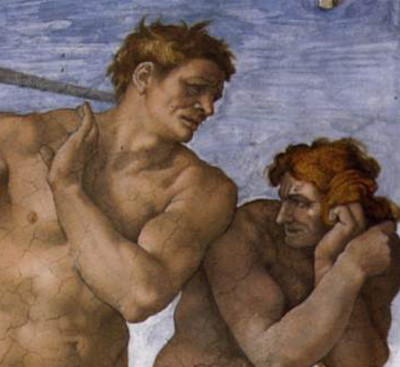
Afterward, she contracts beside Adam. Her hands rise toward her face, and her body bends inward as if trying to escape both the angel and her own exposure. Hair and features appear changed; the human form that had opened to temptation now shields itself.
The contrast gives shame a bodily syntax. Michelangelo does not need clothing or an elaborate landscape to show psychic transformation. Posture performs it.
Genesis describes the pair’s awareness of nakedness, their concealment, God’s questioning, judgments and removal from the garden.[6] The fresco omits much of that intervening dialogue. Eve’s altered body carries the accumulated consequence.
Adam Before and After
Adam’s transformation is equally dramatic. In the temptation he reaches forward with a stable torso and firm legs. In the expulsion he recoils while still moving away, one forearm crossing near his face and the other responding to the angel’s weapon.
The expelled Adam appears older and more burdened. His face tightens, the body bends and the confident reach becomes defensive retreat. Michelangelo turns time into morphology.
Adam and Eve also move as a pair without matching exactly. He remains more upright, meeting the threat with raised arms; she folds below and behind him. Their different reactions create a diagonal group driven out of the painted field.
This is not merely the loss of ideal beauty. The same anatomical power persists under distress. Muscles now serve fear, resistance and painful motion rather than untroubled agency.
The Angel and the Sword
The expelling angel descends from above, clothed in vivid red and extending a sword toward Adam and Eve. The weapon forms a near-horizontal line, directing the pair out of Eden.
Genesis places cherubim and a fiery revolving sword east of the garden to guard the way to the tree of life.[6] Michelangelo condenses guardianship into an active expulsion. The figure does not wait at a distant gate; the sword intrudes into the humans’ space.
The angel’s body is compact and airborne, contrasting with the exposed weight of the couple. Its pointed arm and blade produce a single vector of command. The economy is severe: one figure is enough to close paradise.
The red garment also answers the serpent’s warmer coils near the tree, visually linking the two decisive agents across the composition without equating their roles.
Paradise and Barren Ground
The temptation side is shaded by a dense green canopy and backed by rocks. The expulsion side opens onto a sparse, exposed terrain. Environmental contrast reinforces the moral and temporal divide.
Michelangelo does not paint Eden as an expansive garden full of identifiable plants and animals. The tree carries most of paradise’s abundance. This restraint keeps the bodies dominant and ensures clarity from below.
On the right, emptiness becomes punishment. The pair are driven into a world with little shelter, and their nakedness now reads as vulnerability. A few broad colour fields establish exile more powerfully than a descriptive wilderness might.
The continuous horizon makes the distinction especially striking. Paradise and post-Edenic land are adjacent in paint, yet the human experience of them is irreversible.
Continuous Narrative and the Speed of Consequence
Showing a figure twice within one setting asks the eye to perform time. Viewers recognise Adam and Eve, cross the tree and confront their altered repetition.
The interval between episodes contains the rest of Genesis 3: the eating, awareness, covering, divine interrogation and judgment.[6] Michelangelo does not illustrate these separately. Their omission increases speed. The fruit is taken, and punishment seems already present.
This compression should not be mistaken for a claim that no time passes in the biblical account. It is an artistic structure that makes ethical consequence visually unavoidable.
The tree does not simply separate “before” from “after.” Its serpent initiates the first episode, while the angel’s sword propels the second. Two diagonals radiate from the centre, one offering inward and one driving outward.
Reaching, Taking and Recoiling
The composition can be followed as a history of arms. Adam extends one arm toward the forbidden fruit and uses the other to steady his reach. Eve lifts a hand to receive. The serpent answers them with its own human gesture. On the opposite side, the angel’s sword-bearing arm replaces invitation with command.
The expelled bodies then reverse the earlier openness. Adam raises his forearm across his face and turns a palm outward; Eve brings both hands up around her head. What had been reaching becomes shielding. Michelangelo binds moral change to a sequence of related physical actions.
These correspondences cross the tree even when the figures do not align precisely. The eye remembers a hand before the fall while encountering its transformed counterpart after it. Continuous narrative thereby makes the body keep its own record.
The sword is the hardest extension in the field. Fruit passes through a chain of curved limbs; punishment arrives along an almost straight blade. Organic seduction and abrupt exclusion acquire different geometries.
Nakedness Changed by Knowledge
Adam and Eve are nude on both sides, but nakedness does not mean the same thing twice. During the temptation, exposed bodies appear self-possessed and integrated with the garden. Afterward, the same condition becomes something the pair try to hide.
Genesis describes their eyes opening and their awareness of being naked, followed by coverings and concealment before God.[6] Michelangelo does not paint the sewn fig leaves prominently into the expulsion. He conveys the new consciousness through contracted posture and defensive hands.
This makes shame a relation rather than an object. Nothing inherent in flesh has altered, yet the bodies experience themselves differently. The angel’s gaze and weapon intensify their exposure, while the empty landscape offers no shelter.
The transformation also complicates Michelangelo’s ideal anatomy. Beauty remains visible, but it can no longer signify untroubled innocence. Form is forced to bear knowledge, fear and mortality at once.
The Sixth Central Story
In the Vatican’s altar-to-entrance arrangement, the fresco follows Creation of Eve and precedes Sacrifice of Noah.[2] It begins the third conceptual movement identified by the Museums: the entry of evil into human history and its consequences.
The shift from creation is immediate. Eve, newly raised in the preceding scene, now appears twice in transgression and exile. Adam’s near-contact with God in his creation becomes a failed reach into the tree and a defensive response to divine punishment.
The next scenes enlarge consequence from one couple to communities. Noah’s sacrifice, the Flood and drunkenness move the narrative into ritual, catastrophe and renewed failure.[2]
Sequence position does not supply working order. The panel belongs to the entrance-side half completed by August 1510, but exact fresco chronology requires more technical evidence than the central-story list provides.[3]
Why the Short Title Is Incomplete
Expulsion from Paradise is memorable and corresponds to the dramatic right half. It is also the inherited name of many isolated reproductions. Used without clarification, however, it can make the temptation seem like background.
The Vatican title Original Sin and Banishment from the Garden of Eden treats the two actions as equal components.[1] It better matches the full width and Michelangelo’s continuous narrative.
This is more than cataloguing etiquette. Titles frame causality. Name only the punishment and the tree’s central role weakens; name both actions and the fresco’s before-and-after anatomy becomes apparent.
The shorter title remains suitable when referring specifically to the right-hand detail. Scope should determine wording.
The Fresco Within Its Bay
The Genesis field is surrounded by Michelangelo’s painted architecture and adjacent figures, part of a ceiling that also includes prophets, sibyls, ancestors, ignudi, medallions and corner narratives.[3] A scene crop removes that architectural system.
The wide, shallow format suits paired episodes. Michelangelo can place temptation and expulsion side by side while keeping the tree central. The format also encourages lateral scanning, unlike the more compact vertical pressure of some cosmic scenes.
From the floor, the strongest signals are silhouettes and diagonals: Adam’s reach, the serpent’s coils, the angel’s sword and the expelled couple’s recoil. Fine expressions emerge only through closer study.
The work therefore operates at two speeds. Its moral structure can strike quickly, while its bodily parallels reward patient comparison.
Those two speeds are integral to its exceptional power as public religious art.
Restoration, Damage and Reproduction
Vatican accounts place the ceiling within a long conservation history and the modern restoration of the chapel.[4][5] Cleaning brought renewed attention to bright colours and to the contrast between the fertile and barren sides.
The fresco also displays cracks and variations that become prominent in close photographs. These surface conditions belong to a material work on plaster, not to Michelangelo’s narrative design alone.
Cropping is especially consequential. A reproduction may show only temptation, only banishment or the full composition. Reversing or narrowing the image can distort the direction from sin to exile and remove the central tree.
Colour reproduction varies with photography and screens. The safest description emphasises stable relationships—green canopy, pale sky, warm flesh, red angel—rather than treating one digital file as definitive.
Gender, Blame and Shared Action
The story has often supported traditions that place disproportionate blame on Eve. Michelangelo’s composition complicates that simplification. Eve engages the serpent, but Adam actively reaches into the tree. Both appear in the act; both undergo expulsion.
The serpent’s female upper body creates an uneasy visual resemblance to Eve, yet it does not remove Adam’s agency. His scale and standing position make his gesture highly visible.
After the fall, suffering is again differentiated but shared. Eve contracts; Adam resists and recoils. Neither escapes consequence.
The fresco does not settle centuries of theological debate about guilt. It does provide visible evidence against describing Adam as merely passive within Michelangelo’s version.
Why the Fresco Matters
The fresco matters because it makes moral transformation visible through the same bodies shown twice. Paradise is not lost through a caption or symbol alone. It is lost in posture, age, expression and direction.
It matters because its centre is both object and hinge. Tree and serpent join temptation to punishment, while the angel’s sword completes a powerful horizontal mechanism.
Most importantly, Michelangelo makes consequence instantaneous to the eye. Cause and exile remain inseparable. The beauty of the first couple is not erased but turned against itself, becoming the vehicle through which shame and mortality are felt.
Artist Up Close
Michelangelo understood that repetition could reveal change more sharply than novelty. He paints Adam and Eve twice, but does not ask a label to distinguish “before” and “after.” Anatomy carries the difference. An arm once extended to take now rises to shield; a torso once open now collapses. The artist’s knowledge of the body becomes moral narration—not because muscle is virtuous or sinful, but because every choice alters how a body occupies the world.
Frequently Asked Questions
Discussion
Which part of Michelangelo's Expulsion from Paradise changes the scene most for you: the tree dividing the two episodes, the angel driving Adam and Eve out, or the contrast between before and after?
Reader Insights
How does the left side of the scene shape the way you read the expulsion that follows?
What changes when Adam and Eve move from the garden scene into exile?
How does this scene bridge the Creation images and the Noah scenes?
Join the Conversation
Compare this scene with Creation of Eve and Sacrifice of Noah, and ask how Michelangelo makes a turning point visible.
References
- Vatican Museums, Original Sin and Banishment from the Garden of Eden”:, View source.
- Vatican Museums, Central Stories”:, View source.
- Vatican Museums, Sistine Chapel Ceiling”:, View source.
- Vatican Museums, Sistine Chapel History”:, View source.
- Vatican Museums, The Sistine Chapel Twenty Years Later: New Breath, New Light”:, View source.
- United States Conference of Catholic Bishops, Genesis, Chapter 3”:, View source.