


 by Tom Gurney
Tom Gurney BSc (Hons) is an art history expert with over 20 years experience
Published on June 19, 2020 / Updated on November 6, 2025
Email: tomgurney1@gmail.com / Phone: +44 7429 011000
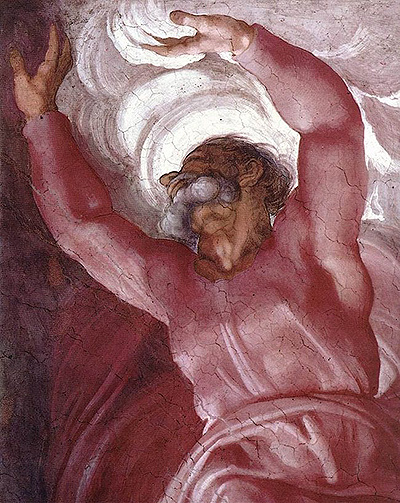
The Separation of Light from Darkness by Michelangelo
At the beginning of the Sistine ceiling’s central Genesis sequence, Michelangelo gives the origin of visible order to one rotating body. God thrusts upward through an indeterminate field, face tipped back, arms raised and torso turning with such force that the painted rectangle seems unable to contain him. No sun, moon, landscape or human witness explains the event. Division itself becomes bodily action.
The Vatican Museums identify Separation of Light from Darkness as the opening story in a nine-part central progression running from the altar toward the entrance.[1] “First” describes the programme’s physical sequence, not the order of painting. The distinction protects what is extraordinary about the scene: Michelangelo made one of Genesis’s most immaterial acts immediate through anatomy, foreshortening and concentrated motion.
At a Glance
- WorkThe Separation of Light from Darkness
- MakerMichelangelo Buonarroti
- Location and formA frescoed rectangle in the central Genesis spine of the Sistine Chapel vault
- CommissionPope Julius II’s ceiling campaign of 1508–1512[2]
- SubjectGod separates light from darkness in Genesis 1:1–5[3]
- Central sequence positionFirst from the altar toward the entrance[1]
- Principal figureGod alone, radically foreshortened and turning
- Narrative groupThe opening triad devoted to the creation of the universe[1]
- Key interpretive issueThe act is conveyed through a body rather than a literal diagram of light and dark zones
- Chronology cautionSequence position does not establish execution order
- Viewing cautionTight crops remove the ignudi, medallions and painted framework of the surrounding bay
Contents
- The First Act of Distinction
- A Divine Figure Seen from Below
- Arms Raised Against the Void
- Light Without the Sun
- The Opening Cosmic Triad
- Ceiling Position and Working Order
- A Small Field with Monumental Pressure
- Looking from the Chapel Floor
- Colour, Restoration and Reproduction
- What the Scene Does Not Show
- Why The Separation of Light from Darkness Matters
- Artist Up Close
The First Act of Distinction
Genesis begins with an unformed earth, darkness over the deep and divine wind over the waters. God commands light, sees that it is good, separates it from darkness and names Day and Night.[3] The passage establishes creation through distinctions: light and dark, day and night, one period from another.
Michelangelo avoids illustrating this with a neat split screen. There is no line labelled day on one side and night on the other. Instead, the creator’s raised arms and turning body occupy a field whose contrasts remain atmospheric. The separation is understood as force passing through space.
This choice keeps the theological subject from becoming a mechanical diagram. God is neither a small supervisor outside the world nor an emblem resting above it. He is the overwhelming agent around whom the nascent field acquires direction.
The very lack of created objects gives the scene its severity. Later episodes can use heavenly discs, vegetation, water, land or human bodies. Here the image must represent the condition that permits seeing in the first place.
A Divine Figure Seen from Below
God’s pose is difficult to resolve at a glance. His head bends back; the chest and shoulders turn; one arm reaches across the body’s orientation while the other opens the opposite side. Drapery coils around the lower form and further complicates the silhouette.
This is foreshortening designed for the vault. Parts of the body appear compressed or enlarged according to their angle toward the observer. From the chapel floor, the figure reads as a concentrated burst rather than a calmly displayed anatomy.
Michelangelo’s sculptural training is often invoked when describing such bodies, but the comparison should be precise. The fresco does not literally become stone. Paint allows the figure to twist through an atmospheric ground, and colour can merge flesh, robe and surrounding light in ways sculpture cannot. What feels sculptural is the insistence on mass, volume and bodily leverage.
The pose also asks the observer to reconstruct it mentally. Understanding comes through looking back and forth between head, shoulders, arms and drapery. The difficulty is part of the effect: creation is shown as an action too forceful to settle into a stable presentation.
Arms Raised Against the Void
The arms make a broad, asymmetrical opening. They may be read as separating, commanding or sustaining, but their work is visual before it is symbolic. They enlarge the body’s reach and turn an invisible distinction into spatial opposition.
Unlike the paired gestures in Creation of the Sun, Moon and Plants, the hands do not terminate beside recognisable celestial discs. They address an unbounded field. This absence pushes attention back onto the figure’s rotation.
The torso mediates the two directions. Neck, chest and abdomen do not align on one easy axis; their torsion creates an impression of ongoing movement. Michelangelo has not painted the completed calm after separation. He has suspended the exertion of making it happen.
It is tempting to assign an exact meaning to each side, arm or colour. The available institutional accounts identify the subject and sequence but do not provide a key for every anatomical direction.[1][2] Close description is firmer than a total symbolic decoding.
Light Without the Sun
Genesis places the first appearance of light before the creation of the greater and lesser lights on the fourth day.[3] The sequence distinguishes primordial light from the sun and moon that later govern day and night.
Michelangelo preserves that distinction. The panel contains no large celestial discs like its neighbour. Light is conveyed through the visibility and modelling of the divine figure and through contrast across the field, not through a luminous object.
This gives the fresco an unusual self-reflexive power. Paint can show anything only because light makes form visible. A scene about the separation of light and darkness therefore concerns the basic conditions of painting itself: illumination, shadow, edge and legibility.
Yet the fresco is not an essay in optics. Its primary frame is Genesis. The visual problem and biblical act reinforce one another without becoming identical.
The Opening Cosmic Triad
The Vatican groups the nine central stories into the creation of the universe, humanity and Noah.[1] Separation of Light from Darkness opens the cosmic triad, followed in the physical altar-to-entrance sequence by Creation of the Sun, Moon and Plants and Separation of the Earth from the Waters.
All three scenes place God at the centre of action, but each solves a different representational problem. The first uses one rotating figure and few attributes. The second repeats God and adds the sun, moon and vegetation. The third relates divine motion to the differentiation of land and water.
The progression is not merely an increase in objects. It moves between types of divine agency: concentrated separation, simultaneous command and the ordering of an emerging world. The body provides continuity while scale, direction and setting create difference.
Reading these works together also shows why Creation of Adam marks a new stage. Once humanity appears, divine action can be staged as relation between two bodies. The opening panel has no such counterpart; its solitude is fundamental.
Ceiling Position and Working Order
The scene’s location near the altar gives it first place in the Vatican’s stated reading sequence.[1] That fact is sometimes confused with the order in which Michelangelo painted the ceiling. The documented campaign does not support that simplification.
Michelangelo began work under contract in 1508. The entrance-side half through Creation of Eve was completed by August 1510, and the altar-side half followed before the full unveiling in 1512.[2] The Separation of Light from Darkness lies in the later section of this working progression even though it opens the biblical sequence as arranged.
This reversal matters. The beginning of Genesis was among the later portions executed. It allowed Michelangelo to make the earliest cosmic act with the experience accumulated over a vast project, though the surviving public chronology does not justify a precise date or isolated working timetable.
Narrative beginning, architectural position and production history thus cross rather than coincide. The ceiling asks to be read in more than one direction.
A Small Field with Monumental Pressure
Compared with some central stories, the composition is strikingly compressed. The divine figure occupies much of the available field. Little environmental space remains to soften his impact.
This scale makes the image readable from below, but it also produces pressure. Limbs approach the border; drapery seems to turn against it; the body feels both airborne and confined. The rectangle acts less like a window into deep space than a force field shaped by the figure.
The relationship to the surrounding bay complicates that pressure. Ignudi and medallions inhabit the broader decorative system, while painted architectural members articulate the ceiling.[2] A scene-only crop makes God appear isolated in a self-contained picture. A wider view reveals that one explosive centre participates in an even denser ensemble.
Neither view should replace the other. The close crop supports anatomical attention; the bay restores the scale and neighbouring bodies against which the central figure operates.
Looking from the Chapel Floor
Smarthistory emphasises the vault’s height and the practical challenge of seeing so much imagery overhead.[4] Under those conditions, Michelangelo needed forms that could survive distance. The lifted arms, tipped head and powerful torso create a recognisable knot of action even when finer modelling becomes hard to follow.
Looking upward also changes bodily empathy. A viewer’s own neck bends while God’s head is thrown back. The physical inconvenience of seeing does not reproduce the painted pose, but it makes orientation an active part of the encounter.
Photographs frequently rotate the panel into a comfortable frontal image. That is necessary for study, yet it can conceal how unusual the original placement is. The fresco was made for an observer who moves beneath it, not for a fixed eye squarely facing a wall.
The most responsible viewing combines bodily and analytical attention: first recognise the thrust of the whole, then study how fragments of anatomy generate it, and finally return the image to the ceiling’s continuous architecture.
Colour, Restoration and Reproduction
Modern conservation transformed the conditions under which the ceiling is discussed. Vatican accounts distinguish the long history of the chapel from the twentieth-century campaign and its continuing study.[5] Cleaning made vivid colour contrasts newly prominent, while debates over technique and removed surface material remain part of scholarly reception.
For this panel, colour influences the boundary between body, robe and surrounding field. Photographic exposure can heighten or flatten those differences. A digital image may make light and darkness appear more literal than the fresco does in architectural space.
No single screen reproduction should be treated as an unmediated colour standard. Historical photographs, printed plates, current institutional imagery and personal photographs differ because of date, lighting, equipment and processing as well as conservation state.
The stable evidence lies in the composition: one figure, turning anatomy, raised arms and an environment ordered through contrast.
What the Scene Does Not Show
There is no human witness, landscape chronology or explanatory inscription inside the central field. Michelangelo does not show the naming of Day and Night as speech. Nor does he paint a scientific account of cosmic origins.
Those absences prevent common misreadings. The image is not a literal portrait of the universe’s first instant, and its tonal areas should not be mapped mechanically onto modern cosmology. It is a Renaissance Christian interpretation of Genesis embedded within a papal chapel.
The surrounding programme introduces prophets, sibyls, ancestors and salvation history, but this individual scene remains deliberately elemental.[2] Its power depends on withholding the narrative abundance found elsewhere.
Why The Separation of Light from Darkness Matters
The fresco matters because Michelangelo solved an almost impossible subject through concentration. He had to show an act without objects, witnesses or familiar landscape. One body supplies agent, direction, scale and emotional intensity.
It also matters as a threshold. In the ceiling’s biblical reading, everything visible follows this first separation. In the working campaign, however, the panel belongs to Michelangelo’s later advance toward the altar. Beginning and culmination occupy the same image.
The scene ultimately resists calm explanation. Its theology can be stated in a sentence; its body cannot. The twisting pose keeps creation active, as if distinction were still passing through muscle and air.
Artist Up Close
Michelangelo makes a creator whose authority is inseparable from exertion. The figure does not wave over a completed cosmos; he occupies the strain of division. This is neither weakness nor ordinary labour. It is the artist’s way of making power visible. By giving the unseen act a difficult, rotating anatomy, Michelangelo turns theology into an encounter with weight, leverage and motion—and lets paint do what no static diagram could.
Frequently Asked Questions
Discussion
What feels most powerful in Michelangelo's Separation of Light from Darkness: the twisting figure, the opening Genesis subject, or its place in the wider Sistine ceiling?
Reader Insights
How does the scene introduce the central Genesis sequence without explaining the whole ceiling?
Where does Michelangelo make an invisible act feel bodily and forceful?
What changes when the scene is seen as part of a wider ceiling bay rather than a cropped image?
Join the Conversation
Compare this opening scene with another Genesis panel and ask how Michelangelo changes scale, body and narrative pressure.
References
- Vatican Museums, Central Stories”:, View source.
- Vatican Museums, Sistine Chapel Ceiling”:, View source.
- United States Conference of Catholic Bishops, Genesis, Chapter 1”:, View source.
- Smarthistory, Michelangelo, Ceiling of the Sistine Chapel”:, View source.
- Vatican Museums, Sistine Chapel History”:, View source.