 by Tom Gurney
Tom Gurney BSc (Hons) is an art history expert with over 20 years experience
Published on June 19, 2020 / Updated on November 6, 2025
Email: tomgurney1@gmail.com / Phone: +44 7429 011000
The Creation of Eve by Michelangelo
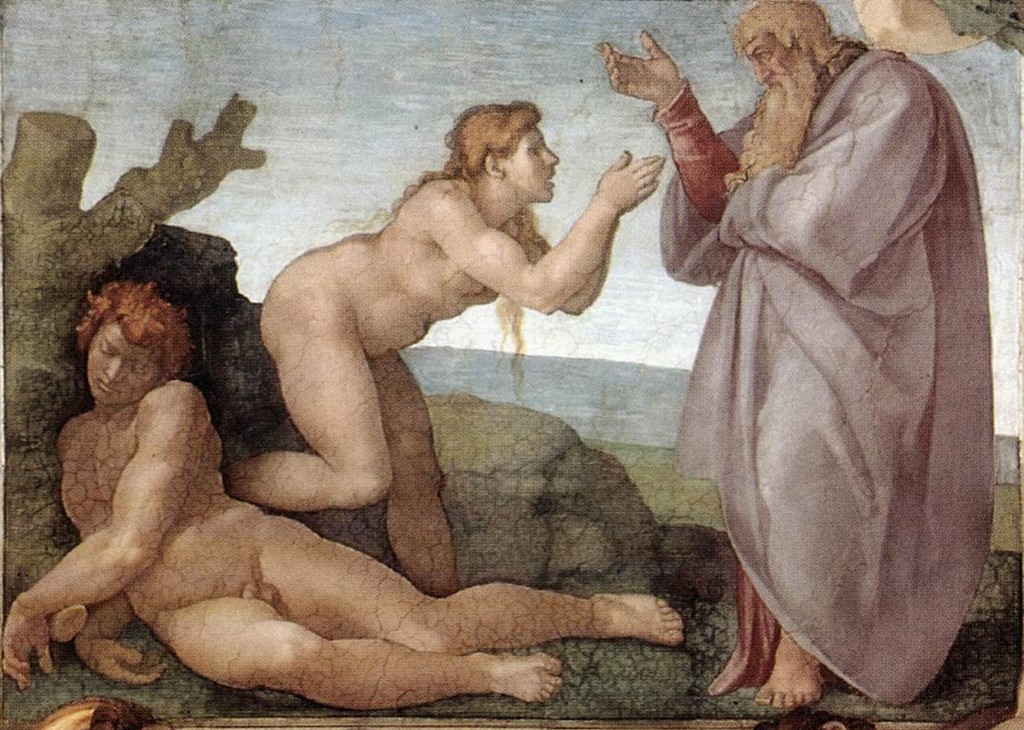
Eve rises from Adam’s sleeping body with her hands joined and her face lifted toward God. Adam remains stretched along the earth, heavy and unaware; God stands upright at the opposite side, clothed in a pale mantle and answering Eve with a measured gesture. Michelangelo reduces the origin of the first woman to three figures, yet the relations among sleep, awakening and recognition make the scene one of the Sistine ceiling’s most concentrated human dramas.
The fresco occupies the fifth position in the Vatican Museums’ altar-to-entrance order of the nine Genesis stories.[1] It stands at the centre of that sequence and marked an important practical threshold in Michelangelo’s campaign: the first completed half of the ceiling extended from the entrance wall through this scene by August 1510.[4] Narrative centre and working milestone meet in the same image, although neither provides an exact day on which it was painted.
At a Glance
- WorkThe Creation of Eve
- PainterMichelangelo Buonarroti
- TechniqueFresco
- SettingThe central narrative field of the Sistine Chapel vault
- Patronage and datesJulius II commissioned the vault, painted between 1508 and 1512[4]
- Biblical sourceGenesis 2:18–25[2]
- Main figuresThe sleeping Adam, the rising woman and God
- Central sequence positionFifth from the altar, between Creation of Adam and Original Sin and Banishment[1]
- Working-history significanceEndpoint of the ceiling half completed by August 1510[4]
- Primary visual structureThree bodies at different heights linked through gesture and gaze
- Name cautionGenesis calls her “woman” at creation; Adam gives the name Eve later, after the transgression narrative begins[2][3]
- Dating cautionAugust 1510 dates the completion of a larger ceiling section, not this fresco in isolation
Contents
- What Michelangelo Shows
- Genesis 2 and the Woman from Adam’s Side
- Eve’s Gesture
- Adam’s Sleep
- God Standing on Earth
- A Landscape Reduced to Essentials
- Creation of Eve and Creation of Adam
- The Centre of the Nine Stories
- The August 1510 Milestone
- Fresco, Plaster and Enlarged Form
- Looking Up in the Chapel
- Restoration and Reproduction
- Later Images of Eve
- Why The Creation of Eve Matters
- Artist Up Close
What Michelangelo Shows
Adam reclines diagonally across the foreground, one arm fallen toward the edge and his head resting beside a truncated tree. His sleep removes him psychologically from the encounter occurring above him. Eve emerges behind his body, her knees bent and torso angled upward. She clasps or brings her hands together while turning toward God.
God stands at full height, an unusual contrast with the airborne creator in many neighbouring scenes. His covered body forms a broad vertical mass. One hand rises in command or blessing; the other gathers the mantle near his chest.
The three figures produce a sequence of levels. Adam belongs to the ground, Eve occupies the act of rising and God stands. The composition can be read as an ascent from sleep through consciousness toward divine presence.
Yet Michelangelo does not paint a simple staircase. Eve leans forward, God inclines toward her and Adam’s long body pushes horizontally beneath them. The encounter is stable and urgent at once.
Genesis 2 and the Woman from Adam’s Side
Genesis presents Adam’s solitude after the naming of animals. No suitable partner is found for him, so God causes a deep sleep, takes from his side and builds the woman. Adam recognises her as kin—bone and flesh—and the passage moves toward the union of the pair.[2]
Michelangelo condenses the account. There is no separate depiction of the incision, divine construction or Adam’s spoken recognition. Sleep, emergence and encounter occupy a single moment. The bodily relationship makes the origin legible without showing a literal surgical act.
The reclining Adam and rising Eve remain close enough for her source in him to be understood. At the same time, Eve directs her attention to God rather than back toward Adam. Her first painted relation is vertical and divine.
The title uses the familiar name Eve, but Genesis does not apply it at this instant. Adam names her Eve in Genesis 3:20, after the eating of the fruit and the divine judgments.[3] Art-historical convention makes Creation of Eve clear and useful, while the textual timing adds nuance.
Eve’s Gesture
Eve’s hands are central because they mediate bodily emergence and spiritual response. Raised near her face, they can suggest prayer, wonder, supplication or acknowledgement. The gesture is legible without demanding one exclusive emotional label.
Her arms also continue the upward motion begun in knees, hips and torso. Michelangelo constructs awakening as a coordinated bodily curve. Eve does not merely stand after having been created; she is caught in the transition from earthbound crouch to conscious encounter.
Her gaze completes the movement. The head turns toward God, and the space between their faces becomes charged even though their hands do not approach the near-contact familiar from Creation of Adam.
The modesty of the gesture distinguishes Eve from the more expansive creator figures. Her body is powerful, but response rather than command organises it.
Adam’s Sleep
Adam is present as origin but absent as witness. His closed or lowered eyes and slackened pose establish the deep sleep described in Genesis.[2] Michelangelo makes unconsciousness visible through weight.
The long torso and legs spread across much of the lower field. This horizontal mass anchors the composition and gives Eve something from which to rise visually as well as narratively. His hand drops near the border, reinforcing the surrender of agency.
Sleep also suspends reciprocity. In Creation of Adam, Adam lifts a hand toward God. Here his body offers no answering gesture. Divine action proceeds while the first man cannot observe it.
That absence prevents the scene from becoming a conventional introduction between two awake people. Eve’s creation belongs to a mysterious interval in which Adam’s body is both source and sleeping landscape.
God Standing on Earth
The upright creator differs strikingly from the airborne God of the cosmic panels and Creation of Adam. He stands within the same spare landscape as the human bodies, giving the encounter a quiet physical proximity.
His large mantle conceals much of the anatomy that Michelangelo otherwise makes emphatic. Volume comes through drapery rather than exposed muscle. The covered divine body contrasts with the naked first humans while maintaining equal monumental weight.
The raised right hand addresses Eve. It may be described as command, summons or blessing, but the image does not carry a caption choosing among them. The essential point is relational: God’s gesture and Eve’s hands answer across a narrow interval.
The other hand draws inward at the chest, creating a counter-motion. Michelangelo balances public authority with gathered reserve.
A Landscape Reduced to Essentials
Tree, rock, narrow ground and distant horizon establish Eden without turning it into a luxuriant botanical setting. Michelangelo gives more pictorial space to bodies than to paradise.
The broken or abbreviated tree behind Adam helps separate his head from the sky and introduces a vertical form beside the reclining figure. Its cut appearance can invite symbolic speculation, but no single emblematic meaning is required to understand the scene.
The landscape’s sparseness makes distance between the figures clear. Adam lies close to the foreground edge; Eve rises behind him; God stands across a shallow opening. The setting behaves almost like a sculptural platform.
This economy also supports visibility from below. Three large silhouettes and a few ground markers remain legible in an immense decorative system.
Creation of Eve and Creation of Adam
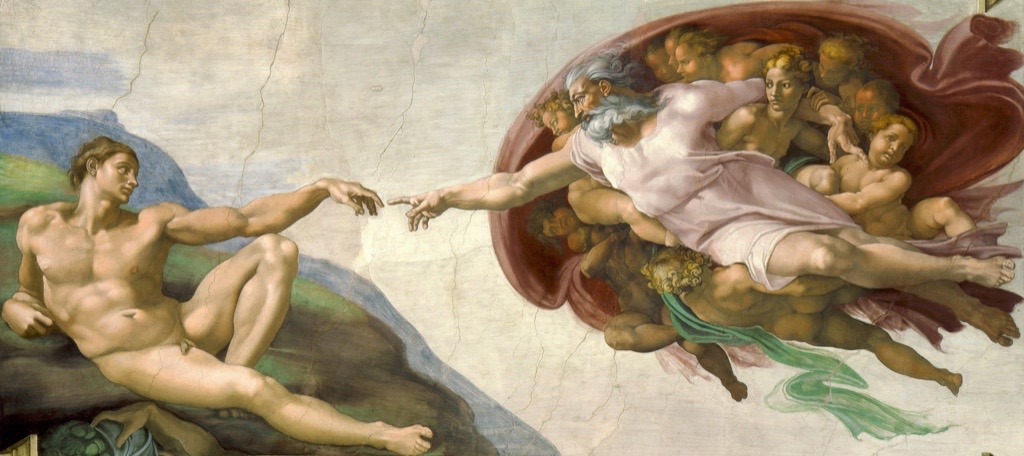
The two creation scenes are neighbours in the Vatican sequence and natural companions.[1][7] Both stage divine life-giving action through a small number of monumental figures, but their structures differ profoundly.
In Creation of Adam, God flies toward a reclining man. The nearly touching index fingers concentrate potential energy into one narrow gap. Adam is awake enough to respond, and his body stretches laterally against a bare earth.
In Creation of Eve, God stands while the new human rises. No fingertips approach. A triangle of bodies replaces the two-part encounter: sleeping Adam below, Eve between, God above and opposite.
The contrast reveals Michelangelo’s refusal to repeat a successful formula. One creation turns on suspended contact; the other on emergence and recognition. Adam’s origin is imagined as animation, Eve’s as awakening.
The Centre of the Nine Stories
From altar toward entrance, Creation of Eve is fifth among nine central episodes.[1] Four cosmic and human-origin scenes precede it; the transgression and Noah narratives follow.
Its centrality gives Eve’s upward movement special programmatic weight. She is created at the sequence’s midpoint, then reappears immediately in the combined temptation and expulsion scene. The first woman’s emergence therefore becomes a hinge between innocence and the history of evil.
This does not mean the entire ceiling can be reduced to one central key. The programme also includes prophets, sibyls, ancestors, ignudi, medallions, pendentives and spandrels.[4] Position suggests relation, not a fully solved private code.
The physical order also differs from the order of painting. Michelangelo began at the entrance side, making the scenes encountered last in the altar-to-entrance reading among the first executed.[4]
The August 1510 Milestone
The Vatican Museums state that work had advanced from the entrance wall as far as Creation of Eve by August 1510, completing one half of the vault.[4] This gave part of the painted programme a temporary endpoint while work on the altar-side half remained.
The date is valuable because it ties this scene to a documented phase boundary. It does not prove that Michelangelo painted the entire fresco during August, completed it last among that half’s components or worked without interruption.
What it does establish is architectural progress. By that summer, observers could encounter a substantial sequence reaching through Eve’s creation. The later cosmic panels would extend the project toward the altar before the full opening in 1512.
The distinction between milestone and isolated date exemplifies responsible chronology. Large fresco campaigns advance through preparations, plaster sections and adjacent decorative work that a single completion statement cannot unpack fully.
Fresco, Plaster and Enlarged Form
Fresco requires pigment applied to fresh plaster in manageable daily sections. The medium rewards decisiveness while demanding planning. Large contours, colour zones and modelling have to operate within a surface whose readiness is temporary.
In Creation of Eve, the three bodies are clearly separated by profile and colour. Adam’s warm flesh lies against dark earth and trunk; Eve’s paler rising form occupies open sky; God’s lavender-grey mantle builds a broad block at the side.
These divisions support both working procedure and distant clarity. They do not reveal every hand involved or every stage of transfer. The public institutional record establishes Michelangelo’s authorship and overall campaign, not a named labour assignment for each passage.[4][6]
Close photographs make cracks and surface variation prominent. From the floor, compositional masses regain priority.
Looking Up in the Chapel
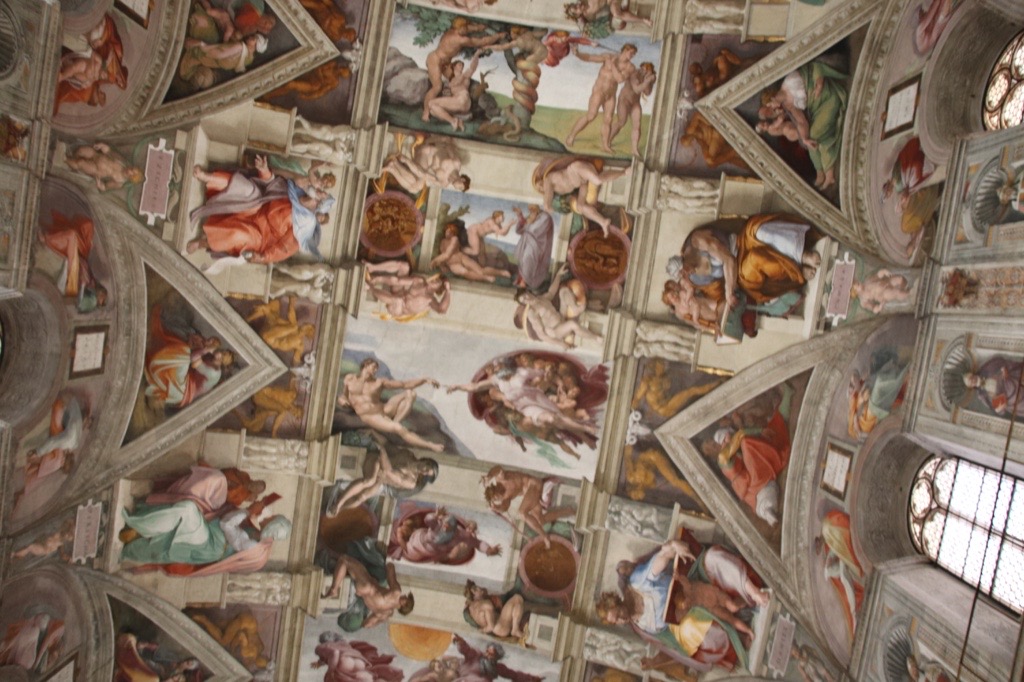
The fresco is not mounted vertically at eye level. It belongs overhead within painted frames and beside other bodies. Smarthistory stresses the scale and density that confront visitors in the chapel.[8]
Seen from below, Adam’s long horizontal and God’s broad vertical form the first readable opposition. Eve’s smaller figure must bridge them. Her raised arms and bright placement help her survive that competition.
A tight digital crop makes gestures intimate and invites facial study. A complete bay restores the ignudi, medallions and architectural fiction around the narrative. An overall ceiling view shows why this rectangle is both central and relatively small.
These scales should be used together. The work is simultaneously an image of three persons and one element in a total environment.
Restoration and Reproduction
The Sistine ceiling’s modern conservation belongs to the Vatican’s longer record of restoration and study.[5][9] The cleaned surface brought renewed attention to Michelangelo’s bright colour and to differences between pre- and post-restoration images.
The pale sky, warm flesh, green-grey earth and God’s cool mantle vary across photographs. Lighting and digital processing can alter those relations. A reproduced hue is not automatically a stable measurement of the fresco.
Cropping changes meaning as decisively as colour. Remove Adam’s dropped hand, and his heaviness weakens; cut the open space between Eve and God, and the exchange becomes cramped; omit the surrounding bay, and architectural scale disappears.
Responsible visual study records which version is being seen and lets uncertainty about colour reproduction remain visible.
Later Images of Eve
The subject of Eve continued to attract artists, copyists and collectors. Drawings or prints associated with Michelangelo’s figures must be identified by their own date, medium and attribution rather than assumed to be preparatory works for this fresco.
A later sheet after the ceiling can preserve a pose while reversing, isolating or regularising it. Such an object belongs to the reception of the fresco unless documentary and technical evidence connect it to Michelangelo’s design process.
The Metropolitan Museum presents Michelangelo’s design practice through his drawings and related works, supplying broad context for the importance of work on paper.[10] It cannot turn every related figure study into an autograph preparation.
Reception is most informative when mediation is named. Copies show what later viewers valued, but they also reveal how an overhead narrative was converted into portable figures.
Why The Creation of Eve Matters
The fresco matters because it gives the first woman monumental agency at the instant of emergence. Eve is not an accessory beside an active Adam. He sleeps while she rises, looks and responds.
It matters because three poses describe three conditions of being: unconscious weight, awakening consciousness and divine authority. Michelangelo makes theology spatial.
It also holds a crucial place in the ceiling’s history. As the midpoint of the nine stories and the boundary of the first completed campaign section, it joins narrative and labour without allowing them to collapse into one chronology.
Artist Up Close
Michelangelo could make drama through stillness as readily as through violent motion. Adam barely acts; God’s gesture is restrained; Eve’s rise supplies the scene’s decisive current. The artist differentiates flesh not only by anatomy but by states of awareness. One body sleeps, another comes into relation, a third calls. In that spare exchange, creation becomes less a spectacle of supernatural effect than the awakening of attention.
Frequently Asked Questions
Discussion
Choose an image of the scene and identify whether it is the fresco, a photograph, an engraving, a later drawing or a digital crop. Check whether its caption makes that status clear.
Reader Insights
List the positions, gestures and gazes of Adam, Eve and God. Then separate what is visible from what a viewer infers.
Set Creation of Eve beside Creation of Adam. Compare God’s position, Adam’s state, the active gesture and the space between bodies.
Place the scene between Creation of Adam and Original Sin and Banishment. Ask what the middle position contributes to the movement from innocence to consequence.
Join the Conversation
Compare an isolated detail with an overall ceiling view. Record what becomes visible and what disappears when the scene is removed from its architectural setting.
References
- Vatican Museums, Central Stories”:, View source.
- United States Conference of Catholic Bishops, Genesis, Chapter 2”:, View source.
- United States Conference of Catholic Bishops, Genesis, Chapter 3”:, View source.
- Vatican Museums, Sistine Chapel Ceiling”:, View source.
- Vatican Museums, Sistine Chapel History”:, View source.
- Vatican Museums Online Catalogue, Michelangelo, Creazione di Eva, dipinto murale”:, View source.
- Vatican Museums, Creation of Adam”:, View source.
- Smarthistory, Michelangelo, Ceiling of the Sistine Chapel”:, View source.
- Vatican Museums, The Sistine Chapel Twenty Years Later: New Breath, New Light”:, View source.
- The Metropolitan Museum of Art, Michelangelo: Divine Draftsman and Designer”:, View source.