


 by Tom Gurney
Tom Gurney BSc (Hons) is an art history expert with over 20 years experience
Published on June 19, 2020 / Updated on November 6, 2025
Email: tomgurney1@gmail.com / Phone: +44 7429 011000
The Separation of the Earth from the Waters by Michelangelo
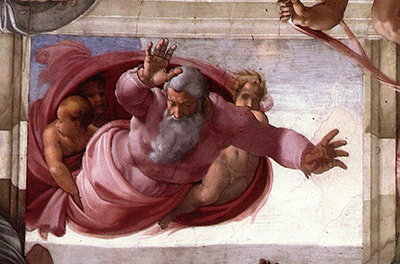
In Michelangelo’s Separation of the Earth from the Waters, God flies toward the observer with both arms extended, the great pink mantle around him swelling into a moving envelope. Attendant figures crowd its curve. Beneath and beyond them, pale blue and earthy tones suggest a world being differentiated rather than a landscape already settled. Creation is once again a matter of direction, pressure and bodily command.
The fresco belongs to the opening cosmic group in the nine central Genesis stories of the Sistine Chapel ceiling.[1] It is also called Separation of Land from Sea, a concise title reflecting Genesis 1:9–10.[3] Less famous than Creation of Adam, it is essential to the ceiling’s movement from primordial distinctions toward the inhabitable world.
At a Glance
- Primary nameThe Separation of the Earth from the Waters
- Alternative titleSeparation of Land from Sea
- Painter and mediumMichelangelo Buonarroti; fresco
- SettingOne of the central Genesis compartments overhead in the Sistine Chapel
- Commission and datesPope Julius II; the ceiling campaign ran from 1508 to 1512[2]
- SubjectGod gathers the waters so dry land appears, from Genesis 1:9–10[3]
- Central sequence positionThird when read from altar toward entrance[1]
- Narrative groupCreation of the universe
- Principal actionGod advances with arms extended, accompanied within a billowing mantle
- Key cautionThe official central-stories overview establishes title, sequence and family context, but not an exact isolated execution date
- Viewing cautionFull-bay reproductions include four ignudi, medallions and painted architecture that do not belong inside the Genesis action
Contents
- Naming the Scene
- Genesis: A World Prepared
- God Advancing Through the Field
- The Mantle and Its Companions
- Making Land and Water Visible
- Between Two Cosmic Neighbours
- From Cosmos to Humanity
- The Complete Ceiling Bay
- Painted Architecture and Real Architecture
- Viewing at Distance
- Restoration, Surface and Colour
- Why the Fresco Matters
- Artist Up Close
Naming the Scene
Two English titles circulate without changing the subject. Separation of the Earth from the Waters emphasises the inherited wording of the division. Separation of Land from Sea expresses the result more compactly: gathered waters are called Seas and exposed dry ground is called Earth.[3]
The alternatives are not evidence for two works. They reflect translation and cataloguing choices. What matters is the connection to the biblical act and to the Vatican’s sequence of central stories.[1]
The word “separation” can also mislead if imagined as a crisp diagram. Michelangelo does not divide the rectangle into equal labelled zones. The environmental distinction remains subordinate to God’s advancing body. The event is apprehended as command before it is read as geography.
This makes the fresco a useful test of title and vision. Once the subject is known, pale and earthy passages begin to cohere as the ordered world. Without the title, the divine flight may dominate so completely that land and water seem almost incidental.
Genesis: A World Prepared
Genesis describes the waters beneath the sky gathering into one place so that dry land appears. God names the dry ground Earth and the gathered waters Seas, then sees that the result is good.[3] Vegetation follows in the same third day.
The act is fundamental because it creates environments. Separation produces places in which later life can exist. The earth is no longer formless deep; it has differentiated surfaces, boundaries and names.
Michelangelo compresses that conceptual transformation. He supplies neither a map nor a panoramic coast. The creator’s gesture carries the passage from disorder toward a habitable structure.
The neighbouring Creation of the Sun, Moon and Plants combines vegetation with the fourth-day heavenly lights, even though land, sea and plants precede those lights in the biblical verses. Ceiling arrangement and scriptural order therefore do not correspond mechanically.[1][3] The divergence should be acknowledged rather than corrected by inventing a new sequence.
God Advancing Through the Field
The divine figure faces outward more directly than in Separation of Light from Darkness. His shoulders spread across the narrow field; one hand lifts, palm visible, while the other reaches laterally. Head and torso turn just enough to prevent the movement from becoming rigid symmetry.
The advancing pose gives God unusual proximity. Rather than observing the world from above in distant profile, he seems to cross the picture’s threshold. Forearms and hands become instruments of ordering, but they also establish the breadth of the composition.
The body is clothed in a long garment whose folds turn around the torso, while the mantle behind creates a larger, curved silhouette. This combination of solid body and airborne fabric lets Michelangelo communicate mass without surrendering flight.
The figure is not simply floating. His direction has urgency. The sense of forward passage converts an abstract decree into an event unfolding toward the observer.
The Mantle and Its Companions
Several smaller figures accompany God within or around the billowing mantle. They cluster tightly, their heads and bodies partially obscured by one another and by the creator’s larger form. The grouping gives the divine movement a collective density.
It can be tempting to identify each attendant with a named angel or a specific theological role. The institutional sources used here do not provide those identities.[1][2] “Attendant figures” or “angelic companions” keeps description proportionate to the evidence.
The mantle does more than shelter them. Its curved red edge establishes an arc behind God and separates the compact group from the pale field. Drapery becomes a vehicle, atmosphere and compositional boundary at once.
Comparison with Creation of Adam is revealing but limited. In both scenes God advances within a mantle accompanied by figures. In the Adam fresco, the group’s relation to the nearly touching hands controls the drama. Here there is no human recipient. The outward hands govern elemental space.
Making Land and Water Visible
The environmental field is restrained. Broad transitions of blue, grey, green and earth colour matter more than topographical detail. Michelangelo does not invite a search for a recognisable coastline.
This lack of descriptive geography suits a world at the moment of differentiation. Land and sea are emerging categories, not yet settings for human history. Their relative sparseness also preserves the creator’s legibility from the chapel floor.
The extended arms encourage the eye to read laterally, as if division spreads across the rectangle. The figure’s motion and the field’s tonal changes cooperate without becoming a literal before-and-after chart.
Calling the scene “land from sea” helps identify the result, but the fresco concentrates on divine agency. Nature does not rearrange itself autonomously; it receives order through command.
Between Two Cosmic Neighbours
In the altar-to-entrance order, this is the third central story. It follows Creation of the Sun, Moon and Plants and precedes Creation of Adam.[1] Together with Separation of Light from Darkness, it belongs to the first triad concerning the universe.
The two separation scenes share an elemental subject and a dominant divine body. Yet their bodies behave differently. Light from Darkness is a compact, twisting knot seen in radical foreshortening. Earth from Waters opens horizontally and advances with a surrounding company.
The intervening sun-and-moon fresco doubles God, producing two actions within one field. Across the triad, Michelangelo varies singular and repeated presence, solitude and accompaniment, rotation and frontal advance.
These distinctions prevent “creation” from becoming a repeated formula. Each panel asks what bodily configuration can make a particular unseen command visible.
From Cosmos to Humanity
The position immediately before Creation of Adam creates a powerful conceptual threshold. Here land and water become distinct; next, a human body receives life. Environment precedes inhabitant.
Visually, the transition is even more striking. In this scene, God’s gesture expands into elemental space. In Creation of Adam, his arm reaches toward another hand. Cosmic command narrows into relation.
That comparison should not erase chronological complexity. The physical reading order from the altar is not the sequence in which Michelangelo executed the two halves. The entrance-side section through Creation of Eve was completed earlier, while the altar-side cosmic scenes belong to the later working phase.[2]
The ceiling thus joins stories in one direction while preserving traces of labour undertaken in another.
The Complete Ceiling Bay
A wider view reveals four monumental nude youths around the central rectangle, two medallions, stone-coloured painted frames and other decorative forms. Those bodies belong to the ceiling’s larger system, not to the gathering of the waters itself.[2]
Their presence nonetheless changes perception. The ignudi bend and extend around the central scene, creating an outer rhythm of flesh that echoes the creator’s gestures. Circular medallions introduce dark, weighty discs against the rectangular opening.
A narrow crop isolates the narrative efficiently but makes the work resemble an independent panel. The full bay restores Michelangelo’s larger orchestration of figure, ornament and fictive architecture.
Careful looking therefore requires two frames at once. The central rectangle carries the Genesis event; the surrounding bay establishes how that event occupies the ceiling.
Painted Architecture and Real Architecture
Michelangelo organised the vault with fictive cornices, pilasters, pedestals and frames. These painted structures separate subjects while also joining them into a continuous architectural fiction.[2]
For Separation of the Earth from the Waters, the frame creates a firm boundary around an action that otherwise seems to press outward. God’s hands approach the sides, and the mantle nearly fills the height. The represented world appears constrained just as it is being ordered.
The actual curvature and height of the vault complicate the illusion. What looks rectangular in a flattened photograph belongs to a built surface encountered at an angle. Michelangelo designs simultaneously for the fictional opening and the real chapel.
That duality is central to the ceiling’s achievement. Painting does not merely occupy architecture; it invents an architecture through which multiple times and scales can coexist.
Viewing at Distance
From the floor, broad masses take priority: the pink robe, red mantle, pale field and fan of arms. Smaller companions register as a clustered presence before their individual poses become clear. Smarthistory’s account of the ceiling stresses both its height and the abundance confronting an observer below.[4]
Digital enlargement reverses those priorities. Faces, fingers and folds invite extended inspection, while the body’s original architectural impact may weaken. Neither view is sufficient alone.
Rotation also matters. Online images are often oriented to make the rectangle comfortably frontal. In the chapel, observers change position and angle as they move. “Up,” “left” and “right” in a photograph should not be mistaken for a complete account of bodily experience beneath the vault.
The strongest encounter alternates scale: recognise the advancing command, examine the compressed attendants, then return the scene to its place between the other Genesis fields.
Restoration, Surface and Colour
The Sistine ceiling’s modern restoration belongs to a longer history of conservation documented by the Vatican Museums.[5] Cleaning made Michelangelo’s bright colour relationships newly prominent and prompted continuing discussion of technique, glaze, dirt and later intervention.
This scene’s broad pinks, reds and pale blues can vary markedly in reproduction. Screen calibration and photographic processing may intensify the mantle or flatten the distinction between earth and water.
The responsible conclusion is not that colour is unknowable. It is that claims should remain tied to relations visible across reliable images and to the material fresco in its conserved state. Exact digital hues are not historical facts.
Surface history also reminds us that the ceiling is not an untouched image transported from 1512. It is a physical work that has aged, been repaired, cleaned, documented and continually re-seen.
Why the Fresco Matters
The Separation of the Earth from the Waters matters because it completes the ceiling’s cosmic opening. Light, heavenly bodies, vegetation, land and sea acquire pictorial order before Michelangelo turns to the creation of humanity.
It matters because the scene demonstrates variation within a unified programme. The creator who twists alone in one panel and appears twice in another now advances with a compact company. Repetition becomes invention.
Most of all, the fresco transforms naming and separation into directed presence. A sparse world gains structure because a body crosses it. Michelangelo allows anatomy, drapery and open hands to carry the scale of Genesis.
Artist Up Close
Michelangelo’s God is both immense and compressed. He advances through a field barely large enough to hold his span, bringing attendant bodies and fabric with him. That pressure makes divine command physical without making it ordinary. The creator’s hands do not touch land or water as an artisan might handle material; they establish direction across the whole. Michelangelo’s distinctive gift is to make invisible authority felt through the exact disposition of weight and movement.
Frequently Asked Questions
Discussion
What feels most important in Michelangelo's Separation of the Earth from the Waters: the act of ordering, the divine motion, or its place between the other Creation scenes?
Reader Insights
How does Michelangelo make a cosmic division visible without a human witness?
What changes when this scene is read between Sun, Moon and Plants and Creation of Adam?
How should a caption handle the shorter Land from Sea label while preserving the route title?
Join the Conversation
Compare this Creation scene with Separation of Light from Darkness and ask how Michelangelo gives different kinds of order a bodily form.
References
- Vatican Museums, Central Stories”:, View source.
- Vatican Museums, Sistine Chapel Ceiling”:, View source.
- United States Conference of Catholic Bishops, Genesis, Chapter 1”:, View source.
- Smarthistory, Michelangelo, Ceiling of the Sistine Chapel”:, View source.
- Vatican Museums, Sistine Chapel History”:, View source.