 by Tom Gurney
Tom Gurney BSc (Hons) is an art history expert with over 20 years experience
Published on June 19, 2020 / Updated on November 6, 2025
Email: tomgurney1@gmail.com / Phone: +44 7429 011000
Michelangelo’s Ancestors of Christ
Below the creation of the world and beneath the colossal prophets, another history unfolds at the pace of ordinary time. Women cradle children, men lean on staffs, families turn away from one another or gather in shadow. Nothing miraculous seems to happen. Yet these tired, watchful and absorbed bodies carry the human descent through which Christ enters history.
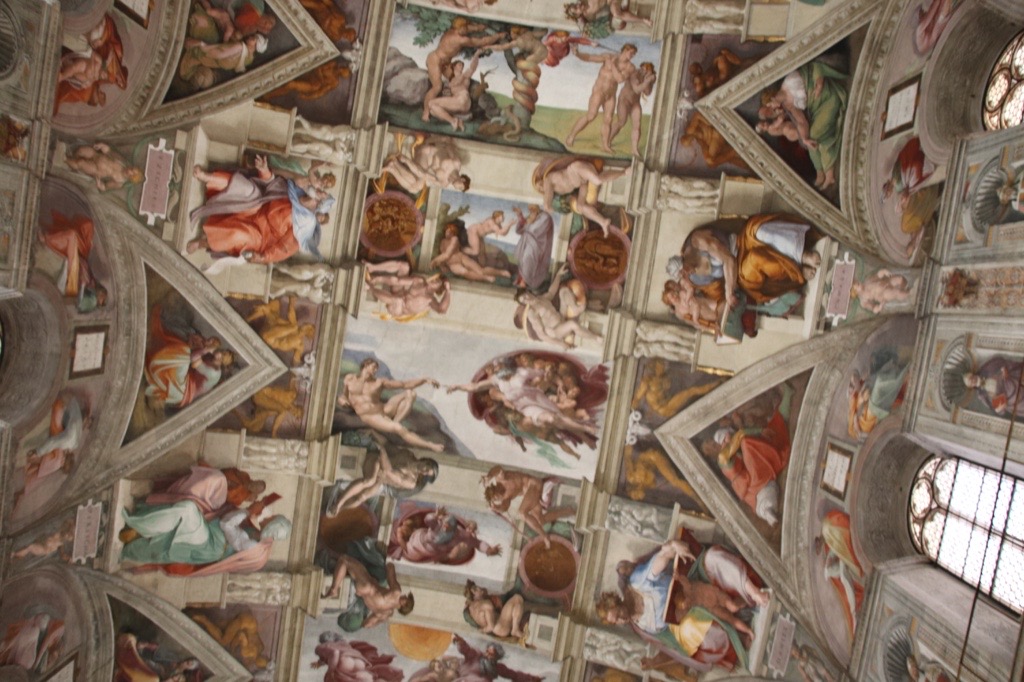
Michelangelo painted the Ancestors of Christ in the lunettes and triangular spandrels around the lower margin of the Sistine ceiling between 1508 and 1512.[1][2] Tablets name groups from the genealogy opening the Gospel of Matthew, but the Vatican Museums warns that individual figures cannot be matched securely to those names.[1] The cycle’s greatest interpretive discipline is also its deepest invitation: to see people precisely without pretending to know exactly who each one is.
At a Glance
- WorkAncestors of Christ, also called the Forefathers of Christ
- ArtistMichelangelo Buonarroti
- Date1508–12, within the Sistine ceiling campaign[2][3]
- TechniqueFresco
- LocationLunettes and spandrels on the north, south and entrance sides of the Sistine Chapel
- PatronPope Julius II
- Textual frameworkMatthew 1:1–17, from Abraham and David through Joseph to Jesus[5]
- Surviving lunettesFourteen named tablet fields[1][6]
- SpandrelsEight triangular family groups, probably completing the genealogical series[4]
- Lost elementsTwo ancestor lunettes formerly on the altar wall were destroyed before the Last Judgement[12]
- Essential cautionTablet inscriptions identify genealogical groups, not every adjacent adult or child[1][6]
- PositionBelow the prophets and Sibyls and outside the nine central Genesis histories[2]
- CharacterDomestic, varied and often inactive rather than narrative
Contents
- Genealogy Without Portrait Labels
- Why Matthew Begins with a Family List
- Where the Ancestors Sit
- Lunettes and Spandrels Are Different
- The Fourteen Surviving Lunette Fields
- Names That Change Spelling
- Family Units, Not a Row of Men
- Women Carrying an Unwritten Genealogy
- Children and Degrees of Finish
- Waiting as an Action
- Domestic Life and Sacred History
- No Single Mood
- The Tablet as Division and Bond
- Walking the Sequence
- Uzziah, Jotham and Ahaz
- Rehoboam and Abijah
- Salmon, Boaz and Obed
- The Josiah, Jechoniah and Shealtiel Spandrel
- The Spandrel above Jesse, David and Solomon
- One Day Does Not Mean No Preparation
- The Ceiling’s Two Broad Campaigns
- Colour Returned by Conservation
- The Two Lost Altar-Wall Lunettes
- Not the Lunettes of the Last Judgement
- Jewish Genealogy in a Christian Chapel
- Why Anonymity Matters
- Painted Architecture and Real Windows
- Bonasone’s Engraving
- Seeing the Cycle at Several Scales
- Artist Up Close
Genealogy Without Portrait Labels
Matthew’s Gospel begins by tracing Jesus’s lineage through three great spans: Abraham to David, David to the Babylonian exile, and the exile to Christ.[5]
Michelangelo turns that written succession into repeated households. Each lunette contains a central tablet carrying two or three names, with figures seated on either side.
It is tempting to treat the inscription as a caption that identifies the nearest faces. The Vatican Museums explicitly resists this. Repeated attempts to connect labels and people have not produced certainty.[1]
The tablet establishes where a field belongs in sacred genealogy. The surrounding adults and children embody descent, family and waiting without becoming securely labelled portraits.
The distinction allows accuracy without impoverishing interpretation. A woman’s pregnancy, an old man’s staff or a child’s reach can be described fully even when a biblical name cannot be attached.
Why Matthew Begins with a Family List
Matthew calls Jesus son of David and son of Abraham before presenting the generations leading to Joseph, husband of Mary.[5]
The genealogy anchors Christ within Israel’s history and Davidic kingship. It also includes ruptures—exile, irregular succession and named women whose stories complicate a purely patriarchal line.
Michelangelo does not illustrate each ancestor’s biblical biography. His cycle translates the idea of descent into bodies inhabiting time.
The apparent inaction matters. Genealogy is largely lived between famous events: births, care, fatigue, ageing and continuance.
These painted families supply that duration beneath the ceiling’s great acts of creation and catastrophe.
Where the Ancestors Sit
Nine Genesis scenes run along the centre of the vault. Seven Hebrew prophets and five classical Sibyls occupy monumental thrones around them. Four corner pendentives show miraculous deliverances of Israel. The Ancestors inhabit lower lunettes and eight triangular spandrels.[2][4]
Their physical position shapes experience. Visitors often look first to the central histories, while the families spread laterally above windows and near the tops of the walls.
“Lower” does not mean unimportant. The prophets announce or anticipate salvation; the Ancestors give it human continuity. Genesis reaches back to the beginning of humanity, while Matthew narrows history towards Christ.
Michelangelo binds cosmic, prophetic and familial time into one architectural hierarchy.
Lunettes and Spandrels Are Different
A lunette is a broad curved field above a window. A spandrel is a tapering triangular field higher up between larger structural elements.
The lunettes divide horizontally around central tablets. Their width allows two distinct social groups or states of attention.
The spandrels compress bodies towards an apex. Adults and children gather into compact pyramids, sometimes half absorbed by shadow.[4]
Both formats belong to the Ancestors, but they do not provide identical evidence. Spandrels lack the same direct tablet structure, and their precise genealogical assignments are even less secure.
The four corner pendentives are larger again and hold different biblical subjects. Architectural vocabulary protects iconographic identity.
The Fourteen Surviving Lunette Fields
The surviving groups are indexed by their tablets:
1. Achim and Eliud 2. Amminadab 3. Asa, Jehoshaphat and Joram 4. Azor and Zadok 5. Eleazar and Matthan 6. Hezekiah, Manasseh and Amon 7. Jacob and Joseph 8. Jesse, David and Solomon 9. Josiah, Jechoniah and Shealtiel 10. Nahshon 11. Rehoboam and Abijah 12. Salmon, Boaz and Obed 13. Uzziah, Jotham and Ahaz 14. Zerubbabel, Abiud and Eliakim[1][6]
This is not a list of fourteen single scenes detached from the chapel. Each title names an architectural field containing tablet, window relationship, multiple bodies and painted framing.
Nor is it the complete 1512 cycle. Two altar-wall lunettes no longer survive.[12]
Names That Change Spelling
Latin inscriptions, Italian catalogue names and English Bible translations produce variant spellings.
Amminadab may become Aminadab; Nahshon may appear as Naason; Zadok as Sadoch; Matthan as Mathan; Jehoshaphat as Jehosaphat; Shealtiel as Salathiel or Sheatiel.
These are not different figures or frescoes. They are linguistic forms moving through biblical translation and institutional tradition.
The safest approach preserves the title used by the relevant institution while offering a familiar English form where helpful.
Spelling discipline matters because uncertainty over individuals is already high. Variant names should not create additional false disagreement.
Family Units, Not a Row of Men
“Forefathers” can sound like a series of isolated patriarchs. Michelangelo instead fills the fields with women, infants, youths and old people.
The Vatican describes symbolic images of humanity formed especially into family units.[1]
That phrase does not mean every group is a modern nuclear family or that every woman is a named wife. It identifies relationship as the programme’s visual substance.
Adults nurse, support, guard or ignore children. Some pairs appear emotionally joined; others inhabit almost separate worlds on either side of an inscription.
Genealogy becomes social rather than merely nominal. Descent is carried by bodies across sex, age and dependence.
Women Carrying an Unwritten Genealogy
Most tablet names are male, following the structure of Matthew’s list, yet women dominate many of Michelangelo’s most memorable groups.
They are pregnant, nursing, holding children, arranging garments or sitting apart. Their bodies make generation visible where the inscriptions merely state descent.
This does not turn every woman into one of the named women in Matthew. Tamar, Rahab, Ruth and “the wife of Uriah” appear in the Gospel, but the fresco provides no secure portrait key linking them to individual figures.[5]
The difference between text and image is productive. The male genealogy is embodied through families whose continuation visibly depends on women.
Michelangelo expands a list into the material and emotional labour of descent.
Children and Degrees of Finish
Children appear with striking inequality. Some infants have weight, expression and complex relation to an adult. Others are abbreviated into swift brushstrokes or half concealed in shadow.[7][9]
This variation is not evidence that the less finished children matter less within genealogy. It reflects visibility, daily plaster, visual hierarchy and the speed needed at height.
From close range, an abbreviated child can look almost unfinished. From the chapel floor, a few decisive marks complete the rhythm of a group.
Michelangelo distributes labour according to perception. Finish is a scale-dependent decision, not a uniform moral value.
The children also prevent waiting from becoming sterile. However weary the adults seem, another generation is already physically present.
Waiting as an Action
The central ceiling contains divine speech, creation, temptation, expulsion, sacrifice and flood. The Ancestors rarely perform recognisable events.
They sit. One leans a cheek on a hand; another turns inward; someone handles clothing or tends a child.
This suspended life has often been understood as waiting for redemption. The interpretation suits their place before Christ, but no single gesture acts as an agreed code for spiritual expectation.
Waiting here is bodily before it is symbolic. It bends backs, lowers eyes and makes families fill time.
Michelangelo finds drama in duration rather than incident.
Domestic Life and Sacred History
The everyday actions can appear startlingly ordinary within a papal chapel.
They prevent the genealogy from becoming an abstract ladder of names. Sacred history passes through pregnancy, feeding, sleep, friction and boredom.
Giovanni Careri has examined the figures’ absorption in ordinary life and the ways Christian ideas about Jewish ancestry and historical difference shaped the cycle.[14]
That is a named interpretation, not a universal key. It is especially valuable because it asks why the families appear so remote from heroic sacred action.
The paintings emerged within a Christian framework that claimed Hebrew genealogy as prehistory to Christ. Modern interpretation must recognise that theology while also examining how it represents Jewish ancestry from a later Christian viewpoint.
No Single Mood
The cycle is sometimes described as uniformly melancholic. Its figures do often appear weary, inward or burdened, but variation is fundamental.
There is tenderness between mother and infant, tension between adults, alertness, sleep, solitude and practical occupation.
Colours also vary. Bright yellow, green, orange and violet can animate bodies whose poses seem withdrawn.
The repeated format encourages comparison. One half of a lunette may be open and luminous while the other contracts into darker space.
Michelangelo does not illustrate one emotional condition fourteen times. He builds a population.
The Tablet as Division and Bond
Every lunette places writing at the centre and bodies to either side. The tablet separates the groups, but it also names the genealogy they share.
This produces an unusual relationship between word and image. The inscription is visually stable, frontal and architectural. The figures twist, slump, grow and attend in time.
Neither half alone explains the field. Without the tablet, domestic groups lose their position in Matthew. Without the bodies, names remain an abstract sequence.
The window arch below intensifies separation, often making the two sides seem like neighbouring households unable to touch.
Genealogy supplies the bond across architecture.
Walking the Sequence
The fourteen lunettes cannot be seen at equal clarity from one fixed position. They extend around three sides of the chapel above windows, while spandrels rise between them.
To follow the series, an observer turns and moves. A family disappears from view as another aligns; tablet spellings become legible only with optical help or enlarged reproductions.
This distributed encounter suits the subject. Genealogy is cumulative, and no single household contains the whole descent.
Movement also reveals contrast. A bright group answers a darker one across architectural intervals; one form of fatigue gives way to another kind of care.
The cycle is not a strip that can be flattened without loss. Chapel space performs its succession.
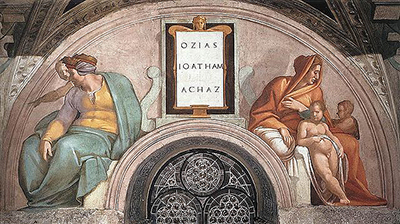
Uzziah, Jotham and Ahaz
In the field titled Uzziah, Jotham and Ahaz, the tablet divides two sharply contrasting groups.[7]
On one side, a seated figure in green and yellow turns away beneath the curve. On the other, a warm orange-red family grouping gathers around children.
The Vatican records a traditional identification of the man on the left as Jotham with his son Ahaz.[7] “Traditional” remains necessary.
Rapid brushwork in secondary figures demonstrates Michelangelo adjusting resolution to height and importance.[7]
The strongest visual fact is not which body matches which name, but how separate households coexist around one genealogical marker.
Rehoboam and Abijah
A pregnant woman sits in profile on one side of the Rehoboam and Abijah tablet. Her hand and swelling abdomen make generational continuation visible.[9]
Across the window, a youth turns inward with an arm hanging down. A roughly sketched child reaches towards his shoulder.[9]
The field opposes pregnancy and withdrawal, concentrated profile and slackened posture. Colour strengthens the distinction.
No secure method assigns the woman to one tablet name and the youth to the other.
Their contrast is meaningful without forced identity. One body visibly contains a future generation; the other seems absorbed by private fatigue.
Salmon, Boaz and Obed
In this lunette, a woman embraces a swaddled sleeping infant. An elderly man sits opposite, bent in profile over a staff.[10]
The Vatican calls arguments identifying the man as Boaz weak.[10] That frank qualification is exemplary.
What can be known visually remains rich: nursing intimacy, age, separation, closed eyes, staff and contrasting orientations.
Earlier retouching concealed the woman’s breast. Conservation removed those additions, making the fresco’s present appearance part of a treatment history.[10]
Restoration recovered a bodily relation; it did not solve the names.
The Josiah, Jechoniah and Shealtiel Spandrel
One triangular group is probably the family of Jechoniah with wife and son Shealtiel, according to the Vatican.[8]
Bodies fit tightly beneath the narrowing field. The proposed family identity follows position and programme, but remains qualified.
This spandrel was completed in two days and used spolvero, the transfer of a full-size cartoon by pricking outlines and pouncing powder through the holes onto fresh plaster.[8]
The technical evidence belongs specifically here. It should not be turned into a rule that every ancestor group used identical preparation or schedule.
Two days can contain extensive prior labour in drawing and cartoon.
The Spandrel above Jesse, David and Solomon
A frontal woman sits with crossed feet and one hand against her cheek. Behind, a man and child emerge from darkness.[11]
The Vatican describes the central figure as enigmatic. Most of the field was painted in one day, apart from a lower corner.[11]
The title locates the triangle above the named lunette; it does not make the woman Jesse, David or Solomon.
Its form determines the arrangement. The frontal body stabilises the widening base while the shadowed pair recedes into a side.
What may look like psychological isolation is also an answer to difficult architecture.
One Day Does Not Mean No Preparation
Fresco is applied to fresh plaster in daily sections known as giornate. A field painted largely in one day required speed once plaster was ready.
That speed does not imply spontaneous invention without drawings. Cartoon transfer, figure studies and colour planning could precede the visible day’s work.
The Josiah spandrel’s spolvero evidence makes the distinction explicit.[8]
Michelangelo could also work more directly in less prominent passages, allowing abbreviated children or transparent strokes to remain.[7][9]
Technical variety answers scale, position and labour rather than one simple evolution from careful to careless.
The Ceiling’s Two Broad Campaigns
Michelangelo signed the contract in May 1508. The first half, extending from the entrance towards the Creation of Eve, was complete by August 1510. The entire ceiling was finished by the end of October 1512 and inaugurated on 1 November.[2][3]
These dates structure the undertaking but do not assign a precise day to every lunette.
The ancestors span an architectural circuit and should not be forced into an exact sequence where evidence does not permit it.
Chronology matters most when it remains proportionate: campaign boundaries are secure; some local giornate are recorded; much intermediate order remains reconstructed.
Colour Returned by Conservation
Modern cleaning challenged the long image of Michelangelo as a sombre colourist. Tests on the Matthan and Eleazar lunette during 1980–84 helped initiate cleaning of the lunettes.[12]
The vault was restored from November 1984 to December 1989, while conservation across the chapel extended from 1979 to 1999.[3][12]
These are connected but distinct spans. Lunettes, vault and Last Judgement did not all undergo one undifferentiated treatment.
Cleaning revealed vivid colour and rapid handling, but it also stimulated debate over what had been removed or recovered.
Conservation is part of how the Ancestors now look, not a neutral erasure of history.
The Two Lost Altar-Wall Lunettes
Fourteen tablet fields survive, but Michelangelo originally painted two more on the altar wall.[12]
They were destroyed when that wall was prepared for the Last Judgement, along with fifteenth-century frescoes and other earlier decoration.[3][12]
Their loss means the current sequence is incomplete. The great later fresco did not simply coexist with the ancestor programme; it replaced part of it.
This destruction was a deliberate transformation of sacred space, not accidental decay.
Any reconstruction of the 1512 chapel must therefore imagine families where the final judgement now commands the altar end.
Not the Lunettes of the Last Judgement
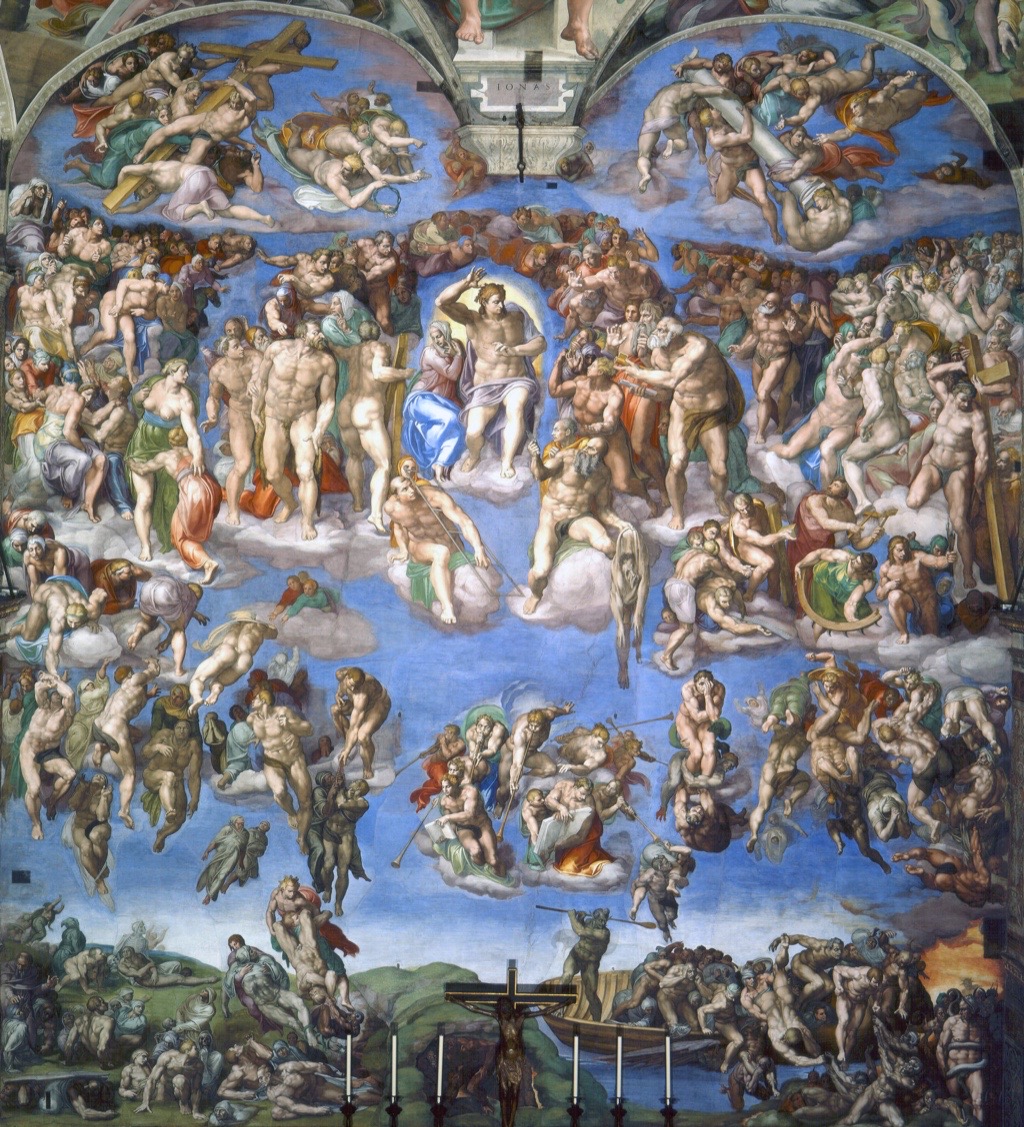
The later Last Judgement, painted between 1536 and 1541, includes two upper lunette-shaped spaces filled with angels carrying instruments of Christ’s Passion.[13]
They share an architectural term with the ancestor lunettes but not subject, date or function.
The Passion instruments belong to the drama of judgement and sacrifice. The families belonged to the genealogy around the earlier ceiling.
Confusing the two cycles obscures Michelangelo’s alteration of the chapel over time.
One artist painted both, but authorship does not make them one programme.
Jewish Genealogy in a Christian Chapel
The Ancestors embody a central Christian claim: Jesus enters history through Israel and the Davidic line.
At the same time, the frescoes were made within a sixteenth-century society that often treated living Jews through exclusion and stereotype. The painted groups should not be romanticised as neutral ethnographic portraits.
Careri’s work draws attention to the tension between Christian appropriation of Jewish ancestry and the figures’ representation as absorbed in ordinary or pre-Christian time.[14]
That tension can deepen looking without assigning prejudice to every weary pose.
The cycle asks how one religious tradition visualises another tradition’s history as its own origin.
Why Anonymity Matters
The inability to name every figure is often treated as a problem awaiting solution. It may also be central to the cycle’s power.
These people occupy sacred history without individual fame. Their lives matter because they transmit humanity, not because each performs a celebrated deed.
Anonymity prevents the groups from becoming a portrait gallery of kings. It makes room for partners, children and generations that written genealogy compresses.
This should not be romanticised as Michelangelo deliberately rejecting names; the evidence does not establish such an intention. But the present visual effect is unmistakable.
Named descent is carried by largely unnamed bodies.
Painted Architecture and Real Windows
The lunettes respond to actual openings while Michelangelo’s painted frames connect them to the fictive structure above.
Tablets sit over window arches like inscriptions embedded in architecture. Figures adapt to curved edges, often bending or turning because the space narrows.
The result blurs building and image. Families appear lodged within the chapel rather than seen through independent rectangular pictures.
Daylight from real windows changes their visibility, while painted shadows make invented bodies seem to inhabit the masonry.
Genealogy becomes part of the chapel’s support system, visually bearing the seers and histories above.
Bonasone’s Engraving
Giulio Bonasone engraved figures flanking the Jesse, David and Solomon tablet after Michelangelo in the sixteenth century.[15]
The print translates colour and fresco scale into a portable network of inked lines. It detaches one architectural group from the surrounding chapel.
Its inscription preserves the genealogical field, but it cannot settle the names of adjacent figures any more than the painted tablet can.[15]
“After Michelangelo” identifies dependence; Michelangelo did not engrave the plate.
The object reveals how the Ancestors circulated to people who could never stand beneath the Sistine vault.
Seeing the Cycle at Several Scales
An overall view reveals position beneath the seers. A complete lunette shows the relationship between tablet and two groups. A close detail exposes hatching, brush speed and touch. A spandrel photograph explains triangular compression.
No single view is sufficient.
Isolation can make an ancestor group resemble a free-standing domestic painting. Excessive distance can reduce individuals to coloured masses.
Michelangelo designed for both local distinction and architectural ensemble. Looking must move between them.
The same principle governs interpretation: close enough to honour a gesture, distant enough not to mistake one body for the whole cycle.
Artist Up Close
The Ancestors show Michelangelo’s genius operating without heroic climax. Their achievement lies in sustained variation across repeated constraints.
Window arches, tablets and tapering triangles could have produced monotony. Instead, he invents different families, colours, tempos and degrees of attention.
He also accepts abbreviation. A secondary child may be a handful of strokes because the field will be seen from far below. Monumentality includes knowing what not to finish equally.
Most movingly, the sculptor of ideal bodies grants sacred history to fatigue. These ancestors carry redemption not by performing miracles but by continuing human life.
Frequently Asked Questions
Discussion
How does the repeated tablet-and-family format turn a written genealogy into a visual sequence?
Reader Insights
What changes when a figure is described through pose and action without being assigned a certain name?
How do the triangular spandrels create a different kind of family group from the broad lunettes?
Why might ordinary actions carry special weight beside the ceiling’s scenes of Creation and catastrophe?
Join the Conversation
What information is lost when one lunette is reproduced without its position in the Chapel?
References
- Vatican Museums, Lunettes—North Wall,, View source.
- Vatican Museums, Sistine Chapel Ceiling,, View source.
- Vatican Museums, Sistine Chapel,, View source.
- Vatican Museums, Spandrels,, View source.
- United States Conference of Catholic Bishops, Matthew, Chapter 1,, View source.
- Vatican Museums, Lunettes—South Wall,, View source.
- Vatican Museums, Lunette Uzziah, Jotham, Ahaz,, View source.
- Vatican Museums, Spandrel of the Lunette Josiah, Jechoniah, Shealtiel,, View source.
- Vatican Museums, Lunette Rehoboam, Abijah,, View source.
- Vatican Museums, Lunette Salmon, Boaz, Obed,, View source.
- Vatican Museums, Spandrel of the Lunette Jesse, David, Solomon,, View source.
- Vatican Museums, The Sistine Chapel Twenty Years Later: New Breath, New Light,, View source.
- Vatican Museums, The Last Judgement,, View source.
- National Gallery of Art, Center for Advanced Study in the Visual Arts, Giovanni Careri, “The Ancestors of Christ: Christians and Jews in the Sistine Chapel,, View source.
- The Metropolitan Museum of Art, The Ancestors of Christ Flanking an Inscribed Tablet,” accession 1980.1140.3,, View source.