 by Tom Gurney
Tom Gurney BSc (Hons) is an art history expert with over 20 years experience
Published on June 19, 2020 / Updated on August 8, 2026
Email: tomgurney1@gmail.com / Phone: +44 7429 011000
Michelangelo’s Awakening Slave
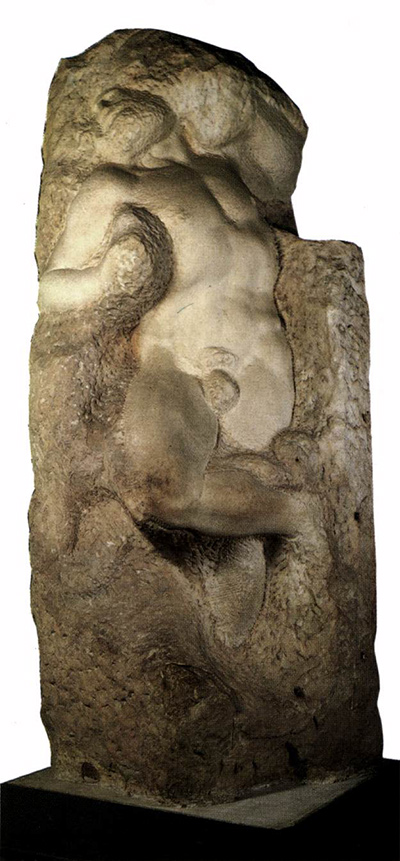
The Awakening Slave has not yet fully become a body. A head turns within the marble, a torso begins to gather itself, and parts of the limbs remain so closely joined to the block that seeing must complete what carving left uncertain. The conventional title makes this partial emergence feel temporal: the figure seems not simply unfinished but in the act of waking.
Michelangelo made the sculpture as one of four Prisoners associated with changing plans for the Tomb of Pope Julius II. The group is broadly dated 1519–1534 and was abandoned after reductions to the commission.[1][2] Now displayed in the Galleria dell’Accademia in Florence, the marble has acquired a second life as one of the most compelling examples of non-finito—the expressive power of incompletion.
Its effect should not be confused with a documented intention. “Awakening” is a persuasive later name, not Michelangelo’s explanation. The project’s disruption accounts for why work stopped, while the surviving stone accounts for why viewers experience that stopping as a drama of creation.
At a Glance
- ArtistMichelangelo Buonarroti
- TitleAwakening Slave or Awakening Prisoner
- Italian namePrigione che si ridesta
- Material and stateUnfinished marble
- Shared datingThe four Florentine figures span about 1519–1534
- Where to see itGalleria dell’Accademia, Florence
- Commissioned contextThe long-running Julius II tomb project
- Companion figuresAtlas, Bearded and Young Slave
- Defining conditionA partially articulated body that appears to turn or rise within the block
- Later historyMichelangelo’s studio; Boboli Gardens; Accademia from 1909
- Final-tomb distinctionNever installed at San Pietro in Vincoli
- Interpretive cautionThe title and idea of spiritual emergence are later readings, not settled iconography
Contents
- The Instant Before a Figure Is Clear
- How the Eye Makes the Figure Move
- One of Four Florence Prisoners
- A Tomb Figure Without a Tomb
- Awakening and Atlas
- The Earlier Slaves in Paris
- What Non-Finito Can and Cannot Explain
- From Studio to Garden to Gallery
- Artist Up Close
The Instant Before a Figure Is Clear
The eye searches the block for anatomy. The head is among the first forms to organise the encounter: its turn suggests attention and gives a direction to the less completely separated body below. The torso is visible enough to imply rotation, but adjoining stone prevents the action from resolving into a stable pose.[1]
This uncertainty is different from the coiled clarity of the Louvre’s Rebellious Slave. There, the limbs and torso are sufficiently complete for struggle to be followed through the body. In Awakening, the struggle is as much perceptual as physical. Viewers repeatedly decide which ridge belongs to muscle, which recess opens space and which mass remains unworked marble.
The title converts that perceptual labour into a story. A figure still joined to stone resembles a person emerging from sleep, when awareness and movement return gradually. The face can seem to wake before the body. Yet the same forms could suggest imprisonment, aborted motion or simply an early carving state.
Michelangelo’s achievement is not dependent on choosing among them. The sculpture’s present force lies in its threshold. Enough is present for the body to command attention; enough is absent for the block to retain competing possibilities.
How the Eye Makes the Figure Move
The sense of awakening occurs over time because the whole body cannot be grasped at once. The eye finds the head, follows a plane into the shoulder, loses a contour in rough stone and recovers another part lower down. Looking repeats emergence.
This sequence differs from viewing a finished nude, whose silhouette immediately separates figure from surrounding space. In Awakening, stone continually returns within the body’s apparent boundary. Perception hesitates between recognising anatomy and noticing material.
That hesitation produces motion without a completed gesture. The sculpture does not need an arm lifted cleanly into space to suggest rising. A directional turn established in the better-defined zones causes the unresolved masses to feel as though they will follow.
The effect is highly sensitive to viewpoint. An angle that aligns ridges can make the torso seem suddenly coherent; a few steps to the side can return it to the block. Modern display permits this oscillation, turning the visitor’s movement into part of the work’s apparent awakening.
Light performs a similar work. Raking illumination catches projecting anatomy while leaving shallow transitions indistinct; softer light allows rough and smooth zones to remain closer in tone. The figure can appear further released or more deeply submerged without the marble changing at all. “Awakening” is therefore partly an event between object, setting and beholder.
One of Four Florence Prisoners
The Accademia identifies Awakening as a marble by Michelangelo and places it within the Prisoners group.[1] Its Atlas record supplies the broad shared history: four sculptures created for Julius II’s mausoleum, left unfinished after the project changed, retained in the artist’s studio, later placed in the Boboli Gardens and moved to the Accademia in 1909.[2]
The names—Atlas, Awakening, Bearded and Young Slave—help distinguish bodies that lack securely documented individual subjects. They record how each work appears now. Atlas bears a heavy upper mass; Awakening seems to stir; the others are differentiated by age and physiognomy.
The four should not be ordered by degree of finish as though they illustrate four consecutive stages of a single statue. The broad 1519–1534 range permits interrupted work, and Michelangelo could develop different zones for different purposes. Visibility of anatomy is not a reliable clock.[2]
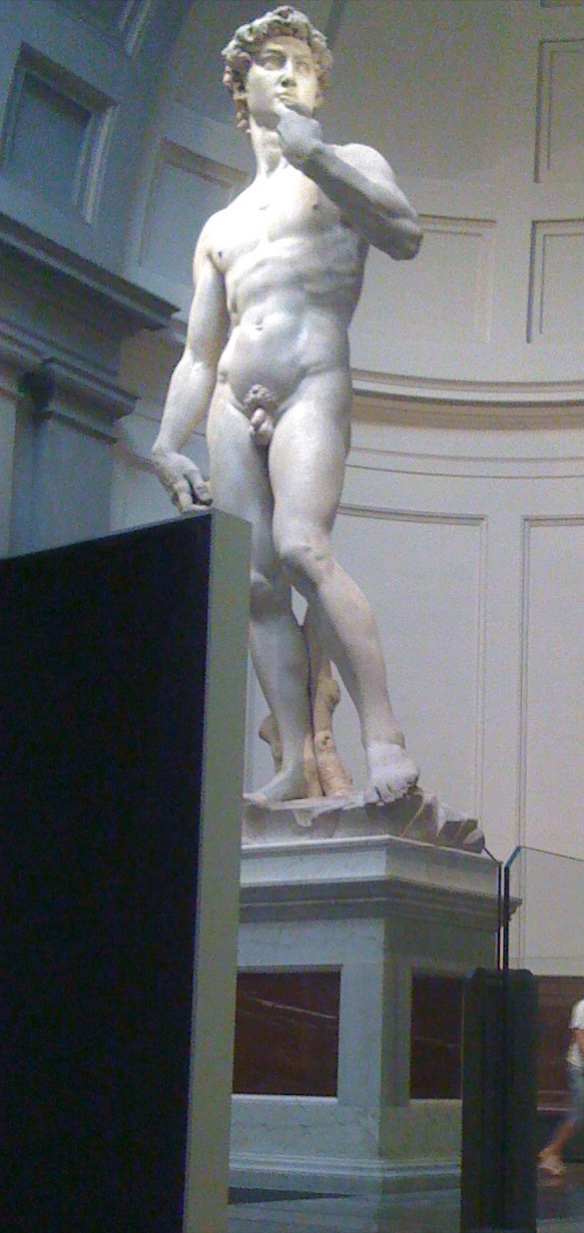
Their present museum line is likewise not an original sequence. The Accademia places the Prisoners along the approach to David, creating an unforgettable movement from embedded bodies toward a finished colossus. That arrangement shapes modern interpretation, but Michelangelo did not design the sculptures as a corridor lesson in his own method.
A Tomb Figure Without a Tomb
The history of Julius II’s monument began in 1505 and extended for about forty years. The Met describes its final, reduced wall structure as unveiled in 1545.[3] Earlier proposals were larger, occupied different kinds of space and included numerous figures that disappeared as contracts changed.
An early design drawing at the Met makes the first ambition visible while also demonstrating the limits of reconstruction: its attribution and exact relation to the lost contract have been debated.[8] Later schemes contain Prisoner-like figures around lower architectural zones, but the precise position of Awakening cannot be fixed from appearance alone.
The Accademia provides the secure boundary. The Florence figures were intended for Julius’s mausoleum and abandoned after reduction.[2] The Awakening Slave is therefore evidence of an unrealised stage, not a statue once installed and removed from the current wall monument.
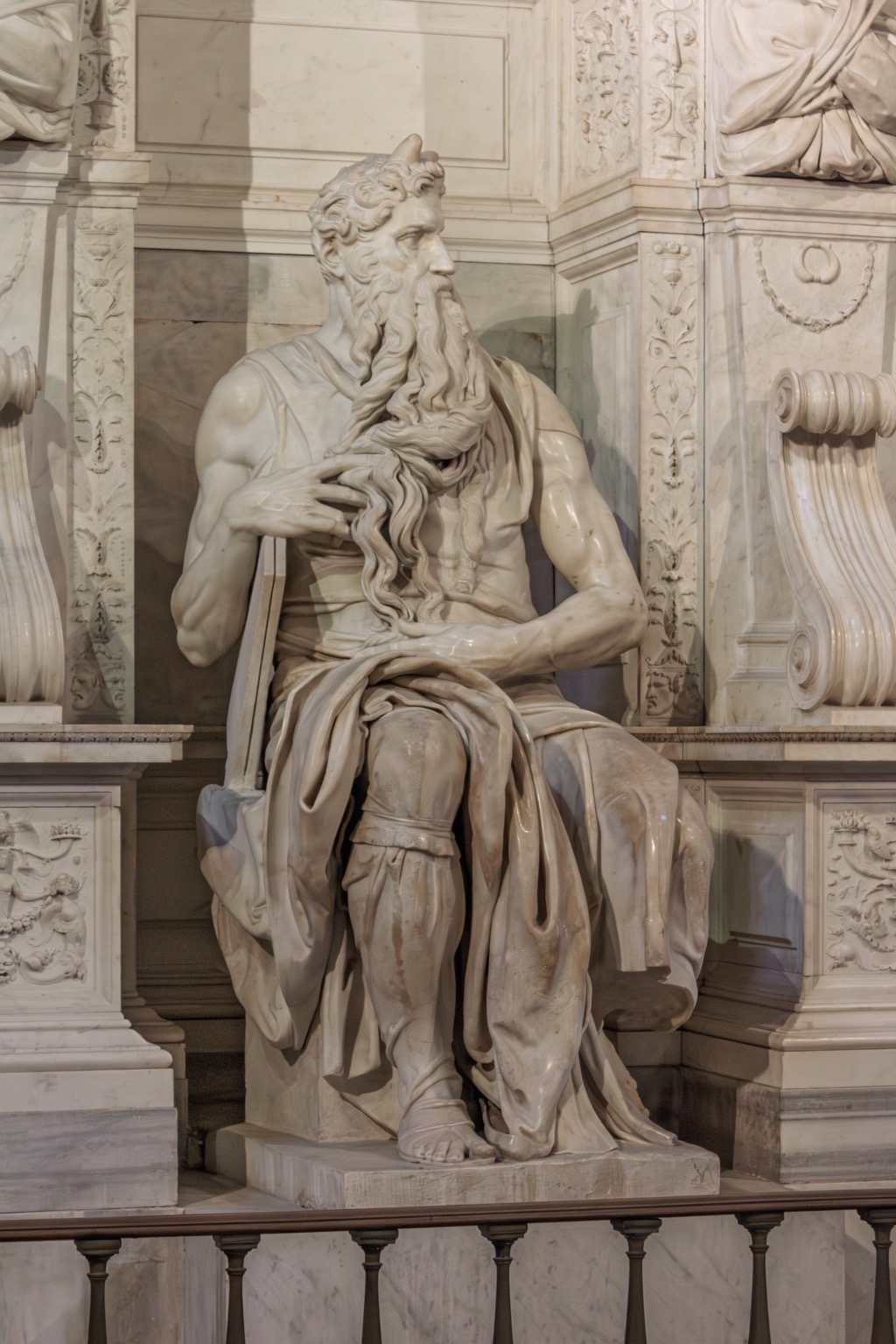
At San Pietro in Vincoli, the completed memorial centres on Moses and contains a different lower programme.[4] Keeping the sites distinct prevents a familiar misconception: the Florence Prisoners are not awaiting return to empty spaces around the Roman prophet.
Architecture nevertheless remains present in Awakening. Its vertical format, compressed depth and partially attached limbs suggest a body conceived in relation to a structural framework. The block is not merely raw stone behind an independent nude; it is the condition through which the nude would have entered a larger rhythm.
Awakening and Atlas
Among the four, Atlas is the closest useful comparison because the Accademia documents its object and shared group history in detail.[2] Both bodies remain deeply involved with their blocks, but the unworked stone acts differently.
In Atlas, the overhead mass reads as a burden. The body appears to brace and compress beneath it. In Awakening, no single block exerts the same downward domination. Stone surrounds and delays the figure, making the action appear incipient rather than weighted.
The distinction reveals how conventional titles influence form. Knowing the name Atlas turns an upper mass into something carried. Knowing Awakening turns incomplete separation into time. Neither title is arbitrary, yet neither is proof of a lost programme.
Together, the sculptures show why non-finito cannot be one effect. Rough stone can read as weight, enclosure, potential, interruption or atmosphere depending on how the emerging anatomy meets it.
The Earlier Slaves in Paris
The Louvre’s Dying Slave and Rebellious Slave belong to a 1513–1515 campaign associated with an earlier reduced tomb.[6][7] Their contours are more completely released and their pairing is organised through opposed actions—yielding and resisting.
The Florence Prisoners are later, more visibly incomplete and differently entangled with marble. They share the broad idea of bound figures made for Julius’s project, but they should not be treated as one unchanged six-statue set. Their proposed architecture and routes into museums differ.
The Louvre’s interpretive account preserves several possible meanings for its Slaves, including captive peoples, mourning arts and the soul bound to matter.[6] Such ideas may inform the wider family, but the Awakening Slave lacks an attribute that proves any one. The apparently emerging body makes a spiritual reading attractive without making it documentary fact.
The comparison also shows how finish affects psychology. In Paris, clear limbs and faces invite viewers to imagine individual states. In Awakening, uncertainty belongs to identity itself. The figure is less a person caught in one emotion than a body becoming available to emotion.
What Non-Finito Can and Cannot Explain
Non-finito describes a work not brought to conventional completion and, in art history, the expressive use or reception of such a state. The term is valuable for Awakening because raw and articulated stone cannot be visually separated. It becomes misleading when it answers every historical question.
The tomb’s reduction offers a documented external reason for abandonment.[2] Michelangelo did not need to decide that the work was aesthetically complete for carving to stop. The lost architectural role may have made further labour pointless.
At the same time, interrupted work can possess qualities no finished version would retain. Tool marks and unremoved mass show the pressure of making. Edges remain provisional. The viewer becomes unusually aware that every smooth surface began as material removed from a block.
The National Gallery of Denmark’s guide distinguishes original objects, casts, facsimiles and reconstructive models in its examination of Michelangelo’s imperfect works.[5] That separation matters because copies can freeze a particular surface state while models can make hypothetical completion look certain. The original marble remains evidence of what was done, not a transparent picture of what would have followed.
The best interpretation therefore joins history and experience. The sculpture is unfinished because the project changed; it is experienced as awakening because Michelangelo had already established bodily direction before work ceased. Later viewers transformed interruption into meaning.
From Studio to Garden to Gallery
After the Prisoners ceased to serve the tomb, they remained in Michelangelo’s studio. Their presence there preserved them but also detached them from the architectural system that had prompted their scale. They later entered the Boboli Gardens, where stone bodies absorbed by rough mass could appear almost native to an outdoor setting.[2]
Their transfer to the Accademia in 1909 created another identity.[2] In a museum devoted strongly to Michelangelo, unfinished surfaces became evidence of genius and process. The group could be studied at close range, compared internally and set against the finish of David.
Each context produces a different Awakening Slave: proposed support within a papal memorial, abandoned workshop object, garden sculpture and modern emblem of creative emergence. The marble has not moved toward one final meaning. Its later settings have accumulated around it.
Specialist tomb scholarship requires contracts, designs, objects and conservation findings to be studied together.[9] That wider record prevents the modern metaphor from erasing the historical commission. It also confirms why the unfinished sculpture deserves attention: it preserves decisions that the final Roman monument cannot show.
Artist Up Close
In Awakening, Michelangelo establishes motion before completing anatomy. A slight turn of the head and the directional pressure of the torso are enough to make surrounding stone feel obstructive. The body does not need a finished contour to acquire agency.
This is a remarkable inversion of ordinary sculpture. Instead of judging the rough passages only by what they lack, the viewer feels how much movement has already been made. The work stops, but the action it generated does not.
Frequently Asked Questions
Discussion
How does the Awakening Slave change when seen as an Accademia object rather than a reconstructed tomb figure?
Reader Insights
How does the title Awakening Slave affect the way viewers read the unfinished marble?
What changes when the sculpture is compared with Atlas rather than with the Louvre Slaves?
How should a public page describe non-finito without turning unfinished work into romantic myth?
Join the Conversation
Set the Awakening Slave beside Atlas Slave, the Louvre Slaves and Moses. Which comparison best clarifies the Julius II tomb project?
References
- Galleria dell’Accademia di Firenze, Prigione che si ridesta / Awakening Slave”:, View source.
- Galleria dell’Accademia di Firenze, Atlas”:, View source.
- Metropolitan Museum of Art, Michelangelo: Divine Draftsman and Designer — Exhibition Galleries”:, View source.
- Roma Capitale / Turismo Roma, Michelangelo’s Locations”:, View source.
- National Gallery of Denmark, Michelangelo Imperfect — English Guide:, View source.
- Musée du Louvre, Imprisoned in Stone — The Louvre’s Slaves”:, View source.
- Musée du Louvre, The Dying Slave”:, View source.
- Metropolitan Museum of Art, Design for the Tomb of Pope Julius II della Rovere”:, View source.
- J. Paul Getty Museum / Getty Publications, Michelangelo’s Tomb for Julius II: Genesis and Genius:, View source.