


 by Tom Gurney
Tom Gurney BSc (Hons) is an art history expert with over 20 years experience
Published on June 19, 2020 / Updated on November 6, 2025
Email: tomgurney1@gmail.com / Phone: +44 7429 011000
Michelangelo’s Crouching Boy
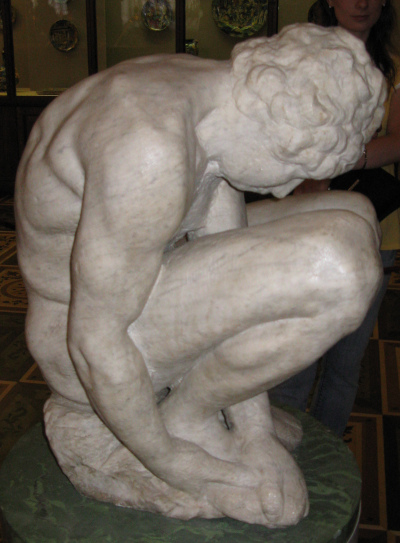
Michelangelo’s Crouching Boy does almost everything by contraction. The nude youth draws his knees toward his chest, bends his head, folds his torso and reaches down toward one foot. At only about 54 centimetres high, he occupies little physical space. Yet the posture makes the body feel extraordinarily dense, as though its energy has been packed into a form that cannot unfold.
The marble is held by the State Hermitage Museum in Saint Petersburg and is generally dated to Michelangelo’s last Florentine period, about 1530–1534.[1] It is unfinished, connected by many scholars with the evolving plans for the Medici tombs in the New Sacristy of San Lorenzo, and still uncertain in function. Even the action is open to question. The boy may be attending to his foot, perhaps in distant recollection of the antique thorn-puller known as the Spinario; he may be mourning; or his inward posture may matter more than any recoverable anecdote.
That uncertainty is not a defect to be repaired. It is the condition under which the sculpture survives: a small body without an established place, attribute or completed surface, compelling because Michelangelo—or possibly an assistant working from his design—made enclosure itself expressive.
At a Glance
- ArtistMichelangelo Buonarroti, with a workshop qualification raised in recent scholarship
- TitleCrouching Boy; also called Crouching Youth
- DateAbout 1530–1534
- MediumMarble
- HeightApproximately 54 centimetres
- Current locationState Hermitage Museum, Saint Petersburg
- Likely projectUsually associated with an unrealised part of the Medici Chapel tomb programme
- StateUnfinished
- ActionThe youth bends toward his foot; a specific thorn-pulling action is possible but unconfirmed
- Attribution cautionThe Hermitage presents the work as Michelangelo; the 2025 SMK exhibition guide suggests that unusual chisel marks may indicate carving by an assistant after Michelangelo’s model
- Provenance landmarkAcquired by Catherine II with John Lyde-Brown’s sculpture collection in 1785
Contents
- A Body Folded into Itself
- What Is the Boy Doing?
- The Medici Chapel Connection
- Unfinished Marble and the Evidence of Tools
- Was It Carved Entirely by Michelangelo?
- Looking from Every Side
- From Florence to Saint Petersburg
- A Different Kind of Michelangelesque Body
- Why Crouching Boy Matters
A Body Folded into Itself
The sculpture is difficult to understand from one outline because every part turns into another. The back slopes toward the lowered head. One thigh rises steeply beside the torso; the other leg bends beneath or across the body. Arms descend between the compressed forms, while the hands approach the foot. No limb offers the open extension familiar from David, the Dying Slave or the standing saints.
This withdrawal gives the figure an unusual relation to the viewer. Monumental sculpture often meets public space through a commanding stance, a projected arm or an outward gaze. Crouching Boy does none of these things. He does not address us. His action, whatever it is, has brought his attention into a small zone near the ground.
The result is private without becoming delicate. Michelangelo’s understanding of the body makes the back, shoulders and thighs carry real weight. The pose is not a decorative curl. It asks how a muscular figure occupies space when almost every joint is flexed.
Compression also changes scale. A standing body 54 centimetres high would read readily as a statuette. This body implies a greater height because it must be mentally unfolded. The viewer senses the limbs that have been gathered together and the vertical figure they could become. Small dimensions therefore contain the idea of enlargement.
That potential is held in check by the head. Lowered between shoulder and knee, it prevents the body from opening psychologically as well as physically. The figure is present as mass but absent as a face.
What Is the Boy Doing?
The most literal reading is that he is examining or treating his foot. This has encouraged comparison with the ancient Spinario, the celebrated image of a seated youth removing a thorn. Michelangelo knew antique sculpture deeply, and the Renaissance recovery of classical poses formed an essential part of his visual education.
But resemblance does not establish a subject. The Spinario sits with one foot raised across the opposite knee and directs both hands toward a visible task. Michelangelo’s youth is more completely folded and does not preserve an unmistakable thorn. If the antique type was in his mind, it has been transformed from a legible action into a denser bodily problem.
Other interpretations connect the figure to mourning. A body bent down and closed off can express grief without tears or theatrical gesture. Within a funerary chapel, such a posture would be appropriate. Designs for the Medici monuments include small crouching figures in parts of the architecture that were never realised, strengthening the association with the New Sacristy.
Still, “mourner” should not be treated as a recovered label. The sculpture has no surviving inscription, contract or documented placement that identifies it. It could have been an attendant figure, a decorative captive, a genius or a formal study whose exact iconography was never fixed.
The safest observation is also the most visually productive: the youth attends to something below him and closes himself against the surrounding world. Whether prompted by pain, work or grief, the posture makes inwardness bodily.
The Medici Chapel Connection
Michelangelo worked on the New Sacristy and its tombs over many years, repeatedly revising their architecture and sculptural population. What survives in San Lorenzo is not the complete fulfilment of one immutable plan. Drawings record alternatives, discarded figures and different arrangements.
Among those proposals are crouching youths associated with upper or lower parts of the tomb architecture. Their compact bodies could occupy spaces where a standing figure would be impractical. This correspondence in date, pose and project makes the Medici Chapel the most persuasive context for the Hermitage marble.[2]
It does not, however, tell us which tomb or position was final. Michelangelo developed monuments for the Medici dukes Lorenzo and Giuliano, while also considering memorials for Lorenzo the Magnificent and his brother Giuliano. The finished chapel concentrates attention on the seated dukes, the four reclining Times of Day and the Madonna with Medici patron saints. Smaller figures visible in preliminary ideas disappeared as the design changed.
If Crouching Boy belonged to this abandoned population, its incompletion becomes historically comprehensible. A figure can cease to be useful before its carving ceases to be promising. Michelangelo’s permanent departure from Florence in 1534 left the chapel itself unfinished and dependent on later installation by others.
The connection also changes the sculpture’s emotional field. In isolation, a youth bending to his foot can seem like a fragment of everyday action. In a tomb programme governed by death, dynastic memory and the passage of time, bodily contraction reads more readily as defeat or mourning. Both experiences remain available because the original position was never secured.
Unfinished Marble and the Evidence of Tools
The surface moves between legible anatomy and rough stone. Broad parts of the torso and limbs have been brought forward clearly, while hands, feet, hair and supporting marble remain less resolved. Chisel marks cross the body. Some transitions are smoothed enough to catch light softly; others preserve the violence of cutting.
It is tempting to describe every unfinished Michelangelo as a deliberate statement about figures imprisoned in stone. His poetry does use carving as a metaphor for bringing a concept out of material, and later viewers have found the visible emergence of form deeply moving. Yet the historical causes of incompletion differ from work to work. A changed commission, interrupted labour, structural problem, departure or rejected design can leave tool marks without making roughness the intended final appearance.
In Crouching Boy, the unfinished state is nevertheless unusually revealing. Because the body turns tightly, the sculptor had to maintain complicated relations between limbs while cutting into a small block. Rough passages show where excess marble still supports or separates forms. More finished passages show how a ridge becomes a shin, a depression separates arm from thigh, and a shift of plane establishes the muscles beside the spine.
The hands are particularly instructive. Their action matters to any interpretation, yet they remain less explicit than the main body. We know the youth reaches toward the foot, but the precise grip or task is not fully articulated. Physical incompletion preserves iconographic incompletion.
The surface therefore does more than demonstrate technique. It keeps meaning unstable. A more fully carved thorn, wound, implement or gesture might have named the action. What survives leaves the body eloquent and the narrative indistinct.
Was It Carved Entirely by Michelangelo?
The Hermitage catalogues Crouching Boy as a work by Michelangelo, and it has long occupied a major place in accounts of his late Florentine sculpture.[1] Its date, compressed bodily invention and connection with Medici Chapel drawings support that position.
Recent research has nevertheless sharpened a workshop question. The digital guide for the 2025 exhibition Michelangelo Imperfect at the National Gallery of Denmark notes that the original surface shows uneven, intersecting hatch marks rather than the more consistently directional chisel strokes associated with Michelangelo. It proposes that an assistant may have carved the figure from his model.[2]
This is not the same as declaring the design unrelated to Michelangelo. Large Renaissance projects depended on workshops, and the New Sacristy employed assistants across architectural carving and installation. Authorship can include different stages: conception, model, blocking out, detailed carving and finishing.
Nor can tool marks answer every question alone. Direction changes with access, posture, stone and phase of work. An unfinished surface may preserve several moments of labour that a polished sculpture would conceal. The Danish guide’s proposal is significant because it names physical evidence, but it remains a scholarly interpretation beside the holding museum’s attribution.
The responsible conclusion is layered. The figure belongs closely to Michelangelo’s Medici Chapel imagination and is accepted by the Hermitage as his sculpture. Whether every surviving cut was made by his hand is less certain. That distinction improves the object’s history; it does not diminish the invention compressed within it.
Looking from Every Side
From the back, the sculpture becomes an account of a spine under pressure. The shoulders round forward, the torso narrows, and the pelvis rises above the compressed seat. Light travels across muscles that are not displayed in a heroic pose but altered by flexion.
From the side, the figure’s construction is clearest. Head, back and thigh form an enclosing arc, while the lower legs and arms create smaller diagonals inside it. The body resembles a knot in which no single limb can be followed without meeting another.
From the front, face and hands remain difficult to command. This frustration is meaningful. The viewer cannot obtain a conventional portrait by moving to the “correct” viewpoint. The boy’s pose keeps his attention withheld.
The unfinished base is active in these views. It can look like a low seat, residual block or ground from which the figure has not fully separated. Because the body is so close to it, stone and anatomy seem to share one compact volume.
This three-dimensional experience distinguishes the work from a drawing of a crouching youth. On paper, overlaps could be clarified or erased. In marble, the sculptor must decide how much stone remains between ankle, hand, calf and thigh, and whether the figure can bear its own weight. The bodily idea is inseparable from engineering.
From Florence to Saint Petersburg
The sculpture’s early movements are not documented with the clarity of a major commissioned monument. By the eighteenth century it belonged to John Lyde-Brown, an English banker and collector who assembled a large body of ancient sculpture during decades of buying in Italy. Renaissance objects entered that predominantly classical collection as well.
Catherine II acquired Lyde-Brown’s collection in 1785. Hermitage collection history records that the sculptures were brought to Russia and initially adorned the imperial residence at Tsarskoye Selo rather than the Hermitage galleries.[3] The Crouching Boy later passed through the Imperial Academy of Fine Arts and entered the museum collection in the nineteenth century.
This provenance placed an unfinished Florentine figure inside a new story of imperial collecting. Removed from the Medici funerary context it may once have served, the boy became evidence of Michelangelo’s hand and eventually a singular national possession—the only sculpture by the artist in Russia.
Its isolation has shaped reception. In Florence, it could be compared directly with the New Sacristy and its abandoned schemes. In Saint Petersburg, it stands as a concentrated encounter with Michelangelo’s sculpture. The distance increases the pressure placed on one small marble to represent a vast career.
It also demonstrates how museum identity can differ from original function. A work perhaps made for a crowded architectural ensemble is now appreciated in the round, under controlled light, as an autonomous object. What was unfinished and unused in one setting became precious in another.
A Different Kind of Michelangelesque Body
Michelangelo is often represented by bodies extended to their limits: David standing alert, the Dying Slave lengthening upward, Adam reaching toward God, Jonah twisting beneath painted architecture. Crouching Boy offers the reverse. Its power lies in how little space a body can occupy without losing vitality.
Comparison with the reclining Times of Day is especially useful. Dawn, Dusk, Day and Night spread across curved sarcophagi, their torsos exposed by unstable poses. The boy gathers the same concern with turning anatomy into a compact, low form. Yet he lacks their allegorical attributes and public scale.
The Florentine Prisoners provide another contrast. Their unfinished marble often appears to hold bodies struggling outward from blocks. Crouching Boy does not simply emerge forward. He turns back into the volume, making the remaining stone seem less like an obstacle than the spatial logic of his posture.
This difference cautions against one universal meaning for Michelangelo’s unfinished work. Roughness can reveal expansion, interruption, retreat or dependence. Here it intensifies enclosure.
Why Crouching Boy Matters
The sculpture matters because it gives formal uncertainty an exact bodily form. We do not know its final destination, fully finished appearance or certain action. Recent scholarship even leaves open how labour was divided between Michelangelo and an assistant. Yet these absences do not make the object empty. They concentrate attention on what can be seen.
A youth has been made to inhabit an extreme pose without losing anatomical credibility. His body communicates inwardness before his face can be read. Tool marks record the negotiation between an idea and a small block. An abandoned funerary scheme survives not through architectural completion but through one displaced, folded figure.
The boy’s scale is essential. He is not a reduced version of a colossus. His compactness makes closeness possible and openness impossible. The viewer circles him, but he continues to look down.
That refusal is the sculpture’s durable achievement. Michelangelo’s most famous figures often dominate their surroundings. Crouching Boy withdraws from them—and holds attention by doing so.
Frequently Asked Questions
Discussion
What details, sources or comparisons stand out to you in Crouching Boy?
Reader Insights
Which formal detail changes how the work reads?
Which documented source or collection history feels most useful?
Which related Michelangelo work should readers compare next?
Join the Conversation
Add a source-led observation, comparison or question for other readers.
References
- State Hermitage Museum, Crouching Boy,” digital collection:, View source.
- Statens Museum for Kunst, Michelangelo Imperfect: Digital Guide, “The Medici Chapel—Crouching Boy,” 2025:, View source.
- State Hermitage Museum, Hermitage Collections (1764–1852)”:, View source.
- Hermitage Foundation UK, The Crouching Boy by Michelangelo”:, View source.
- Statens Museum for Kunst, Michelangelo Imperfect”:, View source.