 by Tom Gurney
Tom Gurney BSc (Hons) is an art history expert with over 20 years experience
Published on June 19, 2020 / Updated on August 8, 2026
Email: tomgurney1@gmail.com / Phone: +44 7429 011000
Michelangelo’s Dying Slave
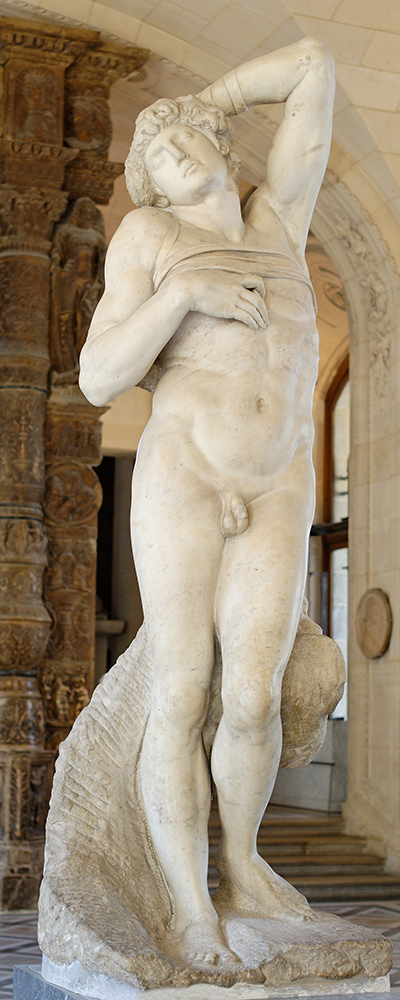
Michelangelo’s Dying Slave does not clearly die. His head falls sideways, one arm rises behind it and the long torso seems to soften, yet his legs remain crossed in an unstable standing pose. A narrow band presses across the chest. The body is caught between support and surrender, consciousness and sleep, tension and release. The famous title supplies a conclusion that the marble itself withholds.
Carved in 1513–1515, the statue was made for a reduced version of the Tomb of Pope Julius II. It was intended for the lower part of the proposed structure but was excluded from the wall monument installed at San Pietro in Vincoli in 1545.[1] Its partner, now called the Rebellious Slave, twists against constraint. Seen together at the Louvre, the pair offer one of Michelangelo’s most arresting contrasts: a body that seems to yield beside one that seems to resist.
Neither response has a securely documented allegorical meaning. The figures have been interpreted as captive provinces, the arts mourning Julius, the human soul bound to matter, or variations on the living body imprisoned in stone.[2] Their incomplete passages encourage such ideas, but altered contracts provide a more immediate historical reason that work stopped. The Dying Slave matters precisely because formal beauty, unfinished process and an abandoned architectural purpose cannot be separated.
At a Glance
- ArtistMichelangelo Buonarroti
- TitleDying Slave; also known within the broader group as a Prisoner
- Date1513–1515
- MediumMarble
- CommissionTomb of Pope Julius II
- Proposed roleA figure for the lower part of the reduced tomb project following Julius’s death
- Current locationMusée du Louvre, Paris
- CompanionRebellious Slave
- Final-tomb distinctionNeither Louvre figure was installed in the monument completed in Rome in 1545
- Visible restraintA carved band crosses the upper torso
- StateHighly developed but not uniformly finished
- Title cautionThe present name does not prove a literal death scene
- Interpretive cautionProposed allegories remain possibilities, not documented instructions from Michelangelo
Contents
- A Body Without a Settled Action
- The Band Across the Chest
- Made for Julius II’s Tomb
- The Louvre Pair
- Surface, Finish and the Temptation of Non-Finito
- What Might the Figure Mean?
- From Gift to Museum Masterpiece
- Artist Up Close
Annotated Details from the Dying Slave
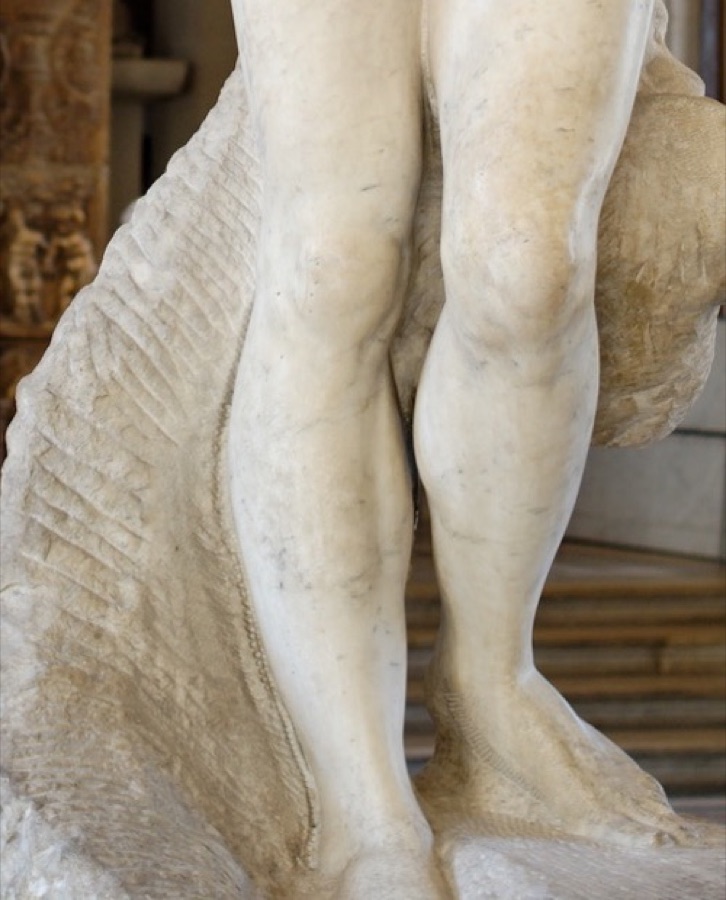
The annotated view follows the marble’s inward rhythm from the raised arm and head through the torso, binding and lower support. The approved image remains source-led and its source note is recorded in the references.[9]
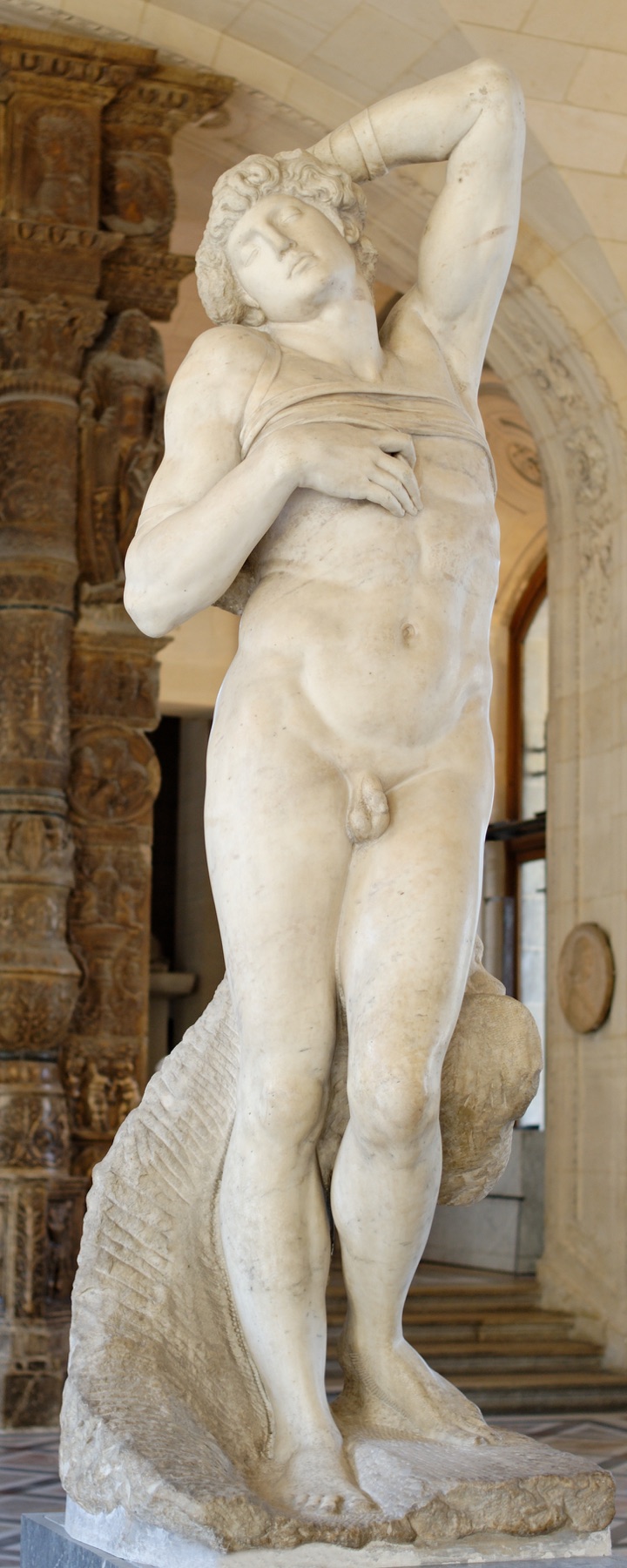
Details from THE DYING SLAVE
Close looking highlights the figure’s raised arm, turning torso and bound lower body while keeping source and rights notes in the references.
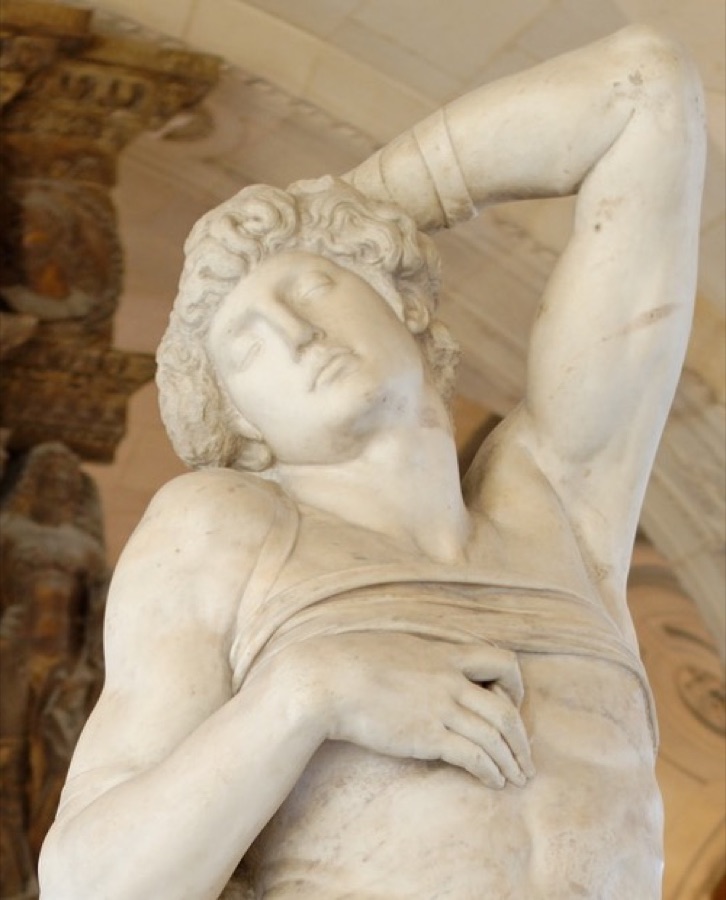
Head and raised arm
The tilted head and raised arm give the figure its suspended, inward-looking movement.
Torso
The torso turns softly, contrasting with the more forceful strain of the paired Rebellious Slave.
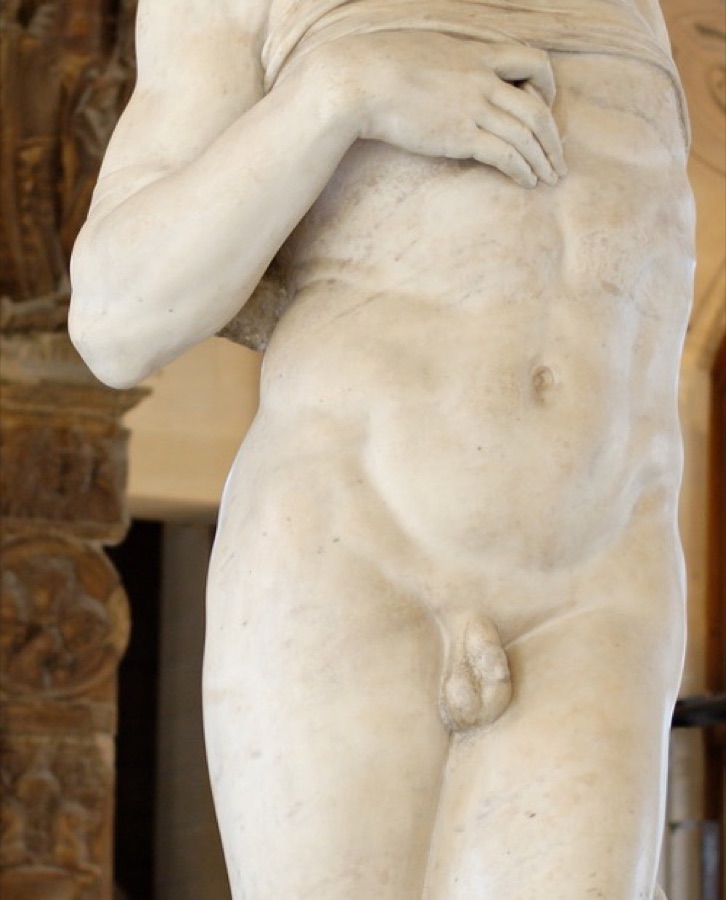
Binding and drapery
The binding and drapery keep the title’s sense of captivity visible without forcing one settled interpretation.
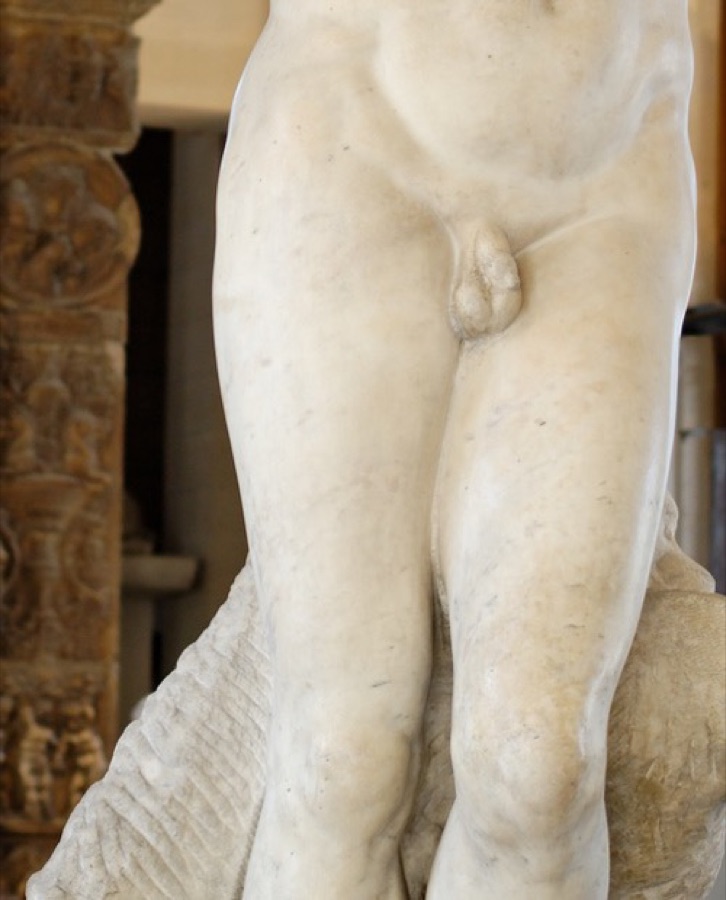
Legs and support
The lower body and support clarify how the statue balances surrender, weight and unfinished project history.
A Body Without a Settled Action
The pose is built from a chain of opposing movements. The left arm bends upward and passes behind the head. The head tilts toward the raised arm, closing the space between cheek and shoulder. The other arm descends closer to the torso, while the chest opens and the hips turn. Below, the legs cross so that the body’s apparent relaxation depends on a precarious base.
From the front, the silhouette rises in a slow curve from the weight-bearing leg through the hip, side and lifted elbow. The opposite edge contracts more sharply. Michelangelo uses contrapposto—the unequal distribution of weight familiar from ancient sculpture—but pushes it beyond calm balance. The figure seems simultaneously upright and in danger of folding.
The title encourages the drooping head and closed or lowered eyes to be read as death. Other associations are possible. The raised arm can suggest waking from sleep, stretching, ecstatic abandon or the bodily vulnerability of exposure. The face is not contorted by pain. The mouth and brow remain comparatively quiet, so the strongest drama occurs through the torso’s long transition from expansion to slackness.
This ambiguity is not a puzzle with one lost answer. It is the sculpture’s operating condition. Michelangelo gives enough bodily information to make change feel imminent, but not enough narrative setting to name its cause. The figure has no wound, weapon, executioner or supporting story. What happens is internal to posture.
The Band Across the Chest
A narrow carved band crosses the upper body and passes beneath the arm. It identifies the figure as constrained even though the restraint is slight beside the mass of the nude.[2] The body could break it easily if physical realism were the only concern. Its importance is symbolic and compositional.
The band interrupts the broad surface of the chest. It creates a line against which the torso’s expansion can be measured and connects this seemingly languid body to the more visibly struggling Rebellious Slave. Both figures are bound, but one appears to spend force against captivity while the other permits force to drain away.
The distinction should not be made absolute. The Dying Slave still requires muscular activity to remain standing, and the Rebellious Slave is held in a pose that can never complete escape. The pair are not simple emblems labelled surrender and resistance. Each contains the other condition.
Their familiar names are later frames. Italian discussion often groups these sculptures as Prigioni, Prisoners, while English usage commonly calls them Slaves.[2] Neither term fixes their status as literal captives from a particular campaign. Naming helps viewers remember their difference, but can also disguise the absence of securely identified individual subjects.
Made for Julius II’s Tomb
The history begins with Pope Julius II’s vast funerary commission of 1505. Michelangelo’s first proposals for St Peter’s imagined a structure much larger than the memorial eventually built. Because the first contract is lost, drawings and later descriptions must be used carefully; even an important early sheet at the Metropolitan Museum has a debated attribution history and does not settle every feature of the original design.[4]
After Julius died in 1513, Michelangelo entered a new agreement for a reduced tomb. The Louvre dates the Dying Slave to 1513–1515 and places it in the lower part of the disposition associated with that second project.[1] The statue was therefore conceived as an architectural figure, one of a repeated group that would animate the base and support a larger hierarchy above.
That original relation is difficult to recover in a museum. A lower placement would have made viewers look upward, strengthened the vertical line of the body and placed the figure against piers, niches or projecting mouldings. Repetition with other bound nudes would have made it less an isolated personality and more one term in an encompassing programme.
Drawn reconstructions and exhibition models can make such relations easier to imagine, but they must retain their labels. The National Gallery of Denmark’s study of Michelangelo deliberately distinguishes original sheets from copies, casts, facsimiles and modern reconstructions.[5] Each can preserve useful evidence; none restores the lost setting without interpretation.
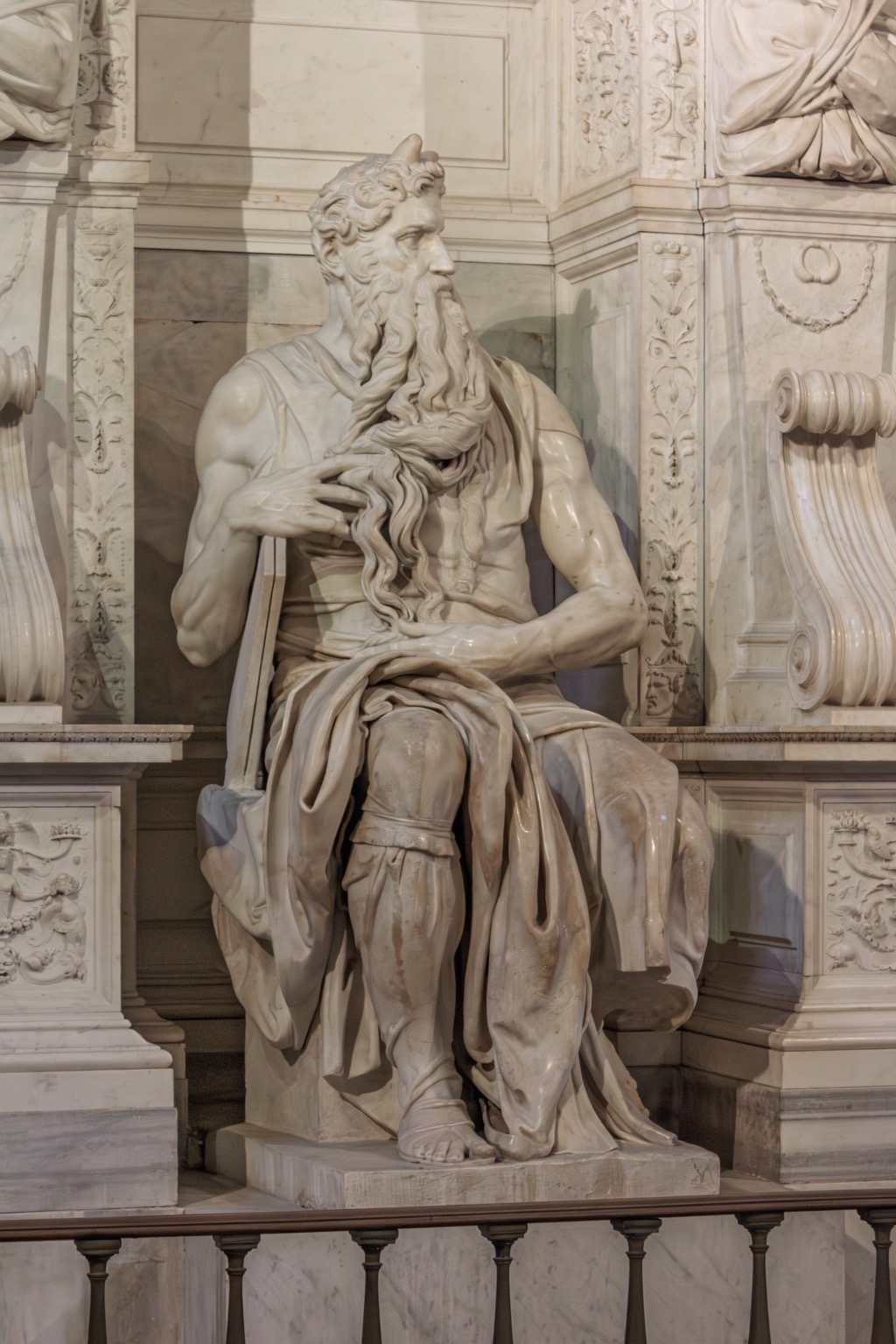
The tomb continued to change for approximately forty years. Drawings and figure studies were especially intense during its first two decades, while contracts, responsibilities and architectural schemes shifted repeatedly.[3] The monument unveiled in February 1545 at San Pietro in Vincoli was a two-level wall ensemble centred on Moses.[3][8] The Louvre Slaves were not omitted from that structure because they had once stood there and were later removed. They belonged to a proposal that was superseded before installation.
This boundary protects both works. Moses should not be shown as though the Dying Slave still flanks it in Rome, and the Paris marble should not be treated as a broken fragment whose only meaning lies in an absent niche. Its displacement generated a new, independent history.
The Louvre Pair
The Dying Slave and Rebellious Slave sharpen each other’s effects. One lengthens and opens; the other contracts and twists. One seems to relinquish conscious control; the other appears to gather every part of the body against restraint. Their opposing motions may have helped energise alternating positions along a monumental base.[2]
The comparison also reveals that “captivity” need not look uniform. Michelangelo could use the bound nude to explore multiple states rather than repeat one formula. The bands are common signs, but differences of axis, finish and muscular engagement give each figure a distinct temporal pressure.
From the Dying Slave’s raised elbow, the eye travels down the exposed side to the hip and crossed legs. From the Rebellious Slave’s compressed shoulder and turned head, movement folds inward. The pair organise space as much as emotion. They could answer architectural uprights while keeping the human body in restless dialogue with them.
Their present all-around display changes that purpose. Visitors can walk behind and beside the figures, discovering support and incompletely resolved passages that an original architectural position might have hidden. Museum space liberates the statues physically while preserving the idea of their bondage in their titles.
Surface, Finish and the Temptation of Non-Finito
The front of the Dying Slave is highly developed. The chest, abdomen, thighs and face pass through carefully modulated surfaces. Hair, band and flesh are differentiated through the depth and direction of carving. Elsewhere the transition between figure, support and block remains more evident.[1][2]
This variation makes the statue valuable evidence of process. Michelangelo established the body in relation to the marble, bringing some zones toward finish while leaving others subordinate or unresolved. Yet visible incompletion does not by itself tell us why the work stopped.
Modern admiration for Michelangelo’s non-finito often treats roughness as a deliberate philosophical statement: the figure struggles to escape the stone, or the artist leaves creation perpetually in motion. Such readings are particularly compelling with the four Florence Prisoners, whose bodies remain embedded in massive blocks. The Galleria dell’Accademia dates that later group broadly between 1519 and 1534 and connects its abandonment to reductions in the Julius monument.[6]
The Louvre pair differ. They are far closer to a finished appearance, and their proposed role belonged to an earlier post-1513 phase. Comparing all six figures illuminates Michelangelo’s carving and the project’s transformations, but it should not flatten them into one deliberately unfinished series.
An altered commission is a sufficient historical reason for uneven completion. If the architecture no longer required a statue, further polishing could waste time and remove useful stone. Some rough passages may also have been positioned away from the principal viewpoint or expected to receive workshop attention. Intention has to be argued zone by zone, not inferred from every tool mark.
What Might the Figure Mean?
No consensus securely identifies what the bound nudes represented. The Louvre presents several traditions of interpretation: defeated peoples under Julius’s authority, the liberal arts grieving the death of their patron, the soul held by matter, or broader images of captivity.[2]
Each possibility emphasises a different part of the commission. Captive provinces would connect the bodies to Julius’s military identity and ancient triumphal imagery. Mourning arts would honour his cultural patronage. Soul and matter would transform physical bondage into a spiritual condition. The tomb’s hierarchy may have allowed political, commemorative and philosophical associations to overlap.
The body itself does not decide among them. The band signals constraint, but there is no attribute identifying Painting, Architecture or a named territory. The apparent sleep or death may support a funerary reading, yet the title cannot be projected backward as proof.
Michelangelo’s sculptural language made this openness possible. The male nude could carry beauty, subjection, force and vulnerability simultaneously. Because the figure’s condition is expressed through the whole body rather than one explanatory object, it remains available to changing intellectual frameworks.
The safest conclusion is not that the sculpture has no meaning. It is that its meaning was relational. Repeated bound bodies within a lost architectural programme would have acquired significance from the pope’s effigy, the figures above them and their rhythm around the base. Isolation magnifies individual psychology while weakening that original syntax.
From Gift to Museum Masterpiece
Michelangelo gave the two Slaves to Roberto Strozzi after they had fallen out of the tomb project. They later entered France and eventually the Louvre.[1][2] This transfer was not a footnote. It converted commission work into a gift and made the statues mobile across courts and collections.
In Paris, the Dying Slave could be admired as an autonomous nude. Viewers no longer needed to reconstruct a papal monument before responding to its elongated body, sensuous surface and enigmatic abandon. The title and museum setting encouraged biography and psychology to replace programme.
Its changing ownership also separated the statue from the contractual disputes that had made it. What began as one element in an obligation to Julius’s heirs became an object capable of carrying honour between private individuals, royal collections and a public museum. The body stayed materially the same while its social function was repeatedly rewritten.
That afterlife helped create the sculpture known today. Its original failure to reach the tomb became the condition of its visibility in the round. An abandoned architectural figure became one of the Louvre’s best-known works by Michelangelo.
The change should not be romanticised as liberation alone. Removal also stripped away relationships that might have clarified scale and purpose. We now possess extraordinary access to the body but incomplete access to the system that first gave it meaning.
Specialist scholarship continues to bring drawings, contracts, restoration findings and sculptures together. The Getty publication on Julius II’s tomb describes precisely this broad evidence base.[7] Its catalogue entry establishes the need for such synthesis without turning a publisher’s description into proof of every detailed reconstruction.
Artist Up Close
The Dying Slave shows Michelangelo making emotional ambiguity from structural clarity. The raised arm, inclined head, rotated hips and crossed legs can all be described precisely; what they mean remains unstable. This is not vagueness. It is a controlled gap between the facts of a pose and the story a viewer tells about them.
The sculpture also reveals how deeply Michelangelo’s bodies depended on architecture. Even in the Louvre, the figure keeps the memory of an upright frame: its long axis, alternating limbs and shallow band suggest a body designed to animate a repeated lower order. The museum allows it to stand alone, but the tomb survives as pressure within its form.
Frequently Asked Questions
Discussion
How does the Dying Slave change when seen as a Louvre object rather than as part of a reconstructed tomb?
Reader Insights
How does the sculpture's meaning change when it is seen as a Louvre object rather than part of a reconstructed tomb?
What is gained and lost by calling the figure a Slave instead of a Prisoner?
How should public pages distinguish unfinished carving from an unfinished project?
Join the Conversation
Set the Dying Slave beside the Rebellious Slave, the Florence Prisoners and Moses. Which comparison clarifies the tomb project most?
References
- Musée du Louvre, The Dying Slave”:, View source.
- Musée du Louvre, Imprisoned in Stone — The Louvre’s Slaves”:, View source.
- Metropolitan Museum of Art, Michelangelo: Divine Draftsman and Designer — Exhibition Galleries”:, View source.
- Metropolitan Museum of Art, Design for the Tomb of Pope Julius II della Rovere”:, View source.
- National Gallery of Denmark, Michelangelo Imperfect — English Guide:, View source.
- Galleria dell’Accademia di Firenze, Atlas”:, View source.
- J. Paul Getty Museum / Getty Publications, Michelangelo’s Tomb for Julius II: Genesis and Genius:, View source.
- Roma Capitale / Turismo Roma, Michelangelo’s Locations”:, View source.
- Annotated image source: Michelangelo, The Dying Slave, c.1513–1515, Louvre, Paris. Page-ready image and detail crops prepared from Tom’s approved public-domain candidate, with object identity anchored to the Louvre collection record above. Crops preserve the approved source-led vertical orientation for overlay review.