 by Tom Gurney
Tom Gurney BSc (Hons) is an art history expert with over 20 years experience
Published on June 19, 2020 / Updated on August 8, 2026
Email: tomgurney1@gmail.com / Phone: +44 7429 011000
Michelangelo’s Bearded Slave
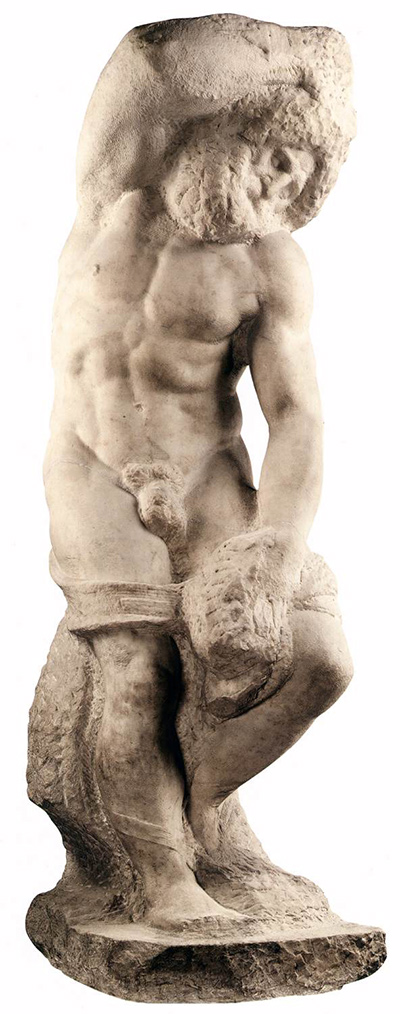
In the Bearded Slave, recognition begins at the face and then becomes uncertain. Beard, features, bent arm and powerful torso have emerged far enough to establish a mature male body, while other passages remain closely joined to the marble block. The figure is neither concealed to the degree of the Awakening Slave nor pressed beneath a dominant mass like Atlas. Its drama lies in the unequal progress of definition.
The sculpture is one of four unfinished Prisoners in the Galleria dell’Accademia in Florence. Michelangelo made the group for changing versions of Pope Julius II’s tomb, broadly between 1519 and 1534. When the programme was reduced, the marbles remained unfinished in his studio.[1][2] The beard supplies a convenient modern title; it does not identify a documented person or allegory.
At a Glance
- ArtistMichelangelo Buonarroti
- TitleBearded Slave or Bearded Prisoner; Italian Prigione barbuto
- MaterialMarble
- DateWithin the group’s broad 1519–1534 span
- Current locationGalleria dell’Accademia, Florence
- Original projectTomb of Pope Julius II
- GroupThe four Florence Prisoners with Atlas, Awakening and Young Slave
- Defining featureA mature bearded head more clearly distinguished than several surrounding bodily passages
- StateUnfinished after reductions to the tomb project
- Later settingsMichelangelo’s studio, the Boboli Gardens, and the Accademia from 1909
- Title cautionThe beard distinguishes the sculpture but does not secure identity or meaning
Contents
- A Face Emerging Before the Whole Body
- The Title and the Problem of Identity
- A Figure from an Abandoned Tomb Scheme
- Uneven Finish as Evidence
- Maturity, Expression and the Unnamed Captive
- Bearded, Atlas and Awakening
- The Earlier Louvre Pair
- Looking Around the Block
- From Studio to Boboli and the Accademia
- Artist Up Close
A Face Emerging Before the Whole Body
The face gives this Prisoner a degree of individuality that its incomplete body cannot fully support. The beard establishes age and texture; the turn or inclination of the head creates attention; the visible features encourage viewers to imagine a particular emotional condition.[1]
Yet the head does not stand apart like a finished portrait. Its relation to the surrounding stone remains tense. Some contours have been separated, while others merge into rougher masses. The viewer moves continually between human recognition and material obstruction.
The bent arm near the head deepens this concentration. It draws the upper body inward, creating a compact zone in which limb, beard and face interact. The gesture can suggest shielding, waking, effort or confinement, but no external event determines it.
Below, the torso is powerfully developed. Shifts across chest, abdomen and hip carry movement downward even where limbs remain incompletely released. The body does not appear mechanically trapped inside a rectangular shell; it rotates through the block, changing which passages become legible from each viewpoint.
The mature head makes the incompletion poignant. A person seems present before the sculpture has acquired all the physical boundaries by which a person is ordinarily distinguished from space. “Bearded” is a small descriptive fact, but it anchors a large perceptual uncertainty.
The Title and the Problem of Identity
Conventional names help separate the four Florence marbles. Atlas is identified by the load-like block above him, Awakening by apparent incipient movement, Young Slave by youthful character, and Bearded Slave by facial hair. These titles record dominant impressions rather than a lost inventory by Michelangelo.[1][2]
The beard may encourage readings of age, wisdom or captivity endured over time. None is secured by an attribute or contemporary description. The figure could once have participated in a repeated class of bound bodies whose meaning arose collectively rather than through individual names.
“Slave” and “Prisoner” are similarly interpretive. The Italian Prigioni avoids some modern associations of slavery but still describes a condition, not an identity. The sculptures belong to Renaissance traditions of captive figures used in triumphal and commemorative architecture. Their modern titles should not be mistaken for documentary representations of named enslaved people.
The absence of a fixed subject does not empty the work. It directs interpretation toward pose, material and architectural relation. The body can signify constraint before the captive’s precise allegorical category is known.
A Figure from an Abandoned Tomb Scheme
Julius II commissioned Michelangelo in 1505 to create a vast funerary monument associated with St Peter’s. The undertaking continued for about forty years and concluded in a far smaller wall structure unveiled in 1545.[3] Its contracts, site and sculptural programme changed repeatedly.
The four Florence Prisoners belong to later work than the two Slaves in the Louvre. The Accademia dates the group across 1519–1534 and says it was abandoned following reductions.[2] This broad range acknowledges that carving may have started, stopped and resumed across different agreements.
An early design at the Metropolitan Museum reveals the project’s ambition while also warning against false certainty: the first contract is lost, the sheet’s attribution has been debated and later descriptions do not yield one unquestioned reconstruction.[8] The exact intended position of the Bearded Slave therefore remains open.
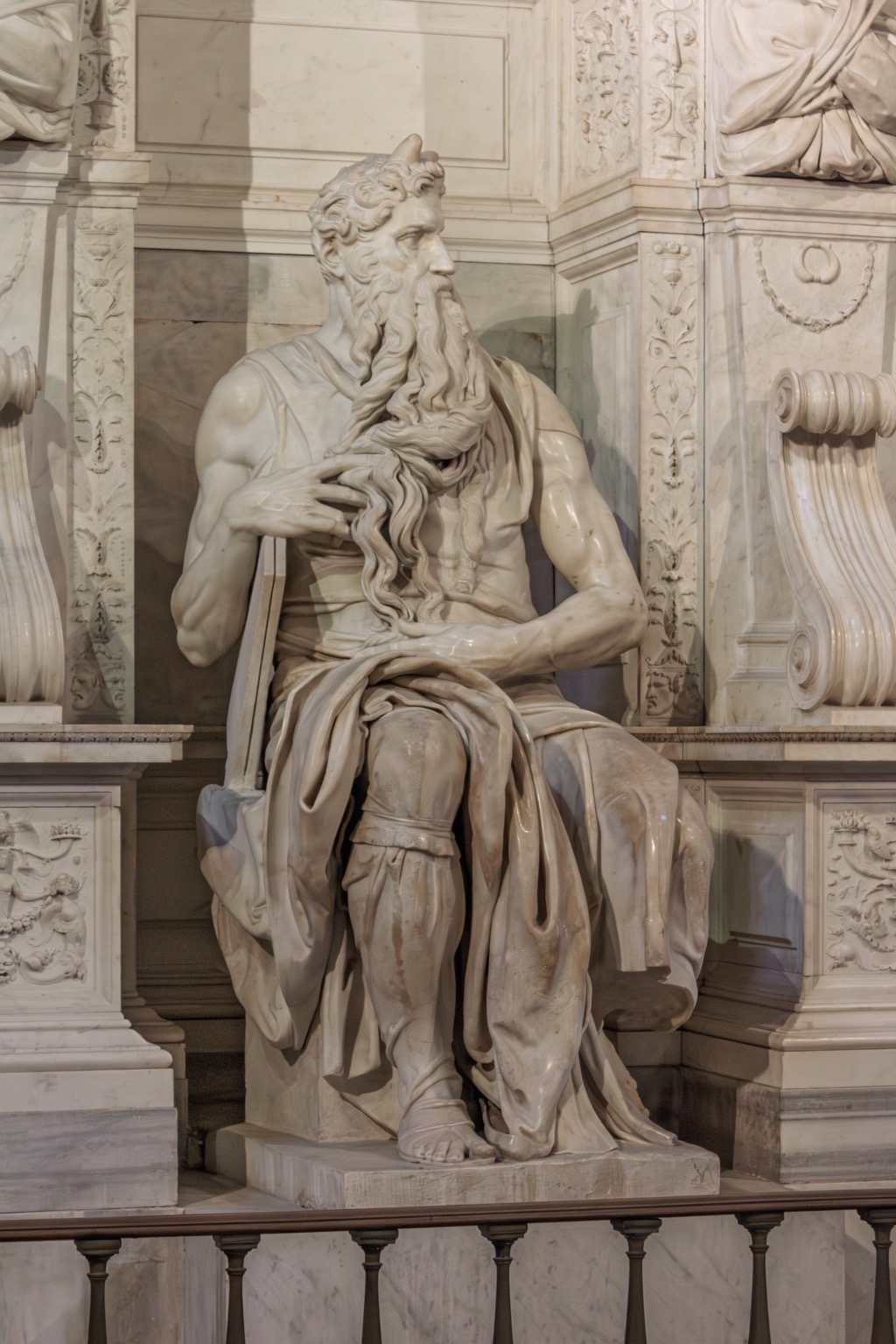
The final monument at San Pietro in Vincoli is a separate solution centred on Moses.[4] The Bearded Slave never stood there. Its bodily relation to architecture must be inferred cautiously from project drawings and its vertical, partly attached form rather than from an empty niche in the surviving wall tomb.
Uneven Finish as Evidence
The sculpture’s surface does not progress uniformly from rough block to polished skin. Some anatomical passages are sufficiently articulated to show tension and direction. Others retain tool traces, shallow transitions or broad masses that have not become a complete contour.
This unevenness can reveal priorities. Establishing the head and principal torso may have allowed Michelangelo to test identity, pose and projection before committing to vulnerable limbs or deep cut-outs. It can also record interruption: once the figure lost its place in the architecture, finishing every zone ceased to serve the commission.
The concept of non-finito describes the extraordinary expressive force such incomplete work has acquired. The body appears to struggle with its own substance, making carving look like liberation. But no rough passage proves that Michelangelo selected the surviving state as a final philosophical statement.
The National Gallery of Denmark’s study of incomplete Michelangelo material distinguishes originals, casts, facsimiles and reconstructive models.[5] That evidence discipline is essential. A cast freezes a surface; a reconstruction proposes context; neither can reveal with certainty how the missing work would have proceeded.
The original marble preserves several temporal layers together. Quarry mass, first blocking, developing anatomy and more resolved features remain visible at once. Viewers encounter not a linear tutorial but a work in which different decisions stopped at different depths.
Maturity, Expression and the Unnamed Captive
Facial hair carries a long history in Western art. It can indicate age, wisdom, foreignness, authority, grief or neglect. The Bearded Slave invites several of these associations, but it supplies no attribute to select one. The beard makes him distinct while keeping him anonymous.
That combination may have been useful in a repeated architectural programme. A group of captive bodies gains visual variety when age, pose and physiognomy change, even if the figures belong to one symbolic class. Individuality can animate the whole without turning every member into a named portrait.
The unfinished state makes expression particularly unstable. A fully worked mouth or eye could sharpen an emotion; rough surrounding planes leave the head suspended between exhaustion, concentration and inward withdrawal. Lighting can harden a ridge into a frown or soften it back into material.
The viewer therefore participates in producing character. We read maturity from the beard, agency from the body’s turn and pressure from the enclosing stone. Those observations are strong; the story that joins them remains provisional.
Nothing in the object record identifies an actual sitter, a captured soldier or a self-portrait. Michelangelo’s anatomy is persuasive enough to make a fictional person feel present without requiring a historical name.[1]
Bearded, Atlas and Awakening
Comparison within the Florence group makes each block more specific. Atlas is dominated by weight pressing above the head. Awakening produces motion through a body only partly recoverable from the stone. Bearded gives facial identity unusual authority while much of the figure remains physically unsettled.[1][2]
These differences should not be converted into a chronology. A more finished face does not prove a later date than a rough one. Michelangelo could advance the feature most important to a figure’s orientation or pause work for reasons unrelated to sequence.
The contrasts instead show how unremoved stone can perform different visual roles. It becomes burden in Atlas, latency in Awakening, and an incomplete boundary around emerging maturity in Bearded. One material condition generates distinct experiences.
Their collective display in the Accademia encourages continuous comparison. Walking past the group reveals bodies at different degrees of legibility before the sequence reaches David. This modern arrangement powerfully frames the Prisoners as stages of creation, though it was not Michelangelo’s intended order.[2]
The Earlier Louvre Pair
The Dying and Rebellious Slave in Paris were carved around 1513–1515 for an earlier reduced tomb project.[6][7] Their contours and anatomy are much more fully separated from the block. One seems to yield; the other twists against restraint.
The Florence Prisoners inherit the broad idea of bound bodies but change its material force. In the Louvre, bands provide a visible sign of captivity. In Bearded, stone itself appears to prevent full emergence. The comparison helped later viewers interpret all six sculptures through soul and matter, but it does not prove one continuous allegorical programme.[6]
Nor did the groups share the same afterlife. The Louvre pair left Michelangelo’s possession and entered French collections. The four Florence marbles stayed in his studio, moved to the Boboli Gardens and reached the Accademia in 1909.[2] Display history is part of why their incompletion now seems so central.
The Getty publication on Julius’s monument situates such comparisons within a much larger archive of contracts, drawings, sculpture and modern restoration study.[9] Its scope is a useful caution: no resemblance of pose or surface can by itself assign the Bearded Slave to a precise scheme. Object observation and documentary reconstruction answer related but different questions.
Looking Around the Block
The sculpture resists the expectation that one frontal viewpoint should disclose its finished idea. The clearer head and torso draw attention first, but moving sideways reveals how heavily other forms depend on the block. A contour that appears free can close again where marble thickens behind it.
This alternation gives the work a pulse. The figure seems more complete from one angle and less complete from another. Modern museum access encourages circling, whereas an architectural placement might have privileged a narrower oblique approach.
The back and sides also expose the limits of the liberation metaphor. Michelangelo was not uncovering an equally complete body everywhere at once. He was creating projection and support through irreversible removal, preserving stone where later decisions remained open. The partially freed head is the result of chosen cuts, not merely discovery.
Close range reveals tool marks as directional acts. At ordinary viewing distance they combine into roughness; nearby they show repeated impacts, changing planes and zones of hesitation. This shift from surface effect to labour is one of the unfinished marble’s most valuable experiences.
From Studio to Boboli and the Accademia
When the tomb scheme no longer required the Prisoners, they remained in Michelangelo’s studio. That setting kept unfinished carving within a working environment, where it might represent stored material, an abandoned obligation or a potential resource.[2]
Their later placement in the Boboli Gardens converted them into features of a Medici landscape. Rough stone and partially emergent bodies acquired new resonance in a grotto setting, even though that role had nothing to do with Julius’s funerary programme.
Transfer to the Accademia in 1909 recast the group again.[2] Under museum light, close comparison made tool marks and degrees of finish legible as evidence of Michelangelo’s process. The Bearded Slave became not simply an abandoned tomb figure but an object through which modern audiences imagine artistic creation.
Each setting adds meaning without replacing the previous one. The sculpture is Roman in its original commission, Florentine in its making and preservation, Medicean in its garden afterlife, and modern in the museum encounter.
Artist Up Close
Michelangelo’s selective development of the head demonstrates how little finished anatomy is needed for presence. Beard, facial direction and the nearby arm make a personality seem to inhabit a body whose boundaries remain uncertain.
The work also reverses normal hierarchy. A finished statue encourages viewers to forget the block; Bearded Slave makes material and person compete. Its historical incompletion becomes an enduring act of perception.
Frequently Asked Questions
Discussion
How does the Bearded Slave change when seen as an Accademia object rather than a reconstructed tomb figure?
Reader Insights
How does the bearded head change the way viewers respond to an unfinished figure?
What is lost when the Florence Prisoners are treated as one group rather than as separate sculptures?
How should a public page describe unfinished marble without turning it into a single symbolic code?
Join the Conversation
Set the Bearded Slave beside Atlas Slave, Awakening Slave, the Louvre Slaves and Moses. Which comparison best clarifies the Julius II tomb project?
References
- Galleria dell’Accademia di Firenze, Prigione Barbuto / Bearded Slave”:, View source.
- Galleria dell’Accademia di Firenze, Atlas”:, View source.
- Metropolitan Museum of Art, Michelangelo: Divine Draftsman and Designer — Exhibition Galleries”:, View source.
- Roma Capitale / Turismo Roma, Michelangelo’s Locations”:, View source.
- National Gallery of Denmark, Michelangelo Imperfect — English Guide:, View source.
- Musée du Louvre, Imprisoned in Stone — The Louvre’s Slaves”:, View source.
- Musée du Louvre, The Dying Slave”:, View source.
- Metropolitan Museum of Art, Design for the Tomb of Pope Julius II della Rovere”:, View source.
- J. Paul Getty Museum / Getty Publications, Michelangelo’s Tomb for Julius II: Genesis and Genius:, View source.