


 by Tom Gurney
Tom Gurney BSc (Hons) is an art history expert with over 20 years experience
Published on June 19, 2020 / Updated on November 6, 2025
Email: tomgurney1@gmail.com / Phone: +44 7429 011000
Michelangelo's Lost Hercules
Soon after Lorenzo de' Medici's death, the teenage Michelangelo carved a marble Hercules larger than life. The figure stood in the courtyard of Palazzo Strozzi in Florence, travelled to France in 1529 as a work sought for King Francis I, and was displayed at Fontainebleau. Recorded into the seventeenth century, it later disappeared.
The sculpture is known through biographies, ownership records and images that may preserve parts of its appearance. It should not be reconstructed as though those sources agree on every gesture. What they do establish is already remarkable: before the Vatican Pietà or David, Michelangelo made an ambitious free-standing pagan hero capable of representing Florentine family power and, later, French kingship.
Hercules was an ideal subject for a young sculptor emerging from Medici study of antiquity. His body promised strength, action and the possibility of rivalry with ancient colossi. The sculpture's international afterlife shows how quickly that youthful achievement became political property.
At a Glance
- ArtistMichelangelo Buonarroti
- TitleHercules
- DateAbout 1492–1494
- MediumMarble
- ScaleOver life-size, commonly reported at roughly 2.3 metres high
- First known settingCourtyard of Palazzo Strozzi, Florence
- Florentine ownerStrozzi family
- French transferSold in 1529 through Giovanni Battista della Palla for Francis I
- French locationPalace of Fontainebleau; later associated with the Jardin de l'Étang
- Last secure eraRecorded in seventeenth-century descriptions
- StatusLost
- EvidenceEarly biographies, Strozzi/French records, garden descriptions and debated visual echoes
Contents
- Hercules as a Florentine Hero
- A Monument after Lorenzo's Death
- Between the Centaurs and David
- Palazzo Strozzi
- The 1529 Sale to France
- Fontainebleau
- What Did Hercules Look Like?
- Disappearance
- Why the Lost Hercules Matters
Hercules as a Florentine Hero
Hercules combined ancient myth with civic usefulness. He defeated monsters, completed impossible labours and represented strength governed by virtue. Florence adopted him repeatedly in public and private imagery.
For the Strozzi, one of the city's great families, a monumental Hercules could signal endurance, courage and social power. In a palace courtyard, the nude hero connected domestic lineage with classical culture.
The subject also belonged to Michelangelo's Medici formation. Ancient torsos and mythological reliefs offered models for a body enlarged by action. His Battle of the Centaurs already demonstrated a command of muscular pagan figures in relief; Hercules transferred that ambition into a single figure in the round.
Because the sculpture is lost, its attribute is uncertain. Club and lion skin would identify the hero, while pose could refer to a labour or present him at rest. Sources name Hercules more securely than a particular episode.
The absence of exact iconography should not encourage a generic muscleman. Hercules was legible through a network of bodily, material and symbolic cues. Which Michelangelo chose remains the central visual loss.
A Monument after Lorenzo's Death
Michelangelo is said to have made the Hercules after Lorenzo the Magnificent died in April 1492. The date places it at a break in patronage. The Medici household that had supported his education was changing, and Florence was moving toward political crisis.
An over-life-size marble demanded material, space and a patron able to sustain work. Its existence contradicts any image of the young artist producing only exercises while waiting for Rome. He was already capable of a major independent statue.
The Strozzi connection is significant because the family were powerful rivals within Florentine political life. A work born from Medici-trained skill could enter another palace and acquire another dynastic meaning.
Early biographies use the sculpture as evidence of rapid development. Michelangelo passes from the small faun anecdote and relief carving to a body comparable with ancient heroes. That progression may be narratively tidy, but the recorded palace history confirms a substantial work.
Between the Centaurs and David
The Hercules occupied a crucial scale between Michelangelo's surviving early reliefs and his colossal marble David. The Battle of the Centaurs compresses many nude bodies into a shallow stone field; the Hercules extracted one mythological body and made it answer space from every side.
That transition required more than enlargement. A relief can support projecting limbs against a background. A free-standing figure must carry its weight through feet, legs and any external support while remaining visually active around its full circumference. The block has to be planned so an arm, club or turn does not create structural weakness.
The later David solved these problems at an unprecedented scale and under the constraint of an old, narrow block. Hercules suggests that Michelangelo had already learned how monumental anatomy changes with viewpoint. The missing sculpture therefore removes an important stage from the visible history of his contrapposto.
Comparison should stop at function. David is a biblical civic hero represented before combat; Hercules is an ancient strongman whose specific action is unknown. Their bodies may share ambition without sharing pose.
The early date also changes the usual narrative of Rome as the place where Michelangelo first achieved sculptural maturity. The Vatican Pietà transformed his reputation, but a Florentine palace had already held a marble capable of confronting architecture at greater-than-human scale.
Palazzo Strozzi
Palazzo Strozzi itself was an assertion of family magnificence. Its vast rusticated exterior and ordered courtyard transformed urban residence into a political statement. A large Hercules in the courtyard would meet visitors inside a carefully controlled environment of stone, wealth and antiquity.
Courtyard display allowed the figure to be viewed from multiple sides while architecture framed it. Light moving through arcades would strike marble differently across the day. The human body stood against the palace's geometric masonry.
The figure's precise original position and base are not secured. Later images or descriptions may reflect changes. It is safest to understand the courtyard as the known early setting rather than reconstruct a complete installation.
Ownership also provided protection and vulnerability. The Strozzi name preserved the statue in records, but family politics and exile later made art transferable capital.
The 1529 Sale to France
In 1529 the sculpture was sold on behalf of Filippo Strozzi the Younger to Giovanni Battista della Palla, a Florentine agent who acquired Italian art for Francis I of France.[1] The transfer occurred amid siege, republican struggle and severe political risk in Florence.
Della Palla's activity converted Florentine masterpieces into instruments of royal collecting. Francis sought ancient and modern Italian art to establish a court culture capable of competing with Italy.
The Hercules was an attractive acquisition: monumental, mythological and made by an artist whose fame had expanded through the Pietà, David and Sistine Ceiling. What began as a youthful Florentine palace statue became a royal masterpiece.
Sale and export also altered meaning. Hercules could symbolise French monarchical force as readily as Strozzi identity. Art's physical movement allowed political allegory to be rewritten.
Fontainebleau
At Fontainebleau, Francis I assembled Italian artists and works within a rapidly transformed palace. Michelangelo's Hercules joined an environment associated with Rosso Fiorentino, Primaticcio and the emerging Fontainebleau style.
The sculpture was later connected with a fountain or garden display and, under Henri IV, with the Jardin de l'Étang. A marble hero exposed outdoors would participate in water, planting, axial views and royal leisure.
Garden movement could also damage the sculpture. Weathering, remounting and changing schemes affect even celebrated works. A figure designed for a Florentine courtyard entered successive French installations not controlled by its maker.
A 1642 description still records the Hercules at Fontainebleau.[1] Its presence across more than a century demonstrates sustained prestige.
The statue was not an isolated Italian trophy. Fontainebleau eventually received Michelangelo's painted Leda and, through French collecting, his Slaves entered royal possession. These works arrived by different routes and at different dates, but together they made his bodily inventions available in France before museums assembled a formal national canon.
Hercules was especially suited to this transfer because his strength could be detached from Florentine family politics and attached to monarchy. The same mythological body that magnified the Strozzi could naturalise the power of Francis I and his successors.
What Did Hercules Look Like?
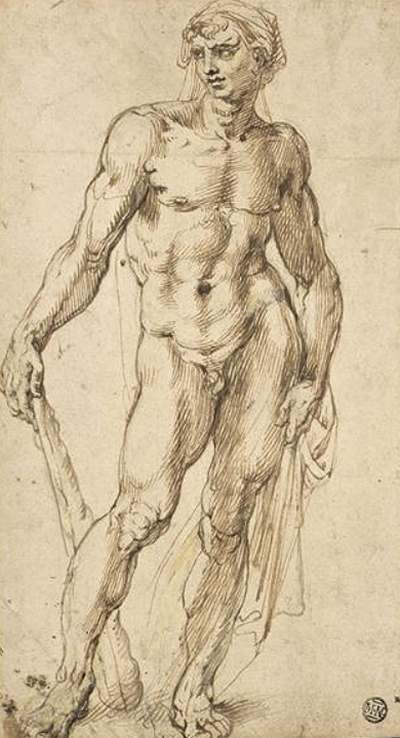
The figure was over life-size and recognisable as Hercules. Beyond those foundations, reconstructions depend on disputed drawings, prints and garden views.
Some images show a nude male hero in dynamic stance and have been proposed as records. But a Michelangelesque Hercules could be copied, reversed, restored or invented after the famous lost statue. Fontainebleau imagery also includes many heroic nudes.
The sculpture may have raised an arm or club, stood over a defeated opponent or concentrated force in a twisting torso. Each possibility changes narrative. No single version should be presented as certain.
Visual restraint is especially necessary because “Hercules by Michelangelo” invites viewers to combine David, the Victory and Sistine bodies mentally. Such synthesis produces an appealing modern fantasy, not evidence.
Disappearance
After seventeenth-century records, the sculpture falls from secure view. Changes to Fontainebleau's gardens, royal building campaigns, weather damage, revolutionary upheaval and dispersal all provide possible contexts.
Marble cannot be melted like bronze, but it can break, be buried, reused in construction or lose identity after severe damage. A fragment without attribute may cease to be recognised as Hercules.
No accepted piece has been recovered. Archaeological claims would need to connect material, scale, findspot and old descriptions. A general Michelangelesque body would not be enough.
The loss removes a major bridge between the adolescent reliefs and the Roman masterpieces. Its scale alone suggests that modern understanding of Michelangelo's early sculpture is materially incomplete.
Why the Lost Hercules Matters
The Hercules matters because it shows Michelangelo working monumentally before his best-known public commissions. He did not discover large-scale bodily invention only with David; an earlier mythological hero had already tested it.
The statue also maps art across political regimes. Medici training produced a Strozzi possession; republican crisis enabled sale; Francis I converted it into French royal culture; later gardens changed its setting again.
Its disappearance teaches a final lesson. Fame does not guarantee survival. A work can be celebrated, recorded and displayed at a royal palace, then vanish as architecture and power change.
What remains is enough to establish importance but not appearance. Michelangelo's Hercules was a large, early marble with a long public life between Florence and Fontainebleau. Its exact body is lost, and that loss should be respected rather than decorated.
Frequently Asked Questions
Discussion
What details, sources or comparisons stand out to you in Hercules?
Reader Insights
Which formal detail changes how the work reads?
Which documented source or collection history feels most useful?
Which related Michelangelo work should readers compare next?
Join the Conversation
Add a source-led observation, comparison or question for other readers.
References
- “Hercule de Michel-Ange à Fontainebleau, Bulletin de la Société nationale des Antiquaires de France (1964/1965):, View source.
- OpenBibArt, Michelangelo's Lost Hercules,” bibliographic record:, View source.
- Giorgio Vasari, Life of Michelangelo Buonarroti,” Lives of the Artists, 1568 edition, in modern critical editions.