


 by Tom Gurney
Tom Gurney BSc (Hons) is an art history expert with over 20 years experience
Published on June 19, 2020 / Updated on August 8, 2026
Email: tomgurney1@gmail.com / Phone: +44 7429 011000
The Genius of Victory by Michelangelo
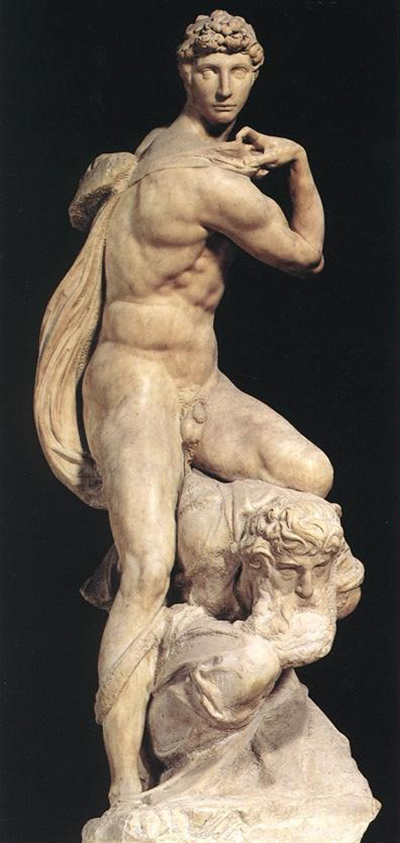
A young man rises over an older captive, yet the act of victory never settles into a simple emblem. The victor’s body spirals away from the figure beneath him; one knee bears down while the torso turns, the head bends, and the marble shifts between resolved flesh and resistant mass. Michelangelo’s Genius of Victory is an image of dominance whose very movement makes dominance unstable.
Now displayed in the Salone dei Cinquecento of Palazzo Vecchio, Florence, the group is generally dated to the 1530s.[1][2] It has often been connected with the long history of Pope Julius II’s tomb, but its intended position and precise programme remain debated. Even its title encourages more certainty than the object can securely bear. “Victory” describes the visible hierarchy of a youthful figure over a subdued older body. It does not hand us a complete allegorical key.
At a Glance
- ArtistMichelangelo Buonarroti
- TitleThe Genius of Victory, often shortened to Victory
- DateGenerally about 1532–1534
- MediumMarble
- FormTwo-figure sculptural group
- SubjectA youthful victor twisting above an older defeated or captive man
- Present locationSalone dei Cinquecento, Palazzo Vecchio, Florence
- StateUnevenly finished, with marked differences between figures and surfaces
- Probable historyFound in Michelangelo’s Florentine studio after his death and transferred into Medici civic display
- Programme cautionFrequently associated with designs for the Tomb of Pope Julius II, but no exact original placement should be treated as settled
- Interpretive cautionThe group can signify victory, domination, youth over age or spiritual conquest; no single reading is securely documented as exhaustive
- Defining formal featureA spiral, or figura serpentinata, that asks to be viewed from several sides
Contents
- A Victory That Turns Away
- Youth Above Age
- The Knee as the Point of Power
- The Unfinished Surface
- Was Victory Made for Julius II’s Tomb?
- A Figure Without a Settled Programme
- The Salone dei Cinquecento
- From Michelangelo’s Studio to Medici Florence
- Looking Around the Sculpture
- Victory and David
- Victory, the Slaves and Moses
- Beauty and Unease
- The Captive as More Than a Base
- Why The Genius of Victory Matters
- Artist Up Close
A Victory That Turns Away
An uncomplicated trophy would present its hierarchy frontally: conqueror above, captive below, both arranged for rapid recognition. Michelangelo complicates that grammar. The younger figure rises, but his torso turns away from the lower body. His head inclines rather than looking outward in triumph. The pose creates ascent without a straightforward proclamation.
This twisting movement is often described through the Italian phrase figura serpentinata, a serpentine figure whose body rotates around an axis. MUS.E’s discussion of Victory supports attention to the group’s spiral character and its importance within Florentine treatments of bodily rotation.[1][3] The term is useful so long as it describes a formal effect rather than substituting for looking.
The turn makes the statue temporal. No single viewpoint reveals every relationship. As the spectator moves, the victorious torso opens and closes, the older body changes from support to opponent, and limbs briefly align before separating. Victory becomes an experience of circling rather than a fixed sign.
Youth Above Age
The age contrast is one of the group’s clearest facts. Above is a smooth, idealised youth; below, a bearded older man bends under pressure. Renaissance allegory frequently used differences of age and bodily type to represent moral or political oppositions. Yet visible contrast does not identify one exclusive opposition.
Youth can suggest beauty, renewal, virtue, strength or the future. Age can suggest defeated experience, vice, tyranny or merely the human cost of conquest. Reversing the moral values is also possible: the youthful victor may appear beautiful but cruel, while the older captive draws sympathy. Michelangelo’s carving permits those reactions because the composition gives bodily dominance without an explanatory inscription.
The lower figure is not inert. His bent body remains large enough to register as a person rather than a pedestal. This is crucial. If he were reduced to an anonymous lump, the victor’s ascent would feel effortless. His remaining presence makes domination physically and ethically weighty.
The Knee as the Point of Power
The encounter concentrates where the youth’s bent leg bears upon the older figure. This point transfers force from one body to another and binds the group structurally. Victory is not represented by distance between winner and loser; it is represented through contact.
From that pressure, the two bodies unfold differently. The captive compresses and turns downward. The youth extends upward, only to curve back across himself. The group therefore combines one material block with two opposed directional systems. The lower body provides resistance, and resistance makes the upper figure’s freedom legible.
Michelangelo understood supports as expressive relationships. A secondary form could stabilise a statue while also carrying narrative meaning. Here, the captive is both subject and structural partner. The composition would lose its spiral force without the body it subdues.
The Unfinished Surface
Different passages reach different levels of completion. Some parts of the youthful body appear comparatively smooth and resolved; other areas, especially around the lower figure and transitions between forms, retain broader working. The unequal surface has encouraged the group’s association with Michelangelo’s non-finito, but it requires the same caution as his other incomplete marbles.
Roughness does not prove a single aesthetic intention. The group’s changing commission history, its possible displacement from a larger programme and its survival in Michelangelo’s studio all offer practical contexts for interrupted work. Nor does every unresolved passage carry equal meaning. Some may reflect access difficulties, supports or the order of carving rather than a wish to dramatise emergence.
The present effect is nevertheless powerful. Smooth youth appears to lift from a coarser, older world. Finish intensifies hierarchy. The victor’s relative clarity may feel like liberation, while the captive remains more continuous with the block. Interpretation can begin from that contrast without claiming that Michelangelo documented it as a philosophical allegory.
Was Victory Made for Julius II’s Tomb?
The group has long been discussed in relation to the Tomb of Pope Julius II. The connection is plausible within Michelangelo’s chronology and the sculpture’s displacement, and substantial scholarship on the tomb’s successive designs keeps Victory within that orbit.[4] The Louvre’s account of the Slaves further demonstrates how sculptures associated with the project could become detached from the final monument.[5]
But “the Tomb of Julius II” was not one stable design. From the vast freestanding monument commissioned in 1505 to the reduced wall tomb completed decades later, scale, figure count, iconography and destination repeatedly changed. Saying that Victory belongs to the tomb project does not automatically determine which phase, niche or symbolic role it occupied.
The final monument in San Pietro in Vincoli has its own coherent, if drastically reduced, form centred on Moses. Victory is not installed there. The safest account therefore describes a likely or traditional association with Michelangelo’s tomb-project world while leaving exact placement open.
A Figure Without a Settled Programme
Allegorical sculpture often gains identity from context. A figure on a tomb may represent virtue conquering vice; in a civic hall it may evoke political dominion; beside other statues it may take meaning from their sequence. Removed from an original programme—or never installed in it—Victory loses those stabilising cues.
Its current title captures the visible action but may conceal the range of possible functions. “Genius” can suggest an attendant spirit or personification, while “Victory” names the ascendancy of one figure. Neither specifies who or what has triumphed.
A broader scholarly account of Michelangelo as draftsman and designer helps frame the body as a vehicle of structural and intellectual pressure.[6] It cannot supply missing iconography. The distinction between formal meaning and historical identification is essential: we can see domination, turning and unequal freedom; we cannot confidently translate them into one lost programme.
The Salone dei Cinquecento
The group’s present setting is one of Florence’s most politically charged interiors. Palazzo Vecchio’s Salone dei Cinquecento was made for large assemblies and reshaped under Medici rule into a theatre of government, history and dynastic authority. MUS.E situates Michelangelo’s sculpture within this civic museum context.[1][2]
In such a room, victory cannot feel politically neutral. The young figure’s ascendancy resonates with surrounding narratives of Florentine power. Yet that resonance belongs partly to later placement. A sculpture conceived in relation to a papal tomb would acquire different associations when installed in a Medici civic hall.
This distinction between origin and reception is not a technicality. Placement produces meaning. The Salone turns the group into an interlocutor within ducal Florence, whether or not Michelangelo initially intended that function. Its history demonstrates how rulers could appropriate an artist’s unresolved work and give it a new public voice.
From Michelangelo’s Studio to Medici Florence
The sculpture remained in Michelangelo’s Florentine studio and entered its major public setting after his death. That passage matters because the artist did not complete an installation that fixes the group’s interpretation. Later custodians and Medici cultural policy helped determine how it would be seen.
A studio object can preserve private working conditions, abandoned plans and unresolved decisions. Once moved into Palazzo Vecchio, those uncertainties become part of a public programme. The marble’s fame and Michelangelo’s authority could serve the prestige of the ruling environment even when the original commission remained unclear.
This afterlife parallels the fate of several sculptures connected with Julius II’s monument. The Louvre Slaves acquired new collection histories far from the tomb, while Florence’s Prisoners entered Medici possession and eventually the Accademia.[5] Michelangelo’s unfinished projects became reservoirs from which later institutions constructed their own narratives.
Looking Around the Sculpture
Begin at the most immediately legible view, where the youth rises above the captive. Note how quickly that clarity erodes when you move. The victor’s chest and back exchange prominence; the older man’s head appears and recedes; the point of knee pressure changes character. No view is merely secondary.
Then compare surfaces. Look for areas where polish makes the youth responsive to light and areas where tool marks break illumination into smaller events. Avoid reducing the lower figure to “unfinished stone.” Identify the bodily decisions already present within him.
Finally examine the silhouette against the room. The extended and folded contours create different shapes as the background changes. A spiralling group is partly designed by the spaces it opens between limbs and bodies, not only by the marble it retains.
Victory and David
Both Victory and David place youthful male beauty in relation to conquest, but they inhabit different psychological and civic worlds. David prepares for combat. Goliath is absent, and tension gathers before the act. In Victory, domination is physically present: one body bears upon another.
The earlier statue’s public identity became closely tied to Florentine republican liberty. The later group entered a Medici setting where victory could serve ducal authority. That contrast should not be exaggerated into a simple political confession by Michelangelo, especially because the group’s intended programme is uncertain. It does show how sculptural meanings change through location.
Form also differs. David creates a commanding principal view while remaining fully freestanding. Victory makes turning itself the subject. The youth’s body cannot be absorbed from one station, and the lower figure continually alters the meaning of his beauty.
Victory, the Slaves and Moses
The most productive tomb comparison concerns different bodily relations to constraint. The Louvre Slaves strain or yield within unfinished marble; Moses sits with contained force in the completed tomb; Victory establishes freedom through an opponent’s subjection. All can be discussed near the Julius project without assigning them one unchanged plan.[4][5]
This family of contrasts helps explain the group’s title. Victory is not simply a raised attribute. It is a distribution of mobility. The young body turns expansively while the old body is compressed. Freedom and confinement occupy the same block.
Yet the comparison must stop before programme certainty. The Slaves have their own disputed functions, and Moses belongs to the final monument. Similar bodily pressures show Michelangelo thinking through related sculptural problems; they do not reconstruct a lost arrangement by themselves.
Beauty and Unease
The youthful figure is beautiful by the standards of Michelangelo’s ideal male bodies: smooth, proportioned and capable of complex motion. But beauty does not make the action gentle. A knee presses into another person, and ascent depends on defeat.
That moral unease prevents the group from becoming empty virtuosity. Viewers may admire the spiral and recoil from its hierarchy. Michelangelo does not resolve the contradiction by making the captive monstrous or the victor transparently virtuous. Allegory remains bodily before it becomes doctrinal.
This ambiguity may help explain the sculpture’s continuing fascination. A fixed symbol can be decoded and left behind. Victory keeps changing as the viewer moves around it and changes ethical position toward what it shows.
The Captive as More Than a Base
It is revealing to imagine the sculpture without the older man. The remaining youth would preserve an elegant twist, but the title Victory would lose its necessary object. Conquest requires someone conquered. The lower body supplies the ethical, narrative and mechanical conditions of the upper figure’s ascent.
Close attention therefore reverses the group’s hierarchy. The eye may first seek the polished youth, yet understanding eventually depends on the less resolved captive. His beard, bent posture and compressed scale create difference; his mass supports the spiral; his continued humanity prevents domination from becoming a weightless abstraction.
This reversal offers a lesson in looking at Michelangelo’s multi-figure sculptures. Secondary does not mean dispensable. A supporting body, child, captive or attendant can control the meaning of the figure granted visual priority. In Victory, the apparent loser is indispensable to the winner’s identity.
His incomplete treatment also slows judgment. Where the youth offers an ideal surface for admiration, the older man makes the spectator work to recover a body from rougher planes. The unequal finish thus reproduces the unequal power of the scene while giving the subdued figure a stubborn material presence that cannot be entirely overcome.
Why The Genius of Victory Matters
The group is a landmark of bodily rotation. Michelangelo turns two figures into one ascending structure, making contact, resistance and viewpoint inseparable. Its influence lies not in a pose that later artists could merely copy, but in the idea that a sculpture can unfold through time as the spectator circles it.
It is equally important as a displaced object. A probable tomb-project association, studio survival and Medici civic display produce multiple contexts rather than one pristine original meaning. The sculpture’s history demonstrates that unfinished works can become politically and aesthetically powerful precisely because later settings reactivate them.
Above all, Victory matters because certainty would make it poorer. We know what the bodies do, where the group now stands and how compellingly it twists. We do not know one final allegorical programme or an indisputable intended position. Michelangelo’s marble thrives in the space between those kinds of knowledge.
Artist Up Close
Michelangelo made Victory in the mature phase of a career burdened by the still-unresolved Tomb of Julius II and transformed by Medici and papal politics. The group combines supreme command of anatomy with an object history he did not finally control. Its serpentine youth helped later artists imagine bodies in complex rotation, while its captivity theme recalls his recurring concern with freedom and stone. Yet the artist left neither a completed installation nor a simple explanation. The work’s authority is visual; its silence is historical.
Frequently Asked Questions
Discussion
What details, sources or comparisons stand out to you in Victory?
Reader Insights
Which formal detail changes how the marble group reads?
Which documented source or collection history feels most useful?
Which related Michelangelo sculpture should readers compare next?
Join the Conversation
Add a source-led observation, comparison or question for other readers.