 by Tom Gurney
Tom Gurney BSc (Hons) is an art history expert with over 20 years experience
Published on June 19, 2020 / Updated on August 8, 2026
Email: tomgurney1@gmail.com / Phone: +44 7429 011000
Michelangelo’s Rebellious Slave
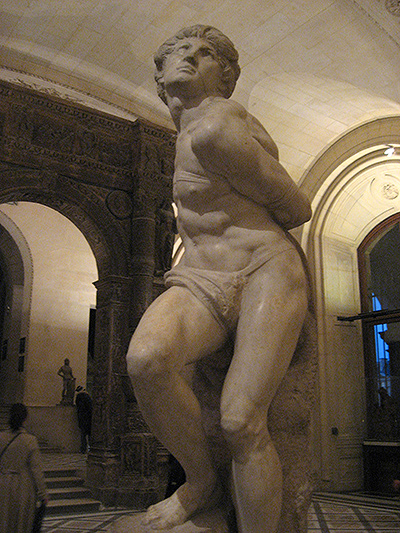
Michelangelo’s Rebellious Slave seems to discover resistance in every direction. One shoulder rises while the head turns away; the torso twists, the hips answer with a contrary movement, and the arms are drawn behind the body. The restraint is slight in material terms, but it transforms the nude into a knot of frustrated force. Unlike its companion, the yielding Dying Slave, this figure appears intensely awake.
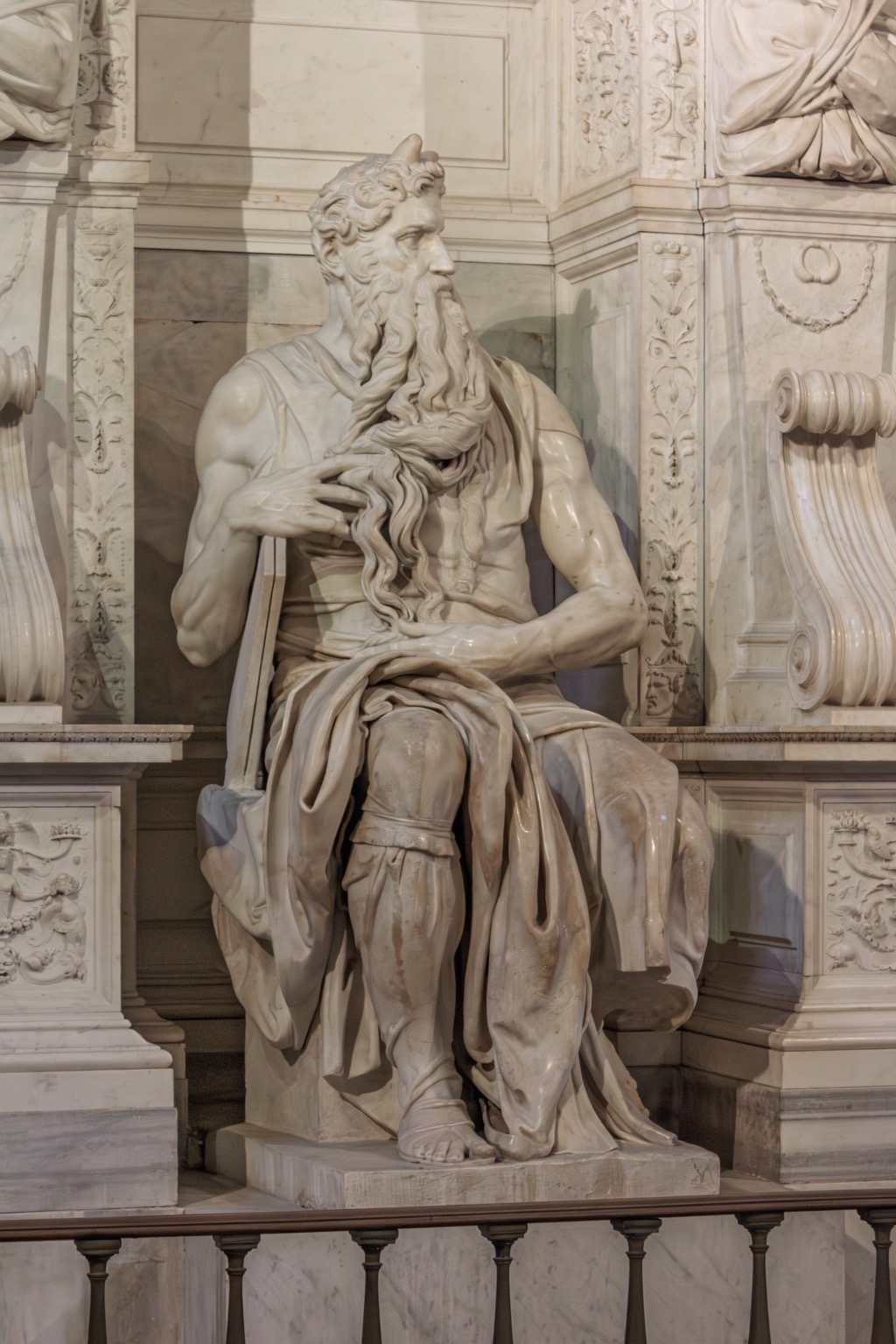
The title makes that contrast memorable, though it is not a surviving statement from Michelangelo. Carved around 1513–1515 for a reduced version of Pope Julius II’s tomb, the marble belonged to an architectural programme that was abandoned before the final monument was installed. It now stands with the Dying Slave in the Louvre, far from the Roman wall tomb centred on Moses.[1][5][6]
Its power comes from several kinds of incompletion. The action cannot finish; the figure cannot escape; portions of the stone remain less fully resolved; and the larger monument for which it was made never took the intended form. “Rebellion” names the visible struggle, but it does not exhaust the work.
At a Glance
- ArtistMichelangelo Buonarroti
- TitleRebellious Slave, also grouped among the Slaves or Prisoners
- MaterialCarved marble
- PeriodAbout 1513–1515
- Original purposeA figure for the Julius II funerary project
- Current locationMusée du Louvre, Paris
- CompanionDying Slave
- Defining movementA powerful rotation of head, shoulders and torso against bound arms
- Final-tomb distinctionNot installed at San Pietro in Vincoli
- ConservationReturned to Louvre display after treatment in 2022
- Interpretive cautionThe modern title and possible allegories do not document Michelangelo’s exact intended meaning
Contents
- Resistance Built into the Pose
- The Opposite of the Dying Slave?
- A Figure from the Changing Julius Tomb
- What Did the Slaves Mean?
- The Sculpture Changes as the Viewer Moves
- Masculine Beauty Under Constraint
- Motion That Cannot Become Narrative
- Finish, Roughness and Interrupted Work
- Conservation and a Renewed Encounter
- Artist Up Close
Annotated Details from the Rebellious Slave
The annotated view follows the sculpture’s active resistance through the head, bound arms, twisting torso and rough support. The approved image remains source-led and its source note is recorded in the references.[10]
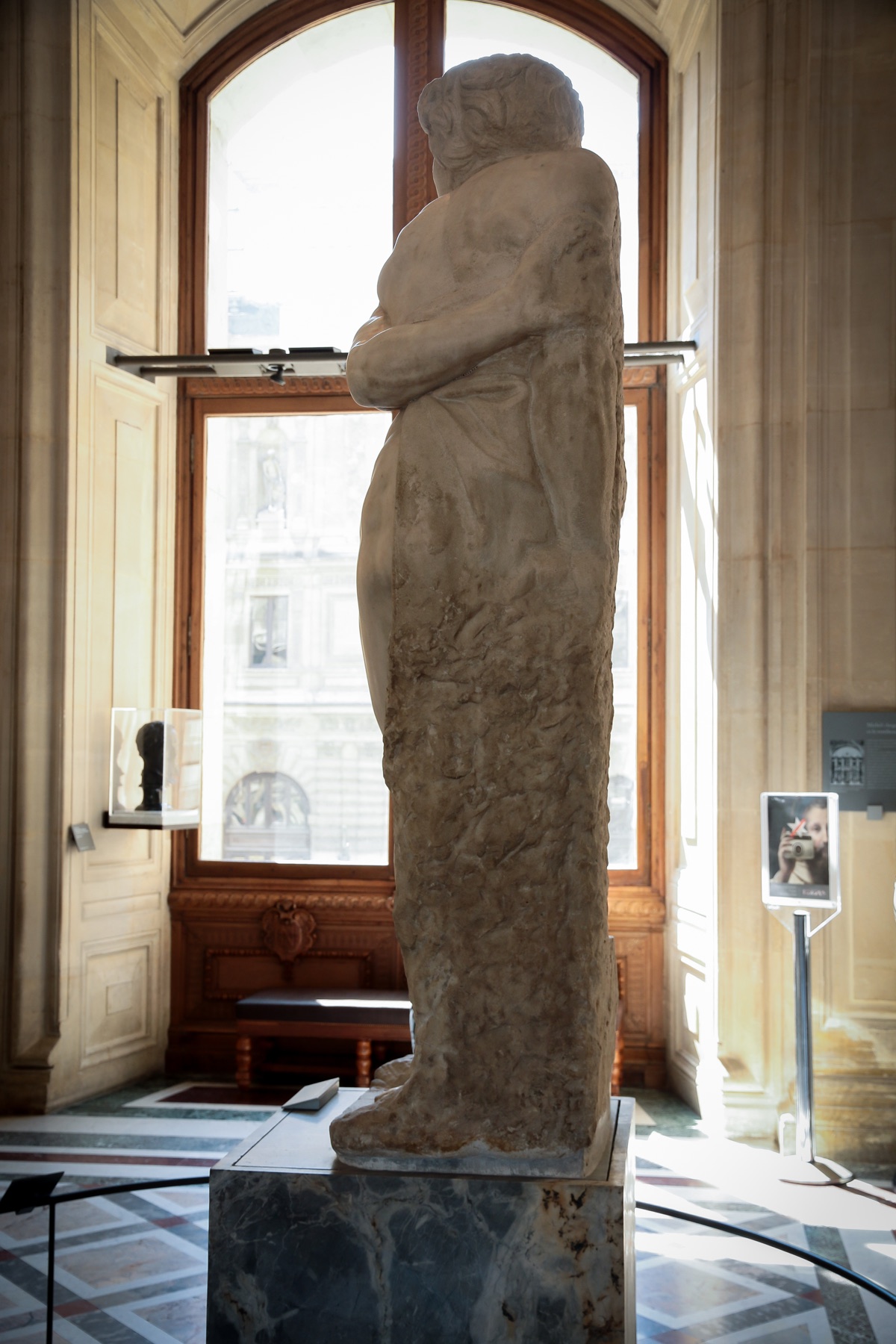
Details from THE REBELLIOUS SLAVE
Close looking highlights the figure’s resisting body, bound movement and rough support while keeping source and rights notes in the references.
Head and neck
The head and neck pull against the body’s alignment, giving the figure its tense, resistant force.
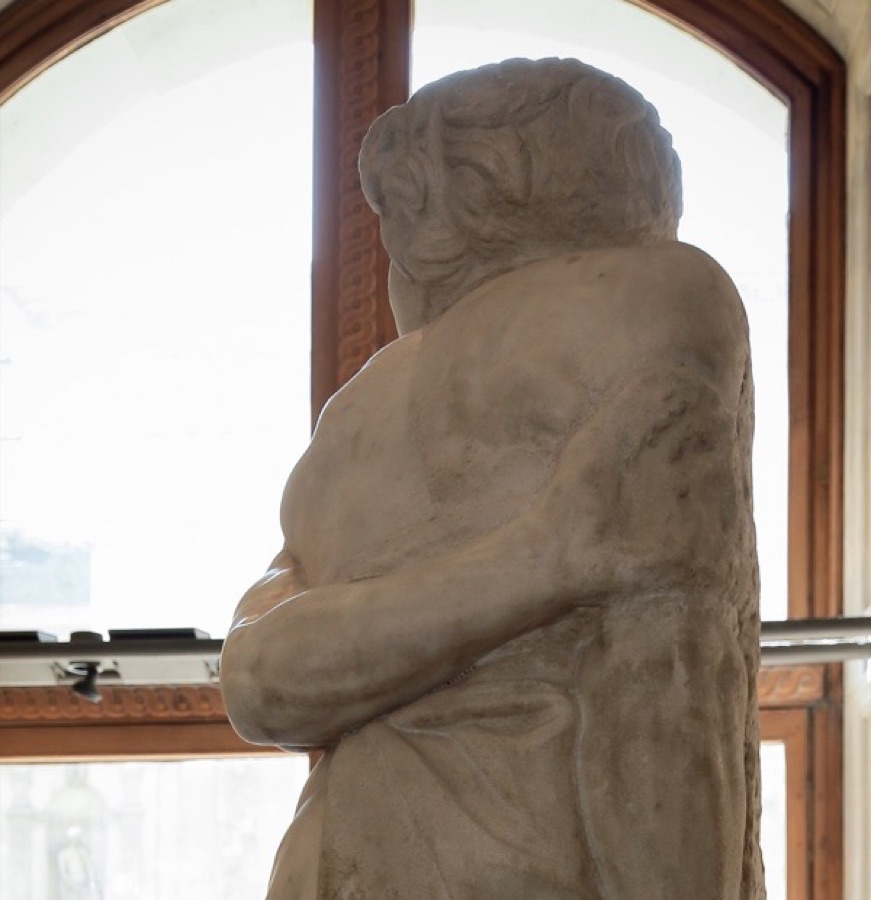
Bound arms
The bound arms make the body’s struggle visible without reducing the sculpture to one fixed meaning.
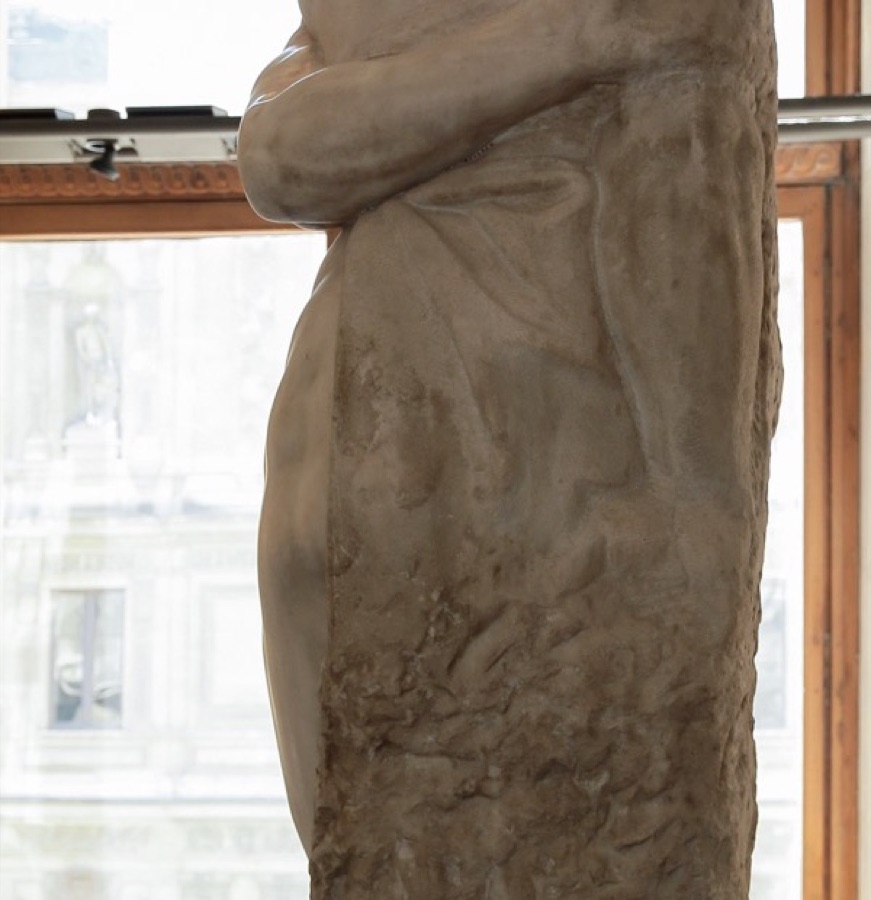
Torso twist
The twisting torso distinguishes the statue from the softer inward rhythm of the Dying Slave.
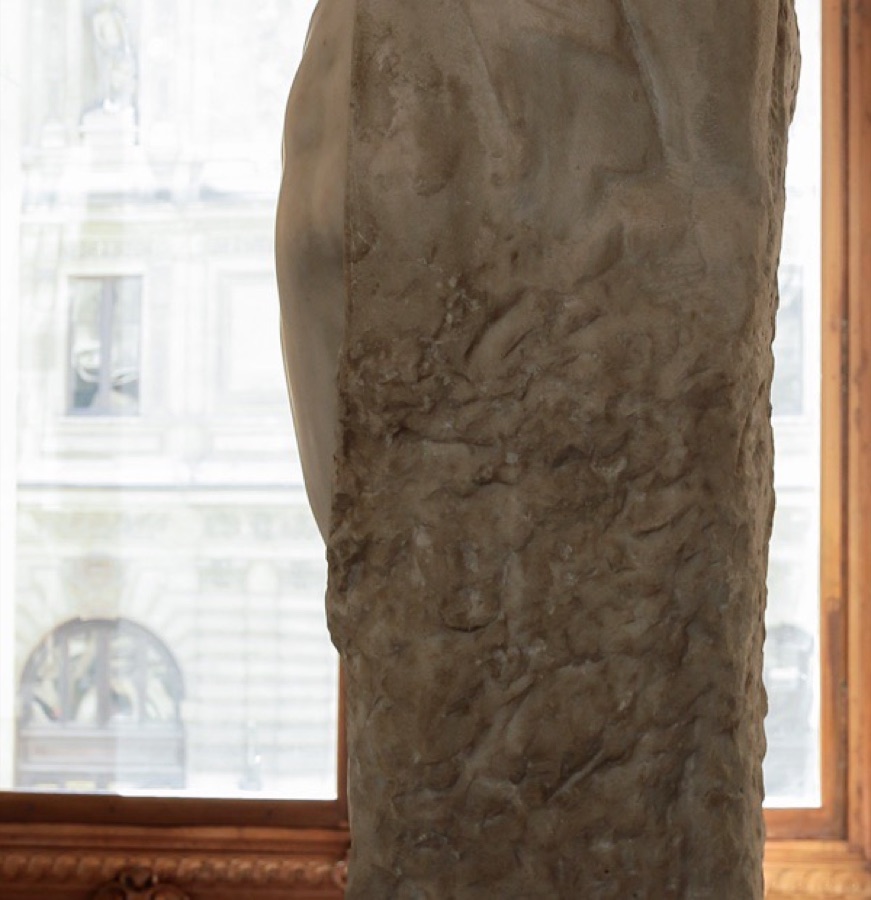
Rough support
The rough support and lower carving keep the figure tied to the tomb project’s unfinished, changing history.
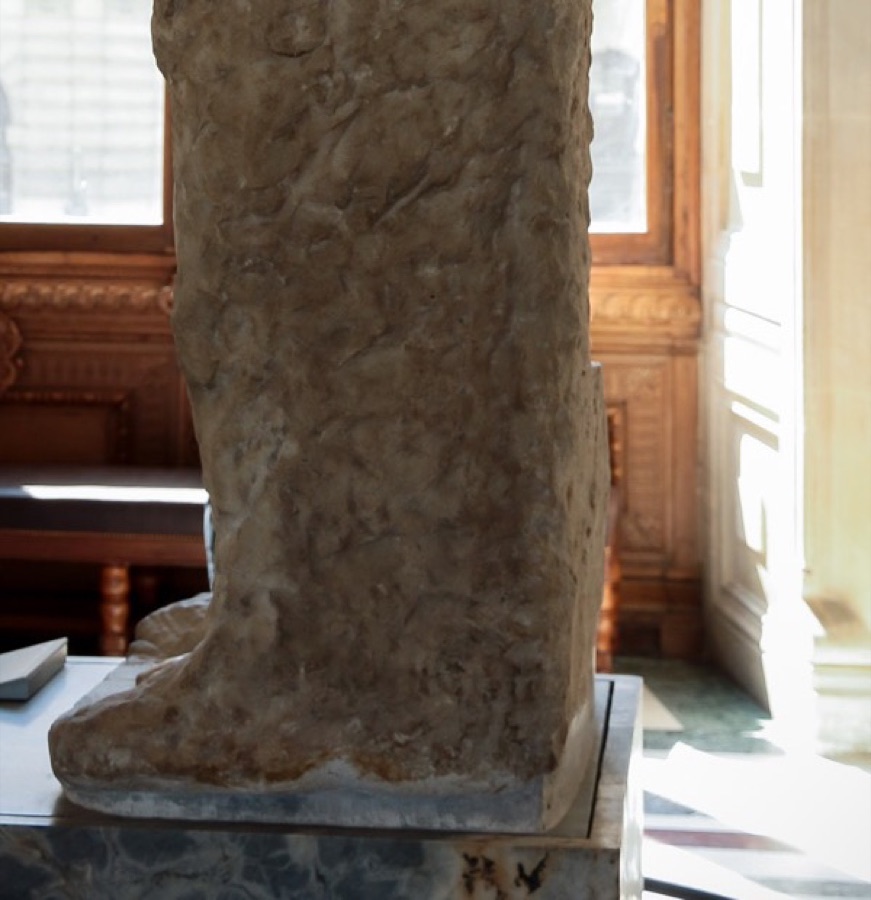
Resistance Built into the Pose
The figure is standing, yet the body refuses a stable vertical axis. Weight passes through one leg while the pelvis turns. The ribcage rotates more forcefully above it; the shoulders rise unequally; the head pulls toward the side. Each transition appears to encounter an obstacle and redirect itself.
The arms intensify the problem. Drawn back and close to the body, they cannot open into a balancing gesture. Their restriction makes the chest and abdomen work harder. Muscles that might otherwise signify ideal strength instead become evidence of strain.
Michelangelo does not need thick chains to make captivity convincing. The binding elements are visually slight.[1] The disparity between the powerful body and its modest restraints encourages psychological or allegorical readings: the figure seems held by something more absolute than rope. Yet physical description should come first. The sculpture’s force arises from the way its large masses cannot align.
The head completes the coil. It does not face the direction in which the chest seems to push. The turned neck compresses one side and stretches the other, making resistance travel upward. From different viewpoints, the pose alternately opens and closes; no single frontal image can resolve it.
The Opposite of the Dying Slave?
The Louvre presents the Rebellious Slave with the Dying Slave, and the titles make them appear to personify opposite responses to bondage.[1] The latter raises an arm, inclines his head and seems to soften into sleep, death or release. The former contracts and twists as though every muscle opposes constraint.[6]
The contrast is real, but “opposites” can become too easy. The Dying Slave must still support an upright body, while the Rebellious Slave remains permanently unable to complete his action. Yielding contains tension; rebellion ends in arrest. Together they explore two unstable states rather than illustrate a moral choice.
Their pairing may once have contributed rhythmic differences to the lower architecture of the tomb. Repeated bound nudes could vary in direction and energy against projecting supports. The precise arrangement remains dependent on changing designs, however, and a reconstruction cannot be treated as the lost monument itself.[4][8]
In the Louvre, both figures are encountered as autonomous sculptures. Viewers can walk around them and read faces as psychological portraits. That freedom is a museum condition. An original lower placement would have aligned their bodies with an architectural order and subjected them to a different angle of sight.
A Figure from the Changing Julius Tomb
Julius II commissioned his funerary monument in 1505. The first project for St Peter’s was extraordinarily ambitious, but the contract is lost and the surviving design evidence is debated. The Met’s early drawing demonstrates a dense architectural and sculptural conception without proving every detail of a single definitive plan.[4]
After Julius died in 1513, a reduced agreement generated a major carving campaign. The Louvre associates its pair with this 1513–1515 phase.[1][2][6] Bound figures were proposed for the lower parts of the architecture, where their bodies would have animated the junction between supporting structure and the memorial figures above.
The commission continued to change over roughly forty years. The reduced wall monument unveiled in February 1545 contains neither Louvre Slave.[3] In San Pietro in Vincoli, Moses occupies the centre of the lower register, with Rachel and Leah beside him.[5] The Rebellious Slave is not a figure removed from that installed arrangement; it belongs to a previous solution.
Its exclusion eventually made independence possible. Michelangelo gave the two Slaves to Roberto Strozzi, after which they moved into French collections. A work devised as one element in a papal memorial became a prestigious gift and, ultimately, a museum masterpiece.
What Did the Slaves Mean?
No surviving explanation by Michelangelo fixes the programme. The Louvre records several interpretive traditions: captives associated with Julius’s conquests, personifications of arts deprived of their patron, or images of the soul constrained by matter.[1]
Political readings suit a pope celebrated for military action and can recall ancient triumphal monuments. The arts interpretation suits Julius’s enormous cultural patronage. A Neoplatonic opposition between spirit and matter fits the compelling sight of a living body caught in stone. These possibilities may overlap, but none should be reported as a deciphered label.
The word “Slave” carries meanings today that can overwhelm the Renaissance context. It should not be used to turn the marble automatically into a modern statement about racialised chattel slavery. “Prisoner” may better preserve the Italian Prigioni, but it too remains a later identifying title. Ethical clarity requires acknowledging the modern weight of the term while keeping claims historically grounded.
The figure’s resistance is nonetheless central. Even without a fixed allegory, the bound body transforms subjection into active form. The sculpture does not merely show force; it makes force visible because movement is prevented.
The Sculpture Changes as the Viewer Moves
A frontal view gives only part of the action. From one side, the twist of the chest opens and the shoulder appears to draw backward into space. From the other, limbs overlap and the figure contracts into a denser column. The marble alternates between exposure and self-concealment.
This variability may preserve something of its proposed architectural role. A figure placed against or between structural supports would not have offered a neutral all-around view. Michelangelo could organise prominent masses for an oblique approach while allowing the architecture to hide other zones. The modern gallery changes that hierarchy by letting visitors choose their own circuit.
The back is especially important to a sculpture whose arms are restrained behind it. What a frontal image abbreviates becomes a physical relationship: wrists, elbows, shoulders and spine are connected through pressure. The action cannot be understood as an expressive face placed on an ideal torso. It is distributed through parts that viewers discover sequentially.
The support and rougher passages complicate the spiral. They interrupt the fantasy of a body freely turning in air and return attention to stone. Where contours remain attached, rotation seems caught by the same material from which it was produced. The marble is not merely the medium used to depict restraint; it participates in the restraint.
Light adds a further change. Across the expanded chest it can describe a continuous muscular surface, while deep overlaps at shoulder and arm fall into shadow. Strong lateral illumination makes the pose more violent; diffuse light makes its transitions slower. Neither condition alone is the sculpture’s definitive appearance.
Masculine Beauty Under Constraint
The Rebellious Slave belongs to Michelangelo’s sustained exploration of the monumental male nude. Its anatomy recalls the idealising authority of ancient sculpture, yet the bound pose denies the autonomy normally associated with heroic nudity. Strength is displayed at the moment it proves insufficient.
That contradiction prevents the figure from becoming a simple defeated captive. The body remains beautiful, enlarged and energetically alive. Constraint does not degrade its form; it reveals the force passing through it. This can make the sculpture feel triumphant even though rebellion never succeeds.
The tension also complicates the proposed political readings. If bound figures represented conquered peoples, their magnificence would turn subjection into a display of the patron’s power. If they represented the arts mourning Julius, their beauty would signify the value of what his death constrained. If they evoked soul and matter, physical perfection would become both prison and evidence of transcendent form.[1]
Michelangelo did not resolve these implications with an obvious attribute. The nude remains ethically and emotionally unstable. Its beauty draws viewers toward a condition of bondage that the title can too easily make picturesque. Responsible looking keeps both the aesthetic achievement and the coercive image in view.
Motion That Cannot Become Narrative
Many sculptures represent the climax of an identifiable action: a blow is about to fall, a runner begins or a body collapses. Here the visible exertion has no external object. The figure does not pull against a clearly anchored chain, turn toward another person or respond to an event outside the frame.
As a result, movement circles back on itself. The head’s refusal, the shoulder’s rise and the torso’s torque make rebellion legible without showing what rebellion is against. Time is suspended. The next instant would need either escape or exhaustion, but marble permits neither.
This suspension explains why the work survives separation from the tomb so powerfully. Its programme is incomplete, yet its bodily problem can be encountered immediately. Viewers feel the impossibility before they know Julius’s contracts. Historical knowledge then deepens the paradox: the figure made to embody constraint was itself released from the architecture for which it had been conceived.
Finish, Roughness and Interrupted Work
The Louvre Slaves are substantially more developed than the four Florence Prisoners. Their anatomy and principal silhouettes approach a finished state, although rougher and unresolved areas remain.[1] The contrast makes them poor evidence for a single universal theory of Michelangelo’s non-finito.
Unfinished passages may preserve carving sequence or correspond to surfaces that would have been less visible in architecture. They may also reflect the moment when the changing commission made further work unnecessary. Project history provides a concrete reason for stopping before philosophy is invoked.
The Florence Atlas, Awakening, Bearded and Young Slave belong to a broader 1519–1534 range and remained in Michelangelo’s studio after reductions.[7] Their bodies are much more entangled with their blocks. They share the tomb history, but their date, degree of finish and later journey through the Boboli Gardens differ from the Louvre pair.
Modern casts, facsimiles and reconstructions add another layer. The National Gallery of Denmark explicitly distinguishes these evidence types in its study of Michelangelo’s incomplete works.[8] A cast can reveal volume; a model can test placement; neither supplies original surface or certainty about meaning.
Conservation and a Renewed Encounter
The Louvre recorded the Slaves’ return to display in 2022 following conservation.[2] Treatment belongs to the history of the physical marbles: it can stabilise surfaces and change how accumulated dirt, old coatings or tonal contrasts affect viewing. It does not return the statues to an uncomplicated 1515 appearance.
Conservation also encourages closer examination of tool marks, joins, supports and differences of finish. Such evidence may refine understanding of making, but it should not be made to solve iconography by itself. A cleaner band remains an ambiguous restraint.
The treatment’s public history also corrects the idea that museum objects are static. Marble accumulates dust, coatings and environmental effects; displays alter; conservation ethics develop. The sculpture seen today is the same Renaissance object, but its visibility has been repeatedly maintained and mediated.[2]
The modern gallery sets the pair at human viewing height and allows comparison from several sides. This accessibility reinforces the Rebellious Slave’s coiled motion. As the visitor moves, one compressed relationship opens while another disappears. Rebellion is not contained in the face alone; it unfolds through changing alignments.
Pair display also makes difference more important than symmetry. The sculptures need not mirror one another or embody a simple binary to create a conversation. Their unlike rhythms ask how the same broad condition—an ideal body subjected to restraint—can generate withdrawal in one marble and circulating effort in another. The answer is made through pose rather than caption.
Specialist study of the tomb draws on contracts, drawings, restoration findings and the dispersed sculptures.[9] The marble gains from that wider history, but it should not vanish into it. The object remains singular: an action designed for architecture that now creates its own space.
Artist Up Close
Michelangelo turns constraint into a method of composition. Because the arms cannot extend, motion circulates through the torso. Because the torso cannot turn freely, the neck and shoulder intensify. The sculpture’s “rebellion” is therefore not an expression applied to an otherwise neutral body; it is a structural consequence of every part meeting resistance.
The marble also demonstrates how Michelangelo could make an unfinished commission yield a complete visual experience. The historical purpose was interrupted, but the bodily action is intelligible and inexhaustible. Failure of installation became the condition for a new kind of encounter.
Frequently Asked Questions
Discussion
How does the Rebellious Slave change when seen as a Louvre object rather than as part of a reconstructed tomb?
Reader Insights
How does the word rebellious shape interpretation before the sculpture itself is closely examined?
What changes when the sculpture is viewed as a displaced tomb figure rather than an independent museum nude?
How should a public page distinguish unfinished carving, physical restraint and open-ended allegory?
Join the Conversation
Set the Rebellious Slave beside the Dying Slave, the Florence Prisoners and Moses. Which comparison clarifies the tomb project most?
References
- Musée du Louvre, Imprisoned in Stone — The Louvre’s Slaves”:, View source.
- Musée du Louvre, Michelangelo’s Slaves Regain Their Brilliance”:, View source.
- Metropolitan Museum of Art, Michelangelo: Divine Draftsman and Designer — Exhibition Galleries”:, View source.
- Metropolitan Museum of Art, Design for the Tomb of Pope Julius II della Rovere”:, View source.
- Roma Capitale / Turismo Roma, Michelangelo’s Locations”:, View source.
- Musée du Louvre, The Dying Slave”:, View source.
- Galleria dell’Accademia di Firenze, Atlas”:, View source.
- National Gallery of Denmark, Michelangelo Imperfect — English Guide:, View source.
- J. Paul Getty Museum / Getty Publications, Michelangelo’s Tomb for Julius II: Genesis and Genius:, View source.
- Annotated image source: Michelangelo, The Rebellious Slave, c.1513–1516, Louvre, Paris. Page-ready image and detail crops prepared from Tom’s approved Commons source, documented in the candidate packet as CC BY-SA 3.0, with object context anchored to the Louvre sources above. Crops preserve the approved source-led vertical orientation for overlay review.