


 by Tom Gurney
Tom Gurney BSc (Hons) is an art history expert with over 20 years experience
Published on June 19, 2020 / Updated on November 6, 2025
Email: tomgurney1@gmail.com / Phone: +44 7429 011000
Michelangelo’s Battle of the Centaurs
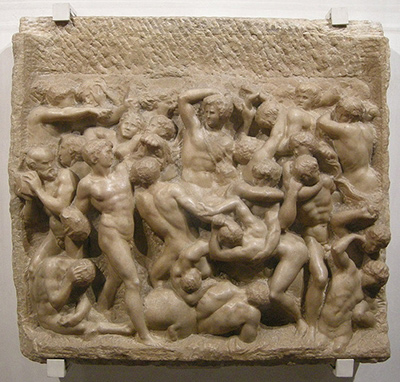
Michelangelo’s Battle of the Centaurs makes marble feel overcrowded. Nude bodies climb, strike, recoil and collapse across a rectangular field with almost no empty ground. Limbs are difficult to assign; heads emerge between torsos; one action interrupts another before it can become clear. The relief does not offer a battle observed from a safe distance. It makes looking itself enter the struggle.
Casa Buonarroti dates the work to 1490–1492, during Michelangelo’s youth in Florence.[1] Early biographical tradition connects it with Lorenzo de’ Medici and the humanist Angelo Poliziano, although the exact mythological episode and original circumstances have been debated. The object is unfinished, but its state is not an empty preliminary stage. Rough and more developed passages intensify the collision between bodies and stone.
Why is Battle of the Centaurs more than a violent early relief? The page focuses on an early Casa Buonarroti marble field where crowded bodies, mythological uncertainty, unfinished stone and Michelangelo's sculptural imagination meet.
At a Glance
- ArtistMichelangelo Buonarroti
- TitleBattle of the Centaurs
- Date1490–1492
- MediumMarble relief
- Current locationCasa Buonarroti, Florence
- SubjectA mythological combat traditionally associated with centaurs; the precise episode remains debated
- Historical contextMichelangelo’s youthful relationship with the Medici circle and Lorenzo the Magnificent
- Literary associationAngelo Poliziano is connected with the subject in early accounts
- StateUnfinished
- Defining formA densely packed field of nude bodies in varying relief depths
- Companion in Casa BuonarrotiMadonna of the Stairs
- CautionLater fame and biography should not supply a complete commission history absent from the object record
- Recent careTreated during the Room of Marbles conservation and refurbishment programme of 2020–2022
Contents
- A Battle Without Empty Space
- What Battle Does the Relief Show?
- Lorenzo, Poliziano and the Medici Garden
- Bodies as a Continuous Field
- Unfinished Surface and the Non-Finito Problem
- Carving a Crowd
- The Quiet Companion: Madonna of the Stairs
- From Early Biography to Modern Conservation
- Later Reception of a Youthful Work
- How to Read the Relief from Edge to Centre
- Violence Without Weapons
- Why the Battle Still Feels Experimental
- Artist Up Close
A Battle Without Empty Space
The first impression is density. Michelangelo gives the eye almost nowhere to rest. Bodies overlap across the slab, and the rectangular boundary cuts the action without enclosing it neatly.
This organisation differs from a classical frieze in which figures may be read one after another. Here the sequence is unstable. A torso that seems central can belong to a combatant whose limbs disappear among others. The viewer repeatedly loses and recovers individuals.
Compression creates violence before any weapon is recognised. The lack of space makes bodily contact unavoidable. Shoulders collide with legs, heads press beneath arms, and falling figures occupy the same field as attackers.
The relief’s depth changes across the surface. More projecting bodies command light; shallower passages remain closer to stone. These differences do not simply establish background and foreground. They make combat seem to move in and out of material.
Michelangelo’s choice of nude figures heightens the effect. Clothing and armour would separate identities and social roles. Nudity turns the scene into an anatomy of force, in which vulnerability and strength occupy the same body.
What Battle Does the Relief Show?
The conventional title identifies centaurs, hybrid beings whose bodies join human and horse. The most familiar interpretation relates the sculpture to the battle between centaurs and Lapiths, a classical subject of order struggling with violent appetite. Early traditions also produced other identifications, and Casa Buonarroti preserves caution around the exact episode.[1]
Poliziano, a leading humanist in Lorenzo de’ Medici’s circle, is associated with proposing or shaping the subject. His presence would place the work within an environment where ancient poetry and visual art informed one another.
Yet the relief does not depend on recognising every creature or named hero. Human torsos dominate, and the most obvious visual fact is collective collision. The title supplies mythological orientation without transforming the slab into a diagram of a literary text.
This ambiguity may result partly from unfinished carving. Features that would distinguish human from centaur or clarify attributes may never have reached completion. It may also reflect Michelangelo’s decision to concentrate on bodies rather than narrative accessories.
An exact title matters less than the moral and formal condition shared by centaur battles: civilisation and instinct become difficult to separate once violence begins. Ideal nudes are subjected to brutal entanglement.
Lorenzo, Poliziano and the Medici Garden
Michelangelo’s youthful presence in the Medici environment has become one of the foundational stories of his biography. Lorenzo the Magnificent gathered artists, antiquities and humanists, creating opportunities for study that extended beyond ordinary workshop training.
Early accounts connect Battle of the Centaurs with Lorenzo and Poliziano.[1] The association is historically meaningful, but it should not be expanded into a precise scene of commission unless the sources establish it. Later biographers wrote with knowledge of Michelangelo’s fame.
The relief’s classical subject suits the culture of the Medici circle. Ancient myth could serve as moral history, intellectual display and a field for artistic competition. Michelangelo’s nude bodies demonstrate learning from antiquity without copying one known ancient relief.
The rectangular marble also invites comparison with sarcophagi and ancient battle fragments. Dense overlapping figures were available as a classical vocabulary. Michelangelo intensifies that vocabulary until individual legibility nearly breaks down.
The work is therefore both learned and physical. Humanist subject matter does not remain a literary exercise. It becomes pressure, impact and the resistance of stone.
Bodies as a Continuous Field
Some figures project strongly enough to seem nearly independent; others remain shallow and partially absorbed. The eye can begin with a head or shoulder and then fail to locate a coherent body. This difficulty is deliberate in effect even if not every surface state was intended as final.
The central zone is particularly congested. Michelangelo avoids a single victorious hero who organises the whole. Action is distributed across competing centres, making battle appear collective and unresolved.
Falling bodies introduce gravity into the horizontal surge. A bent back or lowered head pulls the eye down, while raised arms and climbing torsos push upward. These vectors create a churning motion within the fixed rectangle.
Hands have special importance because they make contact visible. A fist, grip or bracing palm turns anatomical study into aggression. Where hands remain unclear, the surrounding bodies can make force legible by consequence.
The relief asks viewers to reconstruct more than narrative. They reconstruct anatomy. That active looking is one reason the unfinished marble has remained so compelling.
Unfinished Surface and the Non-Finito Problem
Casa Buonarroti identifies the work as unfinished.[1] Some areas retain broad toolwork or incomplete definition, while others are more highly developed. The upper and edge zones do not resolve into a uniform final surface.
One explanation is historical interruption. Michelangelo was young, circumstances changed and a relief without a secure installed destination could be left. The record does not establish one universal reason.
Modern viewers often experience the roughness as perfectly suited to battle. Bodies appear to fight not only one another but the marble itself. This metaphor is aesthetically persuasive but should not be converted into a statement Michelangelo is known to have made.
The surviving state joins accident and achievement. Whatever caused work to cease, Michelangelo had already established a composition whose violence gains intensity from unequal emergence. Later admiration belongs to that actual object.
Finish is also not a simple clock. A smooth figure may belong to an area Michelangelo prioritised, while a rough one may have been blocked out later or intended for less prominence. Degree of polish cannot securely order every figure.
Carving a Crowd
Relief offers a basic material problem: every body must emerge from one slab. Michelangelo cannot move a completed figure forward after carving it. Depth has to be allocated in advance, while undercutting risks weakening projecting parts.
In a crowded battle, these constraints multiply. An arm crossing a torso may require a slight ridge rather than a fully separated limb. A head emerging behind another body needs enough depth to register without consuming stone required elsewhere.
The result shows remarkable economy. Small changes in plane create different bodies. Deep shadow at one overlap can clarify several actions at once. Marble becomes a compressed system rather than a collection of attached figures.
Toolwork also contributes to legibility. Rougher zones scatter light; more finished flesh holds it continuously. The battle’s visual rhythm depends on surface as well as anatomy.
This is why the relief cannot be understood from subject alone. The myth provides bodies in conflict; carving determines how conflict can inhabit stone.
The Quiet Companion: Madonna of the Stairs
Casa Buonarroti displays Battle of the Centaurs with Madonna of the Stairs, the two most famous reliefs of Michelangelo’s youth.[2] Their contrast is almost programmatic.
The Madonna uses extreme shallowness to create monumental stillness. Its mother and child occupy an inward devotional space. The Battle uses crowding and varied projection to make bodies collide.
One is no more “finished” as an idea because it appears calmer. Both ask how little depth a marble field needs to support human presence. Their paired significance lies in opposing answers.
Display history also shaped the relationship. The works occupied different spaces in the Buonarroti house before modern museum arrangements brought them together.[2] Present adjacency encourages viewers to imagine a two-part statement Michelangelo may never have planned.
The pairing remains valuable when treated as comparison rather than destiny. A young sculptor could explore tenderness and violence, Donatellesque shallowness and ancient crowding, without one experiment cancelling the other.
From Early Biography to Modern Conservation
Condivi and Vasari helped establish the relief as evidence of extraordinary youthful ability. Their narratives connected Michelangelo’s early access to Lorenzo with later greatness.[1] Biography transformed the marble into an origin story.
Origin stories simplify. They make every feature look prophetic of David, the Sistine ceiling or the Last Judgement. The relief deserves to remain a work of the early 1490s, not merely a container of future achievements.
Later comparisons are still useful. The ceiling and altar wall contain crowded nude bodies under intense spiritual pressure, while the Battle of Cascina cartoon later made a mass of male nudes central to civic action. These resemblances reveal recurring interests, not direct transfer of individual poses.
Casa Buonarroti and Friends of Florence record conservation and refurbishment of the two youthful reliefs through 2020–2022.[2][3] Cleaning, study and display can clarify toolwork and depth essential to the Battle’s legibility.
The modern Room of Marbles makes the unfinished object a finished centre of attention. Conservation preserves roughness rather than correcting it, acknowledging that interrupted carving has become part of historical identity.
Later Reception of a Youthful Work
Michelangelo is reported to have valued the relief in old age, and early biographers used it to demonstrate how quickly his ability emerged.[1] Such testimony is meaningful but also shaped by retrospective admiration.
The work appealed to later periods because it seemed to expose force before refinement. Romantic and modern viewers could find in the roughness evidence of struggle, while academic artists could study its anatomy and composition.
Its small field contains the kind of bodily intensity often associated with much larger Michelangelo works. Reproduction can obscure this paradox by enlarging the relief on a screen. In person, density is achieved within a physically bounded slab.
The absence of a finished edge or polished unity can make the object feel contemporary, but historical specificity remains vital. It was carved in a culture of Medici humanism, ancient collecting and Florentine relief, not as an anticipation of modern abstraction.
How to Read the Relief from Edge to Centre
The relief discourages the ordinary habit of identifying a principal figure and then treating everything else as support. No uncontested hero holds the centre, and no clean interval separates one action from the next. Instead, Michelangelo distributes force across the field. A raised arm creates an opening only for another torso to close it; a bent back becomes the platform against which a neighbouring body turns; a head that appears decisive from one angle is absorbed into the crowd from another.
This is why photographs can make the object look more legible than an encounter with the marble. Even illumination flattens competing depths into a single readable design. Changing light reveals a more unstable construction. Projecting limbs throw shadows across bodies behind them, while lightly worked areas nearly disappear. Figures continually exchange their apparent positions. The battle is not just represented by gestures; it is enacted by the viewer's difficulty in separating bodies.
The outer zones are especially revealing. They show form at different stages of arrival: a passage may be broadly blocked, another more sharply articulated, another scarcely released from the surrounding stone. These differences should not be tidied into a speculative timetable of exactly what Michelangelo carved first or last. They do, however, demonstrate the sequence of operations that relief demanded—establishing a field, judging projection, opening intervals and refining selected surfaces without destroying the mass that holds the composition together.
A useful way to look is therefore to resist naming the figures for a moment. Follow pressure instead. Notice where a shoulder seems to drive into the next body, where an elbow interrupts a contour, where a cavity separates two forms, and where stone left between them prevents full independence. Only afterwards return to the centaur story. The exercise makes clear why the work remains compelling even when its precise literary identification is debated: its sculptural argument does not depend upon a single label.
Violence Without Weapons
One of the relief's striking features is how thoroughly violence is carried by bodies. The surviving field does not organise itself around a glittering display of armour or weaponry. Grasping, twisting, bearing down and recoiling supply the action. This concentrates attention on anatomy, but the anatomy is not a catalogue of ideal poses. Each body is intelligible through contact with another.
That choice makes the battle feel archaic and immediate at once. The subject belongs to classical myth and to the learned culture associated with Michelangelo's Medici-era formation, yet its effect is physical before it is antiquarian. Knowledge of centaurs, Lapiths or possible literary prompts can deepen an account of the title; it cannot substitute for the marble's network of compression.
The absence of a stable protagonist also complicates any triumphal reading. Conflict consumes the entire field, and the spectator is given no serene vantage point outside it. Even comparatively resolved figures remain locked into the same material plane as their opponents. The relief consequently offers neither a simple celebration of strength nor a neatly resolved moral. It makes bodily power impressive and oppressive at the same time.
Why the Battle Still Feels Experimental
Calling the work experimental does not mean calling it unsuccessful. Its experiment lies in the demands Michelangelo places on relief: how many bodies can occupy a compact field, how deeply some may project while others remain submerged, and how far narrative can be carried by the collision of masses rather than by an orderly procession of named actors.
The unfinished condition preserves those questions in unusually visible form. A fully smoothed surface might have made the scene easier to admire as a unified image, but it would have concealed some of the decisions now available to the eye. What survives is both a mythological struggle and evidence of carving under pressure. That double character—depicted conflict and material resistance—gives the marble an intensity out of proportion to its size.
Artist Up Close
The young Michelangelo treats anatomy as a relational force. A back matters because another body presses against it; an arm matters because it strikes, grips or shelters. No ideal figure remains untouched by the crowd.
He also accepts difficulty as the subject’s medium. The viewer’s struggle to separate bodies repeats, at the level of sight, the struggle carved into them. Narrative and material become inseparable.
Frequently Asked Questions
Discussion
What feels most revealing in Battle of the Centaurs: the crowded bodies, the unfinished marble, or the uncertainty around the exact mythological scene?
Reader Insights
How does compression create energy in the relief?
What does the non-finito surface let the viewer see?
How much story should a public page attach to an uncertain mythological scene?
Join the Conversation
Compare compression, unfinished stone and cautious mythological interpretation while keeping this early relief distinct from other Michelangelo routes.
References
- Fondazione Casa Buonarroti, Battle of the Centaurs”:, View source.
- Fondazione Casa Buonarroti, Michelangelo’s Marbles”:, View source.
- Friends of Florence, The Madonna of the Stairs and the Battle of the Centaurs, and the Refurbishment of the Room of Marbles”:, View source.