 by Tom Gurney
Tom Gurney BSc (Hons) is an art history expert with over 20 years experience
Published on June 19, 2020 / Updated on August 8, 2026
Email: tomgurney1@gmail.com / Phone: +44 7429 011000
Tomb of Lorenzo de’ Medici by Michelangelo
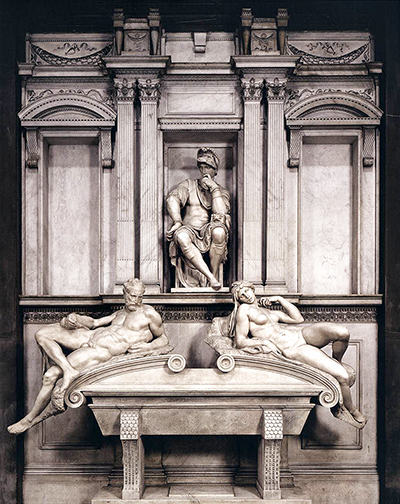
On a curved sarcophagus, morning wakes unwillingly while evening lowers into exhaustion. Above them, a duke in armour withdraws into shadow. Michelangelo’s Tomb of Lorenzo de’ Medici is not a container decorated with three famous statues. It is a wall transformed into a meditation on memory and passing time, where architecture makes bodies appear at once supported, confined and dangerously alive.
The tomb commemorates Lorenzo de’ Medici, Duke of Urbino—not his grandfather Lorenzo the Magnificent.[1][2] The seated duke occupies the upper niche, and Dawn and Dusk recline below.[4][5] Across the New Sacristy stands the tomb of Giuliano, Duke of Nemours, with Night and Day. A third wall gathers the memorial of the Magnifici beneath the Medici Madonna. This three-wall structure is the minimum needed to understand any one monument.
At a Glance
- Designer and principal sculptorMichelangelo Buonarroti
- Memorial subjectThe Duke of Urbino, Lorenzo de’ Medici
- DateDeveloped during Michelangelo’s roughly 1520–1534 New Sacristy work
- MaterialsMarble sculpture and architectural stonework
- LocationNew Sacristy, Basilica of San Lorenzo, Florence; part of the Medici Chapels museum[1][3]
- Principal upper figureIdealised seated Lorenzo, often called Il Pensieroso
- Sarcophagus figuresDawn (Aurora) and Dusk (Crepuscolo)[4][5]
- Opposing monumentGiuliano, Duke of Nemours, above Night and Day
- Separate memorialLorenzo the Magnificent and his brother Giuliano beneath the Medici Madonna
- Programme statusDeveloped through changing plans and left incomplete when Michelangelo departed Florence
- Central ideaAn ideal ruler set above two transitional moments of the daily cycle, within architecture that binds remembrance to bodily instability
Contents
- A Wall, Not a Collection of Statues
- The Correct Lorenzo
- Lorenzo in the Upper Niche
- Dawn: Waking as Labour
- Dusk: The Body Yielding
- The Sarcophagus as an Unstable Support
- Morning and Evening Without Noon or Midnight
- Time Beneath Memory
- Opposite the Tomb of Giuliano
- The Sacred Wall and the Magnifici
- From Free-standing Concepts to Wall Tomb
- Disegno Across Paper, Clay, Marble and Wall
- An Unfinished Programme
- Bodies Larger Than Their Architecture
- Chapel Light and the Passage of Hours
- The Body Commemorated and the Bodies Displayed
- Scale, Height and the Historical Spectator
- When Allegory Becomes Physical
- How to Read the Tomb
- Why the Tomb of Lorenzo Matters
- Artist Up Close
A Wall, Not a Collection of Statues
Reproductions often isolate Lorenzo’s head or the reclining Dawn. The tomb was conceived in the opposite direction: figures and architectural field determine one another. A niche encloses the duke; a broken pediment and mouldings articulate the upper zone; the sarcophagus curves beneath two bodies whose weight appears almost too abundant for its lid.
Architecture establishes rank. Lorenzo sits vertically at the centre, differentiated from the horizontal personifications below. Yet architecture also introduces tension. The niche shadows his face, the sarcophagus slopes beneath its occupants, and the figures press beyond the calm logic of a wall.
The monument’s meaning therefore cannot be assembled by adding three independent biographies. Lorenzo is pensive partly because Dawn wakes below him. Dusk feels exhausted partly because a timeless ideal duke endures above. The tomb is relational before it is symbolic.
The Correct Lorenzo
Lorenzo, Duke of Urbino, died in 1519. He belonged to the generation through which Medici papal power sought to consolidate dynastic rule and territorial title. Michelangelo’s idealised figure commemorates that role rather than furnishing a reliable likeness.
His grandfather Lorenzo the Magnificent died in 1492 and had played a defining part in Michelangelo’s early Florentine formation. The New Sacristy remembers him elsewhere, in a joint burial with his brother Giuliano under the sacred group on the altar wall.[1][2]
Confusing the two Lorenzos does more than misdate a name. It substitutes one memorial programme for another. The duke’s wall joins secular ideal portraiture with personified time. The Magnifici wall joins a shared sarcophagus with Mary, Christ and Medici saints. Michelangelo devised different visual languages for different generations.
Lorenzo in the Upper Niche
The seated figure has acquired the nickname Il Pensieroso because his hand approaches his face and his helmet shadows the eyes. His attitude is compressed and inward, particularly when contrasted with Giuliano’s open command across the room.
From the tomb as a whole, this inwardness gains funerary weight. Lorenzo does not watch the personifications below or address the spectator. He seems removed from the time that moves beneath him, yet his memorial exists because time ended his life.
Armour presents the duke as a ruler and captain, while stillness redirects martial equipment toward contemplation. Michelangelo does not illustrate a historical campaign. He invents an enduring character appropriate to dynastic remembrance.
Dawn: Waking as Labour
Dawn reclines on one side of the sarcophagus, a female body turning upward from sleep. The official object record identifies her as Aurora and binds her securely to Lorenzo’s tomb.[4] The name directs attention toward transition rather than a fixed hour.
Her awakening does not feel effortless. The torso twists, limbs seek support and the head emerges with an air of reluctance. Morning is represented not as radiant landscape but as the body’s difficult return to consciousness.
Michelangelo’s choice gives temporal allegory psychological force without requiring a fixed expression. Every viewer knows awakening through bodily change: weight shifts, eyes open, muscles re-enter use. Dawn magnifies that ordinary threshold into marble.
Dusk: The Body Yielding
On the other side, Dusk embodies the day’s decline. The Italian title Crepuscolo names twilight, the interval in which light withdraws but night has not fully arrived.[5] A mature male body settles across the sarcophagus, powerful anatomy yielding toward rest.
The figure is not simply Dawn reversed. Gender, age and bodily distribution differ. Dusk’s heaviness suggests expenditure, the fatigue of a day completed. Where dawn gathers itself toward rising, evening releases effort.
The two personifications therefore form a pair through opposition and asymmetry. They inhabit the most unstable parts of daily transition, neither fully asleep nor fully active. That liminality suits a tomb: death is imagined through changes of state without being reduced to literal sleep.
The Sarcophagus as an Unstable Support
The curved lid seems an improbable bed for monumental bodies. Its slopes deny the secure horizontal platform that repose would require. Dawn and Dusk appear to balance, slide or hold themselves in place.
This instability activates the architecture. A sarcophagus ordinarily signifies permanent containment. Michelangelo turns its upper surface into a zone of movement. Time cannot rest comfortably upon the vessel of death.
The arrangement also makes structural dependence expressive. The figures need the sarcophagus for support, while their weight gives the chest visual consequence. They are not ornaments laid on an inert container; they transform the tomb into a bodily event.
Morning and Evening Without Noon or Midnight
Lorenzo’s wall contains transitional times, while Giuliano’s tomb carries the more expansive opposites Day and Night. This division was not arbitrary. Each ducal monument receives a pair, and the chapel completes the daily cycle only across the room.
Dawn and Dusk belong together because they blur boundaries. Their light is mixed, their bodies in passage. That ambiguity harmonises with Lorenzo’s withdrawn state. Giuliano’s outward activity is framed by the stronger polarities of waking day and sleeping night.
The four Times should therefore be interpreted as a chapel-wide system as well as individual masterpieces. No single tomb owns time completely. The cycle requires the spectator to turn.
Time Beneath Memory
Placing allegories below the duke creates a hierarchy, but its meaning is double. Memorial art seeks to lift the dead above ordinary change, giving ideal form to a life ended. Lorenzo’s still figure appears to endure while morning and evening continue their endless rhythm.
At the same time, the Times proclaim that duration defeats individuals. Dawn follows dusk whether a ruler lives or dies. Their beautiful, burdened bodies make mortality inescapable beneath the claims of dynasty.
Michelangelo holds commemoration and futility together. The tomb gives Lorenzo lasting visibility, but it surrounds that achievement with temporal figures whose existence announces loss.
Opposite the Tomb of Giuliano
The two ducal walls are paired architectural sentences. Similar structures establish kinship; opposite dispositions create distinction. Giuliano opens toward public action, while Lorenzo closes around thought. The visual dialogue has often been framed as active and contemplative life.
This contrast belongs to Michelangelo’s ideal design, not necessarily to the historical personalities. Neither duke is represented through literal biography. Their bodies provide complementary models of rulership inside the same dynastic chamber.
The lower figures extend the dialogue. Lorenzo’s dawn and dusk turn between conditions. Giuliano’s night and day embody more complete opposites. A viewer who studies only one wall misses how the chapel distributes meaning across movement.
The Sacred Wall and the Magnifici
The wall centred on the Medici Madonna changes the chapel from a secular hall of fame into a Christian funerary space. Beneath Mary and Christ lies a joint memorial for il Magnifico and Giuliano of the preceding generation; Saints Cosmas and Damian flank the central group.[1][2]
That sacred axis gives the ducal tombs an ultimate orientation. Their armoured rulers and nude Times belong to earthly status and natural cycles. The Madonna and Child introduce incarnation and salvation, the theological answer to death.
The Tomb of Lorenzo must therefore be understood as one lateral movement toward a centre it does not contain. Its incompleteness as an autonomous message is deliberate at the scale of the room, even though the chapel’s execution history also remained unfinished.
From Free-standing Concepts to Wall Tomb
Surviving British Museum drawings show Michelangelo considering free-standing sepulchral forms and double-tomb compositions.[6][7] Such sheets document a period when the relation among burials, figures and architecture remained fluid.
They do not provide a single missing blueprint from which the present tomb can be judged as a defective copy. Designs change through practical and conceptual development. The final wall arrangement solves problems of limited space, multiple family members and chapel-wide symmetry that an earlier study may pose differently.
The drawings are most valuable when treated as evidence of decisions. Michelangelo considered other ways for bodies to occupy memorial architecture before settling on a vertical ruler above paired recumbent allegories.
Disegno Across Paper, Clay, Marble and Wall
The Metropolitan Museum’s study of Michelangelo as draftsman and designer situates the New Sacristy within a practice where disegno meant both drawing and intellectual conception.[8] Tomb architecture did not begin only when stone was cut. Ideas moved through sheets and models before entering full scale.
This cross-media process explains why authorship cannot be confined to the surfaces Michelangelo personally polished. The overarching relationships of wall, figure and movement belong to design, even where assistants or later installers participated in execution.
It also explains revision. A drawn pose can alter when tested in clay; a model can change when translated into marble; a statue can require architectural adjustment. The Lorenzo wall is the visible result of that negotiation.
An Unfinished Programme
Michelangelo left Florence in 1534, and the New Sacristy was not complete in the comprehensive sense its early ambition suggested.[2][3] Sculptures retained uneven finishes, planned elements changed, and later hands participated in installation and continuation.
This history requires two cautions. First, not every rough area was deliberately left as an expressive endpoint. Second, not every present relationship can be claimed as the artist’s final, personally supervised placement. The programme belongs to Michelangelo while also bearing subsequent history.
Such layered completion is normal for monuments that exceed one working period. The chapel’s power comes partly from a design strong enough to survive incompletion and continued stewardship.
Bodies Larger Than Their Architecture
Dawn and Dusk appear almost too large for the sarcophagus. Their limbs press into the available ledges, and their torsion generates more spatial demand than the architecture calmly grants. Lorenzo similarly fills his niche with a compact density.
This disproportion animates the wall. Sculpture resists becoming obedient decoration, while architecture prevents it from dispersing. The tomb’s energy lies in their mutual pressure.
Michelangelo repeatedly used confinement to intensify bodies—from figures painted within the Sistine ceiling’s compartments to the Prisoners still joined to blocks. In the New Sacristy, architecture itself becomes the resistant medium.
Chapel Light and the Passage of Hours
Natural and ambient light alter the tomb over the course of a visit and day. Shadows deepen beneath Lorenzo’s helmet, skim the curved sarcophagus and model the Times differently. A monument about dawn and dusk is continuously rewritten by illumination.
This does not mean Michelangelo choreographed every modern lighting condition. It means that projection, recess and polished or rough surface were designed in expectation of light’s change. The names of the figures make viewers especially alert to that relationship.
Photographs often stabilise one moment and equalise visibility. In the chapel, the work remains temporal in the most literal optical sense.
The Body Commemorated and the Bodies Displayed
Lorenzo’s mortal remains are not visible. The tomb’s public bodies are instead an idealised ruler and two impossible personifications. This substitution is fundamental to funerary art. What decays is concealed; what can carry memory is remade in durable stone.
The three sculptures respond differently to that task. Lorenzo supplies name and rank without anatomical likeness. Dawn and Dusk supply bodily mortality without individual biography. The monument joins the specificity of one death to the universality of time passing through every body.
That separation also cautions against taking the sarcophagus as a transparent container. Its visible form is part of an architectural composition, while the practical history of Medici burials and later arrangement belongs to the chapel’s institutional afterlife. The sculpted chest signifies burial whether or not every modern viewer can map remains directly beneath the figures.
Scale, Height and the Historical Spectator
The tomb was designed for a visitor standing below. Lorenzo’s elevated face, the sprawling allegories and the depth of the niche answer that angle. Photographs taken from privileged height can reveal details unavailable from the floor while quietly changing the hierarchy Michelangelo planned.
Foreshortening and enlargement compensate for distance. A hand or shoulder that appears unusually forceful in close reproduction may read coherently from below. The Times’ abundant scale ensures that they remain legible against architecture rather than becoming decorative silhouettes.
The historical spectator also moved within a sacred environment, not a purpose-built gallery. Prayer, funeral memory and approach toward the altar shaped attention. Modern art tourism adds other rhythms—comparison, photography, identification—but the wall continues to organise the body of anyone who looks up at it.
When Allegory Becomes Physical
Morning and evening are not persons, yet Michelangelo gives them age, sex, muscle, fatigue and vulnerability. This embodiment prevents time from remaining an abstract label. A transition is felt as a body waking or yielding.
Allegory works through this productive mismatch. No human being is literally dusk, but every human experiences decline in light and energy. The figure is believable enough to generate empathy and impossible enough to exceed biography.
The tomb’s lasting force lies partly here. Lorenzo’s identity requires historical knowledge; the Times reach spectators through sensation before their titles are read. Dynastic memory is held inside a larger human cycle.
How to Read the Tomb
Start at the sarcophagus rather than the portrait. Identify its curve and the precarious placement of both reclining figures. Follow Dawn upward through her twist and Dusk downward through his yielding weight.
Then raise your eyes to Lorenzo. His compact form gathers the spreading diagonals beneath. Look for the shadow that produces interiority and the armour that signals public rank.
Finally rotate through the room: Giuliano, Night, Day, then the Madonna wall. The tomb’s fullest meaning emerges from that sequence of comparisons rather than a single frontal photograph.
Why the Tomb of Lorenzo Matters
The monument matters because it changes what a tomb can be. It does not simply identify the dead and decorate a container. It stages a conflict among ideal memory, physical time and Christian hope through architecture inhabited by bodies.
It matters because Dawn and Dusk transform abstraction into sensation. Morning becomes effort; evening becomes release. Their cycle makes Lorenzo’s stillness both elevated and doomed.
Above all, the tomb demonstrates Michelangelo’s synthetic power. Portrait, nude, sarcophagus, niche and chapel are not separate achievements. They act upon one another. The result is an ensemble whose visual unity survives changing plans, unfinished surfaces and five centuries of viewers turning between its walls.
Artist Up Close
The New Sacristy demanded every aspect of Michelangelo’s practice: architectural invention, figure design, marble carving, modelling and coordination of assistants. It also unfolded during severe Medici and republican conflict. The Tomb of Lorenzo should not be decoded as a simple statement for or against the family that commissioned it. Its deeper historical truth is the complexity of service: Michelangelo gave Medici memory an unsurpassed form while making time and bodily strain impossible to ignore.
Frequently Asked Questions
Discussion
How does Michelangelo make a memorial wall depend on the figures and architecture around it?
Reader Insights
Does the Lorenzo wall read more as a portrait, a tomb or an architectural composition?
How do Dawn and Dusk change the meaning of Lorenzo's seated figure?
What is gained by reading the Lorenzo and Giuliano walls across the room from one another?
Join the Conversation
Set Lorenzo above Dawn and Dusk. Does the tomb wall feel more like a portrait, an allegory of time or an architectural idea?
References
- Musei del Bargello, Cappelle Medicee”:, View source.
- Catalogo generale dei Beni Culturali, Michelangelo e la Sagrestia Nuova in Firenze — Un progetto innovativo”:, View source.
- Ministero della Cultura, Firenze — Cappelle Medicee: Un ascensore per Michelangelo”:, View source.
- Catalogo generale dei Beni Culturali, Aurora”:, View source.
- Catalogo generale dei Beni Culturali, Crepuscolo”:, View source.
- British Museum, The Medici Tombs in the New Sacristy: Studies for a Free-standing Sepulchral Monument”:, View source.
- British Museum, The Medici Tombs in the New Sacristy: A Study for a Double Tomb with Figures”:, View source.
- The Metropolitan Museum of Art, Michelangelo: Divine Draftsman and Designer”:, View source.