


 by Tom Gurney
Tom Gurney BSc (Hons) is an art history expert with over 20 years experience
Published on June 19, 2020 / Updated on August 8, 2026
Email: tomgurney1@gmail.com / Phone: +44 7429 011000
St Matthew by Michelangelo
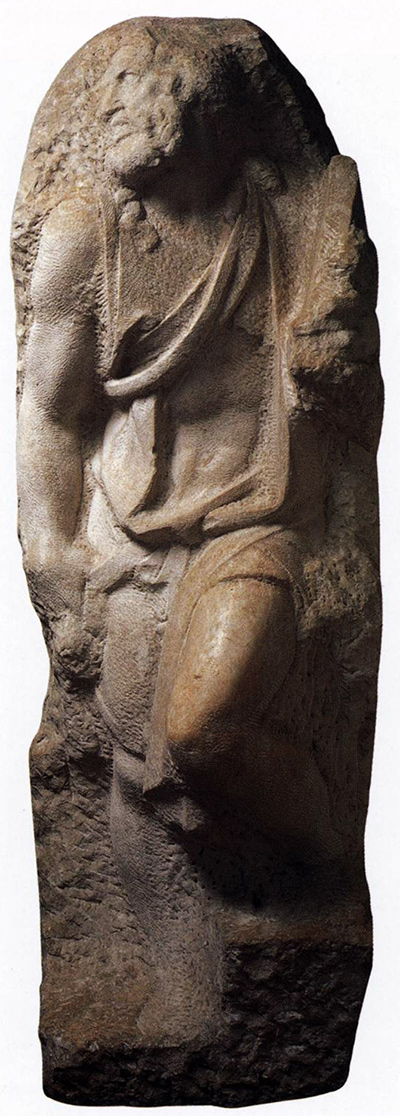
Michelangelo’s Saint Matthew is not a polished apostle standing before a block. It is an apostle still materially joined to one. A bent leg, turning torso and inclined head have been opened from the marble, while broad masses around them retain the evidence of labour suspended. The figure seems to act against its own substance. That visual struggle has made the sculpture a defining example of Michelangelo’s unfinished art—but the history is more precise, and more human, than a legend of a body magically imprisoned in stone.
Commissioned as the first of twelve monumental apostles for Florence Cathedral, Saint Matthew was begun after the triumph of the David. The larger programme dissolved when Michelangelo left Florence for Rome and the service of Pope Julius II. Only this apostle was started. The Galleria dell’Accademia, where the marble is now displayed, dates the surviving work to about 1505–1506; cathedral and national records preserve the broader history of a commission initiated in 1503 and annulled in December 1505.[1][2][3] Its incompletion therefore belongs first to an interrupted institutional project. Everything the rough surface has come to mean begins from that fact.
At a Glance
- ArtistMichelangelo Buonarroti
- TitleSaint Matthew, or San Matteo
- DateCommissioned in 1503; principally worked about 1505–1506
- MediumWhite marble
- ScaleOver life-size
- SubjectMatthew, apostle and evangelist
- Original programmeThe first of twelve apostle statues for Florence Cathedral
- Commissioning bodyOpera di Santa Maria del Fiore
- StatusUnfinished; the other eleven apostles were never begun by Michelangelo
- Present locationGalleria dell’Accademia, Florence
- Later museum historyMoved to the Galleria in 1909, alongside the Prisoners[1]
- Central cautionThe cancelled commission explains why work stopped; the expressive effect of the surviving surface should not be confused with proof that every rough passage was meant as a final statement
Contents
- Twelve Apostles for Florence Cathedral
- After David: A New Florentine Challenge
- Why the Commission Stopped
- Reading the Pose
- A Saint Identified Through the Body
- Tools, Planes and Arrested Labour
- Non-Finito Without Myth
- The Apostles That Never Appeared
- Cathedral Meaning and Museum Meaning
- Saint Matthew and the Prisoners
- The Work’s Florentine Afterlife
- Why Saint Matthew Matters
- Artist Up Close
Twelve Apostles for Florence Cathedral
The commission belonged to an ambitious effort to furnish Florence Cathedral with monumental sculpture. Twelve marble apostles were planned for the sacred space around the presbytery, creating a company of witnesses appropriate to the cathedral’s scale and authority. The Opera del Duomo’s account places Michelangelo’s project within a longer history of attempts to realise these “marble giants.”[3]
The number mattered. Matthew was not intended as a solitary saint with an independent destination; he would have stood within an apostolic body. Each figure needed individual identity, yet the group would have derived force from repetition, scale and placement around the cathedral interior. Imagining the lost programme therefore requires restraint. We know its institutional ambition and its subject family, but not a completed arrangement of twelve Michelangelo statues.
This collective purpose makes the lone surviving block poignant. The Saint Matthew is both an object and a fragment of a programme that never came into being. Its isolation in a museum can encourage us to read every decision as self-contained. The original commission asks us to remember eleven absences around it.
After David: A New Florentine Challenge
Michelangelo received the apostle commission after the public success of the David. The sequence naturally invites comparison: both were conceived for major Florentine institutions, both demanded colossal ambition, and both turned the male body into an instrument of civic and sacred meaning. But Saint Matthew was not meant to repeat the hero in another costume.
The David is a fully realised freestanding nude whose alert body gathers energy before action. Matthew was to be a draped apostle integrated into a cathedral programme. His authority depended on scriptural identity, sacred setting and relation to companions. Michelangelo faced the problem of making an evangelist monumental without reducing him to a classical athlete bearing an attribute.
The surviving pose suggests his answer would have depended on inner movement rather than static dignity. Matthew turns, bends and presses. Even in its incomplete state, the figure refuses the calm frontality of a generic niche saint. The apostle’s body appears seized by attention, as if responding to a summons beyond the block.
Why the Commission Stopped
Michelangelo did not abandon a completed set of designs because he had discovered a philosophical preference for unfinished sculpture. His professional world changed. Pope Julius II called him to Rome for the immense papal tomb project, and the Florentine apostle contract was annulled in December 1505.[1][3] The Accademia’s record allows that work on Matthew may have continued into the following year.[1]
That overlap explains why a single date can mislead. “1503” identifies the beginning of the commission, not necessarily the present extent of carving. “1505–1506” better describes the surviving statue’s principal execution, while acknowledging uncertainty about the exact rhythm of work. The object belongs to a short but disrupted interval between Florentine and papal obligations.
The cancellation also reveals the costs of Michelangelo’s fame. Success brought commissions that competed with one another. The unrealised apostles and the famously troubled Tomb of Julius II were not separate tales of artistic temperament; they were entangled institutional demands. Matthew’s roughness is the visible residue of that collision.
Reading the Pose
The saint does not rise on a simple vertical axis. One leg bends, the torso shifts, and the head turns away from the body’s lower direction. These contrary movements create tension before anatomy or drapery is fully clarified. Michelangelo establishes action through the relationship of large masses.
The pose has often encouraged the metaphor of a figure struggling to escape stone. Visually, the metaphor is persuasive. Matthew’s articulated parts press against a block whose unremoved matter remains obvious. Yet the body is not literally a complete statue hidden inside, waiting only to be uncovered. Sculpture requires selection, measurement and continual revision. The visible figure exists because Michelangelo established particular planes and abandoned others at less advanced stages.
A more exact description preserves the drama. The apostle is caught between several degrees of definition. His movement seems stronger where a leg or torso meets rough stone, because resistance makes direction legible. The block does not merely imprison the figure; it supplies the opposition through which the pose becomes visible.
A Saint Identified Through the Body
Matthew’s identity traditionally rests on his place among the apostles and his role as an evangelist, often represented through a book or angelic symbol. In the unfinished marble, iconographic details do not carry the whole burden. Michelangelo makes sacred attention physical. The turned head and tightening body suggest a person receiving, thinking or responding.
It is not possible to prove a single narrative instant from the surviving state. Is he hearing divine inspiration, turning toward Christ, or simply being organised within an apostolic sequence? The work does not supply a definitive answer. Its devotional force comes from directed awareness rather than a fully narrated episode.
This distinction separates the statue from a portrait. Matthew’s face is not meant to record an individual sitter’s appearance. His body creates an apostolic type whose spiritual concentration is conveyed through action. The saint’s identity is institutional and scriptural, while Michelangelo’s sculptural invention makes it psychologically immediate.
Tools, Planes and Arrested Labour
The block preserves differences between broad reduction and more advanced modelling. Some passages still proclaim the original mass; others have been cut far enough to establish anatomy, drapery or the turn of a joint. Tool marks do not form a uniform decorative texture. They belong to operations performed at different moments and with different aims.
Looking across the marble makes sculpture’s irreversibility palpable. A painter can cover or revise a passage by adding material; a carver advances largely by removal. Each plane narrows what can follow. Michelangelo had to keep enough stone for possible limbs, folds and supports while progressively testing the figure’s projection.
The unfinished state also complicates the distinction between front and side. A completed freestanding statue normally invites movement around a resolved perimeter. Matthew has viewpoints from which bodily intention becomes clear and others where the block reasserts itself. Circling it means passing repeatedly between image and material.
Non-Finito Without Myth
The Italian term non-finito—not finished—describes the object’s condition, but it has accumulated larger meanings. Michelangelo’s unfinished marbles have been admired as revelations of artistic process, symbols of the soul’s struggle with matter and examples of a deliberate aesthetic in which rough stone intensifies completed form. Those readings can illuminate an encounter if they remain interpretations rather than disguised documents.
For Saint Matthew, the external reason for incompletion is unusually strong: the twelve-apostle commission ended as Michelangelo’s obligations shifted to Rome.[1][3] That history should prevent the rough surface from becoming pure autobiography. The work stopped within a contractual and institutional world.
At the same time, historical cause does not exhaust visual effect. Michelangelo had already made decisive choices before stopping. The body’s torsion, the tension between bent and supporting leg, and the distribution of worked and unworked mass create an experience no verbal contract can explain away. Responsible interpretation can hold both truths: incomplete because the project collapsed, compelling because the carving had reached a state of extraordinary potential.
The Apostles That Never Appeared
It is tempting to reconstruct eleven absent figures from the one that survives. Perhaps each would have turned with comparable force; perhaps the cycle would have formed a rhythm of colossal bodies responding around the choir. Such possibilities belong to informed imagination, not fact. No complete set permits the programme’s final visual character to be recovered.
What can be understood is the scale of loss. Michelangelo’s apostolic company might have transformed the cathedral interior and altered the history of Renaissance sculpture. Instead, Florence received one great unfinished fragment. Later attempts to populate the cathedral with apostle statues belong to the Opera’s continuing institutional history, not to a completion of Michelangelo’s particular scheme.[3]
The absence sharpens Matthew’s singularity but should not turn him into a miniature monument for all twelve. He remains one named apostle, begun as the first practical step of a larger commission.
Cathedral Meaning and Museum Meaning
In Florence Cathedral, Matthew would have operated within liturgy, architecture and a circle of apostles. Scale would have answered the vast interior. His pose would have related to an assigned position and to the sightlines of worshippers. Marble whiteness, sacred ceremony and the presence of neighbouring figures would all have shaped interpretation.
The statue’s modern home creates a different encounter. The Galleria dell’Accademia places it within Michelangelo’s sculptural career and near unfinished Prisoners, encouraging attention to process and non-finito.[1][5] Its relocation to the museum in 1909, together with the Prisoners, helped consolidate that comparison.[1]
Neither context is false. The cathedral explains why the statue was commissioned and what kind of figure it was meant to become. The museum makes its material state accessible as an object of close study. Good interpretation keeps the abandoned sacred ensemble behind the compelling modern display.
Saint Matthew and the Prisoners
The Accademia’s unfinished Prisoners make the most immediate visual comparison. Bodies in both groups appear partly released and partly continuous with their blocks. The museum’s collection context rightly allows visitors to study them together.[5] Yet they differ in date, commission and intended meaning.
Matthew belonged to Florence Cathedral’s apostolic cycle. The Prisoners developed within the changing programme of Pope Julius II’s tomb. A saint in a cathedral and bound or allegorical figures for a papal monument cannot be assigned one iconography merely because their incomplete surfaces look related.
The comparison is most useful at the level of carving. In Matthew, Michelangelo already shows how a turn can be made legible before all surrounding stone is cleared. The later Prisoners explore further varieties of emergence, obstruction and unequal finish. The recurrence is real; a single master theory is not required to explain it.
The Work’s Florentine Afterlife
Official records trace the statue’s movement away from its unrealised cathedral destination and eventually into the Accademia.[1][2] That afterlife transformed an incomplete component into an autonomous masterpiece. It also changed what the public expected from it. A work once judged against a missing apostle series came to be valued for revealing Michelangelo’s hand and thought.
The history of reception warns against assuming that today’s most celebrated quality was always the intended endpoint. Renaissance commissioners sought completed statues for a sacred ensemble. Later generations learned to admire interruption itself. The marble contains both histories: the practical disappointment of a failed programme and the aesthetic revelation of process.
Why Saint Matthew Matters
The statue matters because it turns institutional history into visible form. A contract, a departure for Rome and a cancelled programme are not abstract background; they explain the block’s arrested condition. Michelangelo’s career was shaped by patrons whose ambitions exceeded available time, and Saint Matthew preserves one consequence with unusual clarity.
It matters equally as sculpture. Before completing surface or separating every contour, Michelangelo established a body charged with response. Motion resides in the disposition of masses. Rough stone becomes active opposition. The figure’s incompletion reveals not a finished statue concealed whole inside marble, but an intelligence choosing where to cut and how much form must exist before movement can be believed.
Finally, the apostle matters because it joins absence to presence. Eleven planned companions never began under Michelangelo’s hand, and Matthew himself never reached completion. Yet what is present has such force that the lost programme remains imaginable. The work does not need romantic myth to feel alive. Its documented interruption and its unresolved body are enough.
Artist Up Close
When Michelangelo accepted the apostle commission, he had recently completed the David and stood at the centre of Florentine artistic ambition. Within a few years, Julius II’s summons drew him into the papal tomb’s much longer crisis. Saint Matthew occupies the hinge between those undertakings. It shows an artist able to translate heroic bodily design into the sacred identity of an evangelist, but also an artist whose escalating obligations could leave major projects behind. The Metropolitan Museum’s career-wide study of Michelangelo as draftsman and designer supplies the larger context for this traffic between bodily invention, design and execution.[6] His achievement is visible; so are the limits imposed by time, contracts and power.
Frequently Asked Questions
Discussion
Does the rough marble feel like interruption, intention, or both?
How does the planned Twelve Apostles setting change the way you read this single figure?
Where do you see the figure pressing most strongly out of the block?
Join the Conversation
Compare the unfinished figure, the Cathedral commission and Michelangelo's later unfinished marbles.
References
- Galleria dell’Accademia di Firenze, San Matteo”:, View source.
- Catalogo generale dei Beni Culturali, San Matteo”:, View source.
- Opera di Santa Maria del Fiore, The Twelve Marble Giants of the Cathedral of Florence”:, View source.
- Opera di Santa Maria del Fiore, Michelangelo and the Dome of Florence: A Legacy Sculpted in Time”:, View source.
- Galleria dell’Accademia di Firenze, Collections”:, View source.
- The Metropolitan Museum of Art, Michelangelo: Divine Draftsman and Designer”:, View source.