


 by Tom Gurney
Tom Gurney BSc (Hons) is an art history expert with over 20 years experience
Published on June 19, 2020 / Updated on November 6, 2025
Email: tomgurney1@gmail.com / Phone: +44 7429 011000
The Christ of Guadalupe and the Michelangelo Attribution
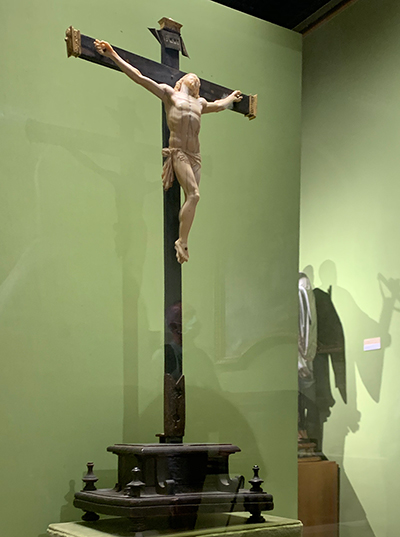
In the Royal Monastery of Santa María de Guadalupe in Extremadura, a small ivory Christ has long carried one of art history's largest names. The crucified body is commonly listed at about 20 centimetres high and traditionally dated around 1560, near the end of Michelangelo's life. Its miniature scale brings the anatomy and suffering of the Crucifixion into a field of intimate attention.
The work is attributed to Michelangelo, not securely documented as his. No surviving contract, letter or unbroken early provenance has established that he carved it. Its historical reputation at Guadalupe deserves to be recorded, but the repetition of a famous name in inventories, guidebooks and derivative lists does not become proof through age alone.
This leaves a valuable object rather than an empty verdict. The Christ of Guadalupe can be understood through ivory devotion, the late Michelangelesque image of Christ, the collecting history of a major Spanish monastery and the methods by which an attribution travels. Its uncertainty is not a reason to ignore it. It is the reason to look more exactly.
At a Glance
- Proposed artistMichelangelo Buonarroti
- StatusTraditionally attributed; not a securely documented autograph work
- TitleChrist of Guadalupe or ivory Crucifix of Guadalupe
- Proposed dateAround 1560
- MediumCarved ivory
- HeightCommonly published as approximately 20 centimetres
- LocationRoyal Monastery of Santa María de Guadalupe, Cáceres, Extremadura, Spain
- SubjectThe crucified Christ
- Evidence problemNo known Michelangelo commission or letter identifies the object
- Essential distinctionLocal continuity and old attribution preserve reception history; they do not by themselves establish authorship
Contents
- A Monumental Subject in Miniature
- Ivory and the Image of Flesh
- The Body on the Cross
- Why About 1560 Has Been Proposed
- Michelangelo's Late Crucifixion Designs
- Guadalupe as Pilgrimage and Treasury
- How Attributions Become Traditions
- Not the Montserrat Ivory
- What Further Research Could Resolve
- Why the Christ of Guadalupe Matters
A Monumental Subject in Miniature
The Crucifixion is inherently public and vertical. Christ's body is raised above spectators, and the cross marks landscape, church or altar. An ivory only about 20 centimetres high transforms that scale. The viewer may hold the whole image within one glance and then move closer to details normally lost above a congregation.
Miniature does not mean minor. Small sacred objects could sustain concentrated prayer in a private or monastic setting. Their reduced scale invited proximity, handling and repeated attention. A minute turn of head or cut across the ribs could carry more expressive weight than a broad monumental gesture.
The Guadalupe figure's importance therefore need not depend on being a model for a larger work. It can be complete at its own size. Renaissance and early modern patrons valued precious devotional objects for their ability to bring sacred narratives into chambers, choir stalls and cabinets.
The danger lies in imagining “small Michelangelo” as an automatic contradiction or authentication. Michelangelo is documented making designs and small objects as well as colossi, and late letters mention work on wooden crucifixes. Capability makes an ivory plausible in the abstract. It does not attach him to this particular Christ.
Scale should instead guide exact questions. How does the carver make a body legible within a narrow tusk? Which anatomical features are structural, and which are sharpened for distant viewing? How were arms joined or accommodated? Those answers can identify practice and period before they identify a person.
Ivory and the Image of Flesh
Ivory is dense, smooth and capable of holding fine detail. Its pale, warm colour can suggest skin without a complete layer of polychromy. When polished, it catches light across chest, limbs and face; cuts in hair, wounds and eyes create concentrated shadow.
The material also sets strict limits. Tusk curves and tapers. Its internal structure and dimensions affect the orientation of a body. Extended arms may need to be made separately or planned around joints. A carver must preserve strength in narrow wrists and ankles while maintaining an appearance of vulnerability.
These conditions differ from Michelangelo's familiar marble practice. Marble blocks allow deep subtraction and large bodies. Ivory requires compressed precision. Comparisons between the Guadalupe figure and accepted marbles can reveal shared bodily ideas, but surfaces cannot be treated as though material made no difference.
Ivory also travelled through international networks. Tusks reached European centres through trade and were transformed by Italian, Flemish, German, Iberian and other specialists. A work preserved in Spain and described as Italian may have passed through several markets and collections. Material alone does not fix origin.
Its preciousness suits Guadalupe's historic treasury. The monastery gathered painting, metalwork, textiles, manuscripts and reliquaries through royal patronage, pilgrimage and centuries of devotion.[1][2] An ivory Christ belongs naturally to that environment whether imported, gifted or locally acquired.
The Body on the Cross
At miniature scale, the first task is clarity. The outstretched arms must form a visible horizontal against the descending torso and legs. Head, chest and knees provide the main changes to an otherwise frontal axis.
The carver uses anatomy to make death legible. The ribs and abdomen describe a body affected by suspension; the head no longer answers the spine with active alertness. The sacred figure remains idealised, but idealisation does not remove weight.
Such features have encouraged comparison with Michelangelo's treatment of Christ across sculpture and drawing. The youthful Santo Spirito crucifix shows an anatomically integrated, restrained dead body. The Vatican Pietà makes death beautiful without making it awake. Late Crucifixion drawings created for Vittoria Colonna reduce the scene to an exposed body raised against darkness and attended by angels.[3]
These comparisons establish a field of possibility. They show why the Guadalupe ivory could be called Michelangelesque. They do not prove that its carver had direct access to Michelangelo, let alone that the master cut it himself. By the later sixteenth century his sacred bodies circulated widely through prints, copies and workshop transmission.
The most responsible visual reading starts from the ivory's own decisions. It asks what is individual before searching for a canonical parallel. Otherwise every slender torso or inclined head becomes evidence only because Michelangelo made the type famous.
Why About 1560 Has Been Proposed
The conventional date places the crucifix in Michelangelo's final years. During the 1550s and early 1560s he returned intensely to Christ's death through the Bandini and Rondanini Pietàs, Crucifixion drawings and personal devotional work.
That chronology gives the object a compelling emotional context. A small Christ could seem related to an ageing artist's private meditation rather than a public commission. Michelangelo's late religious art often compresses figures, support and bodily surrender into radical simplicity.
But a compatible theme is not a date. Artists and workshops continued to adapt his late style after his death in 1564. A work of about 1580 or 1600 could look “late Michelangelo” precisely because his devotional inventions had become models.
Secure dating would benefit from technical examination, comparison with documented ivory workshops and early inventory evidence. The material might reveal tool practice, joins or restoration. Its mounting and associated furniture could offer a terminus if their relationship were demonstrably original.
Until those questions are resolved publicly through an authoritative object record, “around 1560” should remain a proposed date tied to the attribution tradition, not a fixed biographical fact.
Michelangelo's Late Crucifixion Designs
Michelangelo made drawings of the Crucifixion for Vittoria Colonna in the 1530s and returned to related imagery later. A British Museum sheet preserves a black-chalk Christ flanked by lamenting angels, linked to Colonna's written response to a design she received.[3]
The drawings matter because they establish sustained imaginative attention to the crucified body. They also circulated through copies and adaptations. A sculptor could translate a graphic idea into wood, bronze or ivory without the resulting object being carved by Michelangelo.
Translation changes the problem. In a drawing, the cross and body are created by marks on one surface. In ivory, the body must be constructed in three dimensions, attached to a separate support and made strong enough to survive. The sculptor interprets rather than merely reproduces.
No accepted drawing has been established as a direct full-scale design for the Guadalupe Christ. General likeness to late sheets should therefore be phrased as relation, not derivation. A specific correspondence in contour or measurement would be more persuasive than shared mood.
This boundary protects both media. Michelangelo's drawings retain their documented identities, while the ivory can be studied as a later or independent response. Influence is historically significant; it need not be promoted into authorship.
Guadalupe as Pilgrimage and Treasury
The Royal Monastery stands in a mountain landscape in Extremadura and developed around devotion to the Virgin of Guadalupe. It became a centre of royal patronage, pilgrimage, artistic production and cultural exchange. UNESCO inscribed it on the World Heritage List in 1993.[2]
Its architecture and collections preserve multiple periods. Mudéjar, Gothic, Renaissance and Baroque spaces coexist; the celebrated seventeenth-century sacristy contains paintings by Francisco de Zurbarán and richly organised decoration.[2] Reliquaries and precious objects are integral to the institution's history.
Within such a place, an ivory crucifix carries more than a maker's identity. It participates in prayer, memory and the prestige of accumulated gifts. Its scale suits a treasury object or intimate display, while its material signifies value.
The monastery's long religious life can preserve objects that would otherwise be dispersed. It can also preserve inherited labels after the documents supporting them are lost or were never strong. Institutional continuity is therefore both a source of knowledge and a reason for methodological care.
An old attribution may tell us how generations understood the object, what they valued in it and how they presented it. That reception is real even if authorship changes. Guadalupe's identity should not be treated merely as a location appended to a possible Michelangelo; it is the principal continuous history the ivory possesses.
How Attributions Become Traditions
A famous name can enter a collection through a donor's claim, dealer's description, inventory judgment, oral tradition or later connoisseurship. Once recorded, subsequent catalogues often copy it. A tentative “said to be by” can gradually lose its qualification.
Digital lists accelerate this process. A table may give artist, date, medium and dimensions in the same confident columns, even when only medium and location are secure. Repetition across websites can look like multiple independent sources while tracing back to one inherited claim.
The Christ of Guadalupe requires the reverse operation. Each element should be separated. The object exists and is preserved at the monastery. It is made of ivory and represents the crucified Christ. A traditional attribution connects it with Michelangelo. Common lists supply a late date and small dimensions. Direct authorship documentation has not been produced.
This hierarchy does not declare the attribution impossible. It shows what new research would need to provide: an early inventory with traceable history, scientific evidence compatible with a specific workshop, a direct design, or exact comparison stronger than general influence.
“Attributed to Michelangelo” is therefore an honest historical label. It reports a durable proposition while leaving space for the evidence to change.
Not the Montserrat Ivory
The Christ of Guadalupe is sometimes grouped with another ivory crucifix at Montserrat. Both are Spanish monastic objects linked in modern writing to Michelangelo, but they are not the same work and do not share one attribution history.
Montserrat's museum has publicly rejected the Michelangelo proposal advanced in 2006 and regards its ivory as an early-seventeenth-century Mannerist work. It also documents acquisition in Rome by Abbot Marcet in 1920 and a modern change of cross.
Guadalupe preserves a different, smaller figure and an older local attribution. Its public documentation is less decisive about maker and acquisition. Facts from Montserrat—Ghiberti, Marcet, 1920, Manuel Capdevila—must never be transferred to Guadalupe.
The comparison is useful methodologically. Two ivory Christs can inherit the same famous name for different reasons and deserve different conclusions. Medium and subject do not create a single object family with interchangeable evidence.
What Further Research Could Resolve
The most valuable next step would be a full institutional object record integrating conservation, archival and art-historical study. It should document dimensions, ivory elements, joins, surface treatment, cross and mounting, restoration, inventory history and every change in attribution.
Technical imaging could reveal construction and later intervention. Material analysis might identify the species or geographic origin of ivory, within ethical and legal constraints, but would not name the sculptor. Tool marks might be compared with documented ivory specialists.
Archival work should begin at Guadalupe rather than with Michelangelo. When does the object first appear in an inventory? What wording is used? Is a donor, piece of furniture or chapel named? Does the Michelangelo attribution appear immediately or later? Those answers could distinguish old provenance from old opinion.
Italian and Spanish collection networks would then provide context. Gifts between courts and monasteries, imported devotional objects and the activity of artists working after Michelangelo may explain the figure more convincingly than a direct masterwork claim.
The aim would not be to disprove a cherished tradition. It would be to give the ivory a history adequate to its importance.
Why the Christ of Guadalupe Matters
The sculpture matters because it makes a universal sacred subject intimate. Ivory, small scale and anatomical concentration ask for close attention. The body on the cross is reduced in dimensions without being reduced in seriousness.
It also demonstrates the cultural power of attribution. Michelangelo's name links a Spanish monastic treasure to the most celebrated sculptor of the Italian Renaissance. That link may preserve a genuine history of influence or transmission even if autograph carving remains unproved.
Guadalupe supplies the object's strongest secure identity. The monastery's layered architecture, royal and pilgrim history, and extraordinary collections give the ivory a living context independent of the label.
At present, the fairest conclusion remains deliberately open. The Christ of Guadalupe is an ivory crucifix traditionally attributed to Michelangelo. Its form is compatible with the wide late Michelangelesque tradition; its authorship is not secured. This is enough to justify study—and not enough to remove the qualification.
Frequently Asked Questions
Discussion
What details, sources or comparisons stand out to you in Christ of Guadalupe?
Reader Insights
Which formal detail changes how the work reads?
Which documented source or collection history feels most useful?
Which related Michelangelo work should readers compare next?
Join the Conversation
Add a source-led observation, comparison or question for other readers.
References
- Real Monasterio de Santa María de Guadalupe, official site:, View source.
- UNESCO World Heritage Centre, Royal Monastery of Santa María de Guadalupe”:, View source.
- British Museum, Christ on the Cross, flanked by two lamenting angels,” collection record 1895,0915.504:, View source.
- M. Gómez-Moreno, El crucifijo de Miguel Ángel,” Archivo Español de Arte y Arqueología 9 (1933), pp. 81–84.