


 by Tom Gurney
Tom Gurney BSc (Hons) is an art history expert with over 20 years experience
Published on June 19, 2020 / Updated on November 6, 2025
Email: tomgurney1@gmail.com / Phone: +44 7429 011000
Saint Paul
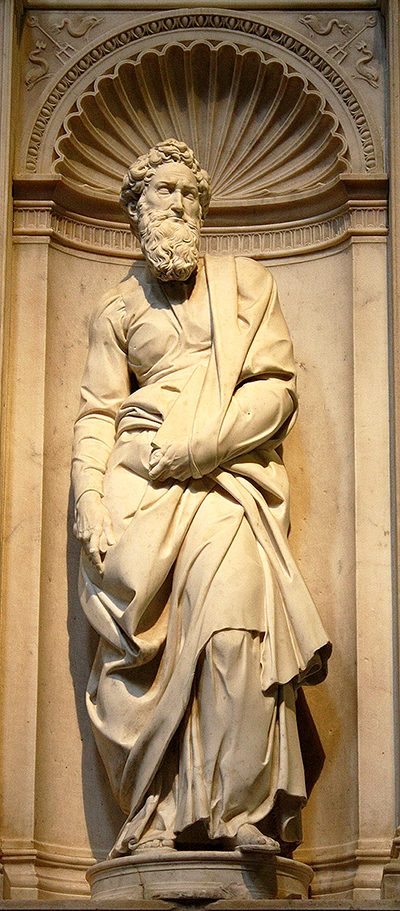
Saint Paul turns sharply inside his niche. Thick curling hair frames a concentrated face; a heavy mantle crosses a body balanced in contrapposto; the head's movement sends energy beyond the narrow marble frame. Among Michelangelo's four Piccolomini saints, this figure has often received the strongest critical praise.[1]
Carved about 1501–1504 and approximately 127 centimetres high, Saint Paul belongs to Andrea Bregno's Piccolomini Altar in Siena Cathedral.[2] It is not the later apostle falling beneath divine light in Michelangelo's Pauline Chapel. This early Paul is a permanent teacher and witness, paired across the altar with Peter.
The work's force comes from compression. Michelangelo does not need a narrative scene. Hair, head, cloth and stance make inward conviction visible before the saint speaks.
At a Glance
- ArtistMichelangelo Buonarroti, with workshop participation in the Piccolomini commission
- TitleSaint Paul
- DateAbout 1501–1504
- MaterialMarble
- HeightApproximately 127 centimetres
- Current locationPiccolomini Altar, Siena Cathedral
- PositionLower niche on the altar's right side
- SubjectPaul the Apostle
- Typical attributesBook or scroll and sword; exact surviving attribute condition belongs to the object record
- Visual characterThick curled hair, focused face, heavy mantle, energetic head turn
- Architectural boundaryStatue under Michelangelo's responsibility; altar framework by Andrea Bregno
Contents
- Paul the Apostle
- The Turning Head
- Hair, Face and Authority
- Drapery and Contrapposto
- Peter's Counterpart
- The Piccolomini Contract
- Michelangelo and Workshop
- Not the Conversion of Saul
- Sword, Book and the Problem of Visibility
- How to Look at Saint Paul
- Why Saint Paul Matters
Paul the Apostle
Paul, originally Saul, appears in Acts as a persecutor of Christians transformed by a revelation of Christ on the road to Damascus. His letters became foundational texts of Christianity, and his missions carried the faith across the Roman world.[3]
Artists identify him with a sword, sign of martyrdom and metaphor for the word, and a book or scroll representing his epistles. A high forehead, dark hair or long beard frequently distinguish him from Peter.
The Piccolomini figure concentrates on intellectual and moral presence. No horse falls and no executioner raises a weapon. Paul stands as the converted teacher after the drama.
His place opposite Peter makes Rome central. Tradition associates both apostles with martyrdom in the city and treats them as complementary founders of the Roman Church.
For a Piccolomini altar celebrating papal family, the pair offers sacred legitimacy deeper than dynastic office.
The Turning Head
Paul's head moves decisively to his right, breaking the niche's frontal expectation.[1] The turn does not detach from the body: shoulders and folds prepare it, while contrapposto establishes opposition lower down.
Potential energy results. The saint seems to have heard or understood something beyond the frame. Michelangelo withholds the external cause, allowing attention itself to become the subject.
The turn also solves an architectural problem. A perfectly frontal figure can merge with a columned altar. Direction creates visual exchange across the structure and pulls the viewer from one niche to another.
From below, curled hair and firm facial planes provide shadow. Minute expression would disappear; a strong head angle survives.
Critics have connected the focused young face with Michelangelo's earlier Saint Proculus in Bologna and later David.[1] The resemblance concerns alertness, not identity. Paul is a clothed apostle within sacred architecture, not a youthful hero awaiting combat.
Hair, Face and Authority
Paul's abundant curls make the head unusually vivid. Hair is not a decorative cap; it expands silhouette and sets off the facial concentration.
Drill and chisel can create deep darks among curls, contrasting with smoother forehead and cheek. At elevated distance, this tonal division keeps the head legible.
The face has often been called intense or firm. Such adjectives should remain tied to observed form: lowered brows, set mouth, head direction and the compression of features.
A popular claim identifies Paul as an early self-portrait of Michelangelo. Resemblance arguments of this kind need caution. No document says the artist used his own features, and the young sculptor's securely identified appearance is not exact enough to turn similarity into proof.
What can be said is more interesting: Michelangelo gave apostolic thought a force comparable to bodily readiness. Intellectual authority occupies a physically charged head.
Drapery and Contrapposto
Paul wears a broad mantle whose heavy folds have been connected with Verrocchio's “wet” drapery and with Donatello's standing saints.[1] Cloth clings selectively, revealing the body's structure without surrendering its own weight.
One leg carries the figure while the other relaxes. The hips shift, and the upper body answers. This contrapposto is not a classical quotation pasted beneath Christian clothing; it organises how the mantle falls.
Large folds create vertical stability. Smaller breaks around joints register motion. The contrast lets Paul seem settled and newly turning at once.
The niche discourages dramatic extension. Michelangelo therefore moves the figure internally: head against torso, weighted side against free side, dense curl against broad cloth.
At modest scale, these oppositions produce monumentality. Paul feels larger than his 127 centimetres because the body is structurally complete.
Peter's Counterpart
Across the altar, Peter looks downward with a quieter adjustment to the viewer. Paul turns laterally with more compressed energy. The two lower apostles establish a dialogue rather than simple bilateral repetition.
Peter's keys evoke institutional authority; Paul's book or sword evokes teaching, mission and martyrdom. Together they join governance with proclamation.
Formal pairing helps viewers recognise them even when attributes are hard to see at height. Peter and Paul were a conventional Roman pair, and architectural opposition reinforces the iconography.
Their nearly equal scale also anchors the altar. Above them, learned papal or episcopal saints extend the vertical programme; empty or altered positions record incompletion.
Michelangelo's later Pauline Chapel frescoes would again set Peter and Paul against one another on facing walls. The Piccolomini pair does not predict those narratives, but it establishes how persistently the apostles could organise a sacred space through opposition.
The Piccolomini Contract
The altar was commissioned by Cardinal Francesco Todeschini Piccolomini and built in the 1480s by Andrea Bregno. It honoured the cardinal's uncle Pius II and Piccolomini standing in Siena.[2]
Michelangelo accepted responsibility for numerous statues in 1501 after Pietro Torrigiani's involvement. He ultimately supplied only four, working in Florence and sending figures to Siena while David consumed his attention.[4]
Paul's contained refinement may reflect its suitability for delegated production stages. Assistants could rough drapery or prepare surfaces while Michelangelo controlled design and decisive passages.
The unfinished contract should not be romanticised as contempt for minor work. It produced financial and moral obligations that persisted. An agreement in 1504 accepted the four statues; later Piccolomini heirs eventually released the artist from remaining liability.
The statue is evidence of that negotiated labour. Its achievement sits beside the programme's incompletion.
Michelangelo and Workshop
Accounts of the Siena saints acknowledge extensive assistant use, and the altar appears in photographic catalogues under Michelangelo and helpers.[5] Paul is often judged the strongest of the four, sometimes encouraging claims that it received more direct work from the master.
Quality alone cannot map authorship. A successful design might be well executed by a trained assistant; a passage directly carved by Michelangelo might remain broad because height made refinement unnecessary.
Tool-mark and surface study can compare the figures. Documentary payments and shipping records can clarify workshop rhythm. Until those forms of evidence converge, the safest public credit keeps Michelangelo's responsibility and workshop participation together.
This is not hedging around a doubtful object. Paul belongs securely to the four delivered Michelangelo statues. The qualification explains how an overcommitted sculptor produced a series.
Not the Conversion of Saul
Michelangelo painted the Conversion of Saul in the Pauline Chapel about forty years later. The fresco shows Paul cast down, blinded by divine light and surrounded by a disrupted company.[6]
The Siena statue shows no conversion event. It represents Paul after transformation, established as apostle and teacher.
Keeping the objects separate prevents biography from swallowing iconography. A reader searching for Michelangelo's Saint Paul may encounter both, but medium, date, location and narrative job differ completely.
Comparison can still illuminate the artist's long career. The early marble compresses revelation into a standing body's attention; the late fresco explodes it across a wall. One is an icon; the other a history scene.
Sword, Book and the Problem of Visibility
Paul's usual sword and book do not operate as interchangeable decoration. The sword recalls execution and the sharpness of the divine word; the book embodies letters addressed to Christian communities. Together they join martyrdom with teaching.
At the altar's height, however, an attribute may be obscured by hands, mantle or shadow. Later damage or replacement can further alter what viewers see. A current object examination should govern claims about which original elements survive.
Even when an attribute is hard to read, Paul's identity remains supported by his pairing with Peter and by the altar programme. Iconography is cumulative. Hair, face, position and bodily distinction cooperate with objects rather than depending upon one symbol.
This layered identification is important in reproduction. A cropped image may remove the paired apostle and make the figure seem generically prophetic. The full altar restores Paul's Roman and papal context.
How to Look at Saint Paul
Locate Paul in the lower right niche and trace the direction of his head across the altar.
Observe the curls from ordinary viewing distance. Their shadow is part of design, not only close virtuosity.
Follow the supporting leg through the mantle. Ask how cloth makes balance visible.
Compare Paul with Peter, then with the figures above. Architectural rhythm becomes clearer through difference.
Do not assume the face is Michelangelo's portrait. Look instead at how physical concentration becomes apostolic authority.
Why Saint Paul Matters
Paul is a compact demonstration of attention. Michelangelo makes a turn of the head carry the energy that a narrative scene might distribute among many figures.
The statue also shows workshop production at its most productive. An existing altar, a distant client and overlapping commitments did not prevent a coherent saint from emerging.
Beside Peter, Paul anchors the Piccolomini family's papal memorial in apostolic Rome. He is small enough to serve architecture and forceful enough not to disappear inside it.
Frequently Asked Questions
Discussion
What details, sources or comparisons stand out to you in St Paul?
Reader Insights
Which formal detail changes how the work reads?
Which documented source or collection history feels most useful?
Which related Michelangelo work should readers compare next?
Join the Conversation
Add a source-led observation, comparison or question for other readers.
References
- Italian-language object history, San Paolo (Michelangelo)”:, View source.
- Penn State University Libraries, Piccolomini Altar: St. Paul and St. Peter”:, View source.
- Bible Gateway, Acts 9 and selected Pauline passages:, View source.
- Opera della Metropolitana di Siena, The Cathedral”:, View source.
- Istituto Nazionale di Studi sul Rinascimento, photograph of the Piccolomini Altar, Michelangelo and assistants:, View source.
- Vatican, Office for Liturgical Celebrations, Pauline Chapel:, View source.