


 by Tom Gurney
Tom Gurney BSc (Hons) is an art history expert with over 20 years experience
Published on June 19, 2020 / Updated on November 6, 2025
Email: tomgurney1@gmail.com / Phone: +44 7429 011000
Saint Gregory
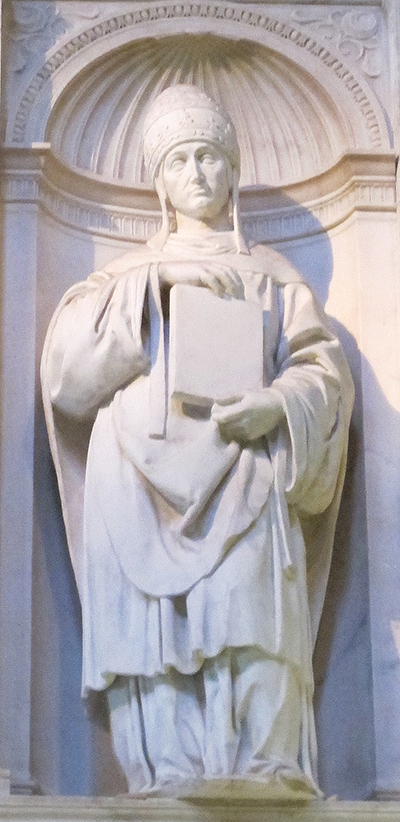
Saint Gregory tilts his tiaraed head and offers a large book toward the viewer. His stance is contrapposto, his drapery varied, but the figure has often been judged the least forceful of Michelangelo's four Piccolomini saints. That verdict has usually been connected with substantial workshop execution.[1]
The marble dates from about 1501–1504 and stands in the right side of the Piccolomini Altar in Siena Cathedral. Published dimensions vary between approximately 126 and 136 centimetres, a discrepancy that should be checked against a current conservation record rather than silently harmonised.[1][2]
Gregory is therefore an ideal case for careful authorship language. Michelangelo was responsible for the statue and its commission; assistants probably carried much of the carving. A workshop-made passage is part of Renaissance production, not a reason to pretend the object has no artistic intelligence.
At a Glance
- ArtistMichelangelo Buonarroti and workshop
- TitleSaint Gregory
- DateAbout 1501–1504
- MaterialCarrara marble
- HeightPublished as approximately 126 centimetres; some sources give 136 centimetres
- Current locationPiccolomini Altar, Siena Cathedral
- PositionMiddle niche on the altar's right side, above Saint Paul
- SubjectGregory the Great, pope and Doctor of the Church
- AttributesPapal tiara and large book
- Visual characterContrapposto, head inclined left, book presented outward
- Authorship controlMichelangelo's design/responsibility with extensive assistant participation
Contents
- Gregory the Great
- The Presented Book
- Tiara, Head and Pathos
- Workshop Authorship
- The Statue Within Bregno's Altar
- A Contract Under Pressure
- Comparing Gregory with Paul
- Measuring the Figure
- Gregory's Writings and a Renaissance Viewer
- Empty Niche Above
- How to Look at Saint Gregory
- Why Saint Gregory Matters
Gregory the Great
Gregory I was pope from 590 to 604 and became one of the four Latin Doctors of the Church. His writings on pastoral care, biblical interpretation and spiritual life shaped medieval Christianity. Tradition also associated him with liturgical reform and the chant later called Gregorian.[3]
Artists identify Gregory through papal vestments, tiara, book and sometimes a dove at his ear, symbolising the Holy Spirit inspiring his teaching. The Piccolomini figure relies principally on tiara and book.
These attributes make Gregory suitable for a papal family altar. He embodies learned and pastoral authority, not merely the office's worldly rank.
His book is shown rather than privately read. Knowledge is directed outward toward the congregation, making teaching a sculptural action.
The figure's precise identity is more stable than the neighbouring Pius/Augustine problem. Tiara and established placement support Gregory, although old documentation and the current site remain the final controls.
The Presented Book
The large volume occupies the saint's front and is turned toward the viewer. It gives his hands a clear task and interrupts the vertical fall of vestments.[1]
At elevated distance, a book needs thickness and strong edges to read. Pages cannot depend on fine incisions alone. The object becomes a block set against the softer rhythms of cloth.
Iconographically, it may refer broadly to Gregory's writings rather than one identified text. Naming the Pastoral Rule, Moralia in Job or Dialogues would require an inscription or more specific evidence.
The act of presentation transforms authorship into instruction. Gregory does not display intellectual possession; he offers doctrine to the Church below.
Physically, the book also stabilises a figure whose head inclines. Its horizontal or diagonal mass counteracts the body's gentle sway.
Tiara, Head and Pathos
Gregory wears the papal tiara, distinguishing him from a mitred bishop. The crown expands his silhouette within the niche and makes papal identity legible from the nave.
His head inclines slightly to the left. Critics have described the effect as pathetic or tender rather than energetic.[1] The term “pathos” here indicates emotional inflection, not inferiority.
The tilt may respond to the book or to the viewer's position. It also differentiates Gregory from Paul's sharp turn below.
If workshop execution softened facial transitions, that does not mean the inclination lacks design. Michelangelo could establish the pose while another hand carried it into surface.
Close study should ask how crown, neck and shoulders connect. A head that seems weak in a frontal photograph may read coherently from the intended low angle.
Workshop Authorship
The Michelangelo commission involved heavy use of assistants, and Gregory has most often been singled out as the figure where their contribution is greatest.[1][4] Fondazione Zeri and historical photographic records preserve “Michelangelo and workshop” as a useful credit.[2]
Several production sequences are possible. Michelangelo may have supplied a drawing or model, selected the block and roughed main masses before delegating finish. He may have returned to face or hands. Documents do not map every step.
Stylistic rankings—Paul strongest, Gregory weakest—can support questions but should not become automatic hand assignments. A constrained niche, different finish state or later surface history can affect perceived quality.
The public wording should neither inflate nor erase. “By Michelangelo” alone hides likely collaboration; “workshop of Michelangelo” alone may understate his contractual and design responsibility. “Michelangelo and workshop” holds both.
This shared authorship is historically normal. Renaissance fame depended on systems of labour, especially when one artist carried simultaneous commitments.
The Statue Within Bregno's Altar
Andrea Bregno constructed the Piccolomini architecture between about 1481 and 1485. Its niches, columns and decorative structure existed before Michelangelo's saints.[4]
Gregory stands above Paul on the right. The placement creates a vertical progression from apostle to learned pope. An upper niche remained empty, making incompletion visible.
On the left, Peter and the Pius/Augustine figure answer the pair. Architecture expects symmetry, but changing identities and missing statues disrupt perfect completion.
Gregory's tiara and book add variety to repeated standing bodies. The series had to remain coherent without making every saint identical.
The altar also framed a Marian focus and Piccolomini commemoration. Gregory is one doctrinal authority within a larger devotional and dynastic programme, not an independent papal portrait.
A Contract Under Pressure
Michelangelo accepted a commission for numerous Piccolomini figures in 1501. That same year he undertook the David, a project of exceptional scale and public consequence.[4]
He worked from Florence and sent saints to Siena, relying on help. Four figures were accepted in a 1504 agreement, while the rest of the programme remained unrealised.
Gregory's workshop character makes those logistics visible. Delegation was not an abstract possibility; it was a practical answer to distance, schedule and ambition.
The patron Francesco Todeschini Piccolomini became Pius III in 1503 and died after a pontificate of only weeks. His death altered the commission's management and left heirs to negotiate completion.
Later release from obligations did not change what the four figures had already become: installed components of a composite altar.
Comparing Gregory with Paul
Paul below Gregory has a forceful turn, dense curled hair and dramatic fold contrasts. Gregory is more contained, with a gentler head inclination and less emphatic chiaroscuro.[1]
The difference has helped scholars identify more workshop participation in Gregory. It also serves iconography. Paul embodies missionary conviction; Gregory embodies pastoral teaching.
One need not be weak for the other to be strong. A papal doctor presenting a book may appropriately address the viewer with measured gravity.
Comparison should consider angle and conservation. Lighting that flatters Paul's deep curls may make Gregory's smoother drapery appear bland. Both were designed for distinct vertical positions.
Together they show how a workshop maintained a common figure type while varying energy.
Measuring the Figure
Sources disagree on height: 126 centimetres appears in an Italian object history, while a regional guide gives 136.[1][5] The difference is too large to dismiss as rounding.
Measurements may include or exclude base, follow an older publication, or contain transcription error. A current technical catalogue should govern final metadata.
Until one is verified, responsible prose states the discrepancy. Choosing the figure that appears most often would create false precision.
This small issue illustrates a larger cataloguing truth: measurements are claims with histories. Even an apparently simple number needs a defined object boundary.
The statue itself is stable; the published measurement remains pending reconciliation.
Gregory's Writings and a Renaissance Viewer
Gregory's book would not have been an empty generic sign to an educated cleric. His Pastoral Rule examined the responsibilities of spiritual leadership; the Moralia in Job turned Scripture into sustained moral interpretation; the Dialogues shaped the saintly culture of medieval Italy.[3]
The Piccolomini patron was himself a learned churchman from a humanist papal family. Gregory's presence therefore joins the altar's commemoration with an ideal of papal teaching. The tiara identifies office, while the offered volume defines what the office owes.
This meaning complicates the usual ranking of the statue as “weak.” Expressive force need not resemble Paul's tense turn. Gregory's act is transmission. A measured body carrying a visibly heavy book can embody responsibility more suitably than athletic drama.
No inscription identifies one specific work, so the marble should not be titled Pastoral Rule. The broader connection remains historically valuable: Gregory's authority rested upon texts that continued to organise Christian government and devotion.
Empty Niche Above
The unfilled upper position on Gregory's side keeps the lost scale of the commission visible. Had the full programme been completed, Gregory would have participated in a taller ascending company rather than ending the sequence.
That absence changes his present silhouette. Open architecture above can make him seem more isolated and more important than the original distribution intended. The altar is both a completed historical object and the residue of an unrealised sculptural population.
How to Look at Saint Gregory
Find Gregory above Paul on the altar's right and view the two as a vertical pair.
Identify the tiara before the face. It establishes papal office at distance.
Follow the book's projection and ask how it reaches toward the viewer.
Observe the inclined head from below and from a closer photograph. Do not judge pose from one level view.
Compare carving among Gregory, Paul, Peter and Pius/Augustine while keeping workshop production and different positions in mind.
Why Saint Gregory Matters
Gregory matters because it preserves the production reality behind a famous name. Michelangelo's responsibility and assistant labour coexist visibly.
The figure also gives teaching physical form. Book, tiara and inclination turn papal learning outward into an address.
Within the unfinished Piccolomini Altar, Gregory marks both fulfilment and absence: one saint delivered from an ambitious contract, standing below a niche the full programme never filled.
Frequently Asked Questions
Discussion
What details, sources or comparisons stand out to you in St Gregory?
Reader Insights
Which formal detail changes how the work reads?
Which documented source or collection history feels most useful?
Which related Michelangelo work should readers compare next?
Join the Conversation
Add a source-led observation, comparison or question for other readers.
References
- Italian-language object history, San Gregorio (Michelangelo)”:, View source.
- Fondazione Federico Zeri, Buonarroti Michelangelo, San Gregorio”:, View source.
- Encyclopaedia Britannica, Saint Gregory the Great”:, View source.
- Opera della Metropolitana di Siena, The Cathedral”:, View source.
- Province of Siena artistic guide, Michelangelo: Saints Peter, Paul, Augustine and Gregory”:, View source.
- Istituto Nazionale di Studi sul Rinascimento, photographic record, Michelangelo and assistants:, View source.